Tag: fax document

  • How to Fax a Document: Complete Guide for 2026

    How to Fax a Document: Complete Guide for 2026

    You've finished the form, signed the contract, or gathered the records. Then the recipient asks you to fax them. You don't have a fax machine, the deadline is approaching, and you need to know whether sending from your laptop or phone will work.

    Learning how to fax a document is straightforward. Choosing the right method takes more judgment. Start with what you're sending, how urgently it needs attention, and who will collect it at the other end. The right approach gets a readable document to the right destination without creating unnecessary expense or privacy risks.

    Choosing the Right Way to Fax

    Choose your sending method around your situation, not the recipient's equipment. A recipient with a traditional fax machine doesn't necessarily require you to use one yourself. Web-based faxing handles the scanning and telephone-network steps electronically while preserving the familiar document-to-fax-number workflow described in the overview of fax technology.

    Your practical options are a browser-based service, a mobile fax app, email-to-fax, or a physical fax machine or fax-enabled multifunction printer.
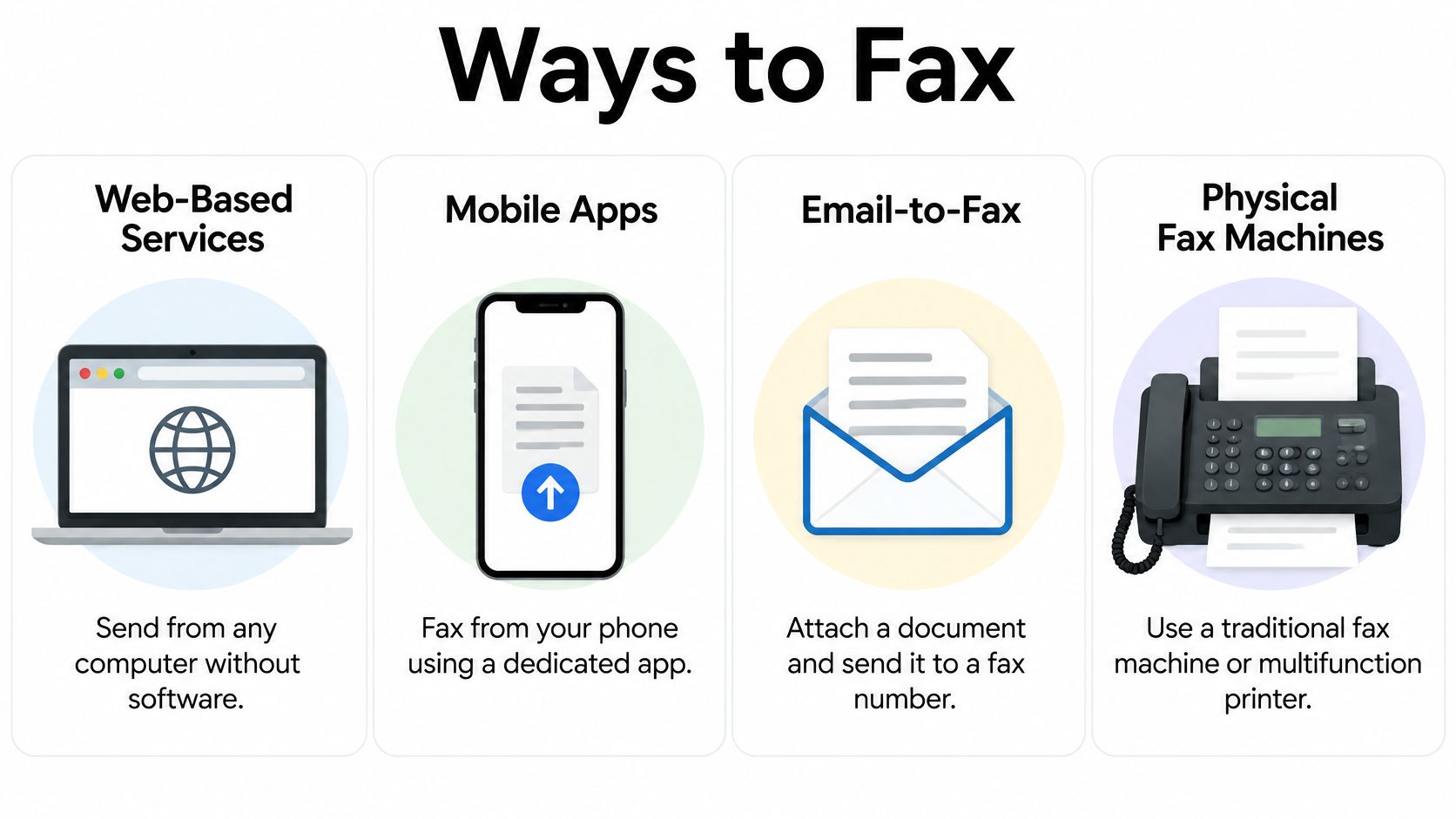
    An infographic showing four common methods to send a fax including web services, apps, email, and machines.

    Match the method to the job

    A browser service is a sensible starting point when your document is already on your computer and you only fax occasionally. You avoid setting up hardware, but you still need to check destination coverage, document limits, charges, and the service's handling of uploaded files.

    A mobile app suits paperwork that's physically in front of you while you're away from your desk. Its main trade-off is preparation: capturing a clean page with a camera takes more care than uploading an existing PDF.

    Email-to-fax fits recurring work when an organization already has a configured service. It can keep sending within an established inbox workflow, but it isn't the same as attaching a file to an ordinary email addressed to the recipient.

    A physical machine makes sense when it's already working, authorized for your documents, and close at hand. Walking to an unfamiliar machine and figuring out its connection under deadline pressure is a different proposition.

    Your situation Practical starting point Main trade-off
    Occasional digital document Browser-based fax Check service limits and file handling
    Paper document while traveling Mobile app or mobile browser Camera capture needs careful review
    Recurring office correspondence Configured email-to-fax service Requires correct service setup
    Signed paper beside a working machine Physical fax machine Requires functioning equipment and connection
    Sensitive or urgent records Recipient-approved method Authorization and human follow-up matter most

    Decide who needs to act

    Machine delivery and human attention are separate requirements. If an office needs a routine form in its intake queue, your method can prioritize convenience. If a named person must act before a deadline, establish who will collect and route the document before choosing the sending method.

    Practical rule: For an urgent fax, arrange the receiving end before pressing Send.

    Cost deserves the same situational approach. For occasional use, compare the total charge for the document you're sending rather than choosing a recurring arrangement you won't use. For ongoing work, prioritize manageable records, predictable handling, and a process colleagues can repeat.

    Preparing Your Document for a Clean Fax

    Open the final document before opening the fax form. Preparation is where you catch missing signatures, sideways pages, faint text, and attachments that shouldn't leave your device.

    For sensitive material, preparation also means checking the destination and the recipient's authority. The U.S. Department of State's fax-handling requirements specifically require those checks for sensitive-but-unclassified material and require the recipient to be present when it leaves government control. Those are institutional requirements, but they offer a useful model for careful sending.
    A document titled Project Proposal lies on a desk next to a scanner and a small plant.

    Build a readable final file

    Use a clean PDF when possible. Keep each sheet as a separate, upright page, and inspect the exported file rather than assuming it matches your editable document.

    • Check completeness. Include every required attachment and signature page. Remove draft pages and unrelated records.
    • Simplify the appearance. Remove decorative backgrounds and unnecessary color. Make sure important information remains distinguishable without color.
    • Inspect difficult areas. Look closely at small print, handwritten entries, dates, and signatures. If they're hard to read in the source, fix them before sending.
    • Preserve the edges. Check that scanning or cropping hasn't removed form labels, reference numbers, or text near the margins.

    Don't shrink a long document merely to reduce its page count. A compact file isn't useful if the recipient can't read the conditions or identify the signature. For a closer preparation check, use this guide to improving fax image quality.

    Make the cover sheet useful

    A cover sheet should help someone route the document without exposing unnecessary information. Include the sender's name, intended recipient or department, callback details, and page count. State whether that count includes the cover sheet so the receiving staff don't have to guess.

    For a medical record or identity document, avoid copying sensitive details into the cover message unless they're necessary for routing. A short purpose statement and an appropriate reference can be more useful than a detailed summary.

    A cover sheet should identify the delivery, not duplicate the confidential document behind it.

    Before proceeding, compare the destination against a trusted contact record or confirm it directly with the recipient. Include the required country and area code, using the format requested by the service or machine. Don't assume a telephone number printed near the fax number is interchangeable with it.

    Finally, check the recipient's submission instructions. Required signatures, attachment order, page-count conventions, and filing references can matter as much as legibility.

    Sending a Fax Online with SendItFax

    You have a signed form ready, but no access to a fax machine. For an occasional fax to a U.S. or Canadian destination, SendItFax accepts PDF, DOC, and DOCX uploads without requiring an account. It is one option alongside mobile apps, email-to-fax, and office equipment.

    Use an existing PDF when possible. Before uploading a Word file, inspect the saved version for unresolved edits, comments, incomplete fields, and unexpected page breaks. The upload step is for sending, not reviewing the document.
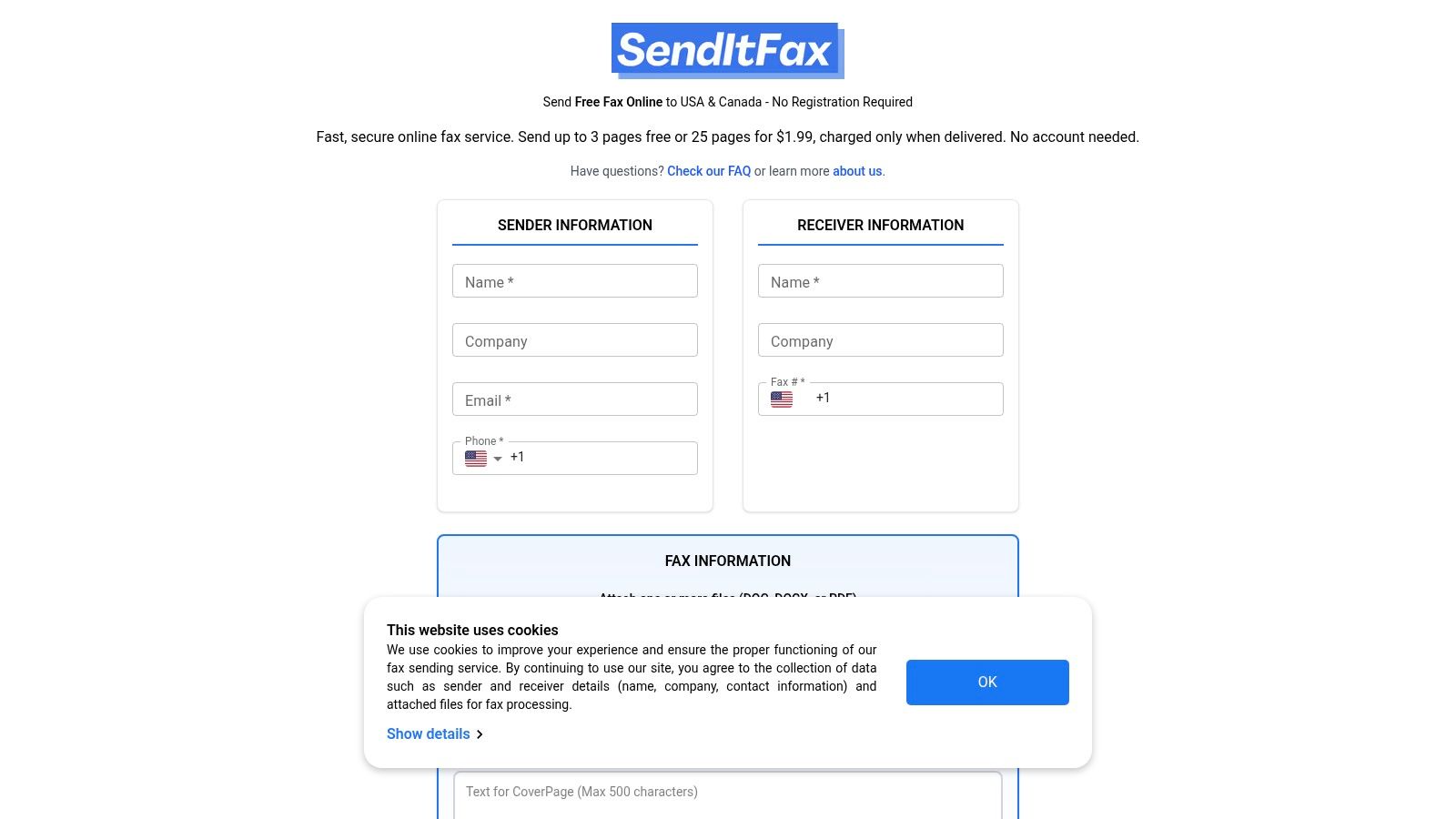
    Screenshot from https://senditfax.com

    The sending form is easier to complete accurately when you have the final file and confirmed destination at hand. Enter the requested sender details so the receiving office can identify you or ask about an unclear submission. Add the intended person or organization and fax number, then compare the number with your trusted record.

    Before attaching the file, check its name. Draft and signed versions can look similar, and selecting the wrong one can undermine an otherwise successful transmission. Add a cover message only if needed, using it for routing details such as the department, purpose, or necessary reference, rather than repeating the document.

    Review the selected option before submitting. Check the current page allowance, cover requirements, delivery terms, and any charge. Keep the original file after sending so you can inspect the exact version submitted if the recipient reports a missing attachment or unreadable signature.

    Match the service option to the job

    SendItFax offers a free option and an Almost Free paid option. The free option has a smaller document allowance, a daily sending limit, and a branded cover. The paid option accommodates longer documents, offers priority delivery, removes the branding, and lets you omit the cover page.

    A short routine form may fit the free option. For a longer contract or a submission where cover presentation matters, consider the paid option. Check the terms shown on the sending form before submitting, since the same treatment may not apply to every document.

    Priority delivery isn't a promise of immediate review. It doesn't confirm that the receiving office is staffed, that its fax line is available, or that someone will open the document as soon as it arrives. If a caseworker, clerk, or clinician needs to act by a deadline, arrange follow-up with the receiving office rather than relying on delivery speed alone.

    Choose based on what needs to improve: document length or presentation may call for a different service tier, while recipient action requires a receiving-side arrangement. After submitting, track the job until it reaches its final status. An upload finishing is not the same as confirming the fax task is complete.

    Faxing from Your Phone or Email

    Choose the method based on what you have in hand and who must receive it. If the paperwork is on your desk and you're away from a computer, a phone can capture and send it. If the original is already a digital file, upload that file rather than printing and photographing it. For a one-time fax, a browser may be simpler than installing an app. Repeated mobile sending may justify a dedicated app, provided it meets your privacy and destination needs.

    For invoice paperwork, complete the invoice before sending. The GetBill invoicing guide covers preparing the document; faxing handles its delivery.
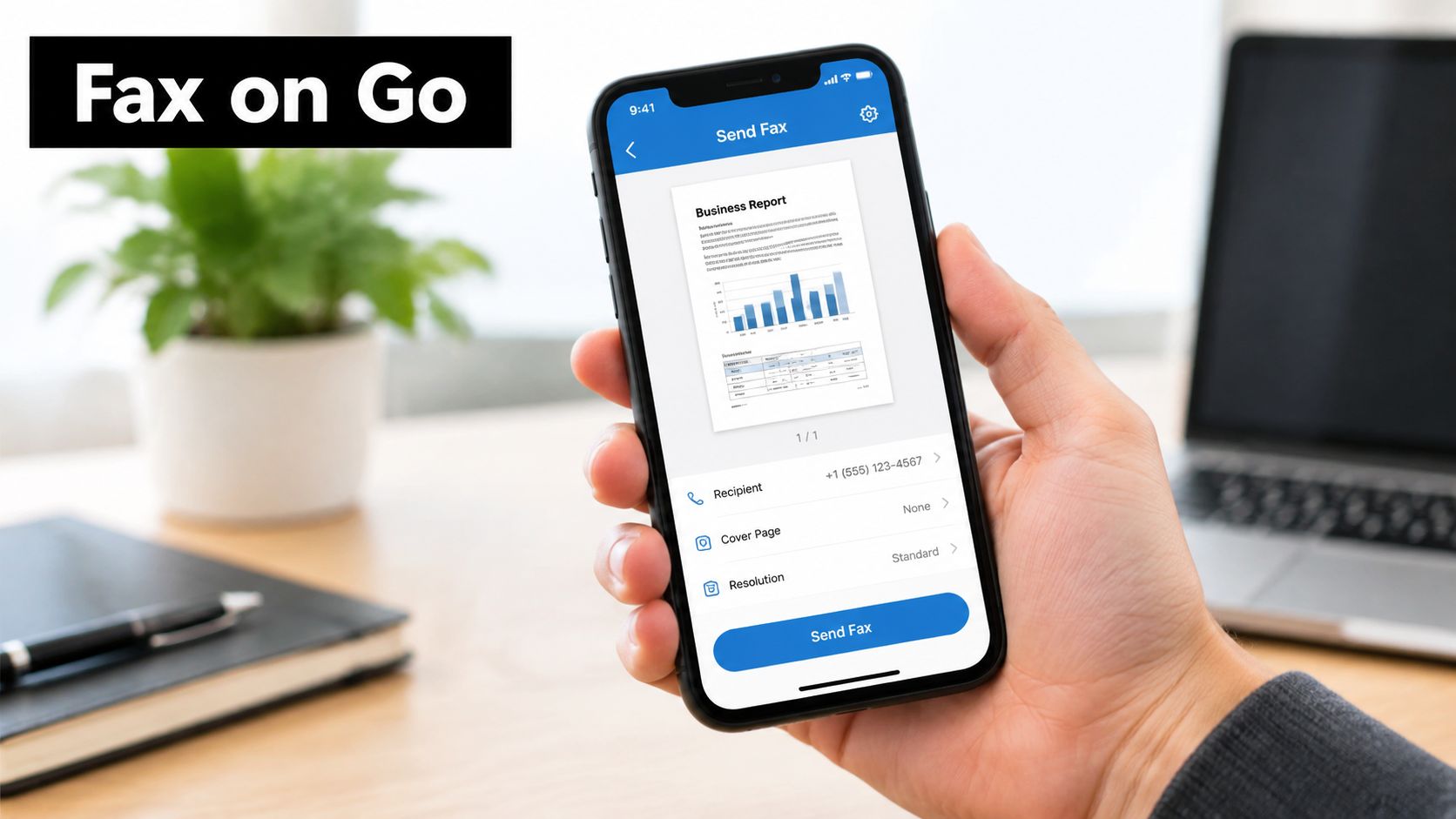
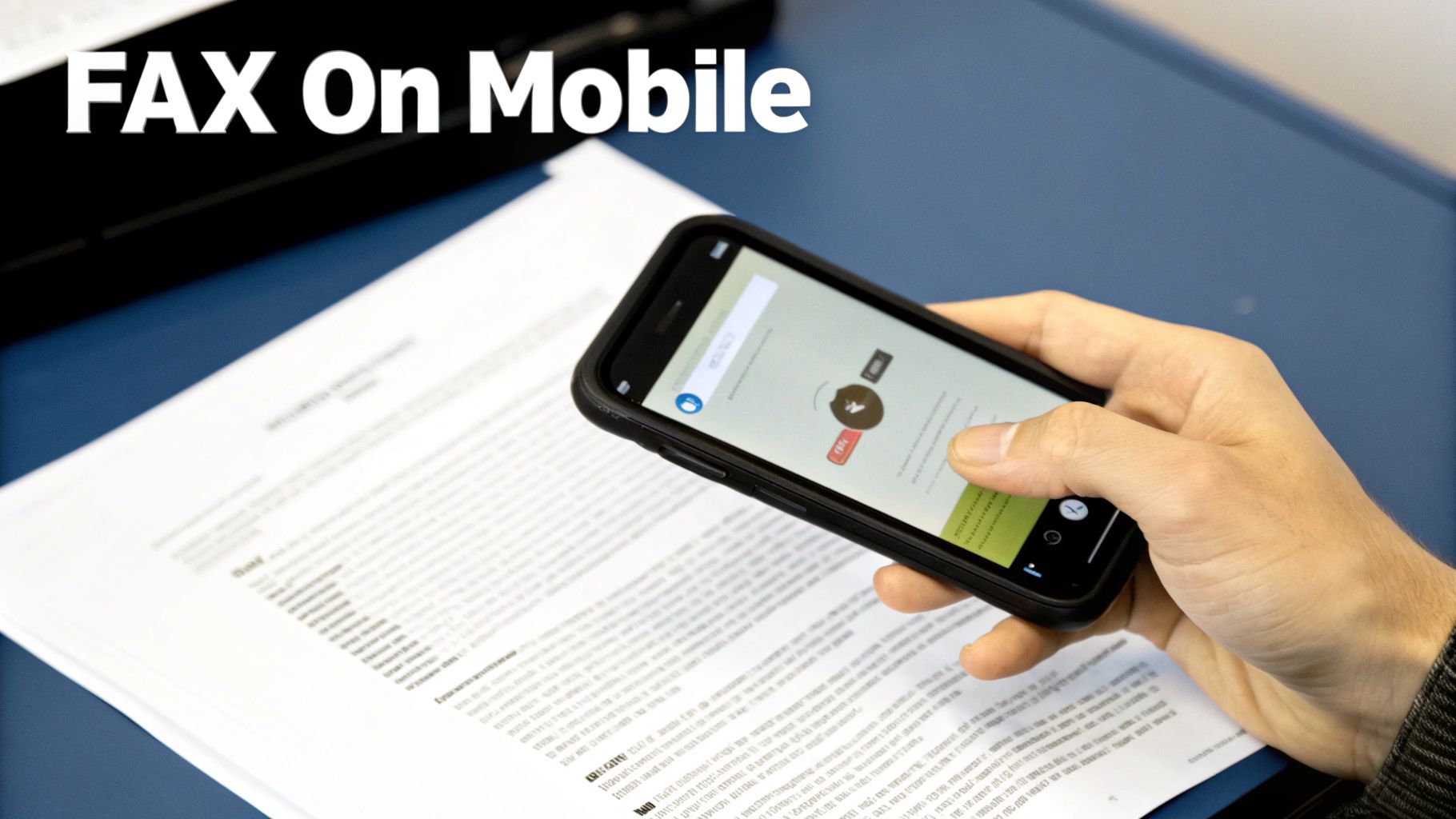
    A person holding a smartphone showing a mobile fax app interface on a desk with office supplies.

    Capture paper without losing detail

    Set the page flat under even lighting and hold the phone parallel to it. Keep your shadow off the text, then inspect the full image before attaching it. A small camera preview can hide blur or clipped edges.

    • Keep every corner visible. Crop away the desk, not the document.
    • Check focus on the text. Retake a blurred image rather than expecting a filter to restore detail.
    • Inspect faint handwriting. Contrast adjustments can make text clearer, but may erase light marks.
    • Arrange pages deliberately. Put attachments in the required order and remove duplicate captures.

    Before installing an app or uploading records, check whether the service supports the destination and file format, what it charges, and whether its privacy terms fit the document. If an upload fails, confirm that the file is saved locally and fully downloaded, then check the format and service limits. Repeatedly pressing Send can leave you unsure which jobs are active.

    Use email-to-fax only with a configured service

    Email-to-fax works through a provider that has linked your email account to fax delivery. Follow its addressing format, attach the final document, and send from the authorized account. The provider sets how it handles the subject line and message body, so don't assume either becomes a cover sheet. Confirm destination coverage before sending. This walkthrough of faxing from email explains the email workflow.

    Before sending What to establish
    Addressing The provider's required destination format
    Attachment The intended final file is attached
    Cover handling Whether the subject or message body is included
    Notifications Where the provider sends the delivery result

    Email is convenient when a service is already configured, but the Sent folder confirms only that your email went out. Check the provider's separate fax result and keep it with the document record. For sensitive paperwork or a recipient who needs confirmation, use the service's delivery status rather than relying on the outgoing email alone.

    Using a Physical Fax Machine or Multifunction Printer

    A signed paper form beside a working office fax is a good reason to use the machine. An unfamiliar printer across town, especially when a fax is urgent, is a poor one. Choose this method when the equipment is already configured, the originals are ready, and you can stay nearby to check the result.

    Before loading anything, confirm that the device can send faxes. A scanner or copier alone cannot. For a multifunction printer, check the model's fax instructions and make sure its required connection works. Test the setup before feeding sensitive originals.

    Set the pages according to the feeder diagram or device instructions. Some machines require face-up loading, others face-down. Align the stack, remove staples, and check whether double-sided pages need to be handled manually.

    At the machine, follow the job from start to finish:

    • Select the fax function, not scan-to-email or copy.
    • Load the intended pages in order and ensure the feeder can take them cleanly.
    • Enter the full destination number, including any outside-line access required by the device.
    • Start transmission and stay nearby to see whether the machine accepts and sends the job.
    • Collect the originals and any report that may contain the destination or document details.

    For ordinary text, standard resolution is usually a practical starting point. Fine mode can help with small print, signatures, and line drawings. The technical description of Group 3 fax capabilities describes a basic resolution of approximately 200 by 100 dpi and an additional 200 by 200 dpi mode. Avoid color or grayscale unless the receiving system supports it. If text is unclear, improve the source document first. A higher-detail transmission setting cannot restore information missing from the original scan.

    Respond to the specific problem, not just the error message. For a feeder jam, stop and determine which pages the machine scanned before restarting. Sending the remaining stack without checking can leave the recipient with an incomplete or confusing submission. A busy destination and a transmission error call for different follow-up, so check the displayed status and the device instructions.

    At the machine: Keep the originals beside you until you've reconciled the job result with the intended document.

    If the display doesn't make the result clear, check the job history or print a transmission report as the device instructions describe. Returning to the home screen does not confirm that the fax succeeded.

    A dedicated fax line at the recipient's office is not, by itself, a reason to use a physical machine. The method makes sense when the equipment and workflow fit the job, such as sending a freshly signed paper form from a configured office printer. When setup is uncertain or time is short, an unfamiliar machine adds extra steps.

    Security, Legal Considerations, and Troubleshooting

    Delivery confirmation is evidence of a transmission result, not proof that the intended person read the document. That distinction matters most when a fax carries a deadline, sensitive information, or instructions someone must act on.

    In a 2025 healthcare fax survey announcement, 88% of practitioners said fax-related delays affect patient care. For an urgent record, waiting passively for an automated status isn't an adequate follow-up plan.
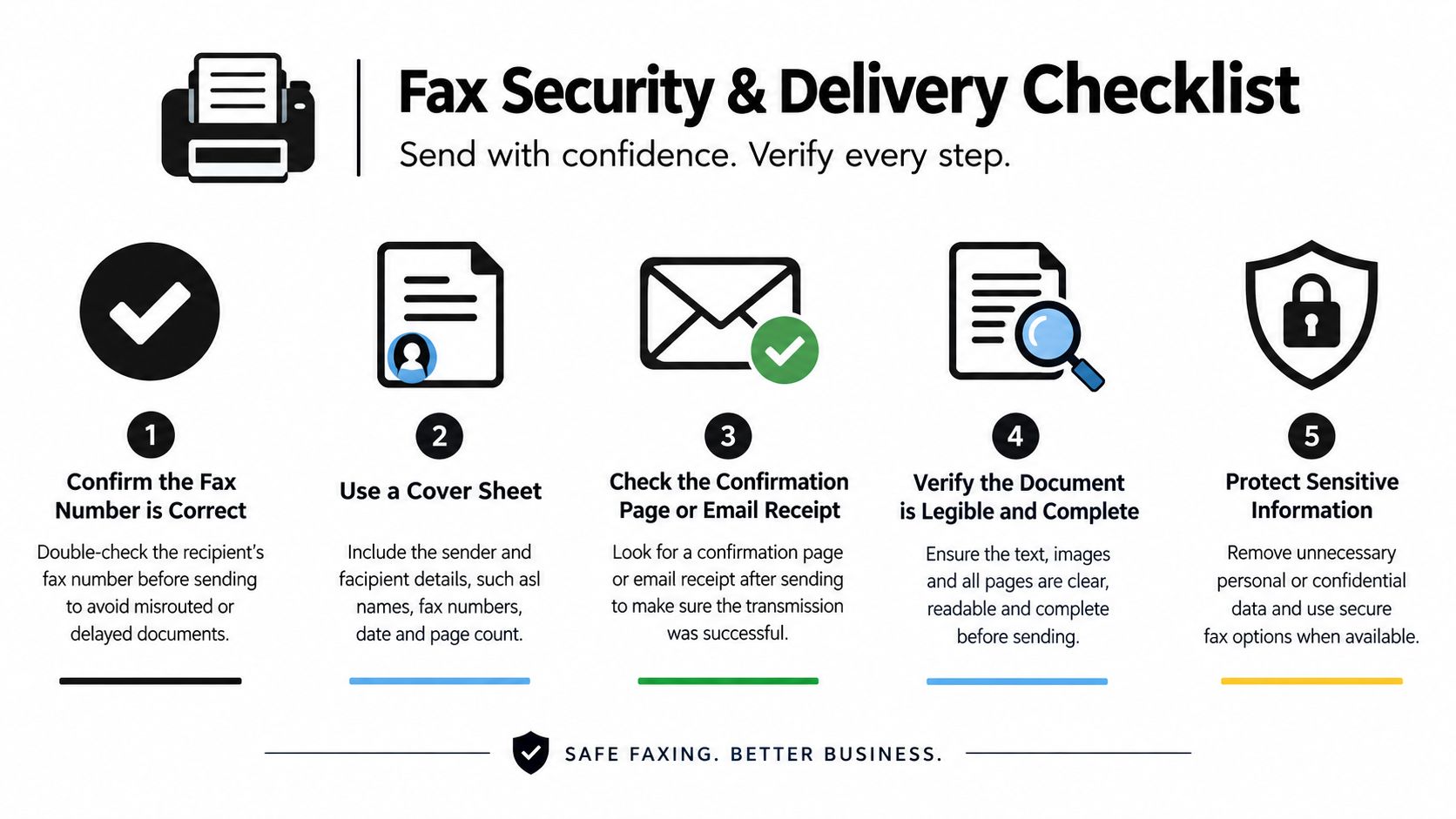
    An infographic titled Fax Security & Delivery Checklist listing five steps for securely sending faxes.

    Check suitability before transmitting sensitive records

    For medical, legal, financial, and identity documents, establish whether the service and receiving process meet the applicable requirements. Don't infer suitability from a confidentiality notice or a general claim that online faxing is secure.

    The Yale privacy procedure for faxing protected information provides institutional guidance on safeguards such as destination verification, confidentiality cover sheets, and secure receiving arrangements. For a practical handling review, consult the publisher's fax confidentiality guidance.

    Before a legal filing or regulated submission, ask the receiving office about accepted delivery methods, required signatures, retention instructions, and what counts as meeting the deadline. Don't assume a transmission timestamp establishes acceptance under the recipient's rules.

    If fax isn't suitable or fails, obtain approval for an alternative. LiveDocument's guidance on sending files securely by email can help you evaluate an email fallback, but ordinary email shouldn't become the default just because the fax didn't work.

    Resolve failures without creating duplicates

    Read the final result before retrying. A queued job may still be active, while a failed job needs investigation.

    Reported problem Practical response
    Busy or unresponsive destination Contact the office or retry after checking availability
    Incorrect destination Reconfirm the number before another attempt
    Unreadable pages Inspect and repair the source document
    Resolution-related failure Use a supported setting and resend
    Incomplete receipt Establish which pages arrived before replacing the submission

    For an urgent fax with no human acknowledgment, call the receiving office and ask staff to locate it using the sender, destination, time, and document description. If they can't find it, agree on whether to resend the complete document or use an approved alternative. Identify a replacement clearly to reduce duplicate processing.

    Finish each job with a short record:

    • Inspect the result. Save the final confirmation or failure report.
    • Reconcile the pages. Compare the reported count with the intended submission.
    • Confirm critical receipt. Ask the responsible person to acknowledge complete, legible delivery.
    • Preserve evidence. Keep the submitted file, transmission record, and relevant acknowledgment according to applicable requirements.
    • Escalate unresolved delivery. Contact the responsible office before the deadline and agree on the next action.

    SendItFax offers browser-based faxing for documents going to U.S. and Canadian numbers, without a fax machine or account setup. Prepare your final file, confirm the recipient's requirements, and visit SendItFax to choose a sending option that fits your document.
  • Where to Go to Fax a Document: 8 Best Options for 2026

    Where to Go to Fax a Document: 8 Best Options for 2026

    In an era dominated by instant messaging and email, the need to send a fax can feel like a search for a technological relic. Yet, for many official transactions involving legal documents, medical records, and government forms, faxing remains a critical and surprisingly secure method of communication. The good news is you no longer need a bulky, buzzing machine and a dedicated phone line to get the job done. The real challenge has shifted from owning the hardware to simply knowing where to go to fax a document quickly, securely, and affordably.

    Whether you are a freelancer sending a single, time-sensitive contract, a patient transmitting records to a new doctor, or a small business needing a reliable document delivery solution, the options are more diverse and accessible than ever before. This comprehensive guide cuts through the confusion, exploring the best modern and traditional methods available. We will break down everything from instant online fax services and convenient retail counters at stores like FedEx Office to lesser-known options at local libraries and even sophisticated mobile apps. Our goal is to provide a clear roadmap, helping you navigate the costs, privacy considerations, and practical steps for each option so you can find the perfect fit for your specific faxing needs.

    1. Online Fax Services (Web-Based Platforms)

    If you're wondering where to go to fax a document without leaving your desk, an online fax service is the most modern and convenient solution. These web-based platforms transform your computer or smartphone into a powerful fax machine, allowing you to send digital files (like PDFs or Word documents) to any traditional fax number through an internet connection.

    This method eliminates the need for physical hardware, paper, and ink. You simply upload your document to a website or attach it to an email, enter the recipient's fax number, and click send. The service handles the conversion and transmission, providing a digital confirmation receipt for your records.

    Who Should Use This?

    Online faxing is ideal for remote workers, small businesses, and anyone needing to send a fax quickly and securely. It's especially useful for transmitting sensitive documents in fields like healthcare, law, or finance, as many services offer HIPAA-compliant options and encrypted transmissions that are often more secure than a shared office fax machine.

    Key Advantage: Online fax services offer unparalleled convenience, allowing you to send faxes 24/7 from anywhere with an internet connection. This accessibility makes it the top choice for urgent or time-sensitive documents.

    What to Consider

    Choosing the right platform depends entirely on your needs. For a one-off fax, services like SendItFax offer a free tier (up to 3 pages) or a low-cost, pay-per-fax option. For regular business use, subscription-based services like eFax provide a dedicated fax number and higher volume allowances.

    Actionable Tips:

    • Check Volume Needs: Use a free or pay-as-you-go service for occasional faxes to avoid monthly fees.
    • Confirm File Types: Ensure the service supports your document format (e.g., PDF, DOCX, JPG).
    • Verify Recipient Number: Double-check the fax number, including the country code for international sends, to prevent transmission errors.

    For a detailed breakdown of different platforms and their features, you can explore this online fax services comparison.

    2. Office Supply Retailers (UPS Store, FedEx Office)

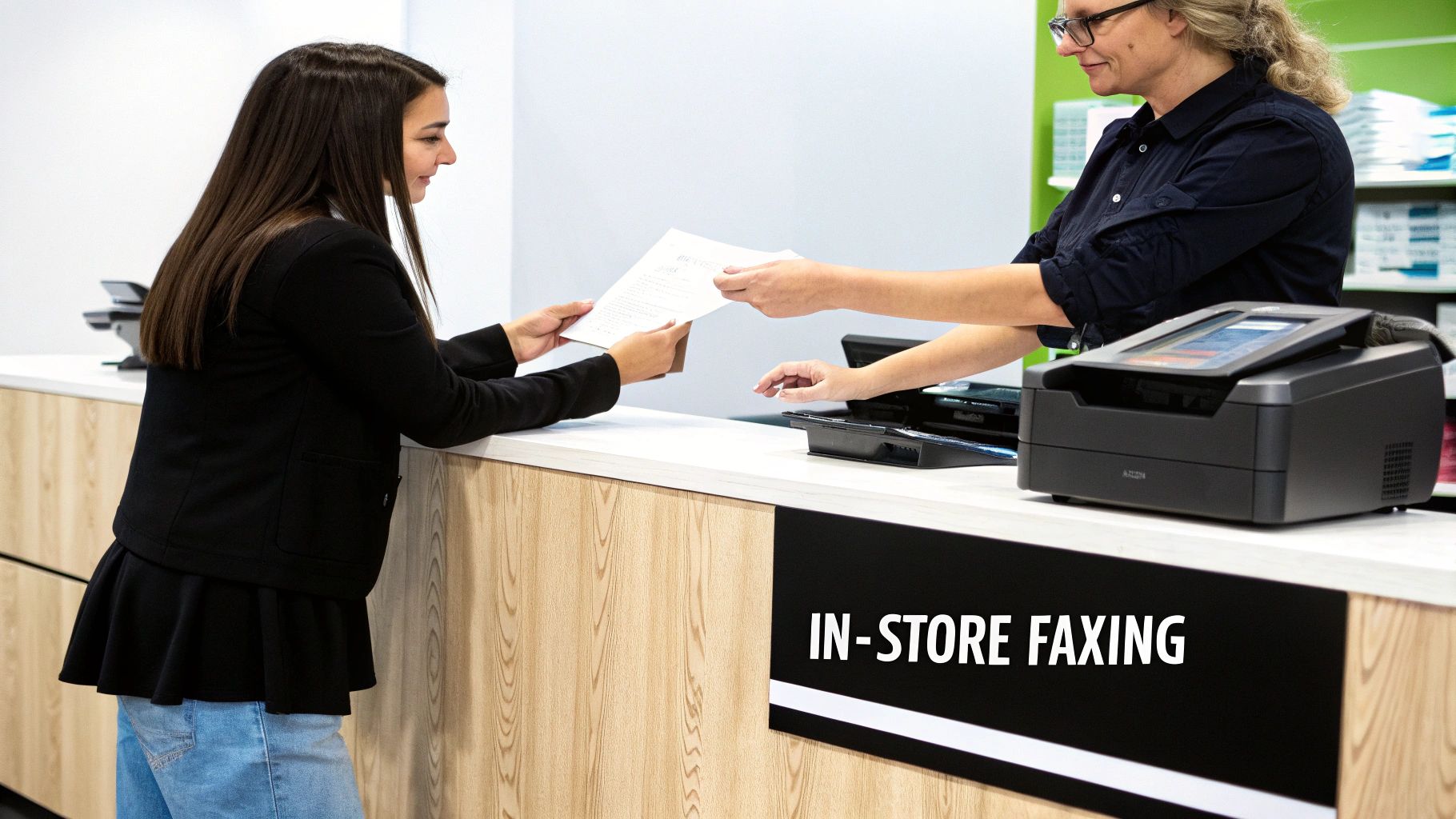
    If you need a reliable, in-person option for where to go to fax a document, major office supply and shipping retailers like The UPS Store or FedEx Office are excellent choices. These ubiquitous storefronts offer walk-in faxing services, making them a convenient solution for those who prefer professional assistance or don't have access to the necessary technology at home.

    This method is straightforward: you bring your physical documents to the service counter, and a store associate handles the entire transmission process for you using their commercial-grade equipment. They will provide a printed confirmation sheet as proof of delivery, which is crucial for official or time-sensitive correspondence.

    Customer hands documents to an employee at a service counter with an in-store faxing sign.

    Who Should Use This?

    This option is perfect for individuals who only need to send a fax occasionally and want to avoid signing up for a service. It's also ideal for people who are less comfortable with technology or need to send physical, original documents that haven't been digitized. The immediate, tangible confirmation receipt makes it a trusted choice for sending important legal, financial, or real estate paperwork.

    Key Advantage: The primary benefit is reliability and professional assistance. Having a staff member manage the process and provide a physical confirmation receipt offers peace of mind that your document was sent successfully.

    What to Consider

    Pricing is typically on a per-page basis and can vary significantly by location and whether the fax is local, long-distance, or international. For instance, The UPS Store and FedEx Office have thousands of locations, but their prices are set by individual franchises. It’s wise to call ahead to confirm costs, especially if you have a large document.

    Actionable Tips:

    • Call Ahead: Always contact your local store to verify they offer fax services, check their hours, and ask about the cost per page.
    • Bring Clear Copies: Ensure your documents are clean and legible to guarantee a high-quality transmission.
    • Request a Receipt: Always ask for the printed confirmation page that includes the date, time, and recipient's number for your records.

    For specific locations and services, you can visit The UPS Store's website or your local print shop's page to find a provider near you.

    3. Email-to-Fax Services (Integrated Email Solutions)

    For professionals who live in their email inbox, email-to-fax services offer a seamless way to fax a document without disrupting established workflows. This method integrates faxing capabilities directly into your existing email client, such as Outlook or Gmail, transforming it into a powerful communication hub.

    The process is remarkably simple: you compose a new email, attach your document (like a PDF or Word file), and send it to a specially formatted email address, typically [faxnumber]@[serviceprovider].com. The service then converts the email content and attachment into a standard fax and transmits it to the recipient's machine, sending a confirmation receipt back to your inbox.

    Who Should Use This?

    Email-to-fax is perfect for businesses and individuals who need to send faxes regularly and want to centralize their communications. It's particularly effective in corporate environments where platforms like RingCentral or Nextiva are already used for unified communications, as it keeps all correspondence, including faxes, archived and searchable within one system.

    Key Advantage: The primary benefit is workflow integration. By allowing users to send faxes from the same platform they use for all other business communications, it eliminates the need to learn a new interface and saves significant time.

    What to Consider

    This solution is typically part of a broader subscription package, making it less ideal for a one-time fax. Providers like RingCentral and Nextiva bundle it with their VoIP and business communication suites. For those using Google Workspace or Microsoft 365, various third-party add-ons can enable this functionality directly within the email interface.

    Actionable Tips:

    • Set Up Forwarding: Configure fax-to-email forwarding so that incoming faxes are delivered directly to your inbox for a fully integrated experience.
    • Use Correct Formatting: Always use the precise email address format required by your provider (e.g., 15551234567@rcfax.com) to avoid delivery failure.
    • Enable Delivery Receipts: Turn on email notifications for sent and received faxes to maintain a clear digital paper trail for compliance and record-keeping.

    4. Healthcare and Legal Document Fax Services (Specialized Providers)

    When you need to fax a document containing highly sensitive information, standard services may not meet the stringent security and compliance requirements of regulated industries. Specialized online fax providers cater specifically to sectors like healthcare, law, and finance, offering platforms engineered for secure transmission and regulatory adherence.

    These services go beyond basic faxing by incorporating features like HIPAA-compliant encryption, detailed audit trails, and certified data storage. Platforms such as MetroFax and Biscom are designed to handle protected health information (PHI) and privileged legal documents, ensuring every transmission meets strict legal and ethical standards for privacy and security.

    Who Should Use This?

    This option is essential for medical professionals, legal firms, financial institutions, and any organization handling personally identifiable information (PII). If your document transmission is subject to regulations like HIPAA, PIPEDA, or GDPR, using a specialized, compliant service is not just a best practice; it is often a legal requirement to avoid severe penalties.

    Key Advantage: These providers offer peace of mind with verifiable compliance and security features, including audit logs and encrypted transmissions that are crucial for regulatory investigations and maintaining client trust.

    What to Consider

    Choosing a specialized provider means prioritizing compliance over cost. While more expensive than general-use services, platforms like Documend (for medical records) provide indispensable features tailored to specific industry workflows. Before committing, verify that the provider’s compliance certifications (e.g., HIPAA, SOC 2) align with your specific legal and jurisdictional needs.

    Actionable Tips:

    • Verify Compliance: Always confirm that the service's compliance certifications match your industry’s requirements.
    • Implement Access Controls: Use features like user authentication and role-based access to restrict document access to authorized personnel only.
    • Maintain Logs: Keep detailed transmission logs for regulatory audits, as these services often automate this process for you.
    • Train Your Staff: Ensure anyone sending faxes understands the secure handling procedures required for sensitive information. You can explore the fundamentals of secure faxing to better inform your team.

    5. Library and Community Center Fax Services

    For those seeking an affordable, community-based option for where to go to fax a document, public libraries and local community centers are invaluable resources. These public-service-oriented locations often maintain a fax machine for patrons, providing a crucial service for individuals who may not have access to office equipment or reliable internet.

    The process is straightforward: you bring your documents to the service desk, and a staff member typically assists with sending the fax. This hands-on help makes it a great option for anyone unfamiliar with faxing. It's a reliable, albeit less private, method for sending non-sensitive paperwork like applications or forms.

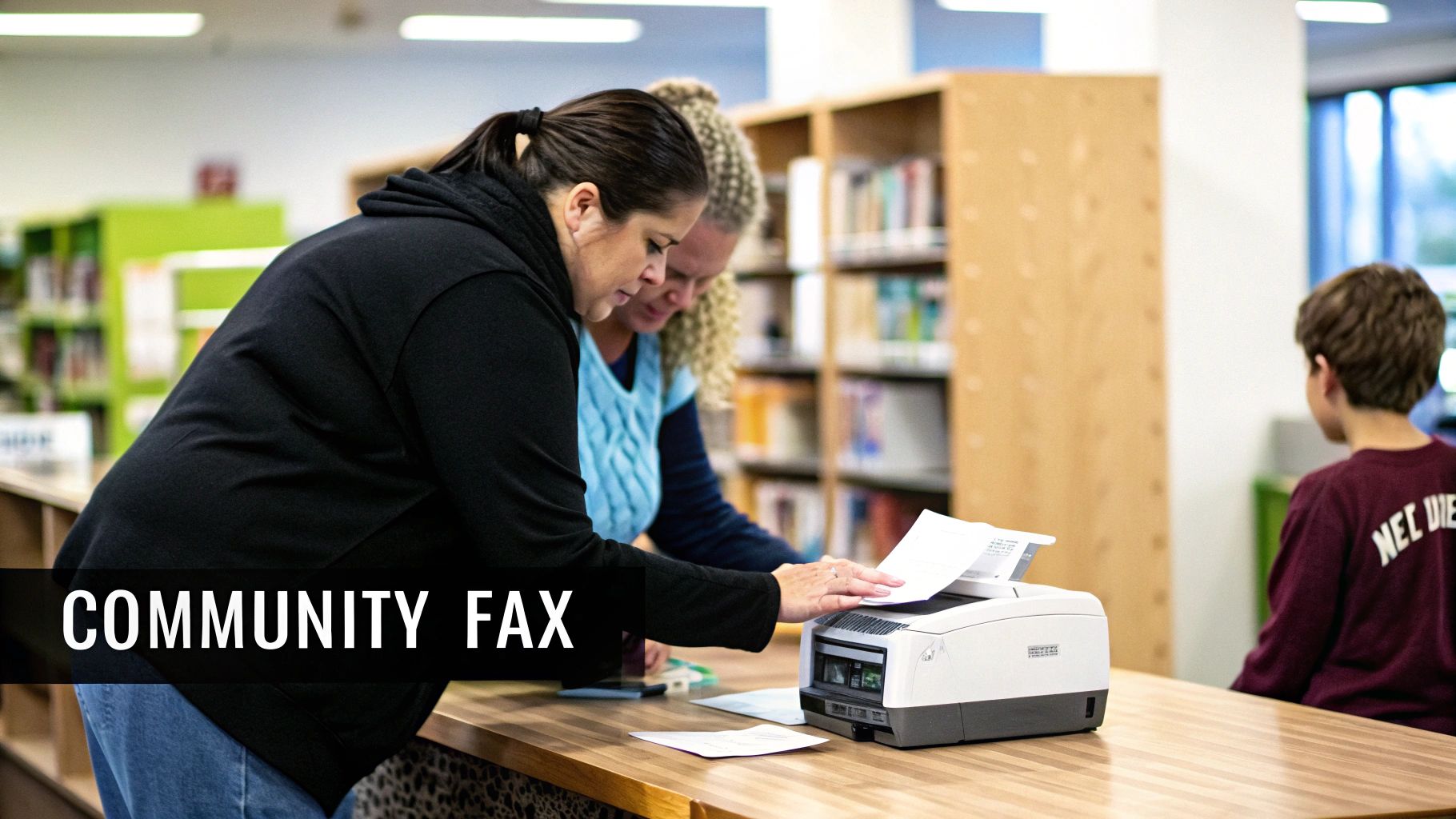
    Two women operating a fax machine in a community library, with a boy sitting nearby.

    Who Should Use This?

    This service is perfect for students, senior citizens, job seekers, and anyone needing to send a fax at a very low cost, or even for free. Community centers, YMCAs, and nonprofit job centers often provide this service to support their members. It's an excellent choice for sending local documents where strict privacy isn't the primary concern, such as submitting a form to a local government agency or a job application.

    Key Advantage: The primary benefit is accessibility and affordability. Libraries and community centers offer a welcoming, low-pressure environment with staff available to help you send your fax correctly, making it ideal for first-time users or those on a tight budget.

    What to Consider

    Availability and cost can vary significantly between locations. While some libraries may offer the service for free, others might charge a small fee per page, often around $0.50 to $2.00. Since these are public facilities, they operate on specific schedules, so you are limited to their business hours. Also, remember that a staff member will handle your documents, so this method is not suitable for highly confidential information.

    Actionable Tips:

    • Call Ahead: Always contact the library or center beforehand to confirm they have a working fax machine, check their hours, and ask about any associated costs.
    • Bring Cash: Many locations only accept cash for faxing fees, so come prepared with small bills and coins.
    • Ask for a Receipt: Always request a printed confirmation page to verify that your document was sent successfully.

    6. Virtual Business Address and Mail Services (Regus, iKor, LiquidSpace)

    For professionals seeking a comprehensive business presence, a virtual office or mail service can be an excellent place to go to fax a document. These services provide a physical business address and mail handling, and often bundle in additional administrative support, including access to faxing services, as part of a monthly package.

    Instead of a standalone service, faxing becomes an integrated part of a broader business infrastructure solution. You typically send your documents through a client portal or by emailing them to the service's administrative team, who then handles the transmission. This is a great solution for maintaining a professional image without the high cost of a physical office lease.

    Who Should Use This?

    This option is tailor-made for entrepreneurs, remote-first companies, and startups that need a prestigious business address for registration and client correspondence. It's ideal for those who already require mail forwarding or a physical address and see faxing as a valuable, convenient add-on rather than a primary, high-volume need.

    Key Advantage: These services bundle multiple professional tools into one package, streamlining administrative tasks and providing a polished business identity that includes a physical address, mail handling, and fax capabilities.

    What to Consider

    The key consideration is value: is the entire package worth the cost? For businesses that only need to fax, this is an expensive route. However, for those leveraging the address and mail services, the included faxing is a significant benefit. Global providers like Regus and specialized services like iKor offer various tiers of service.

    Actionable Tips:

    • Evaluate the Bundle: Compare the total cost of the virtual office package against subscribing to a standalone fax service and P.O. box separately.
    • Check Fax Capabilities: Verify if the service includes both sending and receiving, and understand any page limits or per-page fees that might apply.
    • Confirm Address Use: Ensure the provided business address can be legally used for business registration or LLC formation in your state or country.

    7. Smartphone and Mobile App Fax Solutions (Adobe, Microsoft, Specialized Apps)

    For those who need to fax a document while away from a computer, mobile apps provide an incredibly powerful and portable solution. These applications effectively turn your smartphone or tablet into a scanner and fax machine in one, allowing you to capture, sign, and send documents from virtually anywhere. You can use your device's camera to create a high-quality digital scan of a physical paper.

    A person uses a smartphone to scan documents, demonstrating mobile faxing technology.

    This method combines the convenience of online faxing with the added benefit of mobile document capture. Simply scan your document using the app, enter the recipient’s fax number, and send. The entire process is managed within a single application, making it a seamless experience for on-the-go professionals.

    Who Should Use This?

    Mobile fax apps are perfect for field agents, travelers, freelancers, and anyone who operates primarily from their smartphone. They are especially useful for situations where you need to send a signed contract, an invoice, or an ID document immediately without access to a computer or scanner. Apps from trusted names like Adobe Acrobat Reader or the Microsoft Office suite often integrate faxing into their existing document management features.

    Key Advantage: The all-in-one capability of scanning, editing, and faxing from a single device offers unmatched convenience for mobile workers. It eliminates the need for any external hardware and streamlines the entire workflow.

    What to Consider

    Choosing the right mobile fax solution depends on your ecosystem and frequency of use. If you already use Adobe or Microsoft products, their built-in fax features are a logical choice. For more specialized needs, dedicated apps like Fax Burner or iFax offer robust features, including temporary fax numbers and detailed tracking. Pricing models vary from free, ad-supported services for occasional faxes to monthly subscriptions for higher volume users.

    Actionable Tips:

    • Optimize Your Scan: Use bright, natural light without shadows and ensure the document fills the entire frame for a clear, legible scan.
    • Verify Scan Quality: Always preview the scanned document to check for blurriness or cropping issues before sending.
    • Maintain Stable Connection: Ensure you have a strong Wi-Fi or cellular data connection to prevent transmission failures.
    • Keep Your Originals: Hold onto the physical document until you receive a successful transmission confirmation.

    8. Corporate Telephone and VoIP Systems (Built-in Fax Features)

    For businesses already invested in modern communication infrastructure, the answer to "where to go to fax a document" might be their existing telephone system. Many corporate Voice over IP (VoIP) and unified communications platforms include faxing capabilities as a standard or add-on feature, integrating it directly into the company’s workflow.

    This method leverages your internet-based phone system to send and receive faxes digitally. Instead of a separate fax machine or service, employees can send documents through a dedicated software application, a web portal, or even via email-to-fax. Platforms like 8×8, Ooma Office, and Vonage Business often bundle this functionality, centralizing all business communications.

    Who Should Use This?

    This solution is tailor-made for small to large businesses that already use a VoIP system and want to consolidate their communication tools and vendors. It streamlines operations by allowing employees to manage calls, voicemails, and faxes from a single interface, eliminating the need for separate fax contracts and hardware. It’s an efficient way to equip an entire organization with fax capabilities.

    Key Advantage: Integrating faxing with your VoIP system centralizes communications and simplifies billing. It provides a professional, unified solution without adding another standalone service to manage.

    What to Consider

    The primary consideration is whether your current provider offers this feature and if it meets your needs for reliability and volume. Some systems may have limitations on page counts or charge extra for higher usage tiers. It is crucial to confirm that the service quality is sufficient for business-critical documents, as not all VoIP fax integrations are created equal.

    Actionable Tips:

    • Check Your Current Plan: Contact your VoIP provider (e.g., Grasshopper, 8×8) to see if faxing is included or can be added to your existing package.
    • Test Transmission Quality: Before relying on it for important documents, send several test faxes to an external number to verify delivery speed and clarity.
    • Configure Fax-to-Email: Set up incoming faxes to be delivered to an email address for easy digital archiving and distribution.
    • Understand Backup Options: Inquire about system reliability and have a backup method ready for when your phone system undergoes maintenance.

    For more insights into modern faxing alternatives, explore this guide on faxing without a traditional landline.

    8 Ways to Fax: Quick Comparison

    Category Core Features UX & Reliability (★) Price & Value (💰) Target Audience (👥) Unique Selling Points (✨ / 🏆)
    Online Fax Services (Web-Based Platforms) Browser/email sends, PDF/DOC support, cover pages, free + paid tiers ★★★★☆ Fast & simple 💰 Free limited (3p+cover; 5/day), $1.99/fax (25p) 👥 Remote workers, freelancers, small biz ✨ No fax machine, instant delivery; 🏆 Best for quick/occasional use
    Office Supply Retailers (UPS Store, FedEx Office) In-person staff-assisted faxing, scanning, receipts ★★★★☆ Professional & reliable 💰 Higher per-page ($2–5+), pay-per-use 👥 Walk-in customers, no-internet users, high‑stakes docs ✨ Staff prep & verified receipts; 🏆 Best for immediate, in-person proof
    Email-to-Fax Services (Integrated Email Solutions) Send from email, auto-convert, tracking, archive ★★★★☆ Seamless for email workflows 💰 Subscription / higher enterprise cost 👥 Businesses with corporate email/IT ✨ Integrates with email/archives; 🏆 Best for enterprise workflow integration
    Healthcare & Legal Fax Services (Specialized) HIPAA/SOC2, end-to-end encryption, audit trails, EMR integration ★★★★★ High security & compliance 💰 Premium pricing (compliance-focused) 👥 Healthcare, legal, finance, regulated orgs ✨ Compliance-certified, audit-ready; 🏆 Best for PHI/privileged documents
    Library & Community Center Fax Services Free/low-cost in-person fax, scanning, staff help ★★★☆☆ Accessible but limited hours 💰 Free–$1–$3 per fax; excellent community value 👥 Underserved populations, seniors, no‑internet users ✨ Low/no-cost access; 🏆 Best for community members without tech
    Virtual Business Address & Mail Services Business address, mail scanning/forwarding, fax add-on ★★★★☆ Professional bundled service 💰 Monthly plans; higher overall cost 👥 Startups, freelancers needing business presence ✨ All-in-one business infrastructure; 🏆 Best for professional branding
    Smartphone & Mobile App Fax Solutions Camera scanning, edit, one-tap send, cloud sync ★★★★☆ Very portable (scan quality varies) 💰 Pay-per-fax or app subscription; moderate 👥 Field agents, traveling pros, realtors ✨ Scan + send on-the-go; 🏆 Best for mobile faxing
    Corporate Telephone & VoIP Systems Fax via existing phone/VoIP, web portal, fax-to-email ★★★★☆ Integrated; quality varies by provider 💰 Often included in telecom costs; low incremental 👥 Businesses with VoIP systems ✨ Uses existing infrastructure; 🏆 Best for consolidated communications

    Choosing the Right Place to Send Your Next Fax

    Navigating the world of faxing in a digital age can feel like a paradox, yet as we've explored, the need for this secure and verifiable communication method persists across many critical industries. The question of where to go to fax a document no longer has a single, one-size-fits-all answer. Instead, the modern landscape offers a diverse array of options, each tailored to specific needs regarding urgency, security, frequency, and budget. Your ideal solution hinges entirely on which of these factors you prioritize most.

    Synthesizing Your Faxing Strategy

    The key takeaway from this comprehensive guide is the power of choice. You are no longer tethered to a bulky, physical fax machine. For the occasional user sending a single document, the convenience of a local office supply retailer like FedEx Office or The UPS Store is undeniable. These locations provide in-person assistance and immediate confirmation, making them a reliable choice for those who prefer a hands-on approach or are sending documents that are already printed. Similarly, public libraries and community centers offer a valuable, often low-cost, service that supports local residents with essential business needs.

    However, for professionals, remote workers, and small businesses, the paradigm has shifted decisively towards digital solutions. The true evolution in faxing lies in the flexibility and efficiency of online platforms. Services ranging from integrated email-to-fax systems to dedicated mobile apps have transformed the process, turning your smartphone or laptop into a powerful, portable fax machine. This digital-first approach eliminates the need for travel, hardware maintenance, and paper, aligning perfectly with modern, streamlined workflows.

    The Modern Faxing Advantage: Convenience Meets Security

    Ultimately, the best place to fax a document is the one that seamlessly integrates into your life or business operations without compromising on security. While physical locations offer tangible peace of mind, the robust encryption and secure protocols of reputable online fax services provide an equivalent, if not superior, level of data protection for sensitive information. By understanding the distinct benefits and limitations of each option, from specialized legal providers to built-in VoIP features, you can make an informed decision. This empowers you to send your crucial documents with confidence, ensuring they are transmitted efficiently, affordably, and securely every single time. Your next fax doesn't have to be a chore; it can be a simple, strategic task.


    Ready to experience the most convenient way to send your documents? For a fast, secure, and pay-as-you-go solution that eliminates subscriptions and hardware, try SendItFax. Visit SendItFax to send your first fax from any device in just a few minutes.