You've got a PDF open on your laptop. It's signed, due today, and the instructions still say “fax it back.” You check your home office, then your kitchen, then the coworking room down the hall. No fax machine. No landline. No obvious plan.
When searching for an online fax PDF tool, the document might be a medical intake form, a signed lease addendum, HR paperwork, a government filing, or a vendor packet that still treats fax as normal. The confusing part isn't the idea of faxing. It's the gap between a modern PDF workflow and a transmission method built for older document systems.
Most guides stop at “upload your PDF and click send.” That's usually enough until it isn't. The problems show up one layer deeper. Your file is too large. The PDF is locked. The pages look sharp on screen but muddy after transmission. The service accepts one format but not the way your scanner created it. Or worse, the document contains sensitive information and the free tool you found isn't appropriate for that kind of data.
When You Need to Fax a PDF and Have No Fax Machine
A familiar version of this starts with a form that should have taken two minutes.
You sign a contract digitally, save it as a PDF, and then notice the recipient only accepts fax. Or a clinic asks for completed intake paperwork by fax before an appointment. Or an HR team needs a signed authorization today, and their process hasn't moved to secure upload yet. The document is ready. The machine is missing.
That mismatch is more common than people assume. Industry coverage says more than 17 billion individual documents were sent by fax in 2019, which helps explain why browser-based faxing stuck around as a practical workflow instead of fading away entirely, according to fax usage statistics collected in industry coverage.
The options people usually try first
Most senders consider the same few workarounds:
- Print and drive somewhere: A retail fax counter works, but it turns a simple send into a trip, a wait, and another scan.
- Use an office multifunction printer: That can work if you have one nearby and it's configured correctly. Many people don't.
- Email the PDF anyway: Sometimes the recipient accepts it. Sometimes they reject it because their process still expects fax delivery.
- Find a browser-based fax service: This is usually the middle path when you need speed without hardware.
In plain terms, an online fax PDF workflow lets you start with the file you already have instead of printing, rescanning, and hoping nothing shifts sideways.
Practical rule: If the document already exists as a clean PDF, keep it digital as long as possible. Printing and rescanning usually lowers quality and creates avoidable page-size problems.
The questions that actually matter
Before you send, most confusion falls into four buckets:
- What does the service do to my PDF after upload?
- Why do size limits and page caps show up so often?
- Which PDF quirks cause failed sends or unreadable pages?
- Is the service safe for sensitive records or protected information?
Those are the questions that save time. They're also the ones most quick tutorials skip.
How Online Fax PDF Actually Works Behind the Scenes
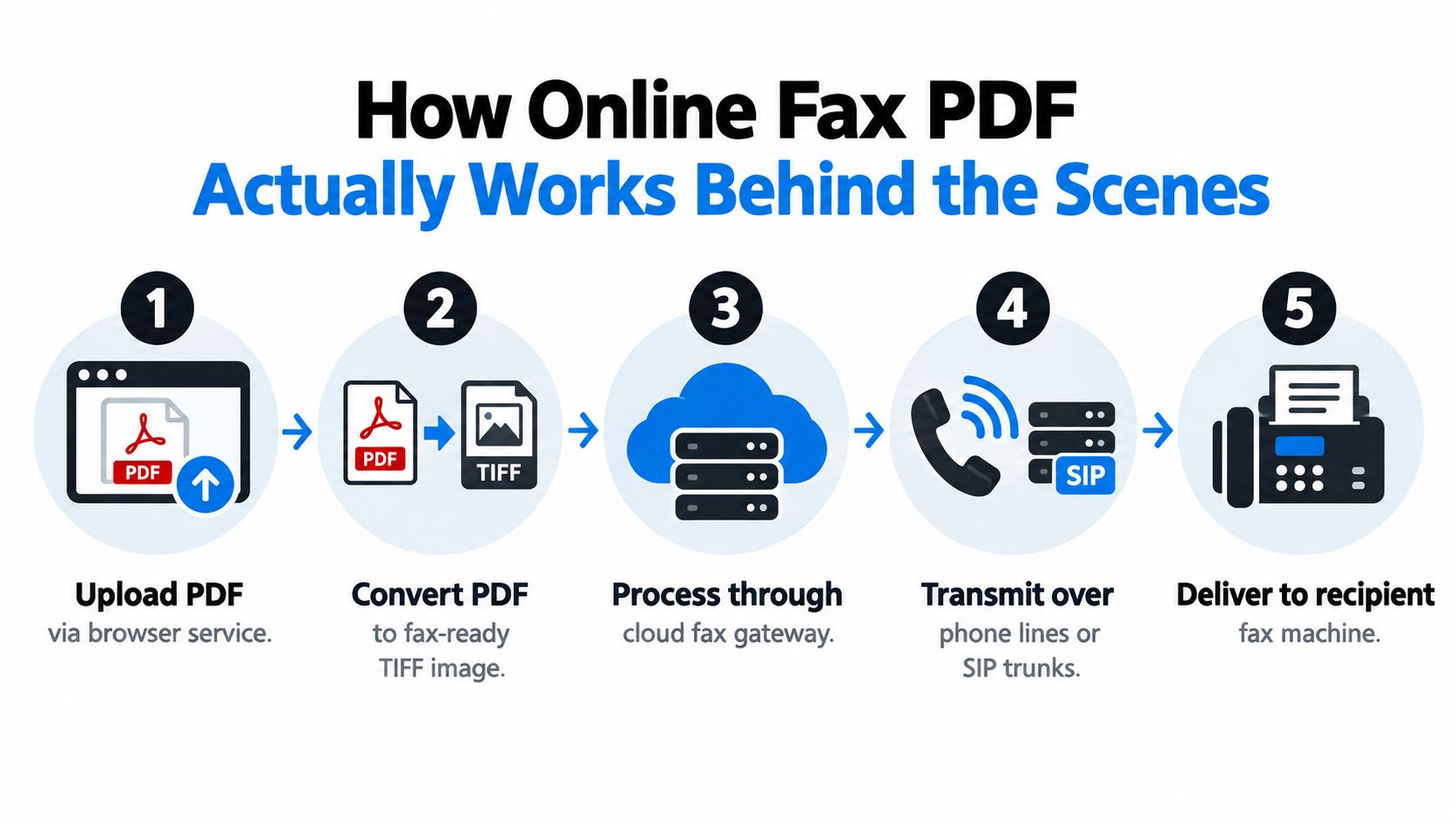
An online fax PDF service is really a translator. You upload a digital document in a browser. The service converts that document into a fax-compatible image format, then sends it through telephony infrastructure to the recipient's fax machine or digital fax inbox.
Here's the basic flow at a glance:
Your PDF is not sent as a PDF
This is the part many people miss. Traditional fax systems don't exchange a modern document file the way email does. In most cases, the service takes your PDF and renders each page into a fax-friendly image stream.
That means your crisp vector text, transparent layers, signatures, and embedded fonts get flattened into page images before transmission. If you want a broader primer on browser-based faxing, this guide on what an online fax service is is a useful companion.
Why resolution matters during conversion
Fax delivery is constrained by page imaging, not by the PDF container itself. Industry guidance commonly points to fax resolutions around 200 dpi, including roughly 204×196 dpi for standard fax and 200×200 dpi or 200×100 dpi modes for compatibility, as noted in this PDF-to-TIFF conversion reference.
That's why a service often converts pages into a multi-page TIFF-like workflow internally. The goal is simple: preserve text while keeping the payload small enough to transmit reliably.
A practical consequence follows:
- Small text can soften
- Color usually gets dropped or flattened
- Dense scanned pages can become harder to read
- Larger files can take longer to process and send
The network layer is built for fax behavior
Fax-over-IP exists because ordinary voice-style packet transport can break fax signals. The standard used for this is ITU-T T.38, which defines how real-time Group 3 fax traffic is carried over IP networks and is designed to protect fax signaling from packet loss, jitter, and latency, according to the ITU-T T.38 specification.
So when a service says it can fax your PDF, it isn't just uploading a file somewhere. It is:
- validating the upload
- rendering pages into fax-ready images
- negotiating a connection with the destination fax endpoint
- streaming the pages in sequence
- recording whether the transmission completed
Later in the process, many services can also return a delivery result to your email or account screen.
A short walkthrough helps if you want to see the workflow visually:
A fax service doesn't preserve your document the way a shared drive does. It rebuilds it into something older systems can accept.
File Types, Page Limits, and Size Caps You Will Hit
The easiest file to fax is usually the one that needs the least interpretation. In practice, that's often a standard PDF with normal page dimensions and readable contrast.
Other file types can work, but each adds a little uncertainty.
Which file types are easiest to send
Here's the practical hierarchy most users run into:
- PDF: Best for signed forms, contracts, and finished documents.
- DOC or DOCX: Useful for editable forms, but formatting can shift if the service converts it differently than your computer does.
- JPG or PNG: Fine for single scanned pages, receipts, or photo captures. Less ideal for multi-page packets.
- TIFF: Often fax-friendly because it already resembles the image-based format fax systems like.
- HTML or web content: Supported by some platforms, but usually less predictable.
If you have a stack of pages as separate files, it's usually cleaner to merge them first. A single multi-page PDF gives you one known page count, one cover-page decision, and fewer chances for pages to send in the wrong order.
The limits that surprise people
Many sends fail at this point. Help content from fax providers shows recurring questions about PDF size limits, automatic compression for large scanned PDFs, locked files, and whether multi-page PDFs send as one fax. One provider's guidance also notes that uploaded files may be deleted after a retention window, which matters if you assumed the document would stay available indefinitely, as summarized in this guide to faxing a PDF and common PDF constraints.
Because services vary, treat limits as operating rules, not trivia. Before sending, check:
| Typical Online Fax PDF Limits by Plan Tier | Accepted File Types | Max File Size | Max Pages per Fax |
|---|---|---|---|
| Free tier | Usually PDF, sometimes image files and documents | Varies by provider | Varies by provider |
| Paid consumer tier | Usually PDF, DOC, DOCX, JPG, PNG, TIFF | Varies by provider | Varies by provider |
| Business or regulated tier | Broader support, often better handling of larger files | Varies by provider | Varies by provider |
The important habit is to expect a cap somewhere. If your contract packet includes many exhibits, scans, and signatures, you may need to compress it, split it, or send it in parts.
One file or several
Sending several attachments can work, but it creates more room for confusion:
- Merged PDF: Better when page order matters.
- Separate uploads: Better only when the service clearly combines them into one transmission and preserves order.
If a provider doesn't explain that behavior, don't guess. A guessed workflow is how page 7 arrives before page 2.
PDF Edge Cases That Break a Fax Send
A lot of people assume, “It's a PDF, so it will fax fine.” That's not a safe assumption.
A PDF can look perfect in Adobe Acrobat, Preview, or Chrome and still fail in a fax pipeline. The reason is simple. The service isn't judging whether the document opens on your screen. It's judging whether it can convert every page into something a fax endpoint can receive.
The common troublemakers
These are the file issues I'd check first:
| Common PDF Edge Cases and How They Behave in a Fax Pipeline | What the Fax Service Does | Workaround |
|---|---|---|
| Password-protected PDF | Often rejects upload or fails conversion | Remove the password, save a clean copy, upload again |
| Owner-locked PDF | May open but block processing steps | Export a new unlocked version if allowed |
| Oversized scanned PDF | May exceed upload or processing limits | Compress images or split into smaller documents |
| Unusual page dimensions | May shrink aggressively or crop oddly | Re-export to Letter or A4 |
| Multiple separate files | May send separately or in unexpected order | Merge into one PDF first |
| Tiny text in scanned pages | May become unreadable after rasterization | Rescan or export with clearer contrast |
| Transparency or unusual layers | May flatten unpredictably | Print to PDF or flatten before upload |
| Certain archival variants | May not process cleanly on all services | Save a standard PDF copy |
Legibility changes after conversion
Fax conversion is unforgiving to small details. Once the service rasterizes the file near standard fax resolution, fine print can blur, thin signature lines can weaken, and colored stamps may lose contrast.
This is especially common with:
- Phone-scanned pages with shadows
- Documents with small footnotes
- Screenshots pasted into PDFs
- Forms with pale gray text fields
If you have to zoom in on your own screen to read a section comfortably, the receiving fax machine may turn that section into guesswork.
What to do when the upload fails
When a service rejects a file, don't start by trying the same file three more times. Change the file.
Good fixes include:
- Re-export the PDF from the original app instead of printing to a scanner app.
- Flatten form fields so typed entries become part of the page image.
- Reduce image weight if the scan is oversized.
- Split the document into logical parts if one large packet keeps failing.
- Standardize the page size to Letter or A4 before upload.
A lot of “fax problems” are really document-prep problems wearing a fax label.
Security and Compliance for Sensitive PDFs
Convenience and compliance are not the same thing.
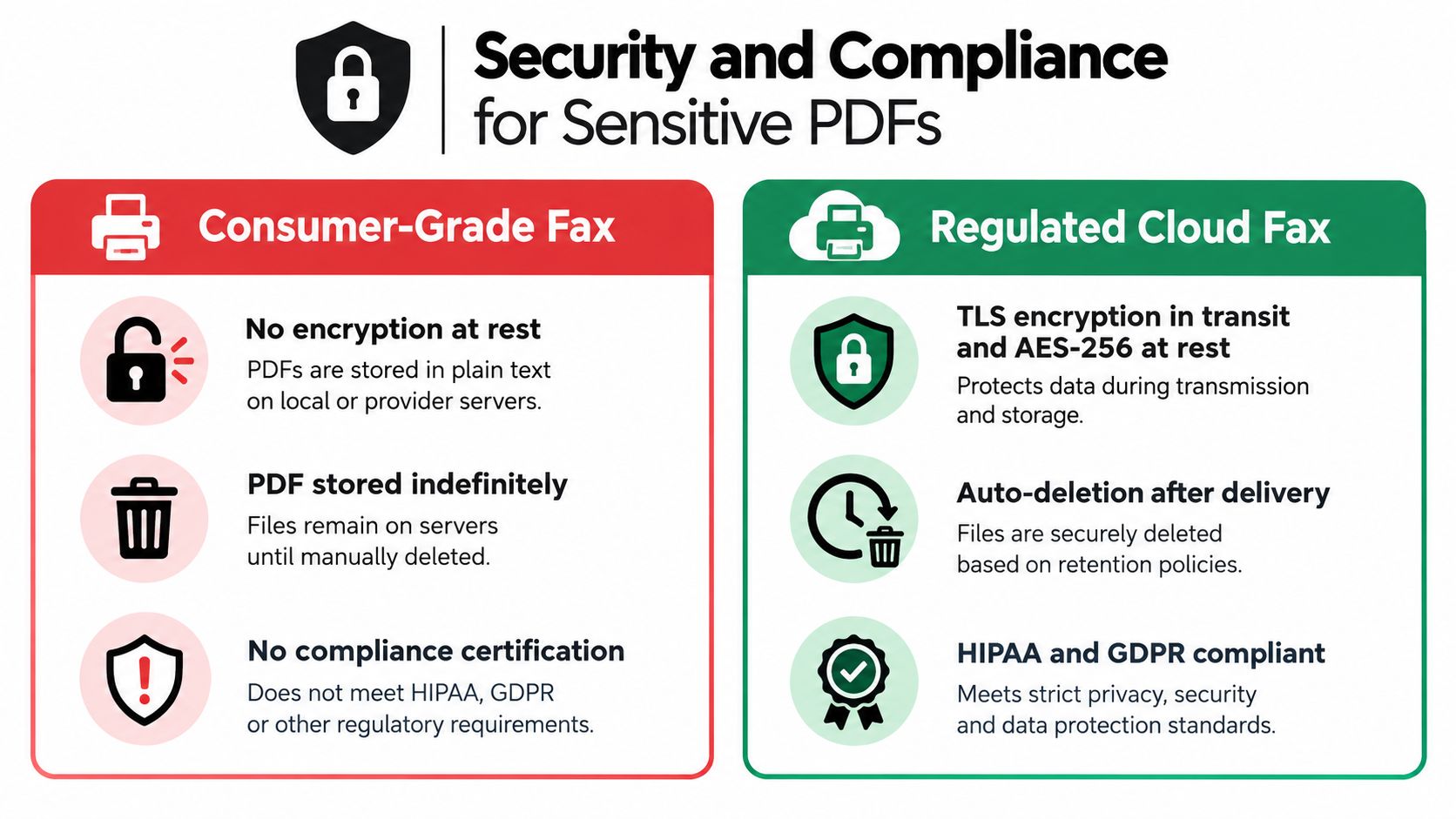
A free browser tool may be fine for a basic public form. That does not make it appropriate for protected health information, legal records, or government documents. The gap sits in what happens to the PDF before delivery, after delivery, and inside the provider's storage and logging practices.
Healthcare is the clearest example. Independent reporting has cited estimates that 70% to 90% of healthcare communication still occurs via fax, that the U.S. healthcare industry exchanges more than 9 billion fax pages annually, and that 71% of hospitals in 2019 used mail or fax to send summary-of-care records while 68% used it to receive them, according to medical fax transmission statistics compiled in industry reporting. That volume is exactly why secure PDF handling matters so much.
What separates a casual tool from a regulated workflow
For sensitive documents, look for real controls around:
- Encryption in transit: The upload and transmission path should be protected.
- Encryption at rest: Stored files, if retained at all, should be protected in storage.
- Access controls: A fax number alone doesn't prove the right person picked up the document.
- Audit trails: You may need a record of who sent what, when, and to which number.
- Retention behavior: Some teams need deletion controls. Others need records retention.
This matters especially in healthcare. Security guidance notes that faxing can be HIPAA-compliant only when a secure cloud fax service uses a BAA and encryption, and it explicitly warns that free online fax services are not HIPAA compliant for PHI, as explained in this HIPAA fax compliance guide.
If you also need to control what happens before upload, such as restricting changes to a finalized packet, it helps to learn how to stop edits on your PDFs before the file enters the fax workflow.
Matching the document to the service
A simple way to decide:
- Low sensitivity: Public forms or basic requests. Consumer tools may be acceptable if the recipient allows them.
- Moderate sensitivity: Business contracts, payroll forms, internal records. Choose a provider with clear security policies and delivery records.
- High sensitivity: PHI, legal case material, government records. Use a service designed for regulated workflows.
This overview of the security of fax is useful if you want to compare the risk of physical fax trays, cloud fax retention, and auditability.
A fax number tells you where the transmission went. It doesn't guarantee who saw the document after it arrived.
Preparing Your PDF for a Clean Transmission
Most fax failures can be prevented before you upload anything. Good prep beats troubleshooting every time.
If you only remember one idea from this section, remember this: prepare the PDF for the receiving fax machine, not for your own laptop screen.
A practical pre-send checklist
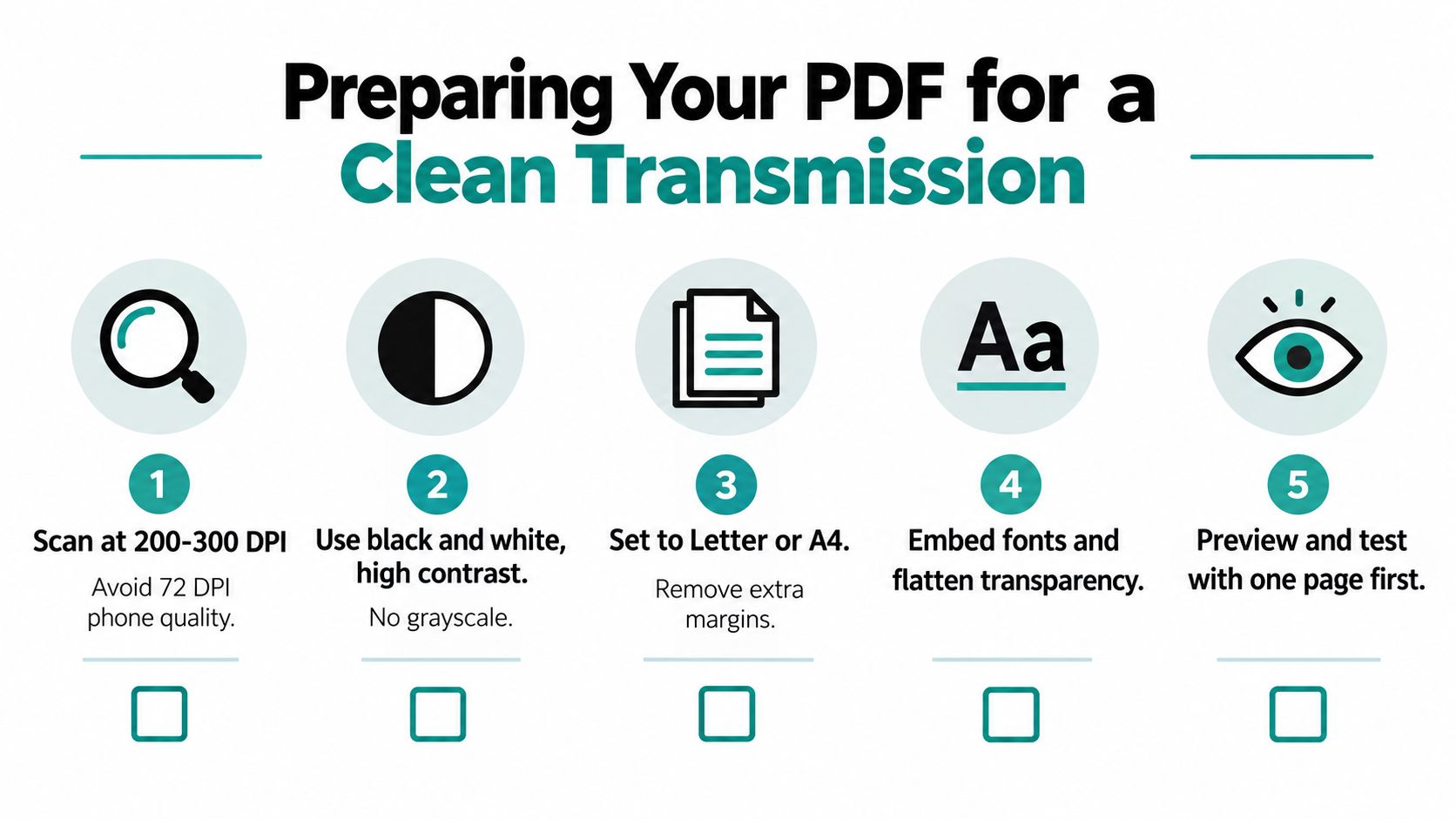
Use this short routine before every upload:
- Check scan quality first. A clean scan in the 200 to 300 dpi range is usually a sensible target for text documents. Very low-quality phone captures are more likely to fall apart after fax conversion.
- Prefer strong contrast. Black text on a white background survives faxing better than gray text, colored highlights, or shadowy photos of paper.
- Make page size normal. Letter and A4 are safer than odd mobile scan dimensions.
- Flatten the document if needed. Flatten form fields, annotations, or layered content if you suspect the service may struggle with them.
- Remove passwords before upload. A locked PDF is one of the fastest ways to get a rejection.
- Count pages before sending. Don't let a surprise appendix push you past the provider's cap.
- Check orientation. Sideways scans and upside-down pages happen more than people admit.
- Verify the fax number carefully. Faxing is less forgiving than email when the number is wrong.
Compression without ruining readability
Compression is a trade-off, not a virtue. You want the smallest file that still keeps the page readable after conversion.
Use lighter compression for:
- clean text forms
- typed letters
- high-contrast contracts
Use gentler compression for:
- handwritten notes
- signatures with thin pen strokes
- pages with small print or stamps
This guide to fax image quality is useful if you're trying to judge whether poor output came from the original scan, the compression step, or the destination machine.
Do one visual check before you send
Open the final PDF and inspect it as if you were the recipient.
Look for clipped margins, faint initials, blank pages, duplicate scans, and pages that loaded in the wrong order. If the document is important, send a short test fax first when your provider and recipient setup allow it.
Choosing the Right Online Fax PDF Workflow
By this point, the useful question isn't “What's the best fax service?” It's “What happens if this PDF fails, leaks, or arrives unreadable?”
That question gives you a better framework than feature lists.
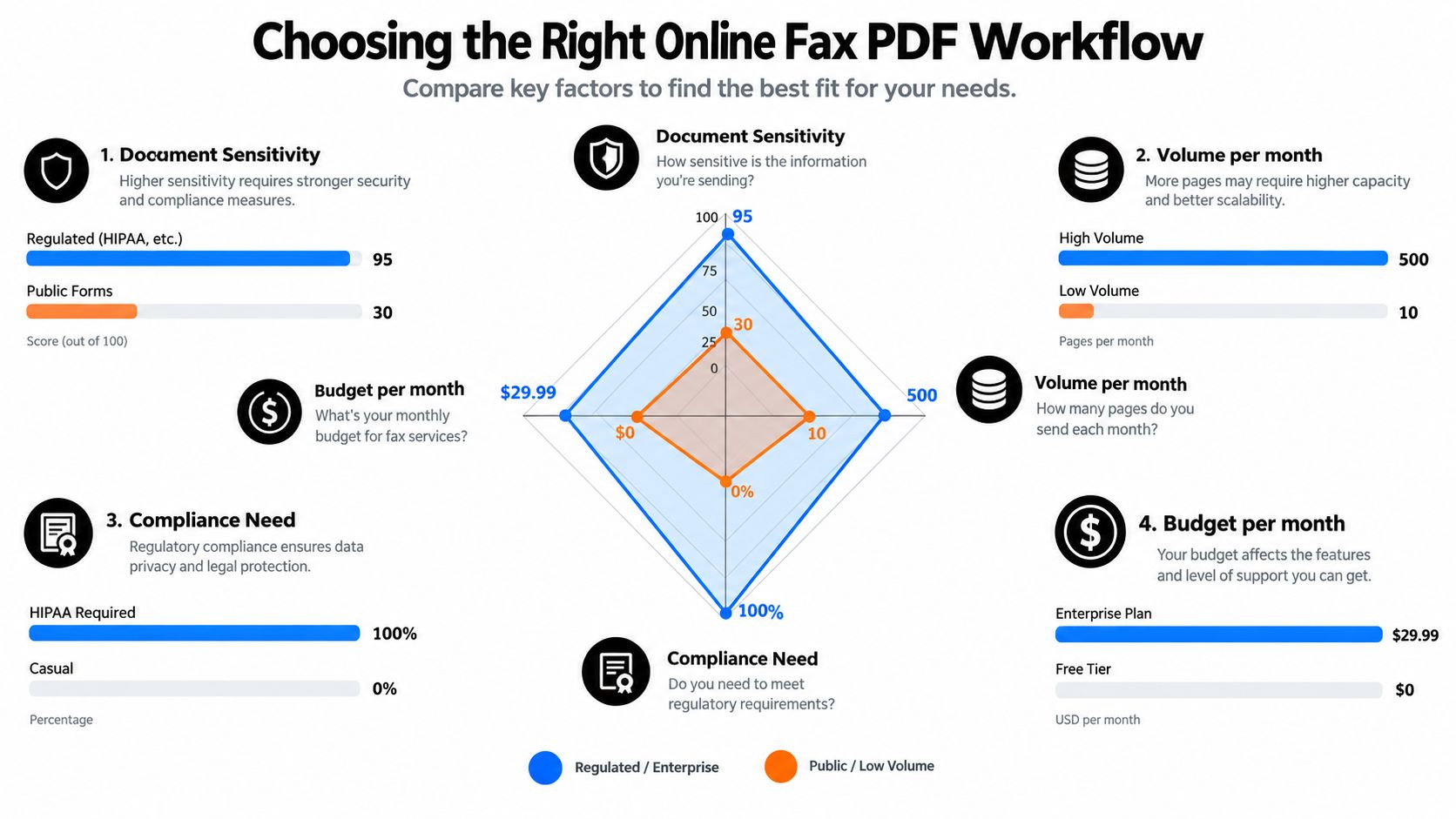
Four decisions that shape the right workflow
Sensitivity of the document
A public form and a medical record should not travel through the same level of tooling by default.
If the PDF contains regulated information, use a provider built for that environment. If it's a routine non-sensitive form, a simpler browser-based service may be enough.
Frequency of use
One-off faxing and daily faxing are different jobs.
- Occasional sender: A pay-per-send or lightweight browser workflow makes sense.
- Regular business sender: A subscription service with history, reusable contacts, and email alerts may save friction.
- Operational team: API access, routing rules, and shared inbox behavior start to matter.
How the document enters the system
Think about where the file lives before faxing:
- In a browser download folder
- In email as an attachment
- In a cloud drive
- Inside a business application
Choose the workflow that removes the fewest steps. If you always start with a signed PDF on your laptop, a browser uploader is usually enough. If staff sends documents all day from line-of-business software, that same browser flow becomes repetitive.
Proof requirements
Some recipients only care that the pages arrive. Others need a timestamped record, sender identity, or an auditable trail.
That requirement changes the acceptable tool category fast.
Matching common situations to common tool types
Here's the plain-English version:
- Single personal form with no unusual sensitivity: A basic browser fax workflow is often enough.
- Freelancer or small business sending paperwork every so often: A lightweight paid workflow with better limits and cleaner cover-page control is usually the practical middle ground.
- Healthcare, legal, or government handling sensitive records: Use a regulated cloud fax setup with formal security controls, retention rules, and documentation support.
For occasional U.S. or Canada sends, SendItFax is one browser-based option that accepts PDF, DOC, and DOCX files without requiring an account, which fits simple document transmission when you don't need a full subscription platform.
The right online fax PDF workflow depends less on convenience than on consequence. Start with the question, “What would hurt more, a failed send or an exposed file?”
If you need to fax a PDF without hunting down a machine, SendItFax gives you a browser-based way to send documents to U.S. and Canadian fax numbers from your laptop or phone. It's built for quick, occasional sending, including PDF uploads and optional cover-page handling, so you can move a document out the door without setting up a full fax system. Visit SendItFax to see whether its workflow fits the kind of PDF faxing you handle most often.