Faxes is the only correct plural form of fax; faxs is a grammatical error. Words ending in x typically take -es in the plural, which gives us faxes, not faxs.
But why does a small spelling choice matter in a business email, legal record, or medical office memo? Because professional writing depends on details that readers can trust. The same word also carries a practical history: fax systems became widely useful through shared standards, and many organizations still depend on them when a recipient's workflow requires fax rather than email or an online portal.
The Correct Plural Form of Fax
The correct plural is faxes. Use it when you mean more than one fax, whether you're referring to documents, transmissions, or the machines themselves.
- “The office received three faxes this morning.”
- “Please send the signed forms as faxes.”
- “The new system can route incoming faxes to the records team.”
The form faxs is incorrect in standard English. The reason is straightforward: nouns ending in x generally form their plural with -es, not by adding only -s. The extra vowel creates a pronounceable ending, so fax becomes faxes.
The word fax can also function as a verb. You can fax a document, and you can say that a colleague faxes a form. For a concise explanation of the term's underlying abbreviation, see this guide to what fax stands for.
Practical rule: If you're describing two or more fax documents or transmissions, write faxes. Reserve fax's for possession, as in “the fax's display,” not for the plural.
Grammar Rules for Words Ending in X
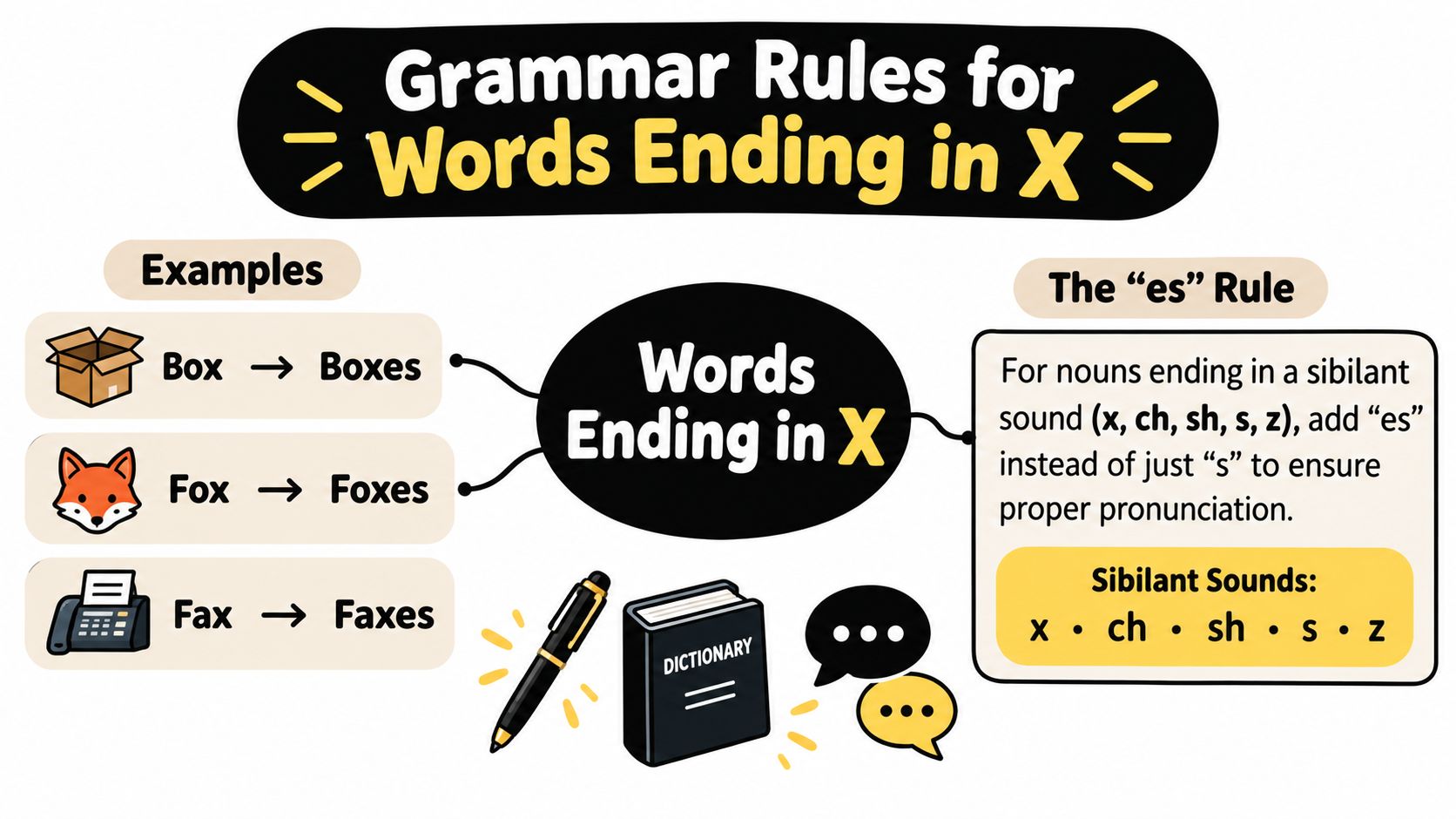
English spelling often adds -es to nouns whose endings produce a hissing or buzzing sound. The letters x, ch, sh, s, and z commonly fall into this pattern because adding only -s would make pronunciation awkward.
Compare these forms:
- box → boxes
- fox → foxes
- tax → taxes
- fax → faxes
- brush → brushes
- class → classes
The rule is partly about spelling and partly about sound. Saying faxs would force the final consonants together. Adding -es creates an extra syllable and makes faxes easier to pronounce.
Not every English plural follows one universal pattern, so writers should still check unusual words. However, fax follows the regular spelling pattern used by familiar nouns such as box and tax. Once you recognize the ending, you don't need to memorize faxes as an isolated exception.
Common Spelling Mistakes and How to Avoid Them
Most errors involving fax come from treating it like a noun that just takes -s. Writers may also use an apostrophe because they confuse plural formation with possession. Neither shortcut produces the standard plural.
| Incorrect Form | Correct Form | Grammar Rule Violated |
|---|---|---|
| faxs | faxes | Nouns ending in x typically take -es |
| fax's | faxes | Apostrophes don't form ordinary plurals |
| Faxes' | faxes | Unnecessary possessive form when no possession is intended |
| fax documentses | fax documents | The noun documents already carries the plural |
Apostrophes have a specific job. They can show possession, as in “the fax's cover page,” or appear in certain contractions. They shouldn't be inserted merely because a word is shortened or because the writer wants to emphasize that more than one item exists.
Capitalization causes a separate problem. In ordinary business prose, write fax and faxes in lowercase unless the word begins a sentence or appears in a title that follows a chosen capitalization style. The term is an established common noun, not normally a proper name.
Proofreading becomes easier when you search for the exact error patterns. A document review for faxs, fax's, and inconsistent capitalization can catch mistakes before an external recipient sees them.
Practical Usage Examples in Business Writing
The plural should fit naturally into the sentence and agree with the surrounding verb. Consider how the same term works in several professional settings.
Email correspondence:
“Please review the attached list of faxes received by the customer-service desk and identify any documents that need a response.”
Legal administration:
“The records department will produce the requested faxes with the associated transmission confirmations.”
Medical records:
“Before filing the faxes, staff should verify the patient identifier and confirm that each page is legible.”
Internal instruction:
“Route incoming faxes to the contracts folder and notify the assigned coordinator.”
Notice the difference between singular and plural agreement:
- “The fax is missing a page.”
- “The faxes are missing pages.”
The verb changes because fax can refer to one item, while faxes refers to multiple items. The word can also describe an action: “The coordinator faxes the authorization form.” Here, faxes is a third-person singular verb, not a plural noun.
Clarity matters more than technical vocabulary. If a recipient needs a specific action, identify the document, destination, and verification step. “Please send the faxes” may be grammatically correct, but “Please send the signed authorization and retain the transmission confirmation” gives the reader a usable instruction.
Understanding Facsimile and Related Terminology
Fax is a shortened form of facsimile, a term associated with reproducing or transmitting an exact copy. The full noun remains correct, and its plural is facsimiles, not facsimilees or facsimileses.
In contemporary office writing, fax is usually the natural choice. It works as both a noun and a verb:
- “We received a fax.”
- “We received several faxes.”
- “Please fax the signed agreement.”
- “The provider faxes records to the designated office.”
Facsimile may suit a formal contract, historical discussion, academic text, or technical description where the longer term provides precision. In everyday instructions, however, “fax the form” is clearer and more direct than “transmit the form by facsimile.”
The shortened word became useful because business users needed a compact label for both the document and the transmission method. That flexibility explains why fax remains common even when the sending process happens through a browser rather than a physical machine. For a closer comparison of the two terms, consult this explanation of facsimile and fax.
Why Fax Technology Remains Operationally Necessary
Calling fax “obsolete” misses an important distinction. A technology can be old while still being operationally necessary for a particular recipient. Healthcare facilities, legal offices, government departments, insurers, and other documentation-heavy organizations may retain fax because their intake procedures, software, and partner networks were built around it.
Fax developed through major technical stages. Alexander Bain patented an early electrical image-transmission device in 1843, and Giovanni Caselli's pantelegraph transmitted an image between Paris and Lyon on 10 February 1862. Later standards improved interoperability, including Group 3, adopted as CCITT Recommendation T.4 in 1980, which generally enabled a page to transmit in about one minute over ordinary telephone networks. This history is documented in the development of the fax machine.
Modern evidence also shows continued use. A worldwide survey of 200 large companies in 2017 found that 82% had seen employees send at least as many faxes as in the previous year, as reported in this history of fax adoption. In Germany, a 2023 Bitkom survey of 505 companies found that 82% still used fax, with one-third using it frequently or very frequently, according to the same source.
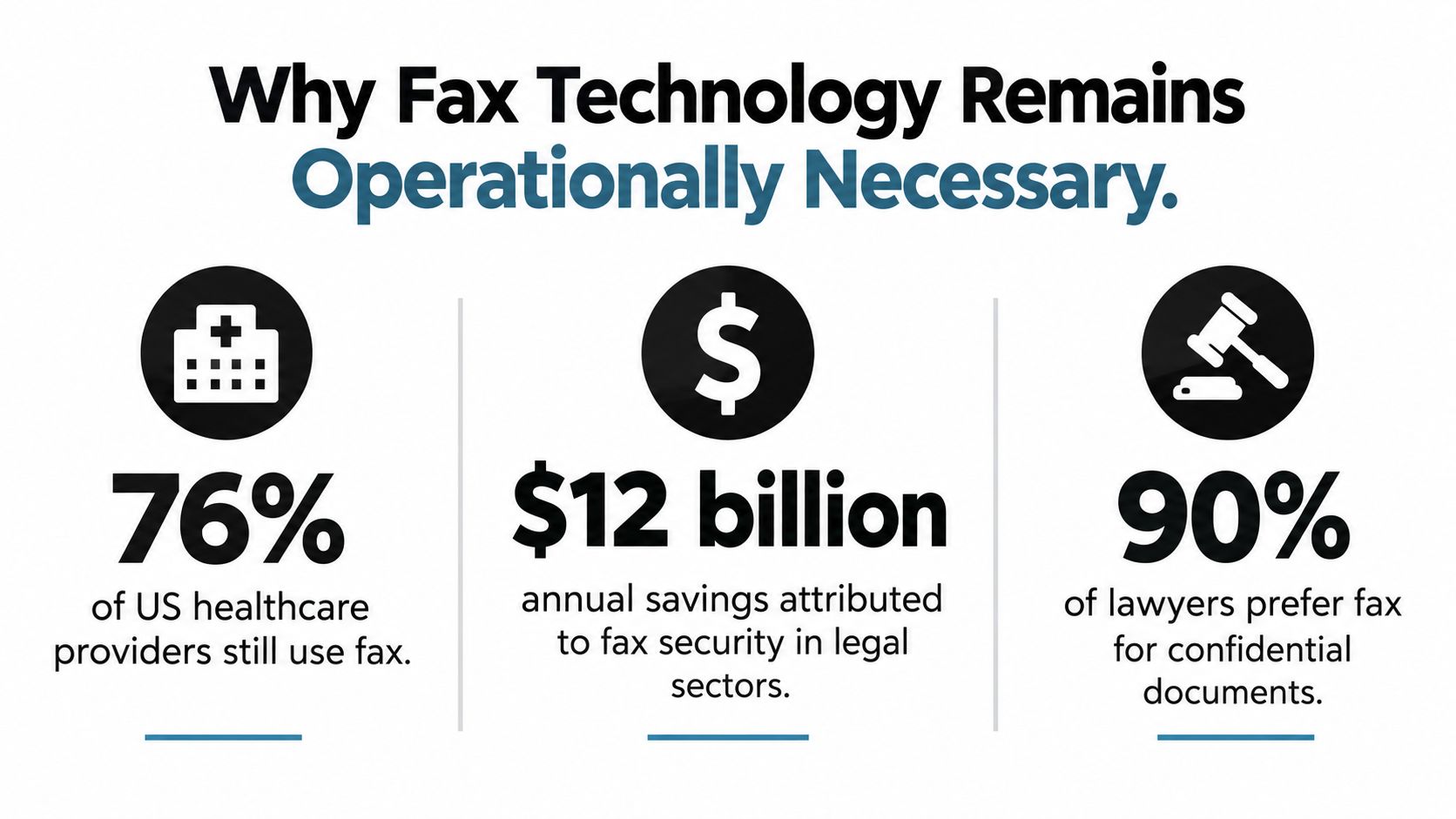
The practical reason isn't nostalgia. A recipient may require fax because it fits an established recordkeeping process or connects with systems that don't accept ordinary email. That doesn't make fax automatically superior. It means senders should ask what channel the recipient accepts. More context appears in this guide to what faxes are used for.
Compliance Rules for Sending Promotional Faxes
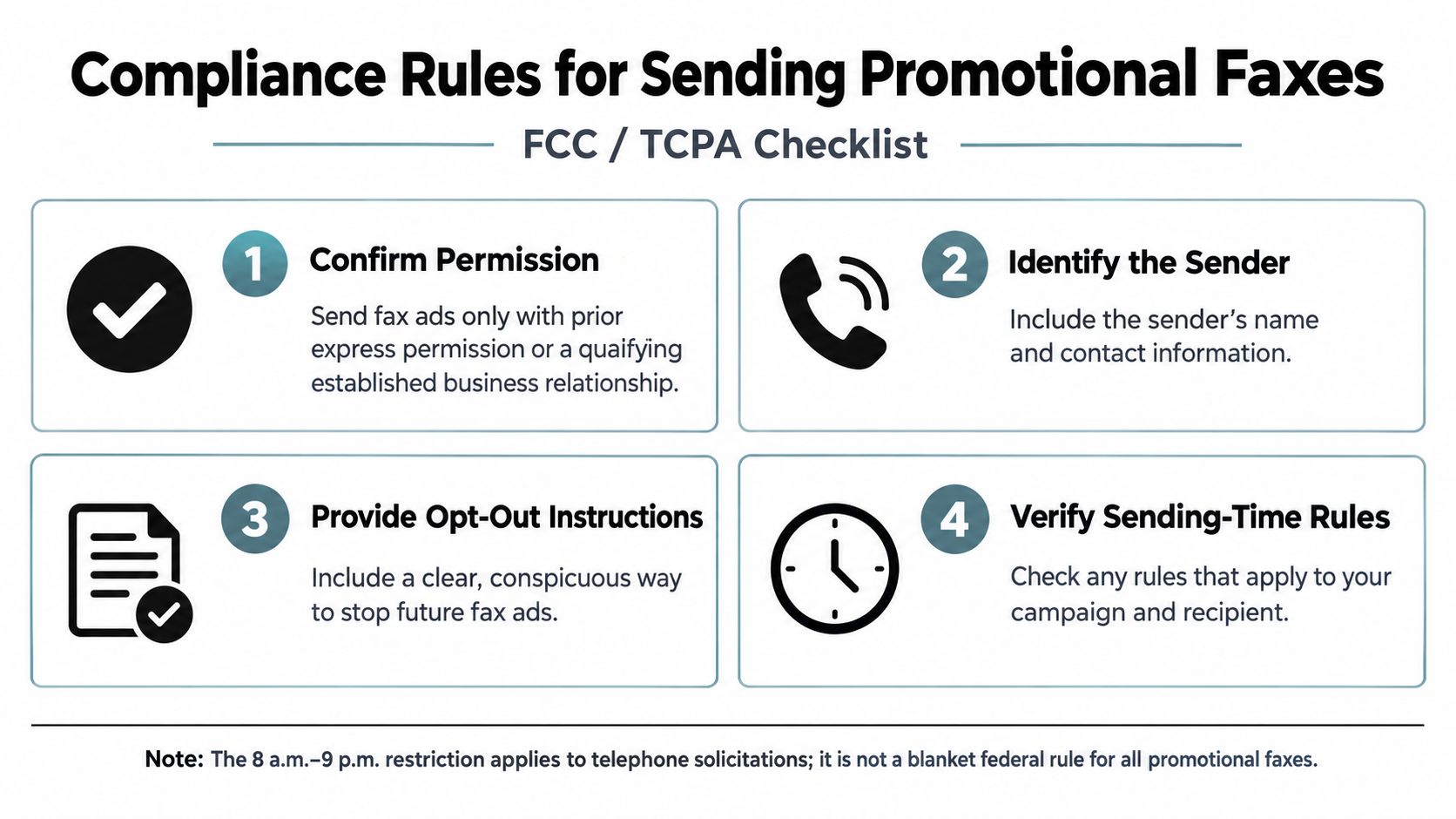
A fax containing a form, contract, purchase confirmation, or other purely transactional material isn't automatically an advertisement. Promotional content requires a more careful analysis in the United States because the Telephone Consumer Protection Act restricts unsolicited advertisements sent by fax.
The FCC's junk-fax guidance states that an unsolicited advertisement generally can't be sent to a fax machine, computer, or similar device. Permission may provide an exception. An established business relationship may also matter when the sender obtained the fax number through permitted means, but that exception carries additional requirements.
Before sending, classify the document:
- Identify the purpose. Decide whether the content is promotional, transactional, or informational.
- Record the basis for sending. Keep evidence of permission or the qualifying business relationship where applicable.
- Review the first page. A covered advertisement must include a conspicuous opt-out notice and a cost-free submission method.
- Process opt-outs promptly. The FCC says an opt-out request must be honored within the shortest reasonable time, no later than 30 days, as stated in its guidance.
Don't assume that a publicly listed fax number equals consent. Marketing teams should also make sure the notice remains readable after conversion and transmission. If the document's purpose is unclear, pause the send and obtain compliance advice rather than treating every fax as an ordinary business document.
Verifying Transmission Success and Handling Errors
A successful transmission report proves less than many senders assume. It may show that a session reached a fax endpoint and that the system completed its transmission procedure. It doesn't independently prove that the intended employee opened the document, that every page was legible, or that the pages entered the correct case or patient record.
The technical foundation matters. ITU-T Recommendation T.30 defines call-establishment and session-control procedures for Group 3 fax equipment. Its optional error-correction feature can request retransmission of affected data, but endpoints may not provide identical recovery behavior. The ITU-T T.30 recommendation therefore supports a practical rule: retain meaningful status details rather than treating an upload or telephone connection as proof of complete receipt.
A verification routine
- Check the destination number. Compare it with the recipient's current instructions before sending.
- Count the pages. Include the cover sheet in your own record and confirm that the expected total appears in the transmission details.
- Inspect the source. Use a clear, legible file with sufficient contrast.
- Read the report. Look for page completion, retry events, negotiated mode, and final status.
- Request acknowledgment. For time-sensitive material, ask the recipient to confirm routing and usability.
- Escalate incomplete delivery. Call the recipient, resend when appropriate, or use another approved channel.
A 2025 healthcare survey found that 52% of faxes required staff intervention and that 88% of respondents said fax delays affected patient care, according to this report on healthcare fax problems. Those findings reinforce why a transmission receipt should begin the verification process, not end it.
Quick Reference Guide for Document Transmission
Use this compact checklist before closing a fax task:
- Spelling: Write faxes, never faxs, when referring to more than one.
- Destination: Verify the recipient's number through an approved source.
- Document: Check page order, readability, and sensitive information.
- Purpose: Separate ordinary records from promotional material.
- Confirmation: Save the transmission report and its status details.
- Follow-up: Ask the recipient to confirm correct routing when timing or confidentiality matters.
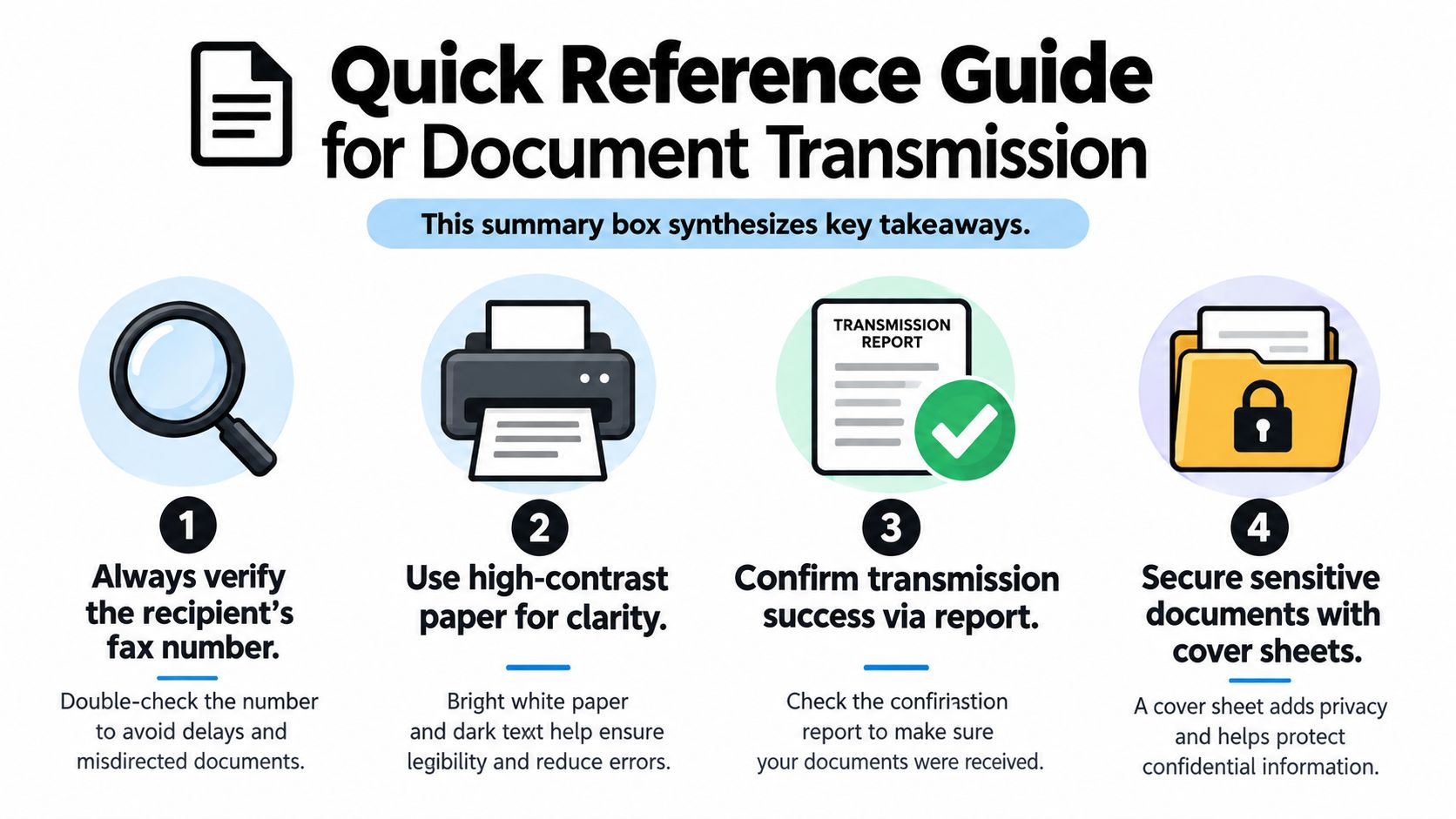
A few terms help organize the workflow. Facsimile is the formal full word, Group 3 is an international fax standard, and error correction refers to recovery procedures that can request affected data again. A browser-based service can connect modern documents with a recipient's fax endpoint, but the sender still owns the responsibility for accurate addressing and appropriate follow-up.
Frequently Asked Questions About Fax Grammar
Can “fax” be a verb?
Yes. You can say, “Please fax the contract.” In the present tense, “she faxes the contract” uses faxes as a verb.
What is the plural of “fax machine”?
Write fax machines. The noun machines carries the plural, while fax functions as a descriptor.
Should “fax” be capitalized?
Usually not. Use lowercase in ordinary prose unless it begins a sentence or appears in a title style that requires capitalization.
Does a confirmation prove the recipient read the fax?
No. It can show transmission status, but you should request acknowledgment when correct routing, legibility, or urgency matters.
SendItFax lets users send documents from a browser to recipients in the United States and Canada without a fax machine or account, with support for PDF, DOC, and DOCX files. If you need to transmit an occasional form, contract, or record, visit SendItFax and review the available sending options before you upload the document.