Tag: free fax from computer

  • How to Do free faxing from computer: Send a Fax for Free

    How to Do free faxing from computer: Send a Fax for Free

    It's easy to think of faxing as a technology that belongs in a museum, right next to dial-up modems and floppy disks. Yet, the ability to do free faxing from computer is surprisingly relevant—and for some professions, it’s an absolute necessity. It’s the modern way to handle legally binding documents without the clunky hardware and dedicated phone line.

    If you work in healthcare, law, or finance, knowing how to send a secure digital fax is a game-changer.

    Why Bother Faxing From a Computer in 2025?

    Laptop displaying secure faxing software interface on wooden desk with organized binders and plant

    In a world filled with email and instant messaging, the fax machine seems like a dinosaur. But here's the thing: many official institutions and regulated industries haven't moved on, and for good reason. It all comes down to security and legal validity.

    An email can be intercepted, hacked, or altered. A fax, on the other hand, is a secure, point-to-point transmission. This is why it remains the go-to method for sending sensitive information where you need undeniable proof of delivery.

    Just think about some of the real-world situations where a fax is still king:

    • Sending signed contracts to your lawyer.
    • Transmitting patient medical records between a clinic and a specialist.
    • Filing official forms with a government body like the IRS.
    • Submitting signed closing documents for a real estate deal.

    In all these cases, you can't risk the document's integrity. Faxing provides that peace of mind.

    The Best of Both Worlds: Digital Faxing

    Thankfully, the resilience of faxing doesn't mean you're stuck hunting for a machine at a copy shop. Today's tech gives us free faxing from computer, blending the trusted security of old-school faxing with the sheer convenience we expect from modern tools.

    This approach completely sidesteps the classic headaches of hardware maintenance. Forget about paper jams, running out of toner, or getting that frustrating busy signal. Instead, you can attach a PDF or Word document and send it from your laptop in seconds. It’s as simple as sending an email, but infinitely more secure.

    To the person on the other end, your document arrives on their traditional fax machine just like any other. They’ll never know you sent it from your couch. You get a digital confirmation receipt, and the whole process is done.

    Even in 2017, the United States was sending an average of 6,000 fax pages every second. That tells you just how embedded this technology still is in critical business operations. If you're curious about the industry's staying power, iFaxApp.com has some interesting data.

    How It Works Under the Hood

    So, what’s actually happening? At its heart, an online fax service is a translator. It takes your digital file (like a PDF), converts it into the specific black-and-white image format a fax machine understands, and then dials the recipient's number to transmit it over the phone lines.

    The service handles all the technical heavy lifting for you. All you need is the destination number. To the receiver, it’s just another piece of paper coming out of their machine. If the whole idea of a dedicated number for a fax is new to you, this helpful guide explains what is a fax number. It's a simple, elegant system that bridges the gap between digital convenience and old-school security.

    Digital Faxing vs Traditional Machines

    Here's a quick breakdown of how sending a free fax from your computer stacks up against an old-school fax machine.

    Feature Free Faxing From Computer Traditional Fax Machine
    Cost Free for limited use; low-cost subscriptions Requires machine, toner, paper, and a dedicated phone line
    Convenience Send and receive from anywhere with internet access Tied to a physical location; must be present to use
    Security Encrypted digital transmission and secure cloud storage Secure point-to-point connection, but physical copies can be misplaced
    Confirmation Instant digital confirmation sent to your email Prints a confirmation page (if it doesn't run out of paper)
    Document Quality Clear, crisp digital quality Can suffer from smudges, lines, and poor resolution

    As you can see, the digital approach maintains the core security benefit of faxing while leaving behind all the physical limitations and ongoing costs. It’s a clear win for anyone needing to send important documents today.

    Sending Your First Free Fax Online
    Person typing on laptop with mouse and notebook for sending free fax from computer

    Ready to send a document without touching an actual fax machine? You might be surprised how simple it is. I'll walk you through the entire process using a web-based service like SendItFax, showing you how free faxing from computer can be done in just a few minutes.

    The best part is that it’s all done right in your browser. There’s no software to download and you don’t even need to create an account for a quick, one-off fax.

    Getting Your Document Ready

    Before you even open a web browser, get your document in order. Most online fax services, including SendItFax, handle common file types like PDF, DOC, and DOCX without any issues.

    From my experience, it’s always best to convert your file to a PDF first. This locks in the formatting, so what you see on your screen is exactly what the recipient gets.

    Also, take a second to look at your document in black and white. Faxes don't do color, so you want to make sure your fonts are legible and any images have enough contrast to avoid turning into a blurry mess on the other end.

    Plugging in the Details

    Once you land on the service's website, you’ll find a straightforward form. This is the crucial part, and getting the details right ensures your fax actually arrives.

    • Who it's for: Pop in the recipient’s full 10-digit fax number. No need to add a "1" at the beginning for numbers in the U.S. or Canada.
    • Who it's from: You’ll need to enter your name and email address. The email is especially important—that's how you'll get the delivery confirmation.
    • Your number: If you don't have a dedicated fax line (most of us don't!), just use your regular phone number.

    Think of this section as the digital equivalent of a return address. It tells them who sent the fax and gives you peace of mind with a confirmation receipt.

    Should You Add a Cover Page?

    A cover page just looks more professional, and it gives the recipient immediate context for what you've sent. Most free services, like SendItFax, let you add a quick subject line and a short message right in the web form.

    This is incredibly useful when you're sending something like a job application or a signed contract. A simple message like, "Signed contract for Project Alpha" can make sure your document lands on the right desk instead of getting lost in the shuffle.

    It's amazing to think this convenience has roots going back decades. The first computer-based fax board, GammaFax, was actually introduced way back in 1985. That innovation was the first real step toward the digital services we have now, building on concepts that started with the very first fax prototype in 1843. You can get the full story by exploring the evolution of fax technology on Documo.com.

    The Final Check and Send

    Okay, you've filled everything out and attached your file. Before you click that send button, give it one last look. Is the fax number entered correctly? Is there a typo in your email address? A simple mistake here is the most common reason for a fax to fail.

    Once you’re sure everything is correct, go ahead and send it. The service takes over, converting your document and dialing the fax number. A few moments later, you should get an email telling you whether it went through successfully or if there was an error. That confirmation email is your proof of delivery.

    This whole system is a world away from traditional email. In fact, many modern fax services can even deliver incoming faxes right to your inbox. If you're curious about that, check out our guide on the fax to email process.

    What's the Catch with Free Fax Services?

    Let's be honest, the word "free" is always appealing. When you just need to send a single document and have no interest in signing up for a monthly plan, a free online fax service feels like the perfect solution. And for many situations, it absolutely is. These services work on a freemium model—they give you the basic functionality for free, hoping that some users will eventually need more and decide to upgrade.

    This is a fantastic setup for sending a quick form, a signed agreement, or a one-off invoice without any fuss. But as with most things in life, "free" usually comes with a few strings attached. Knowing what they are ahead of time will save you headaches later.

    Understanding the Free Limits

    The first thing you’ll run into are the limits. Most free services cap how much you can send. For instance, with SendItFax, the free tier lets you send a document up to three pages long, plus a cover sheet. For most everyday tasks—like sending a signed contract, a doctor's note, or a receipt—that's plenty.

    You'll also likely find a daily sending limit. It's common to see a cap of something like five faxes per 24-hour period. These limits are there for a good reason: they prevent abuse and keep the service running smoothly for everyone. For the average person, these caps are more than generous.

    The Bottom Line: Free fax services are built for light, occasional use. If you find yourself needing to send lengthy reports or dozens of faxes a day, you’ll quickly realize that a paid plan is the way to go for a smoother workflow.

    This is a classic freemium model, common across all sorts of online tools.
    Free limits text on paper with smartphone showing limit warning on wooden desk workspace

    A large base of free users makes it possible to offer premium features to a smaller group of customers who need more power, higher limits, or dedicated support.

    A Note on Branding and Professionalism

    Another part of the trade-off is branding. To help pay the bills, a free service like SendItFax will usually add their logo to the cover page of your fax. This is completely standard and, for personal faxes, it's rarely a big deal.

    However, if you're sending something where appearances matter—think a formal business proposal or a critical legal document—that third-party branding might not project the professional image you want. This is one of the main reasons people choose to upgrade. A small fee is often all it takes to remove the branding and get a clean, polished look.

    What About Privacy and Your Data?

    Whenever you use an online service, it's smart to think about privacy. To send your fax, the service has to process the document on its servers. The good news is that trustworthy providers use encryption to secure your data in transit and have clear policies about how they handle your information.

    Before you upload anything sensitive, it’s worth taking a couple of minutes to scan the service’s Privacy Policy. Here’s what I always look for:

    • Data Encryption: Do they explicitly mention using encryption (like TLS/SSL) to protect your files?
    • Data Retention: How long do they keep your documents on their servers after the fax has been sent?
    • Information Sharing: Do they share your personal info with other companies?

    Services like SendItFax are upfront about using cookies for site functionality and clearly lay out their data practices. If you want to see how different services compare on security, features, and cost, checking out a detailed online fax services comparison is a great next step. A quick look can give you the confidence that the service you choose fits both your privacy standards and your professional needs.

    Knowing When It's Time to Ditch the Free Plan

    Free online faxing is fantastic for that one-off document you need to send in a pinch. It's quick, easy, and gets the job done. But let's be honest, there's a point where "free" starts to cost you.

    Those built-in limitations—like page caps, daily send limits, and the service's logo plastered on your cover sheet—are what make the free model work. But as your faxing needs get more serious, those same limitations can become a real headache. The trick is recognizing when the trade-offs of a free tool are holding you back.

    When Your Image and Brand Matter

    The first and most obvious reason to upgrade is professionalism. Sending a quick form to your gym with a SendItFax logo on it? No big deal. But sending a signed contract to a new client, a legal document to a law firm, or a patient referral to a specialist? That’s a different story.

    Appearances count, and a paid plan gives you the tools to look the part.

    • Custom Branding (or No Branding): The biggest win is removing their logo. Your faxes look like they came straight from your office, not a freebie website.
    • Your Own Dedicated Fax Number: This is a total game-changer. It means people can send faxes to you, which land right in your email inbox. Your computer suddenly becomes a full-fledged fax machine.
    • International Reach: Most free services keep you locked into domestic numbers. A paid plan lets you send faxes around the globe, which is essential if you work with international clients.

    Upgrading takes online faxing from a handy gimmick to a legitimate business communication tool.

    When Volume and Security Are Non-Negotiable

    Beyond looks, paid services are built for real work. Think about a mortgage broker during a busy season or a clinic managing patient records. The free limit of 5 faxes per day just isn't going to cut it. You can't afford to have a critical document delayed because you hit your daily cap.

    I always tell people that upgrading isn't just about paying for more features; it's about investing in reliability. When a single failed fax can stall a major deal or compromise patient care, a small monthly fee is simply the cost of doing business right.

    A subscription plan gives you the capacity to send hundreds of pages a month without a second thought. But more importantly, it gives you peace of mind.

    Many paid services offer enhanced security features, and for some industries, this is an absolute must. For example, HIPAA compliance is a legal requirement for anyone in healthcare handling patient information. Sending sensitive data through a free, non-compliant service is a massive risk. Upgrading to a secure, compliant service isn't just a good idea—it's essential for protecting your clients and your business.

    What to Do When Your Fax Fails to Send
    Woman at desk viewing laptop screen displaying fix fax errors message with error icon

    It’s bound to happen eventually. You’ve uploaded your document, hit send, and a few minutes later you get that dreaded "transmission failed" notification. It's frustrating, but don't worry—the fix is usually pretty simple. Most of the time, the problem isn't even on your end.

    The most common reason a fax fails is that the recipient's fax machine is busy. Remember, old-school fax machines can only handle one thing at a time. If someone else is sending them a fax or they're sending one out, their line will be engaged. It's the modern equivalent of a busy signal.

    Figuring Out What Went Wrong

    Before you immediately hit "resend," take a second to think through the most likely culprits. A little bit of troubleshooting now can save you from repeated failed attempts.

    Nine times out of ten, a fax fails for one of these reasons:

    • The Line is Busy: Someone else is using the machine you're trying to reach.
    • You Typed the Wrong Number: A simple typo is incredibly common. It’s easy to mix up a digit or two.
    • Their Machine is Offline: The receiving machine could be turned off, out of paper or ink, or simply unplugged.
    • A Problem with Your File: The document you uploaded might be too large, corrupted, or in a format that's causing conversion issues.

    From my own experience, the best first step is to just wait. Give it about 10-15 minutes and then try sending it again. That's usually enough time for the other line to free up. If it fails a second time, it's time to dig a little deeper.

    Simple Fixes to Try on Your End

    If a brief pause doesn't do the trick, the issue could be something you can control. The first and easiest thing to check is the fax number. Go back and carefully re-enter all 10 digits, double-checking them against your source. We've all been there—it's a surprisingly easy mistake to make.

    Next, take a look at the file you're trying to send. While services like SendItFax are pretty flexible with PDF, DOC, and DOCX files, a PDF is almost always the most reliable choice. If you're sending a Word document, try saving it as a PDF first and then uploading that version. This process "flattens" the file, which can often resolve tricky formatting bugs that interfere with the fax conversion.

    Pro Tip: Remember that faxing essentially turns your document into a black-and-white picture. If your original file has complex color graphics, tiny fonts, or a busy layout, it can sometimes trip up the conversion process. For the best results, stick to simple, clean documents with clear, black text.

    If you’ve confirmed the number is perfect and you've tried sending a clean PDF file, the problem is almost certainly with the recipient's machine. At this point, the most effective solution is the old-fashioned one: pick up the phone. A quick call to confirm their fax machine is on, stocked with paper, and ready to receive is the fastest way to solve the mystery.

    Got Questions About Faxing From Your Computer? We’ve Got Answers.

    Even when the steps seem simple, it's natural to have a few questions before you hit "send." I get asked about computer faxing all the time, so let's walk through some of the most common queries. My goal is to help you send those documents with complete confidence.

    How Secure Is It, Really? Can I Send Sensitive Info?

    This is probably the most important question, and for good reason. The short answer is yes, it's generally safe if you stick with a reputable service. Professional online fax providers use TLS/SSL encryption to protect your files the moment you upload them. It’s the same technology your bank uses to keep your financial details private.

    Think of it this way: your document is scrambled and secured from your computer all the way to the service's servers. From there, it's sent over traditional phone lines to the recipient's machine. For contracts, invoices, or applications, this level of security is more than enough. However, if you're handling documents that fall under strict compliance rules like HIPAA, I'd strongly recommend a paid, HIPAA-compliant service built for that specific purpose.

    How Do I Know My Fax Actually Went Through?

    This is one of the best parts of faxing online. You're never left guessing. Moments after you send your fax, the service will pop a delivery confirmation receipt right into your email inbox.

    This email is your proof of transmission. It will clearly state whether the fax was delivered successfully or if it failed. If there was a problem—like a busy signal or a wrong number—the notification usually tells you why, so you can fix it and try again without any guesswork.

    Can I Get Faxes Sent to Me With a Free Service?

    Typically, no. Nearly all free online fax services are a one-way street, designed for outgoing faxes only. Receiving a fax requires a dedicated phone number that's always on and ready to accept incoming transmissions, and that’s a feature reserved for paid plans.

    If you need to receive faxes regularly, you’ll want to look at upgrading to a paid account. They’ll assign you a personal fax number, and any faxes sent to it will land in your email as a PDF.

    The move to online faxing isn't just about convenience; it has a huge environmental upside. Traditional fax machines in the U.S. churn through an estimated 200 billion pages of paper annually. If just 5% of that volume moved online, we could save about one million trees every year. If you're curious, you can learn about the impressive stats of online fax and see the bigger picture.

    Do I Need to Install Any Special Software?

    Nope, not a thing. That’s the real beauty of a web-based service like SendItFax. Everything is handled directly in your browser, whether you're on a laptop, tablet, or even your phone.

    There’s no software to install and no hardware to plug in. As long as you have an internet connection, you have a fully functional fax machine right at your fingertips. It’s perfect for when you’re working from a coffee shop or need to send a signed document while traveling.


    Ready to skip the hassle of finding a physical fax machine? Give SendItFax a try for a quick, secure, and painless experience. Send your first free fax now.

  • Send a Free Fax From Computer The Easy Way

    Send a Free Fax From Computer The Easy Way

    Sending a free fax from computer is way easier than you might imagine. All it really takes is an internet connection and your web browser. Online fax services do all the heavy lifting for you, taking your digital file and transmitting it over traditional phone lines—no clunky machine required.

    Faxing Without a Fax Machine Is Simpler Than You Think

    It’s easy to think of faxing as a relic from another time, but it’s still an essential tool in many fields, especially healthcare, law, and real estate where secure document transfer is a must. The old headache was always the machine itself—the paper jams, the busy signals, the dedicated phone line. Thankfully, those days are over.

    With modern digital solutions, anyone can send a secure document from their laptop or desktop in just a few minutes. This isn't just a small trend; it's a huge shift in how people handle documents. The global online fax market has swelled to a value of around USD 4.18 billion, a testament to how many businesses and individuals are ditching old hardware for digital convenience. This boom is fueled by the simple, powerful ability to send a free fax from computer without any special gear. If you're curious, you can read more about the online fax market's growth and see just how widespread this technology has become.

    Why Online Faxing Is the New Standard

    The real draw of online faxing is its sheer simplicity and accessibility. Forget printing a document, walking over to a machine, punching in numbers, and hoping it goes through. Now, you can get it all done with a few clicks.

    This approach brings some obvious wins:

    • It’s Cheaper: You completely cut out the costs of paper, ink, toner, and the inevitable machine repairs.
    • It’s Convenient: Send a fax from wherever you are—your home office, a coffee shop, or even on the go. As long as you have an internet connection, you're all set.
    • You Get a Digital Trail: Most services send an email confirmation, which acts as a digital receipt proving your fax was delivered successfully.

    The beauty of online faxing is how it perfectly bridges the digital and analog worlds. It lets you stay in your modern workflow with PDFs and DOCX files while still communicating seamlessly with organizations that rely on traditional fax machines.

    To really see the difference, let’s put them side-by-side.

    Traditional Fax vs. Online Faxing From Your Computer

    Thinking about the old way versus the new way? The contrast is pretty stark once you break it down.

    Feature Traditional Fax Machine Free Online Fax Service
    Hardware Required Dedicated fax machine, phone line Computer, internet connection
    Supply Costs Paper, ink, toner None
    Accessibility Limited to the machine's location Accessible from any browser, anywhere
    Confirmation Printed confirmation sheet Digital confirmation via email
    Sending Process Manual dialing, feeding paper Upload a file, enter a number, click send

    When you look at it this way, the choice becomes clear. Online faxing takes a process that was tied to a physical location and specific hardware and sets it free, making it accessible, affordable, and a whole lot less frustrating.

    How to Send Your First Online Fax

    So, you need to send a fax but don't have a fax machine. Welcome to the club. Sending a free fax from computer is surprisingly simple once you do it for the first time. Imagine you're a freelancer who just landed a new client. They've asked for a signed contract back, like, yesterday. Instead of hunting down a print shop with a dusty old fax machine, you can handle the whole thing from your computer in less than five minutes.

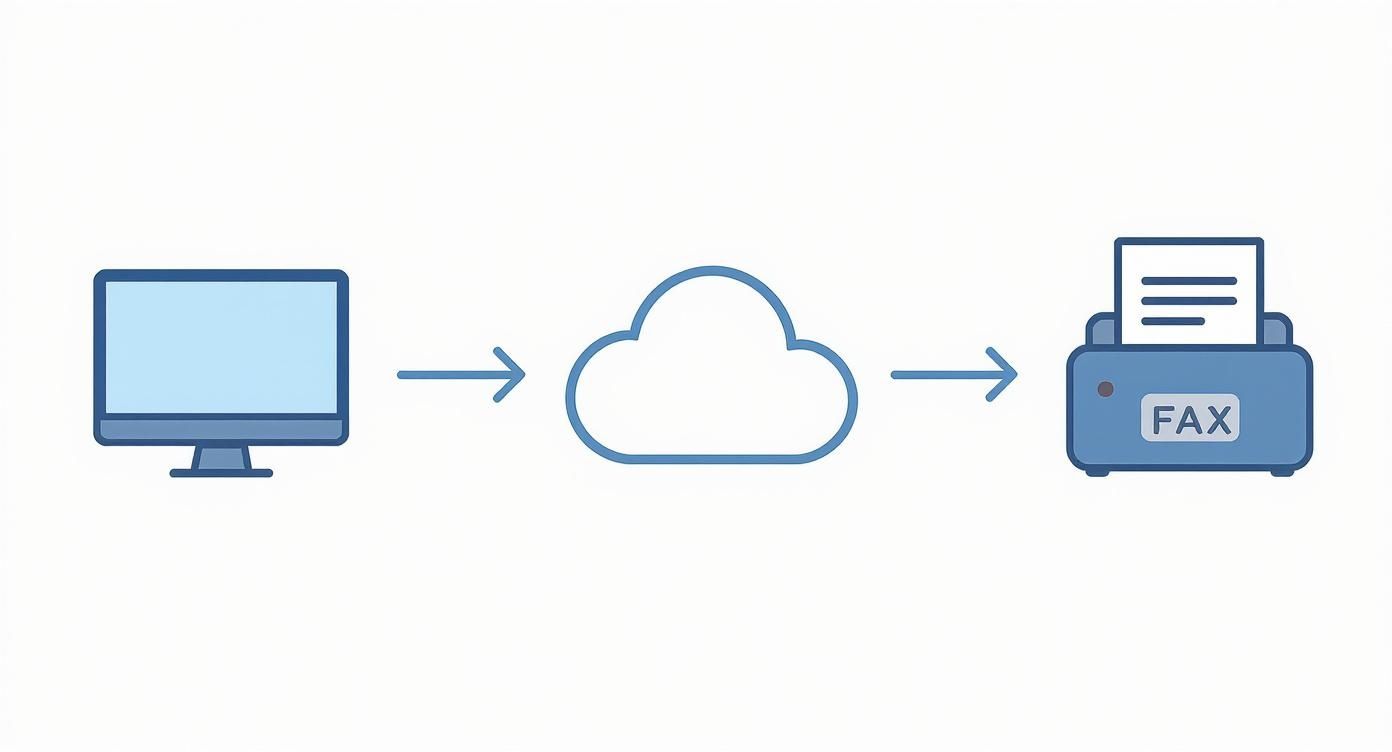
    The magic happens behind the scenes. An online fax service acts as a translator, taking the digital file from your computer and converting it into a signal that a traditional fax machine on the other end can understand and print.

    This is basically how it works: your file goes from your desktop, through the web service, and pops out of the client's fax machine as a physical document.

    Infographic about free fax from computer

    It’s a perfect bridge between the way we work today and the technology some offices still rely on.

    Getting Your Document Ready

    First things first, you need a file to send. The good news is that most free services are flexible and accept the file types you're already using.

    • PDF (.pdf): This is your best bet. PDFs lock in formatting, so you can be confident that the contract you send will look exactly the same on the other end. No weird line breaks or font issues.
    • Word Documents (.doc, .docx): Super convenient if your document is already in Word. Most services let you upload these directly without needing to convert them to PDF first.

    In our freelancer scenario, they’d scan the signed contract and save it as a PDF. This creates a crisp, professional-looking copy that’s ready to go. It’s also smart to glance at the file size—while most documents are small enough, a massive file with high-res images might take longer to upload or even fail.

    Using the Online Fax Service

    With your document saved, head over to the website of a free fax provider. You'll find the layout is usually clean and designed for one purpose: sending your fax without a headache. It's all about filling in a few key boxes.

    You'll start with your own details—your name and email. Don't rush this part. Your email address is critical because that’s how you'll get the delivery confirmation. It's your digital receipt proving the fax went through.

    Next up, the recipient's information. This is where you need to be extra careful.

    The most common reason a fax fails is a typo in the fax number. Always double-check every digit, including the area code.

    If you're sending to someone in the United States, you’ll enter the standard 10-digit number. Most platforms are smart enough to format it correctly, but a quick second look never hurts.

    Uploading and Sending Your Fax

    Okay, all the info is in. Now it's time for the main event. Look for a button like "Choose File" or "Attach Document." Clicking it will open your computer's file explorer, where you can find and select your contract PDF.

    Once it's uploaded, you'll often see an option to add a message to the cover page. This is a great touch. Our freelancer could add a simple note: “Hi team, here's the signed contract for the Q3 project. Please let me know you've received it. Best, [Your Name]." It’s professional and provides immediate context.

    With everything filled in and your document attached, hit that "Send Fax" button. The service takes over, dialing the number and transmitting your file. In just a few minutes, you should get an email in your inbox confirming a successful delivery. If you're curious about all the moving parts of a service like this, our sample page provides a good overview.

    What to Expect From Free Fax Services

    https://www.youtube.com/embed/hYVqTAdr5eE

    Sending a free fax from computer is a lifesaver when you’re in a pinch, but it's good to know what you're getting into. These services are almost always "freemium," meaning they give you the basics for free and hope you'll upgrade for more powerful features. Understanding their limitations from the start will save you a headache later on.

    Navigating the Inevitable Limits

    First off, don't expect to send a 50-page manuscript. The most common restriction you'll hit is a page limit. Most free fax services cap you at around three to five pages per fax. This is perfectly fine for sending a signed contract, a quick invoice, or a doctor's note, which is what most people need them for anyway.

    On top of that, you'll likely run into a daily sending limit. A typical free plan might let you send a maximum of five faxes within a 24-hour window. This setup is designed for occasional use, not for a business that needs to send out dozens of documents every day.

    The Trade-Off: Branding and Professionalism

    Here’s another thing to keep in mind: nothing is truly free. To pay the bills, these services often add their own branding—a small logo or a line of text—to the cover page they generate for your fax.

    For personal stuff, who cares? But if you’re sending a business proposal, a legal document, or your resume, having another company’s logo slapped on it might not look as professional as you’d like. It's a small detail, but one that could matter depending on who's on the receiving end.

    For many people, the convenience of a free service far outweighs these limitations. It's all about matching the tool to the job at hand. A quick, non-critical document? A free fax service is a no-brainer.

    Faxing itself is a technology that just won't quit. It's been around for nearly two centuries, yet an incredible 80% of enterprises still use it, especially for sending sensitive documents securely. This enduring reliance on faxing is precisely why so many online options, both free and paid, have popped up. If you're curious, you can find out more about the faxing industry's surprising resilience.

    A Quick Word on Privacy and Security

    Anytime you upload a document online, you should have privacy on your mind. Before you send something with your social security number or bank details, take a minute to glance at the service's privacy policy.

    It's smart to see how they handle your data and how long they keep your files on their servers. While most use a secure connection, free plans generally don't come with the heavy-duty encryption or compliance guarantees (like HIPAA for medical records) that paid plans offer. For highly sensitive information, you might want to think twice.

    To help you visualize the differences, here’s a quick comparison of what you typically get with free versus paid plans.

    Free vs. Paid Online Fax Plans At a Glance

    This table breaks down the common differences you'll find when deciding between a free service and an entry-level paid subscription. It really helps clarify what you're getting—and what you're giving up—with a free plan.

    Feature Typical Free Plan Typical Paid Plan
    Sending Limit 3-5 pages per fax, 5 faxes per day 100+ pages per month
    Receive Faxes Not available Yes, with a dedicated fax number
    Cover Page Includes provider's branding Ad-free, customizable cover page
    Security Basic encryption Enhanced security, compliance options
    Delivery Speed Standard delivery Priority delivery
    Support Limited to FAQs or email Dedicated customer support

    Ultimately, free plans are fantastic for what they are: a simple, no-cost way to handle occasional faxing needs. But once your volume increases or you need more professional features like a dedicated number, a paid plan quickly becomes the more practical choice.

    Troubleshooting Common Online Faxing Snags

    A person looking thoughtfully at a laptop screen while working on a document.

    So, you've tried to send a free fax from your computer, but it didn't work. It happens. Even with a simple process, a fax can fail to go through, but don't worry—the fix is almost always surprisingly easy. When that dreaded "transmission failed" message pops up or the confirmation email never arrives, it’s usually one of a few common culprits.

    You won't need to be a tech wizard to figure this out. Most of the time, the solution comes down to double-checking a few details or making a quick tweak to your document. Let's walk through the most common problems and get your fax sent.

    What to Do When a Transmission Fails

    A "failed fax" error is frustrating, but it's often caused by a simple typo. Before you panic, check the recipient's fax number again, digit by digit. Is the area code correct? From my experience, a mistyped number is the number one reason for failure.

    If the number is definitely correct, the problem might be on the other end. The receiving fax machine could be busy, switched off, or even out of paper. The best move here is to just wait 10-15 minutes and try sending it again. Sometimes all it takes is a little patience.

    A lot of online fax services are smart enough to automatically retry sending to a busy line a few times before giving up. So, if you don't get an instant failure notice, just give it a little time to work its magic.

    Still no luck? The issue might be your file. A document that's too big or in a weird format can cause the system to time out. Converting your file to a standard PDF is almost always the most reliable fix.

    Dealing With Garbled or Messy Documents

    Ever sent a fax that arrived looking like a jumbled mess? That’s a classic sign of a file compatibility issue. While many services claim to accept different file types, PDF is the universal language of documents for a reason—it locks everything in place.

    Here’s how to make sure your document looks perfect on the other end:

    • Always Convert to PDF: Before you even think about uploading, save or export your document as a PDF. This ensures your fonts, images, and layout won't shift around during the faxing process.
    • Watch Your File Size: Free services can be picky about file size. A document packed with high-resolution photos can easily exceed the limit. Try compressing the PDF or, if it's a massive report, consider splitting it into two separate faxes.
    • Keep Layouts Simple: Faxes are old technology. Documents with complex tables, layered graphics, or unusual fonts can sometimes get scrambled. A cleaner, simpler layout is always a safer bet.

    My Confirmation Email Never Arrived—Now What?

    That confirmation email is your proof of delivery, so it’s totally understandable to get a little anxious when it doesn't show up. The very first place you should look is your spam or junk folder. It’s incredibly common for these automated emails to get filtered out by accident.

    While you're at it, double-check that you typed your own email address correctly on the sending page. We've all made that mistake before! If you've checked your spam and confirmed your email was right, and it's been more than 30 minutes, it's safest to assume the fax failed. Just resend it to be sure your document doesn't get stuck in digital limbo.

    Knowing When to Upgrade to a Paid Service

    A professional working at a desk, indicating a business decision to upgrade services.

    Sending a free fax from computer is a fantastic solution for the occasional, one-off document. But there’s a tipping point where your needs will almost certainly outgrow what a free service can deliver. Figuring out when you've hit that point is crucial for keeping your work professional and efficient.

    Think of it this way: a free service is a great starter tool. But as your faxing volume picks up or the documents you send become more critical, those free-tier limitations can quickly turn into frustrating bottlenecks.

    Signs You've Outgrown a Free Service

    So, how do you know it's time to make the switch? If you find yourself nodding along to any of these common scenarios, a paid plan is likely a smart move.

    • You're Hitting Daily Limits: Constantly running into that five-faxes-per-day cap? It’s a clear sign your needs have grown. A paid plan lets you send what you need, when you need it, without the daily countdown.
    • You Need to Receive Faxes: This is the big one. Free services are a one-way street—they only let you send. If you need a dedicated fax number for clients, colleagues, or vendors to send documents to you, a paid subscription is non-negotiable.
    • Your Brand's Image Matters: Sending an important contract or a client proposal with another company's branding splashed across the cover page just doesn't look professional. Paid plans give you clean, ad-free cover sheets that you can customize to match your own brand.

    When Security and Support Take Center Stage

    For a lot of us, especially those in healthcare, law, or finance, the decision to upgrade comes down to security. Free services generally don't provide the high-level encryption or compliance guarantees (like HIPAA) required for handling sensitive information.

    The fax services market, currently valued at USD 3.31 billion, is expanding because businesses need secure, cloud-based solutions. In fact, roughly 40% of old, on-site fax servers have already been swapped out for cloud services offering encrypted, compliant communications. This trend alone shows why upgrading is so important for anyone dealing with confidential data.

    Moving to a paid service isn't just an expense; it's a proactive measure to protect client information and meet professional standards. That’s a level of security free options just can't offer.

    And what happens when a time-sensitive fax fails to send? With a paid plan, you typically get access to dedicated customer support that can help you troubleshoot and resolve the issue quickly—a lifesaver when you're on a tight deadline.

    If you're weighing your options and want to see what a professional-grade service looks like, checking out a trusted provider like SendItFax at https://new.senditfax.com/ can give you a clear picture of the benefits you'd gain.

    A Few Lingering Questions

    Sending a free fax from computer is usually a breeze, but a few questions almost always come up. It's smart to know the lay of the land before you send. Let's tackle some of the most common queries I hear.

    Can I Receive a Fax for Free With These Services?

    Unfortunately, the answer is almost always no. Free online faxing is typically a one-way street: you can send, but you can't receive.

    Receiving faxes requires a dedicated, personal fax number that belongs only to you. This is a core feature of paid subscription plans. When you upgrade, you're given a permanent number where anyone can send faxes. The service then converts those incoming faxes into a digital file (like a PDF) and drops it right into your email inbox.

    Are Free Online Fax Services Secure Enough for Sensitive Documents?

    This is a big one, and you’re right to ask. While most free services use some form of encryption during the transfer, the overall security can be a mixed bag. For anything truly sensitive—think medical records governed by HIPAA, confidential legal contracts, or detailed financial statements—you really need to pause and think.

    Free platforms generally don't provide the robust, end-to-end encryption or compliance certifications that you get with a professional-grade service. It’s always a good idea to skim the privacy policy before you upload something confidential. For a deeper dive into best practices for document security, you can check out what our experts have to say in this helpful author's guide.

    For everyday, non-sensitive documents, a free service is perfectly fine. But when confidentiality is non-negotiable, investing in a paid service with explicit security guarantees is the only responsible move.

    Do I Need to Install Special Software on My Computer?

    Nope, and that's the beauty of it. The biggest draw of using a web-based fax service is that everything happens right inside your internet browser. No downloads, no installations, no fuss.

    If you have a stable internet connection and a modern browser like Chrome, Firefox, or Safari, you're all set. You just head to the website, upload your file, plug in the details, and hit send. The whole process is designed to be as familiar and straightforward as sending an email.


    Ready to send your fax without the hassle? SendItFax makes it easy. Upload your document and send it in minutes—no account required. Try it now at https://senditfax.com.