Tag: online fax security

  • Is Faxing Secure? The Definitive Guide to Modern Fax Security

    Is Faxing Secure? The Definitive Guide to Modern Fax Security

    So, is faxing actually secure? The answer is a solid yes, but with a big caveat: it completely depends on how you're sending the fax.

    Modern online faxing is built for security with layers of digital protection. On the other hand, traditional fax machines are stuck in the past, full of physical and even digital holes that just don't cut it for handling sensitive information anymore.

    Why Online Faxing Has the Security Edge

    Think back to the old way. A fax's security depended entirely on its physical journey. A document shot across a dedicated phone line, creating a direct connection that was pretty tough to intercept mid-air. The problem? Security evaporated the second that paper spooled out of the receiving machine. Anyone walking by could grab it, read it, or lose it.

    Online faxing completely flips the script. Instead of a vulnerable piece of paper, your document is converted into a secure digital file, wrapped in multiple layers of protection. This modern approach directly plugs the glaring security gaps of those old analog machines.

    Key Security Upgrades You Get with Online Faxing

    Moving from a physical fax machine to an online service isn't just a small step up; it's a giant leap in security. You gain protections that are simply impossible to bolt onto old hardware.

    • Encryption: Your data is locked down with encryption both while it's traveling (in transit) and when it's stored on a server (at rest). Think of it like putting your document in a locked briefcase inside an armored truck.
    • Access Control: Forget about papers piling up in a public tray. With online faxing, only people with the right login credentials can see incoming faxes, keeping them out of the wrong hands.
    • Digital Audit Trails: Every single action is tracked and logged. You get a clear, verifiable record of who sent, received, and viewed a document—and exactly when. This is a game-changer for compliance.

    This diagram really highlights the core security differences between the two methods.
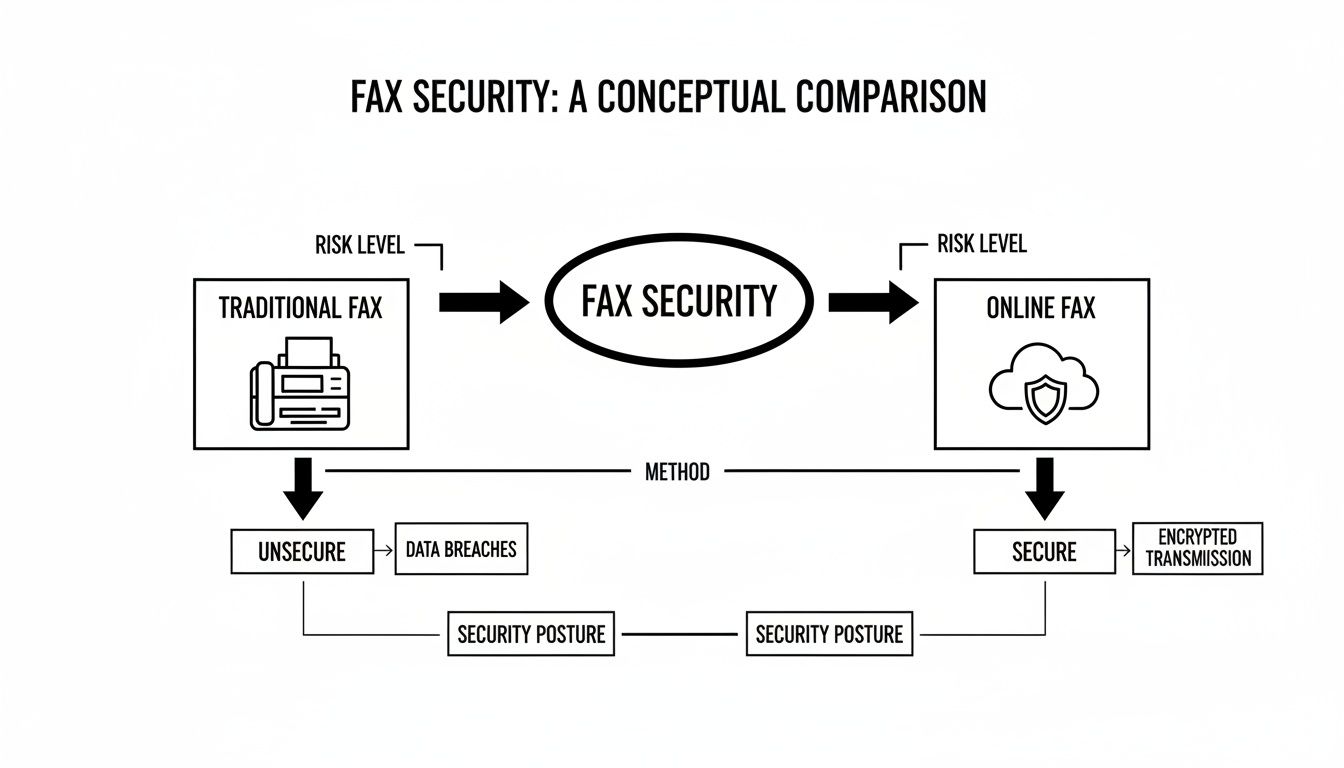
    Diagram comparing traditional fax and online fax security, highlighting risk levels, methods, and security postures.

    As you can see, it’s a stark contrast. The old way is physical and exposed, while the new way is digital and protected. They both get a document from A to B, but their security approaches are from different centuries. If you're weighing your options, our deep dive on whether fax is more secure than email offers even more context on these critical differences.

    To make it even clearer, here's a quick side-by-side comparison.

    Traditional Fax vs Online Fax Security at a Glance

    This table breaks down the fundamental differences in how each method handles security, from transmission to storage.

    Security Feature Traditional Fax Machine Online Fax Service
    Transmission Security Sent over analog phone lines; generally unencrypted and interceptable with the right tools. Sent over the internet using TLS 1.2+ encryption, protecting data in transit.
    Storage Security Printed documents are physically stored; vulnerable to theft, loss, or unauthorized viewing. Faxes are stored in encrypted, cloud-based servers with strict access controls.
    Access Control None. Anyone near the machine can access printed faxes. Requires user authentication (username/password) to view, send, or manage faxes.
    Audit Trails Limited to basic transmission logs (date, time, number). No record of who viewed the physical copy. Provides detailed, immutable logs of all user activity, crucial for compliance.
    Physical Security Risk High. Faxes can be misdialed, left on the tray, or copied without permission. Minimal. The entire process is digital, eliminating physical document risks.
    Compliance Readiness Difficult to make compliant with regulations like HIPAA without strict physical protocols. Designed with compliance in mind, offering features like BAA support for HIPAA.

    Looking at them head-to-head, it's easy to see why online services are the clear winner for any organization that takes data security seriously. The built-in encryption, access controls, and audit trails address the fundamental weaknesses of traditional faxing.

    Why Faxing Still Thrives in a Digital World

    In a world full of instant messages and emails, it’s easy to think of the fax machine as a relic. Yet, faxing isn’t just surviving; it’s thriving, especially in sectors where security and legal validity are non-negotiable. So, why do so many critical industries still rely on this technology?

    It really comes down to how the information travels. Let’s look at the classic comparison between a fax and an email to illustrate why certain industries have been slow to abandon this trusted technology.
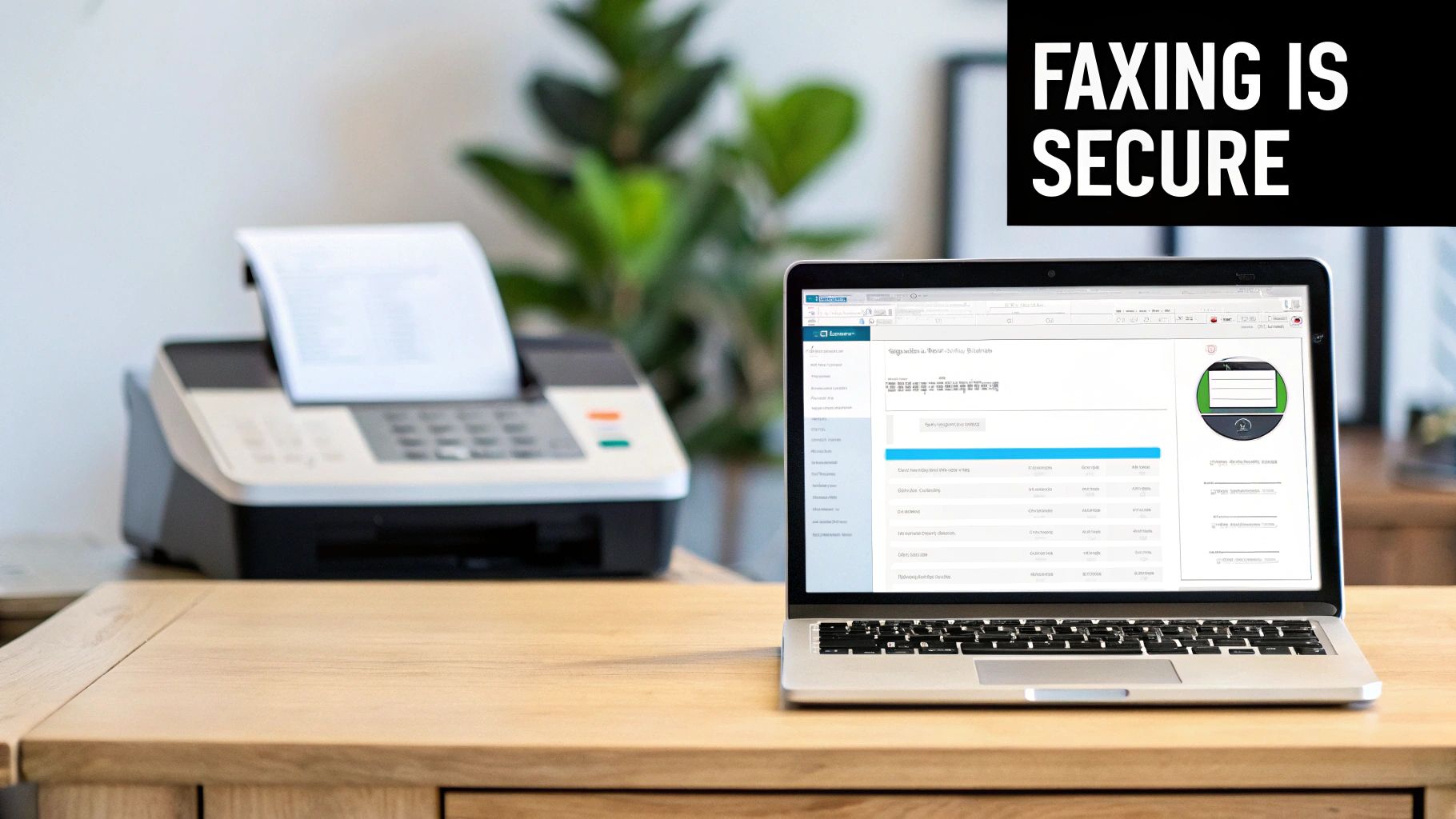
    Office desk with a classic fax machine and a laptop showing a secure online interface.

    The Sealed Letter Versus the Postcard

    Sending a traditional fax is like sending a sealed letter through a dedicated courier. The message travels directly from your machine to the recipient's machine over a point-to-point telephone connection. This direct line is inherently private and difficult to intercept without sophisticated, targeted effort.

    Email, by contrast, is more like sending a postcard. Your message hops between multiple servers on its journey, and at each stop, it could potentially be read or copied. While modern email has security features, its fundamental architecture involves more points of potential exposure than a direct fax transmission. This core difference is a major reason why industries handling sensitive data continue to rely on faxing.

    "For all the talk about email and messaging apps, faxing continues to be the trusted way to send documents when compliance, legal recognition, and reliability matter most."

    This principle of a direct, less exposed transmission channel has cemented faxing's role in sectors where data privacy is not just a best practice but a legal requirement.

    A Deliberate Choice for Critical Industries

    The persistence of faxing isn't due to a lack of innovation; it's a deliberate strategic choice. Industries like healthcare, legal services, and government agencies operate under strict regulatory frameworks that demand verifiable proof of transmission and receipt for sensitive documents like patient records or legal contracts.

    Faxing's long-standing legal acceptance as a method of delivering official documents gives it a significant advantage. This legacy is reinforced by staggering usage numbers. In fact, industry data showed that over 17 billion individual fax documents were sent in 2019, with the U.S. healthcare sector alone responsible for more than 9 billion of them. You can explore more about faxing's continued relevance and market growth in this industry analysis.

    This massive volume proves that for many organizations, the security and reliability offered by faxing are indispensable. While traditional machines have their flaws, modern online services like SendItFax have evolved to offer the best of both worlds—the directness of a fax with the powerful encryption and audit trails of digital technology.

    From Analog Risk to Digital Protection

    Fax security isn't what it used to be. The conversation has shifted dramatically, moving away from the physical risks of old-school fax machines to the sophisticated defenses of modern online services. To really grasp why online faxing is so secure today, you have to understand this evolution.

    Think back to the traditional office fax machine. Its security was purely physical. A document zipped across a dedicated phone line, which was a decent point-to-point connection. But the real vulnerability was what happened when that piece of paper printed out. Anyone walking by the machine could see it, pick it up, or even lose it. That "last-mile" problem was the Achilles' heel of analog faxing.

    The Move to a Digital Fortress

    Online faxing tackles these old-school problems head-on by turning the entire process into a secure digital workflow. Your document isn't a piece of paper anymore; it’s an encrypted data file, locked down at every step.

    This simple change eliminates the most common physical security headaches. There are no more sensitive documents sitting out in the open, no chance of a fax getting lost in a paper shuffle, and no need for physical file cabinets that could be breached. Everything happens inside a secure digital space that only authorized people can access.

    How Modern Fax Encryption Actually Works

    So, what’s happening behind the scenes? Online fax services use layers of powerful encryption to shield your information. It’s not just one thing; it's a system designed to protect your documents from start to finish.

    Let's break it down with an analogy. Imagine you're sending a top-secret contract to a partner across town.

    • Transport Layer Security (TLS): This is your digital armored truck. TLS creates a secure, encrypted tunnel for your fax to travel through. If anyone tries to intercept it along the way, all they’ll see is garbled, unreadable code. It keeps your data safe while it's in transit.
    • AES-256 Encryption: Once the armored truck arrives, the contract is stored in a military-grade digital vault. That vault is AES-256 (Advanced Encryption Standard). This powerful algorithm scrambles your fax data while it's at rest, making it completely useless to anyone who doesn't have the specific key to unlock it.

    These two technologies are the cornerstone of end-to-end fax protection. Top-tier services use 256-bit AES for all transmissions, while protocols like TLS (and its predecessor, SSL) create a secure channel and verify the identity of both sender and receiver. When you layer on compliance with regulations like HIPAA, it's clear that faxing has become an incredibly secure way to communicate. As detailed on westfax.com, cloud-based protection has been a game-changer for fax security.

    This journey from vulnerable paper to encrypted data is precisely why the answer to "is faxing secure?" has changed so profoundly. If you want to dive even deeper, check out our comprehensive guide on the overall security of fax.

    How Online Faxing Helps You Nail Compliance

    Real security isn't just about having strong technology; it's about playing by the rules. For anyone in healthcare, finance, or legal fields, meeting strict compliance standards isn't just a good idea—it's the law. This is where modern online faxing really proves its worth, offering the specific tools needed to satisfy some of the most demanding data protection regulations out there.

    These rules require more than just keeping data under lock and key. You have to be able to prove you’re actively protecting information every step of the way. That means keeping meticulous records, tightly controlling who sees what, and making sure every transmission is secure from end to end.
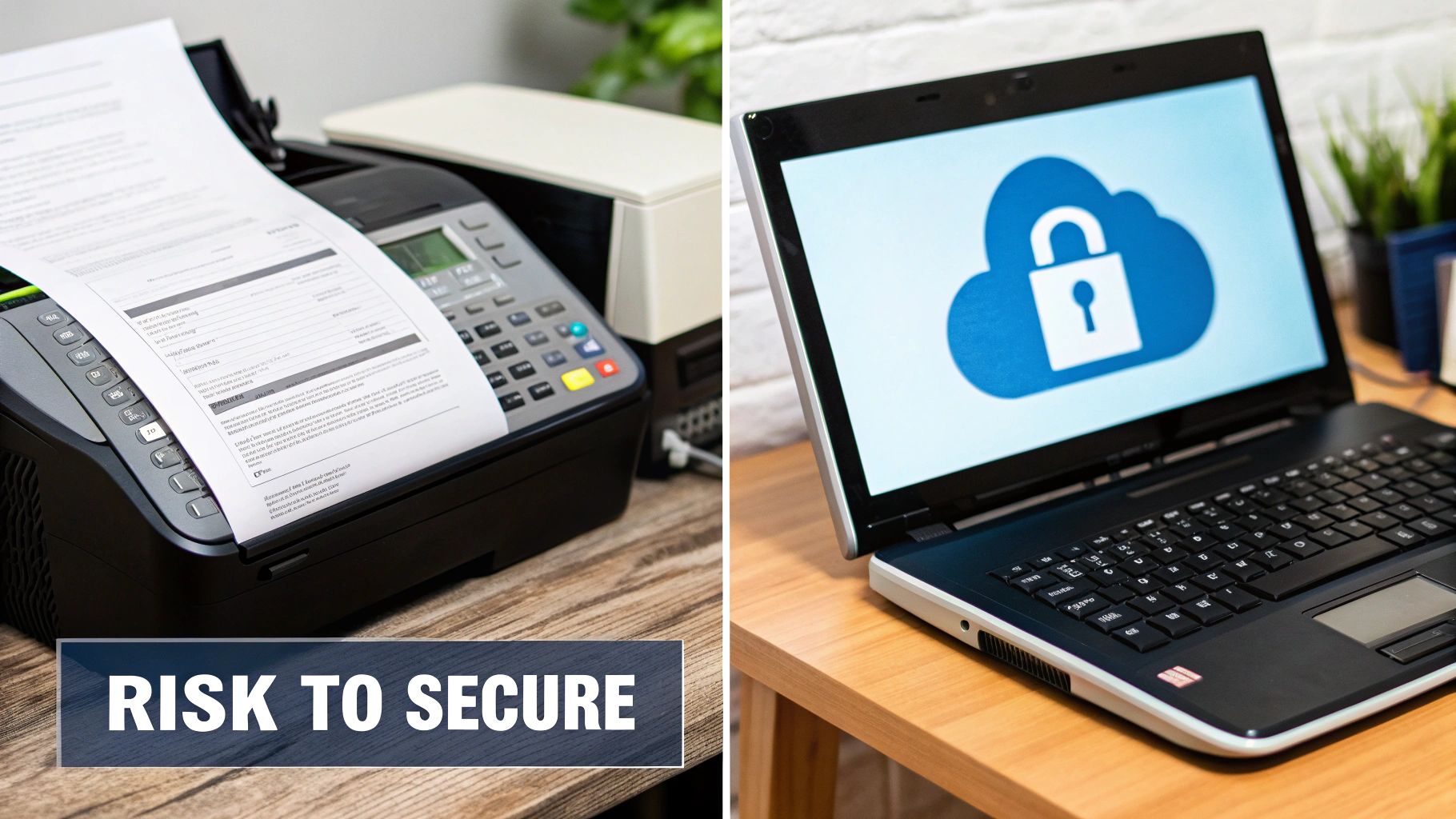
    Split image showing a fax machine with paper and a laptop displaying a cloud security icon, with 'RISK TO SECURE' text.

    From Legal Jargon to Practical Features

    Regulations like the Health Insurance Portability and Accountability Act (HIPAA) in the U.S. and Canada's Personal Information Protection and Electronic Documents Act (PIPEDA) set a high bar for handling sensitive data. Online fax services are built from the ground up to help businesses clear these hurdles with features designed for compliance.

    Take HIPAA, for instance. It dictates everything about how Protected Health Information (PHI) is managed. A single slip-up can result in massive fines, so compliance is a non-negotiable for any medical practice or insurer. Faxing has always been a go-to for sending PHI, and online services just make it that much more secure by adding critical digital safeguards.

    Essentially, a secure online fax platform turns compliance from a manual, anxiety-inducing chore into an automated and trackable process.

    For all the talk about email and messaging apps, faxing continues to be the trusted way to send documents when compliance, legal recognition, and reliability matter most.

    Instead of relying on a physical logbook next to the machine and just hoping a sensitive document wasn't left on the tray, you get a digital dashboard for all your communications. That shift is absolutely crucial when it's time to prove your due diligence to an auditor.

    The Core Features That Make Compliance Work

    So, how exactly does an online fax service help you meet these standards? It all boils down to a handful of core features that directly answer what regulators demand: security, accountability, and control.

    • Immutable Audit Trails: Every single action is logged automatically. You get a concrete record of who sent a fax, who it went to, when they opened it, and from where. This creates the kind of digital paper trail that is gold during a compliance audit.
    • Controlled User Access: Unlike the communal office fax machine, online platforms let you set specific permissions for each user. This guarantees that only authorized staff can ever access sensitive documents—a cornerstone of both HIPAA and PIPEDA.
    • Encrypted Storage: Faxes aren't just protected in transit. They're stored using AES-256 encryption, the same heavy-duty standard trusted by banks and government agencies to keep data safe while it's "at rest."
    • Verifiable Delivery Confirmations: You receive a detailed, unambiguous confirmation that your fax was delivered successfully. This receipt acts as legally recognized proof of transmission, which is vital for contracts, medical records, and official notices.

    These features don't work in isolation. They create a secure, closed-loop system where sending sensitive information is not only safe but also fully documented, turning a major compliance headache into a straightforward part of doing business.

    How to Choose a Genuinely Secure Online Fax Service

    Not all online fax services are built the same, and when sensitive documents are on the line, the difference really matters. Picking the right provider means you have to look past the flashy marketing and low price points to see if they have the technical backbone to truly protect your information.

    Think of it like choosing a bank for your money. You wouldn't just go with the one offering a free toaster; you'd look for FDIC insurance, secure vaults, and a history of reliability. The same logic applies here. A provider's dedication to security should be obvious, transparent, and backed by features that are non-negotiable.

    Essential Security Features Checklist for Online Faxing

    When you're evaluating different services, it's easy to get lost in feature lists. This checklist cuts through the noise and helps you focus on the security measures that are absolutely critical. Use it to grade any provider you're considering.

    Feature What to Look For Why It Matters for Security
    End-to-End Encryption Look for mentions of TLS (for faxes in transit) and AES-256 bit encryption (for stored files). This is the bedrock of digital security. It scrambles your data, making it unreadable to anyone who might intercept it, both as it travels online and while it sits on a server.
    Secure Data Storage The provider should use data centers with strict physical security (guards, locked cages), redundancy, and clear disaster recovery plans. Your faxes don't just disappear after they're sent. They're stored. You need to know that the physical location is as secure as the digital one.
    Multi-Factor Authentication (MFA) Also known as Two-Factor Authentication (2FA), this requires a second verification step, like a code sent to your phone, to log in. Passwords can be stolen, but it's much harder for a thief to steal your password and your phone. MFA is one of the single most effective ways to prevent account takeovers.
    Detailed Audit Trails The service must provide a complete, unchangeable log of all fax activity—who sent what, when, and whether it was successfully delivered. For any kind of business or legal record-keeping, this is non-negotiable. It provides a verifiable history for accountability and proves compliance.
    Compliance Certifications If you're in healthcare, law, or finance, look for explicit HIPAA compliance or other certifications like SOC 2. These aren't just buzzwords. They mean the provider has passed rigorous, independent audits that validate their security controls against industry standards.

    A service that can't tick all these boxes might be fine for sending a dinner menu, but it’s a serious gamble for anything confidential.

    A truly secure online fax service doesn't just promise security; it proves it with transparent, verifiable features. Your data's safety depends on choosing a partner who treats protection as a core function, not an afterthought.

    Making Your Final Call

    Once you've vetted the technical side of things, it's time to consider the human element. Is the platform easy to use? A confusing interface can lead to user errors, which can be just as dangerous as a technical vulnerability.

    Take some time to read reviews from real users and compare different platforms. A service might look great on paper, but a little research can reveal hidden frustrations or strengths. To get a jump start, you can see how different online fax services stack up in our comparison guide.

    Ultimately, a genuinely secure service is built on a foundation of strong encryption, strict access controls, and transparent compliance. By holding providers to that standard, you can choose a service that protects your information with the seriousness it deserves.

    Simple Best Practices for Sending Secure Faxes
    Person holding a tablet displaying secure fax icons including a shield, lock, and documents, with a 'CHOOSE SECURE FAX' banner.

    Even the most advanced security features can't protect against simple human error. While a secure online fax service does the heavy lifting, your own habits are what truly complete the security picture. It's a partnership, really.

    Think of it this way: you can have the best alarm system in the world, but it doesn't do much good if you forget to lock the door. Taking a few extra seconds to follow these best practices will ensure your sensitive documents are protected from start to finish.

    Always Use a Cover Sheet

    A fax cover sheet is more than just a formality—it’s your first line of defense. It acts like the envelope on a physical letter, making sure your document gets to the right person and telling anyone else that its contents are private.

    Every cover sheet should clearly state a few key things:

    • Your contact information: Your name, company, and number.
    • The recipient's details: The specific person and department it's intended for.
    • A confidentiality notice: This is crucial. A simple disclaimer flagging the document as confidential goes a long way, especially for legal or medical information.

    This one simple step prevents your fax from sitting unattended on a shared machine or being read by the wrong person. It's an easy win for security.

    The most common security lapses are often the result of simple human error. Double-checking details before you hit 'send' is one of the most effective security measures you can take.

    Verify and Confirm Every Transmission

    A single wrong digit can send your private information to a complete stranger. It’s a costly mistake that’s surprisingly easy to make. Before you send anything, always double-check the recipient's fax number.

    After you hit send, don’t just walk away. Check the transmission report. A good service like SendItFax will give you a clear confirmation that your document arrived safely. This isn't just for peace of mind; it's your proof of delivery.

    If a fax fails, find out why before you try again. This kind of hands-on approach builds a truly secure and accountable process for all your communications.

    Got Questions About Fax Security? Let's Get Them Answered.

    If you're still on the fence about fax security, you're not alone. Let's tackle some of the most common questions people have to clear up any confusion and show you how modern faxing really works to protect your information.

    Is Online Faxing Actually More Secure Than Email?

    In a word, yes. The difference is night and day when you look at how they operate.

    Think of a standard email like a postcard. It gets passed through various public servers on its journey, and at any of those stops, someone could potentially peek at its contents. A secure online fax, on the other hand, is more like an armored car driving through a private, encrypted tunnel. It goes straight from you to the recipient, locked down the entire way.

    This direct, end-to-end encryption shuts down the vulnerabilities that leave standard email wide open to attack.

    Do I Really Need a HIPAA-Compliant Service for My Own Personal Faxes?

    Strictly speaking, you might not be legally required to, but it's an incredibly smart move anytime health information is involved. The HIPAA rules are aimed at "covered entities" like your doctor's office or insurance company.

    But here’s the thing: choosing a HIPAA-compliant service means your Protected Health Information (PHI) gets the VIP treatment with top-tier encryption and detailed audit logs. It's the gold standard for protecting sensitive medical data, whether you're a hospital or just a patient.

    Using a HIPAA-compliant service for all medical documents is the safest way to ensure your private health information is protected by enterprise-grade security standards, giving you complete peace of mind.

    How Can I Actually Prove a Fax Was Sent Securely?

    This is where online faxing leaves the old clunky machines in the dust. Forget about those flimsy paper confirmation slips that get lost or fade over time. A secure online fax service gives you a rock-solid, digital audit trail for every single document.

    This isn't just a simple receipt; it's a detailed, legally defensible record that typically includes:

    • An exact timestamp of when the fax was sent.
    • Clear confirmation that it was successfully delivered.
    • A permanent, unchangeable log of the entire transaction.

    This verifiable proof is absolutely critical when you're dealing with legal contracts, official records, or anything else where you can't afford to have doubts.


    Ready to send documents with confidence? SendItFax offers a simple, secure, and reliable way to send faxes right from your browser, no account needed. Try SendItFax today for fast and protected document delivery.

  • Security of Fax: How to Protect Your Documents and Stay Compliant

    Security of Fax: How to Protect Your Documents and Stay Compliant

    Even with all the new ways we have to send messages, fax security is still a huge deal, especially for industries that have to follow strict privacy rules. Old-school faxing creates a direct line between two machines, which cleverly sidesteps a lot of the security nightmares we see on the internet. It's a surprisingly tough and reliable way to send sensitive paperwork.

    Why the Security of Fax Still Matters

    An office desk with a fax machine, papers, and text 'Fax Security Matters' and 'Confidential'.

    It’s easy to think of faxing as a relic in our digital world. But the reason it’s still around in critical fields like healthcare, law, and finance isn't about being old-fashioned. It’s all about a unique security model that’s worlds apart from modern tools like email. Grasping this difference is the first step to understanding why professionals who handle confidential information still prioritize the security of fax.

    The real strength of a traditional fax is how it sends information. It travels over the Public Switched Telephone Network (PSTN), essentially creating a private, temporary phone call just for your document. This simple, direct route avoids the complex, multi-server journey an email takes, drastically shrinking the opportunity for cybercriminals to jump in.

    The Email Vulnerability Gap

    Email is incredibly convenient, but it also comes with a long list of security headaches that faxing just doesn't have. When you hit "send" on an email, it gets copied and passed through several servers on its way to the recipient. Each one of those stops is a potential weak point for an interception.

    And that’s before you even consider the common threats that target email every single day:

    • Phishing Attacks: Crafty emails that trick people into giving away logins or personal data.
    • Server Breaches: Hackers breaking into an entire email server, getting their hands on thousands of accounts at once.
    • Malware and Ransomware: Nasty attachments or links that can infect a whole network, leading to stolen data or costly shutdowns.

    This fundamental difference in risk is a major reason why so many organizations still put their trust in fax machines. If you want to dive deeper into this comparison, our guide on whether fax is more secure than email breaks it all down.

    A Legacy of Trust in Regulated Fields

    The proof is in the numbers. In 2019 alone, businesses and individuals sent over 17 billion individual documents by fax across the globe. The U.S. healthcare industry was a massive part of that, accounting for more than 9 billion of those faxes.

    This isn't just a habit; it's a strategic choice. That direct, peer-to-peer connection is a proven way to avoid internet-based risks like the mass hacking events that plague email systems.

    This isn't about resisting change. It's about smart risk management. For many, a direct, verifiable transmission method is simply a safer bet than the convenience of less secure digital options—especially when a data breach could lead to serious legal and financial trouble.

    The Hidden Dangers of Traditional Fax Machines

    It’s a common misconception that traditional faxing is inherently secure. While the direct, point-to-point transmission over a phone line has some built-in privacy, the fax machine itself is often a gaping security hole. Think of it as an open mailbox plopped down in the middle of a busy office. The letter might have arrived safely, but its confidentiality is gone the second it lands in the tray, exposed for anyone to see, copy, or lose.

    This is the central problem with analog faxing: a complete lack of endpoint security. A document with sensitive patient data, confidential legal plans, or private financial records can sit unattended for hours. This creates a huge risk for an internal data breach, where unauthorized employees or even office visitors can access information they have no business seeing.

    The Problem of Physical Exposure

    The most glaring threat to fax security is the physical piece of paper itself. Unlike a digital file that can be locked behind a password, a printed fax has zero built-in access controls. It depends entirely on someone being there to grab it immediately.

    Common security failures with physical faxes include:

    • Unattended Documents: Faxes sent after hours or during a lunch rush can sit on the output tray for ages, visible to anyone walking by.
    • Accidental Misappropriation: In a busy office, it’s all too easy for someone to mistakenly pick up a sensitive document along with their own stack of papers.
    • Improper Disposal: Faxes are often just tossed into a trash or recycling bin without being shredded, making them an easy target for dumpster diving.

    These aren't just theoretical worries. One study revealed that 15% of healthcare data breaches were a direct result of improperly disposing of physical records. A single forgotten fax page can be enough to trigger major compliance violations and steep financial penalties.

    Imagine a law firm receiving a critical piece of evidence for a high-profile case. If that fax is left on the machine, a member of the cleaning crew, a visiting client for another case, or even an employee from a rival firm in the same building could potentially see it. The chain of custody is broken, and confidentiality is compromised instantly.

    No Digital Footprints

    Beyond the physical risks, old-school fax machines have a critical accountability problem. They're analog devices struggling to keep up in a digital world, and that creates a massive traceability gap. When you send or receive a fax, the machine might spit out a little confirmation slip, but that flimsy piece of paper is a poor substitute for a real audit trail.

    There’s no digital record proving who sent the document, who actually picked it up from the machine, or what happened to it afterward. This makes it nearly impossible to investigate a potential data leak or prove you're following regulations like HIPAA, which demand strict tracking of protected health information (PHI). Without an electronic log, you can't answer the most basic questions about a document's journey.

    The Risk of Tapped Phone Lines

    Finally, while the Public Switched Telephone Network (PSTN) is generally reliable, it’s not invincible. The analog signal carrying your fax data can be "tapped" by a determined attacker who gains physical access to the phone line. While it’s less common than a digital hack, it remains a real threat, especially for high-value targets.

    The fax signal itself isn't encrypted. Anyone who manages to intercept the transmission can reconstruct the document. When you combine this vulnerability with the lack of audit trails and the high risk of physical exposure, the conclusion is clear: traditional fax machines are a weak link in any modern security plan. They simply can’t offer the robust, verifiable protection needed for today’s sensitive information.

    How Online Faxing Changed the Security Game

    When faxing moved from the whirring machine in the corner to the cloud, it wasn't just about convenience. It was a complete overhaul of document security. Think of it this way: traditional faxing was like sending a postcard, readable by anyone who happened to walk by the machine. Online faxing is like sending that same information in a locked, armored briefcase.

    Instead of a physical piece of paper sitting out in the open, your sensitive document becomes a secure digital file. This simple change allows for layers of protection that were never possible with the old analog hardware. Let's dig into how these digital safeguards work together to create a fortress for your information.

    Encryption: A Digital Shield for Your Documents

    The biggest leap forward is encryption. It's the core technology that scrambles your data, making it completely unreadable to anyone who isn't supposed to see it. Online fax services apply this powerful protection at two crucial points in your document's journey.

    First, there's encryption in transit. This protects your file as it travels from your device to the online fax service, and then onward to the recipient. This is typically handled by Transport Layer Security (TLS), the very same standard that protects your information during online banking or when you make a purchase from an e-commerce site.

    Think of TLS like an armored car service for your documents. It seals your file in a locked box (encryption) and transports it along a private, monitored route, ensuring no one can intercept it or peek inside along the way.

    Second is encryption at rest. After your faxes are sent or received, they don't just sit on a server unprotected. They are stored in an encrypted state, usually with 256-bit Advanced Encryption Standard (AES), which is considered military-grade. This means that even if a server were somehow physically compromised, the files on it would be nothing more than garbled, useless data.

    An illustration of traditional fax dangers, including exposed documents, no audit trail, and line tapping.

    As you can see, the old way of faxing left documents exposed, offered no real proof of delivery, and was even vulnerable to physical line tapping—all problems solved by modern digital methods.

    Creating a Clear, Verifiable Paper Trail

    Another game-changer is the automatic creation of detailed audit trails. Gone are the days of relying on a flimsy, often unreadable confirmation slip from a physical machine. Online faxing gives you a permanent, detailed electronic record for every single transmission.

    These digital logs are essential for accountability and compliance, capturing key details like:

    • Sender and recipient info: Exactly who sent what and to which number.
    • Detailed timestamps: The precise date and time a fax was sent, received, and completed.
    • Delivery status: A clear confirmation of success or failure.
    • Document details: The number of pages sent and other metadata.

    This digital footprint is non-negotiable for meeting today’s regulatory standards. While the fax machines of the 1980s had no real tracking, modern laws like HIPAA demand verifiable proof of transmission and robust security measures. Online faxing delivers on this by design.

    To give you a clearer picture, here’s a quick comparison of the old vs. new.

    Traditional Fax vs Online Fax Security Features

    Security Feature Traditional Fax Machine Modern Online Fax Service
    Transmission Security Unencrypted; vulnerable to line tapping. TLS encryption protects data in transit.
    Storage Security None. Printed documents are left exposed. AES 256-bit encryption protects data at rest.
    Access Control Open access; anyone near the machine can view. Password-protected portals and secure email delivery.
    Audit Trails Basic, often unreliable confirmation slips. Detailed, permanent digital logs for compliance.
    Document Archiving Requires manual filing; prone to loss or theft. Secure, centralized cloud storage.

    The difference is stark. Modern services build security into every step of the process, a fundamental shift from the inherent risks of analog technology.

    You Control Access and Storage

    Ultimately, online faxing puts you back in the driver's seat. Instead of faxes piling up on a shared office machine, they arrive in a secure, password-protected online portal or directly to a designated email inbox. This simple change completely eliminates the risk of a confidential document being picked up by the wrong person. Our guide on the advantages of cloud-based faxing dives deeper into this benefit.

    Beyond that, these platforms provide secure, centralized cloud storage for all your sent and received faxes. This not only creates an organized, searchable archive but also ensures your documents are protected by the provider's enterprise-grade security infrastructure. This powerful trio—encryption, audit trails, and access controls—transforms faxing into a truly modern and secure communication tool.

    Navigating Compliance With Secure Faxing

    For anyone handling sensitive information, sending a document securely isn't just a good idea—it's often the law. In fields like healthcare, finance, and legal services, strict regulations are in place to protect confidential data, making compliance a cornerstone of secure fax communication.

    Think of these regulations not as suggestions, but as legally binding rules of the road. Getting it wrong can lead to staggering fines, legal battles, and a loss of trust that can be nearly impossible to win back.

    Understanding Key Regulatory Frameworks

    While dozens of regulations touch on data privacy, a few major ones really highlight why secure, modern faxing is so important. Each has its own specific demands for handling information, and today's online fax services are built from the ground up to meet them.

    • HIPAA (Health Insurance Portability and Accountability Act): This is the big one for patient privacy in the U.S. HIPAA demands that healthcare providers and their partners put serious safeguards in place to protect electronic Protected Health Information (ePHI).
    • SOX (Sarbanes-Oxley Act): Aimed squarely at the financial world, SOX requires public companies to keep meticulous, verifiable records of their financial dealings. That means ensuring the documents they send and receive can't be tampered with.
    • GLBA (Gramm-Leach-Bliley Act): This law forces financial institutions to be transparent about how they protect and share customer information, which naturally extends to the communication methods they use.

    What do all these laws have in common? They all demand that data is shielded from prying eyes, that its journey can be tracked, and that access is tightly controlled. Old-school fax machines just weren't built for that, but online faxing gives you the tools you need.

    The real heart of these regulations is accountability. They force organizations to prove they’ve taken every reasonable step to lock down sensitive data. A flimsy confirmation sheet from a thermal-paper fax machine just doesn't cut it as proof, but a detailed digital audit log absolutely does.

    The Non-Negotiable Features for Compliance

    To stay on the right side of the law, a secure fax solution needs to do more than just send a file from point A to point B. It needs a specific toolkit that creates a defensible, auditable security process. Without these features, you’re taking a huge risk.

    Three things are absolutely essential:

    1. Verifiable Audit Trails: When regulators come knocking, you need to show them a clear, unchangeable history of a document's life. Who sent it? Who got it? When did it arrive? Was the transmission successful? This digital paper trail is your best evidence of compliance.
    2. Encrypted Storage: Data isn't only vulnerable when it's in transit. Rules like HIPAA also require data "at rest" to be locked down. Storing faxes on a server protected with AES 256-bit encryption means that even if someone managed to breach the server, the files themselves would be unreadable gibberish.
    3. Business Associate Agreements (BAAs): If you operate under HIPAA, this is a must. A BAA is a formal contract between a healthcare organization and a service provider (like an online fax company) that will handle ePHI. It legally binds the provider to uphold the same strict HIPAA standards, sharing the responsibility for keeping patient data safe.

    Picking a service with these features is your first and most important step toward a compliant workflow. Our comprehensive comparison of online fax services is a great place to start looking for providers who check all these critical security and legal boxes.

    By making sure your faxing practices meet these regulatory demands, you're doing more than just sending documents. You're operating a secure, accountable, and legally sound communication channel that protects your clients, your patients, and your entire organization.

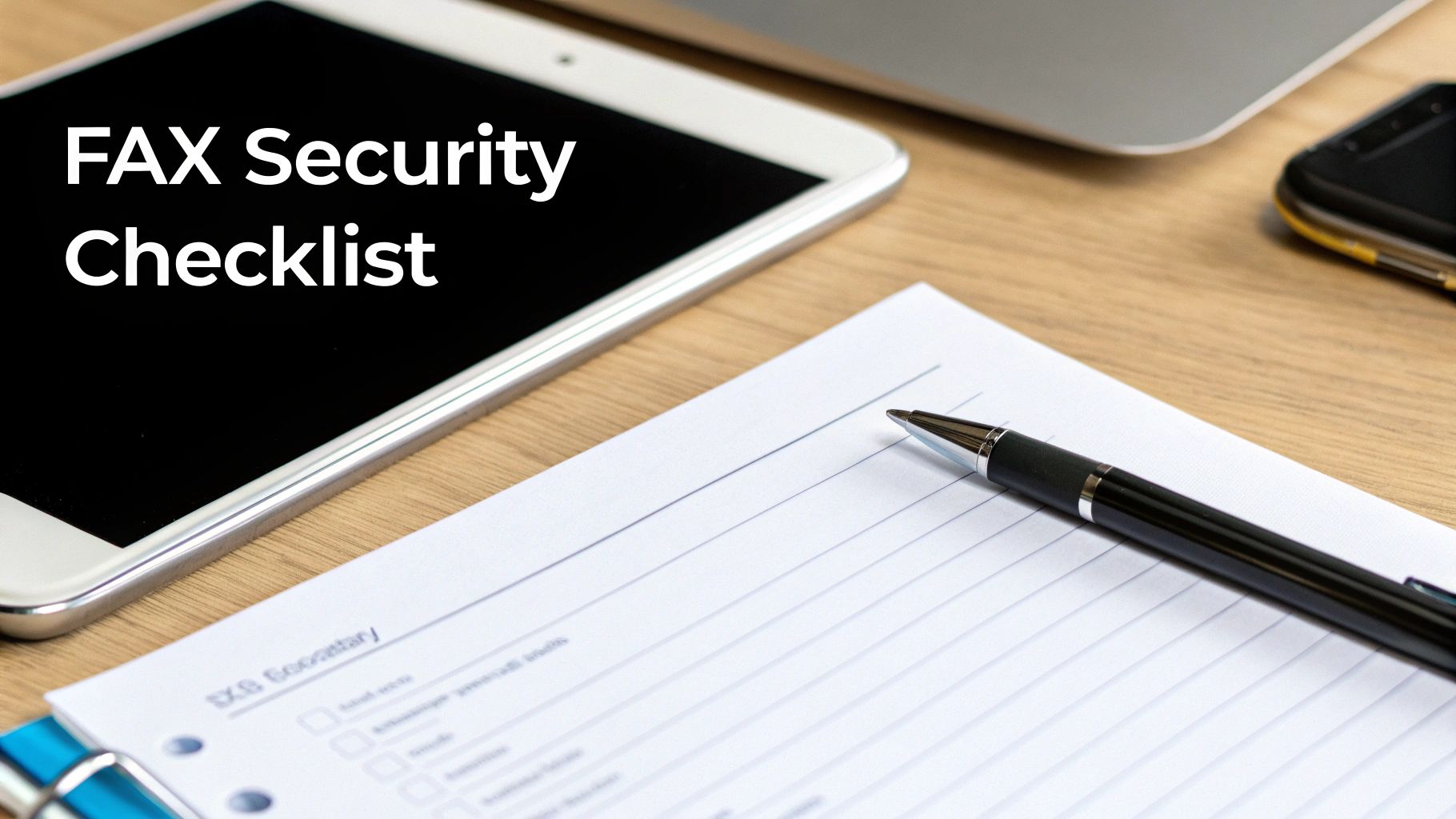
    Your Actionable Fax Security Checklist

    A tablet displaying 'FAX Security Checklist' with a pen and paper on a wooden office desk.

    Knowing the theory behind fax security is great, but putting it into practice is what actually keeps your information safe. This is a no-nonsense checklist with simple, powerful steps you can take to lock down every document you send.

    These tips will make an immediate difference, whether you're just sending a one-off form or you're part of a business that handles sensitive faxes all day long.

    Foundational Steps for Every User

    Before you hit "send," a few quick checks can sidestep the most common security blunders. These are good habits for everyone, no matter how you're sending your fax.

    • Double-Check the Recipient's Number: This is, without a doubt, the most important step. One wrong digit, and your private information ends up in the hands of a total stranger. Always confirm the number directly with the recipient, especially the first time you fax them.

    • Avoid Public Wi-Fi for Online Faxing: If you're using a service like SendItFax, you need to think about it like you would online banking. Public Wi-Fi at a coffee shop or airport is notoriously insecure, making it a prime spot for snoops to intercept your data. Only fax from a trusted, password-protected network, like your home or office.

    • Confirm Receipt: Don't just fire off a fax and hope for the best. A quick follow-up call or email to make sure the right person got it is crucial. This simple action closes the communication loop and confirms your document didn't get lost or land on the wrong desk.

    These basic precautions are your first line of defense. They’re all about preventing the simple human errors that are behind so many data leaks and are fundamental to maintaining the security of fax transmissions.

    Think of it like sending a valuable package. You wouldn't just scribble a partial address and hope it gets there. You'd verify the address, use a courier you trust, and track it until you see a "delivered" confirmation. Your sensitive documents deserve the same care.

    Advanced Checklist for Business Environments

    When your business relies on faxing, especially if you're in a field like healthcare or law, you need to be more systematic about security. The goal is to build a reliable process that minimizes risk and keeps everyone on your team accountable.

    Here are the next-level controls to implement for a truly secure faxing workflow in your organization.

    1. Establish Clear Access Controls: Not everyone in your company needs to see every fax. A good online fax service will let you set up individual user accounts with different permission levels. This means employees only see the faxes relevant to their job, which dramatically shrinks the risk of an internal data breach.

    2. Develop a Document Retention and Destruction Policy: Figure out how long you actually need to keep old faxes for legal or business reasons. Then, create a formal process for getting rid of them securely. Letting sensitive documents pile up in digital storage indefinitely is a disaster waiting to happen. A clear policy ensures data is properly purged when it's no longer needed.

    3. Use Cover Sheets for All Transmissions: A cover sheet isn't just a formality—it's a critical security tool. It needs to have a bold confidentiality notice, a disclaimer, and clear instructions on what to do if someone receives the fax by mistake. This one page can be the difference between a simple mix-up and a serious data leak.

    4. Regularly Review Audit Logs: Get into the habit of checking the detailed audit trails provided by your online fax service. This is where you can spot red flags—like faxes going to strange numbers or someone logging in at 3 AM. Catching this unusual activity early lets you investigate potential security issues before they blow up into a real problem.

    Common Questions About Fax Security

    Even after digging into the details, it's natural to have a few lingering questions. Let's tackle some of the most common ones that come up when people compare old-school faxing with today's technology.

    Is Online Faxing Really More Secure Than Email?

    It’s a fair question, since both use the internet. But for sensitive documents, especially those covered by regulations, secure online faxing has a definite edge. Standard email is a massive target for phishing scams and data breaches, making it a risky bet for confidential information.

    Compliant online fax services are built differently. They use end-to-end encryption and direct, point-to-point delivery. This creates a verifiable audit trail—a crucial requirement for laws like HIPAA—that most standard email systems just don't have.

    Think of it this way: Email is like sending a postcard that hops between different mail carriers. A secure online fax is like using a bonded courier who delivers a locked briefcase directly to the recipient's hand.

    Do I Still Need a Physical Fax Machine to Send a Secure Fax?

    Not at all. In fact, ditching the clunky hardware is one of the biggest security upgrades you can make. Modern online fax platforms let you send and receive faxes securely right from your computer, tablet, or smartphone.

    This shift does more than just save you money on a machine you barely use. It eliminates the single biggest physical security risk of traditional faxing: sensitive documents sitting forgotten on a shared office machine, visible to anyone who walks by.

    How Can I Be Sure My Fax Was Delivered Securely?

    Forget about those flimsy, easy-to-lose paper confirmation sheets. A good online fax service gives you solid digital proof of every transmission. You'll get detailed delivery confirmations and complete logs for every single fax.

    Instead of a piece of paper that could end up anywhere, you have a time-stamped, electronic record. This digital trail is your proof that the document arrived safely, giving you an ironclad audit log for compliance and your own peace of mind.


    Ready to send a document with the security and ease of a modern platform? With SendItFax, you can send your files securely from any web browser, no account required. Try sending your first fax now by visiting senditfax.com.