Tag: digital faxing

  • How to Send a Fax From My Phone The Easy Way

    How to Send a Fax From My Phone The Easy Way

    It's a question I get all the time: "Can I really send a fax from my phone?" The answer is a resounding yes, and you don't even need to download a special app to do it. The simplest, most direct method is using a web-based service like SendItFax right from your phone's browser. You can upload your document, punch in the recipient's number, and hit send in just a couple of minutes.

    This approach is perfect for when you need to get a document out the door without the hassle of creating new accounts or cluttering your phone with another app.

    Why Browser-Based Faxing Is a Game Changer
    A man in a blue shirt sitting in a car, looking at and holding a smartphone, with the text 'FAX FROM PHONE' on the image.

    The image says it all. Modern faxing isn't about being tethered to a machine in a dusty office corner; it’s about sending important documents securely from wherever life takes you. Your office is officially in your pocket.

    Many people still think they need a physical fax machine, but that's a leftover idea from a different era. While the technology has moved on, the fundamental need for secure, legally-binding document transmission hasn't gone anywhere—especially in fields like healthcare, law, and finance. Online fax services neatly bridge that gap, giving you the trusted security of a traditional fax with the convenience you expect today.

    The Power of Simplicity

    The real beauty of using your phone's browser to fax is the immediacy. No digging through an app store, no waiting for downloads, and no creating yet another password you'll have to reset later. It's built for those one-off, "I need this sent now" moments.

    Picture this: you're at a client's site and just got a signature on a critical contract. Instead of hunting for a local print shop to fax it, you can just pull out your phone.

    • Snap a quick, clear photo of the signed document.
    • Use your phone's built-in tools to save it as a PDF.
    • Open your browser, head over to SendItFax, and send it on its way.

    What could have been an hour-long ordeal becomes a simple, two-minute task. That’s the kind of practical efficiency that makes sending a fax from your phone so valuable.

    Faxing Is Far From Obsolete

    Believe it or not, faxing is still a major player. Despite its old-school reputation, the global fax services market was valued at an impressive USD 3.18 billion in 2022. It’s projected to climb to USD 5.96 billion by 2028. This boom is almost entirely fueled by the move to cloud-based faxing that cuts out the need for physical hardware. You can read more about the surprising growth of the fax industry and see for yourself.

    This trend makes one thing clear: people still trust the reliability and legal weight of a faxed document. They just want a better, more modern way to send one. Web-based services deliver exactly that.

    Learning how to send a fax from your phone isn't just a party trick. It's a genuinely useful skill that gives you a secure and immediate way to transmit important documents, whether you're sending a medical form from the car or finalizing a deal from a coffee shop.

    Getting Your Documents Ready to Fax From Your Phone

    Before you can fire off a fax from your phone, you need to make sure your document is in the right shape. Think of it like this: you wouldn't send a letter without putting it in an envelope first. The same logic applies here—your file needs to be properly formatted for a successful trip. Thankfully, getting it ready on your phone is pretty straightforward.

    Most online fax services, including SendItFax, play best with standard file types. For the smoothest experience, you'll want to use PDF, DOC, or DOCX files. Sticking to these common formats is the best way to guarantee your document looks exactly the same on the other end, without any weird formatting glitches.

    From Paper in Hand to a Digital File

    So, what do you do when your document is a physical piece of paper? Maybe it's a signed contract, an invoice, or a medical form. You don’t need a fancy scanner; your phone’s camera is all you need to create a crisp, clear digital version.

    Let's say you're a contractor and you've just gotten a client to sign a work order on-site. You need to get that signed paper back to the office immediately.

    • Find a flat surface with good lighting. A tabletop near a window is perfect. This helps you avoid those annoying shadows that can obscure important details.
    • Open your phone's camera or, even better, a dedicated scanning app like Adobe Scan or the one built into your phone's Notes app.
    • Line up the shot so the entire page is in view, hold steady, and snap the picture.
    • Most scanning apps will automatically convert the image to a PDF. If you're using your camera, just use the "Share" or "Save to Files" option and choose to save it as a PDF.

    In just a minute, that physical contract is now a fax-ready digital file sitting on your phone. For a deeper dive into getting the best possible quality, check out our guide on scanning and faxing best practices.

    My Two Cents: Always, always double-check your scan before you send it. Pinch and zoom to make sure the text isn't blurry and that you didn't accidentally chop off a corner of the page. If the recipient can't read it, the fax is useless. A quick check saves a lot of headaches later.

    A Few Final Formatting Checks

    Once your document is digitized, there are a couple of quick things to keep in mind. Fax technology is old-school—it thinks in black and white. That means some of the things that look great on your screen won't translate well.

    • Go Easy on the Graphics: Complex charts with lots of colors or fancy logos can turn into big, messy black blobs on the receiving end. If a graphic isn't absolutely critical, it's often best to simplify it or leave it out.
    • Keep It High-Contrast: You can't go wrong with classic black text on a white background. Simple, clean fonts like Arial or Times New Roman will always come through clearly.
    • Watch the File Size: Modern fax services are more forgiving than the old machines, but a massive file can still slow things down. Aim to keep your document under 5 MB. This is especially helpful if you're sending from an area with a spotty mobile connection.

    Taking a moment to prep your file properly is the secret to a smooth, error-free fax every time.

    Sending Your First Fax From a Phone Browser

    Alright, you've got your document prepped and ready to go. The next part is surprisingly easy. We're going to use a web-based service like SendItFax right from your phone's browser. The beauty of this is that you don't need to create an account or download anything. The whole thing takes just a couple of minutes.

    Let's break down exactly how it works.
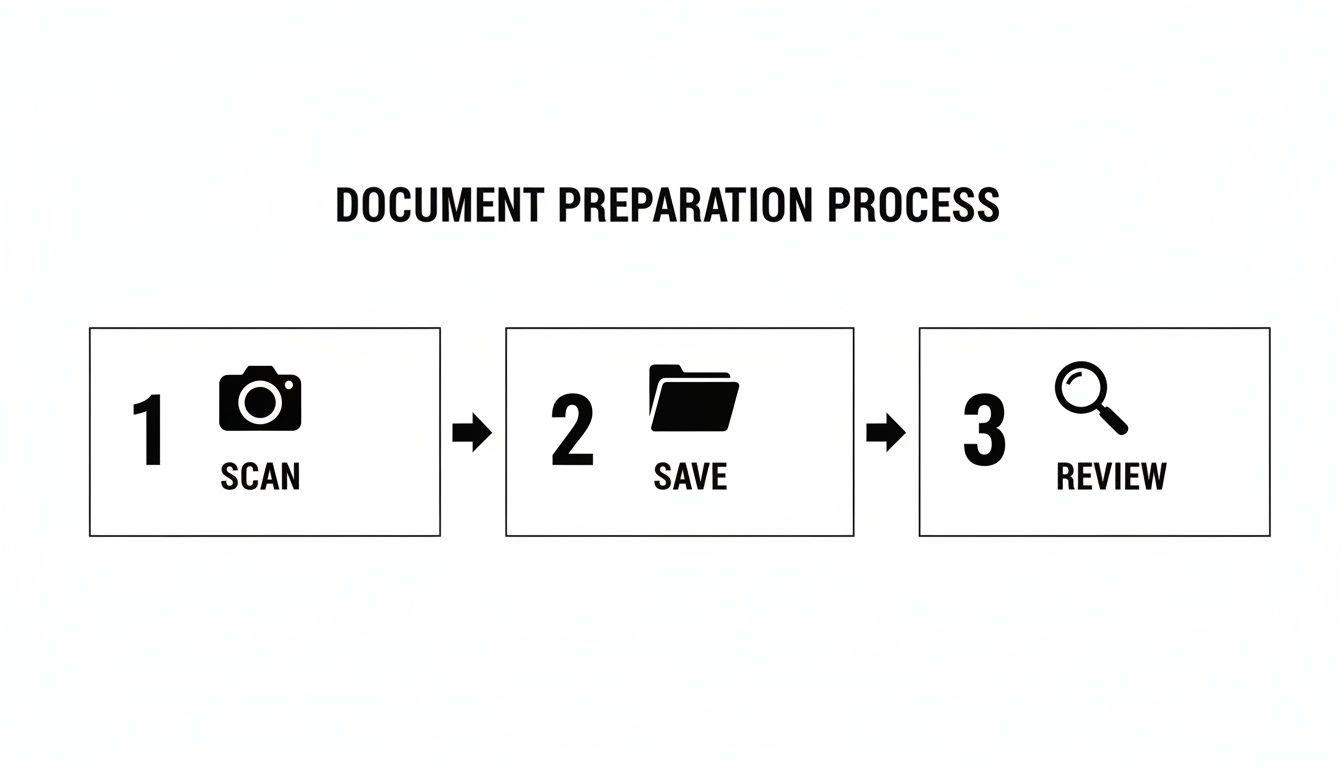
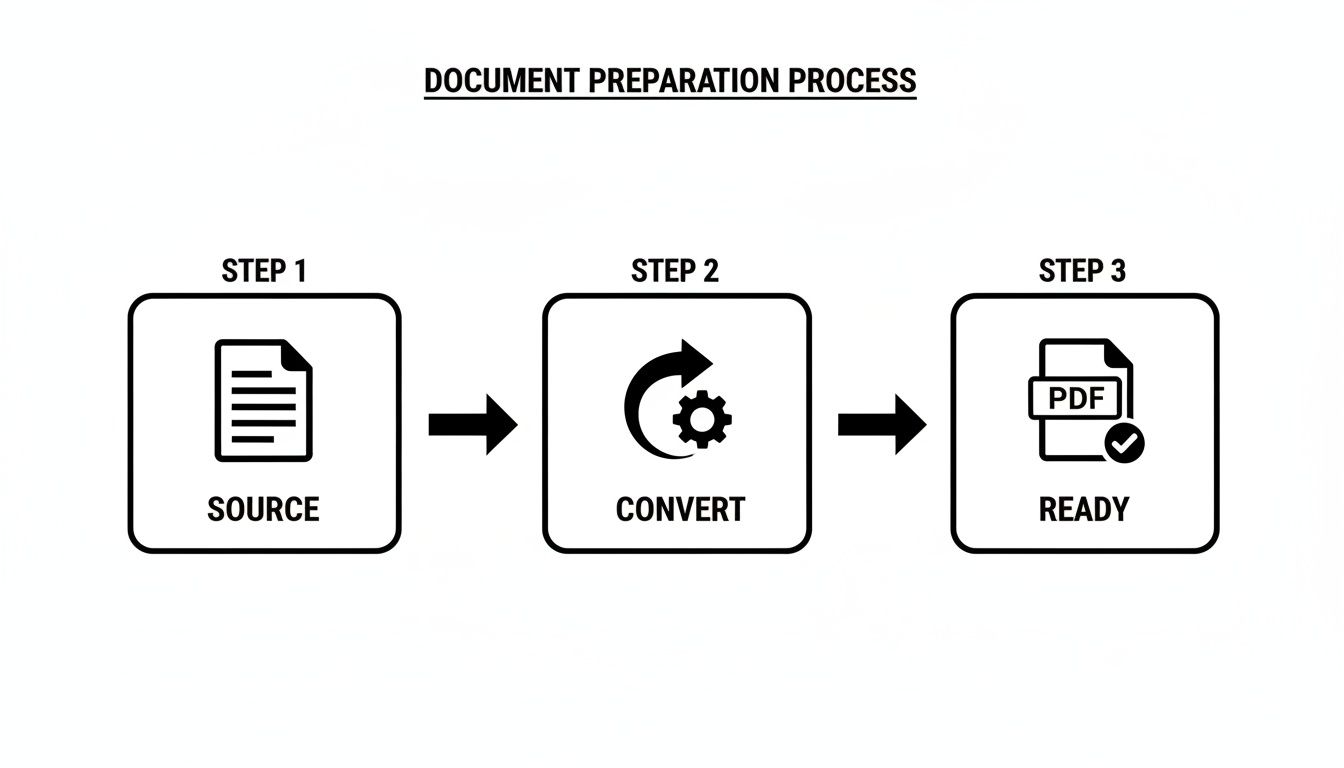
    Document preparation process diagram shows steps: 1 scan, 2 save, and 3 review with icons.

    This little workflow—scan, save, and review—is the foundation. Getting this right beforehand makes the actual sending part a breeze.

    Plugging in the Details

    First things first, you'll see fields for sender and recipient info on the SendItFax homepage. This part is simple but absolutely critical.

    • Your Info: Pop in your name and a good email address. This is non-negotiable, as it’s where your delivery confirmation will land.
    • Recipient Info: Type in their name and the full fax number, area code included. Seriously, double-check the fax number. A single misplaced digit is the number one reason faxes fail to go through. It happens more than you'd think.

    A little habit I've developed over the years is to check the number three times: once as I type it, a second time right after, and one last glance before I hit send. It feels a bit obsessive, but it has saved me from so many headaches and failed delivery notices.

    Attaching Your File and Writing a Cover Note

    Once the contact information is set, it's time to upload your document. Just tap the "Choose File" or "Upload Document" button. This will pull up your phone's file manager, where you can find and select the PDF or DOCX file you prepared earlier. The file name should appear on the screen, letting you know it's locked and loaded.

    Now for the cover page message. Don't skip this! A good cover note isn't just polite; it's professional and gives the person on the other end immediate context.

    Here are a few real-world examples to give you an idea:

    Document Type Sample Cover Page Message
    Invoice "Please find attached invoice #INV-2024-113 for recent services. Payment is due within 30 days. Thank you!"
    Legal Document "CONFIDENTIAL: Attached are the signed contract documents for the Miller account. Please confirm receipt."
    Medical Form "Attached are the completed patient intake forms for John Doe, as requested by Dr. Smith's office."

    A short, clear message makes sure your fax lands in the right hands and gets the attention it needs. If you want to dive deeper into the nuances, we have a complete guide that explains more about how to send an e-fax with proper etiquette.

    The Final Review and Liftoff

    This is the last checkpoint. Take a moment to scan everything on the screen: your email, the recipient's number, the file you attached, and your cover note. If it all looks correct, go ahead and hit that "Send Fax" button.

    From there, the service takes over. It dials up the recipient's fax machine, transmits your document, and then fires off a confirmation receipt directly to your email. That confirmation is your proof of delivery, so hang onto it for your records.

    And that's it. You just sent a fax from your phone without ever needing a clunky old machine.

    Why Online Faxing Is a Secure Choice

    When you're sending sensitive documents—think signed contracts, medical records, or financial statements—security isn't just a nice-to-have; it's everything. This is a huge reason why faxing has stuck around for so long. But how does sending a fax from your phone stack up against a clunky old machine? You might be surprised.

    Reliable online fax services, like SendItFax, don't just send your files over an open line. They use strong encryption to scramble the data from the moment it leaves your device until it reaches its destination. It's a layer of security that traditional fax machines, which operate on standard, often unsecured phone lines, simply can't match.

    Your Data Is Protected in Transit

    Just think about the old way of doing things. A fax arrives and sits on a machine in a shared office space, open for anyone to see. With a modern online service, your document travels directly from your secure device to the recipient's fax machine or a secure digital inbox. This completely sidesteps the physical security risks that have always been a problem with traditional faxing.

    This blend of security and reliability is exactly why so many professionals and businesses still count on fax. A recent IDC report highlighted this, finding that 25% of major organizations stick with fax over email to reduce their risk of data protection violations. On top of that, another 28% prefer fax because it provides a reliable transmission log, which is crucial for compliance in fields like healthcare and law. You can read more about why fax remains a trusted method in business to see just how relevant it is today.

    The bottom line is this: modern online faxing combines the legal weight and point-to-point delivery of a traditional fax with the encryption and security standards you expect from modern technology.

    Practical Security Tips for Mobile Faxing

    While the service provides a secure foundation, there are a few simple habits you can adopt to add an extra layer of protection. Following these best practices ensures your sensitive documents stay completely confidential. Our guide on cloud-based faxing also dives deeper into some of these topics.

    Here are a few actionable tips to keep in mind:

    • Avoid Public Wi-Fi: When sending anything confidential, always use a trusted network. Your home or office Wi-Fi, or even your phone's cellular data, is a much safer bet than the free Wi-Fi at a coffee shop or airport.
    • Manage Your Confirmations: That email confirmation you receive is your proof of delivery. Treat it like a receipt for an important purchase—file it away securely and consider deleting it from your main inbox if it contains any sensitive details from the cover page.
    • Verify the Recipient's Number: This sounds obvious, but it’s the easiest mistake to make. Always, always double-check the fax number before you hit send. Sending private information to the wrong person is a simple error with potentially big consequences.

    Troubleshooting Common Mobile Faxing Issues
    A person looking at their smartphone, sitting at a table with a box, focused on fixing fax issues.

    Even with a simple web service, things can occasionally go sideways when you send a fax from my phone. Staring at a "failed transmission" notification is frustrating, especially when you’re on a deadline. The good news is that most of these hiccups are surprisingly easy to fix.

    Let's walk through the usual suspects so you can get your documents delivered without the headache.

    What to Do When a Fax Fails to Send

    The number one reason a fax fails is maddeningly simple: a busy signal. Unlike email, which patiently waits in a digital queue, a fax needs an open line. If the machine on the other end is already in use, your fax gets rejected.

    Another common culprit is a simple typo in the fax number—an easy mistake to make when you're tapping away on a small phone screen.

    Here’s what to do:

    • Busy Signal: The only real solution here is patience. Give it 5-10 minutes and then try again. If you can, sending it during off-peak business hours can also increase your chances of getting through.
    • Incorrect Number: Before you hit send a second time, carefully double-check every single digit. Is the area code right? It’s the simplest step, but it’s also the one that solves the problem most often.

    If you’ve resent the fax and it still won't go through, the issue might be on their end. Their machine could be turned off, out of paper, or just plain broken.

    Handling Large Files and Missing Confirmations

    Sometimes, the problem isn't the connection—it's the file itself. A hefty document loaded with high-resolution images can struggle to upload and send, especially if you’re on a spotty Wi-Fi or cellular connection. If you notice the upload is crawling or failing, try compressing your PDF to a smaller size first.

    And what about when you’ve sent the fax but the confirmation email is nowhere to be found? First, take a deep breath and check your spam or junk folder. Automated emails from services like these are notorious for getting filtered by mistake. If it’s not there, go back and look at the email address you typed into the form—a tiny typo is all it takes.

    A missing confirmation email can be unsettling, but it rarely means the fax failed. More often than not, it's a simple email delivery snag. Fixing a typo or checking your spam folder usually clears it right up.

    Advanced Tips for Professional Faxing

    Once you get the hang of using a service like SendItFax, you’ll start to notice the little details. For instance, the free plan places some branding on the cover page. That’s perfectly fine for casual use, but maybe not ideal if you're sending a legal contract, a medical record, or a financial statement.

    For a more polished, professional look, upgrading to a one-time paid fax lets you remove all branding. This option often gives you the flexibility to send a fax without a cover page at all, which is perfect when the document speaks for itself.

    It's this kind of flexibility that has fueled the growth of online faxing, especially for small and medium-sized businesses. If you're interested, you can find more insights into the growing online fax service market and its drivers.

    By keeping these common issues and solutions in your back pocket, you can handle just about any problem that comes your way and fax with confidence.

    Got Questions About Faxing From Your Phone?

    Even with a step-by-step guide, you might still have a few questions rattling around. That’s perfectly normal. Let's dig into some of the most common things people ask before they send their first fax from a phone.

    Can I Really Send a Fax to an International Number?

    That’s a great question, and the answer is: it depends entirely on the service you’re using. Many web-based services, like SendItFax, are built specifically for domestic use, covering numbers in the United States and Canada.

    Before you even start composing your fax, the first thing you should do is check the service’s supported countries. If you try to send a fax to a number outside their coverage area, it’s simply going to fail. It's a quick check that can save you a lot of frustration.

    Does Any Printer with a Scanner Double as a Fax Machine?

    This is a really common mix-up. Just because your all-in-one printer can scan documents doesn't mean it can receive faxes. They are two totally different technologies.

    For a printer to work like a traditional fax machine, it needs two key things: a built-in fax modem and an RJ-11 phone jack to plug into a phone line. Lots of modern office printers have this feature, but your standard home printer-scanner combo probably doesn't.

    So, Can I Also Receive Faxes on My Phone?

    Receiving faxes is a different ballgame altogether. To get faxes on your phone, you need your own dedicated fax number that can catch those incoming documents and convert them into a digital file for you.

    The free, no-account services you see online are almost always for sending only. To actually receive faxes, you'll need to subscribe to a paid plan from an online fax provider. They’re the ones who can give you a personal fax number.

    Is It Better to Use a Web Service or a Dedicated App?

    Honestly, this just boils down to how you plan on using it. Neither one is "better" than the other; they're just built for different jobs.

    Here’s a quick way to think about it:

    If You Are… A Web Service (like SendItFax) Is… A Dedicated App Is…
    Faxing a one-off document Perfect. No sign-up, no hassle. Just upload and send. A bit much for a single use.
    Faxing frequently Less ideal. You have to re-enter everything every time. Much better. It saves your contacts and fax history.
    Needing to receive faxes Not an option. The only way. This is a core feature of paid apps.

    So, if you just need to fax something once in a blue moon, sticking with a straightforward browser service is your best bet. But if faxing is becoming a regular task for you, investing in an app subscription will make your life much easier.


    Ready to send that document without the hassle of creating an account or downloading an app? SendItFax is designed to get your fax on its way in just a few clicks. Give it a try at https://senditfax.com.

  • How to Receive a Fax by Email Your Modern Business Guide

    How to Receive a Fax by Email Your Modern Business Guide

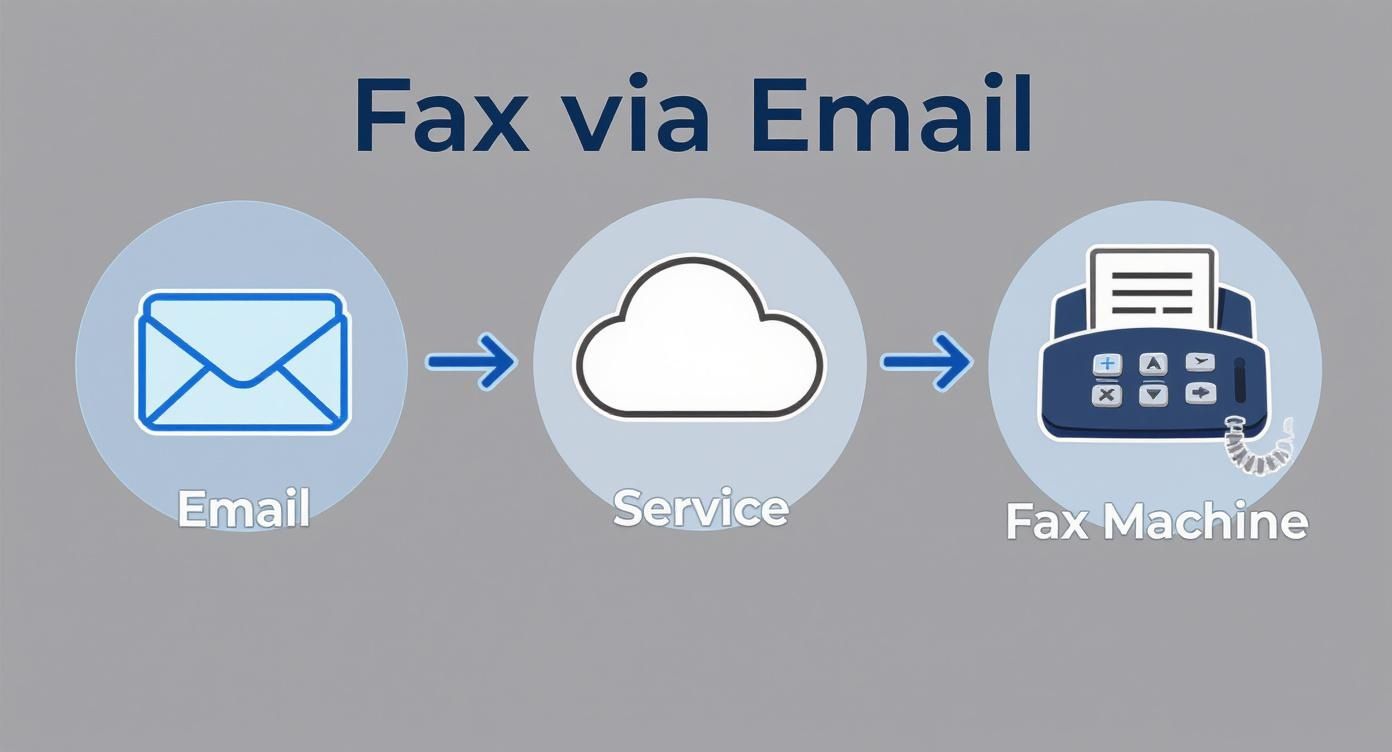
    Receiving a fax through your email is surprisingly simple. You just sign up with an online fax service, and they assign you a virtual fax number. When anyone sends a fax to that number, the service instantly converts it into a digital file (usually a PDF) and sends it straight to your email inbox as an attachment.

    Why Receiving Faxes by Email Is a Game Changer

    A person holds a smartphone displaying a signed document, with 'FAX REIMAGINED' text in the background.

    Let's be real—traditional fax machines feel like they belong in a museum. And yet, for industries like healthcare, law, and real estate, faxing is still a vital part of the job because of its long-standing security reputation. This is where understanding how to receive a fax by email turns an outdated process into a powerful modern tool.

    Online fax services are the bridge between the old and the new. They let you finally get rid of that clunky machine, the expensive ink, and the mountains of paper. It's a massive operational upgrade that feels as easy as checking your email.

    The Real-World Impact

    Think about it. A real estate agent gets a signed purchase offer sent directly to their phone while they're showing a property. They can forward it to their client for review in seconds. Or picture a law firm that can securely archive confidential client files without a single filing cabinet, creating a searchable digital record on the fly. That's the practical magic of fax-to-email.

    This isn't just about making things easier; it’s about making your workflow smarter and more precise. The global fax services market is actually expected to reach USD 4.47 billion by 2030. For professionals who deal with a lot of forms, receiving them by email can slash document-handling mistakes by 30-40%, simply because digital files are easier to track than stacks of paper. You can even read more about the surprising growth of business faxing.

    Key Benefits of Fax to Email

    The perks go way beyond just getting a message in a different place. When you adopt this technology, you'll see real, tangible improvements in how you work.

    • Significant Cost Savings: Say goodbye to spending on paper, ink, toner, and machine repairs. You also cut out the need for a dedicated phone line, which can easily save you hundreds of dollars every year.
    • Unmatched Convenience and Mobility: Check your faxes from literally anywhere—your laptop at a coffee shop, your tablet on the train, or your smartphone between meetings. You’re no longer chained to the office.
    • Enhanced Security and Privacy: Digital faxes land in your private, password-protected email inbox. No more sensitive documents sitting out in the open on a shared office machine for anyone to see. The best services also use strong encryption to protect your data as it travels.

    By moving fax communications into your email, you’re not just updating a tool; you’re creating a more agile, secure, and cost-effective system for handling critical documents. It’s the simplest way to modernize an essential business function.

    How Does Online Faxing Actually Work?

    Ever wondered what’s happening behind the scenes when a fax magically appears in your email inbox? It’s not magic, but it’s a clever bit of technology that acts as a bridge between the old analog world and your digital one. Honestly, you don't need a degree in IT to get it.

    Think of an online fax service as your personal translator. A traditional fax machine still communicates by sending beeps and tones (analog signals) over a phone line—a language your email has no clue how to interpret. The service intercepts those signals and translates them into a format your computer understands perfectly.

    So, when someone dials your online fax number and sends a document, it doesn't just vanish into the ether. The service catches that incoming transmission, digitizes it, and repackages it for the modern world.

    From Fax Tones to an Email Attachment

    The real workhorse of the system is the conversion process. When the service picks up the incoming fax signal, it immediately gets to work interpreting those analog tones.

    • First, it converts the transmission into a digital document, almost always a PDF. Using a PDF is smart because it keeps the document's original formatting locked in place, which is often critical for things like contracts or official forms.
    • Next, the service automatically drafts an email and attaches this brand-new PDF to it.
    • Finally, it sends that email straight to your designated inbox. You get a notification just like any other message, letting you open, save, or forward the fax in seconds.

    This whole process is lightning-fast, usually wrapping up in just a minute or two. The best part? The person sending the fax has no idea any of this is happening. To them, it feels exactly like sending a fax to any other machine. All the convenience is on your end.

    An online fax service like SendItFax essentially modernizes a legacy process without forcing everyone to change how they work. It’s a secure bridge that lets an old-school tool fit right into your digital life.

    Sending Faxes Is Just as Simple

    It’s not a one-way street, either. Sending a fax from your email is just as straightforward.

    You just compose a new email, attach the file you want to send—like an invoice or a signed agreement—and send it to a special email address. For example, you might send it to something like 1-800-555-1234@senditfax.com.

    The service then grabs your email and attachment, translates them back into analog fax signals, and dials the recipient's fax machine to deliver it. This two-way street gives you a complete fax solution without ever needing to own, or even see, a physical machine. For a deeper dive, our complete guide on how fax to email services work breaks down every detail of this incredibly useful tool.

    Choosing the Right Online Fax Service for You

    Picking an online fax service isn't a one-size-fits-all deal. The right choice really depends on how you'll be using it. What works for a solo freelancer sending a contract once a quarter is totally different from what a busy medical office needs to handle patient records every day.

    Let's break it down from a practical standpoint. Think about your typical fax volume, how critical security is, and what your budget looks like. If you only expect to receive a fax here and there, a pay-as-you-go service makes the most sense. But if you’re a healthcare provider, you'll need a robust subscription that's HIPAA compliant and can handle a high volume of documents securely.

    Key Factors to Consider

    When you’re figuring out how to receive a fax by email, the provider you choose is the single most important decision. To make the right call, focus on these core elements.

    • Pricing Models: Does it make more sense to pay a flat monthly fee for a certain number of pages, or would you rather pay only for what you use? Subscriptions are perfect for businesses with predictable faxing needs. On the other hand, a pay-per-use model like SendItFax is a lifesaver for occasional users who want to avoid recurring costs.
    • Number Porting: Do you already have a fax number that your clients and contacts know? If so, you'll want to find a service that lets you "port" or transfer that number over. This saves you the major hassle of updating business cards, websites, and contact lists.
    • Security Standards: For many professionals, this is the most critical factor. Look for providers that offer end-to-end encryption to protect your documents. If you handle sensitive data—like legal briefs or medical charts—make sure the service is compliant with regulations like HIPAA.
    • Ease of Use: A powerful tool is useless if it's a pain to operate. Is the dashboard intuitive? How simple is it to set up your email and manage your received faxes? A clunky interface will just add frustration and defeat the purpose of switching to a more modern solution.

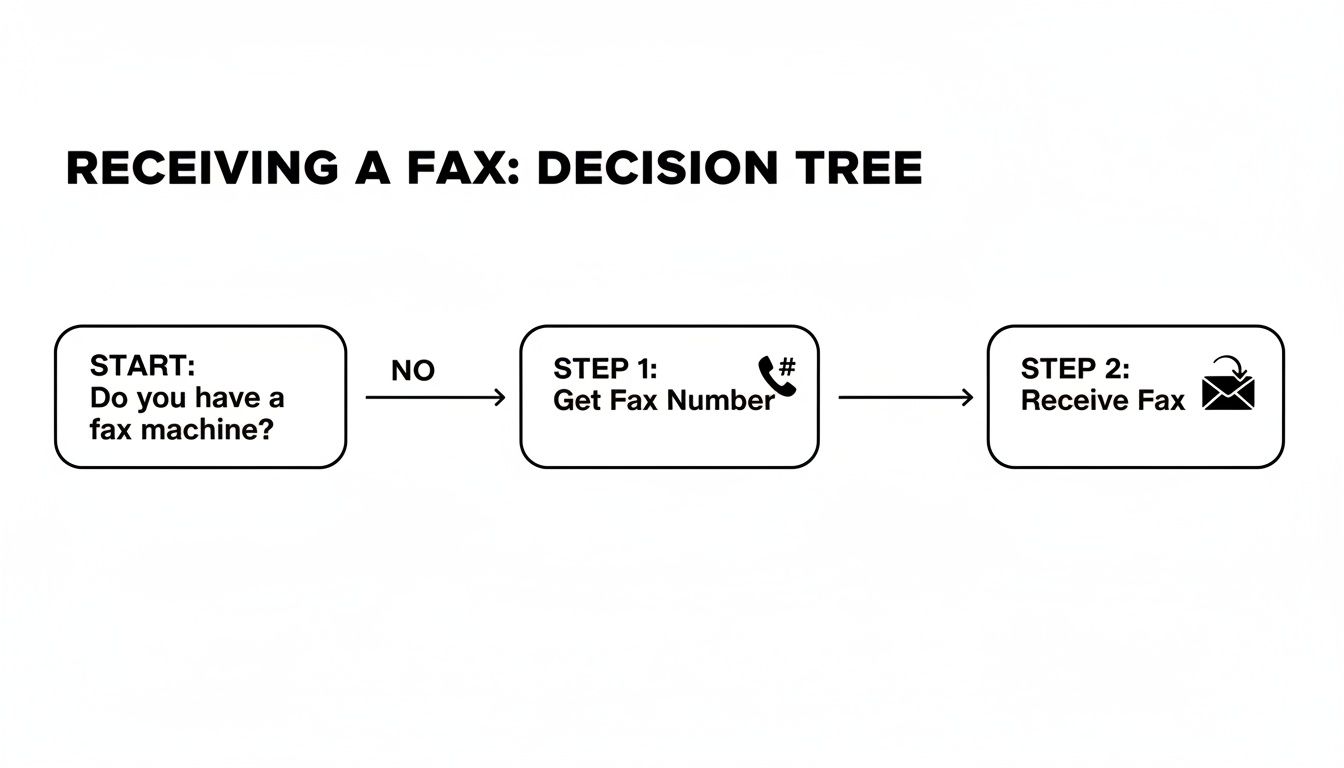
    This flowchart gives you a quick visual of the first few steps you'll take when ditching the old machine for an email-based setup.

    A decision tree flowchart illustrating the steps to receive a fax without a machine.

    As you can see, it all starts with securing a fax number and linking it directly to your email inbox.

    Comparing Online Fax Service Models

    To help you visualize the differences, here's a look at how the main pricing models stack up. This should make it easier to see which approach aligns best with your needs, whether you fax once a year or a hundred times a day.

    Feature Pay-Per-Use Model (e.g., SendItFax) Subscription Model (Low-Tier) Subscription Model (Business-Tier)
    Best For Occasional, infrequent users Individuals or small teams High-volume businesses
    Cost Structure Pay per page, no monthly fee Fixed monthly fee Higher fixed monthly fee
    Page Allowance N/A (Pay for what you use) 100-300 pages/month 1,000+ pages/month
    Number Porting Often available for a one-time fee Usually included Always included
    Advanced Security Varies by provider Basic security, HIPAA often extra HIPAA compliance included
    Flexibility Maximum flexibility, no commitment Moderate flexibility Low flexibility (annual contracts)

    Each model has its place. Your goal is to find the one that delivers the features you need without forcing you to pay for things you won't use.

    Making the Final Decision

    Ultimately, choosing the right service comes down to balancing features with cost. A good first step is to estimate your average monthly fax volume. That number alone will point you toward either a subscription or a pay-per-use plan.

    Remember, the goal is to find a service that seamlessly integrates into your existing workflow, not one that adds another layer of complexity. Prioritize a solution that feels like a natural extension of your email.

    For a much deeper dive into specific providers, check out our detailed online fax services comparison guide. We lay out the features and pricing side-by-side to help you make a truly informed choice.

    Setting Up Your Fax to Email Service

    A laptop on a wooden desk with a Quick Setup overlay, coffee, plant, and notebook, illustrating a modern workspace.

    This is where the magic happens. Getting your fax-to-email service running is surprisingly quick and doesn't require an IT degree. The whole point is to get you receiving faxes in your inbox with as little fuss as possible, turning what used to be a clunky process into just another part of your digital day.

    Essentially, you just need to sign up, sort out your fax number, and tell the service which email address to send everything to. Let’s break it down.

    Your Fax Number, Your Choice

    First things first: you need a fax number. This is what people will dial to send you documents. When you sign up for a service, you’ll be presented with a couple of options, and your choice really boils down to your business's history with faxing.

    • Get a New Number: If you’re just starting out or don't have an established fax line, this is the simplest route. Services like SendItFax let you pick a new local or toll-free number right during the signup process. It's the fastest way to get the ball rolling.
    • Port Your Existing Number: Got a fax number that your clients have known and used for years? You'll want to port it. Porting simply means transferring your existing number from your old provider to your new online service. It's a critical step for maintaining business continuity.

    Just a heads-up: while porting is a fantastic feature, it does take a bit more time than grabbing a new number. Plan for it to take anywhere from a few days to a week to complete the transfer.

    Configuring Your Destination Email

    With your number sorted, the next step is connecting it to your email. This is the heart of "fax-to-email" and it's usually as easy as typing your email address into a field in your account settings. You can route faxes to any email you want—Gmail, Outlook, or your own custom domain, it doesn't matter.

    Here's a pro tip I've learned from experience: consider setting up a dedicated email address just for faxes, like faxes@yourbusiness.com. This creates a clean, organized funnel for all incoming faxes, keeping them separate from your day-to-day emails and making them much easier to track.

    The entire setup is designed to take just a few minutes. The goal is to bridge the gap between old-school faxing and modern work with practically zero friction, so you can worry about the documents themselves, not the technology behind them.

    This kind of setup is more relevant than ever. The cloud fax market is on track to hit USD 860.5 million by 2026, partly because faxing is still so prevalent in many industries. And with the post-pandemic remote work boom causing a 20-30% jump in demand for browser-based tools, knowing how to get a fax by email is a vital skill for distributed teams. You can discover more insights on the future of cloud fax markets to see where things are headed.

    Automate Your Inbox for Ultimate Efficiency

    Once you're set up, don't just let those fax notifications flood your primary inbox. Take an extra five minutes to create an email filter. Trust me, this is a game-changer for staying organized.

    For example, in Gmail or Outlook, you can set up a rule that automatically moves any email coming from your fax service (like notifications@senditfax.com) into a dedicated folder you've named "Incoming Faxes."

    Setting this up is simple:

    1. Open an email notification from a test fax you've received.
    2. Find the "Create filter" or "Create rule" option in your email client, usually based on the sender's address.
    3. Choose the action to "Move to" a specific folder or "Apply label," then select your "Incoming Faxes" folder.

    This one little automation keeps your main inbox tidy and ensures all your important faxes are neatly filed away, ready for you the moment you need them. It's a small tweak that pays huge dividends in your daily workflow.

    Now What? How to Manage Your Digital Faxes Like a Pro

    A person uses a laptop displaying cloud storage icons, next to organized physical files and a 'ORGANIZE SECURELY' sign.

    Okay, so your fax-to-email service is up and running. The faxes are rolling in. Now the real work begins: building a smart system to handle everything. Just letting digital faxes pile up in your inbox is a surefire recipe for chaos.

    To really get the most out of your setup, you need a solid workflow for organizing, archiving, and protecting these documents. This is where you move from just receiving faxes to truly managing them with confidence.

    Develop a Smart Organization System

    The cornerstone of any good digital workflow is organization. Think of your digital faxes just as you would any other critical business document. A great first step is creating a dedicated folder structure that mirrors how you actually work.

    For example, a busy real estate agent could set up email folders for each client or property. That way, finding a specific signed offer from three months ago is a matter of a few clicks, not an endless, panicked scroll through a cluttered inbox. This is so much more effective than just relying on your email's search bar.

    Don’t treat your inbox like a to-do list or a filing cabinet. As soon as you review a fax, file it away. This simple habit keeps your inbox clean and prevents crucial documents from getting lost in the noise.

    This kind of proactive management is becoming the norm. The global online fax market is booming, valued at USD 2.88 billion and on track to reach USD 5.18 billion by 2035. Big companies, making up about 50% of all users, are driving this trend because they can't afford disorganized or insecure document handling. If you're curious, you can read the full research about online fax market growth and see the data for yourself.

    Prioritize Security and Archiving

    Security is non-negotiable when you receive a fax by email, especially if those documents contain sensitive client or patient data. While good online fax services offer secure transmission, your own digital habits play a huge part in keeping that information safe once it lands.

    Make these security practices second nature:

    • Lock Down Your Email: Your email account is now the front door to your faxes. Use a strong, unique password and, wherever possible, turn on two-factor authentication. It's one of the best defenses you have.
    • Spot the Fakes: Be on the lookout for phishing scams disguised as fax notifications. Always double-check the sender’s email address before you click a link or download an attachment.
    • Use the Cloud for Safekeeping: For secure, long-term storage, consider setting up an email rule that automatically forwards or saves faxes to a trusted cloud service like Google Drive or Dropbox. This gives you a centralized, backed-up archive of everything important.

    These steps ensure your digital faxing is not just convenient but also incredibly secure. For a deeper dive, check out our guide on the security of fax communications and learn the best practices from top to bottom.

    Got Questions? We've Got Answers

    Switching to a new system for something as established as faxing naturally brings up some questions. It's smart to get the full picture before you dive in. I've been helping people make this transition for years, and a few key questions always pop up. Let's walk through them so you feel completely comfortable.

    These are the things people usually ask when they're figuring out how to get faxes sent to their email. Getting these points clarified will make the whole process feel much less like a leap of faith.

    Can I Keep My Old Fax Number?

    Absolutely. In almost every case, you can bring your existing fax number with you. Any good online fax provider knows that number is part of your business's identity. They have a standard process called number porting.

    Think of it as simply moving your number from your old phone carrier to their service. It's not instantaneous—it can take anywhere from a few days to a couple of weeks to complete—but it's a routine procedure. This means you get all the benefits of a modern system without the massive pain of updating your contact info everywhere.

    Are Email Faxes Actually Legally Binding?

    This is a critical question, and the answer is a confident yes. Faxes you receive via an online fax service hold the same legal weight as a piece of paper spat out by a traditional machine. The secret is in the digital audit trail.

    Online services generate detailed transmission logs that confirm successful delivery. Honestly, this digital record is often stronger proof than the flimsy confirmation slip you'd get from an old machine.

    For anyone in law, finance, or healthcare, this is huge. You need to know your documents are secure and legally sound. Digital faxing meets that standard, giving you modern convenience without compromising on legal validity.

    A quick tip: if you handle sensitive information, make sure your chosen service mentions security like TLS encryption. And for anyone in healthcare, a HIPAA-compliant service isn't just a good idea; it's a requirement to protect patient data properly.

    What if My Email Server Goes Down?

    Your faxes will be safe. This is a common worry, but it actually points to one of the biggest strengths of an online service. The service doesn't send the fax directly to your email; it receives it on its own secure servers first.

    It then forwards a copy to your inbox. If your email is down for maintenance or having an off day, that fax just sits safely in your online fax account, waiting for you. You can log into the service's website or app to see it immediately, or it will be there in your inbox once things are back online. It’s a built-in safety net that ensures you never miss a thing.


    Ready to see how much simpler faxing can be? SendItFax offers a straightforward, pay-as-you-go service that lets you send faxes right from your browser—no sign-ups or subscriptions needed. You can get started in just a few seconds.

  • How to Fax from Mac Without a Fax Machine

    How to Fax from Mac Without a Fax Machine

    It might seem old-fashioned, but sending a fax from your Mac is actually pretty simple these days, and you definitely don't need a clunky machine sitting in the corner. The most direct route is using a secure, browser-based service. You just upload your file, pop in the recipient's info, and send it on its way over the internet.

    Why Bother Faxing from Your Mac in 2024?

    Let's be honest, faxing feels like a technology that should have gone the way of the dinosaur. And yet, it's still a surprisingly vital tool in a lot of industries. While we all use email and Slack for everyday chats, faxing still has a firm grip in situations where security, legal weight, and a verifiable paper trail are absolute must-haves. For Mac users working in these fields, figuring out how to send a fax isn't just a random task—it's often a frustrating necessity.

    Medical professional typing on a laptop with a stethoscope and files, discussing why fax matters.

    Who Still Faxes, Anyway?

    It turns out, a lot of important people do. Certain fields rely on fax because of how it works. The transmission travels over a dedicated phone line, creating a direct connection that’s much harder to intercept than an email bouncing from server to server.

    • Healthcare: It's all about privacy here. Doctors, clinics, and hospitals frequently fax patient records, lab results, and prescriptions to stay compliant with strict privacy laws like HIPAA. A fax creates a clear, documented trail that the information was sent and received.
    • Legal: Lawyers and their teams depend on faxing for time-sensitive documents that need a signature—think contracts, court filings, or affidavits. A faxed signature often carries legal weight, and that little confirmation page is solid proof of delivery.
    • Government & Finance: When you're dealing with official correspondence, loan applications, or compliance paperwork, there's no room for error. Government agencies and banks use fax to ensure document integrity and maintain that all-important verifiable trail.

    The Modern Mac User's Headache

    The problem for most of us isn't why we need to fax; it's how. Let's face it, nobody has a physical fax machine anymore. They're big, they need their own phone line, and they just don't fit into a modern home office. This creates a real bottleneck when you have an urgent document that needs to be sent right now.

    You’ve been there: the signed contract is sitting on your desktop, the deadline is looming, but you have no physical way to send it. That’s the exact gap that modern, browser-based fax services were designed to fill.

    And this isn't a niche problem. The global market for fax services is surprisingly massive—it was valued at $3.31 billion in 2024 and is still growing. That's because industries that can't compromise on reliability continue to trust it. In some healthcare environments, for example, up to 90% of communication still happens over fax. If you want to dive deeper, you can explore the fax market growth on ResearchAndMarkets.com. All this just goes to show why knowing how to send a fax from your Mac is still a surprisingly practical skill to have.

    The Easiest Way to Send a Fax from Your Mac

    Let's be honest, when you need to fax something from your Mac, you want it done fast. You don't have time to dig up an old fax machine or mess with complicated software. The good news is, you don’t have to. The quickest path is using a simple, secure web service right from your browser.

    This whole approach turns your Mac into a fax machine, minus the clunky hardware and confusing setup.

    Services like SendItFax are built for this exact purpose. You can skip the whole account creation and password dance. Just visit the site, pop your document in, and send it off. It’s perfect for those one-off tasks, like sending a signed contract to a client or a form to a government office that still lives in the analog world.

    Getting Your Document Ready

    First things first, you need your document. Most online fax services play nicely with the usual suspects: PDF, DOC, and DOCX files. So, whether you’ve just finished a document in Pages or have a PDF saved on your desktop, you’re good to go. If you're using Pages, just export it as a PDF or Word file first.

    The SendItFax homepage gets straight to the point with a clean, drag-and-drop interface.

    You can literally just pull the file from a Finder window and drop it right into the browser. It’s designed to be quick.

    Once the file is there, the next step is plugging in the details for you (the sender) and the person you're faxing. The fields are all standard, so there are no surprises.

    Filling Out Sender and Recipient Details

    This part is all about accuracy. Getting these details right ensures your fax lands in the right hands.

    • Recipient’s Info: You’ll need their name and, most importantly, their fax number. Double-check that number. A single wrong digit is the number one reason faxes fail to send. For the US and Canada, you usually don't need the country code, but it's always smart to confirm the format if you're unsure.
    • Your Info: Add your name and a valid email address. That email is non-negotiable—it's where the service will send your delivery confirmation. You'll also be asked for your phone number, which is helpful for the recipient if they need to contact you.

    Your confirmation email is your proof of delivery. Think of it as the digital version of that little printed receipt you'd get from an old-school fax machine. Make sure you use an email you actually check.

    Adding a Professional Cover Page

    Don't skip the cover page. It’s not just a formality; it gives the person on the other end immediate context. It tells them who the fax is from, who it's for, and why they should care.

    Most web services give you a spot to add a custom message. Something simple works best.

    For example, a quick note like, "Here is the signed lease agreement we discussed. Please let me know you've received it," or "Attached are the requested medical records for Jane Smith." This little step prevents your important document from getting lost in a pile.

    While some paid services let you send a fax without a cover page, including one is almost always the right move. For a deeper dive into the best practices, you can learn more about how to send a fax online and why these details are so important.

    After you've filled everything out, you just hit send. The service takes over from there, converting your file and sending it across the phone lines. In just a few minutes, an email will pop into your inbox confirming that your fax was sent successfully. And that’s it—a seamless process that started and ended right on your Mac.

    Choosing the Right Faxing Plan For Your Needs

    Not all faxing needs are the same, and picking the right plan usually boils down to your specific situation. It’s less about just saving money and more about matching the right tool to the task at hand. Often, the decision comes down to document length, how professional you need to look, and urgency.

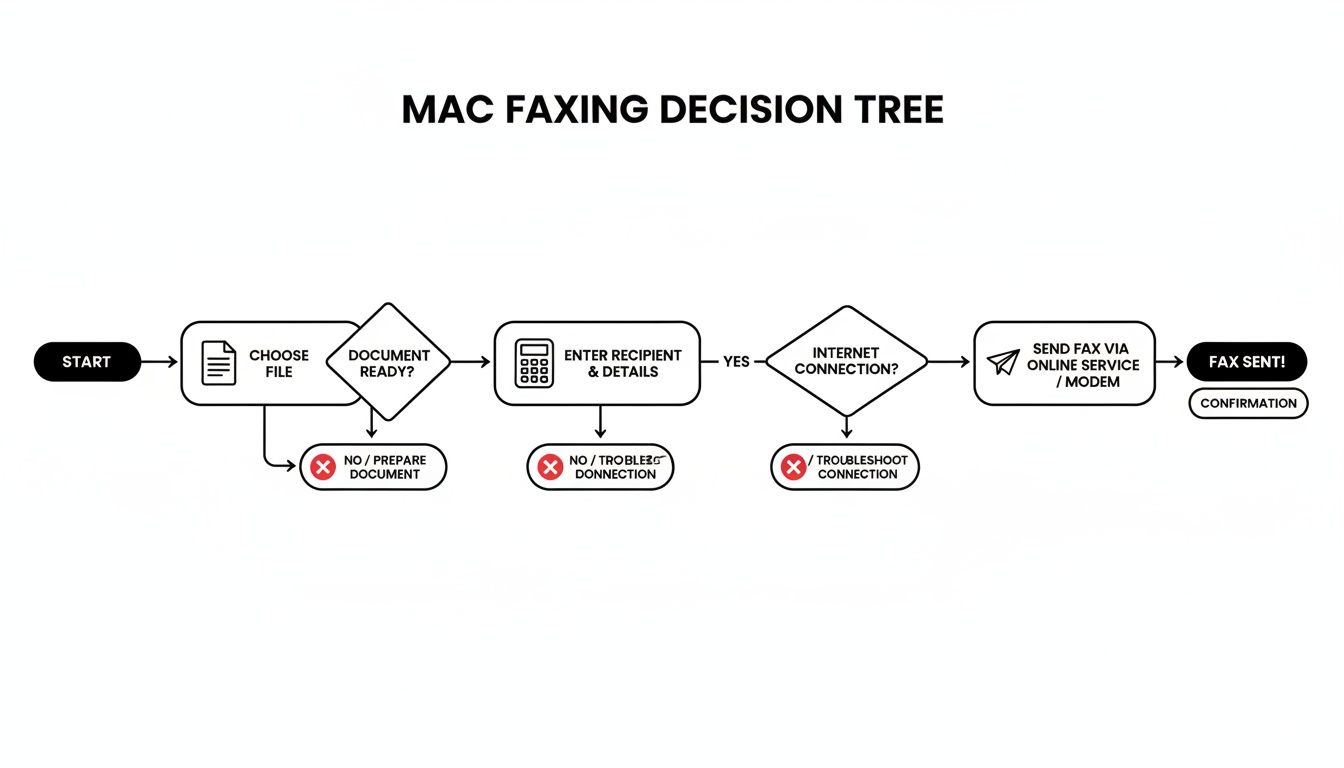
    This visual guide breaks down the core steps for sending a fax from your Mac, no matter which plan you're on.

    Flowchart detailing the steps to send a fax from a Mac, including document and internet connection checks.

    As you can see, the process is pretty straightforward: grab your document, pop in the details, and hit send. Simple.

    When Free Faxing Makes Sense

    The free option is absolutely perfect for those quick, one-off tasks where a branded cover page isn't a deal-breaker. Think of it as the ideal tool for personal errands.

    For instance, you might be:

    • A student sending a signed financial aid form to their university.
    • Someone submitting a single, non-urgent document to a government agency.
    • A parent who needs to quickly fax a signed permission slip for a kid's school trip.

    In these situations, the main goal is just getting the document where it needs to go. A small service logo on the cover page is a pretty minor trade-off for a completely free fax.

    Key Takeaway: The free tier is your go-to for casual, personal faxes that are short and not time-sensitive. It gets the job done without costing a dime.

    Stepping Up to a Low-Cost Plan

    For just a couple of dollars, a low-cost plan like the "Almost Free" option unlocks some serious professional advantages. This tier is built for those times when presentation and extra features really matter.

    Imagine a small business owner sending a multi-page contract to a new client. A clean, unbranded look is essential to maintain a professional image. Or picture a healthcare professional transmitting sensitive patient referrals; priority delivery ensures the document gets processed faster, which can be critical. If you want a deeper dive, our guide to the cheapest online fax service explains how these small upgrades deliver huge value.

    Here's a quick comparison to help you choose the right SendItFax plan for what you need to do right now.

    SendItFax Free vs Almost Free Plan Comparison

    Feature Free Plan Almost Free Plan ($1.99)
    Page Limit Up to 3 pages + cover Up to 25 pages + optional cover
    Cover Page Branding Includes SendItFax branding Completely brand-free
    Delivery Speed Standard queue Priority delivery
    Best For Personal, one-off documents Business, multi-page, or urgent faxes

    Ultimately, choosing your plan is all about looking at your immediate needs. For a simple, one-and-done task, free is fantastic. But for anything that needs a more professional touch or involves more than a few pages, that small investment in a low-cost plan is money well spent.

    A Look at Other Ways to Fax From a Mac

    While using a simple web service is usually the easiest way to send a fax, it's worth knowing about the other options out there. Frankly, looking at the alternatives often highlights just how convenient a browser-based tool can be, especially if you only send a fax once in a blue moon.

    The Old-School Method: macOS "Print to Fax"

    Believe it or not, macOS once had a built-in "Print to Fax" feature. It sounds perfect on the surface—a native solution right in the print dialog. But this is really a ghost of a bygone era, a time when Macs had internal modems and everyone had a landline phone jack next to their desk.

    To get this fossil of a feature working today, you’d be on a real hardware hunt. You would need:

    • An active telephone landline plugged into your Mac.
    • An external USB fax modem, since no modern Mac includes one.
    • The right drivers to get the modem and macOS to talk to each other.

    For most people, this is a non-starter. The hassle and cost of tracking down and setting up the hardware turns a simple five-minute task into an expensive weekend project.

    Dedicated Fax Apps on the App Store

    Another path is to download a dedicated fax application from the Mac App Store. These apps can feel a bit more polished and sometimes integrate with your contacts, giving you a self-contained faxing hub right on your desktop.

    The catch? This convenience almost always comes with a subscription. Most of these apps require a monthly or annual fee to keep your account and a dedicated fax number active. If you just need to send a single contract or a form once a year, getting locked into a recurring payment doesn't add up.

    This is where the difference between a subscription and a pay-as-you-go service really stands out. For that one-off fax, an account-free service saves you from a commitment you just don't need.

    These dedicated apps are great for businesses or professionals who regularly send and receive faxes. But for the average person, the setup and ongoing cost are complete overkill.

    Why Online Faxing Is Still the Go-To

    The fact that we're even discussing different faxing methods shows a surprising truth: faxing isn't dead. It’s still deeply integrated into many professional fields.

    In fact, over 80% of businesses, from solo operations to huge corporations, still rely on faxing. The big change is that nearly 90% of organizations are now using or considering cloud-based online fax services. It's a massive shift away from clunky hardware. You can dive deeper into these trends by reading about the current state of the faxing industry on iFaxApp.com.

    When it comes down to it, the best way to fax from your Mac depends entirely on how often you need to do it. For the overwhelming majority of people sending a document here and there, a simple web service that doesn't require an account is the most direct and budget-friendly choice. It lets you skip the hardware headaches of the old days and the subscription traps of modern apps.

    Getting Your Fax Right: Best Practices for Secure Sending

    Sending a fax isn't just a matter of clicking a button. To make sure your documents land safely, look professional, and get to the right person, a little prep work goes a long way. Think of it as the modern etiquette for a technology that still perfectly connects the digital and physical worlds.

    Hands typing on a silver laptop with a smartphone and document stack, featuring 'Secure Fax Tips' banner.

    It all begins with the document itself. Remember, faxes are transmitted in black and white, which means high contrast is your best friend. Stick with clean, simple fonts like Arial or Helvetica. It's also smart to avoid light gray text or complex graphics, as they can turn into an unreadable smudge on the other end.

    For the most reliable results, always save your document as a PDF. This format locks in your layout, ensuring what you see on your Mac is exactly what prints out of the recipient's machine.

    Why You Should Never Skip the Cover Page

    I can't stress this enough: always use a cover page. It's the very first thing the recipient sees and acts as a crucial routing slip, especially in a busy office environment. It instantly clarifies who sent the document, who it's for, and what it’s about.

    A solid cover page should clearly state:

    • Your contact details (name, phone number)
    • The recipient’s name (and department, if you know it)
    • A quick subject line (e.g., "Signed Agreement for Acct #54321")
    • The total page count, including the cover page itself.

    Taking 30 seconds to add this can be the difference between your sensitive document getting delivered immediately and it getting lost on a shared printer for hours.

    Keeping Your Faxes Private and Secure

    When you fax from your Mac using an online service, you're placing your trust in that platform. Always choose a reputable provider that uses strong encryption to shield your documents while they're in transit. A good sign is seeing payment processing handled by Stripe, which means your financial details are managed by a secure, industry-leading gateway.

    For anyone working in fields like healthcare or law, confidentiality is everything. It's a shocking but true statistic that 70% of all healthcare communication still happens over fax. That number skyrockets to 90% for interactions involving electronic health records. You can read more about these surprising fax statistics in healthcare.

    Pro Tip: Before you hit send, triple-check the recipient's fax number. One wrong digit could accidentally send confidential information to a complete stranger, creating a massive privacy headache. This is the single most effective way to prevent a data breach.

    If you handle sensitive information—from legal contracts to patient charts—it pays to understand how your data is being transmitted. Taking a few minutes to read up on the core principles of fax security will give you peace of mind and help you stay compliant. By sticking to these practices, you can fax from your Mac with confidence and keep your information safe.

    A Few Lingering Questions About Mac Faxing

    Even when a process is simple, you're bound to have a few questions before you hit "send" for the first time. It's only natural, especially when you're moving away from old, clunky hardware to a slicker web-based method. I've heard these questions pop up time and again, so let's get them cleared up right now.

    My aim here is to give you direct, no-nonsense answers so you can fax with total confidence.

    Can I Actually Receive Faxes on My Mac This Way?

    This is probably the most common point of confusion, so let's tackle it head-on. Pay-as-you-go services like SendItFax are built for one thing and one thing only: sending faxes. They're brilliant for firing off a document from your Mac quickly without getting roped into a subscription.

    If you need to receive faxes regularly, you're looking at a different kind of tool. For that, you'd want a dedicated online fax service that gives you your own virtual fax number. Just know that these almost always come with a monthly fee.

    Is It Really Safe to Send Sensitive Documents Online?

    It is, provided you’re using a credible service. Any modern online fax platform worth its salt is built with security in mind, using encryption to shield your documents while they're in transit. Honestly, it's a huge leap forward from the old office fax machine, where your confidential papers could be left sitting in a tray for anyone to see.

    For instance, a service like SendItFax handles its payments through Stripe, which is one of the most secure and trusted payment processors on the planet. This keeps your financial details locked down and handled separately from the fax transmission itself.

    Your biggest contribution to security is simple: always, and I mean always, double-check the recipient's fax number before you send. That one small habit is your best defense against your private information ending up in the wrong hands.

    What’s the First Thing I Should Do If My Fax Fails?

    It's definitely frustrating when a fax doesn't go through, but the reason is usually pretty simple. The usual suspects are a typo in the fax number, a busy signal at the other end, or a problem with their machine—maybe it's out of paper or even switched off.

    First things first: check the number you typed, digit by digit. If it’s correct, the best bet is to just give it 10-15 minutes and try again. The line was probably just tied up. Most paid services will also give you a delivery report with clues about what went wrong, which can make troubleshooting a lot easier.

    Do I Need Any Special Software or Clunky Hardware?

    Nope, and that’s the beauty of it. To fax from your Mac with a modern web service, all you need are two things you're already using: a good internet connection and a web browser like Safari, Chrome, or Firefox.

    This whole approach is designed to let you sidestep all the old-school fax paraphernalia. You can completely forget about installing weird software, fighting with drivers, or hunting down a USB fax modem. It turns what used to be a technical headache into a simple task you can do right from your browser.


    Ready to see for yourself? With SendItFax, you can get your documents sent straight from your Mac in just a couple of minutes—no account required. Give the fast, secure, and headache-free way to fax a try at https://senditfax.com.
  • How to Send a Fax: Easy Online Guide You Can Do Now

    How to Send a Fax: Easy Online Guide You Can Do Now

    Sending a fax online is surprisingly straightforward. You just upload your document to a web service like SendItFax, punch in the recipient's fax number, and hit send. That's it. This approach ditches the need for a clunky machine and a dedicated phone line, letting you send files like PDFs or Word docs right from your computer or phone in a matter of minutes.

    Why Online Faxing Still Matters

    It's easy to think of faxing as something that went out with dial-up internet, but for a lot of professionals, it’s still a go-to tool. Fields like healthcare, law, and government hang on to it for good reason: it’s incredibly secure and holds up legally. When you’re handling sensitive information, the direct point-to-point connection of a fax gives you a level of security that your average email just can't promise.

    A laptop displaying 'Secure Faxing' on its screen sits on a wooden desk with paper documents.

    Learning to send a fax online isn't about dusting off old tech. It’s about getting comfortable with a modern communication method that puts security and reliability first, whether you’re using it for work or personal stuff.

    The Enduring Role of Fax in Key Industries

    So, why are so many vital sectors still leaning on this method? It all comes down to compliance and having a paper trail. Take healthcare, for instance. Doctors and hospitals have to follow strict HIPAA rules to keep patient information private. Faxing gives them a secure, verifiable way to send records between clinics, pharmacies, and insurance companies.

    The numbers really tell the story. At its peak, global fax transmissions hit over 17 billion documents in a single year. The U.S. healthcare system alone accounted for more than 9 billion of those. Even now, about 17% of businesses around the world still use faxing, which shows just how essential it remains in certain fields.

    The real advantage? A fax transmission creates a solid record of exactly when a document was sent and successfully received. That kind of proof is gold for legal and medical paperwork.

    Thinking about making the switch? It helps to see the differences side-by-side.

    At a Glance Comparing Traditional vs Online Faxing

    This table provides a quick comparison of the key differences between using a traditional fax machine and a modern online fax service, helping you understand the benefits of going digital.

    Feature Traditional Fax Machine Online Fax Service
    Hardware Requires a dedicated machine and phone line. No special hardware needed—just a computer or smartphone.
    Cost High initial cost plus ongoing expenses for paper, ink. Low monthly subscription fees, often with free trial options.
    Accessibility You have to be physically present at the machine. Send and receive faxes from anywhere with an internet connection.
    Document Quality Can be blurry or distorted depending on the connection. Delivers crisp, clear digital copies every time.
    Security Secure point-to-point, but documents can be left exposed. Enhanced with end-to-end encryption and secure cloud storage.
    Confirmation Prints a confirmation page (if it doesn't jam). Sends instant email notifications and provides a digital log.

    As you can see, online faxing takes the core strengths of traditional faxing and modernizes them for today’s needs, offering a more flexible and cost-effective solution.

    Security and Legal Recognition

    Faxing is often considered a safer bet than email when you're sending sensitive documents. A classic fax travels over a dedicated phone line, which is much harder to intercept than hacking into an email server. You can dive deeper into whether fax is more secure than email in our detailed comparison.

    Today's online fax services build on that security with features like end-to-end encryption. This scrambles your documents from the moment you send them until they land safely on the recipient's machine. It’s this blend of old-school reliability and new-school security that makes faxes legally binding in many situations, from signing contracts to submitting official paperwork. It’s a surprisingly useful skill to have in your back pocket.

    Getting Your Documents Ready for a Perfect Send

    Before you even get to the "send" button, the single most important thing is the quality of your document. I’ve seen it happen countless times: a blurry or poorly formatted file gets sent, and it arrives as an unreadable mess on the other end. This wastes time and can cause real headaches, especially with important paperwork.

    The goal here is simple: start with a clean, crisp digital file. That one step will solve 90% of potential problems down the line.

    Choosing the Right File Format

    The file type you use has a direct impact on how your fax looks when it prints out of that machine miles away.

    For anything with a lot of text—think contracts, applications, or official letters—PDF is the gold standard. It’s the closest thing to a guarantee that your formatting, fonts, and layout will stay exactly as you intended.

    If you have a Word document, I strongly recommend converting it first. It only takes a second. Our guide on how to convert a Word document to a PDF shows you exactly how.

    Other common formats that usually work well include:

    • DOC/DOCX: Microsoft Word files are accepted almost everywhere, but be aware that formatting can sometimes get a little wonky during the fax conversion process. PDF avoids this.
    • JPG/PNG: These are perfect for sending photos, diagrams, or scanned papers. Just make sure they are high-resolution. A fuzzy image will only look worse after being faxed.

    Pro Tip: Think of your digital file as the "original" master copy. The better its quality, the clearer the final fax will be. You can't make a low-resolution scan look sharp on the other end.

    How to Scan Physical Papers (Without a Scanner)

    What if your document is a physical piece of paper? You don’t need to hunt down a bulky office scanner anymore. Your smartphone is more than capable of creating a great-looking digital copy.

    For the best results, lay the document on a flat surface with plenty of light. Watch out for your own shadow! Position yourself so the light source isn’t directly behind you, casting a shadow over the page.

    Modern phone cameras and scanning apps (like Adobe Scan or even your phone's built-in Notes app) are smart enough to find the document's edges and automatically straighten the image for you.

    Once you have the picture, take 30 seconds to edit it. The most important tweak is to increase the contrast. This makes the text pop and the background a clean white. It makes a massive difference in readability for the person receiving the fax. Zoom in and double-check that even the fine print is sharp.

    Finally, save your freshly scanned document as a PDF or a high-quality JPG. Taking these few extra minutes to prep your file properly is the secret to a smooth transmission every single time. It's the foundational step that ensures your message gets received loud and clear.

    The Complete Walkthrough for Sending Your First Online Fax

    Alright, you've got your documents scanned, cleaned up, and ready to go. Now for the easy part: actually sending the fax. If you're used to wrestling with an old, clunky fax machine, you're in for a pleasant surprise. The whole process is much more like sending an email.

    Let's walk through it together using a service like SendItFax as our example. The goal of these platforms is to be dead simple—get your file from your computer to their machine with zero fuss.

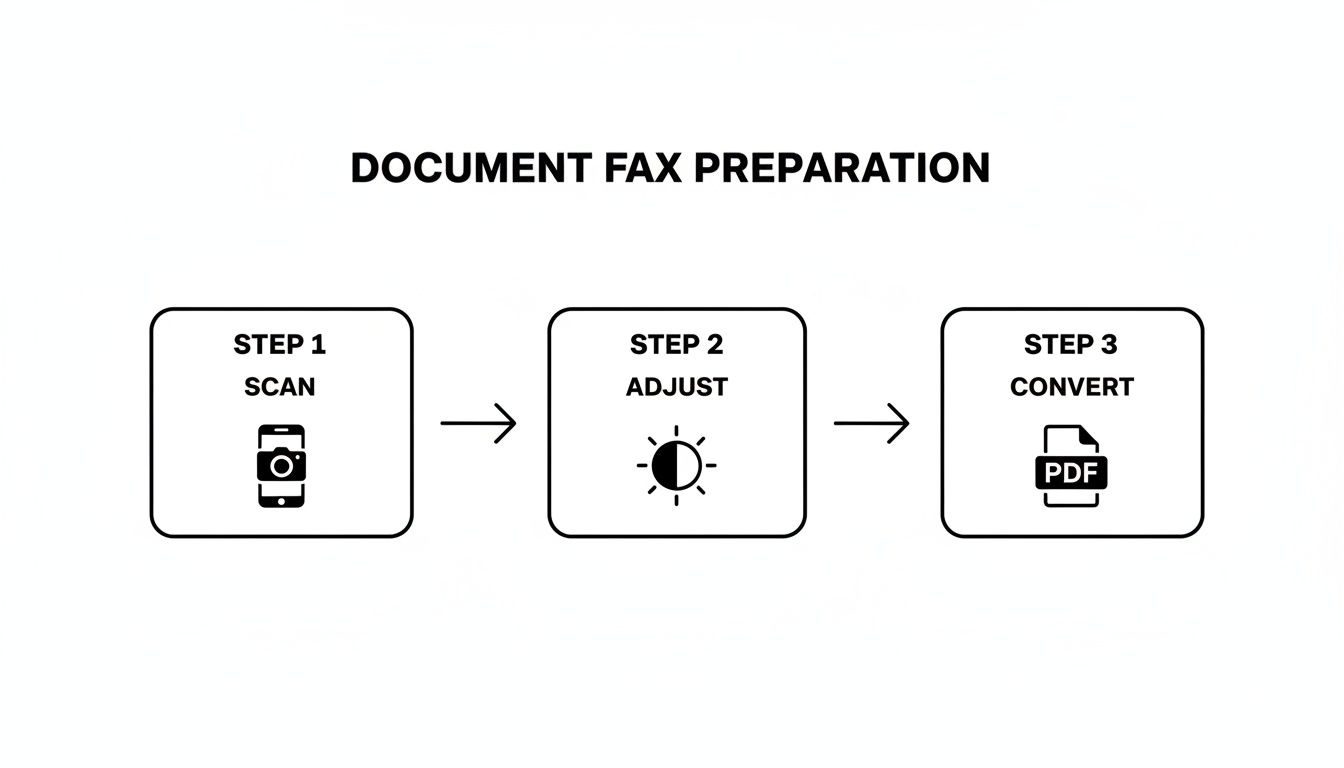
    This little visual sums up the prep work perfectly. You scan it, tweak it for clarity, and save it as a PDF. That's it.

    A three-step process for document fax preparation: Scan with a phone, adjust settings, then convert to PDF.

    Getting this part right is the secret to making sure your fax lands on the other end looking sharp and professional.

    Entering Sender and Recipient Information

    First things first, you have to tell the service who you are and where the fax is going. Think of it as the "To" and "From" on an envelope. On the sender side, you'll plug in your name, maybe your company, and your email. That email address is critical—it’s where your delivery confirmation (or failure notice) will land.

    Now for the recipient's info. The make-or-break detail here is the fax number. This is where most mistakes happen, so pay close attention.

    • Sending to the U.S. or Canada? You'll need all 10 digits: area code plus the number. Something like 212-555-0199.
    • Going international? You'll have to lead with the country code, then the city/area code, and the local number. A fax to London, for example, would look something like +44 20 7946 0958.

    I can't stress this enough: double-check every single digit. One wrong number and your fax either vanishes into the ether or ends up in the wrong hands. It’s the digital version of sending a sensitive contract to the wrong street address.

    Uploading Your Document and Adding a Cover Page

    Next, you'll see a big, friendly button to upload your file. This is where you grab that polished PDF you just created. Most services these days even let you drag the file from your desktop and drop it right into the web page. Easy.

    This is also your chance to add a cover page. Don't skip this. While it might seem optional, a cover page is essential for any kind of professional communication. It’s the first thing the recipient sees and tells them what they’re looking at and who it’s for.

    A good cover page is your fax’s handshake. It provides immediate context and makes sure your document doesn't get lost in a pile on a shared office machine. It gets it routed to the right person, right away.

    So, what goes on a great cover page?

    1. A Clear Subject Line: Get straight to the point. Instead of "Fax," try "Signed Lease Agreement" or "Invoice #5829 for Payment."
    2. A Quick Note: This is the spot for a brief message. Something like, "Hi John, attached are the 5 signed pages for your records. Please confirm receipt."
    3. The Page Count: Always, always include the total number of pages you're sending, including the cover page itself. This is how the recipient confirms they got the whole thing.

    Once all the fields are filled and your document is attached, take one last look over everything. Is the fax number perfect? Names spelled correctly? Happy with your cover page message?

    When you’re good to go, hit "Send." The service takes over from there, translating your digital file into a signal that a traditional fax machine can understand and dialing up the recipient. Within a few minutes, you should get an email in your inbox confirming whether the fax went through successfully.

    Free vs. Paid Online Faxing: Which One Is Right for You?

    When you're ready to send a fax online, you’ll quickly hit a fork in the road: go free, or pay for a subscription? There’s no single right answer. The best choice really boils down to what you’re sending and how often you’ll be sending it. Let's break down what you get—and what you give up—with each.

    Free services, like the starter option here at SendItFax, are fantastic for those one-and-done situations. Imagine you just need to send a signed three-page contract to a vendor. A free plan is the perfect tool for the job. No cost, no commitment.

    But, as with most things in life, "free" comes with a few strings attached. You'll usually run into some predictable limitations:

    • Strict Page Limits: Most free services cap you at just a handful of pages per fax.
    • Forced Branding: Expect the service’s logo or a small ad to appear on your cover page.
    • Slower Delivery: Your fax often gets put in a queue behind paying customers, so it might not go out immediately.

    For a single, non-urgent document, those trade-offs are usually a no-brainer. But if your faxing needs are more consistent or business-related, you'll start feeling the limitations of the free model pretty quickly.

    When Does It Make Sense to Pay for a Fax Service?

    If you're sending faxes more than once in a blue moon, or if they're for professional purposes, upgrading to a paid plan is less of a luxury and more of a practical necessity. Paid services are built for consistency, better security, and a polished, professional look.

    This shift towards professional-grade services is actually driving major growth in the industry. The global market for online faxing was valued at $3.3 billion in 2024 and is projected to reach $4.47 billion by 2030. Why? Because businesses need features that free plans simply can't provide, like advanced security and software integrations.

    Stepping up to a paid plan isn't just about getting rid of ads. It’s an investment in a professional toolkit that ensures your faxes are delivered securely, reliably, and with the clean presentation your business deserves.

    The Real Perks of a Premium Plan

    So, what exactly are you paying for? A premium online fax service unlocks a whole suite of powerful features that make a real difference.

    The biggest game-changer is getting a dedicated fax number. This means you can not only send faxes but also receive them, effectively turning your email into a two-way virtual fax machine. You also get a major security boost with features like end-to-end encryption. This is non-negotiable for anyone handling sensitive information in fields like healthcare (think HIPAA compliance) or law.

    On top of that, you can typically expect:

    • Generous page limits, and sometimes even unlimited faxing.
    • Detailed delivery confirmations and an organized, searchable archive of sent faxes.
    • Priority delivery, so your faxes jump to the front of the line.
    • A clean, professional look with no third-party branding on your cover sheets.

    If you're still on the fence, check out our online fax service comparison to see a side-by-side breakdown. For the occasional personal document, free is often all you need. For anything more, a paid plan is a smart move for pure reliability.

    Keeping Your Faxes Secure and Private

    When you're handling sensitive documents—think medical records, legal contracts, or financial statements—security isn't just a feature; it's a necessity. Knowing how to send a fax online is less about convenience and more about using a channel known for its robust privacy. Unlike an email, which can be intercepted at various points, a secure online fax creates a much more direct and protected pathway for your information.

    A wooden desk with a document, a black padlock, and a tablet, with a text overlay 'Encrypted FAX'.

    This heightened security is exactly why so many regulated industries still depend on faxing. It’s not an outdated habit; it’s a deliberate choice to meet strict legal and compliance requirements.

    How Encryption and Compliance Work

    The magic behind modern online fax security is end-to-end encryption. Imagine locking your document in a digital safe the moment you hit "send." The file is instantly scrambled into unreadable code and isn't pieced back together until it safely arrives at the recipient's fax service. This process shields it from prying eyes while it's in transit.

    This level of protection is a game-changer for meeting compliance standards like HIPAA (for healthcare) and GDPR (for data privacy). These regulations have strict rules about handling personal information, which is especially critical in healthcare, where about 75% of providers communicate digitally. To send a fax that holds up legally, a service must offer features like encryption and a zero-trust framework, giving your documents a legal standing that a standard email just can't match. You can learn more about where this technology is headed from these future trends in faxing from FaxFix.com.

    When you're picking a service, always look for explicit mentions of HIPAA compliance or TLS encryption. That's your green light, signaling that the provider has the right infrastructure to protect your data seriously.

    Practical Tips to Keep Your Faxes Safe

    While a good service handles the technical heavy lifting, you're the first line of defense. Keeping your own account secure is just as crucial as the transmission itself.

    Here are a few simple but powerful habits to get into:

    • Create Strong Passwords: Don't just recycle your email password. Make a unique, complex password for your fax service account to keep it locked down.
    • Turn On Two-Factor Authentication (2FA): If the service offers it, enable 2FA immediately. It adds a vital second layer of security by asking for a code from your phone before you can log in.
    • Triple-Check the Number: This one is huge. Always, always double-check the recipient's fax number before sending. A single wrong digit could land your confidential document in the hands of a complete stranger.

    By pairing the provider's security features with your own smart practices, you can send faxes with complete peace of mind, knowing your documents are protected every step of the way.

    Of course. Here is the rewritten section, crafted to sound completely human-written and natural.


    What to Do When Your Online Fax Fails

    Even the most reliable online fax service can hit a roadblock now and then. But don't worry—most of the time, the fix is surprisingly simple once you know what to look for. Figuring out why a fax failed is the first step to making sure it gets through on the next try.

    The most frequent error you'll encounter is the classic "busy signal." It means exactly what it sounds like: the receiving fax machine is already tied up with another transmission, or maybe someone left the phone off the hook.

    My advice? Don't hit resend right away. Just give it 15 or 20 minutes. Nine times out of ten, the line will be free when you try again.

    Digging into Other Error Messages

    Sometimes you'll get a more puzzling message, like "no answer" or a generic "communication error." These usually signal a problem on the other end—it could be a bad phone line, or the machine itself might be powered off or out of paper.

    Before you start pulling your hair out, run through this quick checklist:

    • Is the number right? It sounds obvious, but you’d be surprised how often a single wrong digit is the culprit. Double-check it.
    • Is their machine actually on? A quick phone call or email to your recipient can save you a lot of hassle. Just ask if they're ready to receive a fax.
    • Could it be your file? On rare occasions, a corrupted file or one that’s unusually large can cause the transmission to time out and fail. Try re-saving it or reducing the file size if possible.

    The single most useful tool you have is the delivery confirmation report. It’s not just a pass/fail notification; it gives you specific codes and reasons for the failure. Always check it before you do anything else—it takes all the guesswork out of the equation.

    Learning how to troubleshoot these little hiccups is just as important as knowing how to send the fax in the first place. A proactive approach turns a potential headache into a minor delay, and you can get back to your day.

    Got Questions? We’ve Got Answers.

    When you're trying a new way to handle an old task, a few questions are bound to come up. Sending a fax online is a perfect example—it blends a technology we all know with the convenience of the internet. Let's clear up some of the most common sticking points people run into.

    You might be wondering what you actually need to get started. Honestly, it's less than you think. All it takes is a device with an internet connection (your laptop, tablet, or phone will do) and the document you want to send saved as a digital file. No dedicated phone line, no bulky machine.

    Another big one we hear all the time: "Is an online fax even a 'real' fax in the eyes of the law?" For most situations, the answer is a resounding yes.

    Is an Online Fax Legally Binding?

    When you send a fax through a trusted service, it carries the same legal weight as one sent from a clunky old machine. Courts, government bodies, and businesses generally accept electronically sent documents and signatures as completely valid.

    This is a game-changer for time-sensitive things like signed contracts or official applications where you need solid proof of delivery. The digital delivery confirmation you get is your verifiable record that the document arrived safe and sound.

    For anyone working in healthcare or finance, online faxing is often the smarter choice. Modern services use security measures like end-to-end encryption, creating a protected digital trail that a traditional fax machine could never provide.

    Can I Receive Faxes This Way, Too?

    Absolutely. While one-off sending services are fantastic for a quick task, most paid online fax platforms give you your own dedicated fax number.

    This means you can start receiving faxes right in your email inbox, usually as a PDF attachment. It turns your email into a full-fledged faxing hub, letting you handle back-and-forth communication without ever touching a piece of paper.


    Ready to send your document without the headache? SendItFax lets you send secure faxes right from your browser in under a minute. Try it now at https://senditfax.com and see how easy it can be.

  • How to Fax From Computer A Modern Guide to Digital Faxing

    How to Fax From Computer A Modern Guide to Digital Faxing

    Believe it or not, sending a fax from your computer is now just as easy as sending an email. The simplest way to do it is with an online fax service. You just upload your document, punch in the fax number, and click send. Think of it as a digital translator, converting your file into a signal that any old-school fax machine can understand and print.

    The Modern Way to Fax From Your Computer

    A laptop on a wooden desk displays a digital fax interface, surrounded by office supplies.

    Faxing has come a long way from the screeching, paper-jamming machines tucked away in a corner office. Today, the ability to fax from computer is an everyday tool for countless professionals. Forget needing a dedicated phone line and a clunky piece of hardware—now you can send documents securely over the internet from absolutely anywhere.

    This method is perfect for sending sensitive or official documents that require a secure, reliable transmission method, like:

    • Signed contracts and important legal paperwork
    • Confidential medical records and patient intake forms
    • Official government or financial documents

    This isn't some brand-new, untested technology. The jump from mechanical to digital faxing started way back in 1985 when a company called GammaLink introduced the GammaFax. This was the first computer fax board that let a PC talk to the global fax network. This long history is precisely why faxing from a computer is still a trusted and established communication method today. You can learn more about the history of fax technology and see how it has evolved.

    Faxing Methods at a Glance

    So, why have online services become the go-to choice? To really get it, it helps to see how they compare to the more traditional methods. Each has its pros and cons, but when it comes to pure convenience and modern features, the differences are night and day.

    This table breaks down the key distinctions to help you decide which approach fits your needs.

    Feature Online Fax Service Traditional Fax Machine Fax Modem
    Hardware Required None (just a computer) Fax machine, phone line Fax modem, phone line
    Accessibility Anywhere with internet Fixed physical location Fixed physical location
    Ease of Use Simple web interface Manual dialing and feeding Requires software setup
    Cost Low monthly or per-fax fee Machine, ink, paper, line Modem, phone line costs

    As you can see, the requirements and flexibility vary quite a bit.

    Key Takeaway: For the vast majority of users, an online fax service strikes the perfect balance of convenience, affordability, and modern functionality. It completely removes the need for physical hardware and lets you manage faxes with the same ease as checking your email.

    Sending Your First Fax With an Online Service

    Person using a laptop to send their first fax, with 'Send' on screen and 'FIRST FAX' on a paper.

    If you think sending a fax from your computer is going to be complicated, I have good news. It's surprisingly straightforward. If you've ever attached a file to an email, you're already 90% of the way there.

    Let’s run through a common scenario. Imagine you’re a freelance designer who just landed a project with a government agency. You’ve signed the contract, but they need a hard copy sent via fax for their records—a classic requirement. You have the signed PDF on your laptop and need to send it securely and get proof it was delivered.

    This is the perfect job for a web-based service like SendItFax, especially since you can often send a one-off fax without creating an account.

    The Sending Process in Action

    First things first, just pull up the online fax service in your web browser. A good service will have a clean, intuitive interface that feels a lot like filling out a shipping label online. No guesswork needed.

    You'll see clearly marked fields for the recipient's information and your own. Getting these details right is important, as this is what populates the cover page and tells the person on the other end who the fax is from.

    The layout guides you through the three essential parts: who it's going to, what you're sending, and who it's from.

    After you've put in the numbers and names, it’s time to upload your document. In our example, you’d just browse your computer and select that signed contract PDF. Most services are built to handle the file types you use every day.

    You can almost always count on support for:

    • PDF (.pdf): This is the best choice for documents where formatting matters, like contracts.
    • Microsoft Word (.doc, .docx): Great for sending letters or reports.
    • Image Files (.jpg, .png): Handy if you've scanned a physical document with your phone.

    A Quick Tip from Experience: Always double-check international fax numbers. They need a country code (like +44 for the UK) followed by the local number. I've seen more faxes fail from a simple formatting error here than almost any other reason.

    Finalizing the Details and Hitting Send

    Once your file is attached, you'll usually see an option to add a cover page. For our contract scenario, this is a must. It's the perfect place to add a quick note like, "Attached is the signed contract for Project Alpha. Please confirm receipt." It provides instant context and looks professional.

    All that’s left is to hit "Send." At that point, the service does all the heavy lifting. It converts your digital file into a format that fax machines understand and dials the recipient's machine over the phone network. You've just learned how to fax from computer without needing any special hardware.

    Within a few minutes, an email should land in your inbox. This is your confirmation receipt, telling you whether the fax went through successfully or if it hit a snag, like a busy signal. For your records, this email is just as good as the printed confirmation sheet from an old-school fax machine.

    To see how different online fax platforms compare, you can find a deeper dive into how to send a fax online that explores more features and services.

    Preparing Your Documents for a Perfect Send

    What you do before you hit "send" is just as crucial as the fax transmission itself. Getting your documents ready is the secret sauce to making sure the person on the other end receives a clean, professional, and perfectly readable file.

    Think of it this way: a few minutes of prep work can save you from the headache of a failed transmission. It prevents common frustrations like blurry text, missing pages, or jumbled information, ensuring your message lands exactly as you intended.

    Why Your Cover Page Still Matters

    A fax cover page isn't just some old-school formality; it’s your professional handshake. It tells the recipient who you are, what you’re sending, and—most importantly—how many pages they should expect. This little detail is critical for confirming they got the whole document.

    Without one, your important paperwork could easily get lost in the shuffle on a shared office machine.

    For a cover page to do its job, it needs a few key details:

    • Your Info: Your name, company, and a contact phone number.
    • Recipient's Info: The person's name and their fax number.
    • The Basics: The date and a clear subject line (e.g., "Signed Contract for Project Alpha").
    • Page Count: Always include the cover page in the total (e.g., "5 pages, including cover").

    My Two Cents: Keep the message on your cover page short and sweet. Its job is to provide context, not to be the main event. Something as simple as "Please find the attached invoice" is all you need.

    Getting Your Files Fax-Ready

    Here’s something to remember: fax technology, even the modern digital kind, still boils down to sending a black-and-white image. Because of this, some things just don't translate well. Low-resolution photos can turn into a pixelated mess, and colorful backgrounds often become solid black blobs that swallow your text.

    To sidestep this, keep your documents high-contrast and simple. Stick with a clean, standard font like Arial or Times New Roman in black, set against a plain white background. This simple trick ensures maximum readability and a professional look.

    The absolute best format for online faxing is, hands down, a PDF. It’s the universal standard for a reason. A PDF locks in your layout, fonts, and formatting, so what you see on your screen is exactly what they’ll see on theirs.

    While many services accept Word files, I always recommend converting to PDF first to be safe. If you're not sure how, our guide on how to convert Word documents to PDF walks you right through it. Taking that one extra step guarantees a perfect result every time.

    Exploring Different Ways to Fax From a Computer

    While online fax services are often the easiest route, they're not the only game in town. It's worth knowing the other options, as the best method often depends on the hardware you have on hand or simply your personal workflow.

    Think of these alternatives as different tools in your communication kit. Each one provides a unique bridge between your digital files and the traditional fax network.

    Using Email to Send a Fax

    One of the slickest ways to send a fax is with the email-to-fax feature that many online services offer. This approach marries the familiar comfort of your email inbox with the backend power of a dedicated faxing platform. Honestly, it's brilliant in its simplicity.

    You just compose an email as you normally would and attach the document you want to send—a PDF, a Word doc, you name it. The only real trick is in the "To:" field. Instead of a person's email, you'll use a special address provided by your fax service.

    It usually follows a simple formula:

    • Recipient's Fax Number: 18005551234
    • Service's Domain: @senditfax.com
    • Final Email Address: 18005551234@senditfax.com

    Once you hit "Send," the service does all the heavy lifting. It grabs your email, converts your attachment into a fax-friendly format, and sends it over the phone lines. It's a fantastic solution for anyone who practically lives in their email and can't be bothered to log into another website.

    Faxing With a Modem or All-in-One Printer

    If you still have a landline kicking around, you can go old-school. These methods require specific hardware, but they're still perfectly functional and can be a good fit for certain situations.

    Windows Fax and Scan
    Believe it or not, Windows has a built-in utility that can turn your PC into a fax machine. The big catch? You need a fax modem—a piece of hardware that physically connects your computer to a phone line. If you're one of the few who still have that setup, you can send documents right from your desktop.

    Mac's Built-in Faxing
    Apple users have a similar option. macOS has a native print-to-fax feature where you can simply choose "Fax" as your "printer" from the print dialogue. But just like with Windows, it’s a no-go unless your Mac is tethered to a phone line with a modem.

    Multifunction Printers
    This is a much more common scenario. Most modern "all-in-one" printers have faxing built right in. You can use the printer’s desktop software to send a digital file directly, or you can scan a physical document and fax it—all using the printer's connection to the phone line. It effectively turns your computer and printer into a single, cohesive faxing unit.

    The Bottom Line: These hardware-based methods absolutely work, but they chain you to a specific location and a physical phone line. You lose the incredible flexibility of online services, which let you fire off a fax from a coffee shop, an airport, or anywhere else with an internet connection.

    No matter which method you end up using, this checklist covers the essential prep work to make sure your fax goes through smoothly.

    A black and white flowchart for document preparation, including checks for cover, contrast, and PDF conversion.

    Nailing these three things—a proper cover page, high-contrast documents, and the universal PDF format—is the surest way to guarantee your document arrives looking professional and, most importantly, perfectly readable.

    Understanding Security, Compliance, and Cost

    A tablet displaying a lock icon, papers, and a document labeled 'SECURE FAX' on a wooden desk.

    Let's be honest: when you're faxing from your computer, you're probably not sending a birthday card. You're handling sensitive stuff—contracts, medical records, or financial statements. That means security isn't just a nice feature; it’s the whole reason you’re using fax in the first place.

    Traditional fax machines are surprisingly vulnerable. They send data over unencrypted analog phone lines, which can theoretically be intercepted. This is where modern online fax services have a huge advantage. They use SSL/TLS encryption, the same technology that protects your credit card details when you shop online. It creates a secure, private tunnel for your documents from your computer to the recipient.

    Keeping Your Faxes Safe and Compliant

    If you work in healthcare, law, or finance, you know that compliance is non-negotiable. Sending protected health information (PHI), for example, requires a HIPAA-compliant service. Simply using any online fax provider won't cut it.

    A genuinely HIPAA-compliant service will have several critical safeguards in place:

    • Encrypted Data Storage: Your faxes aren't just protected in transit; they're stored securely on the service's servers.
    • Strict Access Controls: Robust user authentication ensures that only people who are supposed to see a fax can actually access it.
    • A Willingness to Sign a BAA: The provider must offer a Business Associate Agreement (BAA), which is a legal contract required under HIPAA that outlines responsibilities for protecting health data.

    Always double-check a service's compliance claims before you send anything sensitive. A mistake here can lead to massive legal headaches and financial penalties. For a detailed rundown of different providers, check out our online fax services comparison.

    Breaking Down the Cost of Online Faxing

    The price of online faxing can vary quite a bit, so it pays to find a plan that actually matches how you'll use it. Most services use a few common pricing models, each designed for a different type of user. Figuring out which one you fall into is the key to avoiding overage fees or paying for a bunch of pages you'll never use.

    Choosing the right plan often makes faxing from a computer far more affordable than owning and maintaining a clunky physical machine.

    Comparing Online Fax Service Costs

    Here’s a breakdown of typical pricing models to help you find the most cost-effective faxing solution.

    Plan Type Typical Monthly Cost Included Pages Overage Rate (per page) Best For
    Pay-Per-Fax ~$1.99 per fax Varies (e.g., 25) N/A Individuals sending one-off documents like contracts or forms.
    Monthly Subscription $10 – $20 150 – 500 $0.05 – $0.10 Small businesses and professionals with regular, predictable faxing needs.
    Annual Plan $100 – $200 per year Varies widely $0.03 – $0.07 High-volume users who can benefit from a bulk discount.

    By thinking about your faxing frequency, you can easily pick a model that makes sense for your budget. If you only send a fax once in a blue moon, a pay-per-fax option gives you that flexibility without locking you into a monthly bill.

    Troubleshooting Common Computer Faxing Issues

    Even with the most reliable online fax services, you're bound to run into a snag every now and then. It happens. The good news is that most of these problems are incredibly simple to fix once you know what to look for. So, before you get frustrated, let's walk through a few quick troubleshooting steps to get your document on its way.

    Transmission failures are easily the most common headache. You’ve uploaded your document, hit send, and then a few minutes later, you get that dreaded notification: "Fax Failed." Nine times out of ten, this isn't an issue with the service you're using, but something on the receiving end.

    Diagnosing a Failed Fax

    When a fax fails to send, your confirmation email will usually give you a specific error code or message. Learning to decode these is the key to solving the problem.

    • Busy Signal: This is the one you'll see most often. It means exactly what it sounds like—the recipient's fax machine was already busy, either sending or receiving another document. The fix is simple: just wait about 10-15 minutes and try sending it again.
    • No Answer: This error means the fax machine on the other end didn't pick up the call. It could be turned off, out of paper, or maybe even unplugged. Your first move should be to double-check that you dialed the right number. If you're sure you have it right, it might be worth contacting the recipient to make sure their machine is online and ready to go.
    • Communication Error: This is a catch-all message for a fuzzy connection. It could be static on the phone line or a temporary network hiccup between the service and the receiving machine. Just like with a busy signal, the best plan is usually to wait a few minutes and resend.

    Pro Tip: Before you hit "resend," always, always double-check the fax number you typed in. I've seen it happen countless times—a single wrong digit is the culprit. It’s such an easy mistake to make, but thankfully, it's just as easy to fix.

    Solving Document Quality Problems

    What if the fax goes through, but the person on the other end says it looks blurry, skewed, or totally unreadable? This almost always points back to the quality of the file you uploaded, not the fax transmission itself.

    Remember, faxing is an old-school, black-and-white technology at its core. It doesn't handle shades of gray, complex images, or low-resolution files very well.

    To make sure your faxes arrive looking sharp and professional, here’s what I recommend:

    • Start with a good source file. If you’re scanning a paper document, set your scanner to at least 300 DPI (dots per inch) and, critically, scan it in black and white mode, not grayscale or color.
    • Keep it high-contrast. Stick with standard, clean fonts (like Arial or Times New Roman) in black text on a plain white background. Avoid using colored text, fancy watermarks, or shaded table cells, as they often turn into a garbled mess.
    • Convert to PDF first. While most services accept JPEGs, Word docs, and other formats, PDF is the gold standard for faxing. It locks in all your formatting, so what you see on your screen is exactly what gets transmitted.

    Finally, what if you never get a confirmation email at all—success or failure? The first place to check is your spam or junk folder. If it's not hiding in there, you might have had an issue with the file upload itself. Make sure you didn't accidentally attach an unsupported file type, like a spreadsheet or a video file, and then try sending it one more time.

    Have Questions About Computer Faxing? We Have Answers.

    It's completely normal to have a few lingering questions when you're moving from a physical machine to faxing from your computer. We get them all the time. Let's clear up some of the most common ones so you can feel confident sending your documents.

    Can I Get Faxes on My Computer, Too?

    Yes, you absolutely can. When you sign up for most online fax services, you're assigned your own dedicated fax number.

    When someone sends a fax to that number, the service acts as a digital mailroom. It catches the transmission, converts it into a PDF, and sends it directly to your email inbox. Some services even have a secure online dashboard where all your received faxes are stored, so you can access them anytime without sifting through paper.

    Do I Still Need a Phone Line?

    Nope! If you're using an online fax service, you do not need a phone line. This is one of the biggest benefits. The entire process happens over your internet connection, so you can finally get rid of that extra landline you were keeping just for the fax machine.

    The only time you'd need a physical phone line is if you were going the old-school route with a fax modem plugged into your computer—a method that's pretty much a relic these days.

    Is It Secure to Send Sensitive Documents This Way?

    In most cases, it’s actually more secure than a traditional fax machine sitting in an open office. Reputable online fax services use robust encryption (like SSL/TLS) to scramble your data as it travels from your computer to its destination, keeping it safe from prying eyes.

    When dealing with things like medical records, legal documents, or financial information, security is non-negotiable. For these situations, make sure you choose a service that is explicitly HIPAA compliant. These services add extra security layers, like end-to-end encryption and secure file storage, to meet strict regulatory standards.

    Can I Send a Fax From My Phone?

    Definitely. The best online fax services have dedicated mobile apps for both iOS and Android, which makes faxing on the move a breeze.

    With a good mobile app, you can:

    • Pull documents directly from your phone's storage or cloud drives like Google Drive and Dropbox.
    • Snap a picture of a paper document with your phone’s camera and instantly turn it into a high-quality file ready for faxing.
    • Send your fax from anywhere you have a signal—whether you’re on Wi-Fi or cellular data.

    Ready to see just how easy it is? With SendItFax, you can send secure faxes to the U.S. and Canada right from your browser—no account needed. Give it a try and send your first fax in minutes. Get started with SendItFax.

  • Send a Fax from My Computer Without a Fax Machine

    Send a Fax from My Computer Without a Fax Machine

    So, you need to send a fax from your computer? The simplest way by far is to use an online fax service. These platforms let you upload a digital document and send it right over the internet—no fax machine, phone line, or special software needed. It's really as easy as sending an email.

    Why Sending a Fax from Your Computer Makes Sense

    A laptop displaying 'DIGITAL FAXING' on its screen, with a smartphone and plant on a wooden desk.

    If you picture a clunky, noisy machine humming in an office corner when you think of faxing, you’re not alone. For a long time, that was the only way. But even today, industries like healthcare, law, and real estate still rely on fax for transmitting important documents, even though the hardware itself feels like a relic.

    This is where online fax services come in. Instead of running to a print shop and paying upwards of $2.00 per page to use their public machine, you can handle the whole thing from your laptop. It’s a huge step up in convenience, bringing an old-school technology into your modern workflow.

    The Modern Alternative to Traditional Faxing

    Sending a fax from your computer isn't just about ditching old hardware. It’s about switching to a smarter, more secure, and cheaper method, especially if you only send faxes every now and then.

    This digital approach gets rid of all the classic frustrations of using a real fax machine:

    • No More Busy Signals: Online services usually retry sending automatically if the line is busy. You don't have to stand there and redial.
    • Zero Maintenance Costs: Forget about buying pricey ink, toner, or special thermal paper.
    • Better Security: Your sensitive documents aren't left sitting in a public tray for anyone to see. They’re sent directly and securely.
    • A Clear Digital Trail: You get a digital confirmation receipt sent straight to your email, giving you a solid record that your fax was delivered.

    The real win here is simplicity. Online platforms act as a bridge between the digital world and the analog one, converting your files into a format that a traditional fax machine can receive. You get to stick with the tools you already know and use.

    Ultimately, knowing how to send a fax from your computer means you can tackle this task in a few minutes, from absolutely anywhere you have an internet connection. It’s the perfect modern fix for a surprisingly persistent communication need.

    Getting Your Documents Ready for Digital Faxing

    Before you can fire off a fax from your computer, you’ve got to get your document in order. While the best online fax services are pretty forgiving, getting the file format right is the single most important thing you can do to avoid a failed transmission. It's what guarantees your document looks exactly as intended when it prints out on the other end.

    Think of it like this: you wouldn't just toss clothes into a suitcase and hope for the best. You’d fold them neatly so they arrive looking good. Preparing your file for faxing works the same way.

    Choosing the Best File Format

    Most services, including SendItFax, can handle common file types like DOC and DOCX just fine. But if you want to be certain everything goes smoothly, the undisputed champion for digital faxing is PDF (Portable Document Format). There are a couple of really practical reasons for this.

    First off, a PDF locks in your formatting completely. All your fonts, images, and page layouts stay exactly where you put them, no matter what software or machine the recipient has. This is absolutely critical for official documents like contracts or invoices where every detail matters. PDFs also tend to be smaller files, which means they transmit faster and more reliably.

    Pro Tip: Make it a habit to always save or export your final document as a PDF before you upload it. This simple step single-handedly prevents over 90% of potential formatting glitches and ensures what you see is what they get.

    Creating a PDF is incredibly simple with the software you already use:

    • From Microsoft Word: Just go to File > Save As, then choose PDF from the format dropdown.
    • From Google Docs: Click File > Download > PDF Document (.pdf).

    That's it. Taking five seconds to do this will make the whole process of sending a fax from your computer feel much more reliable.

    What About Physical Papers?

    So what happens when the document you need to send is a physical piece of paper, like a signed form or an important receipt? You don't need to run out and find a scanner. Your smartphone is more than capable.

    Apps like Adobe Scan or even the built-in Notes app on an iPhone can turn your phone's camera into a high-quality scanner. The key is to lay the document flat in a well-lit room to avoid shadows. You want the text to be sharp and clear, because a blurry scan will almost certainly result in an illegible fax on the other end.

    By making sure your files are properly prepared—whether they start on your computer or as a piece of paper—you're setting yourself up for a successful send. This groundwork ensures your fax arrives looking professional, clear, and error-free. For a closer look at the entire process, our guide on how to send a fax online has even more tips. A little prep work goes a long way.

    Your First Online Fax: A Practical Walkthrough

    Alright, let's walk through sending your first fax from your computer. It might sound a bit dated, but it's often a necessary step, and thankfully, modern tools make it incredibly simple. We’ll use a service like SendItFax as our example because it’s built for exactly this—sending a quick fax without the hassle of signing up for an account.

    It’s easy to forget just how big a deal the fax machine was. The shift from clunky hardware to computer-based faxing was a game-changer. Back in the '80s, fax machines exploded in popularity, jumping from 30,000 in the U.S. in 1973 to a staggering 4 million by 1989, all thanks to the first computer fax board that hit the market in 1985. We've come a long way since then.

    Getting Started on the Website

    When you land on an online fax service, you'll find a clean, straightforward form that looks a lot like sending an email. The design is deliberately minimalist to get you from point A to point B as fast as possible.

    You'll typically see three main sections:

    • Sender Info: This is where you put your name and email.
    • Recipient Info: The name and fax number of the person you're sending to.
    • File Upload: A simple button to attach your document.

    The whole setup is designed to be intuitive, so you can focus on getting the fax sent without a learning curve.

    Free vs. Paid: Which One Do You Need?

    Most services give you a choice between a free and a low-cost paid option. With SendItFax, the free version is perfect for a one-off task. You can send up to three pages plus a cover sheet, which is great for things like a signed permission slip or a simple form. The only catch is a small service branding mark on the cover page, which usually isn't a big deal for personal faxes.

    If you're sending a longer document or need a more polished look, the "Almost Free" plan is the way to go. It ditches the branding, bumps the page limit to 25, and often puts your fax at the front of the line. This is the better choice for business contracts, job applications, or anything where a professional appearance matters.

    A good way to think about it: the free option is like a postcard—quick, easy, and gets the job done. The paid option is like a formal letter in a sealed envelope—it offers a bit more privacy and professionalism.

    Accuracy Is Everything: Filling in the Details

    This is where you need to pay close attention. Start with your own information; your name is standard, but your email address is critical because that’s where the delivery confirmation will be sent.

    Next, carefully enter the recipient's details. The fax number is the most important part. One wrong digit and the whole thing fails.

    • For U.S. and Canadian numbers, just enter the 10-digit number, area code and all (e.g., 212-555-0123).
    • Take a second to double-check. Seriously. Rereading the number before you click "send" can save you a world of frustration.

    Once the contact info is locked in, you’ll attach your file. This is where that earlier prep work comes in handy. The process is pretty simple, as you can see below.

    A flowchart illustrates a three-step document preparation process: Source, Convert, and Ready PDF.

    As the chart shows, converting your document to a PDF is the most reliable way to ensure it goes through without a hitch.

    Don't Skip the Cover Page

    The final piece of the puzzle is the cover page. While you can sometimes skip it on paid plans, I always recommend using one. It acts like the subject line of an email, immediately telling the recipient who the fax is from and what it’s about.

    Just a short, clear message will do. Something like, "Attached is the signed contract for Project Alpha," or "Medical records for Jane Doe, as requested." In a busy office where one person manages all incoming faxes, that context is a lifesaver. For those who send faxes more regularly, it's also worth learning how to fax via email to make the process even smoother.

    With your file attached, details double-checked, and cover page ready, you can hit send with confidence. You've just sent a fax from your computer—no noisy machine required.

    Confirming Your Fax Was Delivered Successfully

    So you’ve just sent a fax from your computer. Now what? The great thing about modern faxing is that you aren't left guessing whether your document made it to its destination. You get clear, immediate feedback that gives you a digital paper trail for peace of mind.

    Almost as soon as your transmission is complete, you should see a confirmation pop up in your email inbox. This isn’t just a simple notification; it's your official receipt. It will show the exact time and date, the recipient's number, and, most importantly, the final delivery status. For anything important, like legal paperwork or medical records, this confirmation is your proof of delivery.

    Understanding Delivery Status Notifications

    Your confirmation email or the service's dashboard will use a few key terms to let you know how things went. Getting to know what these mean will help you figure out what, if anything, you need to do next.

    Here’s a quick reference guide to understand the status of your sent fax and what steps to take.

    Fax Status Codes and What They Mean

    Status Code Meaning Recommended Action
    Delivered Great news! Your fax was successfully received by the recipient's machine. No action needed. Just file away the confirmation email for your records.
    Failed The transmission couldn't be completed, even after a few tries. Double-check the fax number for typos. If it’s correct, make sure your file isn't corrupted and try sending again later.
    Busy The fax line on the other end was tied up, and the service couldn't connect. Most services automatically retry a few times. If it still fails, give it 15-20 minutes before you try resending.

    This process is remarkably solid. The technology behind sending a fax from a computer has been fine-tuned over decades, making it incredibly fast and accurate. The dominant Group 3 standard, which has been in place since 1980, compresses page data to send a document in as little as 6 to 15 seconds over a decent internet connection. If you're curious about the technical details, you can explore the history of fax technology on edinformatics.com.

    What to Do When a Fax Fails

    Seeing that "Failed" status can be a little jarring, but don't worry—it’s usually an easy fix. Before you start to troubleshoot complex issues, run through a couple of simple checks.

    The most common reason for a failed fax—by a huge margin—is a simple typo in the recipient's number. Always take a moment to double-check each digit before you hit send. This one small step can prevent the vast majority of delivery issues.

    Once you’ve confirmed the number is spot-on, take a look at the document itself. Is the file corrupted? Is it a standard format like a PDF? Sometimes, the issue isn't on your end at all. The recipient's machine could be offline, turned off, or just out of paper. Often, the best solution is simply to wait a bit and try sending it again.

    Keeping Your Sensitive Documents Secure

    A laptop with a green padlock icon on screen next to a stack of documents, emphasizing secure faxing.

    Let's be honest. When you’re sending a fax from your computer, it’s probably not a dinner invitation. More likely, it’s something important and private—medical records, a signed contract, or financial statements. This is why security isn't just a nice-to-have feature; it's the whole point.

    The good news is that modern online fax services are built for this. They offer a level of protection that the old clunky office fax machine could never match. Think about that shared machine in the corner of the office. Any document you send can sit in the output tray, visible to anyone who walks by. An online fax, on the other hand, zips through a secure, encrypted tunnel directly to the recipient. It’s the digital equivalent of a sealed, tamper-proof envelope.

    Key Security Features to Look For

    When you're picking a service, there are a few non-negotiable security features to watch for. At the top of the list is encryption. You'll want a service that uses a heavy-hitter like 256-bit AES to scramble your files. This should apply both while the fax is in transit and while it's stored on their servers (at-rest). It’s a simple way to ensure that even if someone intercepted your data, it would be completely unreadable.

    Another big tell is compliance with industry standards. If you're in healthcare, for instance, HIPAA (Health Insurance Portability and Accountability Act) compliance is a must. This means the service adheres to strict federal rules for protecting patient data. Reputable providers are usually upfront about their compliance credentials, so it shouldn't be hard to find.

    The biggest security win with online faxing is the control it puts back in your hands. You're eliminating the physical weak spot—the shared machine—and all the risks that come with it, from lost pages to prying eyes.

    Best Practices for Protecting Your Information

    Of course, the service is only one half of the equation. A few smart habits on your end can seal the deal and keep your information locked down.

    • Always Verify the Number: This one seems obvious, but it’s the easiest mistake to make. One wrong digit and your confidential document ends up in the hands of a total stranger. Double-check it before hitting send.
    • Use Strong Account Security: Treat your fax service account like your bank account. Use a strong, unique password and enable two-factor authentication if it’s offered.
    • Review Confirmation Receipts: Don’t just assume the fax went through. Always check the delivery confirmation. It’s your proof of receipt, so save a copy for your records.

    These simple checks, paired with a solid service, create a robust defense for your data. The technology behind this is pretty impressive, too. Modern Group 3 fax transmissions can compress and send millions of bits of data in just 6 to 15 seconds. You can learn more about the evolution of fax technology at Britannica if you're curious about the technical side.

    Choosing the right platform is critical. Our online fax services comparison is a great place to start, as it breaks down what to look for in terms of security. At the end of the day, sending a fax from your computer isn't just about convenience—it's about choosing a fundamentally more secure way to handle your important documents.

    Common Questions About Sending a Fax from a Computer

    Even when the process seems simple, it's natural to have a few questions bubble up the first time you send a fax from your computer. Getting those sorted out is the key to feeling confident and knowing exactly what to expect. Let's walk through some of the most common things people ask about online faxing.

    The whole idea is to make sending a digital fax feel as normal as shooting off an email. This is your final-check guide before you hit that send button.

    Do I Need a Phone Line to Fax from My Computer?

    This is easily the most common question, and I've got good news: the answer is a firm no. When you use a web-based service, you completely bypass the need for a physical phone line. Your internet connection is the only thing you need.

    Think of the online fax service as a smart go-between. It takes the file you upload, dials into the old-school telephone network from its end, and sends the information over to the recipient's fax machine. It's a clever bridge connecting your modern setup to their legacy tech, which means you can send a fax from my computer from a coffee shop, your home office, or anywhere else with a Wi-Fi signal.

    Is It Possible to Receive Faxes on My Computer?

    Absolutely. While a service like SendItFax is built for sending faxes quickly and easily, many other providers offer subscription plans that include your own dedicated fax number. This turns your computer into a full-fledged fax hub.

    The setup is pretty slick:

    • You get a unique local or toll-free fax number.
    • When someone sends a document to that number, the service catches it.
    • It instantly converts that transmission into a digital file (almost always a PDF).
    • That PDF is then sent straight to your email inbox or a secure online dashboard.

    This lets you manage all your faxes in one place, creating a tidy, paperless system.

    Being able to send and receive faxes on your computer takes an outdated chore and makes it a modern, efficient part of your workflow. It folds faxing right into the digital tools you already use, no extra hardware required.

    Can I Send a Fax Internationally?

    Yes, and this is one of the best perks of using an online service. Sending a fax across the globe is almost identical to sending one down the street, with just one small but critical detail to remember: the number format.

    You have to add the correct country code at the beginning of the recipient's fax number. For instance, if you're sending a fax to someone in the United Kingdom, you'd start the number with +44. Just be sure to glance at the service's pricing, as international rates are usually a bit different from domestic ones.

    What Usually Causes a Computer Fax to Fail?

    A failed fax is annoying, but the cause is almost always something simple and easy to fix. Knowing what to look for can help you solve the problem in seconds and get your document on its way.

    Most of the time, a transmission error comes down to one of these culprits:

    • Incorrect Fax Number: This is the big one. A single wrong digit is the most common reason a fax fails. It pays to take a second and double-check the number before you send.
    • Busy Signal: The fax machine on the other end might just be in use. Good online services don't give up after one try; they'll typically make several more attempts automatically to get through.
    • File Issues: A corrupted file or an unusual document format can trip up the system. The safest bet is to always convert your document to a standard PDF before you upload it.

    If you keep these simple things in mind, you'll find that online faxing is incredibly reliable, ensuring your important documents get where they need to go, every time.


    Ready to send your first fax without the hassle? With SendItFax, you can send a secure fax in minutes right from your browser—no account needed. Try it now at https://senditfax.com.

  • Free fax online no credit card: Send Faxes Instantly

    Free fax online no credit card: Send Faxes Instantly

    Yes, you can absolutely send a free fax online with no credit card required, and it only takes a few minutes. Services like SendItFax have made this possible by offering a freemium model. This lets you send a handful of pages for free—no payment info needed—which is a game-changer for those one-off, urgent faxes.

    Why Free Online Faxing Is a Lifesaver

    Hands holding a phone and paper next to a laptop promoting online fax services.

    We’ve all been there. You need to send a signed permission slip to your kid's school, but they only accept faxes. The deadline is an hour away, and who owns a fax machine anymore? This is the exact moment a free online fax service feels like magic. Instead of scrambling to find an office supply store, you can send it right from your kitchen counter.

    These services neatly connect old-school office requirements with the convenience we expect today. They work by providing a basic, no-cost option that's often supported by ads or by adding their own branding to the cover page. The strategy is straightforward: they hope that if you ever need to send more pages or want a more professional, unbranded look, you'll remember them and upgrade to a paid plan.

    Getting Your Document Ready

    First things first, you need a digital version of your document. Don't worry, you don’t need a clunky scanner for this—it’s easier than it sounds.

    • If you have a physical paper: Just grab your smartphone. Lay the document on a flat, well-lit surface and snap a clear photo. Most phones have a built-in feature to save images as a PDF, which is the perfect format for faxing.
    • If it's a digital file: You're already a step ahead! If your document is a Word file or a downloaded PDF on your computer, just make sure it's saved in a common format like DOC, DOCX, or PDF.

    The market for these simple, cloud-based tools has really opened up, which is great news for anyone with occasional faxing needs. It's pushed companies to make the whole process much more straightforward for individuals and home offices.

    Let's break down the process into a few simple actions to get you started immediately.

    Your Quick-Start Guide to Sending a Free Fax

    This table cuts right to the chase, giving you the essential steps to get your document on its way without any fuss.

    Action What You Need to Do Insider Tip
    Digitize Your Document Use your phone's camera to scan the paper, or just save your digital file as a PDF. For multi-page documents, use an app like Adobe Scan or your phone's Notes app to combine all pages into a single PDF file.
    Find a Free Service Navigate to a reliable free online fax website like SendItFax. Look for sites that don't require you to create an account for a one-time send. This saves you a lot of time.
    Enter Fax Details Type in the recipient's fax number (including the country and area code) and your email address for confirmation. Double-check the fax number. A single wrong digit is the most common reason for a transmission to fail.
    Upload and Send Attach your PDF or other supported file and hit the send button. Keep your browser window open until you see a "sending" confirmation. Then, wait for the final success or failure email.

    Once you’ve sent it, just sit back and wait for the confirmation email. It’s that simple.

    For many people, the biggest draw is the ability to send a free online fax with no sign up. This is what really sets these services apart, cutting out the friction of creating yet another username and password. This no-nonsense approach is incredibly useful for those random tasks that pop up when you least expect them.

    Key Takeaway: The whole point of a free online fax service is speed and simplicity. The goal is to go from a physical paper in your hand to a successful delivery confirmation in your inbox in under five minutes.

    How to Pick the Right Free Fax Service for the Job

    So, you need to send a fax for free, and you definitely don't want to pull out your credit card. Great. But which service should you use? The answer really depends on what you're sending. Firing off a single, urgent form is a totally different ballgame than sending a five-page application, and picking the right tool will save you a headache.

    Let’s be clear: not all free fax services are created equal. They have different rules about how many pages you can send, how many faxes you can send in a day, and how much of their own advertising they slap on your cover sheet. These little details can make a big difference, especially if you’re trying to look professional.

    Know Your Limits: What to Check Before You Upload

    Before you even think about uploading your document, take a moment to ask a few key questions. This will quickly help you weed out the services that won’t work for you.

    • How long is my document? This is the big one. Most free options top out at three pages, not including the cover sheet. If you have a longer document, you'll either need to find a more generous service or consider paying a tiny one-time fee to send more.
    • How many faxes am I sending today? Many platforms will cut you off after a certain number of free faxes per day, usually around five. If you're sending separate documents to multiple people, you could hit that limit faster than you think.
    • Does a branded cover page matter? Honestly, for a quick personal fax, who cares? But if you're sending something for your business, having another company's logo plastered on your fax can look a bit amateur.

    If you want to get really granular and see how all the different platforms compare, this detailed online fax services comparison breaks down both the free and paid plans. It's a great resource for seeing the bigger picture.

    For example, take a quick look at a service like GotFreeFax. They lay out their free vs. paid options right on their homepage, which I appreciate.

    You can see the trade-off immediately: the free option is limited to 3 pages, but for a small fee, you can get rid of the ads and send more. That kind of transparency is exactly what you want.

    Vetted Alternatives That Get the Job Done

    While the service we recommend in this guide is a solid all-rounder, a couple of other reliable players offer a free fax online no credit card option, each with its own quirks.

    FaxZero has been around forever and is built for speed and simplicity. It’s my go-to for firing off quick, text-heavy documents.

    • What's good: It handles common file types like DOCX, PDF, and JPG without a hitch. Best of all, there’s no account to create, so you can get a fax out the door in under a minute.
    • What's not so good: The free service is capped at three pages and includes FaxZero branding on the cover page. I've also found that faxes with lots of images or complex graphics can sometimes lose a bit of quality.

    GotFreeFax offers a little more breathing room, making it another strong choice.

    • What's good: You get up to three pages per fax and can send a maximum of two free faxes per day. The interface is clean and doesn't try to confuse you.
    • What's not so good: Just like the others, your cover page will have their branding on it. It’s the standard trade-off for a free service.

    My Two Cents: Before you do anything, double-check the supported file types. This is where most people get tripped up. Most services handle PDFs and Word docs just fine, but support for image files like JPG or PNG can be hit or miss. Nothing is more frustrating than a failed fax because you tried to send an unsupported file. Match your document format to the service from the get-go.

    So, You Need to Send a Fax? Here's How to Do It in 5 Minutes

    Let's walk through a real-world scenario I see all the time. You just signed a critical contract, but the vendor on the other end is old-school—they only accept faxes. You need to get it to them now. Don't panic and start searching for a local copy shop. You can handle this right from your computer in a matter of minutes.

    Believe it or not, faxing is still hanging on. Industry data from 2025 shows that over 80% of businesses still use faxing in some form. More telling is that 90% of those companies are either looking into or have already adopted online faxing to keep things moving. This is a common and surprisingly simple problem to solve.

    Thinking through a few key points first will save you a headache later.

    A workflow diagram depicting document icons transforming into a daily planner, calendar, and a unique eye logo.

    Running through this quick mental checklist—page count, daily limits, branding—helps you pick the right service without hitting a wall mid-send.

    First, Get Your Document Ready

    Before you can send anything, you need a digital version of that signed contract. Your smartphone is the perfect tool for this job.

    1. Lay your signed document on a flat, well-lit surface. A kitchen table near a window works great.
    2. Use a scanning app. Adobe Scan is fantastic, but the built-in scanner in the iPhone's Notes app or the Google Drive app on Android works just as well.
    3. Scan each page. The app will automatically clean up the images and compile them into a single PDF file—the gold standard for online faxing.

    My Two Cents: Don't just snap a regular photo (like a .JPG) and send it. Converting it to a PDF makes it look far more professional, keeps all the pages bundled together in the right order, and prevents any weird formatting issues on the recipient's end. It’s a small step that makes a big difference.

    Sending Your Fax, Piece by Piece

    With your PDF in hand, navigate to a service like SendItFax. The beauty here is that you don't have to create an account or pull out your wallet.

    • Plug in the Details: You'll see fields for your name and email. Your email is crucial because that's where the delivery confirmation will be sent. Double-check that you've correctly entered the recipient's fax number, including the area code for U.S. and Canadian numbers.
    • Going International? If you're sending a fax overseas, you’ll need a country code. For instance, a number in the United Kingdom would start with +44. Nearly every service has a dropdown list of countries to make this part foolproof.
    • Upload and Add a Note: Attach your PDF contract. You'll also see an option for a cover page. It’s always good practice to use it. A simple message like, "Signed contract for Project Alpha as requested. Please confirm receipt," is perfect.

    Once you hit "Send," the service takes over, converting your file and dialing the fax machine. A few moments later, an email should land in your inbox. This is your proof of delivery. Hold onto it! If the fax fails, this email will also tell you why—often it's just a "busy signal," meaning their machine was tied up. In that case, just try again in a few minutes.

    Keeping Your Information Safe on Free Platforms

    Let's be honest, handing your documents over to a service advertising a free fax online no credit card option can feel a little sketchy. It's smart to be cautious. When something is free, you have to wonder where the catch is, especially when it comes to your private information.

    The truth is, the level of risk really comes down to what you're sending.

    A laptop screen displays a lock icon and "STAY SECURE" text next to documents and a pen on a wooden desk, symbolizing data security.

    If you're just faxing a signed permission slip for school, a simple event registration, or a basic inquiry to a business, these platforms are generally fine. But if you're dealing with documents loaded with sensitive personal info—think Social Security numbers, bank account details, or medical records (PHI)—you need to hit the brakes. That kind of information demands a higher level of security, the kind you typically only get with paid, HIPAA-compliant fax services.

    Key Security Features to Look For

    Even for everyday faxes, you can do a few quick checks to protect yourself. Before you upload a single file, spend a minute or two on the service's website. You can learn a lot about their commitment to security.

    Here are the absolute must-haves:

    • Secure Connection (HTTPS): Glance at the website's URL in your browser's address bar. It must start with https://. That little "s" is a big deal; it means the connection between your computer and their servers is encrypted, making it incredibly difficult for someone to snoop on your data while it's being uploaded.
    • A Clear Privacy Policy: A legitimate service won't hide its privacy policy. Find it and look for their data retention or deletion practices. You're looking for a service that promises to automatically and permanently wipe your files from their servers right after the fax goes through.
    • Minimal Data Collection: The platform should only ask for what it absolutely needs to send the fax—your email for the confirmation receipt and the recipient's fax number. If they start asking for a bunch of other personal details, that's a red flag.

    These basic checks can help you quickly sort the good services from the questionable ones. If you want to dig deeper into a specific platform, online discussions can be a goldmine of information. For example, many people have asked whether FaxZero is safe for different kinds of documents, and reading those experiences can be really helpful.

    Practical Steps to Protect Yourself

    Beyond just checking out the service, a few simple habits can add an extra layer of security and give you some well-deserved peace of mind.

    My Pro Tip: Before you even scan your document, grab a black marker. Physically black out any information the recipient doesn't strictly need. If they only need to see your signature on the last page, there's no reason to also send your account number or home address from the top of the form.

    And one last thing: always use a secure Wi-Fi connection. Sending sensitive documents over the public Wi-Fi at a coffee shop or airport is just asking for trouble. Stick to your home or office network to keep your data protected from start to finish.

    Why Bother With Faxing in a Digital-First World?

    It’s a fair question. Why are we even talking about sending a free fax online with no credit card when email, Slack, and a dozen other messaging apps exist? It feels a bit like learning how to use a rotary phone.

    But the reality is, faxing holds on tight in some very important corners of the professional world, and for good reason. Unlike an email that can be intercepted, forwarded, or easily disputed, a fax creates a direct, point-to-point connection. That transmission log has real legal weight, making it the preferred method for documents that need ironclad proof of delivery.

    For that reason alone, faxing remains deeply woven into the fabric of industries where security and legal validity are everything.

    Where Faxing Is Still King

    Think about the daily grind in these sectors:

    • Healthcare: Doctors' offices and hospitals still lean heavily on fax to send patient records, prescriptions, and sensitive lab results. It’s a tried-and-true way to stay compliant with tough privacy laws like HIPAA, thanks to that secure, machine-to-machine connection.
    • Legal: For law firms and courts, fax is a workhorse. It’s used for filing official documents, serving notices, and sending time-sensitive contracts where a confirmed delivery receipt is non-negotiable proof.
    • Government and Finance: From official tax forms to loan applications, these institutions often mandate fax to ensure document integrity and maintain a clear, auditable trail.

    This isn't just about old habits dying hard. It's big business. The global market for fax services was valued at a surprising $3.31 billion in 2024 and is still growing, largely driven by these very industries. You can discover more insights about the surprisingly resilient fax market and see just how relevant it remains.

    Online faxing isn't about reviving an old technology; it's about building a modern bridge to an essential one. It lets you meet these old-school requirements without needing a dusty machine in your office.

    At the end of the day, when you need to send something that demands a higher level of trust than an email can offer, faxing provides that assurance. Online services have just made this legacy system accessible to anyone with a laptop, connecting the modern worker to the institutions that still depend on it.

    Your Questions About Free Online Faxing, Answered

    Sending a free fax online without digging for a credit card is a huge time-saver. These services handle millions of faxes every year, and they’ve figured out how to do it without charging you for simple, one-off sends.

    Their model is pretty straightforward: they make money from ads on their site or by adding a small, branded cover sheet to your fax. It's a small trade-off for the convenience.

    Let’s tackle some of the most common questions people have about how it all works, from hidden costs to keeping your documents safe.

    Are These Free Fax Services Actually Free?

    Yes, for most everyday uses, they absolutely are. If you're just sending a quick form or a signed document, you won't pay a cent.

    Here’s how they keep the lights on without your credit card:

    • Ad-Supported: You’ll likely see banner ads or partner links on the website. This is what funds the service.
    • Branded Cover Sheets: The service might add its logo or a small footer to the cover page. It’s usually discreet.
    • Optional Upgrades: Need to send more than 3+ pages or want to remove the branding? That’s when you’ll see an option to pay, usually a small one-time fee.

    I remember faxing a two-page rental application using SendItFax just last month. It went through perfectly, no fees, no hassle.

    "For simple faxes under the page limit, I’ve never paid a dime," says small-business owner Jamie L.

    The key is to stay within the service's limits. Most platforms let you send up to three pages per fax and around five faxes a day completely free. If you need more, you’ll see a clear prompt to upgrade for a small fee, often around $1.99. No surprises.

    Also, it’s good practice to check their privacy policy. Most services automatically delete your uploaded files within a few hours for security, which is a great feature.

    Can I Also Receive Faxes for Free?

    Receiving faxes is almost always a paid feature, and there's a simple reason for it. To receive a fax, you need a dedicated phone number, and maintaining those numbers costs the provider money.

    Free services focus on what most people need: one-way sending.

    If getting faxes is a must-have for you, here’s a quick breakdown of what to expect:

    Feature Free Plan Paid Plan
    Inbound Fax No Yes, with a dedicated number
    Monthly Fee $0 Starts around $1.99
    Page Storage Temporary (just a few hours) Up to 30 days

    Some services offer a free trial that includes a temporary inbound number. It’s a great way to test the receiving feature, but just be aware that the number usually expires after a short period. I once tested a trial from another service and it worked great, but the number was gone before I could get a response back.

    How Do I Know If My Fax Actually Arrived?

    This is where email confirmations become your best friend. A few minutes after you hit "send," you should get a detailed report right in your inbox.

    This confirmation is your proof of delivery. It typically includes:

    1. The recipient’s number and a timestamp.
    2. A clear "Success" or "Failure" status (and a reason, like a busy line).
    3. A summary of the file, including the total page count.

    Always open that PDF report and give it a quick scan to make sure everything looks right.

    What if you don't get a confirmation within 30 minutes? First, don't panic. Check your spam or promotions folder. Then, double-check that you entered the recipient's number and your own email address correctly.

    If the problem is a busy signal, just wait a few minutes and try again. It usually clears up. If it fails a second time, you might want to try a different fax number for the recipient if you have one, just to rule out an issue on their end.

    Is It Safe to Send Sensitive Documents This Way?

    The level of security you need really depends on what you're sending.

    For everyday, non-sensitive documents like a school permission slip or an event flyer, a free service is perfectly fine.

    However, if you're dealing with high-stakes information—think medical records, financial statements, or government IDs—you should absolutely spring for a paid, HIPAA-compliant service. These platforms are built for security and guarantee things like:

    • End-to-end encryption for all your files.
    • Automatic file deletion after delivery is confirmed.
    • Clear audit logs to track everything for compliance.

    Here are a few quick security tips for any online faxing:

    • Look for HTTPS: Make sure the website address starts with https://. That "s" means your connection to the site is encrypted.
    • Redact Information: If a document contains information that isn't strictly necessary, like a full Social Security number, it’s smart to black it out before uploading.
    • Use a Secure Network: Avoid sending faxes from public Wi-Fi, like at a coffee shop. Stick to your private home or office network.

    When in doubt, it never hurts to send a test fax with some dummy data first. This lets you see the process firsthand and check how quickly the service deletes your files before you send the real thing.


    Ready to fax your next document instantly? Try SendItFax and send a free fax online with no credit card required.

  • Online Fax Service Comparison Choosing the Best

    Online Fax Service Comparison Choosing the Best

    Even in an age of instant messaging, the idea of faxing can feel a little… old-fashioned. And yet, it's still an essential tool for securely sending documents in fields like healthcare, law, and finance where security is absolutely critical. The technology has just moved on from those clunky office machines to sleek online services.

    Why Businesses Still Rely On Digital Faxing

    A laptop displaying 'DIGITAL FAXING' with a checkmark, alongside a stack of papers and a plant.

    The staying power of faxing isn’t about being stuck in the past; it’s a smart move grounded in security and legal weight. Regular email can be intercepted, but online faxing establishes a secure, point-to-point connection for sensitive information. That's why it's still a core part of many modern business operations.

    This shift from hardware to cloud platforms is fueling some serious growth. The global online fax service market was valued at USD 2.11 billion in 2024 and is expected to hit USD 4.5 billion by 2035. This growth underscores the real, and growing, demand for secure digital document exchange. You can find more market insights over at wiseguyreports.com.

    The Modern Case for Online Faxing

    Moving to digital faxing solves several key business problems at once, which makes a detailed online fax service comparison crucial for any team. Here are the main reasons it remains so relevant:

    • Enhanced Security: The best services provide end-to-end encryption and meet strict regulations like HIPAA. This keeps sensitive documents, from patient records to legal contracts, properly protected.
    • Legal Compliance: Faxes often count as legally binding documents and come with verifiable transmission receipts. This is incredibly important for contracts, government forms, and court submissions.
    • Operational Efficiency: Getting rid of physical fax machines cuts down on costs for paper, ink, and maintenance. Plus, it frees up your team to send and receive documents from anywhere, on any device.

    The real magic of online faxing is how it mixes old-school reliability with modern-day convenience. It satisfies tough legal standards while giving you the flexibility of a cloud tool.

    Picking the right service means looking deeper than just the price. You have to consider whether you need a dedicated line for incoming faxes—which you can learn more about in our article on what is a fax number—or if you just need to send a document out every now and then. This guide will give you a clear roadmap to compare your options and find the perfect fit.

    Core Criteria For Your Online Fax Service Comparison

    Before you start comparing online fax services side-by-side, it’s smart to figure out what actually matters. Picking the right provider isn't just about finding the lowest price—it's about matching the service to how you'll actually use it. A little structure now will help you make a strategic choice, not just a quick one.

    This framework helps you cut through the marketing fluff and focus on what impacts your workflow, security, and budget. When you know what to look for, you can confidently size up each provider and find the one that truly fits your needs.

    Pricing Models and Page Limits

    The first thing you’ll notice is how different services charge. Most providers use either subscription plans or a pay-per-use model. Subscriptions are great for businesses with a predictable, steady stream of faxes, giving you a set number of pages each month for a flat fee.

    But what if you only fax once in a blue moon? A pay-per-use service like SendItFax makes a lot more sense. You pay a small fee only when you send a fax, so you're not stuck with a monthly bill for a service you hardly touch. When looking at subscriptions, always check the overage fees. These charges for exceeding your monthly page limit can run anywhere from three to ten cents a page and can sting if you're not careful. Our guide to the cheapest online fax service digs deeper into how these models really affect your bottom line.

    Essential Features and Functionality

    Beyond the basics of sending and receiving, today's fax services are packed with tools that can genuinely make your life easier. Think about what your team absolutely needs:

    • Mobile Apps: Need to send faxes while on the go? An app is a must for anyone working out in the field or from home.
    • E-Signatures: If you’re constantly sending contracts or forms that need a signature, integrated e-signature features are a game-changer.
    • API Access: This is a big one for larger companies. An API lets you plug faxing capabilities directly into the software you already use, like your CRM or an EHR system.
    • Cloud Storage Integration: Being able to grab a document right from Google Drive or Dropbox instead of downloading and re-uploading it saves a ton of time.

    The key is to distinguish between "nice-to-have" features and essential tools. A solo user sending a few documents a month has vastly different needs than an enterprise that requires deep system integration.

    Security Protocols and Compliance

    For many industries, security isn't just a feature—it's the whole point. People often use fax instead of email because it's more secure, but not all online fax services are created equal. You'll want a provider that offers end-to-end encryption to keep your data safe, both while it's being sent and while it's stored.

    If you're in healthcare, finance, or law, compliance is non-negotiable. Look for providers that explicitly offer HIPAA or GLBA-compliant plans. Crucially, they must be willing to sign a Business Associate Agreement (BAA). This is a legally required contract for handling protected health information (PHI) and other sensitive data. Without one, you're exposing your business to serious legal and financial risks.

    Comparing The Leading Online Fax Providers

    Now that we know what to look for in an online fax service, it's time to see how the top players really stack up. A direct online fax service comparison shows that while most services handle the basics, the real differences are in the details—how they’re priced, who they’re built for, and the specific problems they solve. We're going to dig into the practical side of things.

    This isn't about just ticking boxes on a feature list. We’ll look at these services from the perspective of real users, whether you're a freelancer sending one invoice or a hospital that needs ironclad security. The goal is to find the perfect fit for how you actually work.

    The image below breaks down the three main pillars we're using for this comparison: Price, Features, and Security.

    Flowchart illustrating product evaluation criteria: price, features, and security, represented by icons.

    Finding the right service is all about balancing these three elements to match your specific needs.

    SendItFax: The No-Account Champion for Occasional Faxing

    SendItFax has cleverly carved out a space for itself by focusing on people who just need to send a fax right now, without the hassle of signing up for a subscription. It’s designed for those one-off tasks.

    The biggest draw? You don't need to create an account. You can send a document to any number in the U.S. or Canada straight from their website. Their free option is fantastic for quick jobs, giving you up to five faxes a day, with each fax limited to three pages. It’s perfect for sending a signed contract, a receipt, or any other document when you can't use email.

    For those times when you need a bit more, the Almost Free plan is a game-changer. It's a simple, flat fee of $1.99 per fax for up to 25 pages, and they even remove their branding from the cover page. This pay-as-you-go model is the ideal middle ground for anyone who doesn't want to be locked into a monthly plan they'll barely use.

    Key Differentiator: SendItFax's magic is its no-registration, pay-per-fax model. It’s the digital equivalent of walking up to a physical fax machine, sending your document, and walking away. No commitment, no fuss.

    This on-demand approach taps into a real need. While the online fax market is dominated by subscriptions—in 2024, North America held about 37% of the global market, with subscriptions making up roughly 63% of that—SendItFax caters to everyone else. You can read more on these trends in a detailed report from Credence Research.

    eFax: The Enterprise-Grade Powerhouse

    eFax is one of the original players in the online fax game, and its platform is built for big businesses with high-volume demands and complex needs. Think of it less as a simple tool and more as a complete communications system.

    Its standout features include the ability to handle massive files (up to 3GB) and send a single fax to 20 different people at once. This is a must-have for companies distributing things like detailed financial reports, architectural blueprints, or large legal documents.

    Security is also a major focus for eFax. They offer HIPAA-compliant plans and are willing to sign a Business Associate Agreement (BAA). With features like searchable cloud storage and a detailed admin portal, it's a solid choice for regulated industries that need pristine records and audit trails. All this power comes at a price, though, making it a bit much for small businesses or individuals.

    Dropbox Fax: Seamless Integration for Cloud Users

    Formerly known as HelloFax, Dropbox Fax plays to its strengths by tying faxing directly into your cloud storage workflow. Its best feature is its deep integration with services like Dropbox, Google Drive, and OneDrive, letting you grab a document, sign it electronically, and fax it off without ever leaving your cloud environment.

    This cloud-first design is a huge win for teams that live and breathe in these platforms. It makes faxing feel like a natural part of managing documents, not a separate, clunky task you have to switch over to.

    Dropbox Fax has a free plan, but it's limited to just five pages for the entire life of your account, so it's really more of a trial. The paid plans are fairly priced and include international coverage, making it a good all-rounder for businesses with a global reach. The one catch is the lack of a dedicated mobile app, which might be a problem for anyone who needs to send faxes while on the move.

    SRFax: The Healthcare and Compliance Specialist

    While other services might offer HIPAA compliance as a feature, SRFax has built its entire service around it. It’s laser-focused on the needs of healthcare providers, law firms, and anyone else handling sensitive personal information.

    SRFax comes loaded with heavy-duty encryption, comprehensive audit logs, and a signed BAA for all its healthcare-focused plans. One of its more unique features is a secure downloader tool that automatically pulls faxes from their server to your local computer, ensuring that sensitive data isn't left sitting in the cloud.

    The user interface does feel a bit dated compared to its competitors, and it doesn't have the slick cloud integrations of a service like Dropbox Fax. But for any organization where security and compliance are non-negotiable, SRFax's specialized approach offers peace of mind that's hard to find elsewhere.

    Online Fax Provider Feature Comparison

    To make things even clearer, here’s a quick-reference table that boils down the key differences between these top online fax services. This helps cut through the marketing fluff to show what really matters for you.

    Provider Pricing Structure Starting Price Monthly Page Limit HIPAA Compliant Plan Ideal Use Case
    SendItFax Free & Pay-Per-Fax $0 (Free) / $1.99 (Per Fax) N/A (Pay-per-use) No Individuals, freelancers, and occasional users.
    eFax Subscription $18.95 / month 200 pages Yes (Protect Plan) Large businesses and enterprises with high volume.
    Dropbox Fax Subscription $9.99 / month 50 pages No Teams deeply integrated with cloud storage platforms.
    SRFax Subscription $3.95 / month 25 pages Yes (Healthcare Plans) Healthcare, legal, and compliance-focused industries.

    This table makes it obvious there's no single "best" service—just the right service for a particular job.

    A freelancer who only sends a few contracts a year would be wasting money on an eFax subscription; their needs are perfectly met by SendItFax’s Almost Free plan. On the other hand, a large hospital would find SendItFax completely unsuitable for its compliance needs, making SRFax or eFax the only logical choices. The right decision always comes back to your specific use case, faxing volume, and security requirements.

    Taking a Closer Look at Security and Compliance

    For many businesses, faxing isn't a throwback—it's a deliberate security measure. When you're dealing with sensitive documents like patient records or legal agreements, the security of a fax service is the only thing that matters. This is why any good online fax service comparison has to dig much deeper than just page limits and monthly fees.

    The heart of modern secure faxing is encryption. A trustworthy provider must protect your documents at every stage, both while they are traveling across the internet (in-transit encryption) and when they are sitting on their servers (at-rest encryption). If a service is missing either one, you're leaving a door open for potential data breaches.

    Making Sense of HIPAA and GLBA Compliance

    If you work in a regulated industry, compliance isn't just a feature; it's a legal necessity. The Health Insurance Portability and Accountability Act (HIPAA) and the Gramm-Leach-Bliley Act (GLBA) establish firm rules for how personal information must be handled.

    The truth is, not all online fax services are created equal in this regard. Some providers, like SRFax and eFax, have built their services from the ground up to meet these strict requirements.

    • HIPAA Compliance: This is non-negotiable for anyone in healthcare. A HIPAA-compliant service uses powerful encryption and strict access controls to secure protected health information (PHI).
    • GLBA Compliance: Financial firms are bound by GLBA to protect consumer financial data. This involves secure data handling and robust privacy protocols.
    • Business Associate Agreement (BAA): Any provider that handles PHI for you must be willing to sign a BAA. This is a legal contract that holds them accountable for protecting that data, making it a cornerstone of your compliance efforts.

    Choosing a provider that won't sign a BAA for handling PHI is a major compliance risk. For any healthcare-related organization, this is a deal-breaker.

    This focus on compliance is driving market trends. Many businesses are now adopting hybrid models—combining cloud convenience with on-premise security—to satisfy regulations like HIPAA. It’s no surprise that small and medium-sized businesses in healthcare, law, and insurance are major players, with these sectors projected to contribute over USD 200 million to the market by 2030, according to insights from Research and Markets.

    What Security Looks Like in the Real World

    Beyond the big compliance labels, it’s the practical, day-to-day security features that show you how reliable a service truly is. For example, some platforms offer detailed audit trails that log every action taken on a fax. This kind of record-keeping is incredibly useful for internal security checks and proving compliance.

    Here are a few other critical features to look for in your online fax service comparison:

    • Secure Cloud Storage: Faxes should always be stored in an encrypted environment.
    • User Authentication: Features like multi-factor authentication provide an essential extra layer of account security.
    • Data Residency: Some services allow you to choose the geographic location where your data is stored, which can be crucial for complying with regional privacy laws.

    Even services built for casual use need to take security seriously, though they approach it differently. A free fax service probably won't be HIPAA-compliant, but it should still use basic encryption to safeguard your transmission. When looking at no-account options, it's smart to ask a simple question: for the document I'm sending, is FaxZero safe? This helps you match the security level to the sensitivity of your information.

    In the end, checking for security isn't just ticking a box. It's about deeply understanding your legal responsibilities and finding a service with a security framework strong enough to fulfill them. For anyone in a regulated industry, this will always be the most important part of the decision.

    Which Online Fax Service Fits Your Needs?

    Person holding a tablet showing 'CHOOSE YOUR FAX' options for occasional, small business, and enterprise plans.

    There’s no single "best" fax service. The right choice really comes down to how you work, what you send, and what you’re willing to spend. A proper online fax service comparison shows that each provider has its own sweet spot. To help you sort through the options, I’ve broken down my recommendations based on who you are and what you actually need.

    This isn't about just listing features; it's about matching the tool to the job. Whether you send one fax a year or thousands, there's a service that will feel like it was made for you.

    The Occasional User

    You’re a freelancer with an invoice, a homeowner submitting a permit, or just someone who needs to get a signed form back to the doctor’s office—and you need to do it now. A monthly subscription makes no sense, and you definitely don’t want to create another account for a one-off task.

    Recommendation: SendItFax

    For this exact scenario, SendItFax is hands-down the best option. Its whole model is built around speed and convenience, letting you skip the sign-up process entirely.

    • Free Faxes: You get up to five free faxes a day (up to three pages each) to anywhere in the U.S. and Canada.
    • Almost Free Plan: If you need more pages, the pay-per-fax plan is just $1.99 for up to 25 pages, and it removes the SendItFax branding from the cover sheet.

    It’s the digital equivalent of walking up to a machine, sending your document, and walking away. No commitment, no wasted money on a service you barely use.

    The Small Business

    Your team relies on faxing for purchase orders, client contracts, and other official correspondence. You need an affordable plan that can grow with you, support multiple team members, and play nice with the cloud storage tools you already depend on.

    Recommendation: Dropbox Fax

    Dropbox Fax (which you might remember as HelloFax) is a fantastic choice for small businesses that live in the cloud. Its biggest advantage is the seamless integration with Google Drive, Dropbox, and OneDrive. This completely simplifies document workflows. Plus, the pricing is competitive, and the plans are built to support multiple senders, making it a solid tool for collaboration.

    The ability to pull a document from your cloud drive, sign it digitally, and send it as a fax without ever downloading a file is a huge time-saver for a busy team.

    The Healthcare Clinic

    For you, security isn't just a feature—it's everything. You handle Protected Health Information (PHI) all day long and have to meet strict HIPAA standards. Your fax service is a critical piece of your legal and ethical responsibility to protect patient privacy.

    Recommendation: SRFax

    While other services might be HIPAA-compliant, SRFax has built its entire reputation on it. They go all-in with strong encryption, detailed audit trails, and will readily sign a Business Associate Agreement (BAA), which is an absolute must-have for any healthcare provider. Their platform is specifically hardened for the demands of clinics, hospitals, and medical billing offices.

    The Integrated Enterprise

    Your organization needs more than just a fax number; you need faxing capabilities baked directly into your core business applications, like an Electronic Health Record (EHR) or a CRM system. You're dealing with high volumes, and automation is the name of the game.

    Recommendation: eFax

    eFax is a heavyweight contender built for exactly this kind of large-scale operation. It offers a powerful API that lets developers wire fax functionality into custom software, paving the way for fully automated workflows. With enterprise-grade features like support for huge files (up to 3GB), searchable fax archives, and a central admin portal, it has the muscle to handle complex corporate needs.

    Frequently Asked Questions About Online Faxing

    Even after a detailed online fax service comparison, it's normal to have a few questions rolling around in your head. Making the right choice is all about confidence, so let's clear up some of the most common things people ask. This is the final check to make sure you’re picking the perfect service.

    These answers cover the nuts and bolts of digital faxing, from how secure it really is to what happens with your fax number.

    Is Online Faxing Genuinely More Secure Than Email?

    Yes, absolutely—especially when you go with a provider that takes compliance seriously. Unlike standard email, the best online fax services use end-to-end encryption. Think of it as creating a secure, private tunnel for your document to travel through, from your screen to the recipient's fax machine. A normal email, on the other hand, can be exposed at multiple points along its journey if it isn't properly locked down.

    On top of that, services designed for sensitive industries provide things like detailed audit trails and encrypted document storage. This creates a solid, verifiable record of when a fax was sent and received, which is exactly why faxing is still trusted for critical legal, financial, and medical documents.

    The real security edge of online faxing comes from its direct, encrypted connection. Fax technology was built from the ground up for document integrity, while standard email was made for open communication. They're just built differently.

    Do I Need A Physical Phone Line To Send Faxes?

    Not at all. A physical phone line is a thing of the past with online faxing. These services are powered entirely by the internet, so you can ditch the extra cost and hassle of traditional fax hardware. As long as you have an internet connection, you can send and receive faxes from anywhere.

    You can do it right from a web browser, through a mobile app on your smartphone, or even by sending an email. Your provider takes care of all the technical heavy lifting on their end, including managing the fax number and converting your digital files into a format that a fax machine can understand. It makes faxing a completely flexible, on-the-go tool.

    Can I Port My Existing Fax Number To A New Service?

    Yes, you almost always can. Any reputable online fax provider will let you port your existing number over. This is a must-have feature for any business that wants to modernize its setup without confusing customers or partners who already have your contact info. Porting simply means you transfer your current fax number to the new online service.

    The process usually just requires you to fill out a request form with your new provider, and sometimes there's a small one-time fee. It’s a little bit of paperwork for a huge payoff: you get all the benefits of a modern fax service without having to reprint business cards or update your website.

    What Happens If I Exceed My Monthly Page Limit?

    Most online fax subscriptions give you a certain number of pages each month. If you send or receive more than that, you'll be charged an overage fee for every extra page. These charges usually fall somewhere between $0.03 and $0.10 per page.

    It's really important to look at those overage rates before you sign up, because they can add up fast if you have a busy month. If you don't fax consistently, or your volume changes a lot, a pay-per-fax service like SendItFax’s Almost Free plan often makes more financial sense than a subscription where you could get hit with high overage fees.


    Ready to send a fax without the commitment of a monthly plan? SendItFax lets you send secure faxes to the U.S. and Canada on a pay-per-fax basis—no account needed. Try it now at senditfax.com.

  • cloud based faxing: A modern guide to secure docs

    cloud based faxing: A modern guide to secure docs

    Picture this: sending a legally binding document with the rock-solid security of a fax, but with all the convenience of an email. That’s the simple idea behind cloud based faxing. It’s a modern service that turns your computer, tablet, or smartphone into a secure fax terminal—all you need is an internet connection.

    What Is Cloud Based Faxing and Why Does It Still Matter?

    Remember the jump from snail mail to email? We traded stamps, envelopes, and trips to the post office for the instant gratification of a digital inbox. Cloud based faxing does the exact same thing for a technology that, while old, is still surprisingly critical for many businesses. It frees you from the clunky machines, dedicated phone lines, and the endless cycle of buying paper and toner.

    Instead of a physical machine handling the scanning, dialing, and printing, a cloud fax service does all the heavy lifting behind the scenes. It’s like a digital translator, bridging the gap between the internet you use every day and the old-school telephone network that fax machines rely on. You can send a PDF from your laptop, and it will materialize perfectly on a traditional fax machine on the other end.

    The Modern Need for Digital Faxing

    This isn't just a matter of convenience; it’s about keeping your business competitive and your documents secure. For industries like healthcare, law, and finance, security and compliance aren't just suggestions—they're the law. Traditional faxing has always been trusted for its point-to-point privacy, but it’s incredibly inefficient and anchors you to a single physical location. On the other hand, email is fast but often falls short of the security needed for truly sensitive information.

    Cloud based faxing elegantly solves this problem. It gives you:

    • Serious Security: Features like end-to-end encryption act as a digital armored car for your documents, protecting them from prying eyes.
    • Regulatory Compliance: Many top providers are built to meet strict standards like HIPAA, making them safe for sending confidential patient or client files.
    • Work-from-Anywhere Freedom: You can send and receive faxes from any device, whether you're in the office, at home, or on the road.
    • Real Cost Savings: Say goodbye to expenses for machines, repairs, dedicated phone lines, paper, and ink.

    This powerful blend of security, flexibility, and savings is why the market is booming. Valued at USD 3.3 billion in 2024, the fax services industry is expected to climb to USD 4.47 billion by 2030, thanks to innovations in cloud technology and AI-powered features. You can find more details on these business faxing trends at business.com.

    A Smarter Way to Handle Important Documents

    At the end of the day, cloud based faxing is a sleek, modern answer to a long-standing business need. It keeps the legal weight and security that made faxing a cornerstone of business communication, but wraps it in a package that fits perfectly into today’s digital world.

    As you start exploring what's out there, you'll find that not all services are created equal. Understanding the nuances is crucial, which is where our online fax services comparison comes in handy. It’s simply the smarter way to manage your critical documents without being shackled to outdated hardware.

    How Digital Faxing Translates Your Documents

    Ditching that old, clunky fax machine for an online service might seem like a bit of technical wizardry, but what’s happening behind the screen is actually quite simple. The best way to think about it is that your online fax provider acts as a digital translator, fluent in both the language of the internet and the old-school analog signals of traditional fax machines.

    It handles all the heavy lifting, so you don't have to.

    When you send a fax, you start with a regular digital file—a PDF, a Word doc, even a photo. You just upload it to the service's website or attach it to an email, type in the recipient’s fax number, and hit "send." That’s when the magic begins.

    From Digital File to Analog Signal

    Once you send your file, the service’s servers get to work. They take your digital document and convert it into the series of beeps and squeals that fax machines understand. This process, often called rendering, faithfully translates every line and pixel of your document into an audio-based format.

    From there, the service dials the recipient's fax number using the Public Switched Telephone Network (PSTN)—the very same network that handles landline phone calls. Once it connects, it plays those audio tones, sending the information just like a physical fax machine would. The whole operation is handled in secure, professional data centers, which means you don't have to worry about busy signals or failed transmissions.

    At its core, every online fax is a sophisticated conversion. The service essentially "prints" your digital file to a virtual fax modem. This modem turns the document's image into an analog signal that can travel over traditional phone lines, guaranteeing it can be read by any legacy fax machine on the planet.

    This diagram shows that simple but powerful jump from old hardware to today's digital tools.

    Diagram illustrating the transition from an old fax machine sending documents to the cloud, then to a new laptop and smartphone.

    As you can see, a document starts at a traditional machine, passes through the cloud for processing, and lands on modern devices like a laptop or smartphone, closing the loop.

    Receiving Faxes in Your Digital Mailbox

    Receiving a fax is just as easy—it's the same process, but in reverse. When someone sends a document from their traditional machine to your online fax number, the service is always on, ready to catch the incoming call. No more missed faxes because the machine was off or out of paper.

    Here’s how the digital translation works on the receiving end:

    1. Accepts the Analog Call: The system answers the incoming call from the sender’s fax machine.
    2. Translates the Signal: It takes those incoming audio tones and converts them back into a clean digital file, usually a PDF.
    3. Delivers to You Securely: This new digital document is sent right to your email inbox as an attachment. Most services also let you view and store faxes in a secure online portal or a mobile app.

    This all happens automatically in just a few moments. All you have to do is open an email. The tricky parts—managing phone lines, translating signals, and confirming delivery—are completely handled by the cloud based faxing service. It's a seamless experience from start to finish.

    Traditional Fax vs. Cloud Fax vs. Email

    A fax machine next to a laptop displaying a cloud email icon, comparing FAX vs EMAIL.

    Choosing how to send an important document isn't just a matter of convenience anymore. It’s a business decision that directly affects your security, costs, and even legal standing. For years, the choice was pretty stark: the old-school fax machine for secure documents or email for speed. But now, a third option has emerged that changes the game entirely.

    To really get why so many businesses are making the switch, it helps to put all three methods side-by-side. Each one has its place, but their strengths and weaknesses become glaringly obvious when you look at what a modern business actually needs. This comparison makes it clear why cloud based faxing has become the go-to for professionals.

    The Security Showdown

    When you're dealing with sensitive information, security is everything. Traditional faxing earned its reputation for being secure because it creates a direct, point-to-point connection over a phone line. Think of it like a sealed pneumatic tube shooting a document straight to the recipient—it's incredibly difficult for an outsider to intercept mid-journey.

    Standard email, on the other hand, is more like sending a postcard. It’s quick and easy, but your message hops across numerous servers on its way, often without any encryption. This leaves it wide open for prying eyes. While encrypted email services exist, they aren't the norm and usually require both the sender and receiver to jump through technical hoops.

    This is where cloud based faxing really shines. It takes the secure, direct-dial concept of traditional faxing and layers on modern security protocols like end-to-end encryption. Your document is protected from the second you hit "send" all the way to its destination, offering a level of security that standard email just can't touch.

    Accessibility and Hardware Hassles

    Let’s be honest: the biggest headache with a traditional fax machine is being chained to it. You have to be physically in the office, standing over a clunky machine that needs its own phone line, a constant supply of paper, and expensive ink cartridges. If you’re working from home or on the road, you're out of luck.

    Email is the complete opposite. Its greatest strength is its incredible accessibility from literally any device with an internet connection. But as we just covered, that convenience comes with a major security trade-off.

    Cloud faxing gives you the best of both worlds. You get the work-from-anywhere freedom of email combined with the robust security of a fax. You can send and receive legally binding documents from your laptop, tablet, or smartphone, all without a single piece of hardware in sight.

    By moving fax capabilities to the cloud, businesses gain the robust, point-to-point security inherent in fax technology while enjoying the modern accessibility of email. This hybrid approach solves the core limitations of both older methods, making it ideal for today's flexible work environments.

    Cost and Compliance Considerations

    The costs of running a traditional fax machine are more than just the price tag on the box. You’re paying for a dedicated phone line every month, plus the endless cycle of buying paper, toner, and eventually, paying for repairs. These costs sneak up on you and can easily add up to hundreds, if not thousands, of dollars a year.

    Email is generally cheap, but it’s a non-starter for regulated industries. Trying to send Protected Health Information (PHI) through a standard email, for instance, is a serious HIPAA violation that can result in massive fines. It simply lacks the security and audit trails required by law.

    A cloud based faxing service gets rid of all that. It’s a straightforward subscription, so you have a predictable monthly cost with zero hardware expenses. More importantly, the best providers are built from the ground up for compliance. They offer critical features like detailed audit trails and will sign Business Associate Agreements (BAAs), making them the safest and most cost-effective choice for professionals who need to meet strict HIPAA regulations.

    To wrap it all up, let's look at a direct comparison. The table below breaks down how each method stacks up against the factors that matter most in a business setting.

    Comparison of Document Transmission Methods

    Feature Traditional Fax Machine Cloud Based Faxing Standard Email
    Security High (point-to-point) Very High (encrypted) Low (unencrypted by default)
    Accessibility Very Low (office-bound) High (any device) High (any device)
    Compliance (HIPAA) Compliant (with safeguards) Compliant (designed for it) Not Compliant
    Hardware Needs Machine, phone line, supplies None Computer or mobile device
    Overall Cost High (ongoing expenses) Low (predictable subscription) Low (often part of a suite)

    As you can see, cloud based faxing consistently hits the sweet spot, offering the security and compliance of a traditional fax machine with the flexibility and low cost of email. For businesses that can't afford to compromise on any of these fronts, the choice becomes pretty clear.

    Nailing Down Top-Tier Security and Compliance

    When you’re dealing with patient records, legal contracts, or financial statements, security isn't just a feature—it's everything. We've all seen old fax machines spitting out sensitive documents onto a shared tray for anyone to see. That old way of working offers a false sense of security that just doesn't cut it anymore.

    This is where modern cloud based faxing completely changes the game. These services are built from the ground up to protect your information with multiple, overlapping layers of defense. The entire process becomes controlled and auditable. Instead of a physical document sitting out in the open, your faxes land as encrypted digital files in a password-protected inbox. That simple change alone eliminates one of the most glaring security risks of traditional faxing.

    Protecting Your Data with End-to-End Encryption

    At the heart of any good cloud fax service is end-to-end encryption. The best way to think about this is like a digital armored car for your documents. From the moment you click "send," your files are sealed in a tamper-proof container that can only be opened by the person it's intended for.

    • Encryption in Transit: This is the armor your document wears as it travels across the internet. It scrambles the data, preventing anyone from snooping on it while it's on its way to the provider's servers.
    • Encryption at Rest: Once your fax arrives and is stored, it doesn't just sit there unprotected. It remains encrypted, making the files completely unreadable to anyone who might gain unauthorized physical access to the servers.

    This one-two punch of encryption ensures your information is locked down at every single stage of its journey.

    The Make-or-Break Role of HIPAA Compliance

    For anyone in healthcare, the Health Insurance Portability and Accountability Act (HIPAA) is the law of the land. The rules for protecting patient information are incredibly strict, and the penalties for messing up are severe. This is precisely why cloud based faxing has become such a critical tool for medical practices, hospitals, and insurers.

    The best providers design their platforms with these regulations in mind. They offer indispensable features like detailed audit trails, which give you a complete history of every document—who sent it, who viewed it, and when it was delivered. This creates a permanent, unchangeable record that's absolutely essential for accountability and security reviews.

    One of the most critical pieces for HIPAA compliance is the Business Associate Agreement (BAA). This is a formal, legally binding contract where your fax provider promises to protect patient data according to HIPAA standards. If a service provider won't sign a BAA, that's a massive red flag and a serious compliance risk.

    The healthcare industry’s need for bulletproof document delivery has fueled the growth of the cloud fax market. As detailed in a Business Research Insights report, this rapid move away from clunky hardware helps organizations meet HIPAA’s demands while also cutting costs and making workflows more efficient.

    Beyond the Basics: Secure Data Centers and Full Audit Trails

    Top-tier cloud fax services don't just stop at encryption. They host their entire infrastructure in highly secure data centers that are often certified with standards like SOC 2, proving they meet rigorous controls for security and confidentiality. Frankly, it's a level of physical and digital protection that most businesses could never afford to build on their own.

    On top of that, the detailed audit trails give you total transparency. You can trace a document's entire journey, which provides undeniable proof of transmission and receipt—something that can be a lifesaver for legal or compliance purposes. While free services might seem tempting, you have to ask what you're giving up in security. To learn more, check out our analysis on whether free services like FaxZero are safe for your important documents.

    Sending Your First Online Fax: A Practical Walkthrough

    Person typing on a laptop displaying 'Send First Fax' with a cloud icon, symbolizing online faxing.

    The best way to really grasp how simple cloud-based faxing is is to see it in action. If you're picturing yourself standing over a clunky machine, feeding in pages one by one, think again. Sending your first document online feels a lot more like sending an email. Let's walk through the steps together to show you just how easy it is.

    The whole process is designed to be straightforward, even if you’re not particularly tech-savvy. Platforms like our own SendItFax service provide a clean, simple web interface where everything you need is right in front of you. No more fiddling with buttons or deciphering cryptic error codes.

    Preparing Your Document and Recipient

    To kick things off, you'll log into your provider's web portal or open up their app. You’ll usually be greeted by a dashboard with a big, clear "Send Fax" button. This is your starting point for every document you send out.

    The first few fields you’ll fill in will look very familiar:

    1. Recipient's Information: Type in the full fax number, area code included. Most services also have fields for the recipient's name and company, which is great for your own records and for populating the cover page.
    2. Sender’s Details: Your own information (name, company, contact number) is typically pulled straight from your account settings, but you can usually tweak it for any specific fax you're sending.

    Think of this step as the digital version of filling out a traditional fax cover sheet. It's all about making sure your document gets to the right person and they know who sent it.

    The core idea behind a good cloud faxing interface is to remove friction. The goal is to make sending a secure, legally-binding document as effortless as attaching a file to an email and clicking 'send.' The technology handles the complex routing and delivery confirmation automatically.

    Attaching Files and Finalizing Your Fax

    Now for the main event: adding the document you want to send. Just like composing an email, you'll find a button labeled "Attach Files" or "Upload Document." Clicking this lets you browse your computer and select the file you need.

    One of the biggest perks is the wide range of file types most services accept. They handle the conversion for you instantly.

    • PDFs and Word Documents: These are the bread and butter of online faxing and work flawlessly.
    • Image Files: Got a JPEG, PNG, or TIFF? No problem.
    • Spreadsheets: Many services can even take an Excel file and get it ready for transmission.

    Once your files are attached, you’ll get the chance to add a cover page. This is a nice professional touch where you can add a subject line and a short note. For a lot of businesses, a clear cover page is crucial for making sure the fax gets routed to the right desk on the other end.

    With all the details filled in, your documents attached, and the cover page ready, you just hit "Send." The cloud-based faxing service does all the heavy lifting from there—dialing the number, transmitting the data, and getting confirmation. You'll get a notification, usually by email and in your account dashboard, as soon as it's been successfully delivered.

    How to Choose the Right Cloud Faxing Service

    Picking the right provider for your cloud based faxing is a big deal. It’s a decision that directly affects your security, your team's workflow, and, of course, your budget. The market is flooded with options, and it's easy to get lost in the marketing noise. The trick is to look past the flashy promises and dig into the details that actually matter for your business.

    Remember, you're not just buying a piece of software. You're choosing a partner to handle your sensitive documents. A little homework upfront will ensure you land a service that not only gets the job done today but can also scale with you down the road.

    Evaluate Pricing and Page Volume

    Most people start by looking at the price, but it’s the pricing model that really tells the story. Providers usually have a few different ways they charge, and the best one for you comes down to a simple question: how much do you actually fax?

    • Pay-Per-Fax Plans: Perfect for the occasional user. If you only send a fax once in a blue moon, paying a small fee per transmission—like with SendItFax’s Almost Free plan—makes a lot more sense than getting locked into a monthly subscription.
    • Tiered Subscriptions: This is the sweet spot for most businesses with a steady faxing rhythm. You get a set number of pages each month for a flat fee. The one thing to watch out for is the overage rate—the cost for each page you send beyond your limit. Those can sneak up on you.
    • Unlimited Plans: If you’re running a high-volume operation, like a busy medical clinic or a law firm, an unlimited plan is a no-brainer. It gives you predictable costs and one less thing to worry about.

    Before you pull the trigger, take a moment to estimate your monthly fax volume. You might be surprised to find that the plan that looks cheapest on the surface is actually the more expensive option for how you work. For a deeper dive, you can explore options for the cheapest online fax service to see a full comparison of different pricing models.

    Must-Have Features and Usability

    Price is important, but what good is a cheap service if it’s a pain to use? A clunky interface can slow everyone down, which completely defeats the purpose of upgrading your faxing system in the first place.

    Look for a provider that feels intuitive and comes with the features you'll actually use every day:

    • Mobile Apps: In a world of remote and hybrid work, being able to send and receive faxes from a phone or tablet is non-negotiable.
    • E-Signature Support: If you handle contracts, loan documents, or patient consent forms, built-in electronic signature tools are a massive time-saver.
    • Broad File Support: Make sure the service plays nice with the files you already use, like PDFs, Word documents (DOCX), and common image formats.

    A great cloud faxing service should feel like a natural extension of your existing tools. The less time you spend learning how to use it, the more time you can spend on productive work. The goal is seamless integration, not another complicated piece of software.

    Security and Compliance Certifications

    For any business that deals with sensitive information, this is the most important part of the evaluation. Period. A data breach stemming from a non-compliant service can be catastrophic. You need to see concrete proof of security, not just vague assurances.

    Here's what should be on your checklist:

    • HIPAA Compliance: If you're in healthcare, this is mandatory. The provider absolutely must be willing to sign a Business Associate Agreement (BAA). No BAA, no deal.
    • Encryption Standards: Ask if they use strong encryption for your data both in transit (as it's being sent) and at rest (when it's stored on their servers).
    • Data Center Security: Top-tier providers use secure, audited data centers with certifications like SOC 2 to prove their physical infrastructure is locked down.

    This intense focus on security is what’s driving much of the innovation in the industry. In fact, market projections show the global cloud based faxing market is expected to grow from USD 1.2 billion in 2024 to an estimated USD 3.46 billion by 2033, largely because businesses need scalable and secure solutions. You can read more about this trend in this comprehensive report. Choosing a provider with proven security credentials means you're partnering with a company that takes this responsibility as seriously as you do.

    Frequently Asked Questions About Cloud Faxing

    Even after seeing all the benefits, it's normal to have a few lingering questions before you jump in. Moving away from a piece of hardware you've used for years is a big change, so let's tackle some of the most common things people ask.

    Think of this as the final check-in to make sure you're completely comfortable with how cloud faxing really works day-to-day.

    Do I Need a Phone Line for Cloud Based Faxing?

    Nope, not at all. This is actually one of the biggest perks. Cloud based faxing works entirely over the internet.

    Your provider handles all the behind-the-scenes magic of connecting to the old-school telephone network. All you need on your end is a simple internet connection for your computer or smartphone. This completely cuts the cord, saving you the cost and hassle of a dedicated phone line just for faxing.

    Can I Keep My Existing Fax Number?

    Absolutely. Most businesses insist on it, and for good reason. Good providers offer something called number porting, which is just a fancy term for moving your current fax number over from your old phone company to your new cloud fax service. It's a standard, straightforward process.

    By porting your number, you get to skip the massive headache of telling every single client, vendor, and partner you have a new number. Business just keeps humming along without a single interruption.

    This way, you get a modern, flexible system without losing the fax number everyone already knows.

    How Will I Receive Incoming Faxes?

    Receiving faxes is just as simple as sending them. When a fax comes through to your number, the cloud service catches it, instantly converts it into a digital file (usually a PDF), and gets it to you.

    You'll typically get your faxes in a few convenient ways:

    • To Your Email: The fax arrives as a PDF attachment right in your inbox.
    • In Your Online Portal: Log in to your provider’s secure dashboard to see and manage all your faxes in one place.
    • On Your Phone: Most services have a mobile app that gives you a heads-up the moment a new fax arrives.

    Is Cloud Based Faxing Legally Binding?

    Yes. Faxes sent via a reputable cloud fax service hold the same legal weight as documents sent from a traditional machine. In fact, the proof is often stronger.

    These services create detailed transmission logs that act as a verifiable, time-stamped receipt. This digital audit trail is far more robust than the flimsy confirmation page that might (or might not) print out from an old fax machine, giving you solid proof of delivery.


    Ready to send a secure fax in minutes without the hardware? With SendItFax, you can send documents from any device with an internet connection, no account needed. Experience the convenience for yourself at https://senditfax.com.
  • Your Guide to Sending a Fax via Email

    Your Guide to Sending a Fax via Email

    Ever wondered how an email can magically turn into a physical document coming out of a fax machine? It's not magic, but it's a clever bit of technology that uses an online fax service as a translator between your inbox and a traditional fax machine.

    You just write an email like you normally would, attach your document, and send it to a unique email address. This address is usually a combination of the recipient's fax number and the service's domain name, something like 15551234567@senditfax.com. From there, the service handles the rest, converting your digital file into a standard fax and sending it over the phone lines.
    How Sending a Fax via Email Actually Works

    For a lot of us, "faxing" still conjures up images of clunky office machines, constant paper jams, and that screeching dial-up sound. But the truth is, faxing is still a go-to method in fields like healthcare, law, and finance because it’s secure and legally recognized. Sending a fax from your email gives you the best of both worlds: the reliability of a fax with the convenience of an email.

    The process itself is surprisingly straightforward. You're not plugging your computer into a phone jack. Instead, you're using an online fax provider as the middleman. Think of the service as a digital courier that takes your email and makes sure it gets delivered to a fax machine.

    The Role of the Online Fax Service

    The online fax service is the engine making this all happen. The moment you hit "send" on your email, it travels to the provider's secure servers, where a few critical steps take place behind the scenes:

    • Conversion: The service takes your attachment—whether it's a PDF, DOCX, or another common file type—and converts it into a black-and-white image format (usually a TIFF file) that fax machines can understand.
    • Transmission: It then dials the recipient’s fax number using its own phone network and transmits the converted document, just as if it were sent from a physical fax machine.
    • Confirmation: Once the fax goes through successfully, the service sends a confirmation receipt right back to your email. You'll know for sure that your document was delivered.

    This whole process is completely seamless and usually takes just a few minutes. The person on the other end gets the fax on their machine as they normally would, with no idea it started its journey from an email inbox. No special equipment or software is needed on their end.

    To give you a clearer picture, here’s a quick breakdown of how the different pieces fit together.

    Fax via Email Process at a Glance

    Component What It Is Why It Matters
    Your Email Account Any standard email client (e.g., Gmail, Outlook). This is your starting point. It’s the familiar interface you use to compose and send the fax.
    Recipient Address The fax number combined with the service's domain. This special address tells the service exactly where to send the fax.
    Attached Document The file you want to fax (PDF, DOCX, etc.). This becomes the body of the fax itself after being converted by the service.
    Online Fax Service The intermediary platform (like SendItFax). It handles the technical heavy lifting: conversion, dialing, and transmission.
    Recipient's Fax Machine A standard, physical fax machine. Receives the document over a phone line, just like any other fax.

    This setup ensures that you can communicate with anyone who uses a fax machine, without ever needing one yourself.

    The process works just as smoothly in reverse, too. When someone sends a document to your virtual fax number, the service converts the incoming fax into a PDF and delivers it straight to your inbox. If you want to dive deeper, you can explore our guide on how fax to email services work. It’s a two-way street that makes professional communication incredibly flexible.

    How to Compose and Send Your First Email Fax

    Sending a fax from your email inbox is surprisingly simple once you get the hang of it. The biggest mental shift is learning how to "address" the fax. Instead of typing in a regular email address, you'll use a special format that combines the destination fax number with your service provider’s domain.

    Let's say you need to send a signed contract to a partner at fax number 1-555-123-4567. If you're using SendItFax, you’d simply pop this into the "To" field of your email: 15551234567@senditfax.com. That's it. This unique address is the magic command that tells the service to convert your email into a fax and dial the number.

    This diagram breaks down exactly what happens behind the scenes after you hit send.

    Diagram showing the process of sending a fax via email through a cloud service to a fax machine.

    As you can see, your email doesn't go directly to the fax machine. It's routed through a cloud service that acts as a translator, converting your digital files into a format the fax machine can understand and print.

    Your Email Becomes the Cover Page

    Now for the cover page. The great thing about email faxing is that you don’t need to create a separate one. The service automatically generates a professional-looking cover sheet using the subject and body of your email.

    Think of the email's subject line as the headline for your fax. Make it count. Something direct like "Subject: Signed Agreement for Project Phoenix" immediately tells the recipient what they're looking at.

    The body of your email is where you'll put the standard cover page details. I always recommend including the basics to make sure your fax gets to the right person without any confusion.

    • To: Recipient's Full Name and Company
    • From: Your Full Name and Company
    • Date: The date you're sending it
    • Pages: Total page count (including the cover sheet itself)
    • RE: A quick one-liner about the document's purpose

    Pro Tip: Don't skip the details in the email body. A busy office might receive dozens of faxes a day. A clear, informative cover page ensures your important document doesn't end up in the wrong hands or get lost in the shuffle.

    If you're sending faxes internationally and need a refresher on country codes and proper formatting, our guide on what is a fax number has all the details you’ll need.

    Attaching Your Document for a Perfect Send

    The last piece of the puzzle is attaching your file. Most modern fax services, including SendItFax, handle the most common formats with ease—think PDF, DOC, and DOCX.

    But here's a lesson from experience: fax is a black-and-white medium. Fancy formatting, colorful graphics, or complex tables in a Word document can sometimes get scrambled in translation, resulting in a messy or unreadable fax on the other end.

    For anything important—contracts, legal notices, invoices—my advice is to always use a PDF. A PDF locks in the layout, fonts, and formatting. This ensures what you see on your screen is exactly what prints out of the recipient's machine. It's a simple step that prevents a lot of potential headaches like blurry text or jumbled pages.

    Why Businesses Still Depend on Digital Faxing

    It’s easy to think of faxing as something that went out with dial-up modems, but sending a fax via email is still a critical tool in many industries. It all boils down to two things you just can't get from a standard email: rock-solid security and legal proof of delivery.

    When you're dealing with sensitive information, regular email is often a weak link. It’s typically unencrypted, which means it can be intercepted. Online faxing, however, is a different beast. It sends your documents through secure, private networks, giving you the kind of protection needed to meet tough regulations.

    Person reviewing a document in front of a laptop with SecureFaxing logo, suggesting online document processing.

    This is why you'll still find it heavily used in healthcare, law, and finance. A doctor's office can send patient files knowing the process is HIPAA compliant, or a legal team can securely send a contract without the risk of it being intercepted.

    The Power of Verifiable Proof

    What truly sets online faxing apart is the delivery confirmation receipt. Think of it as a certified letter for the digital age. Unlike an email's "read receipt," which is easily ignored, a fax confirmation is legally binding proof that your document arrived.

    This little report is packed with metadata that can hold up in court:

    • The exact date and time the transmission finished.
    • The sender's and recipient's fax numbers.
    • A count of the pages that were successfully sent.
    • A clear status message, like "OK" or "Success."

    For anyone who's ever needed to prove they sent something by a deadline—like a contractor submitting a bid—this confirmation is priceless. It eliminates any "I never got it" arguments.

    Sending a fax via email isn't just about getting a document from here to there. It's about creating a secure, legally-binding paper trail that standard email simply can't match.

    A Technology That Refuses to Fade

    Believe it or not, faxing is still a massive industry. Back in 2019, the U.S. healthcare system alone sent over 9 billion faxes out of a global total of 17 billion. In fact, 70% of all communication in healthcare still happens via fax.

    The numbers don't lie. The global fax services market was valued at $3.3 billion in 2024 and is expected to grow to $4.47 billion by 2030. You can read a full breakdown of fax technology's continued growth to see just how relevant it remains.

    This isn't about being old-fashioned; it's about being practical. When security, compliance, and legal proof are on the line, the ability to send a fax via email is still an indispensable business tool.

    How to Choose the Right Online Fax Service

    Picking the right service to send a fax via email isn't a one-size-fits-all deal. It really boils down to your specific needs. Are you just sending one document, or do you need a rock-solid solution for your business day in and day out? Figuring that out first will point you in the right direction.

    The choice often comes down to free versus paid services, and each has its place. Free options are great for that rare, one-off fax that isn’t super sensitive. Need to send a signed permission slip to your kid's school? A free service will get the job done just fine.

    But there's always a catch. Free tiers usually have strict page limits, slap ads on your cover sheet, and offer little to no customer support if something goes wrong.

    A person works on a laptop and fills out paperwork, with a text overlay promoting a fax service.

    Paid plans, on the other hand, are built for more serious work. They typically give you a dedicated fax number, much higher page limits, and essential features like HIPAA compliance, which is non-negotiable if you’re handling medical records.

    Comparing Free vs Paid Fax via Email Services

    To make an informed choice, it helps to see the key differences side-by-side. Here’s a quick breakdown of what you can generally expect from free versus paid online fax providers.

    Feature Free Services Paid Services
    Cost $0 upfront cost Monthly or annual subscription fee
    Page Limits Very limited (e.g., 5-10 pages per fax/month) High volume (hundreds or thousands of pages)
    Dedicated Number Not usually offered Yes, often with a choice of local or toll-free
    Security Basic; may lack advanced encryption Enhanced security, often with HIPAA compliance
    Cover Pages Often branded with service provider's ads Customizable, professional, and ad-free
    Support Limited to email or community forums Priority support (phone, chat, email)
    Receiving Faxes Typically not supported Full send and receive capabilities
    Best For Occasional, non-sensitive personal use Business, legal, and healthcare communications

    Ultimately, free services are a great entry point, but businesses and professionals who rely on faxing for critical documents will find the features and reliability of a paid plan to be a worthwhile investment.

    Look Beyond the Price Tag

    Once you've decided between free and paid, it's time to dig into the details. The little features can make a huge difference in how smoothly things run.

    Keep an eye out for these key capabilities:

    • International Faxing: Planning to send documents overseas? First, check if the service even supports international numbers and then look at the rates. They can vary quite a bit.
    • Mobile Apps: If you’re not always at your desk, a good mobile app is a lifesaver. It lets you send and manage faxes right from your phone.
    • Cloud Storage Integrations: Services that link up with Google Drive, Dropbox, or OneDrive are incredibly convenient. You can attach files directly from the cloud without having to download and re-upload them.
    • API Access: This is a big one for businesses. API access lets your developers integrate faxing directly into the software you already use, like a CRM or an electronic health record (EHR) system.

    Thinking through these features will help you find a service that genuinely matches how you work. For a direct comparison of different providers, check out our detailed online fax services comparison.

    Understanding the Pricing Models

    Online fax providers generally stick to one of two pricing structures: a monthly subscription or a pay-per-fax model. Subscriptions are perfect if you send a steady stream of faxes. You get a set number of pages each month and pay a small fee for any you send over the limit.

    On the flip side, a pay-per-fax model—like we offer at SendItFax—is ideal if you only send faxes every now and then. You just pay for what you use, with no monthly commitment. It’s a great fit for individuals and small businesses with unpredictable faxing needs.

    Unlike a standard email, a fax gives you a verifiable receipt that proves your document was successfully delivered. This is a huge deal for contracts, legal notices, and other time-sensitive paperwork. It’s a major reason why faxing is still so trusted.

    In fact, that security and reliability are why 90% of organizations are looking into modern online faxing solutions. They’re actively trying to bring this trusted technology into their current workflows. Choosing the right service is the first step in making that upgrade.

    Troubleshooting Common Email to Fax Issues

    So you've hit "send" on your fax. What happens next? Unlike a regular email that just lands in your sent folder, sending a fax this way involves a critical feedback loop: the delivery confirmation. Think of it as your official receipt for the transmission.

    When everything goes right, you'll get a success notification. This email is your proof of delivery, confirming the recipient's fax number, the exact time the fax went through, and how many pages were sent. It’s a good habit to save these confirmations, especially for important documents, as they can serve as a legally recognized record.

    But what if you get a failure notification? Don’t worry. This isn’t just a dead end; it’s a diagnostic tool designed to tell you exactly what went wrong so you can fix it.

    Decoding Common Fax Failure Notices

    Figuring out why a fax failed is the first step to resending it successfully. Most of the time, the error message points to just a handful of common issues.

    For instance, the classic "busy signal" means the fax machine on the other end was already in use when the service tried to call. Most online fax services are smart enough to automatically retry a few times. If it keeps failing due to a busy signal, it might be worth giving the recipient a quick call to make sure their machine is on and ready.

    Another common slip-up is an invalid number. It’s surprisingly easy to mistype a digit in the email address format. A simple typo in an address like 15551234567@senditfax.com is enough to stop the transmission in its tracks. A quick double-check of the numbers before sending can save you a headache.

    Key Takeaway: A failure notice isn't just an error—it's a diagnostic tool. Read it carefully. It almost always contains the specific reason your fax didn't go through, saving you from guessing what went wrong.

    A Practical Troubleshooting Checklist

    If the failure notice isn't about a busy line or a wrong number, it's time to look at what you sent. Here are the most frequent user-side issues I’ve seen that can cause a fax to fail.

    • Check Your File Format: Did you attach the right kind of file? Most services, including SendItFax, are built to handle common document types like PDF, DOC, and DOCX. Trying to send something like an image file (PNG, JPG) or a spreadsheet will usually result in an immediate rejection.

    • Watch the File Size: Is your document massive? If you’ve got a file loaded with high-resolution images, its size might exceed the service's limit. The fix is usually simple: try compressing the file or re-saving it as a smaller PDF.

    • Confirm Your Email Address: If you're on a paid plan, your account is likely tied to a specific email address for security. Trying to send a fax from an unregistered or unauthorized email account will cause the service to block it.

    • Review Page Limits: This is a big one for free services. They often have hard limits on how much you can send. SendItFax’s free plan, for example, has a three-page maximum. If your document is four pages long, it just won't go through.

    Running through this quick checklist usually helps pinpoint the problem in just a minute or two, letting you correct the issue and get your document successfully on its way.

    Common Questions About Email Faxing

    It's natural to have a few questions when you're moving from a classic fax machine to a more modern approach. People often wonder if the convenience of email comes at the cost of what makes faxing reliable in the first place. Let's dig into some of the most common concerns.

    Can I Get Faxes in My Email, Too?

    Absolutely. This is one of the best parts of switching to an online fax service. When you sign up for a paid plan, you're assigned your own dedicated virtual fax number. Anyone can send a fax to that number from a traditional machine, just like they always have.

    The magic happens on the backend: the service catches the incoming fax, converts it into a PDF, and drops it right into your email inbox. It essentially turns your email into a two-way street for all your faxing needs, letting you send, receive, and manage everything digitally. No paper, no ink, no clunky machine.

    Is It Secure and Legally Binding?

    This is the big one, and for good reason. Security and legal validity are often the entire point of faxing. The good news is that high-quality online fax services are built from the ground up with security in mind.

    When you send a fax via email, the service doesn't just forward your email. It uses robust encryption, like SSL/TLS, to protect the data from the moment you hit "send" until it's delivered. This is the same level of security that protects your online banking and shopping, which is a world away from the generally unencrypted nature of a standard email.

    Beyond that, professional-grade services are often built to meet tough industry standards.

    • HIPAA Compliance: This is a deal-breaker in the medical field. Compliant services are designed to safeguard Protected Health Information (PHI) according to strict federal privacy and security rules.
    • Legal Validity: That delivery confirmation you get in your email is more than just a notification—it's your proof of delivery. It contains all the metadata needed (time, date, page count) to stand up as legally admissible evidence that your document was successfully transmitted.

    Because of these security protocols and the detailed transmission records, a document faxed through a reputable online service is considered just as legally binding as one sent from a traditional fax machine. You get a secure, verifiable paper trail without the paper.

    How Do I Send a Fax Internationally?

    Sending documents across the globe is surprisingly straightforward. The process is almost exactly the same as sending one domestically, with just a small tweak to the "To" address. You just have to add the country code and city/area code before the local fax number.

    For instance, if you were sending a fax to London (country code 44, city code 20), the email address would look something like 442071234567@faxservice.com. Just be sure to drop the leading zero from the city code if it has one—that's a common mistake.

    Of course, international rates will likely be different from domestic ones, so it's always a good idea to check your provider's pricing plan first. Still, being able to securely send a document to another country from your desk in a matter of minutes is a huge plus.


    Ready to send a fax the easy way? With SendItFax, you can send your documents securely from any browser without needing an account. Try SendItFax for free today