Tag: fax from computer

  • Send Faxes Online in Minutes with a Free Online Fax Service

    Send Faxes Online in Minutes with a Free Online Fax Service

    It might seem like a relic from another era, but faxing is surprisingly alive and well, especially for professionals who need to send secure documents in a flash. Services like SendItFax have brought faxing into the 21st century, letting you send files from any device with HIPAA-grade encryption—no bulky machine or dedicated phone line needed.

    Why Faxing Still Has a Place in a Digital World

    In many industries, a fax isn't just a piece of paper; it's a legally binding, tamper-evident record. Think about it: healthcare providers need a clear audit trail when sending patient records. For lawyers and real estate agents, a signed agreement sent via fax is often considered legally authentic.

    An online fax service acts as the perfect bridge, connecting old-school requirements with modern, cloud-based workflows. You can send contracts, intake forms, and other sensitive documents right from your browser. It just works.

    • Serious Security: End-to-end encryption keeps your data safe from prying eyes.
    • Instant Delivery: Forget overnight shipping or the tedious scan-and-email routine.
    • Built-in Compliance: Meets tough industry standards like HIPAA and e-signature laws.
    • No Hardware Hassles: Finally, you can ditch the clunky machine and extra phone line.

    This is a game-changer for a small medical practice or a solo real estate agent. You get to maintain the same professional standards as a massive corporation without the overhead. Plus, every transmission creates a digital footprint, which is perfect for audits and verification.

    Meeting Security and Compliance Head-On

    With a service like SendItFax, compliance isn't an afterthought; it's baked right in. Every fax you send is encrypted, both while it's traveling and when it's stored.

    In a world of fleeting digital messages, the fax remains one of the few communication methods with near-universal legal acceptance.

    Don't just take my word for it. Recent industry surveys show that businesses are actively embracing online fax. In fact, around 90% of organizations are either already using or seriously looking into online fax solutions. What's more, over 80% reported that their fax usage has either increased or held steady. Clearly, faxing is still critical. You can dig into these stats over on the iFaxApp blog.

    SendItFax Free vs Paid Options at a Glance

    So, what's the catch with a free service? It's usually about limits. A quick comparison makes it easy to see which option fits your needs.

    Feature Free Service Almost Free Plan ($1.99)
    Price per Fax $0 $1.99
    Daily Fax Limit 5 Unlimited
    Pages per Fax 3 plus cover 25
    Cover Page Branding Yes (SendItFax branding) No (Your branding)
    Delivery Priority Standard High
    Optional Cover Page No (It's required) Yes (You can skip it)

    As you can see, the free plan is perfect for occasional, one-off faxes. But if you're sending more documents or need a more professional look without their branding, the 'Almost Free' plan is a very small price to pay for that flexibility.

    Real-World Scenarios Where Fax Is King

    Still not convinced? Let's look at where this really matters.

    In a medical setting, a clinic can securely fax lab results or patient consent forms in minutes. Using a free online fax service helps them sidestep the compliance headaches of email and keeps their operations running smoothly.

    For legal teams, that fax confirmation receipt is pure gold—it’s solid proof of delivery for important court filings. A paralegal can send a two-page affidavit from their desk and get a timestamped email confirmation, creating an admissible record.

    Here are a few more everyday examples:

    • Healthcare: Teams securely fax patient charts and HIPAA-compliant forms.
    • Legal: Law offices transmit time-sensitive contracts and know exactly when they were received.
    • Real Estate: Agents send closing documents on a tight deadline to seal the deal.
    • Freelancers: Invoicing a client who requires documented proof of submission? Fax is the answer.
    • Government: Agencies rely on fax for permits and official records that need a verifiable timestamp.
    • Nonprofits: Grant applications can be faxed instantly to meet a strict deadline, avoiding courier delays.

    These examples show that an online fax service isn't just a quirky holdover. It’s a practical, indispensable tool for any field with strict documentation rules. Beyond that, it also cuts down on paper waste and saves you the time you'd otherwise spend scanning and mailing everything by hand.

    Alright, now that you see why you might need it, let's walk through the actual steps to send your first fax online.

    How to Send Your First Fax from Your Computer

    If you've never used a free online fax service, the idea might seem a little intimidating. But trust me, it's nothing like dealing with an old, clunky fax machine. Modern platforms like SendItFax have made the whole process incredibly simple—it's basically like sending an email, but with the security and legal weight that faxing still carries.

    Let's walk through how to get your document from your desktop to its destination, without the paper jams and confusing beeps. The entire process boils down to just a few clicks: pop in your info, tell it where to go, and attach your file.

    Getting Your Document Ready to Send

    First things first, let's talk about your file. Before you even open your browser, make sure your document is in a fax-friendly format. While some services are flexible, your best bet is to stick with PDF, DOC, or DOCX files. These are the gold standard and will save you from weird formatting glitches when the document gets to the other side.

    For instance, if you have a contract that you signed and scanned as a JPG image, take a moment to convert it to a PDF. It’s a small step that ensures your document looks crisp and professional, exactly as you intended. Think of it as putting your document in a sturdy envelope before mailing it.

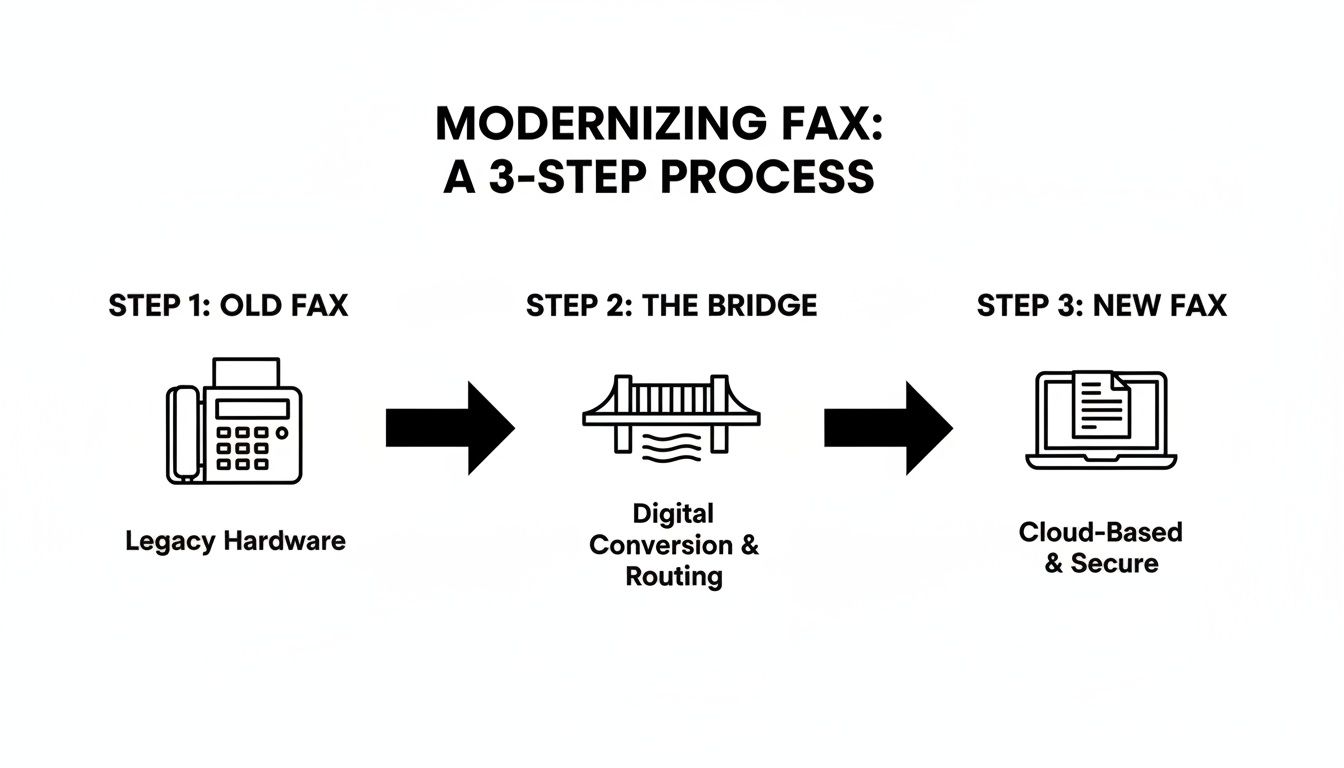
    The journey from old-school hardware to modern cloud faxing is a pretty big leap, simplifying everything.

    A three-step process diagram for modernizing fax from legacy hardware to cloud-based and secure systems.

    This shift is what makes sending a quick fax from your computer possible.

    Plugging in the Sender and Recipient Details

    Okay, file's ready. Now, head over to the online fax service. You'll see a clean, straightforward form waiting for you.

    This is where accuracy is absolutely critical. A tiny typo here can send your document into the void. You'll need to provide:

    • Your Name and Email: Your name tells the recipient who it's from. The email is vital—that’s where your confirmation (or failure notice) will be sent.
    • Recipient's Name and Fax Number: Double-check, then triple-check that fax number. A single wrong digit is the number one reason faxes fail. Adding the recipient's name is also a smart move, especially if you're faxing to a large organization with a shared machine.

    Pro Tip: A surprisingly common mistake is forgetting the area code. For any faxes going to the U.S. or Canada, always use the full 10-digit fax number. It’s a simple thing that prevents a lot of headaches.

    Treat this step like addressing a physical letter. Get it right, and it gets there. Get it wrong, and you're back to square one.

    Writing a Clear and Helpful Cover Page

    The cover page is your fax's handshake. Most free services create one for you automatically using the sender and recipient info you just entered. You’ll also get a small text box for a message.

    Don't just leave it blank or write something generic. Be concise, but give the recipient some context.

    A good cover page message looks like this:
    "Hi Mark, here is the signed W-9 form for the project. Please let me know if you need anything else. Thanks, Jane Doe."

    A less-than-helpful message:
    "Here are the documents."

    The first example is professional and immediately tells the recipient what they're looking at and what to do next. The second one just creates more work for them, which isn't a great look. For a deeper dive into crafting the perfect cover page and other tips, our complete guide on how to send a fax online has you covered.

    Uploading Your File and Hitting Send

    You're at the finish line. Just look for the "Choose File" or "Upload Document" button. This will let you browse your computer and select the document you prepped earlier.

    Once your file is attached, give all the information one last look-over. If everything looks correct, go ahead and click "Send Fax." That’s it! The service takes over from here, and you can get back to your day.

    In a few minutes, you’ll get an email in your inbox. This is your proof of delivery, so hang onto it, especially if you're sending something important like a legal document or a time-sensitive form.

    Balancing Security, Privacy, and Service Limits

    Person's hands typing on a laptop with a 'SECURE & PRIVATE' message and lock icon on screen.

    Handing over your documents to any online platform means you're placing a certain amount of trust in that service. When you’re using a free online fax service, it’s smart to understand both the security measures they have in place and the natural limitations that come with a free tool. Knowing this balance helps you make the right call, especially when you're faxing something sensitive.

    Any reputable service is going to make data protection a priority. Most use standard encryption protocols like SSL/TLS to keep your documents safe while they travel from your computer to their servers. It’s the same basic technology that protects your credit card info when you shop online, creating a secure tunnel for your data.

    But let's be realistic—the "free" model sometimes comes with a catch. Some of the less-than-reputable providers might be funding their service by collecting user data for advertisers. This is why you should always look for a service with a crystal-clear privacy policy. A trustworthy platform like SendItFax is upfront about how it handles your data, making it clear that your documents and personal info are never sold to third parties.

    Understanding the Boundaries of Free Faxing

    To keep the lights on, every free service has to set some ground rules. These aren't hidden tricks; they're just the terms of the deal. Getting familiar with them upfront saves you from any potential headaches down the road.

    Honestly, for most people who just need to send a fax now and then, these limits are perfectly fine. It's a fair trade: you send a fax at no cost, and the service manages its resources by setting clear usage caps.

    Here’s what you can typically expect with any free online fax service:

    • Daily Fax Quotas: To stop spam and manage their systems, services almost always limit how many faxes you can send in a day. A common cap is around five faxes per 24-hour period.
    • Page Count Restrictions: Free faxes are meant for shorter documents. You’ll usually find a limit of three pages, and that doesn't include the cover page the service adds on. It’s perfect for a quick form but not for that long report you need to send.
    • Branded Cover Pages: That cover page will almost certainly have the service's logo on it. Think of it as their a form of advertising, which is a big part of how they can offer the service for free.

    The main takeaway here is that a free service is built for occasional, non-commercial use. If you’re sending a 20-page legal contract or need a clean, professional look for a client, you’ll want to look at a paid plan.

    When Security and Privacy Are Non-Negotiable

    While today's encryption makes online faxing pretty secure, the sensitivity of your document should always be the deciding factor. If you're just sending a signed permission slip to your kid's school or a simple form to a local shop, the security from a solid free service is more than enough.

    But when you’re dealing with highly sensitive information, the stakes are way higher.

    Document Type Potential Risk with a Low-Security Service Recommended Approach
    Medical Records Could lead to a HIPAA violation if the service isn't compliant. Only use a service that explicitly offers HIPAA-grade security.
    Financial Statements Your bank account numbers or private financial data could be exposed. Stick to a provider with top-notch encryption and a rock-solid privacy policy.
    Legal Contracts Risk of interception or challenges to the document's integrity. A paid, secure service with detailed delivery confirmations is a must.

    For documents like these, you aren't just sending a file—you're transmitting confidential information that demands the highest level of protection. While a service like SendItFax provides a strong security baseline even on its free tier, always pause and evaluate just how sensitive your information is before you hit send.

    To get a deeper dive into the technical side of things, you can learn more about why fax is often trusted over email for secure documents in our article on the security of fax transmissions. It’ll help you feel confident you're choosing the right tool for the job, every single time.

    Knowing When to Upgrade from a Free Service

    A free online fax service is a lifesaver for sending a quick document now and then. Need to get a signed form back to your kid's school or fax a single-page receipt? It’s perfect for that—no cost, no hassle. But eventually, you might find yourself running into the limitations that come with "free." Knowing when you've outgrown the free tier is crucial for keeping your communications smooth and professional.

    Think of it this way: free services are built for casual, infrequent use. The moment faxing becomes a regular or critical part of your work—whether for business, legal matters, or important personal documents—the small price of an upgrade starts to look like a smart investment in reliability.

    When Page Count Becomes a Problem

    The most frequent reason people upgrade is pretty straightforward: they need to send a longer fax. Most free plans have a hard cap of around three pages, not counting the cover sheet. That’s fine for a simple invoice, but it’s a non-starter for anything more substantial.

    Imagine you're a mortgage broker trying to send a 20-page loan application. A free service would simply reject it, leaving you scrambling to find another solution with a deadline looming.

    This is a common headache for legal professionals, too, who regularly deal with lengthy contracts, discovery documents, or court filings that easily surpass the free limit. In these cases, paying a small one-time fee for a plan like SendItFax’s Almost Free option, which handles up to 25 pages, is a no-brainer.

    Needing a More Professional Image

    With a free service, there's always a trade-off. They usually place their own branding and ads on the cover page. For sending something to a friend, who cares? But when you're trying to make a good impression, it can look a bit unprofessional.

    A few real-world examples where this matters:

    • Submitting a bid to a potential client: You want your company’s logo on that cover page, not someone else's.
    • Sending a formal application for a grant or license: A clean, unbranded document looks far more serious and polished.
    • Communicating with a government agency: Removing third-party branding helps your submission look as official as possible.

    Upgrading to a paid tier gets rid of that branding and gives you a clean slate. It’s a subtle touch, but it says a lot about your attention to detail.

    Upgrading isn't just about getting more features; it’s about matching the right tool to the job. When your reputation is on the line, a paid service is less of a cost and more of an essential part of your professional toolkit.

    When Time Is of the Essence

    Another thing to consider is speed. Free faxes are sent with standard priority, meaning they get in line behind faxes from paying customers. They usually go through quickly, but during busy periods, you could experience delays.

    If you’re up against a hard deadline—like submitting a legal filing minutes before the court closes or sending a time-sensitive medical record—you can't afford to wait in a queue. Paid plans offer priority delivery, which bumps your fax to the front of the line. That small advantage can be the difference between making a deadline and missing it entirely.

    For a deeper dive into how different providers stack up, take a look at our online fax services comparison.

    Faxing isn't going away, either. The global market for fax services hit $3.3 billion and is expected to reach $4.47 billion by 2030, largely because it remains a secure and trusted method in many industries. You can find more data on the growing business faxing market on Business.com. This trend highlights why having a reliable fax solution—free or paid—is still a smart move for any professional.

    Getting It Right: Practical Faxing Tips for Your Industry

    A clean workspace with tablets displaying business icons, a laptop, and documents, illustrating industry fax tips.

    Faxing isn't a one-size-fits-all game. The way a medical clinic sends sensitive patient records is worlds apart from how a freelancer zips over a signed contract. Knowing these differences is what separates an effective fax from a potential compliance headache.

    Every industry has its own set of rules, security expectations, and documentation standards. Using a free online fax service effectively means tailoring your approach to meet those needs. Let's break down some real-world advice for a few key fields.

    For Healthcare Professionals and Administrators

    When you're dealing with Protected Health Information (PHI), security and compliance are everything. A fax isn't just a piece of paper; it's a legal medical document. One small mistake could lead to a serious HIPAA violation.

    Your fax cover page is your first line of defense. It's not just a formality—it’s a critical compliance tool that directs the receiving party on how to handle the sensitive information inside.
    • Airtight HIPAA Statement: Every single fax must include a confidentiality notice. Something standard like, "This fax contains confidential, legally privileged information intended only for the recipient named above," is non-negotiable.
    • Clear Patient Identifiers: To avoid dangerous mix-ups, always include at least two unique patient identifiers. Think full name and date of birth, or a medical record number.
    • Sender Verification: The recipient needs to know who you are and how to reach you. Clearly state your name, title, facility, and a direct contact number so they can instantly verify the source.

    Think of it this way: the cover page sets the stage for privacy. It gives clear instructions and reduces the risk of PHI ending up in the wrong hands at a busy clinic or hospital.

    For Legal and Real Estate Professionals

    In the legal and real estate worlds, the proof of delivery is often just as important as the document itself. Faxes create a time-stamped paper trail for contracts, court filings, and closing documents. That trail has to be indisputable.

    Here, the cover sheet becomes a formal record of transmission. It establishes precisely when a document was sent, who it was for, and what it was about. This can be your saving grace if a delivery date or time is ever challenged.

    A well-documented fax transmission is a powerful tool. In a legal dispute, that email confirmation showing the exact time a 10-page contract was successfully delivered can make all the difference.

    To build that bulletproof paper trail, make sure every fax includes:

    • Date and Time of Transmission: Even though the service logs it digitally, explicitly stating it in your cover page message reinforces the timing.
    • Case or Property Information: Use a reference line with a case number, client name, or property address. This helps the recipient file it correctly and immediately.
    • Total Page Count: Always specify the total number of pages (e.g., "12 pages including this cover sheet"). This helps the recipient confirm they’ve received the complete document and that nothing went missing.

    For Freelancers and Remote Teams

    For independent contractors and distributed teams, it’s all about speed and flexibility. A free online fax service is a lifesaver, letting you handle administrative tasks from literally anywhere without needing clunky office hardware.

    The most common scenarios here involve sending signed contracts, NDAs, invoices, and project forms. The goal is to get it done quickly while still looking professional. Imagine a freelance designer needing to fax a signed Non-Disclosure Agreement to a new client before they can access project files—they can do it from their laptop at a coffee shop in minutes.

    Even in these less formal situations, best practices still matter. A simple, clear cover page message like, "Attached is the signed NDA for the Q3 design project. Please confirm receipt," ensures your document gets to the right person and doesn't get lost on a shared fax machine. It’s a small step that keeps your projects moving forward without a hitch.

    Got Questions About Free Online Faxing? We’ve Got Answers.

    Even a simple process can bring up a few questions. When it comes to using a free online fax service, getting clear on the details helps you send documents with confidence. We’ve rounded up some of the most common questions people ask, with practical answers to help you get the job done.

    This isn’t about dense technical specs—it’s about the essential info you need to make sure your documents arrive successfully every single time.

    Do I Really Need to Create an Account?

    Nope. And that’s one of the best parts. With a service like SendItFax, there’s no sign-up process at all. You can send a fax without creating an account, which is a huge win for both convenience and privacy.

    Think about it: no new password to remember and no need to hand over personal data just to send a one-off document. It's the perfect setup for those rare occasions you need to fax something and don't want to get locked into a service. This approach also minimizes your digital footprint, which is always a smart move.

    How Will I Know My Fax Actually Went Through?

    This is where your email address is crucial. Once you click send, the service does the work of connecting to the recipient's fax machine. As soon as the transmission is finished—or if it happens to fail—you'll get an automated email notification.

    That confirmation email is your virtual receipt. It serves as your proof of delivery and typically includes all the important details:

    • The exact date and time the fax was sent.
    • The recipient’s fax number.
    • The total number of pages that were successfully delivered.
    • A unique confirmation number or transmission ID for your records.

    Crucial Tip: Always double-check that you've entered your email address correctly. A simple typo is the number one reason people miss their confirmation and are left wondering if their document ever arrived.

    Can I Receive Faxes with a Free Service?

    Here’s a key distinction you need to know: nearly every free online fax service is send-only. They are built to let you push documents from your computer to a physical fax machine, but they don't give you a number to receive faxes back.

    If you need two-way communication, you’ll almost certainly have to upgrade to a paid plan. Paid services assign you a dedicated virtual fax number. When someone sends a fax to that number, it’s converted into a digital file (like a PDF) and delivered right to your email inbox or a secure online dashboard.

    Why Did My Online Fax Fail to Send?

    Getting a failure notification is frustrating, but don’t worry—the reason is usually something simple and easy to fix.

    Before you hit "send" again, run through this quick troubleshooting checklist. The problem is likely one of these common culprits:

    1. Check the Fax Number: Is the number 100% correct? A single wrong digit, even in the area code, is the top reason for failure.
    2. Busy Signal: Just like in the old days, the receiving fax machine might be in use. Give it a few minutes and try again.
    3. Page Limits: Did you go over the limit? Most free services cap faxes at three pages plus the cover page. Anything longer will get rejected.
    4. The Receiving Machine: The machine you're sending to could be turned off, out of paper, or unplugged. If possible, it might be worth a quick phone call to confirm their machine is ready to go.

    By checking these few things, you can solve most transmission issues and get your document where it needs to be.


    Ready to send your first fax without the hassle? SendItFax makes it easy to send documents securely right from your browser, no account needed. Try it now at https://senditfax.com.

  • How to Fax from Laptop: A Modern Guide

    How to Fax from Laptop: A Modern Guide

    When you need to fax from a laptop, the simplest, most straightforward way is to use an online fax service. These services act as a bridge, taking your digital files and sending them over the internet to a traditional fax machine. No hardware, no dedicated phone line needed.

    Why You Still Need to Fax in a Digital World

    Laptop displaying fax still matters message with security lock icon on desk workspace

    It’s a fair question. Didn't faxing disappear along with dial-up modems and floppy disks? Surprisingly, no. In certain crucial industries, it's not just hanging on—it's still a required method of communication. For professionals in healthcare, law, and finance, sending a fax is often a non-negotiable part of the job.

    The resilience of faxing boils down to two things: security and legal validity. A fax creates a direct, point-to-point connection that’s much harder to intercept than a typical email. This inherent security makes it the go-to for sending sensitive information, like medical records governed by HIPAA or legally binding contracts.

    The Modern Advantage of Laptop Faxing

    Knowing how to fax from a laptop connects these old-school requirements with today's need for flexibility. You’re no longer tied to a clunky machine in the corner of the office. Now, you can send critical documents from literally anywhere you have an internet connection.

    This simple shift makes a huge difference:

    • Better Security: Online fax services add modern encryption to the transmission process, giving you a layer of protection that old analog machines could never offer.
    • Real Cost Savings: Forget about paying for paper, ink, toner, and machine maintenance. You also get to ditch the dedicated phone line that fax machines used to require.
    • Total Convenience: Send a signed contract from a coffee shop or submit an urgent form from your home office. Your laptop is now a powerful, portable fax machine.

    This isn't just anecdotal; the numbers back it up. The global fax services market was valued at an impressive USD 3.3 billion in 2024 and is expected to keep growing, largely because of its vital role in secure business communications. You can dig into the full fax services market trend report for a deeper look.

    Key Takeaway: The real reason faxing sticks around is trust. When you send a fax, you get a transmission receipt. This receipt is legally recognized proof that your document arrived, confirming the exact time it was received.

    For a quick overview of your options, here’s a look at the most common methods for faxing from a laptop.

    Laptop Faxing Methods at a Glance

    This table breaks down the main ways to send a fax from your computer, helping you pick the right one for the job.

    Method Best For Ease of Use Typical Cost
    Online Fax Service Frequent faxing, businesses needing a dedicated number, and high security. Very Easy Monthly subscription (e.g., $10-$30/month)
    Email-to-Fax Quick, one-off faxes for users already subscribed to an online service. Easy Included with most online fax subscriptions.
    Windows Fax & Scan Occasional faxing for users with access to a landline and fax modem. Moderate Cost of a phone line and modem.
    Mac Faxing Apps Mac users who prefer a native app experience and have a fax modem. Moderate App cost plus phone line and modem.

    As you can see, online fax services usually offer the best balance of features, security, and convenience for most people today.

    Why It Still Matters for You

    At the end of the day, a fax provides a verifiable paper trail that’s often required for official business. When you absolutely need to send a document that requires a signature and undisputed proof of delivery, faxing remains the gold standard.

    Understanding what is a fax number and how modern services work is the first step. By using your laptop, you can tap into this trusted system without any of the old-school headaches, ensuring your most important communications are both secure and compliant.

    Using an Online Fax Service for the First Time

    Laptop computer displaying send fax easily message on screen with office supplies on wooden desk

    Diving into a new digital tool can seem like a chore, but you'll be surprised at how simple it is to send your first fax from a laptop. Online fax services have come a long way, and most are designed to feel as familiar as sending an email. Let's walk through a common, real-world scenario to see how it works.

    Imagine you just found the perfect apartment, but the landlord needs the signed lease back immediately. For their own compliance reasons, they’ve asked you to fax it. This is the perfect situation to learn how to fax from a laptop without having to track down an old-school machine.

    Navigating the Dashboard

    Once you've picked a service like SendItFax and logged in, you’ll land on a clean, straightforward dashboard. The best part? There’s no software to install. Everything happens right in your web browser. The main screen will lay out all the essential fields you need to fill out.

    You'll typically find a simple form with fields for:

    • The recipient's fax number
    • Your sender details (name, company, etc.)
    • A button to upload your documents
    • An area for a cover page message

    The layout is built for speed, eliminating any guesswork. You just work your way down the form, filling in each part as you go.

    Pro Tip: I can't stress this enough: always double-check the recipient's fax number. A single wrong digit is the number one reason faxes fail. Unlike email, you won't get a nice "undeliverable" message telling you about the typo.

    Uploading Your Lease Agreement

    Alright, let's get that signed lease attached. Modern online fax services are incredibly flexible and accept a ton of different file types, so you're not stuck with just one format.

    Most platforms, SendItFax included, can easily handle:

    • PDF files: This is the gold standard for official documents, as it preserves all formatting perfectly.
    • Microsoft Word documents (.doc, .docx): Great for sending over contracts or letters you've just finished writing.
    • Image files (.jpg, .png): Super useful if you signed a physical document and just snapped a clear picture of it with your phone.

    In our scenario, you'd just click the "Upload File" button and grab the PDF of your signed lease from your laptop. The service takes care of converting and preparing it for transmission. You can even attach multiple documents, and the service will merge them into a single fax for you.

    Adding a Professional Cover Sheet

    Think of a cover sheet as the introduction to your fax. It tells the recipient who it's from, who it's for, and why you're sending it. This is especially important if you're faxing to a big office where your document might get passed around.

    A good cover sheet always includes:

    • To: The landlord's name
    • From: Your name
    • Date: The current date
    • Pages: The total page count (including the cover sheet!)
    • Subject: Something clear, like "Signed Lease Agreement for Apt 4B."

    Most services also give you a text box for a quick note. A simple message like, "Hi, please find the signed lease agreement attached. I look forward to moving in!" adds a nice, professional touch.

    Give everything one last look, hit "Send Fax," and you're done. If you're still weighing your options, our online fax services comparison is a great resource to help you find the perfect fit.

    Getting Your Documents Ready for a Perfect Send

    Sending a fax from your laptop is incredibly convenient, but a little prep work goes a long way. Think of it like this: you wouldn't feed a crumpled, messy stack of papers into a physical fax machine. The same logic applies here. Taking a moment to get your digital files in order is the key to making sure they arrive looking sharp and professional.

    The most important choice you'll make is the file format. While a service like SendItFax is flexible, one format is king for a reason.

    Why Your File Format Matters

    Hands down, the best format for faxing is the Portable Document Format (PDF). It’s the gold standard. When you save a file as a PDF, you're essentially taking a snapshot that locks in everything—all the fonts, images, and spacing. This means that crucial invoice or signed contract will look exactly the same on the other end, with no weird formatting glitches or missing text.

    Of course, other common formats work too:

    • DOC/DOCX: Microsoft Word files are usually fine, but there's a small risk the formatting could shift if the recipient doesn't have the exact same fonts you do.
    • JPG/PNG: Image files are great when you need to send a picture of something, like a signed document you snapped with your phone. Just make sure the photo is clear, well-lit, and easy to read.

    From my own experience, I always convert my final documents to PDF before faxing. It's a quick, one-click step in almost any program and saves you from a ton of potential headaches. It guarantees my documents always look professional when they land.

    Going From Paper to Pixels

    But what if your document is a physical piece of paper, like a signed form or an important receipt? You don't need to hunt down a scanner. Your smartphone is a surprisingly powerful scanning tool that's probably within arm's reach right now.

    Instead of just taking a picture, use a dedicated scanning app like Adobe Scan or even the feature built into your phone's Notes app. These tools are designed for this exact purpose. They'll automatically find the edges of the paper, fix the perspective, and boost the contrast to create a clean, crisp digital file that looks way better than a regular photo. It’s a simple trick that makes a huge difference in legibility.

    Don't Skip the Cover Sheet

    Finally, let's talk about the cover sheet. It might seem like a small detail, but it's the first thing your recipient sees. It’s your professional handshake, ensuring your fax gets to the right person right away, which is especially important in a big, busy office.

    Make sure your cover sheet has all the essentials:

    1. To: The recipient's full name, company, and fax number.
    2. From: Your name, company, and a contact phone number.
    3. Date: The date you're sending the fax.
    4. Pages: The total page count, and don't forget to include the cover sheet itself in that number.
    5. Subject: A clear, concise subject line (e.g., "Signed Lease Agreement for Suite 2B") and a quick note in the comments can add vital context.

    The good news is that most web-based fax services generate this for you. You just fill in the blanks. It’s a foolproof way to ensure your fax is professional, complete, and arrives without a hitch.

    Exploring Other Ways to Fax From Your Laptop

    https://www.youtube.com/embed/qtWEtt5JV90

    While logging into a web portal is a fantastic, straightforward way to send a fax, it’s not the only tool in your digital faxing kit. Sometimes your workflow just demands something faster or more integrated. Let's dig into a couple of powerful alternatives that give you even more flexibility.

    The Power of Email-to-Fax

    One of the most efficient methods out there is email-to-fax. This is a killer feature that most quality online fax services include, and it essentially turns your regular email client—whether it's Outlook, Gmail, or Apple Mail—into a direct faxing machine. It's perfect for those moments when you just need to fire off a document without logging into another website.

    The process itself is refreshingly simple. You just compose a new email, attach your document (like a PDF or Word file), and send it to a special address provided by your fax service. It's that easy.

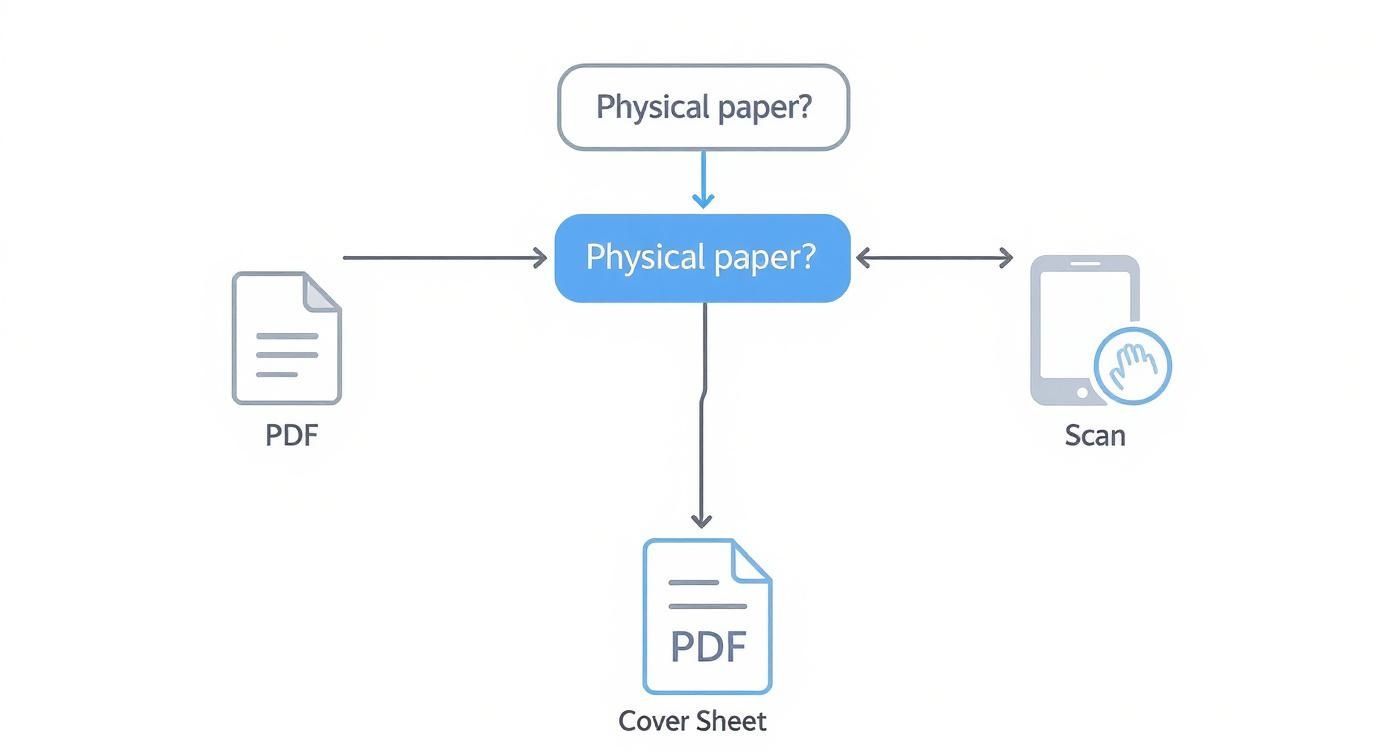
    Before you send, you obviously need your document ready. This flowchart breaks down how you can get your file prepped, whether you're starting with a physical piece of paper or something that's already on your computer.

    Flowchart showing digital fax process from physical paper to PDF or scan conversion

    As you can see, the path from your initial document to a fax-ready file is pretty direct, always ending with that all-important cover sheet to make sure it looks professional.

    To use the email-to-fax feature, you just need to format the recipient's "To" address in a specific way. For example, you might type the destination fax number followed by the service’s domain, something like 18005551234@senditfax.com.

    What’s really slick is how it handles the cover page. The email's subject line automatically becomes the subject on the fax cover sheet, and whatever you write in the body of your email populates the cover sheet's message area. It’s an incredibly smooth process that fits right into a routine you already know.

    For a complete walkthrough, be sure to check out our detailed guide on how to fax via email.

    Using Your Operating System's Built-In Tools

    Another path you could take is using the tools that are already on your computer. If you're a Windows user, this means turning to the classic Windows Fax and Scan utility. This program has been a part of the operating system for ages and offers a direct way to send faxes—but there's a pretty big catch.

    To make it work, you need a piece of hardware that most modern laptops simply don't have anymore: a fax modem. This is a physical device that connects your laptop to a telephone line. So, if you happen to have a landline and a modem lying around, you can actually set it up to send and receive faxes right from your desktop.

    Key Takeaway: While using a built-in tool like Windows Fax and Scan lets you avoid subscription fees, the hardware requirement makes it pretty impractical for most people today. The sheer convenience of online services almost always outweighs the hassle of setting up a physical connection.

    The leap from those old, clunky machines is significant. Faxing from a laptop has evolved by replacing bulky hardware with smart, internet-based services and software. Laptops with an internet connection can now bypass physical phone lines entirely, as services convert your digital files into fax-compatible formats and transmit them through cloud servers. You can read more about the technological evolution of faxing on Britannica.

    Ultimately, choosing between email-to-fax and a built-in OS tool comes down to your specific situation. For speed, convenience, and seamless integration with a service you're already using, email-to-fax is the clear winner. For the rare, occasional fax where you actually have all the required hardware, an OS utility might just get the job done.

    How to Fix Common Digital Fax Problems

    Person reviewing printed document while working on laptop computer outdoors with fix fax issues text

    So, your digital fax didn't go through. It happens. Even with a reliable online service, transmissions can fail, but before you get frustrated, know that most of these hiccups are surprisingly easy to fix. The trick is understanding what went wrong in the first place.

    When a fax fails, your service will shoot you a transmission report. Don't just archive it—this report is your best friend for troubleshooting. It’ll usually have an error code or a short message like "Busy Signal" or "No Answer" that tells you exactly what happened.

    Decoding Failed Transmissions

    A "Busy Signal" is the most common roadblock you'll encounter. This isn't a problem on your end. It just means the recipient's fax machine is tied up, either sending or receiving another document. The solution is simple: patience. Give it 10-15 minutes and then try resending.

    Then there's the "No Answer" message. This one means the receiving machine never picked up the call. A few things could be going on here:

    • Wrong Number: You might have a typo in the fax number. It's the most common culprit.
    • Machine Issues: The receiving machine could be turned off, out of paper, or unplugged.
    • Voice Line: You might be accidentally faxing a regular phone number instead of a dedicated fax line.

    Before you do anything else, double- and triple-check the fax number you typed in. One wrong digit is all it takes. If the number is correct, you might need to give the recipient a quick call to make sure their machine is on and ready to go.

    Key Takeaway: Failed faxes are rarely your fault. In my experience, over 90% of transmission failures are due to issues on the recipient's end—a busy line, a machine that's off, or just a simple wrong number.

    Tackling Blurry or Unreadable Faxes

    What about when the fax does go through, but the person on the other end says it looks like a smudged mess? This is almost always a quality issue with the original file you uploaded. A low-resolution image or a poorly scanned document will inevitably look blurry on the other side.

    The fix is all in the prep work. Go back to your source document. If it's a scan, make sure you used a setting with high contrast to get a crisp, clean image. For digital files, a high-quality PDF is your best bet for preserving formatting and sharpness. A little extra care before you hit "send" ensures your document arrives looking professional and, most importantly, readable.

    Common Questions About Faxing From a Laptop

    Switching from a clunky machine to sending faxes from your laptop is a game-changer, but it's totally normal to have a few questions. The whole process feels different, especially when you're thinking about things like security and legal proof. Let's tackle some of the most common things people ask when they're getting started.

    Getting these questions answered will help you feel confident that your important documents are being sent securely and professionally.

    Is It Really Secure to Fax Sensitive Documents This Way?

    Yes, and honestly, it's often much safer than using the old office fax machine. Think about it: a traditional fax spits out sensitive documents onto a tray for anyone to see. Online fax services are built with modern digital security in mind.

    Reputable services use end-to-end encryption, which basically scrambles your data as it travels from your laptop to its destination. This creates a secure tunnel that prevents anyone from snooping on your files in transit.

    The biggest security win is actually on the receiving end. Instead of a confidential medical record or a signed contract sitting in plain sight on a shared machine, incoming faxes land securely in your email inbox or a password-protected online account. Only you see them.

    If you work in an industry like healthcare or law, just be sure to pick a service that is explicitly HIPAA-compliant. This ensures they meet the strict legal standards required for handling protected information.

    Are These Laptop Faxes Actually Legally Binding?

    Absolutely. A fax sent from your laptop through an online service carries the same legal weight as one sent from a traditional machine. The secret sauce is the verifiable proof of delivery you get afterward.

    Every time you send a fax, the service generates a detailed transmission receipt. This is your official record, and it confirms everything you need for legal purposes:

    • The exact date and time it was sent.
    • A clear confirmation of a successful delivery.
    • The recipient's fax number.

    This kind of documentation is invaluable for legal contracts, official filings, or any time you need undeniable proof that a document was sent and received. In many ways, the digital paper trail from online faxing is far more reliable and easier to store than a flimsy, printed confirmation page.

    So, Do I Still Need a Phone Line Hooked Up to My Laptop?

    Nope, not at all! This is probably one of the best parts of learning how to fax from a laptop. You can ditch the dedicated phone line entirely.

    Online fax services use a technology called Fax over IP (FoIP), which just means they send the fax data over your internet connection. As long as your laptop is connected to Wi-Fi or an ethernet cable, you're good to go. The service handles the technical wizardry of converting your PDF into a signal that a standard fax machine can receive on the other end. It completely frees you from the cost and hassle of maintaining an old analog phone line.


    Ready to send your first fax without the fuss? With SendItFax, you can send secure, legally valid faxes right from your browser in minutes. No account, no subscription, just simple, reliable faxing. Try SendItFax now!

  • How to Fax Online for Free The Ultimate Guide

    How to Fax Online for Free The Ultimate Guide

    It might sound old-school, but faxing is still a surprisingly common requirement in today's world. Thankfully, sending a fax for free online is incredibly simple. All you need is a web-based service like SendItFax, where you can upload a file, type in the destination fax number, and hit send. No machine, no phone line, no hassle.

    Why Bother With Faxing Anymore?

    You’d be surprised. For all our digital progress, faxing remains a critical tool in sectors like healthcare, law, and government. Why? It's all about security and legal standing. A fax creates a direct point-to-point connection for sending sensitive documents, which is often considered more secure and legally binding than a simple email.

    This isn't just a niche practice; the online fax market is booming. It's projected to more than double, growing from USD 2.2 billion to USD 4.5 billion by 2035. A big part of that growth comes from people ditching clunky old machines for cloud-based faxing. In fact, if just 5% of users switched from traditional to online faxing, we could save a staggering 10 billion pages of paper annually.

    The Clear Edge of Faxing Online

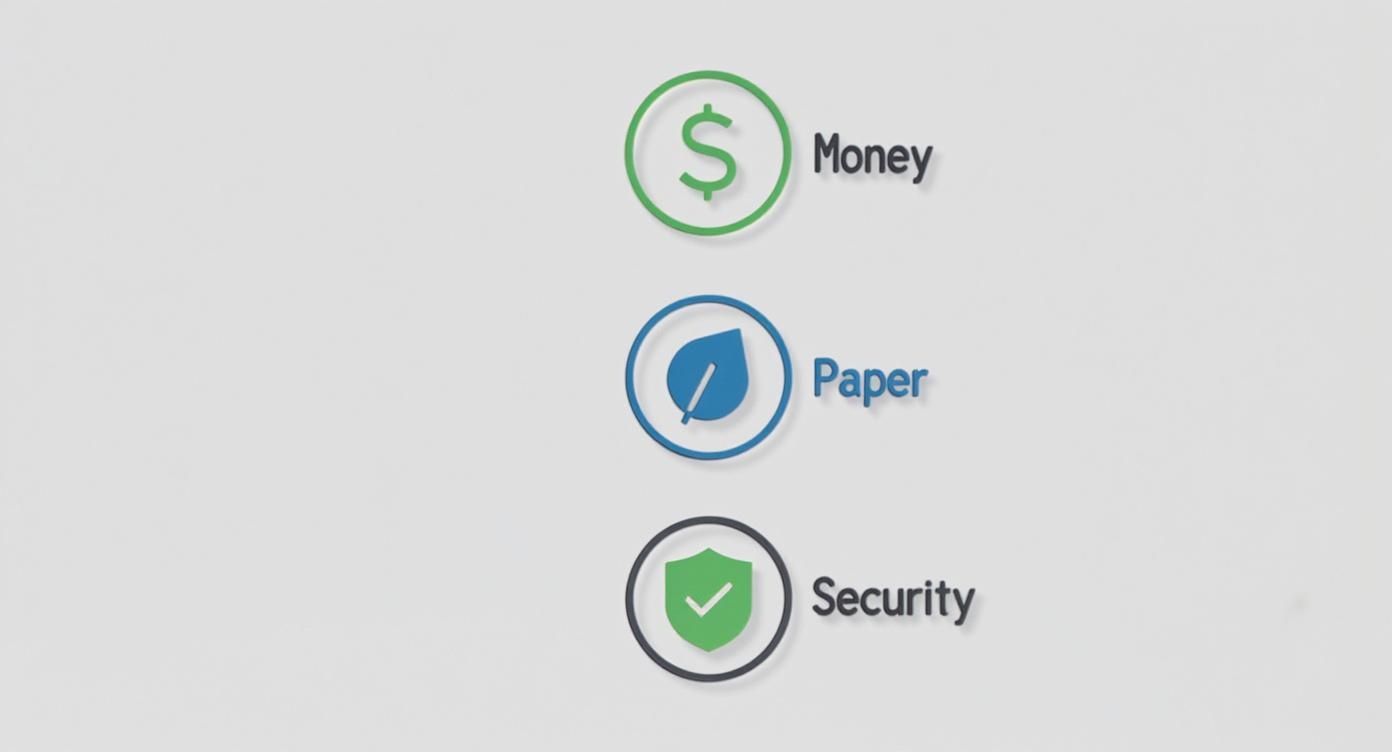
    Choosing a free online fax service is the perfect modern solution to an old-world problem. You get to skip the bulky hardware, the extra phone line, and the endless costs of paper and toner. It’s a smarter way to work.

    Three icons with labels: Money (dollar sign), Paper (leaf), and Security (shield with checkmark).

    The benefits really stack up, especially for individuals or small businesses who only need to send a fax now and then:

    • Total Convenience: Send a document from your laptop, tablet, or even your phone—wherever you have an internet connection.
    • Zero Cost: You completely avoid the purchase price and ongoing maintenance costs of a physical fax machine.
    • Better Security: Reputable online services use encryption, which is a huge step up from leaving a sensitive document sitting in the tray of a shared office machine.

    Online faxing isn't just a replacement; it's an upgrade. It allows you to meet the requirements of legacy systems without giving up the efficiency and security we've come to expect from modern technology.

    Traditional Faxing vs Free Online Faxing

    Here’s a quick breakdown of how a free online service stacks up against a traditional machine for the occasional user.

    Feature Traditional Fax Machine Free Online Fax Service
    Initial Cost $100 – $400+ for the machine $0
    Ongoing Costs Paper, ink/toner, dedicated phone line, repairs $0 (for sending)
    Convenience Tied to a physical location Send from anywhere with internet
    Document Format Physical paper only Digital files (PDF, DOCX, JPG, etc.)
    Security Documents can be left exposed in the output tray Often includes encryption for secure delivery
    Environmental Impact Consumes paper and electricity Paperless and eco-friendly

    The choice is pretty clear. For sending the occasional document, a free service just makes more sense.

    Getting started is easy, but it helps to understand the fundamentals, like learning what is a fax number and how it works in a digital setup. Once you have that down, you'll see just how powerful this simple tool can be.

    Getting Your Documents Ready to Fax

    Before you can send a fax online, you need to have your document in a digital file. This might seem obvious, but the format you choose can make or break the whole process. Get it wrong, and your recipient could end up with a blurry, unreadable mess.

    Most free fax services are pretty flexible and accept common file types. But from my experience, one format stands head and shoulders above the rest for reliability.

    Pick the Right File Type for a Clean Send

    You'll usually see options for PDF, DOCX, and JPG. While you can send a Microsoft Word file (DOCX) or a simple image (JPG), I always recommend sticking with PDF (Portable Document Format).

    Why? Because a PDF is essentially a picture of your document. It locks everything in place—the fonts, the spacing, the images. This means what you see on your screen is exactly what will print out on the other end, which is crucial for things like signed contracts or official forms where every detail matters.

    Think of a PDF as a digital snapshot. It prevents anything from getting jumbled or reformatted during the fax transmission, guaranteeing a professional and readable result every time.

    From Paper to a Digital File

    What if your document is a physical piece of paper sitting on your desk? No problem. You don't need a clunky old scanner anymore; your smartphone is more than capable of doing the job.

    The camera on your phone, paired with a scanning app, can create a crisp digital copy. You might even have a scanner built right into your phone's native apps, like the Notes app on an iPhone or the Google Drive app on Android.

    To get a great scan, just follow these simple tips:

    • Light it up: Find a spot with good, even lighting. Lay your document on a flat, dark surface to create contrast. Try to avoid shadows or glare, as they can make the text hard to read.
    • Get a steady shot: Hold your phone parallel to the document, making sure you can see all four corners. Most scanning apps are smart enough to find the edges and straighten the image for you.
    • Tweak it a little: Once you've captured the image, use the app's editing tools to crop out the background. Bumping up the contrast can also make the text pop and the white background look cleaner.

    Mind the File Size

    This is a step people often forget. Free online fax services have to manage their resources, so they usually limit the size of the files you can send—typically somewhere between 5 MB and 10 MB. A really high-quality scan or a document with lots of images can easily blow past that limit.

    If your file is too big, don't worry. Just pop it into a free online PDF compression tool. A quick search for "compress PDF free" will turn up plenty of easy-to-use options that can shrink your file down without sacrificing much quality, ensuring it uploads and sends without a hitch.

    Sending Your First Free Online Fax

    You’ve got your document prepped and ready to go. Now for the easy part. Sending a fax online is surprisingly straightforward, but a few small details can make all the difference. Let's walk through it so you know exactly what to expect.

    Your first move is to head to a free online fax service. You'll immediately see a prompt to upload your file. This is where having that compressed PDF comes in handy—it makes for a quick and painless upload every time.

    Getting the Recipient Details Right

    This is where you need to pay close attention. It's the number one spot where faxes fail, and it's usually due to a simple typo.

    For faxes within the U.S. and Canada, it’s just the area code and the seven-digit number. Don't worry about adding a "1" for long-distance; the service handles that for you.

    Sending a fax internationally? You'll need to be a bit more careful. You have to start with the country code, then the city/area code, and finally the local number. For instance, a fax to London needs the UK's country code (44) at the very beginning. Forgetting that prefix is an almost guaranteed way to get a "failed transmission" notice.

    A quick tip from experience: Always, always double-check the fax number before you hit send. One wrong digit can send your confidential documents to the wrong machine or just into the ether. It’s a two-second check that can save you a massive headache.

    Why You Should Bother With a Cover Page

    The cover page is your fax’s handshake. It's the first thing your recipient sees. While some services like SendItFax make it optional on paid plans, I'd argue it's essential for free sends, especially if you're faxing a large office with a shared machine. A good cover page ensures your document doesn't get lost in the shuffle.

    Here's the key info to include:

    • To: The recipient's full name and title.
    • From: Your name and company (if it's relevant).
    • Date: The day you're sending it.
    • Subject: Be specific! "Signed Contract for Project Apollo" is a lot more helpful than "Contract."
    • Number of Pages: Don't forget to include the cover page itself in the count (e.g., "5 pages, including cover").

    Modern services make this whole process incredibly simple, turning what used to be a clunky office task into something you can do from your phone.

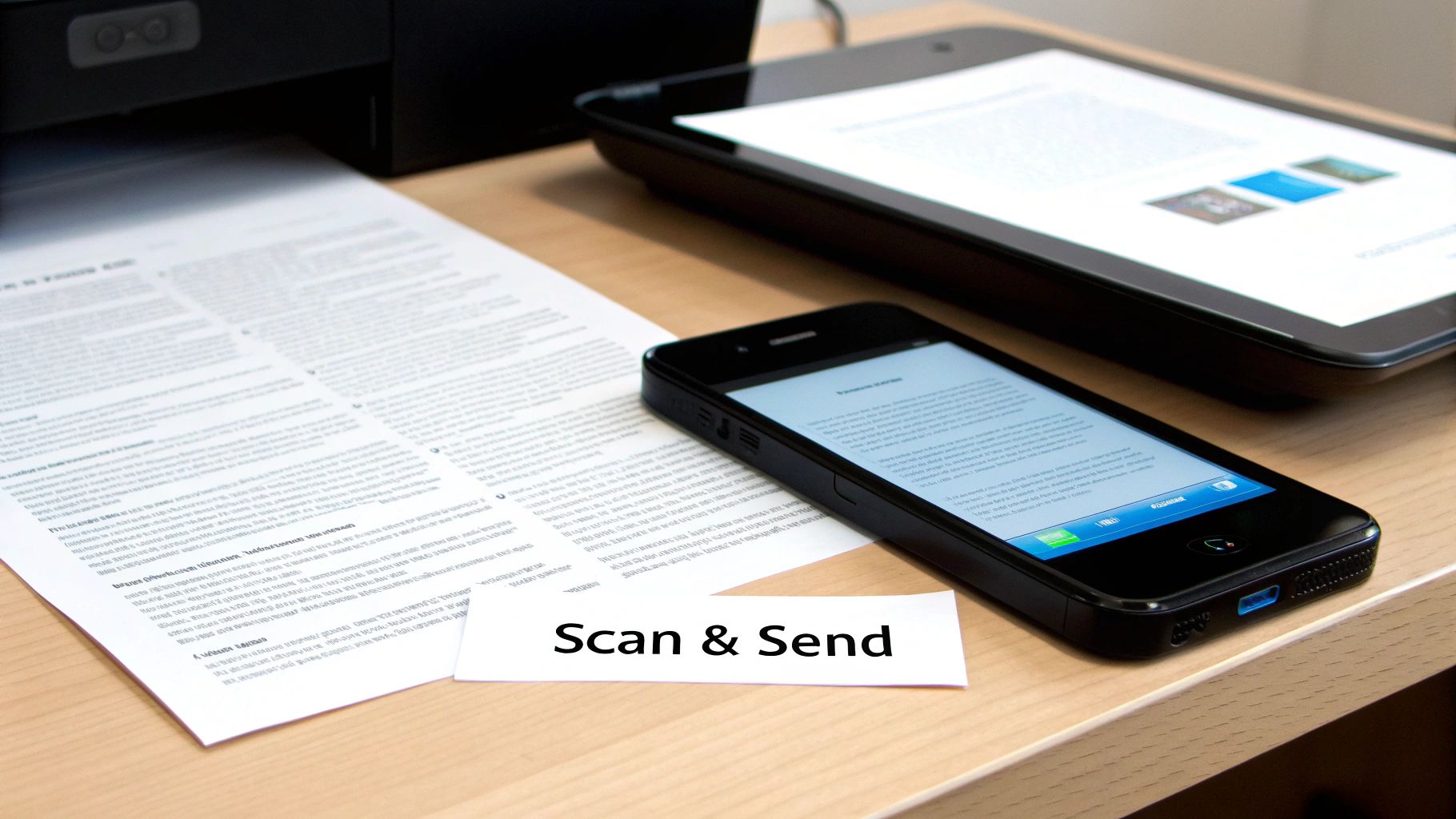
    A document being scanned and sent with a smartphone and tablet, featuring a 'Scan & Send' label.

    What Happens After You Click "Send"

    Once you hit that button, the magic happens behind the scenes. The service converts your file into a signal that a traditional fax machine can understand and then starts dialing. It's not always instant—if the recipient's line is busy, the system will patiently redial a few times.

    Keep an eye on your email inbox. You'll get a confirmation message that tells you whether the fax went through successfully or if it failed. This email is your proof of transmission, so it's important. If you don't see it within a few minutes, check your spam folder before you panic.

    A "failed" notification isn't the end of the world. It’s usually just a busy signal, a disconnected number, or that tiny typo in the fax number we talked about. The process to send a free fax from your computer is built to handle these little hiccups, but getting the details right from the start is the best way to avoid them.

    Navigating the Limits of Free Fax Services

    https://www.youtube.com/embed/I4YKQdY6xwk

    Free online fax services are an incredible tool for sending a quick document here and there, but it's important to go in with your eyes open. They all have guardrails in place, and knowing what they are ahead of time will save you a lot of frustration. I like to think of it less as a drawback and more as a simple trade-off for getting a service at no cost.

    The most common hurdle you'll run into is a daily page limit. Most providers will cap you at a certain number of pages per day, typically somewhere between three to five pages per fax. This is usually plenty for sending back a signed contract or a single application form. But what happens when your document is longer?

    Smart Workarounds for Page Limits

    Don't throw in the towel. With a little creativity, you can work around those limits pretty easily. Let's say you have a seven-page document but the service only allows five pages per fax. The answer is simple: split it up. It just takes a little extra communication.

    Here’s how I’ve handled this in the past:

    • Split your document. I use a free online PDF tool to break my seven-page file into two smaller ones. In this case, I'd make one with pages 1-4 and a second with pages 5-7.
    • Be crystal clear on your cover pages. For the first fax, I'll make the subject line something like: "Contract Submission – Part 1 of 2 (Pages 1-4)."
    • Send the second part right away. Then, I immediately send the next one with a corresponding subject: "Contract Submission – Part 2 of 2 (Pages 5-7)."

    This approach lets the person on the other end know exactly what to expect and makes it easy for them to assemble the full document. It keeps things professional and organized, which is always a good look.

    The real goal isn't just to get the pages sent; it's to make the recipient's job as easy as possible. Clear labeling on the cover page transforms a workaround into a thoughtful, organized process that prevents any mix-ups.

    Another big limitation is the inability to receive faxes. Free services are almost always a one-way street—you can send, but you can’t get one back. This makes sense, as providing a dedicated incoming fax number costs the provider real money. If you need two-way faxing, that’s the clearest sign that a free plan won't cut it for you.

    When It's Time to Consider an Upgrade

    Free services are purpose-built for occasional, non-critical faxes. But you’ll start to see signs when it’s time to look at a paid option, even a really affordable one.

    You should think about upgrading if you find yourself:

    • Constantly hitting the limits: If splitting documents or waiting for the next day to send a fax has become a regular part of your routine, your workflow is being slowed down.
    • Needing to receive faxes: This is the number one reason people make the switch. For any kind of business or official back-and-forth, a dedicated number is a must-have.
    • Wanting a more professional appearance: Free services, including SendItFax, often put their branding on the cover page. That’s perfectly fine for personal use, but a paid plan gets rid of it for a cleaner, more professional look.
    • Sending highly sensitive information: While most free services are secure enough for general use, paid plans often come with better compliance features and guaranteed priority delivery.

    For most people, the jump isn't to an expensive monthly subscription. A service like SendItFax has what they call an "Almost Free" plan where you pay a small, one-time fee per fax. It removes the branding, bumps your limit up to 25 pages, and gives your fax priority delivery. It's the perfect middle ground for when your needs have grown just a little bit.

    Keeping Your Sensitive Documents Secure

    When you're faxing something for free online, it’s easy to forget you're handling sensitive information. Whether it’s a signed contract or a personal medical form, you're handing that data over to a third-party service. Just because it's free doesn't mean you should have to compromise on security.

    Thankfully, good services take this seriously. The absolute bare minimum you should look for is encryption. Specifically, check for services using SSL (Secure Sockets Layer) or its more modern cousin, TLS (Transport Layer Security). This is the same stuff that protects your credit card details when you shop online. It essentially creates a scrambled, secure tunnel between your computer and the fax service, making your documents completely unreadable to anyone trying to snoop on them while they're in transit.

    Two stacks of documents and a 'SPLIT PAGES' sign on a wooden table outdoors in sunlight.

    Reading Between the Lines of a Privacy Policy

    Okay, I get it—nobody wants to read a privacy policy. It’s usually a wall of legal jargon. But taking just a minute to skim it can tell you everything you need to know about how your files are being treated.

    You don't need a law degree to spot the warning signs. Look for specific language about what happens to your documents after they’ve been sent. A reputable service will be up-front about deleting your files from their servers after a short, defined period.

    A solid privacy policy will explicitly state that your data will not be sold or shared with third-party advertisers. If the language is vague or gives the company broad rights to use your content, that's your cue to find a different service.

    An Essential Security Checklist

    Before you upload a single document, run through this quick mental checklist. These are the green flags that signal a service actually cares about your privacy.

    • SSL/TLS Encryption is a Must: Look for the "https://" at the beginning of the website's URL. If it's not there, don't use the service. Simple as that.
    • A Clear Data Deletion Policy: The service should automatically and permanently purge your sent faxes once the transmission is finished.
    • Minimal Data Collection: The service should only ask for what's truly necessary to send the fax—your email for a confirmation receipt and the recipient's fax number. Anything more is a red flag.

    For certain fields, you have to think about legal compliance, too. If you’re sending anything related to healthcare, for instance, the service absolutely must be HIPAA compliant. This is a federal standard that ensures patient information is handled with the highest level of security.

    Most free services won't meet this high bar, but it’s crucial to be aware of. Some methods, like sending faxes directly from your email, can add another layer of control. You can learn more about how to fax via email to see if that approach works better for your security needs. Ultimately, choosing a service with transparent, common-sense security practices lets you send faxes for free without looking over your shoulder.

    Troubleshooting Common Online Faxing Problems

    A person holds a tablet displaying a secure document with a lock icon, emphasizing secure online faxing.

    Even the simplest tech can have its moments. When you’re trying to get a free fax out the door, a small hiccup can feel like a major headache. The good news is that most of the time, the fix is incredibly simple.

    The most common issue by far is the dreaded "fax failed" notification. My first bit of advice? Don't panic. It rarely means something is wrong with the service or your document. In my experience, more than 90% of these failures boil down to just two things: a busy signal on the other end or a simple typo in the fax number.

    Before you even think about resending, take a breath and double-check the number you typed in. If you got it right, the receiving machine was probably just tied up. Give it a few minutes, then try sending it again.

    When Your Confirmation Email Goes Missing

    So you've hit "send," but there's no confirmation email in sight. It's easy to assume the fax failed, but that's usually not the case. The first place you should always look is your email's spam or junk folder. Automated messages from online services get flagged all the time.

    If it's not hiding in spam, check to see if the service has a user dashboard or a "sent faxes" log. Most do, and it’s the best way to get a real-time status update on your transmission without having to guess.

    A missing confirmation doesn't mean a failed fax. Always check your spam folder and the service's dashboard for a status update before you attempt to resend the document.

    Fixing Upload and Quality Issues

    Sometimes the problem pops up before you even get a chance to send it. If you can't get your file to upload, the culprit is almost always one of two things: the file is too big, or it's in the wrong format. Free fax services are strict about their size limits, so if your PDF is on the heavy side, run it through a free online PDF compressor to shrink it down.

    What if the fax goes through, but the person on the other end says it's blurry or unreadable? That’s not a transmission error—it’s an issue with the quality of your original file. A little prep work can make all the difference.

    Here’s what I recommend:

    • Rescan your document: Find a flat surface with good lighting and hold your phone steady, directly above the page. No weird angles.
    • Boost the contrast: Most scanning apps have a feature to make text darker and the background whiter. Use it.
    • Stick with PDF: Always save your final file as a PDF. It locks in the layout and quality, so what you see is what they get.

    Ultimately, a crisp, clean source file is the secret to a professional-looking fax. It ensures your message gets received loud and clear every time.

    Got Questions About Free Online Faxing?

    It's completely normal to have a few questions before you start sending faxes online. I've been doing this for years and have run into just about every scenario, so let's clear up some of the most common points of confusion.

    Can I Actually Receive Faxes for Free?

    This is probably the number one question I get, and the short answer is almost always no. Think of free online fax services as a one-way street—they're built for sending documents out, not for receiving them.

    To get incoming faxes, you need your own dedicated fax number. That's a feature you'll only find in paid plans, so if you need that back-and-forth communication, you'll have to spring for a low-cost subscription.

    How Safe Is It to Fax Sensitive Documents?

    You can fax sensitive documents, but you have to be smart about it. Your top priority should be finding a service that uses SSL/TLS encryption. That's the same technology your bank uses to keep your online sessions secure, and it scrambles your data as it travels, making it unreadable to anyone else.

    I'd also take a minute to read the provider's privacy policy. You want to see a clear statement that they automatically delete your files from their servers once the fax goes through. You don't want your private info just sitting on some company's server indefinitely.

    One thing I can't stress enough: free services are generally not HIPAA compliant. If you're dealing with personal health information or other legally protected data, you absolutely need to use a paid, secure service. It's the only way to meet your legal and privacy obligations.


    Ready to skip the old fax machine and send a document right now? With SendItFax, you can send up to three pages completely free, with no account sign-up required. If you've got a slightly longer document, our Almost Free plan handles up to 25 pages and gets you priority delivery. Give it a try at https://senditfax.com.

  • Send Fax Online for Free Your Complete Guide

    Send Fax Online for Free Your Complete Guide

    Sending a fax online for free is surprisingly straightforward. All it really takes is a web browser, the document you need to send, and the recipient's fax number. These services cut out the need for a clunky fax machine, letting you send documents straight from your computer or phone. It’s a modern twist on an old-school technology, and it's more relevant than ever in many professional fields.

    Why Online Faxing Is Still Essential Today

    A person sending a document from a laptop, symbolizing the ease of online faxing.

    It might feel a bit old-fashioned to talk about faxing when we have email and instant messaging. But faxing has come a long way from the screeching, paper-jamming machines of the past. For industries like healthcare, law, and government, it’s still a crucial—and legally binding—way to send sensitive documents securely.

    The Modern Advantages of Internet Faxing

    Moving fax technology online has given it a new lease on life, making it incredibly accessible. The most obvious win? No more hardware. You can ditch the dedicated phone line and the machine itself, which means no more spending on paper, ink, or repairs. If you've ever wondered how to send a fax without a landline, online services are your answer.

    This convenience is a game-changer. Whether you're working from home, traveling, or just not at the office, you can zap a critical document over in minutes from any device with an internet connection. It’s become a go-to tool for remote professionals everywhere.

    Let’s not forget the environmental bonus, either. Going digital with your faxes cuts down on paper waste, helping your office operate a little greener.

    Faxing isn't just surviving; it's thriving by adapting. The core principles of security and legal validity that made traditional faxing essential are now paired with the convenience and cost-efficiency of modern technology.

    This fusion of old-school reliability and new-tech ease is fueling some serious growth. The global fax services market was valued at USD 3.31 billion and is expected to hit USD 4.48 billion by 2030. This boom is almost entirely driven by cloud-based faxing solutions that are simply more secure and convenient than their physical counterparts. Millions of people now choose to send a fax online for free to handle everything from legal contracts to medical records.

    Making Sense of Free Online Fax Services

    A quick search for how to send a fax online for free will turn up a ton of options, all claiming to get the job done at no cost. But as with most things in life, "free" usually comes with a few catches. Knowing what these are from the get-go will save you a lot of time and frustration.

    Most of these services run on what's called a "freemium" model. They give you a basic, no-cost way to send a fax, hoping that if you need more advanced features, you'll upgrade to a paid plan. It's not a scam—it's just a trade-off. You get to send your document for free, and in return, you accept a few limitations.

    What to Expect from Freemium Faxing

    The most common restrictions you'll run into are related to how much you can send and how it looks. If you just need to send a one-off, urgent document, these trade-offs are usually no big deal. But for a multi-page contract or something that needs to look ultra-professional, you'll want to read the fine print.

    Here's a breakdown of the usual limitations:

    • Daily Fax Limits: Most free platforms cap the number of faxes you can send within a 24-hour period, typically somewhere between two and five faxes per day.
    • Page Caps: This one is a biggie. You'll almost always find a limit on the number of pages you can send in a single fax. This is often just three to five pages, and that usually doesn't include the cover sheet.
    • Branded Cover Pages: To pay the bills, free services will almost always put their logo or a small ad on the cover page of your fax. It's their way of advertising.

    Before you jump in, it’s helpful to see these limitations laid out. They're pretty standard across the industry and are designed to handle casual, low-volume needs.

    Common Limitations of Free Online Fax Services

    Limitation Type Common Restriction What This Means for You
    Sending Volume 2-5 faxes per 24-hour period. Great for an occasional form, but not for sending multiple documents in one day.
    Page Count 3-5 pages per fax (excluding cover page). Your 10-page report won't make the cut. You'll need to use a paid service or split it up.
    Branding The service's logo or ad is placed on the cover page. Fine for personal use, but might not look professional for business communications.
    No Inbound Faxes You can only send faxes, not receive them. If you need a reply faxed back, a free service won't provide you with a number to receive it.

    Understanding these trade-offs is the key. They aren't meant to trick you; they're set up to make sure the service remains viable for those who truly need a quick, one-off solution.

    How These Limits Affect Your Decision

    These restrictions are tailor-made for common, simple tasks—think sending a signed permission slip back to your kid's school or faxing a single-page invoice. Platforms like CocoFax and FaxZero are popular because they nail this. They let you send a couple of faxes a day with a 3-page limit, and you don't even have to pull out your credit card. It's a straightforward deal that works, which is why some of these services see user satisfaction rates over 94%.

    But if you have a 10-page business proposal to send, a free service is probably not the right tool for the job. Likewise, that branded cover page might not project the polished image you want when sending a formal quote to a client.

    It all comes down to matching the service to your specific task. If you find you're constantly bumping up against these free limits, it might be time to look at other options. Our guide on how to fax from a computer without a fax machine dives into more flexible alternatives for when "free" just isn't enough. By weighing your needs against these common trade-offs, you can pick the right service with confidence.

    How to Send Your First Free Fax Online

    Ready to send that document? Let’s walk through the process. It's pretty similar across most platforms offering to send a fax online for free. We'll cover everything from prepping your file to confidently hitting that send button.

    Getting Your Document Ready for a Clean Transmission

    This first part happens before you even open a web browser. The quality of your original file is everything—it directly affects how clear the fax looks on the other end. A fuzzy or poorly formatted document will only get worse after going through the faxing process.

    To make sure your fax arrives looking crisp and professional, stick with the most common file formats. I've found these to be the most reliable:

    • PDF (.pdf): This is the undisputed champion for online faxing. PDFs lock in your formatting, so what you see is exactly what they get. No surprises.
    • Microsoft Word (.docx, .doc): A safe bet for any text-heavy documents. Almost every service supports it.
    • Image Files (.jpg, .png): Perfect for sending scans of signed papers or photos, but make sure the resolution is high enough to be readable.

    My Pro Tip: Before you upload anything, convert your document to a black-and-white PDF. Not only does this shrink the file size for a quicker transmission, but it also boosts the clarity. Remember, fax machines are built for high-contrast black and white, not shades of gray.

    Filling in Sender and Receiver Details—Accurately!

    This step seems almost too simple, but you'd be surprised how often a tiny typo here causes a fax to fail. It's the number one culprit. Take a few extra seconds to double-check every single detail.

    You'll need to pop in your name and email. The service uses your email to send you that all-important delivery confirmation.

    For the recipient, the fax number is critical. You absolutely have to include the full number with the area code. Sending internationally? You'll need the country code, and don't forget to drop any leading zeros. For instance, a number in the UK should start with +44.

    Keep in mind that free services always come with a few strings attached. This is where you’ll run into daily send limits, page caps, and branding on your faxes.

    Infographic showing a three-step flow of free online fax limits: Daily Limit, Page Limit, and Branding.

    This flow really captures the trade-offs: how many faxes you can send, how long they can be, and the fact that there will be a logo on the cover page. It’s the price of "free."

    What to Put on the Cover Page

    Most free services will create a cover page for you using the details you just entered. This is your chance to add a quick, clear message for the person on the other end, much like the body of an email.

    Make sure you write a clear subject line, like "Signed Contract for Project Alpha" or "Invoice #5821 Attached." Then, add a brief note explaining what the document is. Don't write a novel; just be concise. This cover page is also where the service will almost certainly place its logo or advertisement—that's how they keep the lights on.

    If you need more pointers, our guide on sending a free fax from your computer has some great extra tips.

    Uploading and Sending Your Fax

    Okay, you've prepped your file and filled in all the details. The last move is to upload your document. Look for a button that says "Browse" or "Upload File." Find your document, select it, and give everything on the screen one final once-over.

    Once you hit "Send," the system puts your fax in a queue. Now, you just have to be a little patient. It can take a few minutes for the fax to go through, especially if the recipient's line is busy or there's a lot of network traffic.

    The best part is the confirmation email. When that lands in your inbox, you have proof that your document arrived safe and sound.

    Keeping Your Documents Secure When Faxing Online

    A digital lock icon overlaid on a document, symbolizing online fax security.

    Let's be honest, you're usually faxing something important. Contracts, medical forms, tax documents—this isn't stuff you want floating around the internet. When you send a fax online for free, convenience is great, but the security of that information has to be priority number one. Free services can be a mixed bag when it comes to protecting your data, so you need to know what to look for.

    The absolute baseline for any secure service is encryption. It's the digital equivalent of putting your document in a locked safe before it travels. Look for services that use modern standards like SSL (Secure Sockets Layer) or its successor, TLS (Transport Layer Security). This scrambles your data during transit, making it completely unreadable to anyone who might try to intercept it.

    But what happens after your fax arrives at their server? That’s where the privacy policy comes in, and it's just as important.

    Spotting Privacy Red Flags

    A vague or missing privacy policy is a giant red flag. If a company isn't clear about how they handle your documents, you should assume the worst. Some free platforms make money by selling user data to third parties, and the last thing you want is the contents of your faxes getting scooped up.

    Here’s what I always check for in a privacy policy:

    • Data Retention: How long are they hanging onto your fax? A good service will delete your files from their servers right after the fax is successfully sent. There's no reason for them to keep it.
    • Information Sharing: The policy should have a crystal-clear statement saying they won't sell or share your personal info or the content of your faxes. If it's not there, walk away.
    • Clear Language: Is the policy written in dense legalese that no normal person can understand? That can be a deliberate tactic to obscure shady practices. Trustworthy companies are transparent.

    The gold standard for any online fax service is a commitment to user privacy that includes both strong technical safeguards and a clear, user-friendly policy. Your data's journey should be secure from the moment you click "send" until it's confirmed as delivered.

    Proactive Steps for Maximum Security

    You aren't just at the mercy of the service provider; you can take steps to protect yourself, too.

    Before you even upload a document, take a moment to review it. Is there any information the recipient absolutely doesn't need? Think about blacking out details like a full Social Security number or a bank account number if it's not essential. It’s a simple step that adds a powerful layer of protection.

    And finally, that delivery confirmation email is more than just a heads-up. It's your record that the document landed securely where it was supposed to go, not lost somewhere in a digital void. By choosing a reputable service and being a little cautious yourself, you can make sure your private information stays exactly that—private.

    Troubleshooting Common Online Faxing Problems

    So you’ve followed all the steps, hit "send" on your free fax, and… nothing. Or worse, you get a failure notification. Don't worry, it happens to the best of us. Even with a straightforward process, a small hiccup can derail a transmission. The good news is that most of these issues are easy to fix yourself.

    Nine times out of ten, the problem is a simple typo in the fax number. It's so easy to do. One wrong digit is all it takes for the whole thing to fail. Before you dive into any complex troubleshooting, your very first move should always be to double-check that number, area code and all.

    When Your Fax Just Won't Send

    If you’re sure the number is correct, the next place to look is the file you’re trying to send. Free services are fantastic, but they often have strict limits. A file that’s too big or in a weird format will get rejected outright. Most platforms handle standard PDFs and Word documents just fine, but if you're sending a massive high-resolution photo, you might be pushing the limits of the free plan.

    Another classic issue is simply a busy signal. Remember, unlike email, a fax machine is a one-track mind—it can only handle one thing at a time. If someone else is sending a fax to that same machine, your attempt will fail.

    A Little Trick I've Learned: When I suspect a busy line, I resist the urge to immediately hit "resend." I give it a solid 10-15 minutes. Just taking a short break often gives the other person's machine enough time to clear up, and my next attempt goes through without a hitch.

    If you’re still stuck, here are a few more things to try:

    • Make it a PDF: If you're working with an image or a complex document, try saving it as a simple, black-and-white PDF. This not only shrinks the file size but also puts it in a universally accepted format, which dramatically improves its chances.
    • Check the Service Status: Sometimes, the problem isn't on your end or the recipient's end. The online fax service itself could be having a momentary glitch. A quick look at their website or social media pages usually reveals if there are any system-wide issues.
    • Simplify the Document: Is your file loaded with colorful charts and high-res photos? Remember, traditional faxing strips all that away, converting everything to black and white anyway. Creating a simplified, text-focused version can often solve the problem.

    The Mystery of the "Sent but Not Received" Fax

    This is one of the most frustrating scenarios: you get a confirmation email saying your fax was sent successfully, but the person on the other end swears they never got it. What gives?

    Often, the fax did arrive, just not where they were expecting it. In a big office, it might have landed on a different machine down the hall. Or, it could be sitting unread in a digital fax folder if they use a fax-to-email service.

    Your best bet here is to follow up with the recipient. Give them the exact time of transmission from your confirmation receipt. That little piece of data can be a huge help for them to track it down on their side, whether it's in a paper tray or a digital inbox.

    Knowing When to Upgrade from a Free Service

    Being able to send a fax online for free is a lifesaver when you just need to send a quick, one-off document. It’s perfect for those rare moments. But at some point, the limitations of a free service can go from a minor inconvenience to a major headache. Knowing when you’ve hit that point is key to keeping your workflow smooth and professional.

    Think of it like this: a free photo editor is great for cropping a picture for social media, but you wouldn't use it to design a company's entire marketing brochure. Free fax services are built for the same kind of light-duty work—quick, infrequent, and non-critical tasks. The minute faxing becomes a regular part of how you do business, it’s probably time to look for a better tool.

    Recognizing the Tipping Point

    So, when have you officially outgrown a free plan? The most obvious sign is the page limit. Let's say you need to send a signed, 12-page lease agreement. A free service that caps you at three pages just isn't going to cut it. Trying to split that document into four separate faxes is clunky, unprofessional, and a surefire way to confuse the person on the other end.

    Another big one is the need to get a fax back. Free services are almost always a one-way street; you can send, but you can’t receive. If you're negotiating a contract and need the other party to fax back their signed copy, you’re stuck. You need a dedicated fax number for that, and that's a feature reserved for paid plans.

    Here are a few real-world scenarios that scream "it's time to upgrade":

    • You consistently need to send documents that are longer than 5 pages.
    • The mandatory branding on the free cover page just looks amateurish, and you need to maintain a professional image.
    • You absolutely need a dedicated number so clients, vendors, or colleagues can send faxes directly to you.
    • Sending a couple of faxes a day has become routine, and you keep bumping up against those daily limits.

    When your professional reputation is on the line, a clean, unbranded fax that sends reliably is worth the small cost. It tells the recipient you’re serious about your business.

    Exploring the "Almost Free" Middle Ground

    The good news is that "upgrading" doesn't have to mean jumping into an expensive monthly subscription. There’s a sweet spot in the middle—"almost free" or pay-per-fax plans. These are built for people who need more than what free offers but don't fax nearly enough to justify a full-blown subscription.

    For example, a service like SendItFax's Almost Free plan lets you pay a small, flat fee for each fax you send. This tiny investment gets you past the biggest hurdles of free services—like page limits and branding—without locking you into a recurring bill.

    Free vs Paid Online Fax A Quick Comparison

    Deciding when to upgrade? This table breaks down the key differences between free and paid services.

    Feature Free Plans Paid/Almost Free Plans
    Page Limit Typically 3-5 pages per fax Often 25+ pages, sometimes hundreds
    Cover Page Mandatory, with provider branding Optional, with no external branding
    Receiving Faxes Not available; send-only Yes, with a dedicated fax number
    Sending Volume Capped at 2-5 faxes per day High volume or unlimited sending
    Support Limited to FAQs or community forums Dedicated customer support available

    In the end, it's all about matching the tool to the task. If you’re spending more time figuring out how to work around the limitations of a free service than you are actually getting work done, that’s your cue. Stepping up to a low-cost paid plan can save you a ton of frustration and help you present a much more polished, professional image.

    Common Questions About Sending a Fax Online

    Even with a straightforward process, you probably have a few questions before you hit send. Let's tackle some of the most common ones I hear from people new to online faxing.

    Is Sending a Fax Online Actually Secure?

    This is a great question, and the short answer is: it depends on the service.

    The good ones use standard security measures like SSL/TLS encryption. Think of it as the same technology that protects your credit card information when you shop online—it scrambles the data so it's just gibberish to anyone trying to snoop.

    The real difference-maker, though, is the provider's privacy policy. A reputable service will be upfront about how long they store your faxes and will explicitly state they don't share or sell your data. If you're sending anything with sensitive personal or financial information, take five minutes to check their security promises. It's well worth the peace of mind.

    Can I Get Faxes Sent to Me for Free?

    Almost certainly not. Think of free online fax services as a one-way street: they’re fantastic for sending documents out, but they don't give you a number to receive them.

    Getting your own fax number is what allows people to send documents to you. That feature is pretty much always a part of a paid or "almost free" plan. If you need two-way faxing, you'll have to look beyond the completely free options.

    The bottom line is that free services trade features for cost. You get the core ability to send a document, but things like receiving faxes, removing ads, or sending large files are reserved for paid tiers.

    Do I Have to Install Special Software?

    Nope, and that’s the beauty of it. You don't need to download or install anything.

    Modern online faxing is completely web-based. If you have a web browser—like Chrome, Firefox, or Safari—on your computer or smartphone, you have everything you need. Just upload your file, enter the details, and you're good to go.

    Will the Person on the Other End Know I Used a Free Service?

    Yes, they probably will. This is the most common catch with free faxing.

    To pay their bills, free services typically add their own branding—a logo or a small ad—to the cover page that goes with your fax. For casual situations, like sending a signed permission slip to your kid's school, this is no big deal.

    But if you're sending a resume, a business contract, or anything where a professional image matters, that branding might look a bit out of place. For a completely clean, professional-looking fax, a paid plan is your best bet.


    Ready for a faxing solution that balances power with simplicity? SendItFax offers an Almost Free plan that removes branding, increases your page limit, and gives you priority delivery for just a tiny one-time fee. Send your next fax with confidence.