Tag: fax to email

  • Receiving Faxes Without a Fax Machine: Your Complete Guide

    Receiving Faxes Without a Fax Machine: Your Complete Guide

    You're waiting for a signed contract, medical record, or government form, and the sender insists on using fax. You don't own a fax machine, there's no dedicated fax line in the office, and buying hardware today would solve yesterday's problem.

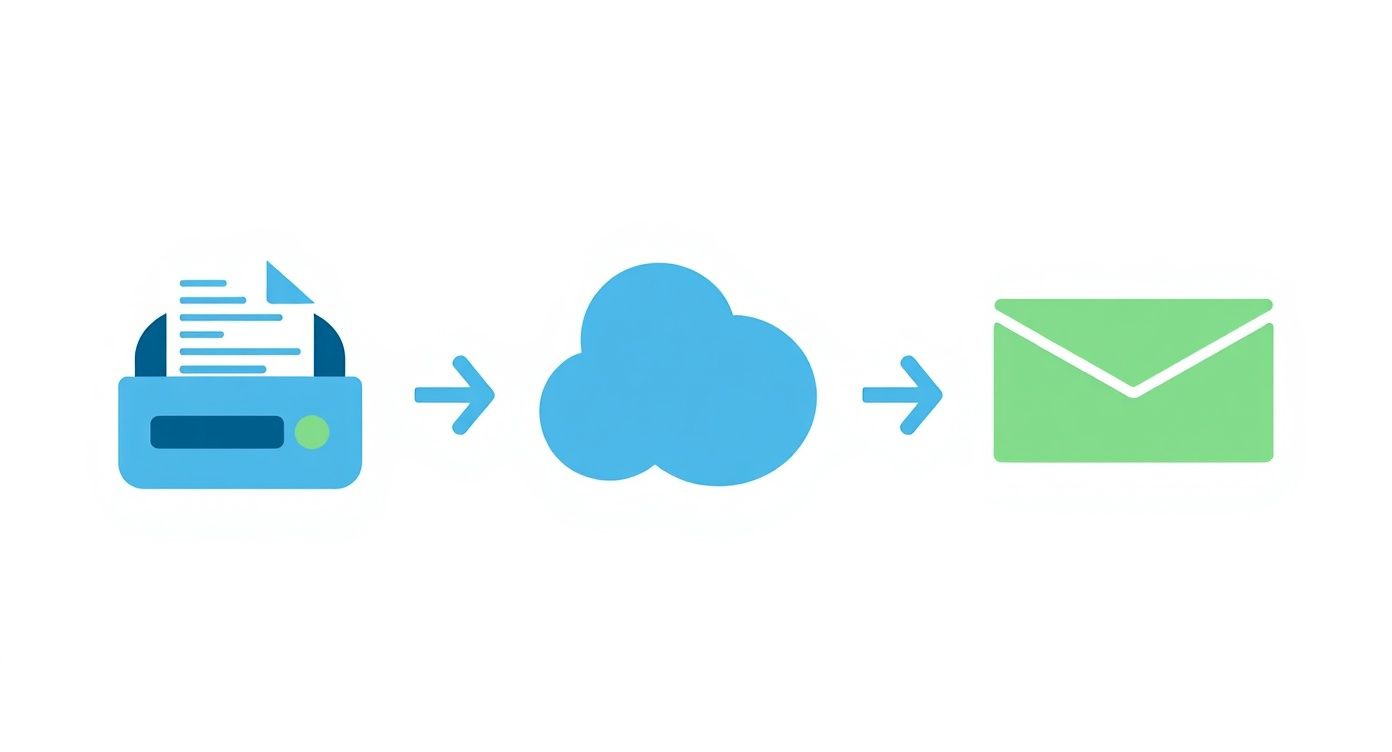
    The practical answer is receiving faxes without a fax machine through an online fax service. The provider assigns you a fax number, answers incoming transmissions in the cloud, converts them into digital documents, and delivers them to an email inbox, web portal, or mobile app. You still need a fax number, even though you no longer need the machine.

    Fax remains active in document-heavy industries. More than 17 billion documents were sent by fax in 2019, and the U.S. healthcare industry exchanges more than 9 billion fax pages annually, according to industry coverage of fax's continued use. The right setup lets you accept those documents without paper, toner, a modem, or an always-on office device.

    When You Need to Receive a Fax but Own No Machine

    A client calls at 3:45 p.m. and says the signed agreement is ready. Their office can fax it, but they won't email it. You look around your workspace and find a laptop, a phone, and an inbox, but no fax machine or analog telephone line. Waiting for equipment would delay the contract, so you need a way to make your business reachable by fax now.

    The fastest escape route is a fax-to-email service. You create an account, receive an assigned fax number, and tell the sender which number to dial. The provider handles the fax signal and sends the finished document to your email as a digital attachment or places it in a browser dashboard. A guide to places where you can receive faxes can help if you need a temporary public or retail option rather than a permanent business workflow.

    You can also choose among several delivery models:

    • Fax-to-email services: Incoming documents arrive in a monitored inbox, usually as PDFs.
    • Virtual fax numbers: A number gives outside parties a conventional destination while your team works digitally.
    • Mobile fax apps: Push notifications and document viewing help professionals who work away from a desk.
    • Storefront locations: Retail business centers can handle isolated, urgent transmissions when you don't need an ongoing number.

    The key distinction is easy to miss. Sending a fax digitally and receiving a fax digitally are different workflows. For inbound faxing, the sender needs a number to dial. You can't just give someone a normal email address and expect a traditional fax machine to deliver into it.

    Practical rule: Set up the number before you need it, then verify it with a test fax.

    A dependable setup takes four actions: choose a provider, configure delivery, send a test fax, and monitor the first real transmission. That process turns an emergency workaround into a repeatable way to receive contracts, records, forms, and notices.

    Choosing the Right Service and Fax Number Type

    Start with the volume and the people who need access. Someone receiving an occasional signed form may prefer a simple service with pay-as-you-go billing. A small legal or medical team needs a shared inbox, user permissions, searchable records, and transmission logs. Don't choose a solo plan for a team just because the monthly price looks lower. The administrative friction will cost more than the subscription difference.

    Next, decide whether you need a new number or want to preserve an existing one. A freshly assigned number is usually the quickest route. Porting an established fax number makes more sense when clients, courts, insurers, agencies, or suppliers already use it. Changing that number can create missed documents and force every contact to update its records.

    Number type also affects how people perceive and use your business line:

    Number Type Best For Typical Availability Cost Impact
    Local Regional businesses and local contacts Often available by area code May fit standard number pricing
    Toll-free Organizations receiving documents from broad geographic areas Offered by many online providers May carry different plan or number charges
    Existing ported number Businesses with established fax contacts Depends on provider and porting eligibility May involve provider-specific porting costs
    Newly assigned number New businesses or temporary workflows Usually available during signup Often the simplest setup path

    Ask about integrations before committing. A legal team may want automatic storage in a document-management system. A healthcare practice may need a workflow connected to an EHR. A sales or operations team may prefer a CRM connector or cloud-storage destination. If you're evaluating outside support for legal document handling, a resource covering virtual legal assistants companies can help you think through access, delegation, and document ownership before you share an inbound fax queue.

    Pricing usually falls into three categories: monthly subscriptions, page bundles, and pay-as-you-go billing. Occasional users should avoid paying for capacity they won't consume. Daily inbound traffic justifies a recurring plan when it includes shared access, archiving, notifications, and useful controls.

    For a deeper explanation of the number itself, review this guide to an online fax number. The recommendation is straightforward: choose local for regional continuity, toll-free for broad reach, and porting when your current number already appears throughout your business materials.

    Setting Up Your Account and Configuring Delivery

    A good inbound configuration takes less effort than installing a physical machine, but you should still treat it like business infrastructure. A missed fax can be a missed deadline, not just a minor notification problem.

    Screenshot from https://example.com/screenshots/online-fax-inbox-settings.png

    Begin by creating the provider account with a business-controlled email address. Verify ownership, then select either a newly assigned number or an existing number eligible for porting. Don't use an employee's personal inbox as the only account owner. If that person leaves, your recovery process becomes unnecessarily difficult.

    Configure delivery and notifications

    Set the primary delivery address for inbound faxes. Most services send the received document as a PDF attachment and retain a copy in the web portal. Add a secondary address when the document is time-sensitive or when a second person must monitor the queue. A shared address can work for a small team, but individual user accounts are safer for access tracking.

    Enable email alerts, mobile push notifications, or desktop notifications according to your workflow. Then turn on two-factor authentication for every user who can view sensitive documents. Notifications tell you a fax arrived. Authentication controls who can open it.

    Customize your business identification and cover-page details. Correct company information helps senders recognize the destination and reduces confusion when a fax crosses between departments. Include a monitored phone number or email address for transmission problems, but don't publish private account credentials.

    Test the complete path

    Send a test fax from a second account, a colleague's service, or a willing sender. Confirm that the document reaches the correct inbox, opens properly, carries the expected page count, and appears in the provider dashboard. Then test the return path if your team also needs to send replies. The instructions for receiving a fax by email are useful when you're checking the email-delivery portion of the setup.

    Place the test document in a clear archive structure after verifying it. Separate folders by client, matter, patient workflow, or operating year, depending on your business. Use consistent filenames and retention rules, and connect cloud storage only after confirming that the destination has appropriate access restrictions.

    The video below shows the kind of browser-based workflow many users adopt for digital fax reception.

    Finally, ask a real sender to transmit a non-sensitive test page. A successful internal test proves your account works. A second test from outside your organization confirms that the public number, provider routing, email delivery, and sender instructions all work together.

    Comparing Costs and Features Across Methods

    The cheapest method isn't automatically the right one. Receiving one unexpected fax at a retail counter is different from managing a steady stream of legal filings or patient records. Compare the destination, access model, storage, and number continuity before comparing price.

    Method Typical Cost Inbound Pages Included Key Features Best For
    Dedicated online fax provider Varies by provider and plan Depends on subscription or bundle Assigned number, email delivery, portal, archives, team controls Businesses with recurring inbound needs
    Email-connected fax service Varies by provider and plan Depends on account terms Inbox delivery, PDF attachments, browser access Solo users who work primarily by email
    Mobile-first fax app Varies by provider and plan Depends on account terms Push alerts, mobile viewing, document capture Professionals away from a desk
    Retail or storefront reception Usually charged per transmission or page No recurring allowance Staff-assisted handling and one-off access Emergency or isolated documents

    Dedicated services generally offer the strongest long-term value for teams because they combine a number with storage and controlled access. Look for searchable archives, multiple recipients, file previews, download options, and transmission records. Those features matter more than a small difference in subscription price when several people need the same document.

    Email-connected delivery is convenient, but it creates a security dependency on your mailbox. If your email account is poorly protected, the fax workflow is poorly protected too. Mobile apps add speed and flexibility, but they need careful notification settings and device security.

    Retail reception avoids subscriptions and setup, but it doesn't create a dependable inbound address for recurring senders. It also makes it harder to build a searchable history or route documents automatically to the person responsible for them.

    Choose by workflow, not by sticker price. A number, archive, and shared access can matter more than a low introductory fee.

    For occasional sending rather than inbound reception, SendItFax offers browser-based fax transmission to U.S. and Canadian numbers without requiring an account. Its free option supports up to three pages plus a cover, with a daily limit of five free faxes, while the Almost Free option costs $1.99 per fax and supports up to 25 pages. Those details make it relevant for sending a reply, not a substitute for maintaining a dedicated inbound number.

    Security and Compliance Considerations

    Digital delivery isn't automatically secure, and a physical fax machine isn't automatically safer. The security question is what happens from the sender's transmission to the stored document, and which people can access the result.

    Choose a provider that documents TLS encryption in transit and AES-256 encryption at rest. Require individual logins, strong authentication, and role-based access where multiple employees share an inbound number. Keep received documents inside an approved business mailbox or controlled portal instead of forwarding them to an unencrypted personal account.

    Healthcare organizations should ask whether the provider will sign a Business Associate Agreement when the service handles protected health information. Fax remains an accepted communication method in healthcare, and digital reception can reduce exposure to documents sitting unattended in an output tray. The service still needs appropriate controls, retention practices, and access policies.

    Legal teams benefit from timestamped delivery records, transmission histories, and audit trails. Those records help show when a document arrived and who accessed it, but they don't replace the firm's own retention and chain-of-custody procedures. Configure the provider and your document system together.

    A digital fax security checklist featuring encryption in transit, encryption at rest, and provider compliance requirements.

    Use this selection checklist:

    • Verify encryption: Confirm protection in transit and at rest in the provider's current documentation.
    • Request compliance terms: Ask for a BAA when your workflow involves protected health information.
    • Control access: Use individual accounts, two-factor authentication, and role-based permissions.
    • Protect the mailbox: Keep attachments in a secured business environment, not a personal forwarding address.
    • Review retention: Set archive and deletion rules that match your legal or regulatory obligations.
    • Check audit records: Confirm that the service records delivery and account activity in a usable format.

    Why Digital Fax Reception Is More Reliable Than You Think

    The old assumption is that a fax must be physically attached to a phone line to be dependable. Modern internet fax standards use a store-and-forward model. The sender transmits fax images through email or an IP gateway, and the receiving service reconstructs the document for delivery. RFC 4142 describes this Internet fax approach as a way to preserve familiar fax behavior over Internet transport.

    The important reliability work happens at the gateway. Interoperability problems can occur between networks, carriers, and fax systems, so production services use T.38 or ECM-style handling with automatic retries. Published industry findings cited in technical coverage of online fax reliability report about 82% success with T.38 plus Error Correction Mode, compared with about 46% for ECM without T.38, and roughly 1.33 transmission attempts per successful fax.

    An infographic titled The Reliability of Digital Fax highlighting 99.9% uptime and under 3 second delivery.

    That doesn't mean failures disappear. A sender can dial the wrong number, a document can arrive unreadable, or an email notification can be delayed. The difference is that a cloud service can retry, preserve the transmission record, and keep the received document available while you investigate. A hardware machine can also stop receiving because of paper, toner, power, or line problems, often without anyone noticing immediately.

    Reliability comes from the whole chain, not from the absence of hardware. Choose a provider with gateway redundancy, delivery notifications, retry behavior, and a dashboard where you can verify the inbound record.

    Troubleshooting and Your Next Steps

    Most inbound fax problems have a short diagnostic path. Check the obvious delivery points first, then confirm that the sender used the correct destination.

    A four-step infographic illustrating troubleshooting methods for resolving issues when receiving digital faxes successfully.

    • Check every mailbox folder: Look in junk, spam, quarantine, and any dedicated fax folder. Add the provider's notification address to your approved senders if your mail system filters it.
    • Confirm the number: Ask the sender to verify the full fax number, including the relevant area or country code. A single incorrect digit sends the document elsewhere.
    • Inspect the account: Confirm that your assigned number is active and that the delivery email still belongs to a monitored employee or team.
    • Request the transmission report: Ask the sender for the result of the send attempt. A report can show whether the problem occurred before the provider received the call.
    • Download the original file: If an in-app preview or OCR result looks wrong, download the original fax attachment, such as a TIFF image, instead of relying on the preview.
    • Contact support for stalled transmissions: A fax sitting in a pending queue needs provider review, especially when a retry doesn't clear it.

    Run a test before you distribute the number to clients, suppliers, courts, insurers, or agencies. Send a document from a second fax account or ask a friend to transmit one, then confirm receipt, readability, notifications, and archive access.

    You don't need a machine to be reachable by fax, but you do need a provisioned number and a verified delivery path. Choose a service that matches your volume and privacy requirements, configure the inbox carefully, and test it before the next urgent document arrives.


    SendItFax provides browser-based fax transmission without a fax machine, including a free option for limited sending and a paid option for larger documents and cleaner presentation. If you need to send a reply after receiving an inbound fax, visit SendItFax and transmit the document from your browser.
  • Receive Faxes Without a Fax Machine How to Do It Right

    Receive Faxes Without a Fax Machine How to Do It Right

    You're waiting for an important form, contract, or medical record, and the sender says, “We can only fax it.” There's no fax machine in your office, no spare phone line, and no time to buy hardware. The practical answer is to give the sender a digital fax destination and receive the document as a PDF through email, a web portal, or an app.

    That works because faxing is no longer tied to a machine on your desk. Cloud-based services translate the incoming transmission for you, while the sender can continue using a traditional fax machine or another online fax platform. The decisions are less about hardware and more about setup effort, privacy, reliability, and whether you need a one-off reception path or a permanent fax number.

    Why You Can Now Receive Faxes Without Hardware

    A small business client once needed a signed supplier agreement sent before the end of the day. The supplier had a fax machine, but the client had moved fully to laptops and cloud storage. Instead of printing the agreement and finding a local print shop, the client used a virtual fax number. The supplier sent the document as usual, and the completed fax arrived as a PDF in the client's inbox.

    An infographic explaining how to receive faxes online without needing a physical fax machine hardware.

    That process is now common because fax has become software- and cloud-mediated rather than purely hardware-based. Industry coverage cites more than 17 billion faxed documents sent in the United States in 2019, including about 9 billion healthcare pages, which shows why digital reception still needs to interoperate with legacy fax workflows (fax usage statistics and industry coverage).

    The sender still dials a fax number. Your provider receives the transmission, converts it into a digital document, and routes it according to your settings. Depending on the service, that destination may be an email attachment, a secure dashboard, a mobile app, or an integrated business folder.

    What you need before the first fax arrives

    For regular use, you'll usually need a dedicated virtual fax number. That gives senders a stable destination and keeps incoming documents separate from your personal phone number. A dedicated number makes sense when clients, agencies, clinics, or suppliers may send documents repeatedly.

    A shared or public number can be suitable for an occasional document, but it creates a different privacy profile. You'll need to understand who else can access the number, how the service identifies you, and how long the resulting PDF remains available.

    Practical rule: Choose the smallest setup that matches the document's sensitivity. Convenience is acceptable for a routine form, but confidential records deserve a controlled destination.

    Speed and cost also vary. A subscription with a dedicated number provides continuity and management tools, while a one-off service may avoid account creation altogether. Before giving anyone a fax number, check whether the service sends documents directly to your inbox, stores them in a portal, or requires you to retrieve them through a shared access process.

    Comparing Your Main Options to Receive Faxes Digitally

    The best reception method depends on whether the fax is occasional, recurring, confidential, or shared among a team. A service with a dedicated number offers control and continuity, while a public-number model reduces setup but can expose more metadata or access responsibility.

    Method Best For Setup Effort Privacy Control
    Online fax service with a dedicated number Regular business or personal reception Moderate Stronger control through account permissions and routing
    Fax-to-email delivery Users who already manage work through email Low to moderate Depends on inbox security and forwarding rules
    Mobile fax app People who need access away from a desk Low after installation Depends on app security, device lock, and notification settings
    Shared or public number model Occasional, low-sensitivity documents Very low Limited, because access and retention may be shared or temporary

    A dedicated online fax service is the most dependable choice when you expect repeated inbound documents. It gives you a stable number, a place to review received faxes, and usually a history of delivery activity. The trade-off is an account, provider relationship, and possibly an ongoing charge.

    Fax-to-email feels simpler because the PDF lands where you already work. It can also create the greatest practical exposure if the inbox is personal, forwarded automatically, accessed by several people, or visible in lock-screen notifications. Email delivery is convenient, but the inbox becomes part of the document's security boundary.

    A mobile app helps when you need to review an incoming fax while traveling or away from the office. Make sure the app supports secure login, device protection, and controlled notifications. A notification that reveals the sender or document subject can expose more than you intended.

    For a one-time, non-sensitive document, a shared or public-number model can remove the account barrier. Independent coverage describes models where the sender uses a shared fax number and the recipient confirms a few digits to access the resulting PDF (how to receive a fax online). That can work for a temporary form, but it isn't the right choice for medical records, legal agreements, identity documents, or anything that shouldn't be associated with a shared access path.

    For a broader feature comparison before choosing a provider, review this online fax services comparison.

    Getting Set Up to Receive Faxes in Minutes

    Start by deciding whether you need a temporary receiving path or a number you'll keep. For an ongoing workflow, compare providers based on number availability, PDF delivery, storage controls, user permissions, notifications, and support for sensitive documents. For a one-off fax, prioritize clear access instructions and a transparent retention policy over a long feature list.

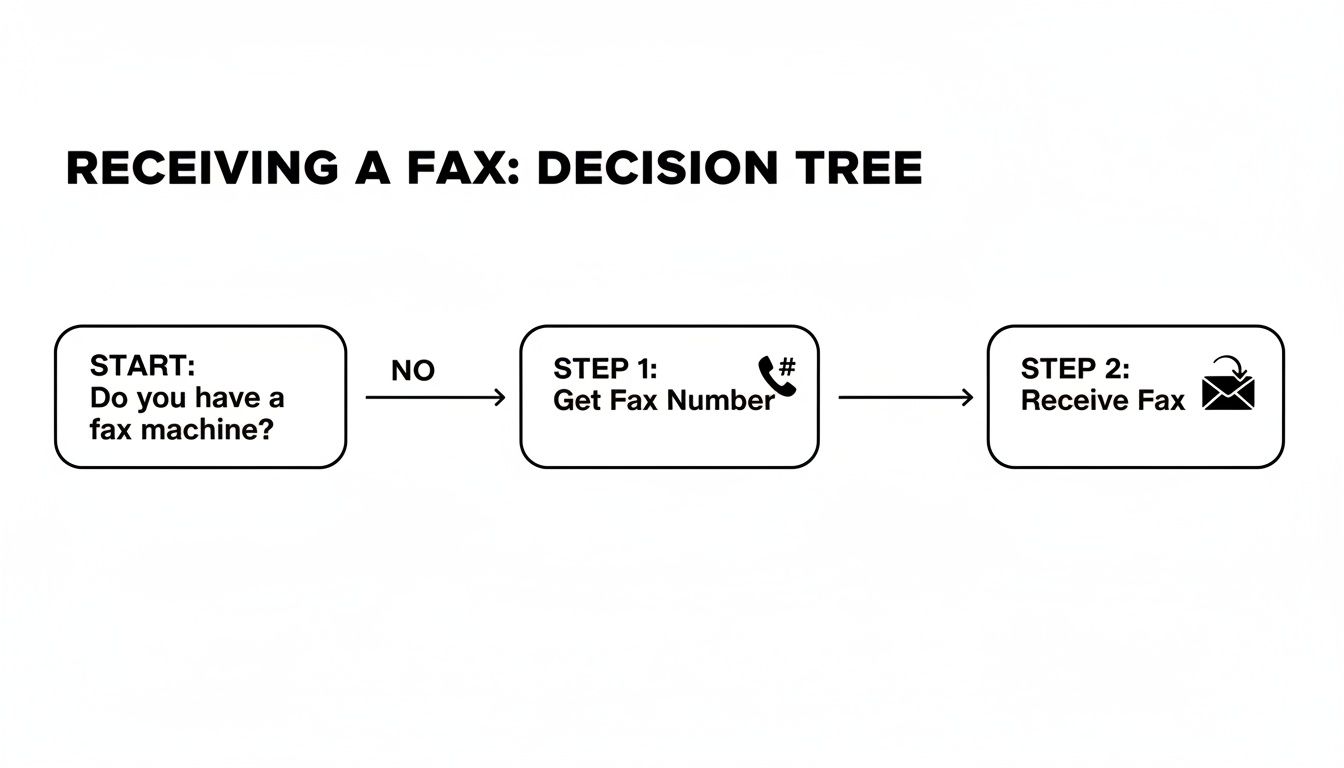
    Once you choose the service, claim or receive the virtual number. Send that number to the person or organization transmitting the document, and confirm the required dialing format. Don't assume an email address alone is enough. The sender needs a fax destination unless the provider specifically supports another inbound method.

    A four-step infographic illustrating the quick process to receive faxes without a dedicated fax machine.

    Configure delivery before sharing the number

    Connect the number to the destination you'll monitor. That might be a work inbox, a secure portal, or a mobile app. Use a dedicated mailbox or folder if several people handle incoming documents, and set notifications that identify a new fax without displaying confidential content in the alert.

    Create a simple naming and storage convention before the first document arrives. For example, use the sender name and received date in the filename, then move the PDF into a restricted folder after review. Keep the original delivery message or portal record when you need an audit trail.

    A test fax is essential. Ask a trusted person to send a short document, then confirm that the PDF arrives, pages are legible, notifications work, and the reply address or sender details are understandable. A successful number assignment doesn't prove the entire inbound route works correctly.

    If the test fails, check whether the sender used the correct number, whether the provider shows an inbound attempt, and whether the email address or app connection is active. Don't distribute the number widely until you've completed that test. For a practical email-based workflow, see this guide to receiving a fax by email.

    Managing Incoming Faxes Day to Day

    Receiving the PDF is only the first half of the workflow. The next question is who reviews it, where it goes, and how you prevent a useful document from disappearing into an inbox.

    For an individual, the process may be simple. Open the PDF, check that every page arrived, download it to a private folder, and reply to the sender if confirmation is needed. For a small team, assign one person to monitor new faxes and route each document to the appropriate owner.

    A woman reviewing a legal contract on her tablet while a smartphone displays her email inbox.

    Build a routine around the PDF

    Use folders that reflect the work rather than the technology. “To review,” “sent to accounting,” and “archived” are more useful than leaving every file in a general fax folder. If your provider supports tags or routing rules, apply them by sender, department, or document type.

    Pay attention to multi-page documents. Scroll through the entire PDF, check that pages are in order, and look for cut-off content or unreadable scans. If the document is a signed contract or medical form, compare the received page count with the sender's expectation before confirming receipt.

    A received notification is not the same as a verified document. Open the file and confirm that it is complete before telling the sender everything arrived.

    Keep inbound sessions manageable where possible. Fax-over-IP connections are more sensitive to network conditions than ordinary voice calls, and longer documents give a weak connection more opportunity to fail. Dialogic testing found that success can fall sharply as document length increases, with faxes exceeding 20 pages dropping below 1% successful delivery at the tested throughput level, and a 55-page fax statistically undeliverable in that model (reliable fax over VoIP testing).

    For large records, ask the sender whether the material can be split into shorter transmissions or delivered through an approved secure channel. That isn't always possible, but it can prevent repeated failed sessions and unnecessary back-and-forth.

    Privacy Reliability and Compliance Tips You Should Know

    Bitkom reported in 2024 that 77% of German companies still used fax, with 25% using it frequently or very frequently (fax usage statistics and business trends). That continued use creates a modern privacy question: where should a document land, who can open it, and how long should it remain available?

    A professional checklist for privacy, reliability, and compliance tips when using digital fax services.

    For a one-off fax, avoid creating unnecessary accounts or sending a sensitive PDF through a personal mailbox. Choose a reception method that keeps the document in a controlled destination and exposes it to as few people and systems as possible. A physical machine can leave pages in an open tray. Email can place copies in forwarding rules, backups, and several inboxes. A cloud fax service can reduce that exposure only when its access and retention controls fit the document.

    Reduce exposure before the fax arrives

    Use a dedicated business inbox or controlled portal, with access limited to staff who need the document. Enable multi-factor authentication, then record who administers it, which recovery method is approved, and how access is removed when a staff member changes role. Suppress subject-line and lock-screen previews that reveal sensitive details. Automatic forwarding should remain off unless the destination is approved and documented.

    For healthcare documents, the statement that “fax is compliant” is too broad. HIPAA safeguards depend on the actual arrangement, including encryption and a signed Business Associate Agreement where applicable. HIPAA guidance warns that traditional analog machines and free consumer fax tools do not qualify automatically, while misdirected faxes remain a breach risk (HIPAA fax compliance guidance).

    Keep the compliance record with the workflow. Save the provider's security and BAA documentation, note which account receives the fax, and define who reviews access logs when an incident occurs. A clinic using an insurance verification service may need the same documented controls for authorized review, routing, and handling of insurance information. The service does not replace the clinic's privacy obligations.

    Treat reliability as a network problem

    Fax relay depends on fax-specific signaling and error handling, not just clear voice audio. T.38 switches from audio to packet-based fax relay after tone detection. Vendor testing reported T.38 with V.17, ECM, and redundancy maintained a 100% success rate in a figure-based test across page counts, and recommended validating the inbound path with real faxes after T.38 is enabled (T.38 fax-over-IP guidance).

    Ask the provider how it handles packet loss, gateway negotiation, transcoding, retention, audit records, and failed deliveries. Review its fax security controls before sending sensitive documents through the service. This review gives you evidence for vendor records and makes the reception method easier to justify during an internal compliance check.

    Choosing the Right Setup and Staying Ready

    The decision becomes straightforward when you rate the fax need against three factors: frequency, sensitivity, and budget.

    For a single routine form, a temporary or pay-per-use receiving option may be enough, provided you understand who can access the PDF and when the file is deleted. For recurring business documents, a dedicated virtual number with controlled delivery is worth the additional setup because senders can reach the same destination repeatedly.

    Sensitive documents deserve a private number, restricted inbox or portal access, strong authentication, and a documented retention rule. Don't use a shared number for medical records, legal contracts, identity documents, or confidential financial information because it is faster to create.

    Keep the setup dependable

    Use this short maintenance checklist:

    • Test the number: Send a real test fax after setup and after any major provider or routing change.
    • Protect the destination: Restrict inbox access and review forwarding rules.
    • Check every PDF: Confirm page order, legibility, and completeness before acknowledging receipt.
    • Store deliberately: Move important documents into an approved folder instead of leaving them in an inbox.
    • Review retention: Know how long the provider keeps files and how deletion works.
    • Keep senders informed: Store the fax number where authorized senders can find it.

    The right answer isn't always the most feature-rich service. It's the setup that gives you enough continuity for your volume, enough control for your documents, and a receiving path you can test before an urgent fax appears.


    SendItFax offers browser-based fax services for people who need occasional document transmission without a fax machine, while its virtual fax option can support incoming PDF delivery through email or an online dashboard. Visit SendItFax to review the available fax options and choose a setup that fits your next inbound document.

  • How to Receive Fax in Email: Your 2026 Guide

    How to Receive Fax in Email: Your 2026 Guide

    You need a fax today. The sender only knows your old fax number, your office printer is gone, and nobody wants sensitive paperwork sitting on a tray where anyone can grab it.

    That's exactly why businesses still look for ways to receive fax in email. The hard part usually isn't getting the first fax into an inbox. It's what happens after that. Who gets access? Where do those attachments go? Which mailbox should own them? How do you stop a shared inbox from turning into a compliance problem?

    A clean fax-to-email setup solves the hardware problem fast. A good one also fixes routing, visibility, and retention so the workflow holds up when your office is busy, remote, or handling regulated documents.

    Why Receiving Faxes in Your Inbox Still Matters

    Fax feels old until someone refuses to use anything else.

    That happens every day in healthcare, legal, insurance, property management, and back-office admin work. In healthcare alone, about 70% of communication still occurs via fax, roughly 9 billion fax pages are exchanged annually, and 89% of healthcare organizations still maintained active fax machines as of 2019, according to this healthcare fax usage summary. If you work with clinics, billing groups, records departments, or referral partners, that number explains why fax hasn't disappeared.

    The practical takeaway is simple. Most organizations don't need to replace fax overnight. They need a bridge between a legacy transmission method and the tools staff already use all day, especially email.

    Practical rule: Treat fax-to-email as an intake workflow, not just a convenience feature.

    That shift matters. Once a fax lands in email as a file instead of on paper, staff can triage it faster, move it into a case folder, attach it to a record, or forward it to the right person without walking to a machine. For a small business, that usually means fewer missed documents and less confusion about where something landed.

    Where the real value shows up

    The most useful part isn't “no fax machine required.” It's that the document becomes available wherever your team already works.

    That's especially important if you're dealing with protected information or structured recordkeeping. If your office is sorting through what secure handling should look like at a small-business level, this guide to SMB medical HIPAA compliance is a practical reference point for thinking through policies, access, and documentation.

    What inbox delivery actually fixes

    Receiving faxes in email helps with a few stubborn workflow problems:

    • Remote access: Staff can open a fax from a laptop or phone instead of waiting to get back to one machine.
    • Faster internal routing: A referral, signed form, or records request can move to the right person immediately.
    • Cleaner archives: PDF attachments fit better into document management than stacks of printed pages.
    • Less front-desk friction: Teams stop acting as human routers for documents that should have gone straight to the right mailbox.

    Fax is still here because the people sending it haven't changed. Receiving it in email works because your team has.

    Choosing Your Virtual Fax Service

    The first thing to know is that fax-to-email doesn't send a fax directly to an email address. The fax still lands on a virtual fax number, and the provider converts it into a PDF or TIFF for delivery to your inbox. That setup matters because inbound reliability depends on more than your mailbox. The sender's machine, carrier path, and network conditions all affect delivery. Industry guidance notes that combined send/receive error rates hover around 6% in typical fax ecosystems, which is why provider reliability and error handling matter so much in practice, as explained in this receive-fax-by-email overview.

    That means shopping by price alone is a mistake. Cheap service with weak delivery logs or poor retry handling usually creates more staff time than it saves.

    What to evaluate first

    When I review a provider for a small business, I start with operational questions before feature lists.

    • Number options: Can you get a new local number, a toll-free option, or port an existing business fax line?
    • Delivery behavior: Does the service send attachments to email, not just links to a dashboard?
    • Team routing: Can one fax number feed a shared mailbox or multiple approved recipients?
    • Admin controls: Can someone manage retention, deactivate users, and review logs without opening a support ticket?
    • Support model: If a fax fails, will you get useful records or a vague status message?

    If you're comparing vendors side by side, a broad online fax services comparison can help you narrow the shortlist before you test anything.

    Virtual Fax Service Feature Comparison

    Feature What to Look For Good for…
    Number setup New local number, toll-free option, or number porting Businesses replacing a physical fax line
    Email delivery PDF or TIFF attachment sent directly to inboxes Teams that work mainly in Outlook or Gmail
    Shared access Shared mailbox support or multiple recipients Front desk, legal admin, records staff
    Audit visibility Clear delivery logs and status history Offices that need traceability
    Retention controls Storage settings, deletion options, admin review Compliance-sensitive workflows
    Ease of use Browser dashboard that nontechnical staff can navigate Small teams without dedicated IT

    Cost questions to ask before you buy

    Pricing gets messy fast because providers package inbound pages, storage, extra users, and number types differently. Before signing anything, compare the service against your likely workflow, not a generic plan tier. For a useful benchmark on how communication platforms often structure pricing and feature tiers, review these enterprise-grade communication solution costs.

    A fax service becomes expensive when your staff has to babysit it.

    A small office with occasional inbound documents may want the simplest plan that includes one dependable number and direct inbox delivery. A busier team should pay more attention to admin controls, logs, shared routing, and how the provider handles failed transmissions. Those details affect day-to-day work far more than a flashy dashboard.

    Your Step-by-Step Setup Workflow

    Most fax-to-email setups are straightforward once you understand the flow. A service assigns your purchased or ported number a dedicated email endpoint. When someone sends a fax to that number, the service receives it, converts it to a PDF, and forwards it as an attachment to your chosen inbox, as described in this online fax receiving guide.

    That means you're not configuring a fax machine. You're configuring a document intake path.

    A six-step infographic illustrating the workflow for setting up an online fax-to-email service for receiving documents.

    Start with the intake destination

    Before you sign up, decide where inbound faxes should land.

    A solo consultant might use a personal operations mailbox. A clinic, law office, or property team usually does better with a dedicated shared mailbox such as records@, intake@, or admin@. That keeps documents out of one employee's personal inbox and makes handoffs easier if someone is out.

    Then choose the number. If people already know your fax line, porting may be the least disruptive choice. If not, a fresh number is often cleaner because you can build the workflow from scratch instead of recreating old bad habits.

    Configure email delivery and test it

    Once the account is active, connect the destination email address or addresses, choose the preferred attachment format, and enable notifications that include the fax file itself.

    After that, send a test fax. Don't skip this. Confirm four things:

    1. The fax appears in the correct inbox.
    2. The attachment opens cleanly.
    3. The subject line is recognizable enough for staff to spot quickly.
    4. The message doesn't get trapped in junk filtering.

    This walkthrough is a useful visual reference for the broader process:

    Add outbound capability if your staff also replies by fax

    A lot of teams discover that receiving is only half the job. Someone gets a signed form, then needs to fax back a response or send the packet onward.

    If your office also needs lightweight browser-based sending, it helps to understand how email-to-fax conversion works so staff don't assume they can hit Reply on the fax notification email. In most environments, inbound and outbound faxing are separate actions, even if they feel connected in the workflow.

    Keep the first test simple. One page, clear text, known sender, known recipient mailbox.

    That gives you a stable baseline. Once that works, test shared inbox delivery, mobile access, and any filing rules you expect the team to use.

    Configuring Your Inbox for Faxes

    Getting the fax into email is the easy part. Keeping the inbox usable is where most setups start to fail.

    If you let fax notifications pile into a general mailbox, staff will miss time-sensitive documents, forward attachments manually, and create duplicate copies all over the business. A better setup gives faxes their own labels, folders, rules, and ownership pattern from day one.

    A person using a laptop to organize and review digital faxes received in their email inbox.

    Build a simple routing system first

    Start inside Gmail, Outlook, or Microsoft 365 with a dedicated folder or label for inbound faxes. Then create rules based on sender address, subject line pattern, or the mailbox receiving the fax.

    For most small businesses, a basic structure works well:

    • Intake folder: New fax messages land here first.
    • Needs action folder: Staff move anything that requires review, signature, or callback.
    • Completed archive: Finalized items move here only after they're saved in the right system of record.
    • Exceptions folder: Anything unreadable, incomplete, or misrouted goes here for follow-up.

    If the service converts everything to PDF, a guide to working with fax-to-PDF workflows can help standardize how staff save, name, and archive those attachments.

    Set shared access on purpose

    Team delivery is where governance matters. Advanced fax-to-email setups can send received faxes to multiple verified email addresses and offer controls such as auto-delete-from-storage, which is especially important in healthcare, legal, and real estate environments that need documented control over access and retention, as described in this team fax governance guide.

    That should change how you design the mailbox. Don't just dump sensitive faxes into several personal inboxes because it feels convenient. Use a shared mailbox where possible, verify who's allowed to receive copies, and decide whether the provider should retain documents after delivery.

    A shared inbox is a workflow tool. It isn't a substitute for access policy.

    Reduce delivery friction

    Spam filtering is a common reason faxes seem to vanish. If your provider sends automated messages from a consistent address or domain, add it to your safe-sender process. If your staff needs a refresher, KeepKnown explains email whitelisting in a way that's easy to hand to nontechnical users.

    Then document three ownership rules:

    • Who checks the inbox
    • Who files the attachment into the right system
    • Who deletes or retains the email copy according to policy

    That prevents a common mess where everyone assumes someone else handled it.

    Troubleshooting Common Fax-to-Email Issues

    Most fax-to-email problems fall into one of two buckets. The fax never arrived, or it arrived in a form your team can't use.

    Before blaming the provider, separate transmission issues from inbox issues. A good dashboard or activity log usually tells you whether the fax reached the service at all. If it did, the problem is often filtering, mailbox setup, or attachment handling. If it didn't, the sender may need to resend.

    A checklist titled Troubleshooting Common Fax-to-Email Issues featuring seven numbered steps for diagnosing document delivery problems.

    Use this checklist first

    • Check junk filtering: Fax notifications often look automated, so they can land in spam or quarantine.
    • Verify the number used: One wrong digit sends the document somewhere else or nowhere at all.
    • Confirm the account is active: Suspended billing or expired plans can interrupt inbound service.
    • Review provider logs: Look for timestamps, delivery attempts, and any failure notes.
    • Ask the sender to confirm success: Their machine or service may have failed before your provider ever saw the fax.
    • Open the attachment on another device: A rendering issue may be local to one app, not the fax itself.
    • Inspect the original document quality: Faint originals and crooked feeder scans often create unreadable attachments.

    Why retry logic matters

    Some failures are recoverable. That's where the provider's technical design matters more than the user interface.

    In a real-world electronic fax rollout, automatic retry logic increased delivery success to 98.7% and drastically reduced the need for manual monitoring and resubmission, according to this electronic faxing reliability study. If I'm helping a business choose a service, that's one of the first things I ask about. Not whether the vendor says it's reliable, but what happens when a transmission fails the first time.

    If a fax service can't explain its recovery behavior, assume your staff will become the recovery system.

    The most common fixes

    Unreadable fax? Ask for a resend from a cleaner original.

    No email, but the fax appears in the provider portal? Fix your inbox rules, spam filtering, or destination address.

    No fax in the portal either? Start with the sender. That usually saves time.

    Frequently Asked Questions About Fax to Email

    Can I keep my existing fax number

    Usually, yes. Most virtual fax providers let you port a business fax number so customers, clinics, vendors, or attorneys don't have to update their records. Before starting, gather the current account details exactly as they appear with your existing carrier and avoid canceling the old line until the port is complete.

    Is receiving sensitive documents by email secure enough

    It can be, but the answer depends on the full workflow, not just the fax service. Security comes from controlled inbox access, mailbox policies, attachment handling, retention settings, and staff behavior. If the fax reaches a loosely managed shared mailbox and people forward it around casually, the weak point isn't the fax transport. It's your internal process.

    Can multiple people receive the same fax

    Yes, many business-oriented setups support team delivery. The better approach is to decide whether you want multiple individual recipients, one shared mailbox, or a primary mailbox plus backup visibility. Too many direct recipients can create version confusion and widen access more than necessary.

    Can I receive international faxes

    In many cases, yes, but it depends on the number type your provider offers and where the sender is calling from. Test with your highest-priority partners before assuming cross-border delivery will behave exactly like domestic traffic.

    Should I store fax copies in email forever

    Usually not. Email is convenient for intake, but it often shouldn't be the long-term archive for contracts, records, or regulated documents. Move the file into the proper system, then follow your retention policy for the mailbox copy.


    If you also need a simple way to send documents back without a machine, SendItFax is a practical option for occasional faxing from any browser in the U.S. and Canada. It's useful when you need to send forms, contracts, or records quickly without setting up hardware or a full account-based workflow.

  • Can You Send a Fax to Email: 2026 Guide

    Can You Send a Fax to Email: 2026 Guide

    Yes, you can send a fax to an email, but not directly. It takes an online fax service to bridge the gap, and that matters because about 70% of clinical communication in the United States still occurs via fax as of 2026, so this old-meets-new workflow is still very real.

    You're probably here because someone told you, “Just fax it over,” and then gave you an email address instead of a fax number. That's where people get stuck. A fax machine expects a phone number and fax tones. An email inbox expects a message sent over the internet. Those are two different systems, and they don't naturally talk to each other.

    The missing piece is simple once you see it. If the recipient has a fax-to-email setup through an online fax provider, you can send your fax to the virtual fax number assigned to that service, and the service will forward the document to their email inbox. If they only have a normal email address and no fax service behind it, your fax won't have anywhere to land.

    The Simple Answer to a Common Question

    A common real-world example looks like this. You need to send a signed contract, intake form, or medical record quickly. You ask for the fax number. The other person replies, “Send it to my email.” That sounds convenient, but it leaves out the most important detail.

    A traditional fax machine cannot send directly to a standard email address like Gmail or Outlook. The recipient needs a service in the middle that accepts fax calls, converts the fax into a digital file, and forwards it by email. Without that service, the fax sender has no valid destination.

    Where people get confused

    Most guides explain email-to-fax, which is when you send an email and a service turns it into a fax. Your question is the reverse. You want to know if a fax can go to email.

    The answer is still yes, but the recipient has to be set up first.

    Practical rule: If someone says “fax it to my email,” ask for their fax number provided by their online fax service, not just their email address.

    Here's the simplest way to understand it:

    • If you have only an email address: you probably can't fax them yet.
    • If they have a virtual fax number: you can fax that number, and the service can deliver the fax into their inbox.
    • If you're unsure: ask whether they use an online fax provider that receives faxes by email.

    That last point saves a lot of failed transmissions. The process works well when both sides understand that email is the final delivery method, not the direct destination a fax machine can dial.

    The Digital Bridge How Fax and Email Communicate

    Fax and email are like two people speaking different languages. One uses phone-line signaling. The other uses internet mail protocols. They need a translator.

    That translator is an online fax service.

    According to GFI's explanation of email-to-fax architecture, direct fax-to-email transmission is technically infeasible without an intermediary service because fax uses the PSTN-based T.30 standard while email uses SMTP and IMAP over internet networks. In plain English, a fax machine sends fax tones over a phone connection, and an email server has no idea what those tones mean.

    Why a normal email address isn't enough

    A standard email address doesn't behave like a phone endpoint. A fax machine tries to call a number, negotiate a fax connection, and transmit the document. An inbox can't answer that call.

    That's why the recipient needs a virtual fax number tied to a fax platform. The service answers the fax call on their behalf, converts the incoming pages into a digital file, then forwards that file to the recipient's email.

    A five-step infographic showing how a traditional analog fax machine sends documents to a digital email inbox.

    If you want a plain walkthrough of that setup, this fax to email overview helps show what the receiving side looks like.

    What happens behind the scenes

    Here's the basic flow when someone sends a fax to email:

    1. The sender dials a fax number
      This can be from a physical fax machine or an online fax tool.

    2. The online fax service receives the call
      The service acts like a digital front desk for the recipient.

    3. The fax is converted into a file
      The pages are turned into a format such as PDF or TIFF.

    4. The file is emailed to the recipient
      The recipient opens the message and reads the attachment like any other document.

    The email inbox is the delivery box. The virtual fax number is the doorbell.

    The reverse also exists

    The opposite workflow is also common. Someone sends an email with an attachment to an online fax service, and the service converts that file into a fax for delivery to a traditional fax machine.

    That's useful to know because people often assume the whole process is bidirectional by default. It isn't. The recipient needs the right setup on their side for fax-to-email to work.

    A good question to ask is: “What fax number should I send it to so it reaches your email?” That wording gets to the core requirement immediately.

    How to Send a Fax to Email in 3 Easy Steps

    If the recipient already has a virtual fax number, the sending process is usually simple. You prepare the document, enter that fax number, and send it just like any other fax.

    A person using a tablet to send a fax online while sitting at a wooden desk.

    Step 1 Get the right destination

    Before you upload anything, confirm the recipient's fax number, not only their email address.

    Ask one of these:

    • “What fax number should I use?” This is the clearest option.
    • “Do you receive faxes through an online fax service?” Helpful when they keep saying “email.”
    • “Will the fax arrive in your inbox through a virtual number?” Good for legal, healthcare, and real estate contacts who use hybrid workflows.

    If they only reply with an email address, pause there. You don't yet have enough information to fax them.

    Step 2 Prepare a clean digital file

    Most online fax tools work best with PDF, DOC, or DOCX files. If your document started as a phone photo or a fuzzy scan, clean it up first so the faxed copy is readable.

    For scanned forms or image-heavy paperwork, OkraPDF OCR tools can help turn hard-to-read pages into searchable, cleaner documents before you send them. That's especially handy for signed forms, handwritten notes, and multi-page packets that need to stay legible after fax conversion.

    A few practical checks before sending:

    • Check page order: Put signature pages where the recipient expects them.
    • Review orientation: Sideways pages often lead to callbacks.
    • Remove clutter: Dark scan shadows and extra margins can make faxed text harder to read.
    • Use a simple filename: Clear names reduce confusion if the service includes the file name in records.

    Step 3 Send through an online fax service

    Once you have the document and the recipient's virtual fax number, the rest is straightforward:

    1. Upload the file.
    2. Enter your sender details.
    3. Enter the recipient's fax number.
    4. Add a cover note if needed.
    5. Send and wait for confirmation.

    Some services let you fax from a browser without installing anything. Others add options like delivery notices, cover page text, or priority handling.

    If your document is time-sensitive, send it early enough that you can still follow up if the first attempt fails.

    A short demo helps if you've never used browser-based faxing before:

    A simple example

    Say a title company says, “Email is fine, we receive faxes that way.” What they usually mean is this: they have a fax service that forwards incoming faxes to staff email inboxes.

    You would still send the document to their fax number. Their service does the conversion. Their email inbox is only the final stop.

    That's the key distinction missed when asking, can you send a fax to email. You can, but only when the recipient has set up the bridge.

    Why Fax Still Matters in a Digital World

    Fax survives because some industries care less about modern-looking tools and more about traceable, accepted ways to move sensitive documents.

    In healthcare, that's especially visible. mFax reports that approximately 70% of clinical communication in the United States still occurs via fax as of 2026. The same source explains that fax remains important because HIPAA treats fax over a dedicated phone line as a recognized safeguard, while email requires tighter controls such as encryption and vendor agreements.

    A professional man working on a laptop at a desk with the text Fax Still Matters displayed.

    Where fax keeps showing up

    You'll still run into fax workflows in places where paperwork carries legal, clinical, or operational weight:

    • Healthcare offices: referrals, records, orders, and intake paperwork
    • Law firms: signed documents, filings, and formal notices
    • Real estate teams: disclosures, contracts, and closing documents
    • Government and public agencies: forms that still move through older systems

    In those settings, fax isn't just habit. It's often the method people already trust, already audit, and already know how to route internally.

    Why email didn't replace it completely

    Email is easier for everyday communication. But “easy” isn't the same as “accepted in every workflow.”

    A clinic may have a fax number tied to a records department. A law office may have intake staff trained to process faxed submissions. A government office may publish fax instructions because that's how documents get logged and reviewed.

    Some technologies stay in place because the people receiving documents have built their process around them.

    That's why fax-to-email services exist at all. They let one side stay digital without forcing the other side to change how they receive documents.

    Security Costs and Key Considerations

    Convenience matters, but this is the part where you slow down and check the details. Fax-to-email sounds simple until sensitive information is involved.

    According to Brightsquid's review of fax-to-email privacy risks, a major issue with some services is that the final delivery happens through non-compliant, unencrypted email, which can expose protected information and create HIPAA problems. The same source notes that healthcare fax-related breaches have risen, which is why audit trails and stronger security controls matter.

    What to look for in a service

    If documents include personal, legal, financial, or medical information, check for these basics:

    • Clear handling of email delivery: Find out whether the final email step is protected appropriately for your use case.
    • Audit records: You want proof of what was sent and when.
    • Sender and recipient details: Good records reduce confusion later.
    • Support for standard file types: PDF, DOC, and DOCX are the usual starting point.
    • Readable confirmations: You should know whether the fax was delivered or failed.

    For a deeper overview of privacy questions, this fax security guide is a useful checklist.

    Cost and plan comparison

    If you send faxes only occasionally, simple pricing is easier than a monthly contract. Here's a straightforward comparison based on the publisher's plan details.

    Feature Free Plan Almost Free Plan ($1.99)
    Cost Free $1.99 per fax
    Page limit Up to 3 pages plus a cover Up to 25 pages
    Cover page Included with branding Branding removed, cover can be omitted
    Delivery handling Standard Priority delivery
    Best for Occasional personal use Professional or cleaner presentation

    A practical way to choose

    Use the free option when you're sending a short document and branding on the cover page won't matter. Use the paid option when the document is client-facing, longer, or more formal.

    If the document is regulated or sensitive, don't choose on price alone. Choose based on how the service handles delivery, logging, and privacy.

    Troubleshooting Common Fax Transmission Failures

    Most fax failures come down to one of three issues: wrong destination, bad document quality, or delivery problems after the fax was converted.

    When the fax won't go through

    If the sender gets a failure notice, start with the destination.

    • Wrong number entered: Recheck every digit.
    • Recipient gave only an email address: They may not have a fax-to-email service set up.
    • Busy line or retry issue: Wait and send again.
    • Unsupported file or poor scan quality: Convert the document to a clean PDF and resend.

    When the recipient says nothing arrived

    People often assume the service failed, when the issue is inbox handling.

    If the fax service shows delivery but the recipient can't find the email, ask them to check spam, filtered folders, and internal forwarding rules. A general troubleshooting resource like Truelist's guide to fixing missing emails can help them track down where the message went after delivery.

    Sometimes the fax succeeded and the email workflow failed afterward.

    If you want to confirm your setup before sending an urgent document, this guide to testing a fax is a practical place to start.


    If you need to send a fax from your browser without a machine or a full account setup, SendItFax gives you a fast way to upload a document, enter U.S. or Canadian fax details, and send occasional faxes when time matters.

  • How to Receive a Fax Via Email Your Guide to Modern Faxing

    How to Receive a Fax Via Email Your Guide to Modern Faxing

    Receiving a fax through your email is surprisingly simple. You just sign up with an online fax service, they give you a virtual fax number, and you set it up to send any incoming faxes straight to your inbox as a PDF. It’s a modern twist that completely sidesteps the need for a physical machine, paper, or ink, effectively pulling a legacy tool into today's digital workflow.

    Why Receiving Faxes By Email Is a Game Changer

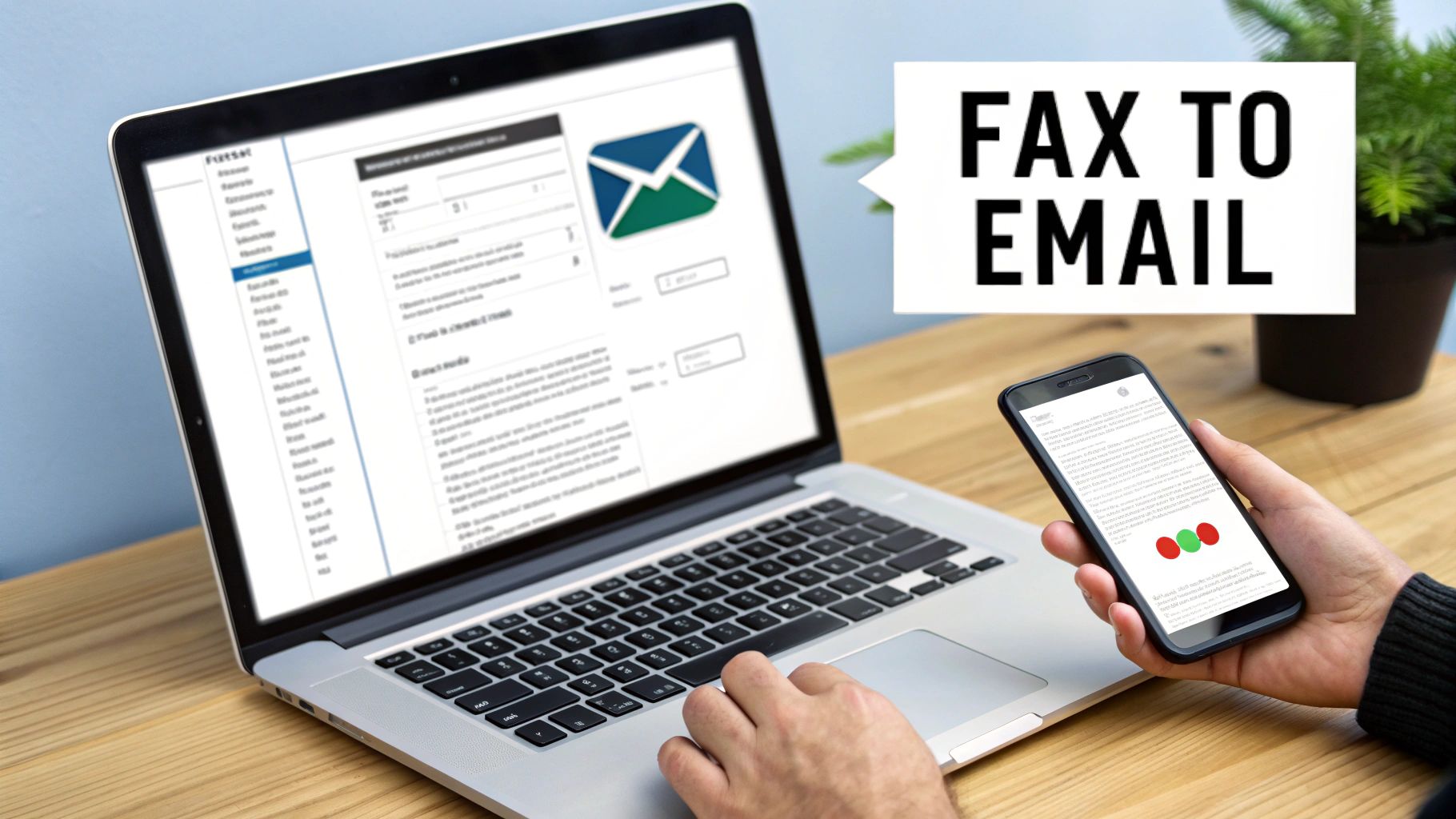
    A person uses a laptop and smartphone on a wooden desk, with a 'FAX TO EMAIL' sign.

    Let's be honest—the screech and buzz of an old-school fax machine feels like a relic. But the reality is that for a lot of fields like healthcare, law, and real estate, faxing is still a non-negotiable, secure way to send signed documents. Figuring out how to receive a fax via email isn't just a neat trick; it's about making a necessary tool fit the way we actually work now.

    This approach blends the tried-and-true security of faxing with the sheer convenience of email. Instead of being chained to a desk, you can get critical documents on your laptop, tablet, or even your phone, as long as you have an internet connection.

    The Core Benefits of Email-Based Faxing

    The upsides to making this switch are pretty clear right from the start. First off, you'll see some real cost savings. Forget about buying and maintaining a clunky machine, and say goodbye to the constant drain of paying for paper, ink, and a dedicated phone line. It's also a great move toward a greener, paperless office.

    But it’s not just about the money. The freedom you get is huge. Imagine getting a time-sensitive legal document while you're on a business trip or a signed contract when you're working from home. Online faxing makes that a reality by dropping faxes right into your inbox like any other email attachment.

    Here are a few of the key advantages:

    • Instant Access: You can read, save, or forward faxes from any device, anywhere in the world.
    • Improved Organization: Digital faxes are easy to search for in your email. No more digging through filing cabinets.
    • Enhanced Security: The best services use encryption, so sensitive documents aren't just sitting out in the open on a shared fax machine tray.

    How Does It Actually Work?

    The tech behind these fax-to-email services is refreshingly straightforward. When someone sends a fax to your special virtual fax number, the service's servers catch it. They act as a digital translator, taking that old analog signal, converting it into a file (usually a PDF), and then shooting it over to you as an email attachment.

    The brilliant part is that the sender has no idea anything is different. They just use their regular fax machine, dial your number, and send the document. On their end, it's business as usual; they don't know it's landing in your inbox instead of printing out on paper.

    This behind-the-scenes conversion is what bridges the gap between old and new technology so effectively. It doesn't force anyone to change their habits. The global fax services market is now valued at $3.3 billion in 2024, and that growth is almost entirely because of these online solutions. Even with over 17 million fax machines still humming away worldwide, this digital shift offers a modern, practical way for businesses to keep up. If you're curious, you can learn more about the persistent relevance of business faxing from Business.com.

    Choosing the Right Fax to Email Service for Your Needs

    Picking the right fax-to-email service is honestly the most important part of this whole process. There are dozens of options out there, and it’s way too easy to get bogged down in endless feature lists and confusing pricing tiers.

    The secret is to think beyond the monthly price tag. You need to find a service that actually fits how you work, whether you’re a freelancer who just needs to send one contract a year or a busy medical office that handles sensitive patient files all day long. Getting this right saves you money and headaches. Getting it wrong means surprise fees and a lot of frustration.

    Cost Versus Value: Finding the Right Pricing Model

    First things first, let's talk about money. Online fax services typically come in three flavors, and each one is built for a different kind of user.

    • Subscription Services: This is the go-to model for most businesses. You pay a set fee each month for a certain number of pages. If you have a pretty good idea of how many faxes you'll be handling, this almost always offers the best cost-per-page and is perfect for predictable workflows.

    • Pay-Per-Use Services: Just need to fax something occasionally? This is for you. You only pay for the pages you actually send or receive, with no monthly commitment hanging over your head. The per-page cost is higher, sure, but you’re not paying for a service you barely touch.

    • Free Tiers: A lot of providers have a free plan, and they can be great for receiving a few faxes here and there. But be aware of the trade-offs—they usually come with strict page limits, the provider’s branding slapped on your faxes, and little to no customer support when you need it.

    As a rule of thumb, if you expect to receive more than 20-30 pages a month, a subscription plan is almost always the smarter financial choice.

    Core Features That Actually Matter

    Once you have a pricing model in mind, it's time to dig into the features. Don’t get distracted by a long list of shiny objects you’ll never use. Focus on the practical stuff that makes a real difference day-to-day.

    A big one is your virtual fax number. Do you need a local number to look like you have an office in a specific city? Or is a toll-free number better for your national customer base? Right after that, you need to ask if the service lets you port your existing fax number. This is a huge deal for established businesses.

    Porting your number is a game-changer. It lets you keep the fax number your clients and vendors have used for years, avoiding the nightmare of updating business cards, websites, and all your contact lists. The process can take a few weeks, but it's completely worth it for that seamless continuity.

    Here are a few other must-haves to look for:

    • File Format Support: Everyone supports PDFs. But what about Word documents (DOCX), images (JPG), or high-quality scans (TIFF)? Make sure the service can handle the file types you actually work with.
    • Mobile Apps: If you're not chained to your desk, a good mobile app for iOS or Android is a necessity. It lets you check, sign, and manage faxes right from your phone.
    • International Faxing: Working with clients overseas? Double-check that the service can send and receive faxes internationally and get a clear picture of the costs—they're almost always higher than domestic rates.

    To see a head-to-head breakdown of what different providers offer, check out our online fax services comparison for a much deeper analysis.

    Security and Compliance: The Non-Negotiables

    For anyone in healthcare, law, or finance, security isn’t just a nice-to-have; it's a legal requirement. If your faxes contain Protected Health Information (PHI) or other sensitive data, HIPAA compliance is non-negotiable.

    A truly HIPAA-compliant service will use strong encryption for your faxes both in transit and while stored on their servers. More importantly, they must be willing to sign a Business Associate Agreement (BAA) with you. Without a BAA, you are not compliant.

    Even if you don't fall under HIPAA, strong security is just smart business. Look for services that offer two-factor authentication (2FA). It adds a critical second layer of protection to your account, so even if someone gets your password, they can't access your private faxes.

    Making Your Final Choice

    To tie it all together, here’s a quick look at what you can generally expect from each type of service.

    Online Fax Service Feature Comparison

    This table breaks down the typical features you'll find with each pricing model, helping you match your needs to the right kind of service.

    Feature Free Tier Services Pay-Per-Use Services Subscription Services
    Best For Very infrequent users, personal one-off needs Occasional business or individual users Businesses with consistent, moderate-to-high volume
    Fax Number Usually a shared or randomly assigned number Dedicated number often included Dedicated local or toll-free number included
    Page Limits Very low (e.g., 10-20 pages/month) No monthly limit; you pay for each page Generous monthly allowance (e.g., 300+ pages)
    Security Features Basic security, rarely HIPAA compliant Standard encryption, some offer compliance Advanced security, HIPAA compliance is common
    Porting Existing Number Almost never available Sometimes available for an additional fee Usually a standard feature

    By weighing these factors against what you truly need, you can pick a service that doesn't just work, but actually makes your job easier.

    Your Guide to Setup and Configuration

    Alright, let's get into the practical side of things. Once you’ve picked your fax-to-email provider, the actual setup is usually a breeze—you can often be up and running in just a few minutes. This is where the concept of digital faxing becomes a real, working tool for your business.

    The first thing you'll do is create your account. Right after that, you’ll face the most important choice in the whole process: what your fax number will be.

    Selecting or Porting Your Fax Number

    Think of your virtual fax number as the digital mailbox for your faxes. Providers almost always give you two ways to go about this, and the right choice really just depends on your current business situation.

    • Get a New Number: This is the quickest way to get started. You can pick a brand-new number and often choose a local area code to establish a community presence. Or, you could opt for a toll-free prefix like 800 or 888 to give your business a more professional, nationwide feel.

    • Port Your Existing Number: What if your clients already know and use your current fax number? No problem. You can bring it with you through a process called porting. This just means you're transferring your number from the old service to the new one. You'll have to sign a Letter of Authorization (LOA) to prove you own the number, but it's a critical step for a smooth transition.

    A Quick Word of Advice: If you decide to port your number, be patient. It can take anywhere from a few days to a couple of weeks. Whatever you do, don't cancel your old fax service until the new provider gives you the green light that the port is complete. Jumping the gun can create a dead zone where you miss incoming faxes.

    With your number sorted, the next step is to tell the service where to actually send your faxes.

    Configuring Your Email Forwarding

    This is the heart of receiving a fax via email. Dive into your service’s dashboard or account settings, and you'll find a section for notifications or inbound routing. This is where you’ll enter the email address (or addresses) that should receive your faxes.

    If you're a one-person shop, just pop in your main email address and you're done. But what if a whole team needs to see the faxes? Most services let you set up a distribution list.

    For instance, you could have faxes automatically sent to:

    • invoices@yourcompany.com
    • sarah.p@yourcompany.com
    • john.d@yourcompany.com

    This is a game-changer for an accounting team. An invoice comes in, and everyone who needs to see it gets it instantly. No more bottlenecks or papers getting lost on a desk. For a deeper dive, you can explore the best ways to manage your fax-to-email workflow in our other guide.

    This simple flowchart breaks down the main things to think about when choosing a service, which in turn affects how you'll set it up.

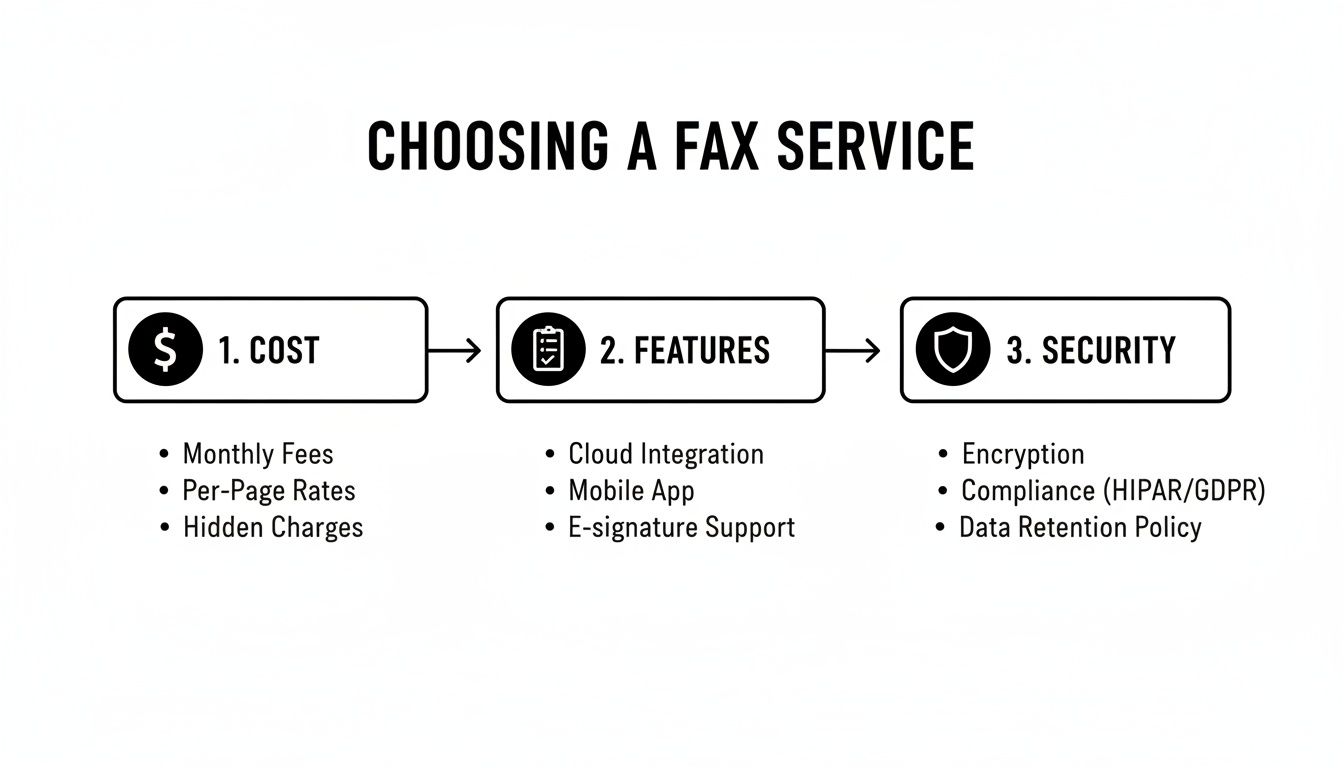
    A flowchart detailing the three main considerations for choosing a fax service: Cost, Features, and Security.

    As you can see, the decisions you make around cost, features, and security will directly shape how you configure the system for your specific needs.

    Customizing Attachment and Notification Settings

    You’re almost there! The last few tweaks involve deciding how you receive your faxes. These might seem like small details, but they can make a huge difference in your day-to-day efficiency.

    Choosing Your File Format

    By default, virtually every service delivers faxes as PDF attachments. It’s the universal standard for a reason. That said, some providers give you other choices for specific situations.

    File Format Best For Considerations
    PDF Just about everything; easy to open, share, and store. This is the industry-standard choice.
    TIFF High-quality archives, especially for detailed scans. Files can be quite a bit larger.
    JPG/PNG Faxes that are mostly images instead of text. Not great for documents with multiple pages.

    Honestly, for 99% of users, sticking with PDF is the smartest move. It’s secure, compatible with everything, and keeps your documents looking just as they were sent.

    Setting Up Notifications

    Your provider might offer more than just an email when a fax arrives. For anyone in a time-sensitive field, getting an immediate SMS text alert can be incredibly valuable.

    Think about a contractor waiting on a signed change order. Instead of nervously checking their inbox, a quick text message lets them know the document has landed, so they can take action right away. Check your account settings for these options—they can be a fantastic tool for staying on top of your game.

    And with that, your system is fully configured and ready to go. You’ve successfully brought a classic piece of business technology into your modern workflow.

    Getting Your Digital Faxes Organized

    So, faxes are now hitting your inbox. Great! But let's be honest, a digital mess is still a mess. If you just let those faxes pile up, you’re trading a teetering stack of paper on your desk for a chaotic, overflowing inbox. The real win comes from building a smart system to organize and archive these documents automatically.

    This isn't just about being neat. It's about being able to pull up a specific contract or client invoice in seconds, not minutes. It’s about cutting out the administrative drag that slows everyone down.

    Let Your Inbox Do the Heavy Lifting

    First things first: stop sorting faxes by hand. Your email client is smarter than you think. Both Gmail and Outlook have powerful filtering tools that can act as your personal filing assistant.

    The easiest way to start is by creating a rule that spots emails coming from your fax service’s address (something like fax@yourprovider.com). Tell the rule to whisk any email from that sender straight into a dedicated folder, maybe named "Incoming Faxes."

    Just like that, your main inbox is clean again, and all your faxes are neatly corralled in one place.

    Pro Tip: Don't stop at just one folder. Get granular. You can create rules that scan the subject line for a client’s name or a specific fax number and file the message into a subfolder like “Faxes from Client ABC.” This is where the real automation magic happens.

    Name Your Files Like You Plan to Find Them Again

    With your faxes sorted, the next hurdle is the attachments themselves. A file named "Fax_2024-10-26.pdf" is practically invisible when you're frantically searching for something three months from now. A consistent, descriptive naming convention is your best friend here.

    Think about what information you'd need to identify a file at a glance.

    • Invoices: INV_ClientName_ProjectName_YYYY-MM-DD.pdf
    • Contracts: CONTRACT_VendorName_ServiceType_YYYY-MM-DD.pdf
    • Medical Records: PATIENTID_RecordType_YYYY-MM-DD.pdf

    This kind of discipline transforms your digital files from a random heap into a searchable database. Finding a document becomes as simple as typing a client's name or a project code into your computer's search bar.

    Connect Everything to the Cloud

    Saving faxes to your computer is fine, but syncing them with a cloud storage service like Google Drive, Dropbox, or OneDrive is a game-changer. It creates a single, secure, and shareable archive that your whole team can access.

    Many online fax services offer direct integrations for exactly this reason. You can often set up a rule within the fax service itself to automatically send a copy of every incoming fax attachment straight to a specific cloud folder. This creates a bulletproof backup and a central hub for all your faxed documents, completely separate from your email.

    The efficiency gains are undeniable. A 2022-2023 healthcare study that processed 4,504 electronic faxes found the average document was just 5.6 pages. In fact, 43.3% of the faxes were only three pages long, making them perfectly suited for quick email delivery and cloud storage. It’s a world away from a traditional fax machine, which can waste minutes on redial delays. You can read more about the speed and reliability of modern faxing on FaxBurner.com.

    By combining automated email rules, smart file naming, and cloud storage, you build a hands-off system that just works. Receiving a fax via email becomes a genuinely streamlined part of your workflow, not just another task to manage.

    Navigating Security and Compliance in Digital Faxing

    Document labeled 'SECURE FAX' and '24' beside a smartphone with a lock icon on a wooden desk.

    When you’re dealing with sensitive information, security isn’t just another feature on a list—it's everything. The good news is that learning how to receive a fax via email almost always means you’re upgrading your security, not compromising it.

    Just think about that old fax machine in the corner office. It spits out documents and leaves them sitting in a tray, in plain sight for anyone walking by. That’s a physical security risk that online faxing eliminates from day one. A digital fax lands securely in your password-protected inbox, giving you a level of privacy that old-school hardware never could.

    Understanding Encryption and Compliance

    The real muscle behind digital fax security is encryption. Any reputable service uses SSL/TLS encryption to shield your documents as they travel from the sender to their servers, and then from their servers to your email. It's the same trusted technology that protects your financial data when you shop online.

    But it doesn't stop there. The best services also use at-rest encryption, meaning your faxes are stored in a scrambled, unreadable format on their servers. For anyone in healthcare, finance, or law, this isn't just a nice-to-have; it's a must.

    If you handle patient information, HIPAA compliance is non-negotiable. A truly compliant provider will do more than just use strong encryption—they'll sign a Business Associate Agreement (BAA). This is a critical legal document that proves the provider is committed to safeguarding protected health information as required by federal law.

    A healthcare study that put eFax systems to the test underscored just how important a reliable setup is. The initial fax failure rate was a surprisingly high 37.7%, but with automated retries, that number plummeted to just 9.9%. This really shows how modern services build in a resilience that’s crucial for protecting sensitive data. You can find more about these findings on secure digital communication in healthcare here.

    Your Security Checklist Before Choosing a Provider

    Before you sign up for any service, you need to ask some direct questions to see how serious they are about security. Their answers will tell you all you need to know. For a deeper dive, you can explore our full guide on faxing security protocols and best practices.

    • Do you offer end-to-end encryption? Make sure they protect data both in-transit and at-rest.
    • Are you HIPAA compliant and will you sign a BAA? This is a hard yes or no. There's no gray area when it comes to medical records.
    • What are your data retention and deletion policies? You need to know how long your faxes are stored and how you can wipe them for good.
    • Do you support two-factor authentication (2FA)? This adds a powerful layer of security to protect your account from unauthorized access.

    Securing Your End of the Connection

    Remember, the fax provider is only one half of the security equation. The other half is you. It all starts with the email account you’ve designated to receive faxes.

    First, use a strong, unique password for that email account. Don’t reuse the same password you use for other websites.

    Even better, turn on two-factor authentication (2FA). This is a game-changer. It means that even if a thief somehow steals your password, they can't get into your inbox without a second code, which is typically sent to your phone. Taking these simple precautions helps ensure your entire digital faxing process is locked down from end to end.

    Troubleshooting Common Fax to Email Problems

    Even with a rock-solid setup, technology has its moments. When you're expecting a fax and it doesn't show up in your email, it's easy to assume the worst. But the good news is that most of these little hiccups are easy to diagnose and fix yourself in just a few minutes.

    The most common issue I see is a fax that was supposedly sent but never landed in your inbox. Before you do anything else, take a deep breath and check your spam or junk folder. It's the simplest step, but you'd be surprised how often aggressive email filters misfile a legitimate fax, especially when you’ve just signed up for the service.

    If a thorough search of your spam folder comes up empty, your next move is to log into your online fax provider's web portal. Think of this dashboard as your mission control—it logs every single transmission, including the ones that failed.

    Diagnosing Missing Faxes

    Your service's activity log is your best friend for figuring out what went wrong. It gives you a clear picture of whether the fax ever reached their system in the first place.

    • It's in the log, but not your email: If you see a "successful" transmission logged on the dashboard, the problem is almost certainly on your email's end. This means your fax service did its job, but your email provider (like Gmail or Outlook) blocked it. The quick fix is to whitelist your fax service's sending address or simply add it as a contact.
    • It's marked as "failed" in the log: If the log shows an error like "busy signal" or "failed transmission," the issue wasn't with you or your service. This tells you the sender's fax machine couldn't connect. You can confidently let them know the problem was on their end and ask them to try again.

    Handling Unreadable or Corrupted Attachments

    What if you get the email, but the attachment is a mess? Sometimes the PDF is garbled, or your computer says it's a corrupted file that won't open. This usually points to a file format mismatch, which is often an easy fix.

    I've found the quickest way to solve a corrupted attachment is to log into the fax service's settings and change the default file format. While PDF is the universal standard, sometimes switching it to TIFF for a particular fax can resolve the issue, especially if the sender is using an older, finicky fax machine.

    Many services also let you adjust the quality settings. If you're having trouble, try switching from a "high-resolution" setting to "standard." A lower-quality file is sometimes more compatible and less prone to corruption. These small tweaks can get your workflow back on track without ever needing to contact support.

    Answering Your Questions About Faxing to Email

    Even after laying out the steps, a few questions always pop up. It's completely normal. Let's tackle some of the most common ones I hear from people making the switch to getting their faxes by email.

    Can I Keep My Old Fax Number?

    Absolutely. This is probably the number one question people ask, and the answer is a resounding yes. Reputable online fax services all offer something called number porting.

    Think of it like moving your cell phone number to a new carrier. You're just moving your existing fax number to your new digital provider. You'll have to fill out a bit of paperwork—usually a Letter of Authorization (LOA)—and the process can take anywhere from a few days to a couple of weeks. But once it's done, you get to keep the number all your clients and contacts already have.

    The most important tip I can give you here is to not cancel your old fax line until you get confirmation that the port is 100% complete. If you cancel too early, you could lose the number for good and miss important faxes during the switch.

    Are Faxes I Get in My Email Legally Binding?

    Yes, they are. A fax that lands in your inbox as a PDF is legally the same as one that spits out of a clunky old machine. The file is a perfect digital copy of the original document.

    For things requiring signatures, these digital transmissions are widely accepted and hold up under laws like the ESIGN Act here in the U.S. That said, if you're dealing with a high-stakes legal contract or a very specific government form, it never hurts to double-check the requirements with your lawyer.

    What if My Internet Goes Out? Will I Miss a Fax?

    This is actually one of the best parts of using an online fax service. If your local internet connection drops, you won't miss a thing.

    Your fax provider receives the transmission on their own secure servers, not your computer. They hold onto it for you, and the moment you're back online, it will be waiting in your inbox. This completely eliminates the old-school problems of busy signals or missed faxes because of a power outage or a paper jam.


    Ready to simplify your workflow? SendItFax makes it easy to send faxes directly from your browser without needing an account or subscription. Send up to three pages for free, or handle larger documents with our affordable Almost Free plan. Visit SendItFax to send your first fax in minutes.

  • How to Receive a Fax by Email Your Modern Business Guide

    How to Receive a Fax by Email Your Modern Business Guide

    Receiving a fax through your email is surprisingly simple. You just sign up with an online fax service, and they assign you a virtual fax number. When anyone sends a fax to that number, the service instantly converts it into a digital file (usually a PDF) and sends it straight to your email inbox as an attachment.

    Why Receiving Faxes by Email Is a Game Changer

    A person holds a smartphone displaying a signed document, with 'FAX REIMAGINED' text in the background.

    Let's be real—traditional fax machines feel like they belong in a museum. And yet, for industries like healthcare, law, and real estate, faxing is still a vital part of the job because of its long-standing security reputation. This is where understanding how to receive a fax by email turns an outdated process into a powerful modern tool.

    Online fax services are the bridge between the old and the new. They let you finally get rid of that clunky machine, the expensive ink, and the mountains of paper. It's a massive operational upgrade that feels as easy as checking your email.

    The Real-World Impact

    Think about it. A real estate agent gets a signed purchase offer sent directly to their phone while they're showing a property. They can forward it to their client for review in seconds. Or picture a law firm that can securely archive confidential client files without a single filing cabinet, creating a searchable digital record on the fly. That's the practical magic of fax-to-email.

    This isn't just about making things easier; it’s about making your workflow smarter and more precise. The global fax services market is actually expected to reach USD 4.47 billion by 2030. For professionals who deal with a lot of forms, receiving them by email can slash document-handling mistakes by 30-40%, simply because digital files are easier to track than stacks of paper. You can even read more about the surprising growth of business faxing.

    Key Benefits of Fax to Email

    The perks go way beyond just getting a message in a different place. When you adopt this technology, you'll see real, tangible improvements in how you work.

    • Significant Cost Savings: Say goodbye to spending on paper, ink, toner, and machine repairs. You also cut out the need for a dedicated phone line, which can easily save you hundreds of dollars every year.
    • Unmatched Convenience and Mobility: Check your faxes from literally anywhere—your laptop at a coffee shop, your tablet on the train, or your smartphone between meetings. You’re no longer chained to the office.
    • Enhanced Security and Privacy: Digital faxes land in your private, password-protected email inbox. No more sensitive documents sitting out in the open on a shared office machine for anyone to see. The best services also use strong encryption to protect your data as it travels.

    By moving fax communications into your email, you’re not just updating a tool; you’re creating a more agile, secure, and cost-effective system for handling critical documents. It’s the simplest way to modernize an essential business function.

    How Does Online Faxing Actually Work?

    Ever wondered what’s happening behind the scenes when a fax magically appears in your email inbox? It’s not magic, but it’s a clever bit of technology that acts as a bridge between the old analog world and your digital one. Honestly, you don't need a degree in IT to get it.

    Think of an online fax service as your personal translator. A traditional fax machine still communicates by sending beeps and tones (analog signals) over a phone line—a language your email has no clue how to interpret. The service intercepts those signals and translates them into a format your computer understands perfectly.

    So, when someone dials your online fax number and sends a document, it doesn't just vanish into the ether. The service catches that incoming transmission, digitizes it, and repackages it for the modern world.

    From Fax Tones to an Email Attachment

    The real workhorse of the system is the conversion process. When the service picks up the incoming fax signal, it immediately gets to work interpreting those analog tones.

    • First, it converts the transmission into a digital document, almost always a PDF. Using a PDF is smart because it keeps the document's original formatting locked in place, which is often critical for things like contracts or official forms.
    • Next, the service automatically drafts an email and attaches this brand-new PDF to it.
    • Finally, it sends that email straight to your designated inbox. You get a notification just like any other message, letting you open, save, or forward the fax in seconds.

    This whole process is lightning-fast, usually wrapping up in just a minute or two. The best part? The person sending the fax has no idea any of this is happening. To them, it feels exactly like sending a fax to any other machine. All the convenience is on your end.

    An online fax service like SendItFax essentially modernizes a legacy process without forcing everyone to change how they work. It’s a secure bridge that lets an old-school tool fit right into your digital life.

    Sending Faxes Is Just as Simple

    It’s not a one-way street, either. Sending a fax from your email is just as straightforward.

    You just compose a new email, attach the file you want to send—like an invoice or a signed agreement—and send it to a special email address. For example, you might send it to something like 1-800-555-1234@senditfax.com.

    The service then grabs your email and attachment, translates them back into analog fax signals, and dials the recipient's fax machine to deliver it. This two-way street gives you a complete fax solution without ever needing to own, or even see, a physical machine. For a deeper dive, our complete guide on how fax to email services work breaks down every detail of this incredibly useful tool.

    Choosing the Right Online Fax Service for You

    Picking an online fax service isn't a one-size-fits-all deal. The right choice really depends on how you'll be using it. What works for a solo freelancer sending a contract once a quarter is totally different from what a busy medical office needs to handle patient records every day.

    Let's break it down from a practical standpoint. Think about your typical fax volume, how critical security is, and what your budget looks like. If you only expect to receive a fax here and there, a pay-as-you-go service makes the most sense. But if you’re a healthcare provider, you'll need a robust subscription that's HIPAA compliant and can handle a high volume of documents securely.

    Key Factors to Consider

    When you’re figuring out how to receive a fax by email, the provider you choose is the single most important decision. To make the right call, focus on these core elements.

    • Pricing Models: Does it make more sense to pay a flat monthly fee for a certain number of pages, or would you rather pay only for what you use? Subscriptions are perfect for businesses with predictable faxing needs. On the other hand, a pay-per-use model like SendItFax is a lifesaver for occasional users who want to avoid recurring costs.
    • Number Porting: Do you already have a fax number that your clients and contacts know? If so, you'll want to find a service that lets you "port" or transfer that number over. This saves you the major hassle of updating business cards, websites, and contact lists.
    • Security Standards: For many professionals, this is the most critical factor. Look for providers that offer end-to-end encryption to protect your documents. If you handle sensitive data—like legal briefs or medical charts—make sure the service is compliant with regulations like HIPAA.
    • Ease of Use: A powerful tool is useless if it's a pain to operate. Is the dashboard intuitive? How simple is it to set up your email and manage your received faxes? A clunky interface will just add frustration and defeat the purpose of switching to a more modern solution.

    This flowchart gives you a quick visual of the first few steps you'll take when ditching the old machine for an email-based setup.

    A decision tree flowchart illustrating the steps to receive a fax without a machine.

    As you can see, it all starts with securing a fax number and linking it directly to your email inbox.

    Comparing Online Fax Service Models

    To help you visualize the differences, here's a look at how the main pricing models stack up. This should make it easier to see which approach aligns best with your needs, whether you fax once a year or a hundred times a day.

    Feature Pay-Per-Use Model (e.g., SendItFax) Subscription Model (Low-Tier) Subscription Model (Business-Tier)
    Best For Occasional, infrequent users Individuals or small teams High-volume businesses
    Cost Structure Pay per page, no monthly fee Fixed monthly fee Higher fixed monthly fee
    Page Allowance N/A (Pay for what you use) 100-300 pages/month 1,000+ pages/month
    Number Porting Often available for a one-time fee Usually included Always included
    Advanced Security Varies by provider Basic security, HIPAA often extra HIPAA compliance included
    Flexibility Maximum flexibility, no commitment Moderate flexibility Low flexibility (annual contracts)

    Each model has its place. Your goal is to find the one that delivers the features you need without forcing you to pay for things you won't use.

    Making the Final Decision

    Ultimately, choosing the right service comes down to balancing features with cost. A good first step is to estimate your average monthly fax volume. That number alone will point you toward either a subscription or a pay-per-use plan.

    Remember, the goal is to find a service that seamlessly integrates into your existing workflow, not one that adds another layer of complexity. Prioritize a solution that feels like a natural extension of your email.

    For a much deeper dive into specific providers, check out our detailed online fax services comparison guide. We lay out the features and pricing side-by-side to help you make a truly informed choice.

    Setting Up Your Fax to Email Service

    A laptop on a wooden desk with a Quick Setup overlay, coffee, plant, and notebook, illustrating a modern workspace.

    This is where the magic happens. Getting your fax-to-email service running is surprisingly quick and doesn't require an IT degree. The whole point is to get you receiving faxes in your inbox with as little fuss as possible, turning what used to be a clunky process into just another part of your digital day.

    Essentially, you just need to sign up, sort out your fax number, and tell the service which email address to send everything to. Let’s break it down.

    Your Fax Number, Your Choice

    First things first: you need a fax number. This is what people will dial to send you documents. When you sign up for a service, you’ll be presented with a couple of options, and your choice really boils down to your business's history with faxing.

    • Get a New Number: If you’re just starting out or don't have an established fax line, this is the simplest route. Services like SendItFax let you pick a new local or toll-free number right during the signup process. It's the fastest way to get the ball rolling.
    • Port Your Existing Number: Got a fax number that your clients have known and used for years? You'll want to port it. Porting simply means transferring your existing number from your old provider to your new online service. It's a critical step for maintaining business continuity.

    Just a heads-up: while porting is a fantastic feature, it does take a bit more time than grabbing a new number. Plan for it to take anywhere from a few days to a week to complete the transfer.

    Configuring Your Destination Email

    With your number sorted, the next step is connecting it to your email. This is the heart of "fax-to-email" and it's usually as easy as typing your email address into a field in your account settings. You can route faxes to any email you want—Gmail, Outlook, or your own custom domain, it doesn't matter.

    Here's a pro tip I've learned from experience: consider setting up a dedicated email address just for faxes, like faxes@yourbusiness.com. This creates a clean, organized funnel for all incoming faxes, keeping them separate from your day-to-day emails and making them much easier to track.

    The entire setup is designed to take just a few minutes. The goal is to bridge the gap between old-school faxing and modern work with practically zero friction, so you can worry about the documents themselves, not the technology behind them.

    This kind of setup is more relevant than ever. The cloud fax market is on track to hit USD 860.5 million by 2026, partly because faxing is still so prevalent in many industries. And with the post-pandemic remote work boom causing a 20-30% jump in demand for browser-based tools, knowing how to get a fax by email is a vital skill for distributed teams. You can discover more insights on the future of cloud fax markets to see where things are headed.

    Automate Your Inbox for Ultimate Efficiency

    Once you're set up, don't just let those fax notifications flood your primary inbox. Take an extra five minutes to create an email filter. Trust me, this is a game-changer for staying organized.

    For example, in Gmail or Outlook, you can set up a rule that automatically moves any email coming from your fax service (like notifications@senditfax.com) into a dedicated folder you've named "Incoming Faxes."

    Setting this up is simple:

    1. Open an email notification from a test fax you've received.
    2. Find the "Create filter" or "Create rule" option in your email client, usually based on the sender's address.
    3. Choose the action to "Move to" a specific folder or "Apply label," then select your "Incoming Faxes" folder.

    This one little automation keeps your main inbox tidy and ensures all your important faxes are neatly filed away, ready for you the moment you need them. It's a small tweak that pays huge dividends in your daily workflow.

    Now What? How to Manage Your Digital Faxes Like a Pro

    A person uses a laptop displaying cloud storage icons, next to organized physical files and a 'ORGANIZE SECURELY' sign.

    Okay, so your fax-to-email service is up and running. The faxes are rolling in. Now the real work begins: building a smart system to handle everything. Just letting digital faxes pile up in your inbox is a surefire recipe for chaos.

    To really get the most out of your setup, you need a solid workflow for organizing, archiving, and protecting these documents. This is where you move from just receiving faxes to truly managing them with confidence.

    Develop a Smart Organization System

    The cornerstone of any good digital workflow is organization. Think of your digital faxes just as you would any other critical business document. A great first step is creating a dedicated folder structure that mirrors how you actually work.

    For example, a busy real estate agent could set up email folders for each client or property. That way, finding a specific signed offer from three months ago is a matter of a few clicks, not an endless, panicked scroll through a cluttered inbox. This is so much more effective than just relying on your email's search bar.

    Don’t treat your inbox like a to-do list or a filing cabinet. As soon as you review a fax, file it away. This simple habit keeps your inbox clean and prevents crucial documents from getting lost in the noise.

    This kind of proactive management is becoming the norm. The global online fax market is booming, valued at USD 2.88 billion and on track to reach USD 5.18 billion by 2035. Big companies, making up about 50% of all users, are driving this trend because they can't afford disorganized or insecure document handling. If you're curious, you can read the full research about online fax market growth and see the data for yourself.

    Prioritize Security and Archiving

    Security is non-negotiable when you receive a fax by email, especially if those documents contain sensitive client or patient data. While good online fax services offer secure transmission, your own digital habits play a huge part in keeping that information safe once it lands.

    Make these security practices second nature:

    • Lock Down Your Email: Your email account is now the front door to your faxes. Use a strong, unique password and, wherever possible, turn on two-factor authentication. It's one of the best defenses you have.
    • Spot the Fakes: Be on the lookout for phishing scams disguised as fax notifications. Always double-check the sender’s email address before you click a link or download an attachment.
    • Use the Cloud for Safekeeping: For secure, long-term storage, consider setting up an email rule that automatically forwards or saves faxes to a trusted cloud service like Google Drive or Dropbox. This gives you a centralized, backed-up archive of everything important.

    These steps ensure your digital faxing is not just convenient but also incredibly secure. For a deeper dive, check out our guide on the security of fax communications and learn the best practices from top to bottom.

    Got Questions? We've Got Answers

    Switching to a new system for something as established as faxing naturally brings up some questions. It's smart to get the full picture before you dive in. I've been helping people make this transition for years, and a few key questions always pop up. Let's walk through them so you feel completely comfortable.

    These are the things people usually ask when they're figuring out how to get faxes sent to their email. Getting these points clarified will make the whole process feel much less like a leap of faith.

    Can I Keep My Old Fax Number?

    Absolutely. In almost every case, you can bring your existing fax number with you. Any good online fax provider knows that number is part of your business's identity. They have a standard process called number porting.

    Think of it as simply moving your number from your old phone carrier to their service. It's not instantaneous—it can take anywhere from a few days to a couple of weeks to complete—but it's a routine procedure. This means you get all the benefits of a modern system without the massive pain of updating your contact info everywhere.

    Are Email Faxes Actually Legally Binding?

    This is a critical question, and the answer is a confident yes. Faxes you receive via an online fax service hold the same legal weight as a piece of paper spat out by a traditional machine. The secret is in the digital audit trail.

    Online services generate detailed transmission logs that confirm successful delivery. Honestly, this digital record is often stronger proof than the flimsy confirmation slip you'd get from an old machine.

    For anyone in law, finance, or healthcare, this is huge. You need to know your documents are secure and legally sound. Digital faxing meets that standard, giving you modern convenience without compromising on legal validity.

    A quick tip: if you handle sensitive information, make sure your chosen service mentions security like TLS encryption. And for anyone in healthcare, a HIPAA-compliant service isn't just a good idea; it's a requirement to protect patient data properly.

    What if My Email Server Goes Down?

    Your faxes will be safe. This is a common worry, but it actually points to one of the biggest strengths of an online service. The service doesn't send the fax directly to your email; it receives it on its own secure servers first.

    It then forwards a copy to your inbox. If your email is down for maintenance or having an off day, that fax just sits safely in your online fax account, waiting for you. You can log into the service's website or app to see it immediately, or it will be there in your inbox once things are back online. It’s a built-in safety net that ensures you never miss a thing.


    Ready to see how much simpler faxing can be? SendItFax offers a straightforward, pay-as-you-go service that lets you send faxes right from your browser—no sign-ups or subscriptions needed. You can get started in just a few seconds.

  • Fax to Email Explained How It Really Works

    Fax to Email Explained How It Really Works

    Fax to email is a clever way to blend old technology with new. At its heart, it’s a service that takes a fax someone sends you and turns it into a digital file—usually a PDF—that lands right in your email inbox. It works by giving you a special, virtual fax number, which means you can finally ditch the clunky old fax machine, along with its constant need for paper and toner.

    Think of it as a digital bridge connecting the world of traditional faxing to your everyday email.

    How Fax to Email Actually Works

    The best way to picture this is to imagine the service as a digital mail courier. When someone sends a fax from a standard machine to your online fax number, you don't hear a thing. The entire process happens behind the scenes.

    Instead of your phone line ringing and a machine starting to print, the service intercepts the transmission in the cloud. Its servers act as the middleman, taking the analog signals from the sender's machine, translating them into a digital format, and packaging the whole thing up as a neat PDF file. From there, it's attached to an email and sent straight to your inbox.

    This flowchart breaks down the journey from a physical document to a digital one.

    Infographic about fax to email

    As you can see, it’s a simple three-step process: the sender faxes, the cloud service converts it, and the document arrives in your email. You can then open, save, or forward it just like any other attachment, whether you're on your computer, tablet, or phone.

    The Technology Behind the Scenes

    This shift from physical to digital faxing is part of a much bigger trend. The move toward fax-to-email services really picked up steam in the early 2000s as businesses looked for ways to cut down on costs like paper, ink, and machine repairs. In fact, a 2015 survey showed that over 60% of medium to large businesses had already switched to some form of digital faxing. You can read more about how this digital shift happened and the impact it's had.

    The technology itself still relies on the Public Switched Telephone Network (PSTN)—the same network that handles traditional phone calls.

    A fax to email service gives you a dedicated phone number on this network. When a fax comes through to that number, the service's servers are the ones that "answer" the call, receive the fax data, and handle the conversion.

    Why This Method Is Different

    The biggest difference is that you're no longer tied to a physical piece of hardware. A traditional fax machine needs its own phone line and has to be plugged in and ready 24/7. A fax to email number, on the other hand, is completely virtual. Its only job is to receive faxes and forward them to you.

    This simple change is what makes it possible to fax without a fax machine, freeing you from the office corner. Your workflow moves from a paper-filled tray to a clean, organized folder in your email account.

    To make the comparison clearer, let's look at them side-by-side.

    Traditional Faxing vs Fax to Email at a Glance

    Feature Traditional Fax Machine Fax to Email Service
    Hardware Requires a physical machine, dedicated phone line No hardware needed; works with any device
    Accessibility Limited to the machine's physical location Accessible from anywhere with an internet connection
    Costs Machine purchase, toner, paper, maintenance, phone line Monthly or annual subscription fee
    Security Documents left on the machine can be viewed by anyone Encrypted transmission and secure digital storage
    Organization Manual filing and storage of paper documents Automatic digital archiving and easy searching
    Reliability Prone to paper jams, busy signals, and mechanical failures Highly reliable with delivery confirmations and no busy signals

    Ultimately, the choice comes down to what fits your workflow. But for most modern businesses, moving away from a physical machine just makes more sense.

    Real-World Benefits of Switching to Online Faxing

    A professional reviews a document on a tablet while sitting in a modern office, symbolizing the efficiency of digital faxing.

    Moving to a fax to email service is about more than just getting rid of that clunky machine in the corner. It's a fundamental shift in how your team handles critical documents, bringing a level of efficiency and security that old-school hardware just can't touch. The most immediate change you'll notice is in your day-to-day workflow.

    Forget waiting by the machine for an urgent contract or sorting through a messy pile of curled-up papers. Now, every fax lands directly in your inbox as a clean, easy-to-manage PDF. Suddenly, every document is searchable, simple to archive, and available on any phone, tablet, or computer.

    Boost Your Operational Efficiency

    Think about all the manual steps that disappear when you manage faxes digitally. The time wasted filing papers, scanning them for digital records, and then digging through cabinets to find them later? Gone. An online service handles all of that automatically.

    This isn't just a minor improvement. Studies show that businesses making the switch from traditional faxing saw their operational efficiency jump by around 30%. The reason is simple: documents become instantly accessible. You can discover more about these efficiency gains here and see how much time is reclaimed when you stop hunting for information and start putting it to work.

    And that’s before we even talk about the money you’ll save.

    • Drastic Cost Reduction: You can say goodbye to endless bills for paper, toner, machine repairs, and that extra phone line.
    • No More Busy Signals: Your clients and partners will never have to hit redial, guaranteeing you get every important document the first time.
    • Scalability: Handling a sudden surge in faxes doesn't require new machines or more phone lines. The system just works.

    Enhance Security and Compliance

    This is where online faxing truly shines. A traditional fax machine is often a huge security hole, sitting out in the open where sensitive documents can be seen by anyone walking by.

    A fax to email service protects your information with end-to-end encryption while it's in transit. Once it arrives, the document is tucked away safely in your email account, where only authorized people can access it.

    This built-in security is a game-changer, especially for anyone in healthcare, law, or finance. Online faxing services create a clean, auditable trail for every single document you send or receive, which is a lifesaver for meeting tough compliance rules like HIPAA. Each transmission generates a confirmation receipt, giving you a rock-solid record for any potential audits.

    At the end of the day, this modern approach doesn't just make your office run smoother—it gives you peace of mind. You know your confidential information is protected by serious security, turning an outdated process into a powerful part of your digital toolkit.

    Your Step-by-Step Guide to Getting Started

    A person at a desk quickly signing up for an online fax service on their laptop, with a coffee cup nearby.

    Making the move to a fax-to-email service is refreshingly straightforward. Forget about technical headaches and complicated installations; you can be up and running in just a few minutes.

    Let's walk through the simple process. First, you'll pick a provider and a plan that fits how you work. Most services offer different tiers based on how many faxes you expect to handle each month, so whether you're a light user or a busy office, there's an option for you.

    Once you've got a plan, it's time to sort out your fax number. This is a crucial step in getting your new system online.

    Choosing Your Fax Number

    You have a couple of choices here, which gives you plenty of flexibility.

    • Get a New Number: You can select a brand-new local or toll-free number. This is perfect if you're just starting out or want a dedicated line for faxes that isn't tied to an existing phone line.
    • Keep Your Existing Number: Got a fax number your clients have known for years? No problem. You can bring it with you through a process called number porting. This ensures a completely seamless transition without disrupting your business communications.

    The ability to port your number is a game-changer. It lets you modernize your whole setup behind the scenes, and your clients won't have to do a thing—they just keep using the number they already have.

    With your number secured, the last piece of the puzzle is connecting it to your email.

    Configuring Your Email and Sending a Test

    This is the easiest part. You simply tell the service which email address—or multiple addresses—should receive incoming faxes. From that moment on, any fax sent to your number gets automatically converted into a PDF and lands right in that inbox.

    Your provider will typically send a confirmation email to let you know the account is active, and then you're ready to go. The best way to make sure everything is working perfectly is to send a quick test fax. You can learn the ins and outs of how to send a fax online to see just how intuitive it is.

    Honestly, in less than an hour, you can go from signing up to having a fully functional, modern faxing solution.

    How to Choose the Right Fax to Email Provider

    Picking the right fax to email provider is a big deal. It affects your daily grind, your budget, and how you protect sensitive information. With so many options out there, it’s easy to get analysis paralysis. The trick is to look past the sticker price and focus on what you actually need to get the job done right.

    First things first, let's talk about money. Don't fall for the cheapest monthly fee you see. The real cost is tied to how many pages you send and receive. A plan that looks like a bargain can get expensive fast if you’re constantly getting hit with overage charges. Take a month or two to track your fax volume so you have a realistic number to work with. That way, you’ll find a plan that fits just right without overpaying for pages you'll never use.

    Evaluating Core Features and Functionality

    Beyond the price tag, the features are what make or break the experience. A bare-bones service might be fine if you send a fax once in a blue moon, but a busy office needs a more powerful toolkit.

    When you're comparing services, here are a few must-haves to look for:

    • Mobile Apps: Does the service have a solid app for iOS and Android? For remote teams or anyone who isn't chained to a desk, being able to send and receive faxes from a phone is non-negotiable.
    • Electronic Signatures: The ability to sign documents right inside the platform is a massive time-saver. It cuts out the old print-sign-scan routine completely.
    • Number Porting: Already have a fax number everyone knows? Make sure you can bring it with you. A good provider will let you port your existing number to their service, so your clients and partners don't miss a beat.

    A provider that offers a comprehensive suite of tools isn't just a utility; it becomes an active part of your workflow. The goal is to find a service that reduces steps, not one that adds complexity to your day.

    Prioritizing Security and Compliance

    For a lot of businesses, security isn't just a nice-to-have—it's the law. If you handle sensitive client data in fields like healthcare, law, or finance, your provider absolutely must offer HIPAA-compliant faxing. This means everything is locked down with end-to-end encryption and the service keeps detailed audit trails of every single fax.

    Don't be shy about asking potential providers about their security protocols and certifications. A reputable service will be upfront about how they protect your data. Skimping on security can lead to huge legal and financial headaches, so this is one area where you can't afford to cut corners. A great way to begin is by seeing what the cheapest online fax service providers offer, then digging into their security credentials from there.

    To help you get a feel for the market, here's a quick look at what different tiers of service typically include.

    Comparing Fax to Email Provider Tiers

    Plan Tier Typical User Key Features Average Monthly Pages
    Basic / Personal Individuals, Freelancers Core faxing, local number, email notifications 100 – 300
    Professional / Business Small to Medium Businesses Mobile app, e-signatures, multiple users 500 – 1,000
    Enterprise Large Organizations HIPAA compliance, API access, advanced security 2,000+

    Ultimately, choosing a fax to email provider comes down to balancing these key factors—cost, features, and security. By taking the time to weigh them carefully, you can find a service that not only works for you today but can also scale with your business down the road.

    Fax to Email Use Cases Across Industries

    Theory is one thing, but seeing how a tool works in the real world is where its value truly clicks. Let's step away from the technical specs and look at how professionals in high-stakes fields are using fax to email to solve everyday problems and get ahead. These aren't just hypotheticals; they're stories of how a simple shift in technology makes a massive difference.

    Think about a busy law firm where every minute counts. A paralegal is in a client meeting across town when an urgent court filing comes in. Instead of it printing on a noisy machine back at the office, it lands as a secure PDF on their smartphone. They can forward it to the lead attorney instantly, saving critical time that could genuinely impact a case's outcome. The old risk of a sensitive document sitting on a shared fax tray is completely gone.

    Streamlining Workflows in Demanding Fields

    Now, let's consider a real estate agent juggling a complex deal. The buyer, seller, and agent are all in different cities, and getting everyone in the same room to sign papers is impossible. Instead of resorting to expensive overnight couriers and waiting days, the agent uses their fax to email service to speed things up.

    • Sending the Contract: The agent simply emails the finalized contract to their fax service, which delivers it as a standard fax to the buyer.
    • Getting the Signature: The buyer prints it, signs it, and faxes it back. The signed document appears in the agent's email inbox moments later.
    • Closing the Deal Faster: The agent then forwards that signed PDF to the seller for their signature, wrapping up the entire process in a few hours.

    This is the kind of agility that sets modern professionals apart. The old way—literally driving to an office to pick up a single piece of paper—is replaced by a workflow that moves as fast as they do.

    The real advantage here isn't just about convenience. It’s about creating a competitive edge. When you remove the logistical roadblocks, you can focus on what actually matters: serving clients, making smart decisions, and closing deals.

    Ensuring Compliance in Healthcare

    Finally, picture a medical clinic that handles a constant flow of patient referrals. Healthcare still depends on faxing to securely transmit protected health information (PHI), but a HIPAA-compliant fax to email service transforms the process.

    When another provider faxes a patient's medical history, it doesn't print out on a communal machine in a busy hallway. Instead, it arrives as an encrypted file directly into a secure, access-controlled email inbox. This instantly creates a digital audit trail, showing exactly who received the file and when. This not only helps satisfy HIPAA's stringent requirements but also makes record-keeping and audits infinitely easier, freeing up staff to focus on patient care instead of paperwork.

    Troubleshooting Common Fax to Email Issues

    A person looking at a laptop with a question mark icon, representing troubleshooting fax to email problems.

    Even the most dependable fax to email setup can have an off day. But don't worry—most of the time, the fix is surprisingly simple once you know what to look for.

    The classic "my fax never arrived" panic is almost always the first issue people encounter. Before you pick up the phone, take a quick peek in your email's spam or junk folder. Overzealous filters are notorious for accidentally flagging legitimate faxes, especially when you're just getting started with a new service.

    If it's not hiding in spam, the next logical step is to check the number. A single wrong digit is all it takes to send a fax into the void. It's also worth checking if your service sent a delivery confirmation; this little report can tell you right away if the transmission failed on the sender's end.

    Solving Quality and Delivery Problems

    So, what happens if the fax does arrive, but it's a blurry, unreadable mess? This is almost always a "garbage in, garbage out" situation. The problem likely started with the quality of the original document. A low-resolution file or a poorly scanned piece of paper will never look sharp on the other end. Your best bet is to ask the sender to try again with a cleaner, higher-quality source.

    On the flip side, what about faxes you don't want? A quality fax to email provider gives you tools to manage your inbox effectively.

    • Block Lists: You can add pesky numbers to a block list, stopping them from ever reaching you again.
    • Secure Senders: Think of this as a VIP list. By creating an "allow list," you guarantee that faxes from your most important contacts always come through without a hitch.

    Getting comfortable with these quick checks can turn a frustrating mystery into a two-minute fix. It’s all about keeping your communication lines open so you never miss a critical document over a small technicality.

    Knowing how to handle these minor bumps in the road empowers you to keep your workflow running smoothly. It builds confidence that your digital faxing solution is working for you, not against you.

    Answering Your Top Questions About Online Faxing

    Thinking about moving away from that old, clunky fax machine? It's a smart move, but it's totally normal to have a few questions before you dive in. Let's walk through some of the most common things people ask, so you can feel confident about switching to a fax to email service.

    Is Faxing Through Email Actually Secure?

    Yes, and in most cases, it’s a whole lot more secure than the old way. Think about a traditional fax machine sitting in an open office—anyone walking by could grab a sensitive document off the tray. It’s basically the digital equivalent of leaving a confidential letter on a public table.

    Online fax services change the game entirely by using strong encryption to protect your documents in transit.

    It’s like this:

    • Traditional Fax: Your document is like a postcard that anyone can read along its journey.
    • Fax to Email: Your document is locked in a digital safe and sent via an armored truck directly to the recipient's inbox. Only the intended person gets the key.

    This level of security is why so many industries, from healthcare to legal, trust online faxing for their most important communications.

    Can I Keep My Current Fax Number?

    Absolutely! This is a huge relief for most businesses. The last thing you want is to have to update all your business cards, website info, and client records.

    Nearly all reputable providers offer a process called number porting. It lets you bring your existing fax number over to their service. The whole process is handled behind the scenes, so from your customers' perspective, nothing changes. They can still fax you at the same number they've always used, but you get all the benefits of a modern system.

    Being able to keep your established number is a game-changer. It means you can completely overhaul your faxing technology without causing the slightest disruption to your business operations or customer contacts.

    How Exactly Do I Send a Fax Using Email?

    It’s surprisingly simple and fits right into the workflow you already use every day. If you can send an email, you can send an online fax.

    You just open a new email, and in the "To:" field, you'll type the recipient's fax number followed by your provider’s special domain (like 15551234567@faxservice.com).

    The email's subject and body become the fax cover sheet, and you just attach your documents—like PDFs, Word docs, or images—just as you would with any other email. Hit send, and the service takes care of the rest, converting it all into a standard fax for the machine on the other end.


    Ready to send a fax the easy way? With SendItFax, you can send documents securely from any device in minutes, no account required. Try SendItFax for free today