Tag: online fax

  • Send Fax From Web Instantly: A SendItFax How-To Guide

    Send Fax From Web Instantly: A SendItFax How-To Guide

    You usually realize you need to fax something at the worst possible time. A clinic wants an intake form today. A lawyer’s office says email won’t work. A county office lists only a fax number. You’re sitting at a laptop with a PDF, no fax machine, no phone line, and no interest in creating yet another account just to send one document.

    That’s exactly where web faxing still earns its keep. If you only need to send a fax once in a while, the process should be fast, clear, and boring in the best possible way. Upload the file, enter the number, send it, and get confirmation. No app install. No hardware. No monthly plan you’ll forget to cancel.

    The account-free angle matters more than commonly believed. A lot of “free” fax tools still push you into signup flows, email capture, and branded cover sheets. For occasional use, that’s friction you don’t need. If your goal is to send fax from web with minimal exposure of your information and minimal setup, the practical path is different from the standard subscription model.

    Why You Still Need to Send a Fax from the Web in 2026

    The usual scenario is simple. Someone on the other end has a workflow that still revolves around fax, and they’re not changing it for your convenience. If you need the document processed today, arguing about outdated technology won’t help. Getting it delivered will.

    A frustrated man looking at documents while working on his laptop at a desk

    Why fax still shows up in real work

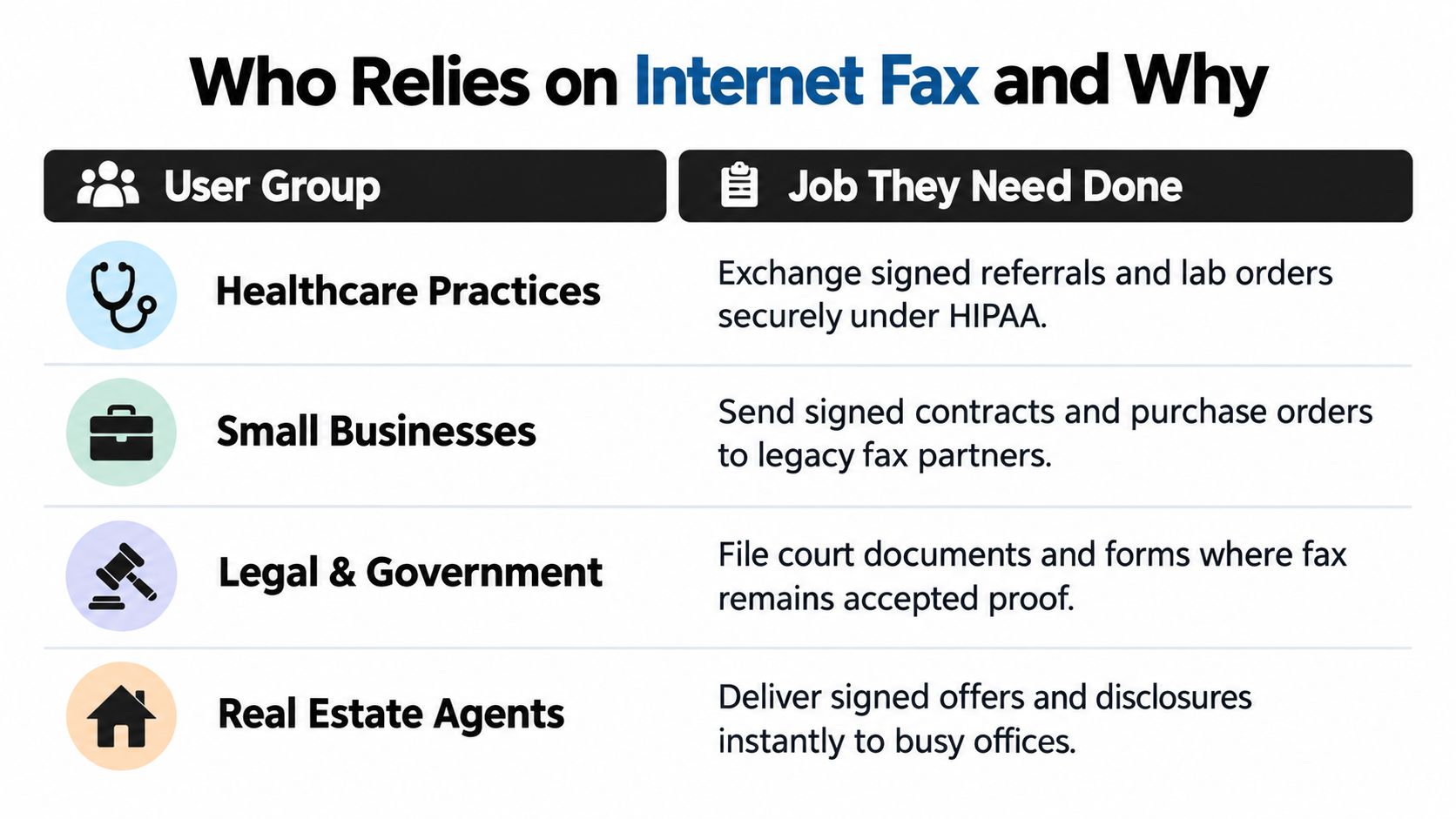
    Fax survives because some industries built approvals, records handling, and intake around it years ago, then kept those processes because they still work for the people using them. That’s especially common in healthcare, legal, government, and property transactions. The person asking you for a fax often isn’t being difficult. They’re following the intake method their office already trusts.

    Internet faxing itself isn’t new. The first wide-scale internet fax service, TPC.INT, was launched almost 30 years ago by Marshall Rose and Carl Malamud, proving documents could move from a browser to a physical fax endpoint and setting the foundation for modern web faxing, as noted in this history of internet faxing.

    Fax from a browser feels old and modern at the same time. The old part is the destination. The modern part is that you no longer need the machine.

    What works for one-off faxing

    For occasional use, the winning setup is usually a browser-based service with no software and no hardware requirements. You open the page, attach the file, enter sender and recipient details, and submit. That’s a much better fit for a remote worker, traveler, freelancer, or office manager handling a single urgent document than a subscription platform built for daily volume.

    The practical benefit is speed, but privacy and simplicity matter too. If you’re sending a contract, intake form, records request, or signed authorization, you probably don’t want to create a permanent account just to move one file.

    A no-account tool like SendItFax fits that use case because it lets you upload DOC, DOCX, or PDF files from a browser, send to U.S. or Canada fax numbers, and choose between a free short fax or a paid one with a cleaner presentation. That model suits people who need to solve a document problem right now, not build a whole fax workflow.

    Preparing Your Documents for a Flawless Fax Transmission

    Bad source files create bad faxes. That rule never changes.

    If you’re trying to send fax from web, your upload isn’t passed through as a perfect digital clone. Web fax systems convert files for fax transmission, and that process punishes fuzzy scans, crooked phone photos, pale gray text, and messy multi-file uploads.

    A person in a green sweater uses their hands to guide a document into a fax machine.

    Start with the right file type

    For browser faxing, stick with the formats the service accepts. In this case, that means DOC, DOCX, or PDF. If you have a Word file, convert it before sending if the layout is even slightly sensitive. That locks in page breaks, signatures, and spacing more reliably than handing off an editable file.

    If your document began in Word, this guide on how to convert Word to PDF is worth using before upload.

    What makes a fax readable

    A clean PDF usually performs better than a casual image capture. Text should be dark, the background should be light, and the page should be straight. If the original is a paper document, scan it flat. Don’t photograph it on a kitchen table under uneven lighting and expect a sharp fax at the other end.

    According to the TIFF-FX standard in RFC 3949, web fax services convert documents into TIFF-FX for transmission, and poor source files like blurry or low-contrast scans are a primary reason recipients get unreadable pages.

    Practical rule: If you have to zoom in on your own file to read it comfortably, the recipient’s fax machine probably won’t improve it.

    Before you upload, check these items

    • Page order: Put pages in final reading order before upload. Don’t assume you can rearrange them during the send flow.
    • Margins: Avoid signatures or dates pressed against the edge. Fax rendering can make tight margins risky.
    • Contrast: Black text on a white background wins. Light gray text, highlighted fields, and faint stamps often reproduce poorly.
    • Single file: Merge related pages into one PDF instead of uploading a loose mix of separate files.
    • Final review: Open the exact file you plan to send. Confirm every page is right-side up and complete.

    That last point saves more trouble than people expect. The issue often isn’t the fax service. It’s the page that was accidentally upside down, cropped, or missing from the PDF.

    A quick visual refresher can help before you send:

    Common prep mistakes that waste time

    People usually lose time in one of three ways. They upload a photo instead of a document scan. They send several separate files and assume the service will combine them in the right order. Or they leave the file in an editable format that shifts when rendered.

    The safer habit is boring but effective. Prepare one clean final file. Keep it legible. Keep it simple. Fax systems reward that discipline.

    Choosing Your Plan Free vs Almost Free

    The plan decision isn’t really about cheap versus expensive. It’s about presentation, page count, and urgency.

    If you’re sending a short, low-stakes document, the free route can be enough. If you’re sending something client-facing, regulated, or time-sensitive, the trade-offs matter more. In those situations, the cleaner paid option usually makes more sense.

    Where free tiers often fall short

    A lot of online fax providers advertise free sending, then require signup and place visible branding on the cover page. That’s a real problem for professional communication. As noted on the Fax.Plus free fax page, free services commonly involve account creation, and branding on cover pages is a frequent complaint that can make the fax look less professional.

    That’s the key distinction in practice. “Free” isn’t just about money. It’s also about what you’re giving up in privacy, speed, and appearance.

    SendItFax Plan Comparison Free vs Almost Free

    Feature Free Plan Almost Free Plan
    Account required No No
    Page limit Up to 3 pages plus cover Up to 25 pages
    Daily use Up to 5 free faxes daily Pay per fax
    Branding SendItFax branding on cover page No SendItFax branding
    Cover page Optional message with cover Cover page can be omitted entirely
    Delivery handling Standard queue Priority delivery
    Best fit Short, casual, non-sensitive sends Professional, client-facing, or longer documents

    If you want a broader cost breakdown before choosing, this article on fax sending costs helps frame when pay-per-fax makes more sense than subscription pricing.

    How to choose without overthinking it

    Use the free option when all of these are true:

    • Short document: You’re within the free page allowance.
    • Low presentation risk: A branded cover page won’t create friction.
    • No ongoing need: You just need to move one basic document quickly.

    Use the paid option when any of these apply:

    • Professional appearance matters: Law offices, clinics, brokers, and formal counterparties usually expect a clean cover or no cover at all.
    • You have a longer packet: Multi-page forms, signed agreements, and records requests get awkward fast when you’re squeezing into a free limit.
    • You need better delivery handling: Priority matters when the receiving machine or office is busy and the document is time-sensitive.

    If the fax affects money, compliance, a closing date, or patient information, treat presentation as part of the document, not an afterthought.

    What works least well is trying to force every use case into the free tier. That often leads to page trimming, branding you didn’t want, or a resend later. For occasional business use, paying once for the clean send is often the more efficient choice.

    Your Step-by-Step Guide to Sending a Web Fax

    This is the primary focus. Once your file is ready, sending the fax is straightforward if you move in the right order and check the details before you hit send.

    A step-by-step guide illustrating the process of sending a document via a web-based fax service.

    Open the web form and enter the recipient carefully

    Start with the destination fax number. Slow down here. Most failed sends I’ve seen start with a typo, not a technical problem. Enter the U.S. or Canada fax number exactly as requested by the recipient’s office.

    Then fill in the sender details the form asks for. This isn’t busywork. The service needs enough information to process the fax and return confirmation properly. If the recipient expects a specific business name, use that name consistently.

    Upload the final document, not a draft

    Attach the finished file only after you’ve reviewed it outside the browser. Don’t use the upload window as your proofing tool. Open the file on your device first, confirm the page order, and check that signatures or initials are visible.

    If you’re working in a tech-heavy environment and you’re used to systems access, tokens, or automated workflows, it helps to keep the concepts separate. A simple browser fax is usually manual and form-based, while automated sending depends on credentials and structured access. If that distinction is fuzzy, this primer on understanding API keys explains the kind of authentication used in app-to-app systems.

    Decide whether to use a cover page

    A cover page can help when the recipient office routes incoming faxes by person or department. It gives context and can reduce confusion when the main document starts abruptly.

    But there are plenty of times to skip it. If you’re sending a straightforward signed form to a known recipient and the paid plan lets you omit the cover page, no cover can be cleaner and more professional than a generic one.

    A useful rule is simple:

    • Use a cover page when routing information matters.
    • Skip the cover page when the document speaks for itself and you want less visual clutter.

    Review the cover page with the same care as the attachment. The wrong recipient name on the cover creates more problems than no cover at all.

    Check the small details before sending

    Often, impatience leads to avoidable resends. Before you submit, scan the full form once from top to bottom.

    Look for:

    • Recipient number accuracy: One wrong digit is enough to derail the send.
    • Correct sender identity: Match the name or organization the recipient expects.
    • Right file version: Make sure you uploaded the signed copy, not the draft without initials.
    • Page count fit: Confirm your file fits the plan you selected.
    • Cover page choice: If branding or presentation matters, verify that you picked the right option.

    Submit and wait for confirmation

    Once sent, the fax moves through the web-to-fax gateway for delivery to the destination machine or fax endpoint. You don’t need to babysit the transmission in the way you would with a physical fax machine.

    Modern web-to-fax gateways report delivery success rates over 95% for U.S. and Canada numbers, and confirmation by email or browser dashboard has been a standard part of the process since the late 1990s, according to ClearlyIP’s overview of internet faxing.

    What matters next is the confirmation itself. Don’t assume “submitted” means “received.” Wait for the delivery message, then keep that email if the document matters.

    What the confirmation actually tells you

    A confirmation usually answers the question the recipient will ask later: did you send it successfully? That’s why I treat confirmation emails as part of the record, not just a convenience.

    Read the status closely. A successful delivery means the receiving side accepted the fax. If the service reports a problem, the message usually points you toward the likely issue, such as number formatting, file rejection, or a receiving-side timeout.

    When to resend and when to pause

    Resend only after you know why the first attempt failed. Blindly firing the same file to the same number wastes time and can create duplicate paperwork on the recipient’s end if the first attempt went through later.

    Pause and check three things first:

    1. Whether the number is correct.
    2. Whether the uploaded file is within the service limits.
    3. Whether the recipient’s machine or gateway may have had a temporary issue.

    That short pause is often the difference between a clean second attempt and a messy chain of repeated sends.

    Troubleshooting Common Errors and Ensuring Delivery

    When a web fax fails, people often assume the service is broken. Usually it’s something more ordinary. Faxing still depends on file quality, correct numbering, and whatever equipment or gateway exists on the recipient side.

    The error may be yours, not the platform’s

    If the file never sends, start with the obvious checks before blaming the tool.

    • Wrong number entered: Recheck every digit against the number provided by the recipient.
    • Oversized upload: Some gateways reject large files before transmission even begins.
    • Bad source file: Corrupt PDFs, weak scans, or odd formatting can trigger rejection or unreadable output.
    • Browser issue: Refresh, re-upload, and make sure your browser session is functioning normally.

    According to the internet fax overview on Wikipedia, common technical pitfalls include T.38 failures with older machines, which can cause timeouts, and files over 20MB being rejected by server gateways before a send attempt is made.

    What to do when the recipient line is busy or times out

    A busy signal doesn’t always mean you did anything wrong. The receiving office may be processing another fax, or their equipment may be slow to respond. In real office workflows, this happens more often with shared lines and older setups.

    Try these fixes:

    • Wait and resend later: A short delay often solves a temporary busy condition.
    • Confirm the number with the office: Ask whether they have an alternate fax line or department number.
    • Reduce file complexity: A cleaner, simpler PDF is easier to process than a bulky image-heavy file.

    Older receiving machines can be the weak link. If your file is clean and the number is right, the timeout may be happening on their side.

    Quick triage checklist

    Use this when a send doesn’t complete:

    Problem Likely cause Practical fix
    Immediate rejection File too large or unsupported issue Reduce size, re-save as PDF, try again
    Busy or timeout Recipient line occupied or older machine issue Wait, verify number, resend
    Unreadable pages Poor scan quality Re-scan with stronger contrast
    No useful confirmation Browser or session issue Refresh and repeat carefully

    The fastest path is usually the least dramatic one. Check the number. Check the file. Then try again once, with a cleaner setup than the first attempt.

    Pro Tips for Healthcare and Legal Professionals

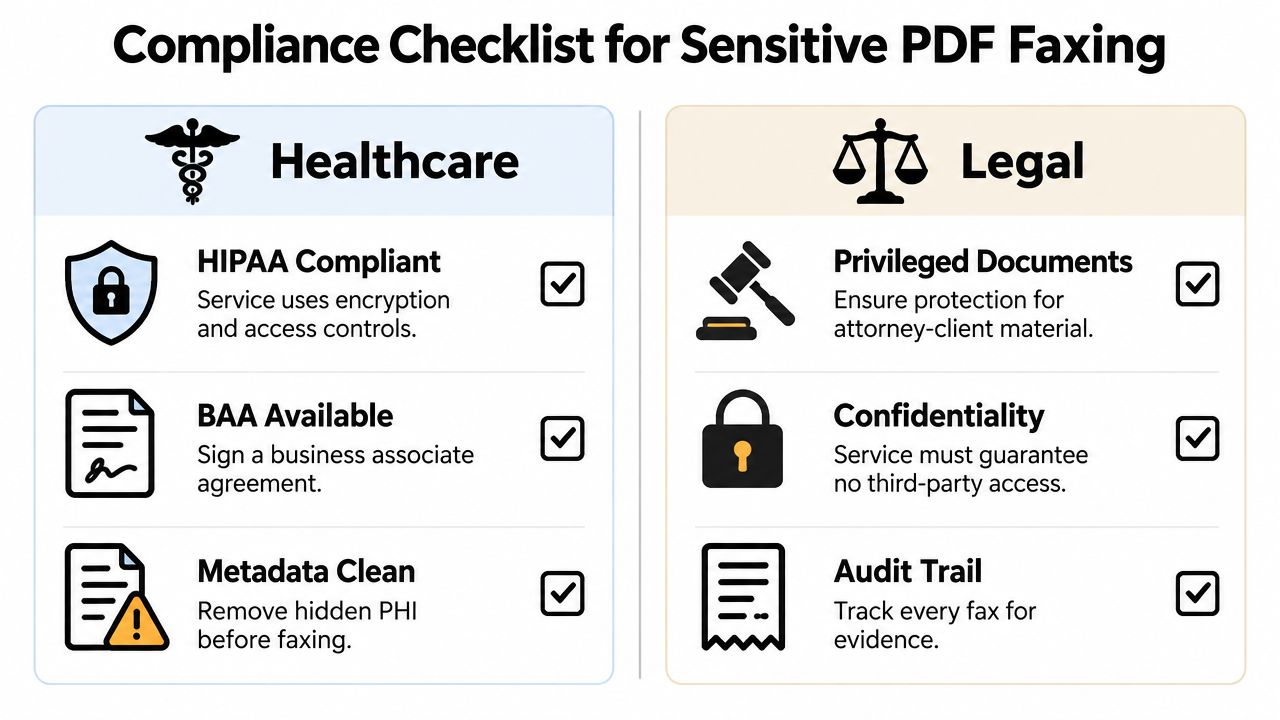
    Healthcare and legal offices don’t just need a fax to go through. They need it to look professional, route correctly, and leave a usable record behind.

    Healthcare needs clean handling

    If you’re sending patient-related paperwork, referrals, signed releases, or records requests, avoid anything that adds unnecessary branding or confusion to the first page. In healthcare workflows, the cover page often determines how quickly staff can route the fax internally. Keep it clear, minimal, and accurate.

    If compliance questions are part of your decision, this overview of a HIPAA compliant fax service is a useful next read.

    Legal teams need proof and consistency

    For law offices, timestamped confirmation matters almost as much as delivery. Save the email confirmation and keep the exact file copy you sent. That gives you a cleaner paper trail if a client, clerk, or opposing office later asks when the document was transmitted.

    For firms reviewing broader operational risk around document handling, device management, and secure staff workflows, outside guidance on law firm IT support can help frame where faxing fits inside the larger practice environment.

    Why occasional users should avoid subscriptions

    In certain scenarios, pay-per-fax models make practical sense. For small businesses and freelancers in fields like real estate and law who send fewer than 10 faxes per year, no-account pay-per-fax models are more cost-effective than monthly subscriptions, as noted by FaxBurner’s market positioning.

    That matches what I’ve seen in remote office work. If faxing is occasional but important, you don’t need a full subscription stack. You need a clean send, confirmation, and no extra friction.

    The right fax setup for a professional isn’t always the one with the most features. It’s the one that handles an important document cleanly the first time.


    If you need to fax a document today without setting up an account, SendItFax gives you a simple browser-based way to send DOC, DOCX, or PDF files to U.S. and Canada fax numbers, with a free option for short sends and a paid option for longer, unbranded transmissions.

  • Cheap Places to Fax Near Me: 2026 Cost & Speed Guide

    Cheap Places to Fax Near Me: 2026 Cost & Speed Guide

    You notice the fax requirement at the worst possible moment.

    A clinic wants a signed release back today. A lender asks for a faxed form instead of an email attachment. A school office gives you a fax number and a deadline, but you haven't seen a fax machine in years. So you open your phone, type cheap places to fax near me, and hope the answer isn't a long drive plus a surprise bill at the counter.

    That frustration is common because faxing hasn't disappeared in the places where documentation, signatures, and formal delivery matter most. Legal offices, medical providers, insurers, and government agencies still ask for it. The machine is old. The requirement is not.

    Your Urgent Fax Needs a 2026 Solution

    The hard part isn't sending the document. It's figuring out where to send it without wasting half your day.

    A young person in a green beanie and plaid shirt holding papers while looking up in surprise

    I've seen the same pattern over and over. Someone assumes the nearest big-box store will be cheap, shows up with a multi-page packet, and only then realizes the cost grows page by page. Someone else drives to a library for the low rate, then runs into limited access, a line, or less privacy than expected.

    The actual problem isn't faxing

    The underlying issue is choosing the wrong method for your situation.

    If you're faxing a short, non-sensitive form and you're already near a library, one choice makes sense. If you're sending documents with personal medical or financial details and you don't want them handled at a public counter, another choice makes more sense. If timing matters more than absolute cost, convenience can beat the cheapest sticker price.

    A fax isn't just a transmission problem. It's a cost, time, and privacy decision.

    What matters most in practice

    Few individuals require a giant directory. They need a fast answer to four questions:

    • How much will this specific fax cost
    • How long will it take
    • Will someone else handle my documents
    • Is there a simpler option than driving somewhere

    That's where this guide is useful. Instead of dumping a list of stores on you, it breaks down the common local choices by scenario. You can decide whether the smartest move is a library, a shipping store, an office supply retailer, a bank branch, or skipping the trip entirely.

    Exploring Your Neighborhood Fax Options

    Before comparing exact trade-offs, it helps to understand the general situation. Local fax options fall into a few predictable groups, and each sits on a different part of the cost versus convenience spectrum.

    Option Typical cost profile Best for Main trade-off
    Public libraries Lowest-cost public option Low-priority domestic faxes Hours, access, privacy vary
    Shipping centers Easy to find in many areas Urgent errands and assisted sending Higher per-page cost
    Office supply stores Familiar retail setup, often self-service People who want a simple walk-in process Cost rises on longer jobs
    Banks and credit unions Often free for account holders Existing customers with occasional needs Service isn't universal at every branch
    Hotels or business desks Situational convenience Travelers already on site Availability and pricing can be inconsistent

    Libraries sit at the budget end

    Public libraries are the first place I mention when someone asks about cheap places to fax near me and cares most about price. According to FaxBurner's overview of fax machine services near you, libraries charge as low as 10 to 25 cents per domestic U.S. page, and some offer faxing free to members. That makes them the natural benchmark for low-cost walk-in faxing.

    The downside is practical, not theoretical. Library fax access depends on the branch, the machine, the staff workflow, and the hours. If you need a same-day send right before closing, the cheapest option can stop being the easiest option.

    Shipping and office supply stores favor convenience

    The UPS Store, FedEx Office, Staples, and Office Depot are the places many people try first because they already know where they are. That's reasonable. These stores are built for walk-in document tasks, and the process is straightforward.

    The trade-off is that they charge more per page than public institutions. That matters less for a one-page form and much more for a packet with multiple signatures, disclosures, or supporting documents.

    Banks can be useful

    Some banks and credit unions will fax documents for account holders. This option doesn't get mentioned enough because it isn't as visible as a retail chain. But if you already have a relationship with the branch, it's worth a quick call.

    This is one of those methods that works well when it works and wastes time when it doesn't. Call first. Don't assume the branch offers it just because another branch does.

    Think in scenarios, not just locations

    A cheap fax location isn't automatically the right fax location.

    A library may win on price. A retail counter may win on speed. A familiar bank employee may feel more comfortable for paperwork that includes private information. The best choice depends on whether your top priority is saving money, finishing fast, or keeping your documents out of a public queue.

    Comparing Local Fax Services on Price Speed and Privacy

    If you want a practical answer, compare local fax options the same way you'd compare a rideshare, a print shop, or a shipping method. Look at total cost, how long it takes to complete the task, and how exposed your documents are while you wait.

    A comparison chart showing pricing, speed, and privacy for fax services at office stores, libraries, and hotels.

    Price by chain

    According to FAX.PLUS pricing comparisons for fax services near you, major retail chains typically charge $1.00 to $1.89 for the first page of a local fax and $1.00 to $2.19 for each additional page. The same comparison lists these rates:

    Provider Local fax National fax International fax
    UPS Store $1.00 first / $1.00 additional $2.00 first / $1.00 additional $3.00 first / $3.00 additional
    FedEx Office $1.89 first / $1.59 additional $2.49 first / $2.19 additional $5.99 first / $3.99 additional
    Staples $1.79 first / $1.59 additional $2.39 first / $2.19 additional $5.99 first / $3.99 additional
    Office Depot $1.49 first / $1.29 additional $1.99 first / $1.79 additional $7.99 first / $3.99 additional

    That same source notes a useful real-world example: a 3-page local fax at UPS might total $3.00 versus $4.07 at FedEx. That's the kind of difference many people don't think about until they're standing at the machine.

    Speed in practice

    Transmission itself is quick. The slower part is everything around it.

    At a self-service machine, you may need to scan, enter the number carefully, confirm page order, and wait for a printed confirmation. At a staffed counter, you may spend more time in line but less time pressing buttons. Libraries can be slower because the fax machine is one shared service among many, and the person helping you may also be handling circulation or patron questions.

    Practical rule: If the deadline is close, judge the trip by queue risk, not by how fast fax technology works.

    Privacy depends on who touches the paperwork

    Here, many people make a poor trade-off without realizing it.

    A public machine in a library or office store is fine for routine documents. It's less ideal when the packet includes medical records, bank details, tax forms, or identification documents. Sometimes you feed the pages yourself. Sometimes a staff member assists. Sometimes other customers are standing close enough to see names, addresses, and pages as they move through the feeder.

    Here's the simple privacy hierarchy I use:

    • Highest privacy among walk-in methods tends to be a self-service machine where you control the pages the entire time.
    • Middle ground is a quieter branch, desk, or store where staff help but the environment isn't crowded.
    • Lowest privacy is a busy public counter where documents sit visible while you wait.

    Convenience is not the same as price

    Retail chains win on predictability. You know what the location looks like, and many stores are set up for people who walk in with a document problem and need help fast. The FAX.PLUS comparison also notes over 5,000 UPS Stores and 1,700 FedEx Offices nationwide, which explains why these places show up so often in local searches.

    Libraries win when your job is simple and cheap matters most. Retail stores win when you need a smoother walk-in experience and are willing to pay for it. If you're trying to estimate the full bill before you leave home, this breakdown of the cost to send a fax is useful because it helps you think in total document cost, not just first-page sticker price.

    Paying more per page can still be the right move if it saves a missed deadline, a return trip, or a failed first attempt.

    Deciding When a Walk-In Fax Service is Your Best Bet

    The right walk-in option depends less on the brand and more on the job in your hand. One signed page is a different problem from a thick packet going to another state or another country.

    Use a library for low-stakes savings

    A library makes sense when all of these are true:

    • Your document is short
    • The fax is domestic
    • You can work within library hours
    • The information isn't so sensitive that a public setting bothers you

    This is the budget-first choice. If you're faxing a basic school form, a single release, or a short document that doesn't need a polished retail experience, the low page cost is hard to beat.

    Use an office supply or shipping store when timing matters

    Office Depot, Staples, FedEx Office, and UPS are better fits when you need a more dependable walk-in workflow. You get clearer transaction handling, easier confirmation, and a setup built for document tasks.

    That matters for people sending forms on lunch break, after other errands, or when they don't want to gamble on whether a public machine is available. If you're already printing marketing materials or picking up branded items for work, it can also be efficient to combine errands. For example, a team ordering flyers and business cards printing might prefer to handle faxing during the same print-services run.

    Watch distance-based pricing carefully

    According to mFax's benchmark comparison of nearby fax services, national fax pricing rises to $1.99/$1.79 at Office Depot, $2.39/$2.19 at Staples, and $2.49/$2.19 at FedEx, while international first-page rates range from $3.00 to $7.99. The same comparison says distance-based surcharges can increase total cost by 2 to 5 times for cross-border transmissions.

    That means the cheap-looking local rate can stop mattering fast if your recipient isn't local.

    Simple scenario matching

    If you want a fast decision, use this checklist:

    • Choose the library when cost is your top priority and the fax is simple.
    • Choose Office Depot or Staples when you want a familiar retail environment without the highest long-distance pricing.
    • Choose FedEx Office or UPS when location convenience matters more than squeezing out every dollar.
    • Choose your bank or credit union when you're an account holder and want to check for a no-fee branch service first.

    If you're still comparing physical locations, this guide on where to go to fax a document can help narrow the trip before you leave home.

    A Faster Cheaper Way to Send Faxes From Anywhere

    You realize you need to fax a signed form today. The file is already on your phone. At that point, the cheapest option is often the one that avoids a car trip, a printout, and a per-page counter fee.

    For a digital document, online faxing usually wins on total cost, speed, and privacy. A walk-in store can still make sense if you only have paper pages in hand, but once a file is saved as a PDF, DOC, or DOCX, going to a store adds steps without adding much value.

    A young person wearing a yellow beanie and green sweater smiling while using a laptop to fax.

    What changes when you fax online

    The practical difference is simple. You upload the file, enter the fax number, add a cover page if needed, and send it from a browser.

    That cuts out several hidden costs people forget to count:

    • Travel time
    • Gas or transit
    • Printing pages you already have digitally
    • Waiting for an open machine
    • Handing private paperwork to a public counter

    For one short fax, those friction costs often matter more than the listed fax price.

    Where online faxing makes the most sense

    Online faxing is a strong fit in three common situations.

    First, the document is already digital. Printing a PDF to feed it into a public machine is the slowest path.

    Second, the packet contains sensitive information. Medical forms, loan paperwork, and signed contracts are easier to control when you send them directly from your own device instead of handling them in a retail setting.

    Third, you fax rarely. In that scenario, the best choice is the one with the fewest steps and the clearest final price, not the one with the most features.

    A practical example of the cost trade-off

    SendItFax is one browser-based option for sending to recipients in the United States and Canada without creating an account. Based on the publisher information provided for this article, it accepts DOC, DOCX, and PDF files, includes an optional cover page message, offers a free option for up to three pages plus a cover with a daily limit of five free faxes, and has an Almost Free plan at $1.99 per fax for up to 25 pages with no branding and priority delivery.

    That pricing structure matters because it changes the math by scenario. A two-page school form or signed authorization may fit the free option. A 12-page packet can also be easier to price in advance with a flat per-fax plan than with a store counter that charges by page and may add long-distance costs.

    The smart default for digital documents

    If your file is on your phone or laptop, online faxing is often the cleaner choice. You save the errand, reduce handling of private documents, and avoid the surprise of a small fax turning into a bigger bill once extra pages or distance are involved.

    If you want the exact steps before trying it, this guide on how to send fax online from your browser walks through the process clearly.

    A Practical Walkthrough Sending Your First Online Fax

    The process is much simpler than many anticipate. You don't need a machine, a phone line, or a long setup.

    Screenshot from https://senditfax.com/

    Step 1 Pick your file first

    Start with the document you need to send.

    The easiest format is a clean PDF. If your file is in Word, DOC or DOCX also works on services built for browser uploads. Before you upload anything, check that every page is included, signatures are visible, and the recipient fax number is correct.

    Step 2 Enter sender and recipient details

    Most browser-based fax forms ask for basic sender information and the recipient's fax number. Fill this out carefully.

    For legal, medical, or financial forms, I recommend matching names exactly to the paperwork. That reduces confusion on the receiving side, especially when the office gets many inbound documents.

    Step 3 Decide whether you need a cover page

    A cover page is useful when the recipient expects identifying information, attention lines, or a short note explaining what the fax is for. If the document stands on its own, you may not need one.

    For a casual one-off send, the free route works if your packet is short and you don't mind service branding on the cover page. For something more polished, a paid flat-rate option is cleaner.

    Step 4 Choose the right plan for the job

    Use the free option when:

    • Your fax is short
    • Branding on the cover page isn't a problem
    • You're sending an occasional document

    Use the paid option when:

    1. Your file is longer and per-page retail pricing would add up
    2. You don't want branding on the cover page
    3. You want priority delivery
    4. You may want to skip the cover page entirely

    Step 5 Send and keep the confirmation

    After you submit the fax, don't close the tab too quickly if the service is still processing.

    Keep any confirmation page, email, or status result. That record matters if the recipient later says the document didn't arrive. A saved digital confirmation is easier to store and retrieve than a paper slip from a store counter.

    For occasional faxing, the fastest workflow is upload, verify, send, save confirmation, done.

    Common Questions About Finding Cheap Fax Services

    Is it safe to fax sensitive documents from a public place

    It can be, but public locations are rarely the most private option. If the pages contain medical, banking, tax, or identification details, avoid crowded counters when possible and don't leave papers unattended in feeders or trays.

    Can I receive faxes at these locations

    Some walk-in businesses may handle receiving, but availability varies a lot by location. Ask before you rely on it. For many occasional users, receiving is less predictable at physical locations than sending.

    Which physical place is usually cheapest

    Libraries are usually the lowest-cost public option when they offer faxing. Banks can be even cheaper for account holders if the branch provides it, but that isn't universal.

    Do I need a printed document to fax

    Not always. If you use an online fax service, you can upload a PDF, DOC, or DOCX directly from your device instead of printing first.

    How do I prove an online fax was sent

    Keep the delivery confirmation or status record provided after submission. That's the digital version of the paper confirmation page people want from walk-in fax locations.


    If you need to send a fax without driving to a store, SendItFax is a simple browser-based option for U.S. and Canada faxing. You can upload a document, enter the fax number, and send it without creating an account. For short occasional faxes, the free option may be enough. For larger packets, the flat-rate paid option can be easier to budget than walk-in per-page pricing.

  • What Are Faxes Used For Today A 2026 Guide

    What Are Faxes Used For Today A 2026 Guide

    Yes, people absolutely still use fax. It’s a common question, and the answer surprises a lot of folks. While email has taken over our day-to-day chats, faxing remains the go-to for critical tasks where security and legal proof aren't just nice-to-haves—they're required.

    Think of it this way: faxing is like a digital notary. It provides a verifiable, point-to-point delivery that’s indispensable when you're sending signed contracts, medical records, or legal filings.

    Why Faxes Are Still Essential in 2026

    A laptop on a modern wooden desk displays 'FAX STILL MATTERS', surrounded by office supplies.

    It's easy to picture a dusty old fax machine humming away in a forgotten corner, but that’s not the reality anymore. Faxing has evolved. Today, those clunky machines have mostly been replaced by slick online fax services, making the technology more accessible and relevant than ever.

    The reason it has stuck around is surprisingly simple. Faxing offers something email and instant messaging can’t always guarantee: a secure, direct connection with a verifiable receipt.

    It’s the difference between sending a certified letter and just dropping a postcard in the mail. An email can be intercepted, misrouted, or vanish into a spam folder, often without you ever knowing if it arrived. A fax, on the other hand, establishes a direct link between sender and receiver, then generates a transmission report that acts as legal proof of delivery. In a professional world, that confirmation is everything.

    Who Still Uses Faxes and Why

    This isn't just a case of old habits dying hard. For many industries, using fax is a matter of compliance, dictated by strict regulations on how sensitive information has to be handled.

    Even as we move through the 2020s, fax remains a dominant force in healthcare. Recent estimates show that over 9 billion documents are faxed annually in the US healthcare system alone—a staggering figure, considering the global total was around 17 billion in 2019. This is largely because regulations like HIPAA demand secure, verifiable transmission for things like prescriptions and patient records. You can get a deeper look at why faxing is still so prevalent on this cacm.acm.org breakdown.

    To help paint a clearer picture of what faxes are used for today, this table breaks down the key players and why they continue to rely on this trusted technology.

    Who Still Uses Faxes and Why

    Industry Primary Use Cases Key Reason for Use
    Healthcare Patient records, prescriptions, insurance claims HIPAA compliance and verifiable delivery
    Legal Court filings, signed contracts, affidavits Legally admissible proof of receipt
    Real Estate Signed offers, purchase agreements, closing docs Secure handling of financial and personal data
    Government Official forms, applications, public records requests Established, secure, and accessible process

    As you can see, for these sectors, the unmatched security and legal standing of a fax transmission make it an indispensable tool, not a technological fossil.

    The Security and Legal Power of Faxing

    Person reviewing a legal document next to a laptop displaying a Wi-Fi security icon and 'Secure and Legal' text.

    If you've ever wondered why faxing is still around in 2026, the answer boils down to two critical factors: security and legal weight. It’s not just about tradition. For industries that handle sensitive information, these two pillars make faxing an indispensable tool, even with so many other ways to send a document.

    Think about how an email travels. It’s like a postcard—it gets copied and passed through multiple servers on its way to the recipient, with each stop being a potential weak point for a data breach. A fax, on the other hand, is more like a secure pneumatic tube. It creates a direct, point-to-point connection over the phone network, sending the document straight from you to them in a closed loop.

    This direct tunnel is what makes it so secure. By avoiding all those intermediate servers, faxing slashes the opportunities for interception that plague email.

    A Legally Binding Digital Handshake

    Security is one half of the equation; the other is legal proof. When you send a fax and it goes through, the machine or online service generates a transmission report. This isn't just a simple "sent" notification—it's a legally admissible document that creates a powerful audit trail.

    This report is essentially a digital handshake, proving not just that a document was sent, but that it was successfully received. It meticulously logs the sender's and receiver's numbers, the exact time of transmission, and the total page count.

    This kind of built-in proof is absolutely essential in regulated fields. It’s why, even today, the US healthcare sector relies on fax for an estimated 90% of certain exchanges. This isn't just a US phenomenon; you'll see lawyers and real estate agents in markets like Canada using fax for the same reason—it provides accountability that is hard to argue with.

    Meeting Strict Compliance Standards

    For industries governed by regulations like the Health Insurance Portability and Accountability Act (HIPAA), that level of proof isn't just nice to have; it's a requirement. Handling Protected Health Information (PHI) in healthcare demands a method that’s both secure in transit and legally defensible.

    Faxing ticks these boxes for a few key reasons:

    • Verifiable Audit Trail: The transmission report is hard evidence of delivery, satisfying strict legal and regulatory demands.
    • Point-to-Point Security: That direct connection we talked about drastically cuts the risk of someone snooping on the data as it's being sent.
    • Legally Recognized Signatures: For decades, faxed signatures have been accepted as legally binding in courts and by government agencies.

    Whether you're using a classic machine or a modern online service, the fundamental structure of faxing provides a level of verification that many purely digital methods still can't match. If you want to get into the weeds on how this works with newer technology, you can learn more about the security of fax in our dedicated guide.

    Ultimately, this is why, for documents where proof of delivery and security are paramount, faxing remains the trusted choice.

    Where Fax Still Reigns: A Look at Key Industries

    It’s one thing to talk about security and legal standing in the abstract. It's another to see it play out where the stakes are highest. In certain sectors, faxing isn't just a preference; it’s deeply woven into the fabric of daily operations, often for strict regulatory reasons.

    Let’s pull back the curtain and see how these high-stakes industries put faxing to work every single day.

    Healthcare: The Lifeline for Patient Data

    In a medical setting, there's zero room for error when it comes to speed and security. Think about a local clinic that needs to send a patient's urgent MRI results to a specialist across town. Emailing that file is a non-starter—it’s an open invitation for a data breach, a direct violation of HIPAA, and a massive risk to patient privacy.

    This is where fax shines. The clinic faxes the documents, creating a direct, secure tunnel for that information. The hospital receives the results instantly, and just as importantly, the clinic gets a transmission receipt. That little piece of paper is a critical part of their compliance record, proving the information was sent and received.

    Fax plays a vital role in patient data security in healthcare, providing a trusted method for handling sensitive information.

    You’ll see faxes used constantly for:

    • Patient Referrals: Moving a patient’s case securely from a primary care physician to a specialist.
    • Prescriptions: Sending scripts to pharmacies, which is especially critical for controlled substances that demand a verifiable audit trail.
    • Medical Records and Test Results: Sharing lab work, imaging reports, and entire patient histories between different facilities.
    • Insurance Claims: Submitting the necessary paperwork for billing and pre-authorizations.

    By using fax, healthcare providers aren't just following tradition; they're meeting their legal duty to protect patient data. In fact, fax is so integral that it still accounts for an estimated 75% of all medical communication. If you're in healthcare, our guide on crafting a HIPAA-compliant fax cover sheet is a must-read to ensure you're on the right side of the regulations.

    The Legal Sector: Where Proof Is Everything

    For lawyers and courts, "I think I sent it" doesn't cut it. You need absolute, verifiable proof of delivery. Legal deadlines are ironclad, and proving you sent a document on time can literally win or lose a case. A lawyer filing a time-sensitive motion can't risk it getting buried in a spam folder or bounced by a server.

    Faxing solves this problem instantly. When the law firm faxes the motion, they create a legally admissible record of exactly when the document was delivered. For decades, faxed signatures have been recognized as legally binding, making them the perfect tool for executing contracts, settlement agreements, and affidavits without waiting on snail mail.

    Real Estate: Closing Deals with Confidence

    A single real estate deal involves a mountain of paperwork, all of it loaded with sensitive financial and personal details—purchase offers, loan applications, and closing statements, to name a few. An agent needs to get their client's signed offer to the seller's agent fast, but more importantly, securely.

    Sending these documents over email exposes clients to unnecessary risk. Fax provides a secure, private channel that keeps this data locked down. The transmission receipt becomes undeniable proof that the offer was submitted before the deadline, protecting everyone involved. It’s a simple, powerful tool that’s why, for so many real estate pros, fax is still the gold standard for handling binding agreements.

    From Clunky Machine to Cloud: The Surprising Evolution of the Fax

    If you worked in an office during the 1980s or 90s, you remember the sound—that screeching, whirring handshake between two fax machines. It was the sound of business getting done. The G3 fax standard turned what was a multi-day wait for a document via post into a matter of seconds, and offices couldn't get enough. By 1990, an incredible 40 million fax machines were humming away in businesses across the globe.

    You can take a deeper dive into this era in this history of faxing from Novatech.net.

    But that reliance on physical hardware—the bulky machine, the dedicated phone line, the constant need for paper and toner—started to feel pretty outdated as the rest of the office went digital and workers went remote. The very thing that made faxing great was becoming its biggest liability.

    The Move to Online Faxing

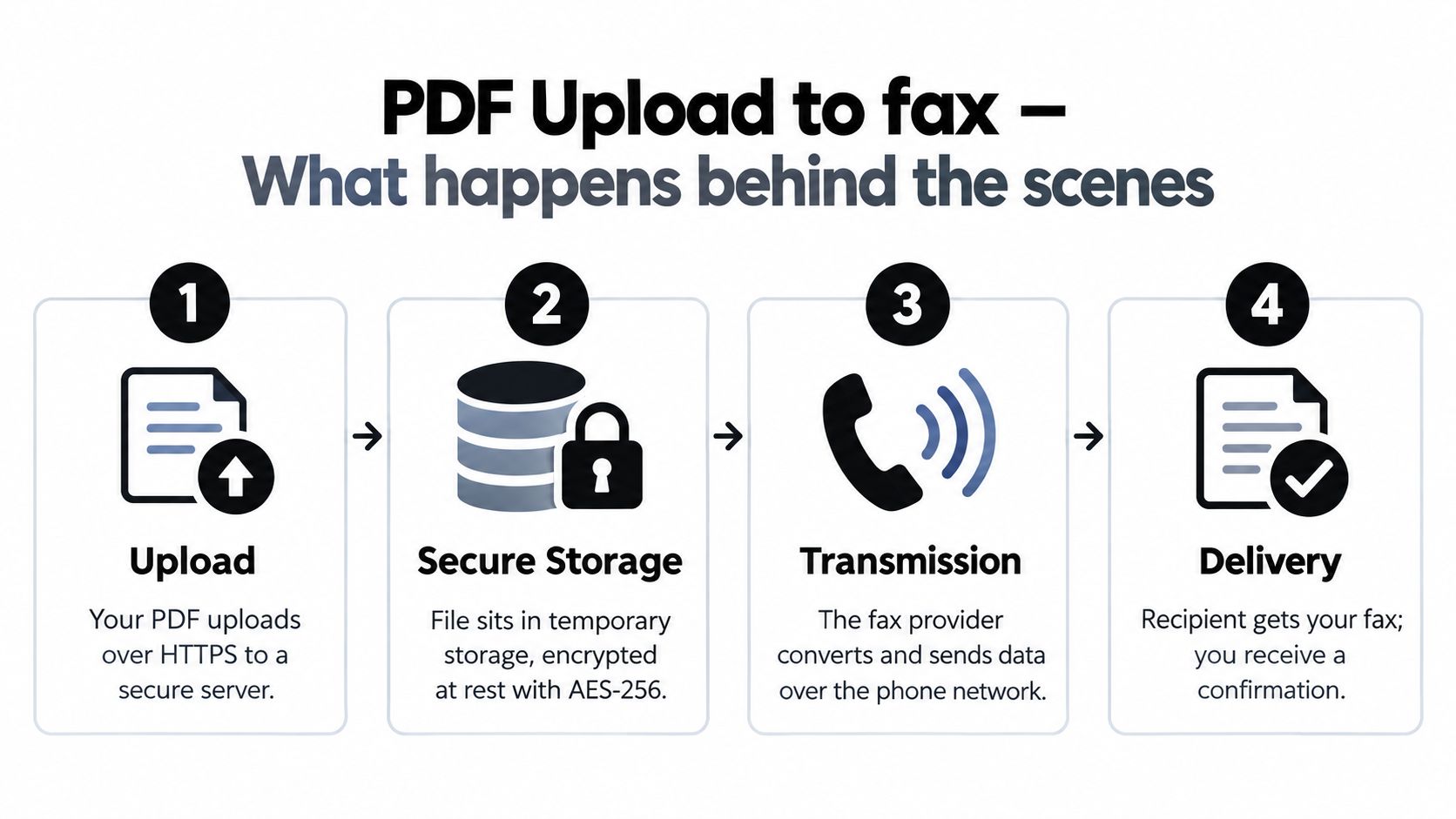
    The fix wasn't to get rid of faxing, but to reinvent it for the internet age. This gave rise to online faxing, which smartly separates the act of faxing from the machine itself. Instead of a dedicated device in the corner, these services use secure online servers to handle the entire process.

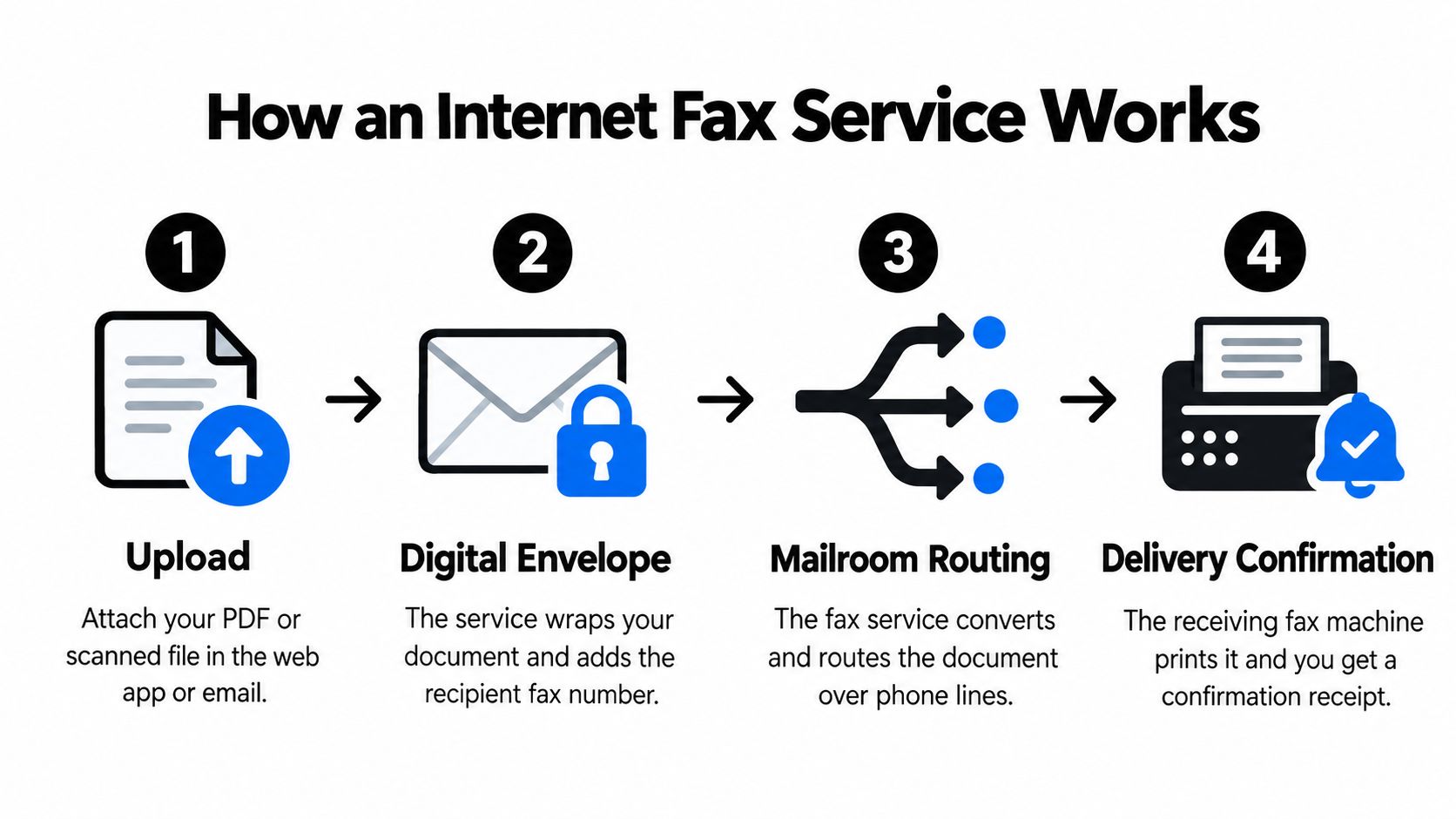
    Think of it as a digital middleman or a translator. You upload a document from your computer, and the online fax service converts it into the right format, dials up the recipient's traditional fax machine over the phone network, and sends it on its way. When someone faxes you, the service receives the call, translates the transmission back into a digital file (like a PDF), and delivers it right to your email inbox.

    This seemingly simple shift brought some massive improvements:

    • No Hardware, No Hassle: You can send and receive faxes straight from your email or a website. Forget about buying a machine, stocking up on toner, or paying for an extra phone line.
    • Fax from Anywhere: As long as you have an internet connection, you can send a fax. It doesn't matter if you're in the office, at home, or grabbing a coffee—your computer or phone is all you need.
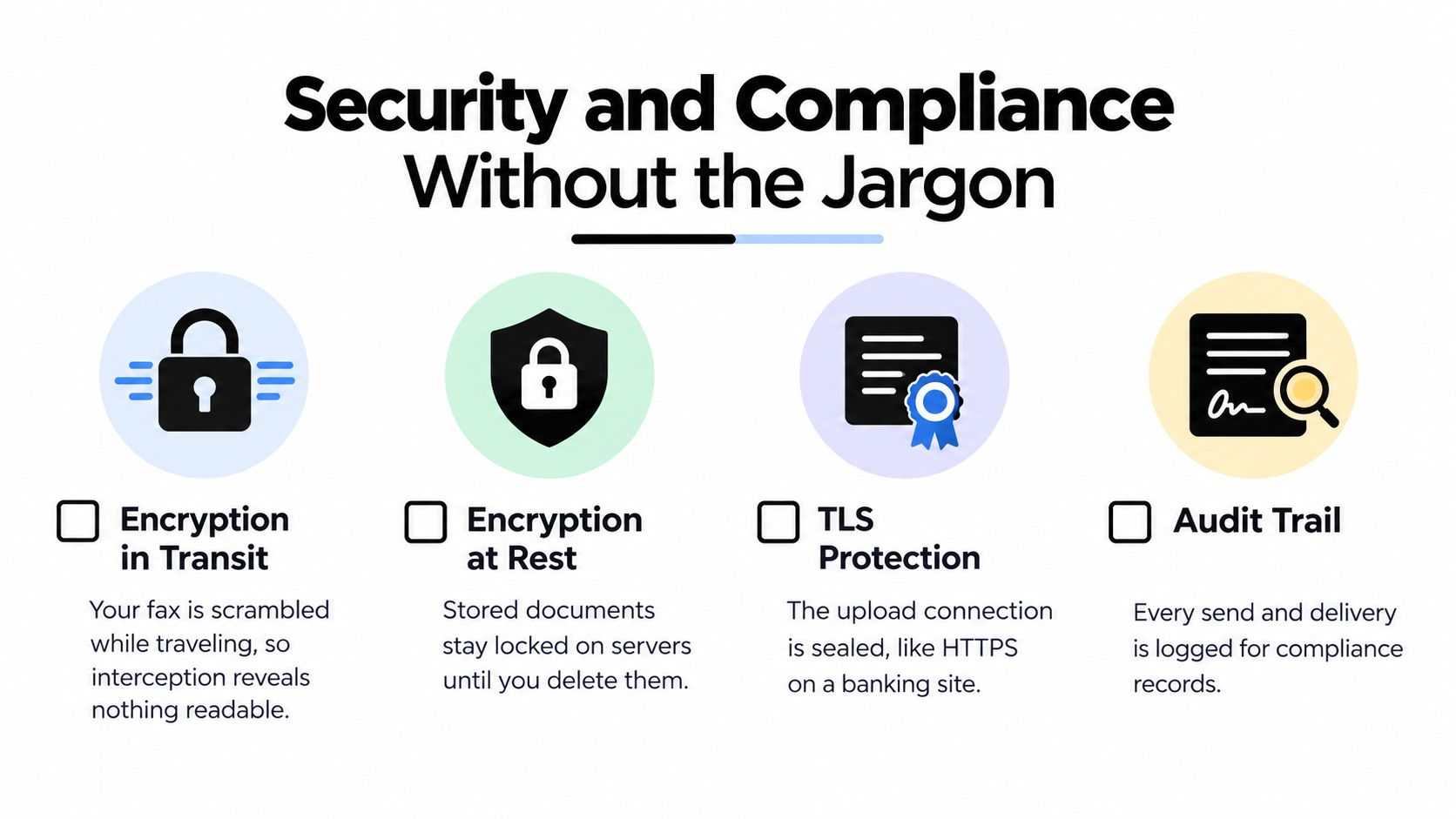
    • Better Security: Good online fax services encrypt your documents when you upload them and while they're stored. This adds a crucial layer of digital security that old-school machines just couldn't offer.
    • The All-Important Digital Trail: Just like the old machines, online services provide detailed confirmation reports. This preserves the verifiable proof of delivery that makes faxing legally significant.

    The core reason for faxing—a direct, point-to-point delivery with proof it was sent and received—is still there. What’s changed is the experience, which now fits perfectly into how we work today.

    This evolution makes faxing practical for everyone, not just large corporations. A freelancer can send a signed contract without buying any equipment. A remote employee can securely file sensitive government paperwork from their laptop.

    Modern tools like SendItFax are built for this exact purpose. They offer a simple way to send a one-off fax to the U.S. and Canada without creating an account, which is perfect for those occasional but absolutely critical documents.

    When to Choose Fax Instead of Email

    Trying to decide between sending a fax or an email? It can feel like a toss-up, but there's a straightforward way to make the right call. Think of it like choosing the right tool for a job. You wouldn't use a hammer to turn a screw, and the same logic applies here—fax and email are built for very different tasks.

    The key question you should always ask is: does this document require absolute security, a legally binding signature, or a verifiable audit trail? If you answer yes to any of those, faxing is your best bet. It’s the go-to for sending anything with sensitive personal data, official forms that need a signature, or legal documents. For just about everything else, like general collaboration or casual messages, email is perfectly fine.

    Breaking Down the Decision

    So, how do these two stack up in the real world? While email is second to none for quick, informal chats, faxing brings a level of security and legal standing that email just wasn't designed for. It’s not about which one is "better," but which one is the right, secure choice for the document at hand.

    • Security: A fax establishes a direct, point-to-point connection over a secure phone network. An email, on the other hand, bounces through multiple servers on its way to the recipient, creating several opportunities for interception.

    • Legal Proof: When your fax goes through successfully, you get a transmission report. This report is a legally recognized document that serves as a verifiable audit trail, confirming the document was delivered. Email provides no such guarantee.

    Here's a simple rule of thumb: If the document contains information you wouldn't want pinned to a public bulletin board—like a social security number, a medical diagnosis, or banking details—choose fax. It was built from the ground up for confidentiality.

    The technology has certainly come a long way. What started with bulky machines has evolved into secure online services that meet today's needs for convenience and security.

    Flowchart illustrating the evolution and timeline of fax technology from early proprietary systems to online fax.

    This evolution is exactly why faxing remains a trusted method for critical documents—it kept the core security benefits and added modern flexibility.

    Fax vs. Email When to Use Each

    To make the choice crystal clear, here’s a head-to-head comparison to help you decide the best method for sending your documents.

    Feature Online Fax Email & Scan
    Security High (direct, point-to-point transmission) Low (travels through multiple vulnerable servers)
    Legal Proof High (provides a legally admissible delivery receipt) None (no verifiable proof of receipt)
    Convenience High (send from any device) High (send from any device)
    Cost Low (often free or low-cost for occasional use) Generally free
    Best For Contracts, medical records, government forms General communication, collaboration, non-sensitive files

    Ultimately, picking between fax and email boils down to assessing risk. For everyday messages, email’s speed and simplicity are unmatched. But when your documents demand security and undeniable proof of delivery, the reliability of a fax transmission remains the industry standard for very good reasons.

    How to Send a Fax Without a Fax Machine

    A person holds a smartphone displaying an online fax form, with a laptop and text 'SEND FAX ONLINE'.

    So, you need to send a fax, but the idea of tracking down a clunky, dust-covered machine feels like a relic from another era. Good news: you don't have to. Sending a secure fax is now as simple as sending an email, thanks to modern online fax services that do all the heavy lifting for you.

    You can send a document straight from your computer or smartphone in minutes. All you need is the file itself and the recipient's fax number.

    Your Five-Step Guide to Online Faxing

    Think of an online fax service as a digital post office. It takes your digital file, translates it into the language a traditional fax machine understands, and dials the number for you. The process is remarkably simple.

    Here’s how it works:

    1. Get your document ready. First, make sure the file you need to send—whether it's a signed contract, medical form, or government application—is saved on your device. Most services work perfectly with common formats like PDF, DOC, or DOCX.

    2. Head to an online fax provider. Open your web browser and go to a service like SendItFax. Many, like this one, are built for quick, one-off faxes without forcing you to create an account.

    3. Fill in the details. You'll see a simple form. Just type in the recipient’s fax number, your name, and your email address so you can get a confirmation. You can also add a quick message for the cover page.

    4. Upload your file. Look for an "upload" or "attach" button and select the document you prepared in the first step.

    5. Hit "Send." That's it. The service takes over, converting your file and sending it across the phone lines. You’ll get an email in your inbox confirming it was delivered successfully.

    From a 19th-century marvel to a business staple in the 1990s, faxing has a long history. While its usage seemed to decline post-2000, digital fax revived it, with 17 billion documents sent in 2019. Now, services are built for everyone, from freelancers to remote workers. You can find out more about faxing’s journey and see why it's still so relevant.

    This whole process bridges the gap between today’s digital world and the legacy systems many industries still rely on. For an even more detailed walkthrough, check out our guide on how to send a fax online for extra tips and tricks.

    Your Top Faxing Questions, Answered

    It's natural to still have a few questions. After all, we're talking about a technology with one foot in the analog past and one firmly in the digital present. Let's clear up some of the most common points of confusion I hear from people new to modern faxing.

    Is Online Faxing As Secure As a Traditional Machine?

    Yes, and I'd argue it’s often even more secure. A traditional fax machine sends your document over the phone lines, which is a secure point-to-point connection. That part is solid.

    The weakness, however, is on either end. An old-school fax can sit on a public tray for anyone to see. Online faxing solves this. Reputable services encrypt your files the moment you upload them and keep them encrypted while stored, adding a layer of digital protection that a physical machine simply can't offer.

    Are Online Faxes Legally Binding?

    They absolutely are. An online fax carries the same legal authority as one sent from a clunky machine in the corner of an office.

    What really matters in a legal context is the transmission confirmation report. This report is your proof—a legally admissible audit trail showing that your document was successfully delivered. It's the reason faxing is still the gold standard for court filings, signed contracts, and other official business where proof of receipt is non-negotiable.

    Why Not Just Use a Secure Email Service?

    This is a great question, but it comes down to one simple thing: compatibility. Secure email services can be fantastic, but they usually have a catch—both you and your recipient need to be on the same system or a compatible one for the security to work seamlessly.

    Faxing doesn't have that problem. Its power lies in its universal nature. You can send a secure online fax to any fax number on the planet, and it just works, whether they’re receiving it on a 30-year-old machine or through their own online service.


    Ready to send a critical document with the security and legal proof it deserves? SendItFax lets you send a fax to the U.S. and Canada right from your browser, no account needed. Try it now at https://senditfax.com.

  • Fax Service Near Me Open Now: Your Ultimate 2026 Guide

    Fax Service Near Me Open Now: Your Ultimate 2026 Guide

    You’ve hit a wall. You have a document that has to be faxed, and the deadline is looming. The frantic search for a "fax service near me open now" begins. Don't worry, you have options. Your choice really boils down to two paths: heading out to find a local spot or handling it right from your screen in minutes.

    Online services are your 24/7 lifeline, allowing you to send a fax from your phone or computer anytime, anywhere. But if you need to fax a physical paper document and prefer in-person service, stores like a local FedEx or The UPS Store are often your best bet—you just have to confirm they’re actually open.

    Finding a Fax Service When You're in a Hurry

    So, you're in a time crunch. That signed contract needs to be sent by midnight, or that application won't be processed. This is where you have to make a quick decision. Do you grab your keys and start driving, or do you find a solution online? Let's break down what each path looks like.

    The old-school method means finding a local business with a public fax machine. Think office supply stores like Staples, shipping centers, and sometimes even a local library or independent print shop. The main upside here is the hands-on help and getting that printed confirmation sheet right away. The big downside? You're completely at the mercy of their operating hours, and paying by the page can get expensive, fast.

    On the other hand, a modern web-based service like SendItFax completely sidesteps the "is it open?" problem. These platforms are always on. You can upload and send a document straight from your computer or smartphone without ever leaving your chair. This is a lifesaver for late-night work or when you're miles from the nearest town. For a more detailed list of physical locations, our guide on places to fax documents near you is a great resource.

    This chart can help you decide which route makes the most sense for you right now.

    A flowchart decision guide for faxing documents, detailing options like in-person or online methods.

    As you can see, the choice hinges on urgency, convenience, and whether you need to handle physical papers.

    Local Fax Services vs Online Faxing

    Deciding between a physical store and an online service comes down to a few key differences. I've put together a quick comparison to help you weigh the pros and cons based on what's most important to you at the moment.

    Feature Local In-Person Fax Service (e.g., UPS, Staples) Online Fax Service (e.g., SendItFax)
    Availability Limited to store hours; may be closed nights/weekends 24/7/365, always available
    Convenience Requires travel and waiting in line Send from anywhere with an internet connection
    Cost Typically $1-$3 per page; can add up quickly Often a flat fee or low-cost subscription
    Confirmation Instant printed confirmation sheet Digital confirmation sent to your email
    Document Type Best for existing physical papers Best for digital files (PDF, DOC, JPG)
    Privacy Handled by a store employee Secure, encrypted transmission from your device

    Ultimately, both options will get your document where it needs to go. The "best" choice is simply the one that fits your immediate needs for speed, cost, and convenience.

    The real choice is between immediate convenience and physical assurance. If you absolutely must have a printed receipt from a clerk and the store is open, that's your answer. For guaranteed 24/7 access and often better pricing, an online service is tough to beat.

    It might seem strange to be talking about faxing in 2026, but it’s still a surprisingly resilient technology. The global fax services market was valued at $3.3 billion in 2026 and is projected to hit $4.47 billion by 2030.

    Why? Because many industries—especially healthcare, legal, and government—still depend on it. In fact, one report from Business.com notes that 17% of businesses rely on fax for secure document transmission. This continued demand is exactly why you can still find fax machines in stores and why online services are thriving.

    How to Find Local Fax Services That Are Open Now

    A person in a car holds a smartphone displaying a map application, looking forward.

    It’s a familiar feeling of panic: you need to send a signed document, and you need to do it now. When an online service won't cut it, finding a physical "fax service near me open now" can feel like a race against the clock.

    Your first instinct is probably to pull up a map on your phone, and that's a great start. But to avoid dead ends, you need to search smarter. Instead of just typing in "fax service," try getting more specific with your search terms. Searching for "shipping stores open late" or even "24-hour print shop" can turn up places you might have otherwise missed. Many of these businesses offer faxing, and their longer hours are a lifesaver.

    Once you have a list of contenders, don't just jump in the car. Head to their websites and look for a "store locator" or "services" page. Big chains like The UPS Store or FedEx Office are usually pretty good about listing their hours and services for each specific location. Taking a minute to check online can save you a frustrating trip.

    Broaden Your Search to Unconventional Spots

    If the usual office supply and shipping stores are all closed, it’s time to get creative. I've learned from experience that some of the best last-minute options are places most people never even consider.

    • Hotel Business Centers: Don't be shy about calling a nearby hotel. Their business center almost always has a fax machine. While it’s technically for guests, many are happy to let the public use it for a small fee. It’s definitely worth a quick phone call.
    • Public Libraries: This one is a hidden gem. You might be surprised to learn that an increasing number of library systems, like the Cincinnati & Hamilton County Public Library, offer completely free faxing services. A quick search for your local library's website could be the cheapest—and easiest—solution of all.

    Pro Tip: Always, always call ahead before you go. This simple five-minute check is the most important step. It confirms the location is open, the machine is working, and you won't run into any unexpected issues. Trust me, it beats showing up to a locked door or a broken machine.

    The Pre-Trip Phone Call Checklist

    Making that quick call is your secret weapon. When you get someone on the phone, you’re not just checking their hours; you’re making sure the entire trip will be a success.

    Here's a quick script I use to cover all the bases:

    1. Confirm the machine is working. Start with the most important question: "Hi, I need to send a fax. Is your public fax machine working right now?"
    2. Verify the cost. Next, get the pricing details. "Great, can you tell me how much you charge per page for a domestic fax?" Prices can be all over the place, from less than a dollar to over $3 per page. Knowing the cost upfront avoids any sticker shock.
    3. Check payment methods. Finally, ask, "What kind of payment do you take for the fax service?" Some smaller shops are cash-only, and it’s always better to find that out before you get there.

    That's it. This brief conversation gives you everything you need to know. You can head out the door feeling confident you've found a reliable spot that's open and ready to get your document sent.

    The Real Answer to "Fax Service Near Me Open Now": Online Faxing

    A person on a sidewalk looks at their phone outside a white building with an 'OPEN NOW' neon sign.

    Let’s be honest. When you’re desperately searching for a "fax service near me open now," the last thing you want to do is drive around town hoping to find a store that’s still open. The real solution isn't a physical place—it's already on your phone or laptop.

    Picture this: It's 10 PM, and you have to get a signed contract to a lawyer across the country before their morning starts. The local print shop closed hours ago. This is exactly where online faxing comes in, turning what used to be a major problem into a few simple clicks.

    Instead of hunting for an open store, you can just pull up a web-based service like SendItFax. The whole process is incredibly straightforward. You just upload your document, type in the fax number, and hit send. No creating an account, no monthly commitment, no hassle.

    Why Online Faxing Is the Modern Choice

    This completely solves the biggest issue with traditional faxing: availability. While local stores have set hours, the internet never closes. This round-the-clock access is perfect for anyone who doesn't work a standard 9-to-5.

    Here’s what makes it so practical:

    • No Account Needed: For a one-off fax, you can send your document without signing up for a service you might not use again for months.
    • Instant Delivery: Your document is transmitted immediately across the U.S. and Canada. You’ll get a digital confirmation right in your email, so you know it arrived safely.
    • Clear, Upfront Pricing: With a pay-per-use service like SendItFax, you see the total cost before you ever click send. No hidden fees or surprise charges.

    And it’s not just a niche solution; it's a massive shift in how people handle documents. The online fax industry was valued at $4.70 billion in 2022 and is expected to hit $12.32 billion by 2030. This incredible growth, tracked in a detailed analysis from Kings Research, is all thanks to people demanding the convenience that online platforms offer.

    Who Is Web-Based Faxing For?

    Honestly, it’s for anyone whose life doesn't always fit into neat business hours. I’ve seen all kinds of people benefit from the flexibility of online faxing.

    Just think about these common situations:

    • Remote Workers: A freelancer burning the midnight oil can send off a client agreement without ever leaving their desk.
    • Travelers: Someone on a business trip can securely send signed paperwork from their hotel room instead of trying to find a business center.
    • Small Business Owners: An entrepreneur can fax a purchase order over the weekend to get a jump on Monday's operations.

    The real power of online faxing is that it works around your schedule, not the other way around. It makes time zones and geography irrelevant, giving you a reliable tool whenever you need it.

    If you want to see exactly how it works, our guide on how to send a fax online breaks down every step. Ultimately, using a web-based service gives you a fax machine in your pocket, ready at a moment's notice. It’s the simple, modern answer to a surprisingly persistent need.

    How to Prepare Your Documents for a Successful Fax

    A desk with a laptop, smartphone, coffee mug, and a paper saying 'SEND ONLINE' with a pen.

    It doesn’t matter if you’re heading to a local print shop or clicking "send" from your laptop—a little prep work goes a long way. Taking a few minutes to get your documents ready is the single best thing you can do to avoid errors, ensure everything is readable, and dodge that dreaded "failed transmission" notice.

    Think of it as a pre-flight check for your paperwork. It all starts with the most common point of failure: the recipient's information.

    You'd be shocked how many faxes end up in digital limbo because of a simple typo in the fax number. Before you do anything else, nail down the details.

    Confirming Recipient Details

    First things first, let's get the destination right. This isn't just about the number; it's about making sure your sensitive document actually gets to the person who needs it.

    • Full Fax Number: Get the complete number, and don't forget the area code and any extension. That area code is easy to miss and a guaranteed way to make the fax fail.
    • Recipient's Name and Company: You'll want the full name of the contact person and their company. This is essential for the cover sheet so your fax doesn't get lost in a mailroom shuffle.

    A quick phone call or email to the recipient to confirm this info can save you a ton of hassle. Trust me, it’s worth the extra minute, especially when you’re in a rush looking for a "fax service near me open now."

    A professional cover sheet isn't just a formality; it's your fax's business card. It tells the recipient who you are, what you've sent, and how to reach you if there's an issue, making the entire process smoother for everyone involved.

    Choosing the Right File Format for Online Faxing

    If you're going the digital route with an online service like SendItFax, the file type you use really matters. While you can fax a photo you snapped with your phone, a clean, text-based document will always give you a clearer and more professional result.

    For the best and most reliable outcome, stick with these formats:

    1. PDF (Portable Document Format): This is the undisputed champion. A PDF locks in all your formatting, so what you see on your screen is exactly what they'll see on their end.
    2. DOCX and DOC (Microsoft Word): Also a great choice. Services like SendItFax are built to convert Word files seamlessly, preserving your text and layout.

    Whatever you do, avoid sending blurry scans or low-resolution images. A fax machine can only work with what it's given, and it will degrade the quality even further, which could make your document completely unreadable. Start with a crisp, high-contrast file—it's a small step that makes a huge difference.

    Why Faxing Still Matters in Healthcare and Law

    You’ve got an urgent document for your doctor or lawyer, and they ask you to… fax it? In 2026? It sounds like a request from a bygone era, but there are some very real, very important reasons why these professions still rely on the humble fax machine.

    It all boils down to security and verifiability. In high-stakes fields like healthcare, law, and government, a standard email just doesn't cut it. Think of a fax as a private, point-to-point phone call for documents. It creates a direct, closed connection between two machines, which dramatically lowers the risk of interception compared to an email that hops through multiple unknown servers on its way to the recipient. That’s why your specialist’s office still has one humming in the corner.

    It's All About HIPAA and Legal Proof

    For anyone in the U.S. medical field, the Health Insurance Portability and Accountability Act (HIPAA) is the law of the land. HIPAA sets incredibly strict rules for protecting patient health information. Because a fax creates an "air-gapped" transmission away from the public internet, it's long been considered a compliant method for sending sensitive data. Plus, the confirmation page acts as a verifiable receipt—an audit trail.

    The legal world operates on the same logic. When a lawyer sends a signed contract or a court filing, that timestamped confirmation page is hard proof of delivery. It's an old-school solution, but it provides a level of assurance that’s tough to argue with in court.

    And don't mistake this for a dying trend. The global fax services market was valued at $3.31 billion in 2024 and is expected to climb to $4.48 billion by 2030. A huge chunk of that growth comes from the healthcare sector, particularly in North America.

    Security Is the Core Principle

    Ultimately, when a clinic needs your medical history or a law firm needs a signed affidavit, their number one job is to protect that information from falling into the wrong hands. Using a fax—whether it’s a physical machine or a secure online service—is one of the most established ways they meet those strict privacy protocols.

    This is where choosing a reliable service is non-negotiable. A modern online platform like SendItFax uses encrypted connections to send your files, blending the trusted, point-to-point nature of faxing with the digital security we expect today. It’s the best of both worlds: the compliance regulators demand and the convenience you need.

    While faxing remains a critical tool, it’s worth noting that many practices are also adopting newer digital processes like e-signature solutions in healthcare. For now, though, the proven, compliant nature of faxing ensures it isn’t going anywhere.

    Understanding the "why" behind the request makes the process feel less like a chore. It’s all about making sure your most sensitive information is handled with the highest standard of care. You can dive deeper into how this works by reading our article on the security of online fax transmissions.

    Common Questions About Sending a Fax

    When you're in a pinch and need to send a fax, a dozen questions can run through your mind. You’re probably wondering about cost, security, and whether that important document will even get there. It's totally normal.

    Let's cut through the confusion. I'll walk you through the most common concerns people have when they're searching for a fax service near me open now, so you can send your fax with confidence, whether you're walking into a store or clicking "send" online.

    How Much Does It Cost to Send a Fax?

    The cost of sending a fax really depends on which path you take.

    If you go to a local spot like FedEx or The UPS Store, you're typically looking at around $2 to $3 for the first page. Each additional page costs a bit less, but for a multi-page contract or application, the total adds up fast.

    This is where online faxing shines. A pay-as-you-go service like SendItFax completely changes the math. They offer a free option to send up to 3 pages (with their branding on the cover sheet). But the real sweet spot for most people is their 'Almost Free' plan—a flat $1.99 for up to 25 pages. If your document is more than a couple of pages long, an online service is almost always the smarter financial choice.

    Is It Safe to Use an Online Fax Service?

    This is a big one, and the short answer is yes, reputable online services are very secure. When you upload your document to a platform like SendItFax, it's sent over an encrypted HTTPS connection. That's the same security protocol your bank uses to protect your financial data.

    Frankly, it’s much safer than letting your sensitive papers sit on a public fax machine at a copy center where anyone could walk by and see them.

    An online fax creates a secure, digital tunnel from your computer directly to the recipient's fax machine. This drastically minimizes the risk of your information being intercepted. As a rule of thumb, I always take 30 seconds to check the Privacy Policy of any service I use. It tells you exactly how they handle your data, giving you that extra peace of mind.

    For things like legal contracts, medical records, or financial statements, that added layer of digital security is invaluable.

    Can I Receive Faxes with an Online Service?

    That depends on the type of service you choose. Many online fax companies are subscription-based, giving you a dedicated fax number that can both send and receive documents. These are great if you need regular, two-way fax communication for a business.

    However, services like SendItFax are built for a different, more immediate need: sending faxes. They are streamlined to be the absolute fastest and simplest way to get a document from your hands to a fax machine, without the commitment of a monthly plan or a personal fax number. If you just need to fire off a one-time fax and be done with it, a send-only service is the way to go.

    How Do I Know If My Fax Was Sent Successfully?

    You don't want to be left wondering if your fax went through.

    At a physical store, they'll hand you a printed confirmation sheet. This report is your proof, showing the recipient's number, date, time, and a "successful" status.

    Modern online services make this even easier. With SendItFax, for example, you get real-time status updates right in your browser and a confirmation email the moment the fax is delivered. If it fails—maybe because the line was busy or you typed the number wrong—you're notified immediately so you can fix it. This digital paper trail is essential, especially when you need to prove you sent something by a deadline.


    Ready to send your fax without the hassle? SendItFax lets you send documents securely from your browser in minutes, no account needed. Experience the convenience of online faxing and get your documents where they need to go, right now. Visit https://senditfax.com to get started.

  • How to Send eFax from Your Computer in Minutes

    How to Send eFax from Your Computer in Minutes

    Sending a fax used to mean wrestling with a clunky machine and hoping the phone line was free. Thankfully, those days are long gone. Now, you can send an eFax right from your web browser in just a couple of minutes, no account needed, using a service like SendItFax. It's as easy as sending an email.

    This shift from hardware to web-based services isn't just a niche trend; it's a massive industry-wide change. The global online fax market exploded from USD 3.16 billion in 2026 and is on track to hit a projected USD 7.22 billion by 2035. If you're curious about the forces driving this growth, you can explore the market trends to see why so many businesses are moving to the cloud for secure document transmission.

    The whole process is designed to be quick and painless. Let's walk through it.

    Get Your Files in Order

    Before you even think about sending, you need to have your document ready. Most web faxing services, including SendItFax, play nicely with the most common file types:

    • PDF (.pdf)
    • Word Documents (.doc or .docx)

    From my own experience, I can’t recommend this enough: always convert your file to a PDF first. It’s a simple step that locks in your formatting, fonts, and images. This way, you can be confident that what you see on your screen is exactly what the recipient will see on their end, avoiding any weird layout shifts that can sometimes happen with Word files.

    Here’s a look at the SendItFax interface. You’ll notice it’s clean and straightforward, with clear fields for all the necessary information.

    As you can see, everything you need is right there: sender and recipient details, the attachment button, and a spot to add a cover page message. No clutter, no confusion.

    Choosing Between Free and Paid Sending

    You'll have a choice to make: send for free or opt for a small upgrade. The free option is fantastic for quick, one-off tasks, like sending a signed permission slip or a single-page form. It gets the job done without any fuss.

    However, if you're sending something more official, like a multi-page contract, an invoice, or an application, the "Almost Free" plan is well worth considering.

    For just a few dollars, you can remove all the SendItFax branding from the cover page and get priority delivery. This makes your fax look far more professional and gives you that extra bit of confidence that it arrived promptly.

    Your decision really comes down to the context. For a quick, casual fax, free is perfect. For anything business-related or important, the small upgrade is a no-brainer.

    A Practical Walkthrough of Browser-Based Faxing

    Alright, enough with the theory. Let's jump right in and walk through sending your first eFax from a web browser. I’ll be using a service like SendItFax as the example, but the core steps are pretty universal. It's a straightforward process, but a few small details can mean the difference between a successful transmission and a frustrating failure.

    Getting the Sender and Recipient Details Right

    First things first: you need to fill out the "To" and "From" fields. This might seem basic, but it’s where a lot of faxes go wrong.

    When you enter the recipient’s fax number, be precise. The most common slip-up I see is people forgetting the area code or adding extra symbols.

    • For any number in the U.S. or Canada, you need the complete 10-digit number (e.g., 555-123-4567).
    • A quick pro-tip: Don't add a "1" at the beginning. The system is built for North American faxing and handles that part for you.

    Next up is your information—the sender details. This is what populates the cover page, so don't skip it! This is how the person on the other end knows who you are and why you're sending them a document. Always include your name, your company if it's relevant, and an email address where you can get the confirmation.

    A fax with a blank "From" section looks unprofessional at best and like spam at worst. I've heard from offices that simply toss out unidentified faxes, so take the extra ten seconds to fill this out properly.

    Attaching Your Document and Adding a Cover Page Note

    With the contact info sorted, it's time to upload your file. Most online fax services are flexible, accepting common formats like PDF, DOC, and DOCX.

    After years of sending digital faxes, I can tell you that PDF is always the best choice. It’s a static format, which means all your formatting, fonts, and images get locked in place. Your document will look exactly how you designed it, no matter what machine the recipient uses.

    If you have a Word doc, it’s worth taking a moment to convert it. We have a handy guide that shows you exactly how to convert your file to a PDF. This one small step can save you a world of headache.

    Finally, you’ll write a brief message for the cover page. This is your opportunity to add context. Think of it as the Post-it Note on top of the physical document.

    Scenario 1: An Urgent Legal Contract
    Your message should be direct and professional. "Attached is the signed commercial lease agreement for 123 Main Street. Please confirm receipt at your earliest convenience."

    Scenario 2: A Simple Medical Form
    Here, something simple and clear is perfect. "Here is the completed patient intake form for John Doe's appointment on Friday."

    At its heart, the entire process is just a few simple actions.

    A visual diagram illustrating the three-step eFax transmission process: prepare, website, send.

    As you can see, you just get your file ready, use the website to put everything together, and hit send. No clunky hardware, no busy signals. Once it's on its way, you just wait for the delivery confirmation email to land in your inbox, giving you peace of mind that your document arrived safely.

    Choosing the Right Plan for Your Situation

    When you’re ready to send your efax, one of the first things you'll decide is whether to use a free or paid option. There’s no single "best" choice—it really just boils down to what you're trying to accomplish with this particular fax.

    For plenty of one-off tasks, the free plan is a perfect solution. Maybe you're a student sending a single-page financial aid form, or a parent who needs to get a signed permission slip over to your kid's school. In those situations, a free fax is fast, simple, and gets the job done without costing a dime.

    When Free Is the Best Fit

    The free service is built for sending small, simple documents without any fuss. You can send up to three pages plus a cover page, and you get up to five free faxes per day. It’s ideal for moments when the content is all that matters.

    • Submitting a one-page form: Perfect for things like a quick rebate form or a basic application.
    • Sending a signed document: If you just need to return a single signed page, this works flawlessly.
    • Personal, non-business use: Sending documents to friends or family where a branded cover page isn't an issue.

    Why You Might Choose the "Almost Free" Plan

    Things change when your fax is for professional or high-stakes business. Imagine you're a real estate agent submitting a 20-page offer on a house. A cover page with third-party branding just doesn't project the professional image you need in that moment.

    That’s where the "Almost Free" plan, at just $1.99 per fax, is a much smarter move. This small investment delivers a huge boost in professionalism.

    For just under two dollars, you get to remove all SendItFax branding, send up to 25 pages, and receive priority delivery. It's a small price for presenting a polished, professional image when it matters most.

    This upgrade is about more than just appearances; it's about how your client perceives you, the urgency of your delivery, and the security of the document. Faxing is still a surprisingly critical tool in many industries. In fact, over 80% of businesses report that their fax usage is stable or has even increased, and 17% of global firms rely on it for operations where email just won’t cut it legally. You can read more about why business faxing is still so common to see just how prevalent it is.

    For these sectors, a paid, unbranded option isn't a luxury—it's a fundamental part of doing business. Paying that small fee ensures your document gets the professional attention it deserves. If you find yourself sending faxes often, you might also want to check out our breakdown of the cheapest online fax services for some long-term savings strategies.

    Ultimately, picking the right plan isn't about getting upsold. It's a practical decision. Just weigh the document's length, its urgency, and the impression you want to make. That will tell you everything you need to know.

    Why eFax Beats Email for Secure Documents

    It’s a fair question we hear all the time: "Why should I bother with eFax when I can just email this document?" For casual messages, email is perfect. But when you’re handling sensitive information, the answer boils down to one critical factor: security.

    Email feels quick and easy, but it’s fundamentally less secure than a modern online fax service. Think of a standard email as a postcard. As it bounces from server to server on its way to the recipient, it’s open to being intercepted and read. That means confidential data—a patient’s medical chart, a signed contract, or private financial records—is left exposed.

    A person holds a tablet displaying a lock icon and a document, illustrating secure eFax services.

    The eFax Encryption Advantage

    This is where services like SendItFax change the game. Instead of sending an open "postcard," modern eFax wraps your documents in layers of security. The process uses robust encryption to scramble your file into unreadable code the moment you send it. That code stays scrambled until it safely reaches its destination, making it completely useless to anyone who might try to snoop on it in transit.

    This level of protection is precisely why eFax is a cornerstone of HIPAA (Health Insurance Portability and Accountability Act) compliance. The act has strict rules for safeguarding patient health information, and encrypted eFaxing meets those high standards.

    • End-to-End Encryption: Your document is protected from your screen all the way to the recipient’s secure inbox or fax machine.
    • Verifiable Audit Trail: Ever had an important email disappear into a spam folder? eFax provides delivery confirmations that serve as a legal record of transmission and receipt. No more guessing if it arrived.

    These safeguards are why professionals in regulated fields still trust fax technology. To see a full breakdown, you can learn more about if fax is more secure than email in our detailed comparison.

    Real-World Scenarios for Secure Faxing

    This isn't just a theoretical benefit; it has major real-world implications. Imagine a law firm needing to send discovery documents protected by attorney-client privilege. An email breach could be disastrous. For situations like that, a dedicated and encrypted platform is non-negotiable. If your work involves secure file sharing with clients, you already know how critical it is to have a locked-down process.

    Here’s the bottom line: Email was built for communication. eFax was built for secure document delivery. That distinction is everything when compliance and confidentiality are on the line.

    Ultimately, choosing to send an eFax isn't an outdated move—it's a smart one. By using a service that prioritizes encryption and verifiable delivery, you’re making a deliberate choice to protect your most sensitive information. It’s about gaining peace of mind that your documents will get where they need to go, safely and securely.

    Troubleshooting Common eFax Transmission Problems

    A person works on a laptop with an open book on a wooden desk, overlaid with 'TROUBLESHOOT FAX' text.

    Even with a tool as simple as online faxing, things can occasionally go sideways. You hit send, wait a few minutes, and then get that dreaded "transmission failed" notification. Your first reaction might be to just send it again, but that’s usually a waste of time if you don't know what went wrong in the first place.

    Taking a moment to play detective is the fastest way to get your document delivered. Most of the time, the fix is surprisingly simple. Once you know what to look for, you can solve the immediate problem and avoid it altogether in the future.

    Let’s walk through the most common reasons an eFax fails and how to fix them in seconds.

    Double-Check the Recipient's Fax Number

    More often than not, a failed fax comes down to a simple typo. It’s incredibly easy to swap a couple of digits or forget one entirely, especially when you’re trying to get something sent off quickly.

    For services like SendItFax sending to the U.S. or Canada, you just need the full 10-digit number.

    • Correct: 555-123-4567 (just the area code and number)
    • Incorrect: 1-555-123-4567 (don't add the "1" for country code)

    The system is smart enough to handle the proper formatting, so adding extra characters or country codes can actually cause the transmission to fail.

    Here's a little trick I use: I always read the number out loud to myself before clicking send. It sounds silly, but it forces my brain to slow down and process each digit, which has helped me catch dozens of typos over the years.

    Resolve File-Related Errors

    If the number is correct, the next place to look is the file you’re trying to send. A document might fail to go through if the file is corrupted, too large, or in a format the service doesn't support.

    The easiest, most reliable fix is to convert your document to a PDF. PDFs are the gold standard for a reason—they lock in your formatting, are universally accepted, and are much less likely to get corrupted during the digital-to-analog conversion process.

    Another common culprit is the page count. A free plan, like the one on SendItFax, typically has a limit, such as three pages plus your cover sheet. If your document is 10 pages long, the system will reject it. Always be aware of your plan's limits before attaching a file.

    The online fax market is exploding, projected to jump from USD 4.70 billion to USD 12.32 billion by 2030. Yet, with an estimated 43 million old-school fax machines still buzzing away in offices worldwide, compatibility is key. These online fax market insights really highlight why using a universal format like PDF is so vital for bridging the gap between new tech and legacy hardware.

    Proactive Steps for Smooth Sending

    Ultimately, the best way to troubleshoot is to prevent problems from ever happening. If you build a few good habits into your eFax workflow, you can get your delivery rate close to 100%.

    Think of it as a quick pre-flight check before you send.

    • Confirm the Number: If it's your first time faxing someone, double-check the number with them. A quick email or call can save a lot of hassle.
    • Always Use PDF: Make this your standard operating procedure. Convert every document to a PDF to eliminate file-related headaches.
    • Mind the Page Count: Glance at your document's page count and make sure it aligns with your plan's limits.
    • Check for Confirmation: Don't just send and forget. Keep an eye out for that "delivery successful" email to be sure your fax arrived.

    A Few Common Questions About Sending an eFax

    Even with a step-by-step guide, a few questions almost always pop up before someone sends their first online fax. It's totally normal to have some lingering "what ifs." My aim here is to tackle those common concerns head-on so you can fax with total confidence.

    Let's dig into the questions I hear most often.

    Can I Send an eFax to an International Number?

    This is a great question, and the answer really comes down to the service you choose. Many straightforward, web-based tools like SendItFax are built to excel in specific regions to keep the process simple and affordable for most users.

    Right now, the platform supports sending faxes to any number in the United States and Canada. If you need to send a document to someone in Europe, Asia, or anywhere else, you’ll want to look for an eFax provider that specifically advertises its international capabilities.

    How Do I Know My eFax Was Delivered Successfully?

    You won't be left in the dark. Once you send your document, the service gives you a delivery status update. If you're on the paid "Almost Free" plan, you get a priority delivery confirmation that acts as your official receipt.

    For free sends, you still get a confirmation on a best-effort basis. It's a smart habit to always check the status screen after sending anything. If a fax happens to fail, the system typically provides an error message that helps you figure out what went wrong before you try again.

    The ability to confirm receipt is one of the main reasons faxing is still so relevant in business and healthcare. An email can vanish into a spam folder, but a fax confirmation gives you a verifiable audit trail that your document arrived successfully.

    Is It Safe to Send Sensitive Documents via eFax?

    Yes, it's dramatically safer than sending a standard email. A quality eFax service uses strong encryption to shield your documents from the moment you hit send until they arrive. This robust security is precisely why eFax is a go-to for sending files governed by privacy laws like HIPAA.

    I like to use this analogy: a regular email is like a postcard anyone can read along its journey. An encrypted eFax is like a sealed, armored briefcase sent directly to its destination. This secure channel is why professionals trust it for everything from confidential legal contracts to private medical records.

    Do I Need to Install Any Software to Send an eFax?

    Not at all. Modern tools like SendItFax are designed to work entirely within your web browser, which means there’s nothing to download or install. This is a huge leap forward from older digital faxing methods that made you juggle clunky desktop software.

    As long as you have an internet connection, you can send a fax from practically any device you own, including your:

    • Desktop or laptop
    • Tablet
    • Smartphone

    This flexibility means you’re never tied to your desk. You can send an urgent document while traveling for work, from a home office, or even from a coffee shop, all without compromising security.


    Ready to send your first fax without the hassle? Give SendItFax a try for a quick, simple, and secure way to deliver your documents straight from your browser. You can get started right here: https://senditfax.com.

  • Fax By Email Your Guide To Sending Documents Online

    Fax By Email Your Guide To Sending Documents Online

    It might seem strange to talk about faxing when we have email and instant messaging, but the reality is, sending a fax by email is one of the most practical ways to handle sensitive documents today. It gives you the security of a traditional fax without being tethered to a clunky machine, paper jams, or a dedicated phone line.

    Why Faxing Is Still Critical

    In a world of constant digital communication, you'd think the fax machine would have gone the way of the dinosaur. And yet, it's not only surviving—it's thriving in key professional sectors. Faxing hasn't just stuck around; it has evolved, blending its old-school reliability with the speed of the internet.

    So, what's keeping the fax machine alive? It all comes down to one word: security. An email can be intercepted, forwarded, or end up on the wrong server. A traditional fax, on the other hand, is a direct, point-to-point connection over the telephone network. This creates a secure and surprisingly hard-to-crack channel, which is exactly why industries with strict privacy rules haven't given it up.

    The Modern Resilience of Fax Technology

    I see it all the time—professionals in healthcare, law, and government still rely on faxing because of its legal weight and proven delivery. When you send a fax, you get a confirmation page. That little piece of paper is legally recognized as proof that your document arrived, something standard email just can't offer with the same authority.

    This makes it essential for things like:

    • Sending medical records where HIPAA compliance is non-negotiable.
    • Submitting legal documents, from contracts to court filings, where proof of receipt is everything.
    • Transmitting official government forms that require a verifiable paper trail.

    The numbers back this up. The global fax services market was valued at $3.3 billion in 2024 and is expected to climb to $4.47 billion by 2030. A recent survey even found that for over 80% of businesses, fax usage has either held steady or actually grown year-over-year.

    Key Takeaway: Faxing isn't sticking around because people are resistant to change. It's because of its built-in security and legal standing. Online faxing just makes this trusted method easier for everyone to use.

    Bridging the Old and New with Fax by Email

    This is where sending a fax by email becomes a game-changer. It maintains the secure, machine-to-machine delivery that makes faxing so reliable but gets rid of all the hardware headaches. In a fast-paced work environment, modern fax solutions use technology like an automated service to make the whole process smooth and efficient.

    Services like SendItFax have completely modernized the experience, letting you send a fax right from your web browser.

    As you can see, it’s as simple as filling out a form online. You just upload your files, type in the recipient's fax number, and add your details. It’s the perfect blend of old-school reliability and modern convenience, solving a long-standing problem with a refreshingly simple solution.

    How To Send Your First Online Fax

    Ready to send your first fax without ever touching a fax machine? It's much easier than you might think. Let's walk through a real-world example to see just how simple it is.

    Imagine you're a consultant who just landed a new client. They’ve asked you to sign a contract and fax it back to their legal team by the end of the day. Instead of hunting down a copy shop, you can do it all from your computer with a service like SendItFax.

    Getting the Details Right

    First things first, you need to tell the service who you are and where the fax is headed. This step is critical—it ensures your document lands in the right hands and that you get a confirmation receipt.

    On the SendItFax website, you'll just see a straightforward web form.

    • Your Info (The Sender): Put your name and email address here. This email is your lifeline; it's where the delivery confirmation (or any failure notice) will land. Think of it as your digital return address.
    • Recipient Info: This is for their name and, most importantly, their 10-digit fax number. I can't stress this enough: double-check that fax number. One wrong digit and it's going nowhere, or worse, to the wrong machine.

    Once you’ve filled that in, you’re ready for the main event: the document and cover page.

    Adding a Professional Cover Page

    Before you attach the contract, let's talk about the cover page. While you can sometimes skip it, I never do. A cover page is your professional handshake; it provides immediate context for whoever picks it up off the machine.

    You don't need to write a novel. For our signed contract, something direct and clear is perfect.

    Subject: Signed Service Agreement for Project Alpha

    Message:
    Please find the attached signed agreement as requested. I look forward to our collaboration.

    Best,
    [Your Name]

    That's it. It tells them what the document is, who sent it, and why. With a service like SendItFax, you just type this into a couple of text boxes, and the system formats it into a clean, professional cover sheet that becomes the very first page of your fax.
    This whole process is surprisingly direct. Your file goes from your browser, through a secure service, and out to a physical fax machine.

    Diagram illustrating the online faxing process from browser to secure cloud and then to a fax machine.

    As you can see, the journey is simple: from your web browser to a secure cloud that does the heavy lifting, then finally to the recipient's fax machine.

    Uploading and Sending Your File

    With the sender and recipient details locked in and your cover page message ready, the final step is to attach your signed contract. Look for a button that says "Choose File" or something similar.

    Click it, find the signed PDF of your contract on your computer, and select it. The service will display the filename to confirm you’ve grabbed the right one.

    Now, give everything one final scan:

    1. Is your email address correct for the confirmation?
    2. Is the recipient's fax number 100% accurate?
    3. Did you attach the correct document?

    If it all looks good, hit that "Send Fax" button. The system handles the rest, converting your file into a fax-friendly format and sending it over the phone lines.

    You're free. No need to stand by a noisy machine, waiting for a confirmation sheet to print. In just a few minutes, an email will pop into your inbox confirming a successful delivery. That email serves as your proof of transmission, and the job is done. It’s the security of faxing paired with the simplicity of email. You can learn more about how closely they're related by checking out our guide on the connection between a free email and a fax machine.

    Getting Your Documents Ready for a Perfect Fax

    Sending a fax by email isn't just about hitting "send." The real secret to a successful transmission lies in how you prepare your document beforehand. I've seen countless faxes fail simply because of a poorly formatted file, so taking a minute to get things right can save you a lot of headaches.

    The aim is to create a "fax-ready" file—one that's clean, clear, and optimized for the journey from your screen to their fax machine. A little prep work ensures your important information shows up looking sharp and professional.

    Office desk with a computer, documents, a plant, and a printer with paper, featuring 'FAX READY FILE' text.

    Choosing the Best File Format

    While most online fax services are pretty forgiving, some file types just work better than others. From my experience, nothing beats a PDF (Portable Document Format). It’s the gold standard for a reason—it locks in your formatting, fonts, and images, guaranteeing that what you see is exactly what the recipient gets.

    Other solid choices that most services handle without a problem include:

    • DOC/DOCX: Microsoft Word files are perfect for text-heavy documents like letters or reports and convert cleanly.
    • JPG/PNG: These image files are great for sending a quick, single-page item, like a snapshot of a signed form. For anything longer, you'll want to combine those images into a single PDF.

    If your document isn't in one of these formats, your best bet is to convert it first. For instance, knowing how to convert Excel to PDF is essential for sending spreadsheets, while a quick Word to PDF conversion is a must-have skill for just about any professional.

    Scanning Physical Papers for Readability

    What if you're working with a physical document? A bad scan will create a blurry, unreadable fax, which completely defeats the purpose.

    To get a crisp, clean scan every time, here are the settings I always use:

    1. Set the Resolution: Stick to 200 to 300 DPI (dots per inch). Any lower and your text might turn into mush. Any higher just creates a massive file that can cause the fax to fail, without actually making it look any better on the receiving end.
    2. Choose the Color Mode: Always, always scan in black and white. Fax machines are monochrome technology. Scanning in color balloons the file size and can make text look splotchy after it's converted.
    3. Clean the Scanner Glass: This one sounds simple, but it’s a big deal. A tiny smudge or dust speck on the scanner bed will show up as a long black line on every single page, often right through a critical piece of information.

    Pro Tip: After scanning, open the file on your computer and zoom in to 100%. If you can’t read it clearly on your screen, they definitely won’t be able to read it on a printed fax page.

    Organizing Pages and Watching Your Limits

    With your files digitized and looking clean, the last step is simple organization. If you're sending multiple documents—say, a cover page, a contract, and an invoice—combine them into a single PDF in the correct order. This keeps everything together and ensures the recipient gets one tidy package.

    Finally, always be aware of page limits. Service plans have different caps, and ignoring them is a common reason for a "failed transmission" email. For example, SendItFax's free plan is ideal for quick sends of up to three pages plus a cover sheet. If you're sending something longer like a detailed legal brief, the paid plan bumps that limit up to 25 pages. A quick check against your plan's limit before you send makes all the difference.

    Choosing The Right Online Faxing Plan

    Figuring out which online faxing plan to choose isn't a one-size-fits-all deal. Your needs can be vastly different from the next person's. You might just need to send a single signed form once a year, while a small business owner across town is faxing multi-page contracts every week.

    The key is to match the plan to the task. To send a fax by email without overpaying—or hitting an annoying page limit—you first need to know what you’re trying to accomplish.

    Person's hand pointing at a digital calendar on a desk with multiple planning tablets.

    When The Free Plan Is Your Best Bet

    For those quick, one-off moments, a free plan is often the perfect solution. It’s built for the person who rarely faxes but suddenly needs to send something, like right now.

    I see this come up in a few common situations:

    • Job Applications: You've found a great opportunity, but they’re old-school and want a faxed application. A free service lets you send your resume and cover letter (usually up to three pages) immediately without pulling out your wallet.
    • Personal Paperwork: Sending a signed permission slip for your kid’s field trip or a quick form to your insurance agent are perfect use cases. These are simple tasks where a free fax gets the job done.
    • Quick Confirmations: Just need to send a single, signed page to confirm you received something? The free plan handles it beautifully.

    The main trade-off, and it's an important one, is branding. Free services almost always put their own logo on the cover page. For personal stuff, that’s usually fine. For anything business-related, you might want to think twice.

    The Value Of The Almost Free Plan

    So, what happens when you need more pages or a more professional touch? This is where a small investment in a pay-per-fax plan, like the $1.99 option from SendItFax, makes a world of difference.

    Let's go back to that business owner. They need to send a 20-page client agreement. A free service is out because of the page limit. But more importantly, a cover page with another company's logo on it just doesn't look professional. It can cheapen their brand image right at the start of a new relationship.

    The "Almost Free" plan isn't just about sending more pages. It's about controlling your presentation and ensuring your document gets priority, which is crucial for time-sensitive materials like legal contracts or client proposals.

    Paying a small fee typically gets you two huge benefits: a clean, branding-free cover page and priority delivery. That means your important fax skips the queue and goes straight to the front of the line—a peace-of-mind feature that’s easily worth a couple of bucks for a time-sensitive contract.

    Breaking Down Your Decision

    To make the right call, it's a simple cost-benefit analysis. The demand for these kinds of flexible faxing tools is growing for a reason.

    The online fax market was valued at $4.70 billion in 2022 and is expected to surge to $12.32 billion by 2030. That growth isn't just from big corporations; it's driven by freelancers, small businesses, and individuals who need to send secure documents without the hassle of a physical machine. You can read more in this in-depth analysis of the online fax market.

    Here’s a quick cheat sheet to help you choose:

    Consideration Choose The Free Plan If… Choose The Almost Free Plan If…
    Document Length Your fax is 3 pages or less (plus cover sheet). Your fax is between 4 and 25 pages.
    Professionalism Sending a personal document where branding doesn't matter. You need a branding-free cover page for a business document.
    Urgency The fax is not time-sensitive and can wait in a standard queue. You need priority delivery to send the document as fast as possible.
    Frequency You send faxes very rarely, maybe once or twice a year. You send faxes occasionally but need reliability for important files.

    By thinking through these points, you can pick a plan that fits your exact needs. If you’re still comparing options, our comprehensive comparison of online fax services offers even more detail. The goal is to find a tool that works for your workflow, your budget, and your professional standards.

    Troubleshooting Common Online Fax Issues

    So you sent your fax, and a few minutes later, you get that dreaded "failed transmission" email. It’s frustrating, but don’t worry—it’s rarely a sign of a major problem with the service itself. Before you even think about contacting support, a quick check of a few common issues will usually solve it.

    Most of the time, that failure notice contains all the clues you need. The problem typically boils down to one of three things: the recipient's number, their fax machine, or how your own files were formatted.

    Why Your Fax Failed to Send

    A failed delivery is easily the most common hiccup you'll run into. You compose your email, attach your document, hit send, and get a failure notice instead of a confirmation. Let's dig into why this happens.

    Believe it or not, the most frequent cause is a bad number. I've seen it happen countless times—a single mistyped digit is the number one culprit, which is why I always recommend copy-pasting the fax number whenever possible.

    Other common reasons your fax might not have gone through include:

    • Busy Signal: The receiving fax machine was already in use. Just like with an old-school phone call, the line has to be free. The easiest fix here is to simply wait 10-15 minutes and send it again.
    • Voice-Only Line: You might have accidentally sent the fax to a standard telephone number. The system tries to connect, but when it doesn't get that specific screeching tone of a receiving fax machine, it gives up.
    • Incorrect Number: It sounds simple, but you'd be surprised how often it happens. Always double-check that you have the complete, correct 10-digit fax number.

    Key Takeaway: A "failed" status isn't a dead end; it's a diagnostic report. More often than not, the fix is as simple as confirming the recipient's number and resending the document a few minutes later.

    Unreadable or Garbled Faxes

    Now, what if your fax confirmation says "success," but the person on the other end calls to say the pages are a blurry, streaked, or unreadable mess? This almost always points back to your source document.

    You have to remember that a fax machine is a pretty low-resolution piece of technology. What looks crystal clear on your 4K monitor can quickly turn to mush after being converted and sent over a phone line.

    If your recipient can't read what you sent, go back and check these things:

    • Look at your original file. Was it a high-quality PDF to begin with? As we covered earlier, scanning physical documents in black and white at 200-300 DPI is the key to clarity.
    • Watch out for tiny fonts. If your document uses a small, delicate font, it’s going to get lost in translation. For guaranteed readability, stick to a standard 12-point font like Times New Roman or Arial.
    • Simplify complex images. Detailed color charts, gradients, and low-contrast photos just don't fax well. If you have to send an image, make sure it's a clean, high-contrast black-and-white version.

    Making these adjustments and resending the fax almost always clears up the problem. It’s a small extra step that makes a huge difference in getting your information across clearly.

    Frequently Asked Questions About Online Faxing

    Even with a simple process, it's natural to have a few questions pop up, especially when you're dealing with important documents. Let's tackle some of the most common ones we hear from people making the switch from old-school fax machines to sending a fax by email.

    Is Sending a Fax by Email Legally Binding?

    Yes, it absolutely is. When you send a document through a service like SendItFax, it travels over the same secure telephone network that traditional fax machines have used for decades. This means it carries the same legal weight for contracts, government forms, or real estate paperwork.

    The technology is fundamentally the same, just with a modern, digital starting point. In fact, these services often add another layer of protection by using encrypted connections, which helps align with privacy standards like HIPAA.

    Think of that delivery confirmation email as your digital receipt. It’s the modern-day equivalent of the printed report from a physical fax machine and serves as your legal proof of transmission.

    Can I Receive Faxes With This Type of Service?

    Pay-as-you-go services are built for one thing: sending faxes out. They’re the perfect solution when you just need to get a document to someone without signing up for a monthly plan. It keeps things incredibly simple and cheap for occasional use.

    If you need to receive faxes, you'll want to look at a subscription-based service. Those plans typically provide you with a dedicated virtual fax number where people can send documents, which then land in your email inbox.

    What Happens If I Send a Fax to a Regular Phone Number?

    It just won't go through. The fax service will try to connect, but a standard voice line isn't listening for the specific signal—that classic fax screech—that it needs to hear.

    After a few attempts, the system will time out, and you'll get an email letting you know the delivery failed. This is exactly why it pays to double-check that you have the correct, dedicated fax number before hitting send. One wrong digit is all it takes for the transmission to fail.

    Do I Need to Install Any Special Software?

    Nope, and that’s one of the biggest perks. Sending a fax by email or through a web portal happens entirely in your internet browser.

    You don't have to download any apps or configure any complicated settings. It’s designed to be as easy as possible.

    • No installation required: It just works, whether you're on a desktop, laptop, tablet, or your phone.
    • Zero setup: You just go to the website, upload your file, type in the number, and you're done.
    • Access from anywhere: If you can get online, you can send a fax.

    This software-free approach makes sending secure documents accessible to everyone, no matter how tech-savvy you are.


    Ready to send your first fax without the fuss? Try SendItFax today and see how easy it is to send your documents securely right from your browser. Get started now at https://senditfax.com.

  • How to Send a Free Fax to USA Numbers Instantly

    How to Send a Free Fax to USA Numbers Instantly

    Yes, you absolutely can send a free fax to USA numbers directly from your computer, no fax machine required. Online services like SendItFax make it possible to upload your file, pop in a U.S. fax number, and hit send. It’s a lifesaver for those one-off, urgent documents.

    Why Faxing to the USA Still Matters in 2026

    It’s 2026, so why are we even talking about sending a fax? It’s a fair question. While it might feel like a technology from a bygone era, the reality is that in the United States, faxing remains surprisingly essential. For some of the biggest sectors, it's not a nostalgic choice—it's a core part of their operations because of its unique security and legal weight.

    Let's break it down. When you fire off an email, your data bounces between multiple servers on its way to the recipient, creating several points where it could be intercepted or fail. A fax, on the other hand, establishes a direct, point-to-point connection over the phone network. That's a much more secure pipeline for sensitive information.

    The Stronghold of Regulated Industries

    This is why you'll find fax machines humming away in industries that are heavily regulated. These fields have built their workflows around faxing for decades, and the sheer cost and hassle of completely overhauling those proven systems are massive.

    • Healthcare: Doctors' offices, hospitals, and pharmacies are constantly faxing patient records, prescriptions, and insurance forms.
    • Legal: Law firms and courts rely on faxing to submit time-sensitive filings, contracts, and evidence with a verifiable transmission receipt.
    • Government: Many federal and state agencies, including the IRS, still require or prefer certain forms to be sent via fax.
    • Real Estate: Agents and title companies frequently use fax to exchange offers, contracts, and closing documents securely.

    This dependence creates a bit of a problem. What do you do when you need to send a crucial document to a hospital or government office but haven't seen a physical fax machine in years? This is exactly where modern online faxing comes in to save the day.

    Here's the key takeaway: Faxing's staying power isn't about being old-fashioned. It's about entrenched, proven workflows in industries where security, reliability, and legal proof of delivery are absolutely critical.

    A Look at Healthcare's Dependence on Fax

    The U.S. healthcare system is the perfect case study. Even today, an astonishing 75% of all medical communication still happens over fax. We’re talking about patient referrals, lab results, and insurance authorizations—the lifeblood of the industry. A single hospital can easily send hundreds of faxes every single day, largely because HIPAA regulations view fax as a secure method for sending protected health information.

    If you're a bit fuzzy on the details of how these numbers work, you can explore our guide on what is a fax number.

    This image really captures the current state of things, with modern digital tools working alongside traditional fax technology.

    A medical professional in a lab coat holds documents next to a fax machine and laptop, with text 'FAX STILL MATTERS'.

    This picture perfectly illustrates the daily dilemma for so many professionals: you’re working in a digital world but constantly need to connect with legacy systems. That’s precisely why a service that lets you send a free fax to USA numbers from your laptop is so invaluable. It gives you a simple, on-demand bridge to these organizations without the cost or clutter of owning a physical machine.

    Sending Your Free Fax in a Few Quick Clicks

    You shouldn't need a clunky machine to send a simple fax. With an online tool like SendItFax, you can get your documents over to any U.S. or Canadian number in just a couple of minutes. It's built to be dead simple, whether you're sending one quick form or a few pages of paperwork.

    Let's break down what you need to do. I’ll show you how to go from having a document on your computer to getting that "delivered" confirmation in your inbox.

    A laptop screen displays 'SEND FREE FAX' with an email icon, beside a smartphone and documents on a wooden desk.

    First Things First: Getting Your Info Straight

    Before you even think about uploading a file, having all the right details ready will make the whole process go smoothly. Think of it as addressing an envelope before you put the letter inside.

    The most important piece of the puzzle is the recipient's full fax number, area code and all. It sounds obvious, but you’d be surprised how many faxes fail because of a simple typo. I always recommend double-checking every single digit.

    You'll also need to pop in your own name and a working email address. That email is crucial—it's where SendItFax will send your delivery receipt. This little email is your proof that the document landed safely on the other end.

    Getting Your Document Ready to Go

    Okay, with your info handy, it's time to prep the actual document. The free service from SendItFax is perfect for shorter faxes, letting you send up to three pages at once. It's just right for things like a signed application, a quick invoice, or a medical form.

    You won't have to worry about weird file conversions, either. The service handles the most common document types you're likely to use:

    • PDF files (.pdf): This is the best choice. PDFs lock in your formatting, so what you see is exactly what the recipient gets.
    • Word documents (.doc, .docx): Perfect for sending off a letter or contract you just finished writing.

    Just find the file on your computer or phone and upload it. The system takes care of turning it into a fax-friendly format automatically.

    Expert Tip: Whenever you can, use a PDF. I’ve seen fewer formatting surprises with PDFs than with any other file type. It’s the safest bet for making sure your document looks professional on the receiving end.

    Adding a Quick Cover Page Message

    The cover page is your fax's introduction. It's included with the free service and is your chance to give the recipient some context right away.

    A good cover page message doesn't need to be an essay. Just keep it clear and to the point. State who it's for, who it's from, and what you're sending. This is a lifesaver in a busy office where one person is sorting through a stack of incoming faxes.

    Quick Cover Page Ideas

    • For a Job Application: "To the Hiring Manager: My application for the Marketing Coordinator role is attached. Thank you for your consideration."
    • For a Signed Contract: "Attn: Jane Doe. Here is the signed service agreement we spoke about. Please let me know you've received it."
    • For a Medical Form: "For Dr. Smith's office: Attached are the new patient forms for John Appleseed's appointment on June 15th."

    These simple messages get your document to the right hands, fast.

    Sending a free fax to USA numbers is incredibly easy, but if you're new to the idea, you might wonder about the catch. If you want to see how it works without ever pulling out a credit card, you can learn more about free online fax options in our guide.

    Once your details are in, your file is loaded, and your cover page is written, give it all one final look. Then, hit send. You’ll get an email a moment later confirming your fax is on its way and a final one once it’s delivered. That’s all there is to it.

    Whenever you hear the word "free," it's smart to be a little cautious. Let's be real—free services usually have some kind of catch, right? When it comes to sending a free fax to USA numbers, though, it's less of a catch and more of a straightforward trade-off.

    Knowing what you get (and what you don't) helps you figure out if a free service is the perfect tool for the job or if you might need a little more firepower.

    The Ground Rules of Free Faxing

    Most free online fax services are built for those one-off, specific tasks. I've seen it time and again: a remote worker needs to fax a single expense report, or someone applying for a mortgage has to send one signed form back to the bank.

    For those quick jobs, a free service is a lifesaver. Here’s what you can generally expect:

    • Daily Sending Limits: To keep the service running smoothly for everyone, there's usually a cap on daily use. For instance, with SendItFax, you can send up to five free faxes every 24 hours.
    • Page Count Maximums: Free faxes are meant for shorter documents. You'll typically find a limit of about three pages per fax, not counting the cover page.
    • Branded Cover Pages: This is the main part of the trade-off. The cover page on your free fax will have the provider's branding on it. It’s how the service stays free.

    These limits are designed for situations where just getting the document there is what counts most, not the fancy presentation.

    When a Free Fax Is the Perfect Fit

    Let's talk real-world scenarios. Imagine you have to send proof of residency to a government office that, for security reasons, only takes faxes. Your document is just two pages. A free online fax is your best bet—you upload the file, punch in the fax number, and send it off without pulling out your wallet.

    Another classic case is signing and returning a contract. A local contractor sends you a one-page service agreement. You can just print it, sign it, scan it, and use a free service to fax it right back. The daily limit of five faxes is plenty for these focused, in-and-out tasks.

    The whole point of a free fax service is to be a reliable bridge for those urgent, low-volume moments. It solves the immediate problem of, "How do I send this one thing?" without you having to sign up for a monthly plan.

    When to Consider a Small Upgrade

    But what happens when your needs grow? Maybe you have a 15-page legal document to send, or you need to send a proposal to a client and want it to look ultra-professional without any third-party branding. That’s exactly when a low-cost, pay-per-fax option becomes the logical next step.

    Seeing the options side-by-side makes the choice clear.

    SendItFax Free vs. Almost Free Plan Comparison

    To help you decide, here’s a quick breakdown of how our free service compares to the "Almost Free" pay-per-fax plan.

    Feature Free Plan (No Cost) Almost Free Plan ($1.99 per fax)
    Cost Completely free $1.99 per fax
    Page Limit Up to 3 pages + cover Up to 25 pages + cover
    Cover Page Mandatory with SendItFax branding Optional, with no branding
    Delivery Speed Standard Priority delivery
    Daily Limit 5 faxes per day Unlimited

    The free plan is your hero for quick, simple sends. But when you need to send longer documents or want a clean, brand-free look, the upgrade gives you that flexibility for less than the cost of a coffee.

    If you’re interested in seeing how these kinds of plans stack up across the industry, our complete online fax services comparison gives you a much wider view of the market.

    When You Should Upgrade to a Paid Fax Plan

    Free faxing is a lifesaver for those one-off tasks—sending a signed form to your bank or a quick document to a government office. But at a certain point, you might notice the limitations start to get in the way. Knowing when to jump from a free service to a low-cost paid plan isn't about getting upsold; it's about recognizing that your needs have evolved.

    It’s less about a single "aha!" moment and more of a practical shift. For a freelancer sending a large contract, that moment comes sooner than for someone just faxing a personal document. It's about hitting a wall where a free tool just isn't built to solve your specific problem anymore.

    Beyond the Three-Page Limit

    The most obvious trigger? Document length. Let's say you're a paralegal needing to send a 15-page affidavit for a time-sensitive filing. A free service with a three-page limit is a non-starter. Trying to split that document into five separate faxes isn't just a hassle—it looks unprofessional and risks confusing the recipient.

    This is exactly where a simple, pay-as-you-go plan makes perfect sense. For a couple of dollars, you can send a much larger document, like the 25 pages included in the SendItFax "Almost Free" plan, in a single, clean transmission. Your document arrives as one coherent package, just as you intended.

    This decision-making process helps clarify when a free plan is enough versus when an upgrade really delivers more value for what you need to do.

    Flowchart for fax needs decision guide, outlining options for single use, low volume, and dedicated fax.

    As your faxing becomes more frequent or complex, the small cost of a paid plan quickly starts to look like a bargain compared to the constraints of a free one.

    Projecting a Professional Image

    In business, how you present yourself matters. While a free service is fine for personal errands, the mandatory branding they stick on the cover page can seriously undermine the professional image you're trying to build.

    Think about these real-world situations:

    • Sending a Client Proposal: You’ve poured hours into a winning proposal. The last thing you want is for it to show up with another company’s logo plastered on the front.
    • Submitting an Official Bid: When you're competing for a contract, every detail is scrutinized. A clean, unbranded fax gives you a more polished, serious edge.
    • Communicating with Patients or Clients: In fields like healthcare or law, a cover page with third-party ads can seem less official and create unnecessary confusion.

    Stepping up to a paid option gives you control. You can remove all that external branding, and you often get the choice to skip the cover page altogether if you don't need one. This puts your important document front and center.

    When your reputation is on the line, paying a small fee for a clean, professional presentation is a wise investment. It shows your clients and partners that you pay attention to the details.

    When Delivery Speed Is Critical

    Most free faxes are sent through a standard queue. They'll get there, but they aren't exactly on the fast track. For many routine tasks, that's perfectly acceptable. But when time is money, you need to know your fax will jump to the front of the line.

    A legal filing with a hard deadline or a last-minute contract amendment are perfect examples—every minute counts. Paid plans almost universally offer priority delivery, which means your transmission gets processed immediately. That one small feature can be the difference between hitting a deadline and missing an opportunity.

    This need for reliability is a big reason why the digital fax market, valued at $3.3 billion in 2024, is expected to grow to $4.47 billion by 2030. This isn't just big corporate spending; it's driven by the very people who need more than a basic free service. In fact, you can find more details about the growing business faxing market and see how small businesses and freelancers, who make up over 80% of companies using fax, are shaping these services.

    This is precisely why plans like the SendItFax $1.99 "Almost Free" option exist. It closes the gap, giving you up to 25 pages with no branding and priority sending, all without locking you into a monthly subscription.

    Tips to Ensure Your Online Fax Gets Delivered

    Hitting "send" on your fax is just the first step. The real goal is making sure your document lands on the recipient's tray, looking sharp and complete. From my experience, a few small checks can make all the difference between a successful transmission and a failed one.

    You’d be surprised how often a simple typo is the culprit. When you’re in a rush, it’s easy to mistype a digit in the fax number. Always take a beat to double-check the full number, area code and all. One wrong number, and your important document is sent into the void.

    Prepare Your Document for Success

    The quality of your file matters—a lot. Remember, the machine on the other end isn't a modern laser printer. If your original document is blurry, smudged, or uses a tiny font, the faxed version will be practically unreadable.

    For the best and most predictable results, always convert your document to a PDF. It’s the safest bet because a PDF locks your formatting in place. This prevents text, images, or signature lines from shifting around during the fax conversion process. While you can use other files like a DOCX, a PDF ensures what you see on your screen is exactly what they'll get.

    Key Takeaway: Think of the confirmation email as your official receipt. It’s your proof that the service successfully transmitted the document to the recipient’s fax machine. No confirmation email often means no delivery.

    If that confirmation doesn’t show up within a few minutes, it’s time to do a little troubleshooting. First, check your spam or junk folder, as automated emails can get lost there. If you still can't find it, that's a strong signal to re-verify the fax number and try sending it again.

    Data Privacy and Delivery Confidence

    It's natural to wonder about privacy when using a free service. Reputable online fax providers use your information—like your email and the recipient's number—strictly to process the fax. This is how they send you that all-important delivery confirmation or notify you if the transmission failed. The content of your document itself is handled securely just for the duration of the faxing process.

    This kind of service fills a surprisingly persistent need. Many industries, like healthcare and legal, have been slow to abandon the reliability of faxing. In fact, a recent survey found that for over 80% of respondents, their fax usage has either stayed the same or actually increased.

    This is why platforms like GotFreeFax, which lets you send two faxes of up to three pages daily, and SendItFax, with its model of five daily faxes of three pages plus a cover page, are so useful. They provide a critical tool for individuals, small businesses, and remote workers who need to send a quick form without the hassle of owning a physical fax machine. You can discover more insights about the faxing industry's surprising stability and growth trends.

    Ultimately, sending a free fax to USA numbers is a straightforward process. By paying attention to these small but critical details, you can ensure your documents arrive quickly, clearly, and reliably every time.

    Of course. Here is the rewritten section, crafted to sound natural, expert, and human-written.


    Common Questions About Sending a Free Fax to the USA

    Even with a simple process, a few questions always pop up, especially when you're dealing with important paperwork. It’s smart to get the details straight before you hit "send." Let's walk through some of the things people often ask when sending a free fax to numbers in the USA.

    Knowing what to expect will help you fax with confidence and get things done right the first time.

    Can I Send a Fax from My Mobile Phone?

    You absolutely can. Modern online fax services like SendItFax are designed to work right from your phone’s web browser. There’s no special app to download or need to be chained to a desktop.

    Think about it—you can grab a PDF from an email, snap a quick photo of a signed contract, and send it off in minutes. This is a lifesaver when you're away from the office and something urgent lands on your plate.

    How Do I Know My Fax Was Actually Received?

    This is probably the most important question of all. You're not just sending a document into the void; a good service gives you proof with a confirmation email.

    Here’s the play-by-play of what happens behind the scenes:

    • First, you'll get an email a moment after sending, confirming your fax is in the queue.
    • Next, once it successfully goes through, you'll receive a final "Success" or "Delivered" email. This is your digital receipt.
    • If the fax fails—maybe the line was busy or you typed the number wrong—you’ll get a failure notice so you can fix the issue and try again.

    If you don't see these messages, take a peek in your spam folder. This confirmation process is what separates hoping your fax arrived from knowing it did.

    Remember, that confirmation email is more than just a simple notification. It’s your verifiable proof, complete with the date and time, that your document was delivered successfully. For anything important, that email is your peace of mind.

    Is It Secure to Send a Fax Online to the USA?

    It's a fair question, especially with sensitive information on the line. When you use a reputable service to send a free fax to USA numbers, security is built into the process. The transmission itself uses the same secure, point-to-point telephone connection as a traditional fax machine.

    Your document is only used for the transmission itself. Unlike email, where copies can linger on various servers, your file is gone from the service once the fax is delivered. This is a big reason why industries with strict privacy rules, like healthcare and law, still rely on faxing.

    Can I Receive Faxes with a Free Service?

    This is a common point of confusion, so let's clear it up. Free services are almost always for sending faxes only.

    Receiving faxes requires a dedicated, always-on fax number that belongs to you. This feature is a core part of paid subscription plans. Think of the free option as a one-way street: it lets you send documents to any fax machine without needing one yourself. If you need people to send faxes to you, you’ll want to look at a low-cost plan that gives you your own personal fax number.


    Ready to get that document sent without the cost or clutter of a fax machine? SendItFax lets you send up to five faxes a day completely free. If you have a longer document or want a more professional look, our Almost Free plan gives you 25 pages and no branding for just $1.99. Give it a try right now at https://senditfax.com.

  • Unlock Efficiency: The Ultimate Guide to Web Based Fax Service

    Unlock Efficiency: The Ultimate Guide to Web Based Fax Service

    Remember the days of wrestling with a jammed fax machine? Or that mad dash to find a print-and-fax shop for a last-minute signature? A web based fax service does away with all that hassle. It essentially turns your computer or smartphone into a powerful, secure fax machine—no extra hardware or dedicated phone line required. It's the modern, sensible alternative to that bulky machine gathering dust in the corner.

    Why Web Based Faxing Is Replacing the Fax Machine

    Let's be honest, the era of the clunky, high-maintenance fax machine is fading fast. For decades, sending a fax was a whole production. You had to print your documents, feed them into the machine, dial the number, and then just hope it went through without a busy signal or a dreaded paper jam. The entire process was anchored to a physical spot and a single piece of equipment that constantly demanded more paper, ink, and repairs.

    A web based fax service flips that entire process on its head. Think of it as a digital go-between, connecting your computer directly to the recipient's fax machine. Instead of printing anything, you just upload a file—like a PDF or a Word document—to a secure website or app. The service takes care of the rest, converting your file into the right format and sending it over traditional phone lines for you.

    The Shift to Digital Efficiency

    This simple move from physical to digital is what’s convincing so many businesses and individuals to ditch their old hardware. By taking the process online, web-based faxing plugs right into a more efficient document management workflow and leaves paper clutter behind. The upsides are immediate and clear:

    • Unmatched Convenience: Send a fax from practically anywhere you have an internet connection. Whether you're at your home office, a coffee shop, or on the move with your phone, you're good to go.
    • Significant Cost Savings: You can finally say goodbye to the endless costs of paper, ink, toner, dedicated phone lines, and expensive machine repairs.
    • Enhanced Security: Your sensitive documents are protected by digital encryption during transit. That’s a massive security upgrade compared to papers left sitting out in the open on a shared office fax machine. If you're curious about the old way, we break it down in our guide on what a fax machine is.

    Market Growth and Industry Adoption

    This isn't just a niche trend; it's a fundamental shift in how businesses communicate. The global online fax industry is on track to grow from USD 3.16 billion in 2026 to an incredible USD 7.22 billion by 2035. This boom is fueled by a growing demand for reliable document transmission without the hardware headaches.

    North America is leading the charge with a 38% market share, driven largely by industries like healthcare and legal, where strict regulations make faxing a compliance necessity. Even with all the new tech out there, a surprising 17% of businesses still rely on faxing for their core operations, proving the technology’s staying power when security and reliability are non-negotiable. You can read more about these market insights here.

    How a Web Based Fax Service Really Works

    Ever wonder how a file on your computer screen turns into a physical piece of paper in a fax machine miles away? It sounds a bit like magic, but the process is surprisingly straightforward once you pull back the curtain.

    Think of a web based fax service as a translator, fluently speaking two different languages: the language of the modern internet and the language of the old-school telephone network. It acts as the bridge that connects your digital world to the analog one, all without you needing any special hardware.

    The Sending Process Explained

    So, what actually happens when you click "send" on a digital fax? In just a few seconds, the service works through a few steps behind the scenes to get your document where it needs to go.

    1. You Upload Your File: First, you simply select the document you want to send—this could be a PDF contract, a Word invoice, or a scanned image. You upload it directly through the service's web portal or mobile app.

    2. It’s Converted for Travel: The service instantly takes your file and converts it into a special black-and-white image format that a traditional fax machine can read. This format is almost always a TIFF (Tagged Image File Format), the universal standard for faxing for decades.

    3. The Call is Made: Now for the cool part. The service uses its own infrastructure to dial the recipient's fax number over the Public Switched Telephone Network (PSTN)—the very same network your phone calls travel on. It then transmits your converted document as a series of audio tones, just like a physical fax machine would.

    On the other end, the recipient's machine answers the call, interprets the sounds, and prints out your document. To them, it looks just like any other fax they’ve ever received. They'd never know it started its life as a file on your laptop.

    This chart shows just how much simpler online faxing is compared to the old way of doing things.

    A flow chart comparing traditional faxing (print, load paper, error) with web faxing (create file, send email, deliver digitally).

    As you can see, all the frustrating physical steps—and the paper jams that come with them—are completely gone.

    How Receiving Faxes Works

    Getting faxes online is even easier; it’s basically the sending process in reverse. When someone sends a fax to your dedicated online fax number, the service handles everything.

    The service acts like a digital receptionist, catching the incoming call from the sender's fax machine. It receives the transmission, converts the analog signal back into a digital file (like a PDF), and delivers it straight to your email inbox.

    Instead of a sensitive document sitting out in the open on a shared office machine, it lands securely in your private email. This popular feature, known as fax to email, completely changes how you manage incoming communications. You can learn more in our detailed guide on how fax to email transforms your workflow.

    The reliability of this whole system hinges on a technology protocol called T.38, which is specifically designed to send fax data over an IP network. It includes error-correction measures that ensure your faxes get through clearly, even if the internet connection isn't perfect. It's this solid technical foundation that makes a web based fax service such a dependable tool for business.

    The Core Features and Benefits of Online Faxing

    So, what really makes a web based fax service better than the old-school machine humming in the corner? It's not just about sending a document from point A to point B. The real magic is in the features that give you tangible, everyday advantages. These aren't just minor bells and whistles; they completely change how you manage important paperwork.

    At its heart, online faxing is all about flexibility. One of the biggest perks is the ability to send nearly any kind of file. Instead of printing a document just to feed it into a machine, you can directly upload common formats like PDFs, Word documents (DOC, DOCX), and even images (JPG, PNG). This simple change cuts out several tedious steps and saves a surprising amount of time.

    Another great tool is the digital cover page. You can type up a professional cover letter and attach it to your fax without ever touching a piece of paper. It ensures your transmission arrives looking polished and professional, which is a small detail that makes a big difference.

    Overhead view of hands typing on a laptop, displaying 'Secure & Simple' text and an email icon with a checkmark.

    From Powerful Features to Practical Advantages

    These features are the foundation for the biggest draws of online faxing: incredible convenience, serious cost savings, and much better security. The ability to fax from any web browser effectively means your office is wherever you happen to be. You're no longer chained to a physical machine.

    This newfound freedom has a direct impact on your wallet. When you switch to a web based service, you can cross off a whole list of recurring expenses.

    • No More Hardware Costs: Forget about buying or leasing a bulky fax machine.
    • Zero Supply Spending: Say goodbye to the endless cycle of purchasing paper, ink, and toner.
    • No Dedicated Phone Line: You don't have to pay your phone company for a separate line just for faxing.
    • Eliminate Maintenance Fees: No more surprise repair bills for paper jams or broken parts.

    For small businesses or anyone who only faxes occasionally, these savings add up fast. The financial benefit is both immediate and long-lasting.

    A New Standard for Security and Confirmation

    Perhaps the most underrated benefit is the massive leap forward in security. A traditional fax machine often spits out sensitive documents onto a shared tray, where they can be seen by anyone walking by. A web based fax service protects your information from the second you hit "send."

    Top services use strong TLS (Transport Layer Security) encryption to shield your documents while they're in transit. Think of it as the same security protocol that protects your online banking transactions—it creates a private, digital tunnel that prevents anyone from snooping.

    On top of that, you get the peace of mind that comes with automatic delivery confirmations. As soon as your fax arrives successfully, the service emails you a receipt. This digital paper trail is your verifiable proof of transmission, complete with the date, time, and recipient's number, which is invaluable for legal documents or time-sensitive contracts.

    Comparing Old and New

    When you put the two methods side-by-side, the advantages of a web based fax service are crystal clear. The old way of doing things is filled with physical limitations, hidden costs, and security gaps that simply don't exist in the modern approach.

    Traditional Faxing vs Web Based Fax Service

    This table breaks down the key differences.

    Feature Traditional Fax Machine Web Based Fax Service
    Location Tied to a physical office Accessible from any device
    Costs Machine, paper, ink, phone line Low pay-per-use or subscription fee
    Security Documents left in the open TLS encrypted during transit
    Confirmation Manual printout receipt Automated email confirmation
    File Types Paper documents only PDF, DOCX, JPG, and more

    Looking at the comparison, it’s obvious that online faxing isn't just a simple replacement. It's a true upgrade that delivers efficiency, savings, and security that old machines just can't match.

    Who Actually Uses a Web Based Fax Service

    A man uses a laptop for a video call with a businesswoman, as another screen shows a woman working remotely outdoors.

    You might think online faxing is just for a handful of tech companies, but the reality is far more interesting. The people who rely on a web based fax service are incredibly diverse, from solo freelancers to massive organizations in heavily regulated fields. What they all have in common is a need for a secure, simple way to send documents without being tied to a physical machine.

    Faxing’s endurance is especially noticeable in certain parts of the world. North America, for instance, makes up about 38% of the global online fax market. That translated to a regional market value of USD 1.79 billion back in 2022. Widespread cloud adoption combined with strict data security laws has made it a permanent fixture in many key industries. You can find more details about the online fax market on kingsresearch.com.

    So, let's look at who’s actually using this technology day-to-day.

    Individuals and Freelancers

    Imagine you're a freelance consultant who just signed a contract. The client’s accounting department needs a signed W-9 form from you before they can cut your first check. You definitely don’t own a fax machine, and the idea of driving to a copy shop just to send one page feels like a complete waste of time.

    This is the perfect scenario for a web based fax service. As a freelancer, your main concerns are speed and convenience. You need something that works right now, without locking you into a monthly subscription you’ll barely use.

    • The Problem: You need to send a single signed document, and you need to do it professionally from your home office.
    • The Fix: A service like SendItFax lets you upload your document, type in the fax number, and hit send—all from your web browser. For a one-page form, a free option is usually all it takes to get the job done instantly.

    For an individual, a pay-as-you-go model turns a potential hour-long errand into a task that takes less than a minute.

    Small Business Owners

    Now, picture a small manufacturing business. You’ve modernized your operations, but a few of your most reliable suppliers are decidedly old-school. They’ve been using the same system for 30 years, and they insist that all purchase orders arrive via fax. No exceptions.

    Your challenge is to bridge that technology gap. You need a consistent way to send multi-page documents without giving up precious office space—and a dedicated phone line—for a machine you’d only use for a couple of vendors.

    For a small business, a web based fax service acts as a bridge to legacy systems. It allows the business to maintain crucial supplier relationships without disrupting its own efficient, paperless operations.

    A low-cost plan that can handle a decent volume is the sweet spot here. An affordable subscription often removes third-party branding from your faxes for a more professional touch and allows for longer documents, like detailed orders. This approach keeps your costs down while ensuring you never miss a beat with your key partners.

    Regulated Industries: Healthcare and Legal

    In fields like healthcare and law, faxing isn't just an option; it's often a necessity driven by compliance and security protocols. Think of a hospital administrator who needs to transfer sensitive patient records to a specialist across town. Or a paralegal who has to file time-sensitive motions with a court that only accepts submissions by fax.

    For these professionals, the stakes couldn't be higher.

    • HIPAA in Healthcare: In the U.S., the Health Insurance Portability and Accountability Act (HIPAA) mandates strict protection of patient health information. Faxing is considered a secure point-to-point transfer method, which helps explain why 40-50% of patient records are still exchanged this way.
    • Court Filings in Legal: Many court systems have procedural rules that require certain documents to be filed by fax, as it provides an immediate, time-stamped proof of delivery.

    The main challenge here is guaranteeing that every single transmission is secure, compliant with regulations, and verifiably delivered. A modern web based fax service built for these industries offers end-to-end encryption, detailed delivery confirmations, and a complete audit trail. It’s a far more secure and organized method than a traditional fax machine, where sensitive documents could easily be left sitting in a public tray.

    Understanding Security, Compliance, and Service Limits

    Before you hit "send" on that sensitive contract or client file, it’s important to pull back the curtain on how these services protect your information and what limitations you might run into. Getting a handle on these details upfront ensures there are no unwelcome surprises down the road.

    One of the biggest security wins for online faxing is encryption. Think of it like this: when you enter your credit card details on a shopping site, Transport Layer Security (TLS) encryption creates a secure, private tunnel to protect that data. Reputable fax services use this same standard, making it vastly more secure than a traditional fax machine that sends your information over an open, unencrypted phone line for anyone to potentially intercept.

    Protecting Your Data With Compliance Standards

    For many professionals, especially in fields like healthcare or law, basic encryption is just the starting point. If you handle sensitive information, you need to know your fax provider meets strict regulatory standards.

    • HIPAA Compliance: Anyone working with patient data must use a service that is HIPAA compliant. This is a non-negotiable requirement that ensures Protected Health Information (PHI) is handled according to federal law.
    • SOC 2 Compliance: This is a key seal of approval. A service with SOC 2 certification has been audited by a third party to verify it has rock-solid controls in place to manage and protect your data.

    When you're vetting a web based fax service, look for providers that meet demanding SOC 2 compliance requirements. This isn't just jargon; it’s verifiable proof that a company takes security seriously.

    Knowing the Practical Service Limits

    Beyond security, you also need to be aware of the practical limits of any service. These aren't meant to be frustrating roadblocks; they simply exist to match the service's capabilities and pricing to different types of users.

    A free plan might have tight restrictions perfect for an occasional user, while a paid business plan will offer much higher allowances to support a busy office's daily workflow.

    Here are the most common limitations to check for:

    • Page Limits: Most providers cap the number of pages you can include in a single fax. A free tier might cut you off after just a few pages, while paid plans can often handle documents of 25 pages or more.
    • Supported File Formats: Nearly all services accept common files like PDF, DOCX, and PNG. But if you work with less common file types, it’s always smart to double-check that they’re supported before you sign up.
    • Geographic Coverage: Don't assume you can send a fax anywhere in the world. Some providers, like SendItFax, are designed specifically for sending faxes within the U.S. and Canada. If you have international clients, this is a crucial detail to verify.
    • Daily Sending Quotas: To prevent spam and abuse, many services—especially the free ones—will limit how many separate faxes you can send in a 24-hour period.

    By weighing both the security protocols and the service limits, you can find a web based fax service that truly fits your needs. A little bit of homework here goes a long way in making sure your documents are safe and always get where they need to go, without a hitch.

    How to Choose the Right Web-Based Fax Service

    Trying to pick the right web-based fax service can feel like a chore, with dozens of options all claiming to be the best. The secret is to cut through the marketing jargon and focus on what actually matters for your specific needs. It really boils down to aligning the price, features, and user experience with how you'll be using it.

    Getting this right means you’ll end up with a tool that genuinely saves you time and headaches. The whole process should be as simple as what you see in the video below.

    Analyze Pricing Models and Your Usage

    First things first: how often do you really send faxes? Be honest. This is the single biggest factor that will determine the right pricing model for you. Most providers operate on one of two tracks.

    Pay-per-fax services are perfect if you only send a document occasionally. Think signing a one-off contract or sending a form once or twice a month. This model saves you from paying a recurring fee for a service you barely touch.

    On the other hand, monthly subscriptions are built for more consistent, higher-volume use. If your business sends dozens or even hundreds of faxes every month, a subscription plan almost always offers a much lower cost per fax and packs in extra features that power users need.

    Assess Key Features Against Your Needs

    Once you have a rough idea of your faxing volume, it's time to think about what the service actually needs to do. Paying for a bunch of fancy features you'll never touch is just a waste of money. Start by asking yourself a few practical questions.

    • Do I just need to send, or do I need to receive faxes, too? A lot of simple pay-as-you-go services are send-only. If you need a dedicated fax number for people to send documents to you, you’ll almost certainly need a subscription plan.
    • Does my brand's appearance matter? Some free or very cheap services will slap their own logo on your cover page. For any kind of professional communication, you'll want a paid service that keeps your faxes clean and brand-free.
    • How long are the documents I'm sending? Free plans often come with surprisingly low page limits—sometimes just three pages per fax. If you’re sending lengthy legal agreements or detailed reports, you need a service that can handle 25 pages or more.

    Answering these questions gives you a simple checklist of your non-negotiables. For a deep dive into how different providers stack up, check out our comprehensive online fax services comparison.

    Prioritize Simplicity and Ease of Use

    At the end of the day, the best web-based fax service is the one you don't need a manual to figure out. A clean, intuitive interface is non-negotiable. You shouldn't have to click through a maze of confusing menus or fill out a complicated signup form just to send one document.

    Take a look at the SendItFax interface below. It’s designed around this exact idea of simplicity.

    Everything is laid out exactly where you'd expect it: clear fields for sender and receiver info, a big button to upload your file, and an optional spot for a cover page note. The design removes all the guesswork and lets you get a fax out the door in less than a minute.

    A truly user-friendly service values your time. It prioritizes a frictionless experience, especially for one-off tasks where speed and simplicity are the top priorities.

    This is precisely where a tool like SendItFax comes in. It was built from the ground up for people who just need to send a fax to the U.S. or Canada without the ceremony of creating an account. By focusing on a dead-simple, three-step flow—upload, enter details, and send—it gets rid of the friction that makes other services feel like a chore.

    Frequently Asked Questions About Web Based Faxing

    Even after getting the hang of how a web based fax service works, some practical questions always pop up. Let’s tackle the most common ones so you can feel completely confident sending your next document.

    Is a Web Based Fax Legally Binding?

    The short answer is yes. In places like the United States and Canada, faxes sent through an online service are just as legally binding as those sent from a clunky old machine. They carry the same legal weight.

    Think of the digital delivery confirmation you get in your email as your official receipt. It serves as verifiable proof that your transmission was successful, which is absolutely critical for contracts, legal notices, and other official paperwork.

    Can I Receive Faxes With Any Service?

    Not necessarily—it really depends on the service you sign up for. Many of the super-simple, pay-as-you-go options are built for sending faxes only. This keeps them straightforward for those one-off tasks where you just need to get a document out the door.

    If you need to receive faxes, you'll have to choose a service that gives you a dedicated online fax number. These almost always come with monthly subscription plans. Incoming faxes are then sent straight to your email, usually as a PDF attachment.

    It’s a key difference to watch for. If you only ever send documents, a send-only service is a great fit. But if you need that two-way communication, make sure you're looking at plans that include a dedicated number.

    Do I Need a Special App or Software?

    Nope, and that’s one of the best parts. The "web based" in the name means you do everything right from your internet browser. You don't have to install any software or download a finicky app, which means no worries about compatibility issues or annoying updates.

    You can send a fax from any device with a browser and an internet connection, whether it's:

    • Your desktop computer at the office
    • Your personal laptop at home
    • Your smartphone while you're out and about

    This "send from anywhere" flexibility is what makes a web based fax service so convenient.

    Will the Recipient Know I Used an Online Service?

    Generally, no. On their end, the document that prints out of their fax machine looks just like any other fax. The content and formatting are preserved, so it appears completely normal.

    The only thing that might give it away is the tiny header text at the very top of the page, and even that is usually minimal. That said, some free services might place a small ad or their own logo on the cover page. Paid plans almost always get rid of this, ensuring your fax looks 100% professional.


    Ready to send a fax in under 60 seconds without creating an account? SendItFax offers a simple, secure way to send your documents to anyone in the U.S. and Canada directly from your browser. Try it now at SendItFax.com.

  • How does efax work? A Simple Guide to Online Faxing (how does efax work)

    How does efax work? A Simple Guide to Online Faxing (how does efax work)

    Think of an eFax service as a brilliant translator. It takes your modern digital document—like a PDF or Word file—and teaches it to speak the old, analog language of a traditional fax machine. You get to skip the clunky hardware, but your recipient’s machine gets the message just the same.

    The Digital Bridge From Your Screen to Their Machine

    At its heart, an online fax service acts as a bridge, connecting the internet you use every day with the plain old telephone network that fax machines have relied on for decades. This is why you no longer need a dedicated phone line, a stack of paper, or messy ink cartridges. All you need is a file and an internet connection.

    The whole operation runs in the cloud. Your eFax provider is essentially offering a form of managed cloud computing services, handling all the complex, behind-the-scenes work. You don't have to wrestle with the technical infrastructure; you just get to focus on what you’re sending.

    How eFax Translates Your Files

    When you click "send," the service grabs your digital file and gets it ready for its journey over the phone lines. It converts your document into a standardized, black-and-white image format that literally any fax machine can understand. This conversion is the first key step.

    The real magic of eFax is its two-way translation. It turns your digital files into analog signals for older machines, and just as importantly, it turns incoming analog faxes back into digital files you can read in your email.

    This process ensures total compatibility. The person on the other end doesn't need an eFax account or any special software. Their fax machine will simply ring, pick up, and print out your document as if it came from the machine in the next room.

    The Journey of an Online Fax

    Sending a fax online is a seamless, four-stage journey that unfolds in seconds. Each step is critical for getting your document from your screen to their machine securely and legibly.

    The table below breaks down exactly what happens at each stage of the process.

    The eFax Journey From Your Screen To Their Machine

    Stage What Happens Your Action Technology Used
    1. Upload You select your document and tell the service where it’s going. Choose a file from your computer or cloud drive. Web Browser / App
    2. Convert The service transforms your file into a universal fax format. Add a cover page message if you want. Server-Side Conversion
    3. Transmit The service dials the fax number and sends the converted data. Hit the "send" button to kick things off. VoIP / T.38 Protocol
    4. Deliver The recipient's machine receives the data and prints it out. Wait for an email confirming the delivery. PSTN / Fax Machine

    From start to finish, the technology handles the heavy lifting. All you see is a simple interface and, a few moments later, a confirmation that your document has arrived safely.

    Ever wondered what happens behind the scenes when you hit "send" on an online fax? It's not magic, but it's a clever bit of engineering that bridges the gap between your modern computer and an old-school fax machine.

    At its core, the process is all about translation. Your computer creates digital files—like PDFs or Word docs—but a fax machine only understands a very specific type of black-and-white image. The first job of an eFax service is to act as an interpreter. It takes your document and converts it into a universally compatible format, usually a TIFF (Tagged Image File Format), ensuring any fax machine on the planet can read it perfectly.

    From Your Screen to Their Machine

    Once your file is converted, the real challenge begins: sending it reliably over the internet. Standard internet traffic, like for voice calls (VoIP), can be a bit choppy. A few lost data packets are no big deal for a conversation, but for a fax, it's a disaster—leading to missing lines or entire pages.

    This is where a specialized protocol called T.38, or 'Fax over IP,' comes into play.

    Think of T.38 as a dedicated, armored car for your fax data. While regular internet traffic might hit potholes and lose a few bits of information along the way, T.38 creates a stable, error-corrected path. It ensures your document's data is completely protected from packet loss and arrives intact, every single time.

    This protocol is the secret sauce to reliable online faxing. It securely transports your newly formatted document across the internet before passing it off to the traditional phone network for the final delivery.

    The Brains Behind the Conversion

    Another piece of technology working in the background is Optical Character Recognition (OCR). While it's not always used for sending, it’s incredibly useful for receiving faxes. OCR scans the incoming fax image and turns the text into searchable data, making it easy to find old faxes just by typing in a keyword.

    This simplified diagram shows how these technologies come together when you send a fax.

    EFAX PROCESS FLOW diagram showing three steps: Upload document, Convert (gears), and Send (fax machine).

    This simple "upload, convert, send" workflow is what makes online faxing feel so effortless, and its reliability is why the market is booming. The global cloud fax industry was valued at USD 3.31 billion in 2024 for a reason. Modern services use this tech to achieve delivery rates of 99.9%, which is why industries like healthcare—where compliance is everything—are leading the charge. In fact, North America currently accounts for 52% of the market share.

    Bridging Two Different Worlds: The Internet and the Phone Line

    The final step is connecting the new world of the internet with the old world of the telephone grid. This is how your email can talk to a machine plugged into a wall outlet.

    • Public Switched Telephone Network (PSTN): This is the classic, century-old network of physical phone lines that traditional fax machines rely on.
    • Voice over Internet Protocol (VoIP): This is the technology that sends voice and fax data digitally over the internet.

    Your eFax service acts as the crucial gateway between them. It takes your transmission sent via VoIP, connects to the PSTN, and dials the recipient's fax number just like a physical machine would.

    This same process works in reverse when you receive a document. The service essentially answers the incoming call from the PSTN, digitizes the signal, and forwards it to you as a clean PDF in an email. It’s a seamless handoff that makes modern communication possible, as you can see in our guide on how fax to email works.

    Understanding How To Receive Faxes Digitally

    A laptop on a wooden desk displaying 'FAX TO EMAIL' on its screen, alongside books and plants.

    While sending documents from your computer is a big improvement, receiving faxes online is where an eFax service really changes the game. This is how you can finally say goodbye to that clunky machine in the corner and all the headaches that come with it. The magic begins with your dedicated fax number.

    Instead of being tethered to a physical machine and a phone line, your eFax number is virtual. Think of it as a special digital mailbox linked directly to your email. To anyone sending you a fax, it works just like a normal number—they can use their old-school machine, and they'll never know you’re receiving it on your laptop or phone.

    The Journey From Their Machine To Your Inbox

    So, what happens when someone sends a document to your virtual fax number? The call doesn't go to a machine in your office; instead, it's answered by the eFax provider's powerful servers. These servers are always on and ready to accept faxes 24/7, which means you'll never have to worry about a busy signal blocking an important document.

    Once the connection is made, the servers essentially do the reverse of the sending process. They take the analog sounds coming from the traditional fax machine, digitize them, and piece the information back together into a standard digital file.

    The most significant benefit of receiving faxes digitally is the immediate transformation of a physical-world process into a secure, digital workflow. Every incoming fax becomes a searchable, archivable, and easily shareable digital asset the moment it arrives.

    This process turns the fax into a high-quality PDF or TIFF file, which are perfect formats for digital documents. That file is then attached to an email and delivered straight to the inbox you designated during setup. You get the fax just like any other email, ready to open, save, or forward from whatever device you’re using.

    Why Digital Reception Is More Secure

    This automated receiving process provides a massive upgrade in privacy and security compared to the old way. Just think about the life of a paper fax in a typical office.

    • Traditional Fax: It prints out and sits in a public tray, visible to anyone who walks by. It can easily get lost in a stack of papers, be misplaced, or even be picked up by the wrong person. This is a huge compliance risk, especially in industries like healthcare, where nearly 50% of referrals still arrive by fax.
    • Digital eFax: The document travels directly to your private, password-protected email inbox. Only you, the intended recipient, can access it. This completely shields sensitive information from prying eyes.

    That difference is more than just a convenience; it can be critical. One study on malpractice claims revealed that communication breakdowns—often from lost documents—were connected to 2,000 preventable deaths. A digital delivery system creates a clear, documented trail that helps seal these dangerous communication gaps for good.

    Managing And Organizing Your Received Faxes

    Beyond the security boost, having faxes land in your inbox makes managing documents incredibly simple. Instead of wrestling with stacks of paper that you have to scan and file by hand, every fax you receive is already digitized.

    This means you can instantly:

    • Archive: Drag and drop the fax into a secure folder on your computer or cloud drive like Google Drive or Dropbox.
    • Search: Find an old fax in seconds using your email's search bar—just type in the sender's name or a date.
    • Share: Forward the document to a colleague or client with a quick click, no scanning required.

    This simple, organized workflow cuts out tedious manual tasks, reduces the chance of human error, and makes sure your important documents are always safe and easy to find when you need them most.

    Keeping Your Documents Secure With eFax

    When you’re sending documents in fields like law, finance, or healthcare, security isn't optional—it’s everything. This is where online faxing truly shines, especially when compared to standard email. Think of a quality eFax service as a digital armored car for your most important files.

    A good service protects your documents at every step of the journey. The magic behind this security is a technology called Transport Layer Security (TLS). It’s a powerful form of encryption that scrambles your document into unreadable code the moment you hit send.

    This means that even if someone were to intercept your transmission, all they would see is a meaningless jumble of data. Your file stays completely private and secure until it arrives at the provider's server, ready for its final delivery to the recipient's fax machine.

    Meeting Strict Compliance Standards Like HIPAA

    For businesses in regulated industries, staying compliant isn't just a suggestion; it's a legal necessity. Dropping the ball can lead to massive fines and a serious loss of client trust. Online fax services are specifically designed to address these concerns, especially for regulations like the Health Insurance Portability and Accountability Act (HIPAA).

    HIPAA requires all Protected Health Information (PHI) to be handled with the highest level of care. A compliant eFax service is built from the ground up to make this possible.

    • Access Controls: Only authorized users with the right credentials can get into the system to send or view faxes. No exceptions.
    • Encrypted Transmission: That TLS encryption we just talked about is a core HIPAA requirement for securing patient data while it's in transit.
    • Audit Trails: Every single action—sending, receiving, viewing—is logged with timestamps, sender/recipient info, and delivery status. This creates a rock-solid, auditable record.

    Getting this level of security is a real challenge with old-school fax machines, where documents might sit out in the open for anyone to see. It’s a similar story with regular email, which often lacks guaranteed end-to-end security. To really dig into the nuts and bolts, you can read our detailed guide on the topic.

    Unlike a standard email that can be forwarded, lost, or intercepted, a compliant eFax transmission is a secure, point-to-point delivery with a verifiable receipt. It provides the digital "proof of delivery" that is so essential for legal and medical documents.

    The Power of an Auditable Trail

    Let's walk through a real-world example. A doctor's office needs to send a patient referral to a specialist across town. With a traditional fax machine, they get a simple confirmation that something went through, but that's it. Was it the right document? Did the right person see it? Did it get lost in a stack of papers?

    These small communication failures have huge consequences. One analysis found that communication breakdowns were a contributing factor in over 2,000 preventable deaths in medical malpractice cases.

    This is the exact problem a modern eFax service solves. Instead of a vague confirmation, you get a detailed delivery report that acts as a legal receipt. It proves:

    1. The exact time the fax was successfully delivered.
    2. The total number of pages transmitted.
    3. Confirmation that the receiving fax machine acknowledged the complete transmission.

    This creates an unbroken, auditable chain of custody. You don't just have proof you sent the document—you have proof it was received. This isn't just about ticking a box for compliance; it's about the confidence and peace of mind that comes from knowing your most critical information got exactly where it needed to go, safely and verifiably.

    Sending Your First Online Fax Step-By-Step

    Laptop on a wooden desk displaying an online fax interface with a 'SEND FAX NOW' banner.

    Theory is great, but seeing is believing. Let's walk through just how easy it is to send a digital fax. You'll see firsthand that you don't need any special equipment or technical know-how. We’ll use a browser-based service like SendItFax, which lets you send a document in minutes without needing to create an account or install a single piece of software.

    Think of this as your hands-on guide. All you need is the document you want to send and an internet connection. No phone line, no clunky machine. The whole process is designed to feel familiar and intuitive, walking you through each step from upload to send.

    This digital-first approach has completely changed the game. Early pioneers in this space let people send faxes straight from an email or a web page, and today that model makes up about 14% of the global cloud fax market. It’s a perfect fit for the 61% of businesses moving their operations to the cloud, and it can slash communication costs by up to 38% compared to a traditional setup. You can explore more data on the cloud fax market from globalgrowthinsights.com.

    Step 1: Tell Us Who and Where

    First things first, you need to tell the service where your fax is headed and who it’s from—just like addressing an envelope. You'll start by entering the recipient's full fax number, complete with the country and area code.

    Next, you'll put in your own name and email address. This part is critical. Your email is how the service sends you a delivery confirmation receipt (or a failure notice if something goes wrong). That confirmation is your proof of transmission.

    Step 2: Attach Your Document

    Here’s where you add the file you actually want to fax. Modern services are built for convenience and accept all the common file types you already use.

    • PDF: This is the gold standard. PDFs are reliable, preserve formatting perfectly, and are almost universally accepted.
    • DOC/DOCX: Microsoft Word files are also a safe bet and widely supported.

    You can usually just drag and drop your file right onto the page or click a button to browse your computer. Many services even let you pull documents directly from cloud storage like Google Drive or Dropbox. Once you’ve selected your file, the service automatically converts it into a fax-friendly format behind the scenes.

    Step 3: Add a Cover Page and Hit Send

    The final step is adding a bit of context. Most services provide a simple text box where you can type a quick message. This gets formatted onto a clean, professional cover sheet that goes out with your document—perfect for adding a reference number, a brief note, or instructions for the recipient.

    Once you’ve given everything a final look, you just click "Send." That’s it! The service takes over, handling the dialing, the digital-to-analog conversion, and even retrying automatically if the recipient's line is busy.

    The real power of a no-account-needed online fax service is its sheer accessibility. It gives anyone the ability to send a secure, compliant document on the fly, completely removing the old barriers of expensive hardware and long-term subscriptions.

    Choosing Your Sending Plan: Free vs. Priority

    If you only send faxes occasionally, you don't need a monthly subscription. Most pay-as-you-go services offer a free option alongside a low-cost priority one. The best choice really just depends on the document you're sending right now.

    To help you decide, here’s a quick breakdown of the options.

    Choosing Your Sending Plan Free vs. Priority

    Feature Free Plan Almost Free Plan ($1.99)
    Page Limit Up to 3 pages + cover Up to 25 pages + optional cover
    Cover Page Mandatory with SendItFax branding Optional, with no branding
    Delivery Speed Standard queue Priority delivery
    Cost $0 $1.99 per fax
    Use Case Quick, non-urgent faxes Longer documents or professional use

    For a more detailed look at the sending process, you can also check out our guide on how to send an e-fax.

    Ultimately, whether you pick the free plan for a simple form or the priority option for a time-sensitive contract, the core process is just as straightforward. This flexibility is what makes online faxing such a valuable tool for modern communication.

    Common Questions About Sending Faxes Online

    Switching from a clunky old fax machine to an online service can feel like a big leap. It's totally normal to have a few questions about how this digital approach actually works in the real world. After all, you need to be sure your documents are getting where they need to go, securely and reliably.

    Let's clear up some of the most common concerns right away. We'll walk through the practicalities so you can feel confident sending your first online fax.

    Can I Send An eFax To A Regular Fax Machine?

    That's a great question, and the answer is a definite yes. In fact, this is precisely what online fax services were built for. Think of the service as a digital-to-analog translator.

    When you hit "send" on your computer, the eFax service takes your digital file—like a PDF or Word doc—and converts it into the classic screeching signal that a traditional fax machine understands. To the person on the other end, it's completely seamless. Their machine just rings and prints out your document, no different than if it had come from a machine in the next office.

    Are Online Faxes Considered Legally Binding?

    For the most part, yes. In places like the United States, faxes sent through a high-quality online service are generally accepted as legally binding documents. The real key here isn't the method, but the proof of delivery.

    This is where eFax services truly shine. They automatically generate detailed confirmation reports for every single transmission. These reports are your digital paper trail, showing exactly when the fax was delivered and how many pages went through successfully. For contracts, legal notices, or medical records, this auditable proof is invaluable. Still, if you're dealing with a particularly critical document, it never hurts to double-check the recipient's specific requirements beforehand.

    A key advantage of eFax is the automated audit trail. Unlike a traditional machine's simple confirmation slip, a digital fax receipt provides timestamped evidence of successful delivery, strengthening its legal standing for contracts and compliance.

    This level of detail gives you a rock-solid record that old-school faxing just can't match.

    What Happens If The Recipient's Line Is Busy?

    Here’s where you’ll really appreciate the switch from a physical machine. We’ve all been there: you send a fax, get a busy signal, and have to stand there and manually try again… and again. It’s a huge waste of time.

    An online fax service handles this for you. If it calls the number and gets a busy signal, it doesn't just give up. The system will automatically retry sending the fax multiple times over a set period. You'll get a notification about the attempts and a final confirmation once it’s successfully delivered. This one feature alone saves a ton of frustration.

    Do I Need To Install Any Software To Send An eFax?

    Nope, not a thing. The best modern services are entirely web-based, designed to be as simple and accessible as possible. You just use your internet browser.

    There’s nothing to download, install, or keep updated. This means you have the freedom to send a secure fax from virtually any device with an internet connection. Use your work desktop, your personal laptop, or even your phone while you’re out and about. It removes all the technical hurdles and makes sending a fax as easy as sending an email.


    Ready to send a secure fax in minutes without creating an account? SendItFax offers a simple, browser-based solution for all your occasional faxing needs. Whether it's a single-page form or a multi-page contract, you can send it securely and get a delivery confirmation without any hassle. Try it now at SendItFax.