Yes, faxing protected health information can be HIPAA compliant. HIPAA regulates the safeguards around a transmission, not the fax technology, so compliance depends on who receives the page, how the number was verified, and whether a business associate agreement is in place.
If your clinic prints a confirmation slip showing that a fax went through, what does that piece of paper prove? It confirms that a receiving line answered and accepted the data. It tells you nothing about whether the right person picked up the pages, whether the number belonged to a retired physician's office, or whether a visitor stood beside an unattended output tray reading a lab panel.
Healthcare teams ask is faxing HIPAA compliant every week because faxing refuses to disappear from clinical workflows. A 2025 Konica Minolta industry report stated that more than 70% of healthcare communication still occurred through fax, rising to as much as 90% when fax traffic connected to electronic health-record applications was included. Treating a delivery receipt as proof of privacy is where practices get burned. True compliance has to be demonstrated per transmission, backed by verifiable evidence and a written response plan ready before a page ever lands in the wrong hands.
Yes, Faxing PHI Can Be HIPAA Compliant
Faxing protected health information (PHI) is not automatically a HIPAA violation. The U.S. Department of Health and Human Services (HHS) faxing guidance has stated since March 23, 2007, that the HIPAA Privacy Rule permits a physician's office to fax patient information to another physician's office for treatment purposes without obtaining a separate patient authorization. The same guidance notes that treatment communications can travel by fax, telephone, email, or other channels as long as covered entities apply "reasonable and appropriate" administrative, technical, and physical safeguards.
Think of a fax like a sealed envelope dropped into a mail slot. Sending medical records through that slot is allowed, but you still have to verify the street address and make sure nobody outside the recipient's team can slit open the envelope on the other side. Compliance lives in the controls around the transmission, not in the fax protocol itself.
| Situation | HIPAA status | What makes it compliant |
|---|---|---|
| Physician office faxes records to another physician for treatment | Permitted without patient authorization | Reasonable safeguards and a verified recipient number |
| Fax sent to a number nobody has verified | Safeguard gap that can lead to a violation | Confirm the number with the recipient before sending |
| Web fax service that stores PHI beyond transmission | Business associate activity | Signed business associate agreement and vendor safeguards |
| Fax received at a shared, unattended machine | Exposure risk | Machine moved to a secure area with access limited to authorized staff |
What Reasonable Safeguards Look Like in Practice
HHS gives concrete baseline expectations rather than vague advice. Covered entities need to confirm that the destination fax number belongs to the intended recipient and place receiving fax machines in secure areas where unauthorized staff, patients, or vendors can't view incoming pages. A hallway machine beside a waiting room creates an obvious physical exposure risk every time a referral prints out.
Web-based fax workflows carry parallel obligations in digital form. Instead of locking a room around a paper tray, your practice has to verify recipient numbers before upload, restrict who can view uploaded documents and delivery records, enforce login authentication, preserve transmission logs, and document procedures for misdirected faxes. When a service handles PHI on behalf of a covered entity, a business associate agreement (BAA) may also be required depending on what the service stores and processes.
A fax isn't compliant because you used a fax line. It's compliant when you can name and document the exact safeguards applied to that specific transmission.
When the Treatment Exception Does Not Apply
Permitting a physician's office to fax records to another treating physician without separate authorization only covers treatment disclosures. Every other reason a clinic, billing team, or clinic manager faxes patient data requires a separate legal check before anyone dials a number.
Before sending a non-routine fax, walk through four checks in order:
- Identify the purpose of the fax. Determine whether the disclosure supports treatment, payment, healthcare operations, a patient's own request for records, or an outside purpose such as marketing or a legal inquiry.
- Apply treatment safeguards when care is the goal. If the records go to another provider to coordinate diagnosis or ongoing care, you don't need a separate patient authorization, so your focus shifts straight to verifying the destination and securing the workflow.
- Check the minimum necessary standard for payment and operations. Billing departments faxing claim documentation to insurers or quality teams handling operational reviews must limit the pages to the smallest amount of PHI needed to accomplish the task, and confirm that HIPAA permits the disclosure without authorization.
- Collect a valid written authorization for everything else. Marketing communications, employer requests, or disclosures to third parties with no permitted HIPAA basis cannot go out until the patient signs a compliant written authorization specifying what gets shared and with whom.
Patient Requests, Vendors, and Researchers
Patients sometimes ask a clinic to fax copies of their own medical records to a home office, workplace, or family member. Under HIPAA's right of access, you generally honor the patient's chosen delivery method, confirm the fax number directly with the patient, and apply your standard pre-send checks. I would always document the patient's verbal or written confirmation of that number in the chart so there's zero ambiguity later.
Requests from outside vendors or academic researchers follow stricter boundaries. Neither group falls under the routine treatment allowance, so you need a documented legal basis before transmitting a single page. Depending on the project, that means executing a BAA for a vendor performing services on your behalf or a data use agreement for a limited data set in research.
The transmission channel never changes the legal test. Purpose and legal authority decide whether a fax can leave your office at all.
Safeguards HIPAA Expects and How to Test Them
HIPAA's Privacy and Security Rules organize compliance into four practical safeguard areas: administrative, physical, technical, and contractual. Most practices can recite the labels from annual training, yet still run manual fax desks where compliance hangs on one coordinator's memory. A 2025 Documo survey found that only 29% of surveyed organizations had automated their fax workflows, which leaves the remaining majority relying on manual dialing, paper trays, or ad hoc log reviews.
Below is a visual overview of all four safeguard categories and how to verify each one during an internal check.
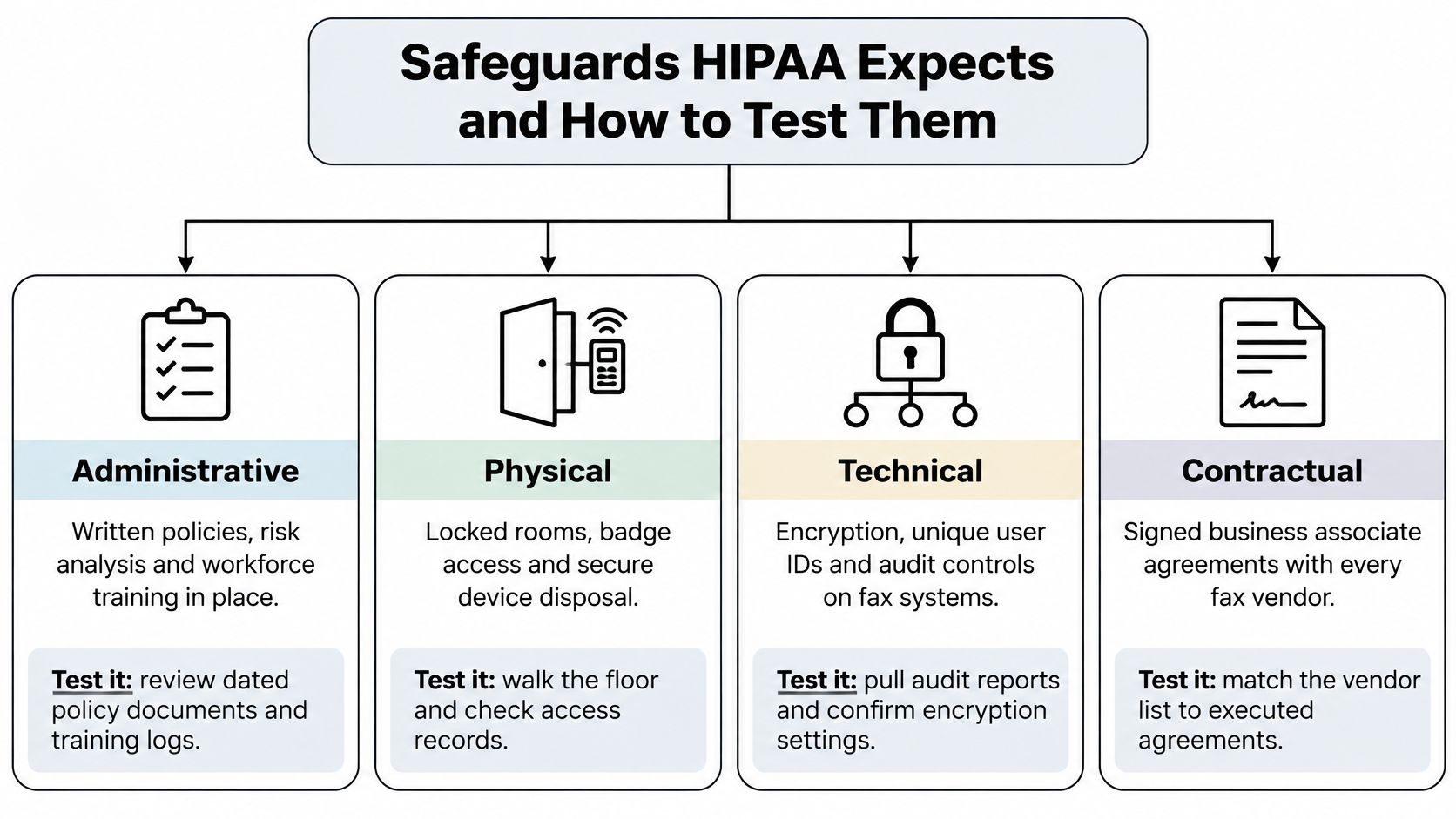
Use the table below as a working baseline. Every row maps a core requirement to an everyday fax control you can inspect in an afternoon.
| Category | Requirement | Fax example |
|---|---|---|
| Administrative | Written policies and workforce training | Named staff approved to send PHI by fax |
| Administrative | Verified recipient list | Frequently used numbers checked at setup |
| Physical | Secure receiving location | Fax machine in a room unauthorized people cannot enter |
| Technical | Access controls and authentication | Login required to view uploads and delivery logs |
| Technical | Transmission security | Encrypted upload and transfer, since HTTPS alone does not establish compliance |
| Technical | Audit records | Transmission logs kept and reviewed on a set schedule |
| Contractual | Business associate agreement | Signed BAA with any web fax vendor that handles PHI |
Run a Four-Category Fax Audit Today
Policies that sit untouched in a binder don't protect patients during a busy clinic morning. Turn the table into four direct questions you can answer today, plus four operational checks that close common gaps:
- Administrative check: Pull your written policy and ask who is authorized to fax PHI, then match that list against your current staff roster and dated training logs. Confirm that frequently used numbers for labs, pharmacies, and specialists were verified with each recipient at setup rather than copied from old paperwork.
- Physical check: Walk to every physical fax machine in your building. If a patient, delivery driver, or cleaning contractor can stand beside the output tray and read a discharge summary, move the machine behind a locked or badge-controlled door.
- Technical check: Open the portal or device that handles outbound and inbound faxes and verify that staff log in with unique credentials before viewing uploads or delivery logs. Review your transmission logs on a fixed monthly schedule, and confirm that encrypted transfer covers the actual workflow. For example, SendItFax is marketed for healthcare professionals to send medical records, prescriptions, and patient information, and all fax transmissions are encrypted using industry-standard security protocols.
- Contractual check: Match every fax vendor and telecom gateway touching PHI against your folder of executed BAAs, and verify that each vendor's document retention and deletion schedule matches your internal records policy.
If you want a structured template to document these reviews, you can download a customizable compliance checklist from Freeform Company and adapt the rows to your clinic's fax workflow. Reviewing broader fax confidentiality practices alongside your written incident plan helps catch blind spots around cover sheets and tray handling before an audit does.
Keep one scaling rule in mind while documenting your controls. Reasonable and appropriate safeguards scale with practice size and risk profile, so a solo therapist's office won't need the same multi-site audit architecture as a regional hospital network, even though both must document how they protect each transmission.
Web Fax Services and Business Associate Agreements
Many clinics switch from a wall-mounted fax machine to a browser-based service and assume the vendor's padlock icon makes every fax HIPAA compliant. That assumption fails fast under scrutiny.

A web fax provider's legal status hinges on whether it acts strictly as a transmission-only conduit or operates as a business associate. According to HHS business associate guidance, the conduit exception applies only to entities that transmit PHI with temporary storage strictly incident to transmission, much like a postal carrier or standard phone line. Any online fax platform that stores, indexes, or processes electronic PHI beyond that transient handoff is generally treated as a business associate, which requires a written BAA spelling out permitted uses, disclosures, and safeguards.
Two technical realities trip up healthcare buyers constantly. First, HTTPS alone does not establish HIPAA compliance, even though the Security Rule requires transmission-security measures while ePHI moves across an electronic network. Second, a successful delivery receipt doesn't prove compliance either. If a provider keeps copies of your PDFs on third-party servers without access controls, audit trails, and a signed BAA, you have a compliance gap regardless of how cleanly the fax delivered.
Vendor rule: Never let a sales badge replace written terms. Request a provider's security documentation and BAA position before your staff transmits the first page of PHI.
Seven Vendor Questions to Ask Before Sending PHI
When evaluating choosing the safest online fax service for clinical records, put seven concrete questions in writing and archive the vendor's answers:
- Retention and deletion behavior: Ask exactly how long uploaded documents and transmission logs remain on the vendor's servers and whether deletion happens automatically or only on manual request.
- Access controls: Confirm who inside your organization and on the vendor's engineering team can view uploaded files, and verify whether the platform supports role-based permissions.
- Auditability: Check whether you can export detailed transmission and access logs on demand to support an internal investigation or OCR inquiry.
- Incident-response commitments: Verify how quickly the vendor notifies you if a security breach exposes stored documents or account credentials.
- Encryption and transmission architecture: Ask how documents are encrypted in transit and at rest, and clarify whether any leg of the delivery travels as unencrypted email before reaching the fax gateway.
- Subcontractor handling: Find out whether downstream telecom carriers or cloud hosts touch your PHI and whether the vendor binds those subcontractors to equivalent protections.
- BAA execution: Confirm in writing whether the vendor will sign a BAA for your specific plan tier before you send patient records.
The short video below walks through how online fax services and HIPAA compliance obligations intersect in everyday practice.
For protected health information, we recommend verifying that SendItFax meets your organization's specific compliance requirements before sending clinical records. We never sell personal information or fax content, and you should still request current security documentation and our BAA position in writing and compare those answers directly against the seven checks above. Never rely on a webpage summary alone when patient privacy is on the line.
Preventing Misdirected Faxes Before You Send
Human dialing errors remain the leading way compliant clinics end up filing breach reports. The HHS 2024 Breach Report to Congress documents incidents across both 2023 and 2024 in which clinical or claims records were mistakenly faxed to another individual, test results were sent to the wrong patient, or sensitive pages landed with an unintended recipient. Decades after the Privacy Rule took effect, misdirected faxes still happen every week.
HIPAA doesn't mandate a single encryption percentage for fax traffic or issue a blanket ban on faxing. Instead, it requires risk-based operational safeguards, and HHS explicitly advises confirming unfamiliar fax numbers before sending and pre-programming frequently used numbers to cut down dialing mistakes. Because once a fax is sent on SendItFax it cannot be recalled or cancelled, prevention has to happen before you click send.
Follow this five-step routine for every outbound PHI fax:
- Call to verify any unfamiliar fax number. Phone the receiving office and read the digits back to a staff member before uploading or dialing. The most common slip here is pulling a stale fax number off a two-year-old referral form after a specialist switched clinics or changed suites.
- Pre-program frequently used destinations. Store verified numbers for recurring pharmacies, imaging centers, and referring offices in speed-dial slots or a controlled clinic directory so staff aren't retyping ten digits from scratch. One transposed digit during a rushed afternoon clinic easily routes an intake packet to a local hardware store or another patient's home line.
- Inspect the cover sheet and trim extra pages. Verify the exact patient name on the cover sheet and attach only the minimum necessary pages for the request. Staff routinely grab a saved cover template that still displays the previous patient's name, or upload an entire 40-page chart when the recipient only asked for one lab report.
- Cross-check recipient name against destination number one last time. Pause for five seconds right before clicking send to match the receiving office's name against the exact digits in the destination field. Most errors slip through because senders proofread the PDF attachment while ignoring the number box at the top of the screen.
- File the transmission record in the patient chart. Save the delivery confirmation and log entry to the corresponding patient record immediately after transmission. Leaving printed slips in a desk pile or buried inside one coordinator's email inbox destroys your proof if a question surfaces months later.
Building a One-Page Prevention Routine
Adopt one essential clinic rule: sending PHI to an unverified number is a safeguard failure even if the fax happens to reach the right office. Luck is not a compliance control, and a strong fax number verification habit removes luck from the equation.
Tape a clean, one-page desk card next to every fax machine and pin a digital version to every workstation that uploads web faxes. Put three items on that single sheet: your five-step pre-send check, the link or binder location of your verified recipient directory, and the direct phone extension of your privacy officer. When staff can see the exact sequence in ten seconds, dialing mistakes drop sharply.
What to Do When a Fax Goes to the Wrong Place
Delivery confirmation is not confidentiality confirmation. A successful transmission report only shows that data reached a phone number, never that an authorized clinician picked up the pages. Treat a misdirected fax as a privacy incident until the receiving party is identified and the pages are accounted for. Use faxes for PHI only when the workflow is justified and the receiving location is controlled, because unattended machines and wrong-number transmissions remain difficult to manage.
According to Saskatchewan's Office of the Information and Privacy Commissioner guidance, a misdirected fax is PHI received by someone without a need to know. Preventing repeat incidents requires verifying numbers with recipients, confirming their receiving precautions, and maintaining written policies and staff training. After any wrong-number transmission, inspect the transmission log, contact the unintended recipient to request return or destruction of the pages, investigate the event as a security incident, and decide whether breach notification or legal review is required.
| Situation | First action | Who to involve |
|---|---|---|
| Fax delivered to a number you did not intend | Stop further sends, pull the transmission log, ask the recipient to return or destroy the pages | Privacy officer |
| Delivery confirmed but recipient unknown | Contact the receiving office to confirm who received the pages | Privacy officer and records staff |
| Fax failed to deliver | Confirm the number and resend with the same information | Sender only, unless content reached an unintended party |
| Breach determined reportable | Notify affected individuals without unreasonable delay under applicable breach rules | Legal counsel and compliance team |
| Recipient in Canada | Follow provincial privacy rules and documented breach procedures | Organization's privacy lead and provincial privacy commissioner guidance |
If a fax fails to deliver on SendItFax and never reaches an unintended number, confirm the destination digits and resend it for free using the same information by uploading the document again. Once a fax is sent, though, it cannot be recalled or cancelled. That makes the first response to a wrong-number event a containment exercise: stop the next send, identify what went out, and secure confirmation that the pages were returned or destroyed.
Keeping Evidence and Navigating Cross-Border Rules
Your response is only as strong as the paper trail behind it. Every time an incident occurs, open a single incident record containing the original transmission log, the exact fax number dialed, the timestamp, the pages included, and a dated log of every phone call or written confirmation showing the unintended recipient destroyed or returned the document. That written evidence is what your privacy officer and legal counsel need to run a risk assessment and determine whether breach notification duties apply.
A delivery receipt still proves only delivery. It does not prove who read the page, whether the pages stayed in authorized hands, or whether the content was limited to what the recipient needed. Keep the receipt with the incident record, but pair it with recipient confirmation, return or destruction evidence, and the internal decision record explaining what happened next. If the file included more PHI than the receiving office needed, say so plainly in the internal assessment and address that failure in the corrective plan.
When a misdirected fax crosses the northern border, do not assume U.S. federal rules cover everything. HIPAA is U.S.-specific, whereas Canadian healthcare providers and organizations handling Canadian patient data operate under separate provincial privacy laws with their own safeguard requirements, reporting thresholds, and provincial privacy commissioner procedures. If your practice faxes records between U.S. and Canadian clinics, map both sets of duties into your response guide.
Incident readiness: Write your misdirected-fax response plan on a calm Tuesday, not during the twenty minutes after someone discovers a lab report went to the wrong number.
Draft a one-page response protocol, assign a named privacy lead, and run a five-minute tabletop drill with the staff who send faxes. Make the protocol name the exact log to pull, the first call to make, the return-or-destruction confirmation to request, and the person who decides whether legal review follows. When everyone knows those steps, a stressful mistake stays contained instead of spreading through silence and guesswork.