Tag: digital fax

  • How to Send E Fax: how to send e fax in browser

    How to Send E Fax: how to send e fax in browser

    Think of sending an e-fax as being just as easy as sending an email. The whole process happens right inside your web browser. All you really need is your document saved as a digital file (like a PDF), an online fax service, and the recipient’s fax number. It’s the perfect blend of modern convenience and old-school fax security.

    Sending an E-Fax From Your Browser Explained

    A laptop on a wooden desk displays 'Send Fax Online', with a book and pencil nearby.

    If you still picture a clunky machine humming away in a corner office when you hear the word "fax," it’s time for a mental refresh. Learning how to send an e-fax today is all about using a simple website. You can send critical documents straight from your computer or phone without ever touching a piece of paper or needing a dedicated phone line.

    This approach gives you the reliability of a traditional fax transmission with the speed and ease of modern tech. Online fax services essentially act as a digital go-between. You upload your file, and the service translates it into a format that any standard fax machine can understand and print. It’s all handled securely over the internet.

    Before we dive into the nitty-gritty, let's look at the big picture. Sending an e-fax can be broken down into four main phases.

    Core Steps for Sending an E Fax Online

    Phase What You'll Do Why It's Important
    1. Preparation Get your documents ready and ensure they are in a supported file format. Prepping your files correctly prevents transmission errors and ensures the recipient sees exactly what you intended.
    2. Composition Upload your files to the service, add a cover page, and fill in sender/recipient details. This is like addressing an envelope. Accurate information is crucial for delivery and for the recipient to know who it's from.
    3. Transmission Choose your delivery option (free or paid) and hit the "Send" button. The service takes over, converting your digital file into a transmittable fax signal.
    4. Confirmation Receive a confirmation receipt and track the status of your fax. This provides a legal audit trail, giving you peace of mind and proof that your document arrived safely.

    This table gives you a quick roadmap of the process we're about to walk through step-by-step. Each phase is simple, but getting it right ensures your documents are sent securely and professionally.

    Why E-Faxing Is Still Essential

    It’s a fair question: with email, why does anyone still fax? The answer almost always comes down to security and legal weight. Many industries—especially healthcare, legal, and government—depend on faxing because it’s a secure and legally recognized way to transmit documents, often helping them stay compliant with regulations like HIPAA.

    An e-fax provides a verifiable audit trail. You get a confirmation page that acts as legal proof of delivery. This is a game-changer when you're sending sensitive information like:

    • Legal documents: Signed contracts, affidavits, and court filings.
    • Medical records: Patient charts, insurance claims, and prescriptions.
    • Financial forms: Loan applications, real estate agreements, and tax documents.

    The continued reliance on fax isn’t just about habit; it's a strategic choice for security and compliance. Modern e-fax platforms add layers of encryption, creating a secure channel for sensitive data that’s much harder to intercept than a standard email.

    The Shift to Digital Transmission

    The move away from physical fax machines is more than a trend—it's a massive market shift. The online fax market is growing much faster than traditional fax services. In fact, projections show the online fax market could hit USD 11,027.27 million by 2032, growing at a compound annual growth rate of 12.9%.

    This growth is all about demand for solutions that are convenient, paperless, and mobile-friendly. For a complete walkthrough of how it works, you can check out our guide on how to send fax online. Services like SendItFax let you send a quick fax to anyone in the U.S. or Canada without the hassle of creating an account, which is perfect for the way modern professionals and individuals work.

    Getting Your Documents Ready to Fax
    A modern workspace with a tablet displaying documents, papers, notebooks, and a plant, promoting document preparation.

    Before you can hit send, your document needs to be in the right digital format. This first step is crucial—think of it like making sure your paper is clean and uncreased before feeding it into an old-school fax machine. The quality of your digital file directly determines how clear the fax will be on the other end.

    Fortunately, most modern online fax services, including ours at SendItFax, are incredibly flexible with the file types they accept. This is a huge part of what makes sending an e-fax so much easier than its predecessor.

    What File Types Work Best?

    Chances are, your document is already in a compatible format. Most services are built to handle the files you work with every day.

    Here are the most common and reliable options:

    • PDF (.pdf): This is the gold standard for a reason. PDFs lock in your formatting, so you can be confident that your fonts, images, and layouts will show up exactly as you intended.
    • Microsoft Word (.doc, .docx): Perfect for text-heavy documents like contracts, letters, or reports. The service automatically converts the file into a fax-friendly format for you.
    • Image Files (.jpg, .png, .tiff): The go-to choice for sending scanned pages, photos, or graphics. Just make sure you start with a clear, high-resolution scan for the best results.

    If you have a file in a less common format, the easiest fix is to convert it to a PDF. Almost any program you use will have a built-in "Save as PDF" or "Print to PDF" function. It takes just a second and creates the most dependable file for faxing.

    A Few Quick Tips for a Clearer Fax

    Remember, traditional fax machines print in black and white. Your pristine color document gets converted into a two-tone image, so a little prep work goes a long way in ensuring it looks good on the other end.

    A few quick checks can make a huge difference:

    1. Keep Fonts Simple: Stick with standard, clean fonts like Arial, Calibri, or Times New Roman. Anything too thin or fancy can become a blurry mess after fax transmission.
    2. Go for High Contrast: Nothing beats classic black text on a plain white background. Avoid colored text or shaded backgrounds, which often turn into muddy gray smudges on paper.
    3. Clean Up the Layout: Simple is better. Complex layouts with overlapping elements don't translate well. Give your content some breathing room with plenty of white space.

    Pro Tip: Before you upload, zoom out and view the whole page on your screen. If any part looks cramped or is tough to read from that distance, it’s a red flag that it won’t be legible on the final fax.

    Uploading From Your Computer or the Cloud

    Once your file is prepped, getting it into the system is as easy as attaching a file to an email. Just look for the "Upload File" or "Attach Document" button and select the document from your computer.

    Many platforms also connect directly to cloud storage. This is a fantastic feature that lets you pull files right from Google Drive, Dropbox, or OneDrive without having to download them first. It's a real lifesaver for staying organized, especially when you're not at your main computer. For a deeper dive, check out our guide on how to fax documents from a computer.

    With your document ready and uploaded, you’re all set for the next step.

    Putting It All Together: Your Fax and Cover Page
    A person is typing on a laptop and holding a pen over a document at a wooden desk.

    Okay, your documents are ready and uploaded. Now comes the part that ensures they actually get where they need to go, and that the person on the other end knows what they're looking at. This is where you address your fax and add the professional touches.

    Think of it like sending a physical package. A small mistake in the address can send it to the wrong place or get it returned to you. The same principle applies here—getting the details right is just as important as the document itself.

    The Most Important Part: The Fax Number

    Believe it or not, the most common reason a fax fails is a simple typo in the recipient's number. It happens more often than you'd think. Before you hit "send," double-check every single digit.

    Most online fax services need the number in a specific format: the full number, including the country code, with no spaces or dashes.

    For a U.S. number like (555) 123-4567, you'd type 15551234567. Forgetting that initial "1" for the country code is a classic mistake that will cause an immediate sending error.

    Pro Tip: Make sure you're sending to a real fax line. Sending to a regular voice line will fail every time because there's no machine on the other end to pick up the signal.

    Why You Should Never Skip the Cover Page

    In the business world, sending a fax without a cover page is like showing up to a meeting without an agenda. It’s unprofessional and creates confusion. The cover page isn't just a formality; it gives instant context and makes sure your document lands on the right desk.

    A solid cover page does a few key things:

    • Identifies You: It clearly states your name, company, and contact details.
    • Names the Recipient: It specifies who the fax is for, which is a lifesaver in a busy office.
    • Explains the "Why": A quick subject line and a short note tell them what the fax is about.
    • Confirms the Length: It lists the total number of pages, so they know if anything is missing.

    Thankfully, you don't have to create one from scratch. Most online fax platforms, including SendItFax, have built-in cover page templates. You just fill in the blanks, and the service generates a clean, professional-looking page for you. It's the fastest way to get it done right.

    Adding a Personal Note

    Even when using a template, you can add a human touch. The "Comments" or "Message" field is perfect for a quick, clear note to the recipient. This isn’t the place for a novel, just a concise summary.

    A good example would be: "Attached are the signed contract pages for the Henderson project. Please confirm receipt at your earliest convenience."

    This simple sentence does two things: it clarifies the purpose of the fax and tells the recipient exactly what you need them to do next. If you have your own branded letterhead you'd rather use, most services also give you the option to attach your own custom cover sheet as the first page of your uploaded document.

    Giving Your E-Fax the Final Go-Ahead

    Alright, you’ve uploaded your documents and sorted out the cover page. You’re at the home stretch, but don't just hit "send" yet. This final step is where the real magic of digital faxing comes into play, giving you a level of control and confirmation you just can't get with an old-school machine.

    Take a quick second to give everything one last look. Is the recipient's fax number correct? Did you attach the right file? This is your last chance to catch a simple typo that could send a sensitive document to the wrong place. Think of it like proofreading an important email—a few seconds of review can save you from a major headache later.

    Send It Now or On a Schedule

    Most online fax platforms give you a choice: send the fax immediately or schedule it for a specific time. Sending it right away is the default, of course, but scheduling is a surprisingly useful feature I've come to rely on.

    For example, if you're working late but need a contract to land on a client's desk first thing in their morning, you can schedule it to arrive at 9:00 AM in their time zone. It ensures your document is at the top of their queue. It's also great for managing large projects where you need to send out documents in a specific sequence or on specific dates without having to do it manually each time.

    The All-Important Confirmation Receipt

    Once you click send, your job isn't quite done. The real peace of mind comes from the digital confirmation trail that follows. Gone are the days of standing by a noisy machine, wondering if all the pages actually went through.

    Almost immediately after your fax is successfully delivered, you'll get a confirmation email. This isn't just a simple "it sent" notification; it's a detailed report. It'll typically show you:

    • The exact date and time of the transmission.
    • How many pages were sent successfully.
    • The recipient’s fax number.
    • A small image of the first page for quick identification.

    This confirmation report is your official proof of delivery. For legal contracts, medical records, or financial paperwork, this digital receipt is often far more reliable and easier to store than those flimsy, fading confirmation slips from a traditional fax machine. It's a permanent record for your files.

    And what if it doesn't go through? If the line is busy or you typed the number wrong, you’ll get a failure notification right away. This lets you pinpoint the issue, fix it, and resend immediately, ensuring your critical communications aren't lost in limbo.

    Secure E-Faxing for Professional Use

    When you’re a professional handling sensitive information, sending a document isn't just about getting it from A to B. It’s about making sure that journey is secure, compliant, and legally sound. For anyone in healthcare, law, or finance, this isn't just a "nice-to-have"—it's an absolute requirement.

    Learning how to send an e-fax securely means choosing a service that understands these high stakes. While standard email can be surprisingly leaky, modern e-fax services are built from the ground up with robust security features designed to shield confidential data from prying eyes.

    For healthcare providers, this is non-negotiable. The Health Insurance Portability and Accountability Act (HIPAA) sets iron-clad rules for handling protected health information (PHI). A HIPAA-compliant e-fax service is essential, as it uses security measures like end-to-end encryption to create a private tunnel for patient records, lab results, and insurance claims.

    Why Compliance is King

    The global fax services market has stayed incredibly relevant, largely because it’s the go-to tool for regulated industries. In fact, the healthcare sector is the most profitable segment for fax providers, with clinics, insurance firms, and legal teams driving the lion's share of revenue. This isn't nostalgia; it's a strategic choice tied to faxing's security advantages. You can see the full research on fax services to get a better sense of these market trends.

    When choosing a service, professionals must look for a provider that will sign a Business Associate Agreement (BAA). This is a critical legal contract that confirms the service meets HIPAA security standards and is willing to share responsibility for protecting PHI. Without a BAA in place, you simply aren't HIPAA compliant.

    After you hit "send," the e-fax service gives you clear feedback on whether the transmission was successful.

    A flowchart illustrating the decision process for sending a message: 'Sent?' leads to 'Retry' or 'Done'.

    This kind of confirmation loop is exactly what you need when you can't afford uncertainty.

    Practical Security Scenarios

    Let's look at a few real-world examples to see why this level of security is so important.

    • For a Law Firm: A lawyer needs to send a time-sensitive, signed contract to opposing counsel. Using a secure e-fax provides a tamper-proof transmission receipt, which serves as legal proof of delivery with a precise timestamp.
    • For a Medical Clinic: A specialist needs to share patient records with a primary care physician. A HIPAA-compliant e-fax ensures the PHI is encrypted in transit, preventing unauthorized access and upholding patient confidentiality.
    • For a Financial Advisor: An advisor is sending account transfer forms to a client for their signature. Secure e-faxing protects this sensitive financial data from being intercepted, which is crucial for preventing fraud and identity theft.

    For professionals, the audit trail is one of the most powerful features of e-faxing. Every sent and received fax is logged with details like date, time, and status, creating a comprehensive record for compliance checks and legal verification.

    When you're evaluating different services, it’s vital to dig into their specific security features. While many platforms offer basic functionality, not all are built the same. You can learn more about assessing a service's safety to help you make an informed choice. Ultimately, using e-fax as a professional tool is about embracing its convenience without ever compromising your duty to protect sensitive information.

    Security Feature Checklist for Regulated Industries

    To maintain compliance and protect client data, certain security features are non-negotiable. This table breaks down what professionals in high-stakes fields should look for in an e-fax provider.

    Feature Importance in Healthcare (HIPAA) Importance in Legal and Finance
    HIPAA Compliance & BAA Mandatory. Essential for handling any Protected Health Information (PHI). A provider must sign a Business Associate Agreement. Highly Recommended. Demonstrates a commitment to data privacy, which is vital for maintaining client trust and meeting regulatory standards.
    End-to-End Encryption Critical. Protects PHI from being intercepted during transmission, ensuring data remains confidential between sender and receiver. Critical. Prevents unauthorized access to sensitive legal documents, contracts, and financial records, protecting against breaches and fraud.
    Detailed Audit Trails Essential. Provides a verifiable record of all fax transmissions, which is necessary for compliance audits and tracking information access. Essential. Creates a legal record of when documents were sent and received, providing proof of delivery for contracts and time-sensitive notices.
    Secure Cloud Storage Very Important. Ensures that archived faxes containing PHI are stored in an encrypted, access-controlled environment. Very Important. Protects stored client files, case documents, and financial statements from unauthorized access or data loss.

    Choosing a provider that ticks all these boxes is the first step toward integrating e-faxing into your workflow responsibly. It’s about building a foundation of trust—both with your clients and with regulatory bodies.

    Common Questions About Sending an E-Fax

    Switching from a clunky office machine to a browser-based fax service is a big improvement, but it's natural to have a few questions along the way. Getting your head around how to send an e-fax is pretty simple, but a little insider knowledge can make the whole process feel even more seamless.

    Here are the answers to the most common questions we hear from people making the switch. Think of this as your quick-reference guide for navigating the day-to-day of online faxing.

    Can I Receive Faxes Too?

    Yes, you absolutely can, and this is where online faxing really shines. When you sign up for most paid services, you'll get your own dedicated online fax number. Anyone with a traditional fax machine can send documents to that number just like they normally would.

    The magic happens on our end. The service catches that incoming transmission and instantly converts it into a digital file—almost always a PDF. That file lands right in your email inbox or your service's online portal. Suddenly, you can save, forward, or delete faxes with a click, just like any other email. No paper, no toner, no hassle.

    What Happens If My E-Fax Fails?

    It's frustrating when a fax doesn't go through, but online services make troubleshooting a lot less mysterious. If a transmission fails, you’ll get an alert—usually an email—letting you know what went wrong.

    Nine times out of ten, it’s one of these issues:

    • The recipient's line was busy.
    • You typed in a wrong or disconnected fax number.
    • Their machine is out of paper or ink (an old classic).

    Most services will automatically try resending the fax a few times for you. If it keeps failing, the very first thing you should do is double-check every single digit of the recipient's fax number. If you're certain the number is correct, the problem is almost definitely on their end.

    Are E-Faxes Legally Binding?

    For most industries and in most places, the answer is a firm yes. Documents sent via e-fax are considered just as legally valid as those sent from a traditional machine. In many ways, they actually provide a stronger legal foundation thanks to the detailed digital paper trail they create.

    Online fax services generate comprehensive transmission logs that act as concrete proof of delivery. These reports record the exact time, date, recipient number, and confirmation of success, creating a far more reliable and verifiable record than a flimsy, fading receipt from an old thermal machine.

    This built-in documentation is why e-faxing is a go-to for sensitive documents in the legal, medical, and financial fields, where having undeniable proof of receipt is non-negotiable.

    Do I Need to Install Any Software?

    Nope! For almost every online fax service out there, you don't need to install a thing. One of the best parts is that the entire system is web-based. You can manage everything right from your internet browser.

    You can learn how to send an e-fax from any computer or tablet with an internet connection. While some providers offer handy mobile apps for your phone, the core service is always accessible straight from their website. It’s a truly flexible way to handle your documents, whether you're at your desk or on the go.


    Ready to send a fax in minutes without the hassle? SendItFax lets you send documents to anyone in the U.S. or Canada directly from your browser—no account needed. Try it now at SendItFax.com.

  • Send Fax From Phone Free Your Ultimate Modern Guide

    Send Fax From Phone Free Your Ultimate Modern Guide

    It’s a question that pops up more often than you'd think: can you really send a fax from your phone for free? Absolutely. You can use a web-based service right from your mobile browser—no app download or special hardware required. Just upload your document, punch in the fax number, and send. Your smartphone essentially becomes a pocket-sized fax machine.

    Why Bother with Faxing in 2024? And How to Do It for Free

    I get it, faxing feels like a relic from another time. But the truth is, it’s still an essential tool in many professional circles. Industries like healthcare, law, and government still depend on it for sending secure, legally binding documents.

    Just to give you a real-world example, the Social Security Administration still lists fax as a primary way to submit official forms. When you run into situations like that, you don't have a choice—you have to send a fax.

    The great news is you don’t have to hunt down a dusty old machine or pay for a dedicated phone line. Modern online services, like SendItFax, bridge the gap, letting you send a fax from your phone at no cost. These services take your digital file, convert it into a format that a traditional fax machine can read, and send it over the phone lines for you.

    A Modern Spin on an Old Technology

    This approach turns a what-used-to-be-a-headache into a simple task you can complete in a few taps.

    Here's what that looks like in practice:

    • No Extra Gear: The smartphone you already own is all you need.
    • On-the-Go Access: Just open your mobile browser to get started, wherever you are.
    • Flexible File Uploads: Grab files directly from your phone's storage or a cloud service like Google Drive or Dropbox.

    The biggest win here is the sheer convenience. A freelancer needing to send a signed contract, or a patient submitting medical forms—both can get it done in minutes without being anywhere near an office.

    Despite the world going digital, faxing has held its ground. Believe it or not, as of 2025, there are still an estimated 43 million fax machines hooked up and running worldwide. This stubborn persistence is exactly why knowing how to quickly send a fax from your phone is such a surprisingly useful skill today. If you're curious about the numbers, you can find more fax usage trends on iFaxApp.com.

    Sending Your First Fax From Your Phone

    You already send emails, texts, and photos from your phone without a second thought. Sending a fax should be just as easy. With a web-based service like SendItFax, you can handle the entire process right from your mobile browser—no app required, no account needed.

    The real advantage here is how direct it is. You just pull up the website, choose your file, type in the number, and hit send. It’s that simple.

    Get Your Document Ready for Mobile Faxing

    Before you even open a browser, the most critical step is getting your document in order. While you can send different file types, I always recommend a PDF. It’s the gold standard for a reason: it locks in your formatting, looks clean and professional, and guarantees the person on the other end sees exactly what you intended.

    Got a paper document? Don't just snap a picture of it. That often leads to weird shadows, skewed text, and a generally unprofessional look. Instead, use a scanner app on your phone—Adobe Scan is a great free option, and even the built-in Notes app on an iPhone does a fantastic job of creating a crisp, high-quality PDF. If your file is already digital, just save a copy as a PDF.

    Navigating the Web Interface on Your Phone

    With your document saved to your phone or cloud storage, you're ready to go. Just open your mobile browser and navigate to the SendItFax free fax page. The whole site is designed to work smoothly on a smaller screen, so you won't be pinching and zooming to find what you need.

    The entire process boils down to these three actions.

    A three-step process diagram illustrating how to send a fax: select file, enter number, then send.

    It’s just as intuitive as sending an email. You'll start by filling in your info and the recipient's details. Pay close attention to the fax number—from my experience, a single wrong digit is the number one reason a fax fails to go through. Your email is also crucial because that's where the delivery confirmation will be sent.

    Next, you'll upload your document. This is where your prep work pays off. You'll see a clear button to "Select File to Fax," which will open your phone's file browser. From there, you can easily grab the PDF you prepared from your local files, Google Drive, or iCloud.

    Finalizing and Sending Your Fax

    After your file is attached, you'll see an option to add a cover page message. I highly recommend using it for any professional correspondence. You don’t need to write a novel; just keep it brief and clear. Include your name, the recipient's name, the date, and the total number of pages.

    Before you tap that send button, do a final once-over.

    • Recipient Fax Number: Is it 100% correct?
    • Your Email: Is there a typo? This is how you'll know it worked.
    • Attached File: Did you select the final version of the document?

    When you’re confident everything is right, hit send. The service takes it from there, and you should get an email confirmation within a few minutes letting you know if the fax was delivered successfully.

    The whole point is to make this fast and painless. Imagine you need to send a signed contract back to a client while you're out of the office. You can sign it, scan it with your phone, and fax it back in under five minutes without ever touching a computer or a fax machine.

    This mobile-first approach is incredibly practical for solving problems on the fly. While sending from your browser is great, sometimes another method fits the workflow better. For a different but equally powerful option, take a look at our guide on how to fax via email.

    What Are the Catches With Free Fax Services?

    The idea of sending a fax from your phone for free sounds almost too good to be true, and in a way, it is. It's an incredible convenience, but it's important to go in with your eyes open. These services operate on a "freemium" model, giving you the basic sending capability at no cost, but with some very clear boundaries.

    Knowing these limits ahead of time will save you from getting stuck right when you need to send something important.

    Page Counts and Daily Sending Limits

    The most common limitation you’ll run into is a cap on how much you can send. This usually breaks down into two things: the number of pages per fax and the number of faxes you can send in a day.

    For example, SendItFax gives you a three-page limit per fax (plus a cover page), which is actually pretty generous. It’s perfect for things like sending a signed contract, a copy of your driver's license, or a quick form to your doctor's office.

    They also cap you at five free faxes per day. For most people, that’s more than enough. But if you’re a small business owner trying to send out ten invoices, you’d hit that ceiling pretty quickly.

    Expert Tip: Think of free services as the perfect tool for occasional, low-volume tasks. They're not designed to replace a dedicated fax solution if you're constantly sending large documents.

    A Word on Branding and One-Way Traffic

    Another thing to expect is a bit of branding. To help pay the bills, services like SendItFax usually add their logo or a small "Sent via SendItFax" message to the cover page. For personal faxes or informal business documents, this is rarely an issue.

    The biggest limitation, however, is that free services are almost always send-only.

    • You can send faxes out to any machine.
    • You cannot receive faxes back.

    Receiving a fax requires having your own dedicated number, and that’s a feature you'll only find on paid plans. If you need people to be able to fax documents to you, a free service won't cut it.

    These trade-offs are standard across the board. The goal of a free plan is to give you a simple, no-frills way to get a document from your phone to a fax machine in the US or Canada. Features like international faxing, scheduling a fax for later, or getting detailed delivery reports are also typically reserved for paying customers.

    If you're looking to get started without pulling out your wallet, our guide to finding a free online fax with no credit card can walk you through the process.

    How to Keep Your Documents Secure When Faxing Online

    When you're faxing a contract, a medical record, or a copy of your ID from your phone, security is probably top of mind. And for good reason. You're handling sensitive stuff, and you need to know it's staying private. Thankfully, any worthwhile online fax service builds its platform with security as a core feature.

    The absolute baseline for security is SSL/TLS encryption. This is the same technology that protects your credit card information when you shop online. It creates a secure, private tunnel between your phone and the fax service, so no one can snoop on your documents as you upload them.

    Hand holding a smartphone displaying an SSL lock for secure faxing, with a laptop and notebook on a wooden desk.

    But that’s just the first step. What happens to your files after they've been sent? This is where a company's privacy policy becomes incredibly important. A reputable service will be upfront about how long they keep your faxes on their servers. Most will automatically delete your files shortly after delivery. If you can't find a clear privacy policy, that’s a major red flag—it's best to look elsewhere.

    Simple Habits for Better Security

    While the fax service manages the heavy lifting on their end, you have a part to play, too. A few common-sense habits can make a huge difference in keeping your information safe.

    First, and this sounds obvious, but you’d be surprised how often it happens: double-check the recipient's fax number. One wrong digit is all it takes to send your private documents to a complete stranger. It only takes a few seconds to verify.

    Be mindful of your internet connection. Sending a sensitive document from the free Wi-Fi at a café or airport is a risk. These public networks aren't always secure, which could leave your data vulnerable. Whenever possible, use your home Wi-Fi or your phone’s cellular data instead.

    Here’s a pro tip: After you get that delivery confirmation, your job isn't quite over. Go back and delete the original file from your phone's downloads or files folder. That way, if you ever lose your phone, that sensitive document isn't sitting there for anyone to find.

    Ultimately, not all free fax services handle security the same way. It pays to do a little homework. For instance, digging into a specific provider with a breakdown like "Is FaxZero safe?" can give you the insights you need to choose wisely. By pairing a trustworthy service with your own smart security practices, you can fax from your phone with total peace of mind.

    When Does Mobile Faxing Actually Come in Handy?

    Knowing how to fax from your phone is great, but when does it actually save the day? From my experience, it’s not just a neat trick—it’s a problem-solver for those moments of urgency and unexpected roadblocks that pop up in real life. It’s about getting things done without the old-school hassle.

    Person using a smartphone and laptop at a cafe, with coffee, for 'FAX-ON-THE-GO'.

    Picture this: you're at a coffee shop wrapping up a rental agreement. The realtor needs the signed lease back ASAP, but their office only takes faxes. Instead of scrambling to find a print shop, you just sign the document, snap a picture with your phone, and fax it over before your latte gets cold. That’s the power we’re talking about.

    Making Personal Tasks Painless

    For everyday life, mobile faxing is brilliant for knocking out those one-off tasks that, for whatever reason, still require a fax number. It turns an annoying errand into a two-minute job.

    Here are a few classic examples I see all the time:

    • Healthcare Forms: The doctor’s office needs a signed medical release form before your visit tomorrow. You can fill it out on your kitchen table and fax it over instantly. No extra trips.
    • Government Paperwork: Submitting a form to a government agency that’s stuck in the fax era becomes something you can handle from your couch.
    • School Enrollments: Your kid’s school needs proof of residency or immunization records. Instead of driving over, you can just fax the documents right from your phone.

    In every one of these situations, your phone acts as the perfect go-between, connecting your digital file to their old-school machine. It’s a huge time-saver.

    A Secret Weapon for Small Businesses

    If you’re a freelancer or run a small business, being nimble is everything. Mobile faxing gives you a professional tool without the cost or clutter of a dedicated machine. Think of a contractor at a job site who needs to send a signed change order to a supplier who only uses fax for their orders. They can approve the document on their phone and zap it over in minutes.

    I’ve worked with many professionals, especially in legal fields, who rely on this. An attorney traveling between meetings can send a signed affidavit to the courthouse or opposing counsel straight from their phone, guaranteeing it lands on time without a trip back to the office.

    This isn’t just about convenience; it’s a genuine competitive edge. It keeps business flowing, no matter where you happen to be. And this isn't a dying technology—it's evolving. The global market for fax services was valued at $2.92 billion in 2021 and is expected to climb to $5.47 billion by 2027. That growth is almost entirely driven by online services that make faxing more accessible. You can dig into more of the data in G2's research on free online fax services.

    Handling Life's Curveballs

    Sometimes, the need for a fax just comes out of left field. You could be traveling and need to send a copy of your passport to a hotel to confirm a reservation. Or maybe you're applying for a loan, and the bank suddenly requests a signed financial document immediately.

    Having the ability to fax from your phone means you can handle these urgent demands on the spot, without throwing your whole day off track. It’s a modern, practical solution for a surprisingly persistent technology, keeping you ready for anything.

    Common Questions About Sending Faxes From a Phone

    Even with a step-by-step guide, it's natural to have a few questions before you send a fax from your phone for free. Let's walk through some of the most common ones I hear, so you can fax with total confidence.

    Diving into a new process always brings up a few "what ifs." Getting clear answers is the best way to make web-based faxing work for you.

    Do I Need to Download a Special App?

    Nope, and that’s the beauty of it. The best free services are entirely web-based, which means you can handle everything right from your phone’s browser, whether it's Chrome, Safari, or something else.

    This is a huge plus. You don't have to clutter your phone with another app you might only use once or twice. Just pull up the website, upload your file, and you’re good to go.

    Is It Really Free to Send a Fax This Way?

    Yes, for those one-off situations, it is 100% free. Most free services operate on a freemium model. They offer a handful of free faxes to people who just need to send something quickly, hoping they'll come back if they ever need more advanced, paid features.

    This is perfect for sending a signed permission slip, a quick contract, or a single medical form without ever pulling out a credit card. No subscriptions, no hidden fees for a simple, one-time send.

    Think about it: a freelancer sending a single invoice or a homeowner submitting a permit application to a city office. These are the exact real-world scenarios free online faxing is built for. It’s a practical tool for everyday tasks.

    It’s an incredibly handy resource to keep in your back pocket for those moments when you suddenly need to send a fax and don't have a machine in sight.

    Can I Also Receive Faxes on My Phone With a Free Service?

    This is where the line is drawn. The answer is almost always no. Receiving faxes is a different beast altogether because it requires a service to give you a dedicated, always-on fax number. That costs them money to maintain, so they have to pass that cost on to you.

    Free services are designed for one-way traffic: sending documents out. If you need to get faxes back from clients, doctors, or business partners, you’ll have to upgrade to a low-cost paid plan that includes a personal fax number.

    How Do I Know If My Fax Actually Went Through?

    You won't be left guessing. Any good service provides a delivery confirmation email once the transmission is finished. This email is your official record.

    It will clearly state one of two things:

    • Successful Delivery: You’ll get a confirmation that the recipient's fax machine picked up.
    • Failed Transmission: You’ll receive an alert that the fax failed, usually with a reason like a busy signal or an invalid number.

    This feedback is crucial. If a fax fails, you know immediately and can double-check the number or try again later. It’s the modern-day peace of mind that replaces standing by a noisy machine, wondering if it worked.


    Ready to send your first document without the old-school hassle? With SendItFax, you can get a fax out the door from your phone in just a few clicks. Give it a try now at https://senditfax.com and see for yourself.

  • How to Send a Fax Without a Fax Machine

    How to Send a Fax Without a Fax Machine

    So, you need to send a fax but don't have a fax machine? You're in the right place. Sending a fax from your computer or phone is easier than ever, and you have a few great ways to get it done: dedicated online fax services, email-to-fax, and mobile apps. These methods are not just convenient; they're often more secure and budget-friendly than that old machine gathering dust in the corner.

    Why You Don't Need a Fax Machine Anymore

    It's true, faxing feels a bit old-school. Yet, it's still a critical part of doing business in fields like healthcare, law, and finance. Why? Because it’s a trusted way to send legally binding signed documents and sensitive records. But the good news is, you absolutely don't need the actual clunky machine anymore. Modern tech has completely changed the game.

    The big win here is a combination of convenience and better security. Digital faxing means no more dedicated phone lines, paper jams, or running out of ink. You can send documents straight from your laptop while working from home or from your phone while you're out and about. It just makes sense.

    The Shift to Digital Faxing

    This isn't just a minor trend; it’s a massive shift in how businesses communicate. The global fax services market hit USD 3.46 billion in 2023 and is expected to climb to USD 6.5 billion by 2029. What's driving this? Cloud-based solutions that let you send a fax just by uploading a file to a website or shooting off an email. You can find more details on this market growth over at Business Wire.

    This decision tree breaks down the simple choices you have when it's time to send a fax today.

    A decision tree flowchart illustrating modern methods to send a fax, including digital options.

    As you can see, it all starts with your digital device, giving you a few different paths depending on what you need to do and where you are.

    The real beauty of modern faxing is how it combines the rock-solid security of the old method with the speed of digital communication. You get a verifiable, point-to-point delivery without being tied to a physical machine.

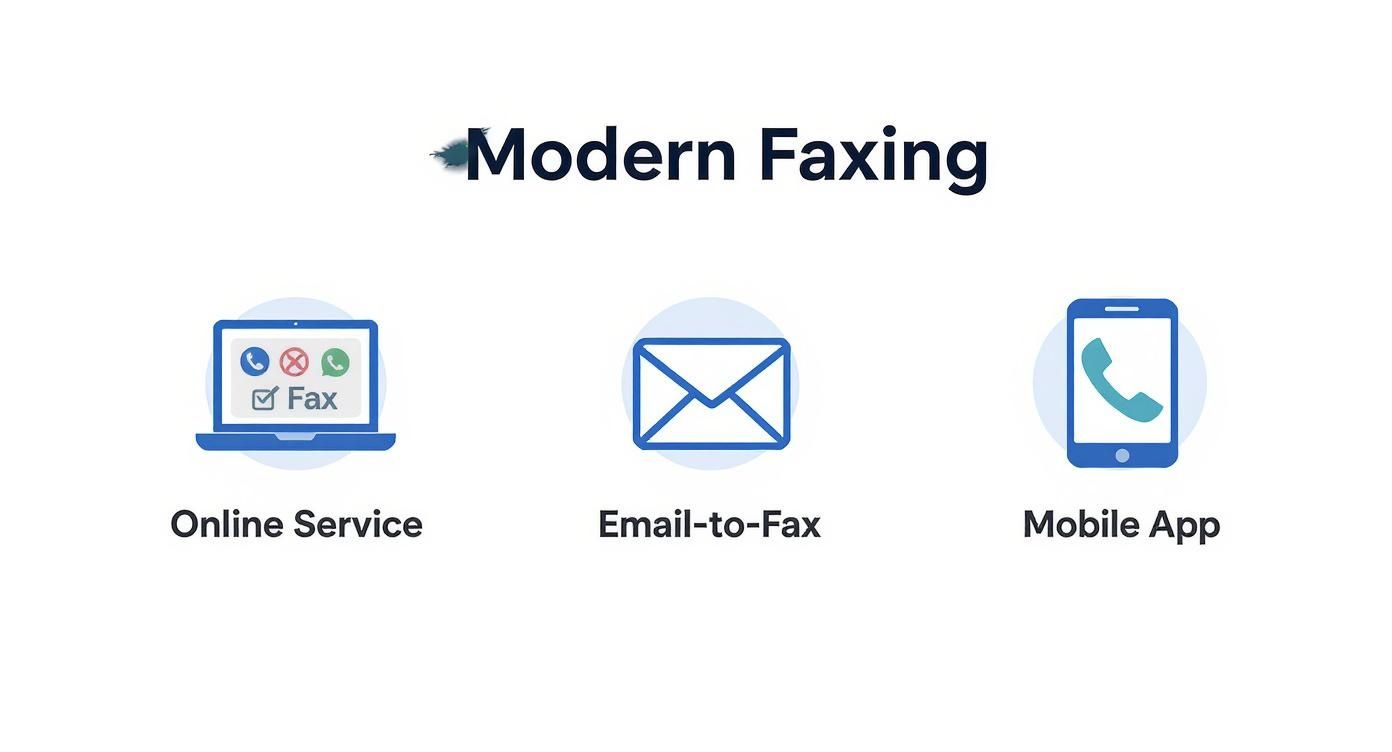
    To help you decide which path to take, here's a quick rundown of the most popular ways to send a fax without a machine.

    Modern Faxing Methods at a Glance

    Method Best For Key Benefit Typical Cost
    Online Fax Service Frequent users, businesses needing tracking and security features. Full-featured platform with archives, scheduling, and compliance options. Free (limited) to $10-30/month subscription.
    Email-to-Fax Sending documents quickly from your existing email workflow. Extremely fast and convenient; no new software to learn. Usually included with online fax service subscriptions.
    Mobile Fax App On-the-go faxing, sending physical documents by snapping a photo. Turns your phone into a portable scanner and fax machine. Pay-per-fax ($1-5) or small subscription fee.
    Public/Office Services One-time, non-sensitive faxes when you're out and about. No account setup required; just walk in and send. $1-2 per page, can get expensive for long documents.

    Each of these options has its place, and the best one really depends on what you're sending and how often you need to do it.

    Choosing Your Method

    The first step is figuring out which approach fits your needs. Each one offers something a little different:

    • Online Fax Services: Platforms like SendItFax are fantastic if you want a simple, web-based tool. You just upload your document, type in the number, and hit send. They often come with handy features like digital cover sheets and confirmation receipts.

    • Email-to-Fax: If you practically live in your email inbox, this is for you. It’s an incredibly efficient way to send attachments by turning a regular email into a fax.

    • Mobile Fax Apps: Perfect for when you're away from your computer. These apps let you use your phone's camera to scan a physical document and send it off in just a few taps.

    In this guide, we’ll walk through each of these methods step-by-step, sharing practical tips to help you send your next fax with confidence.

    Using an Online Fax Service

    Let's be honest, finding a physical fax machine these days can be a real headache. Thankfully, online fax services have completely changed the game. Think of them as your personal fax machine, living on the web, ready whenever you are. They’re designed to be incredibly straightforward, turning what used to be a clunky process into a few simple clicks.

    For instance, say you need to send a signed rental agreement to a property manager who only accepts faxes. Instead of a frantic search for a print-and-scan shop, you'd just log into a service like FaxNow. The dashboard usually has a big, friendly "Send Fax" button waiting for you. From there, you just grab the PDF or Word doc from your computer and upload it.

    Next, you’ll fill out a digital cover sheet—no more trying to cram your message into a tiny box with a pen. You type in the recipient’s fax number, your details, and a quick note. It's clean, professional, and ensures nothing gets lost in translation due to messy handwriting.

    From Your Screen to Their Machine

    Once your file is uploaded and the cover page is set, you just hit "Send." The service does all the heavy lifting behind the scenes. It converts your digital document into the right format for a traditional fax machine and dials the number. You don't have to listen for a busy signal or worry about transmission errors; the platform manages everything.

    One of the biggest perks is the instant gratification of a confirmation email. As soon as the fax goes through successfully, you’ll get a receipt in your inbox. This isn't just a simple "it sent" message; it's proof of delivery, complete with a timestamp and often a thumbnail of the first page. For legal or time-sensitive documents, that peace of mind is invaluable.

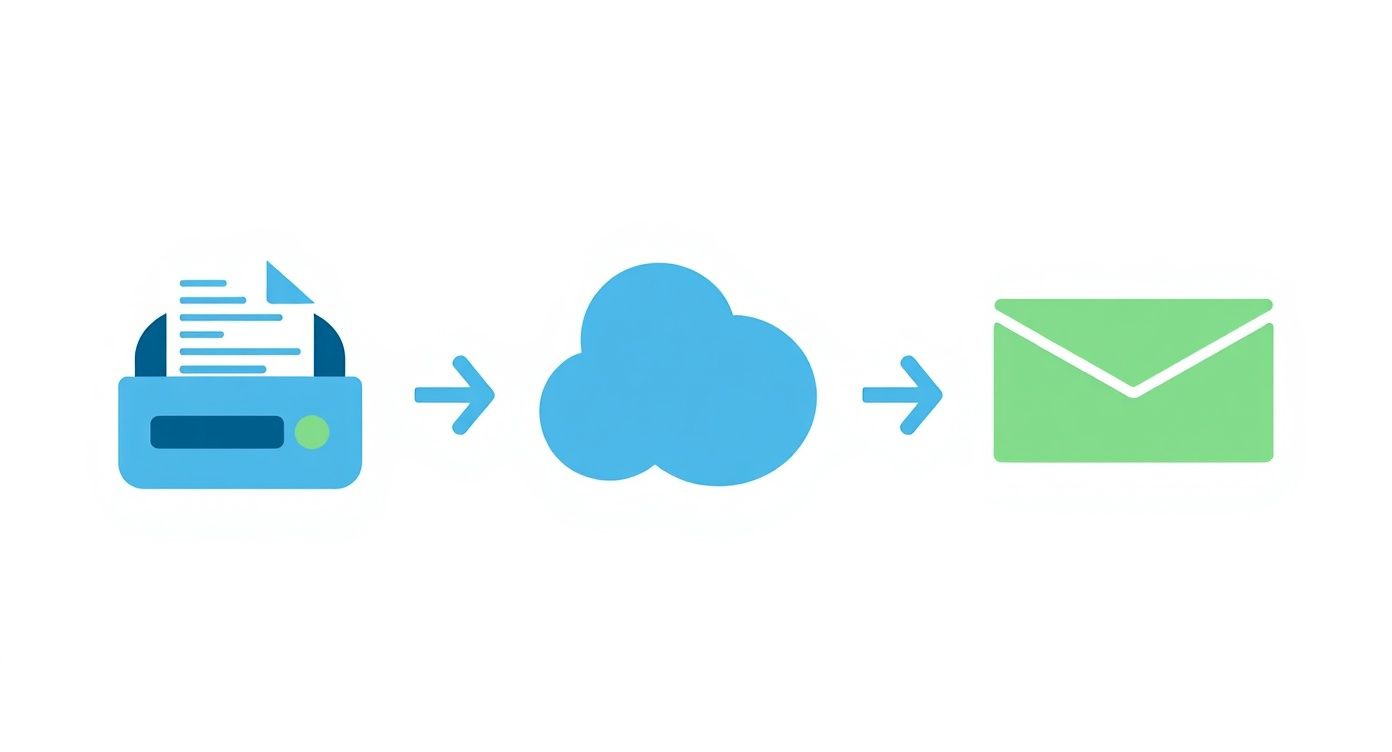
    This diagram shows how it all works:

    As you can see, the service acts as the perfect middleman, bridging the gap between your digital world and the recipient's old-school hardware. No special equipment needed on your end.

    More Than Just a Digital Fax Machine

    Today's online fax services come loaded with features that make them powerful tools for both personal and professional use. They go way beyond just sending a single page.

    • Schedule Your Faxes: Need a report to land on someone's desk first thing Monday morning? You can queue it up over the weekend to send at the exact date and time you choose.
    • Sign Documents Digitally: Many platforms have built-in, legally binding digital signature tools. This means you can sign a contract right in the app before faxing it off, skipping the whole print-sign-scan routine.
    • Pull Files from the Cloud: You can connect your account to Google Drive, Dropbox, or OneDrive. This is a massive time-saver, letting you fax documents directly from your cloud storage without downloading them first.
    • Keep an Address Book: For numbers you fax often, you can save them in a contact list. No more digging through old emails to find the right fax number for your doctor's office or accountant.

    These capabilities turn a simple transmission tool into a full-blown document workflow solution. With so many options out there, it’s a good idea to check out a detailed online fax services comparison to find one that fits your specific needs.

    The Bottom Line: Online fax services aren't just a substitute for a fax machine; they're a massive upgrade. They offer better security, detailed tracking, and workflow tools that traditional hardware could never match.

    There’s a reason this market is booming. The online fax industry was valued at USD 4.70 billion in 2022 and is expected to hit USD 12.32 billion by 2030. According to research from Kings Research on the online fax market, this growth is fueled by flexible plans that work for everyone, from individuals sending a one-off document to large companies with heavy faxing needs.

    Ultimately, if you want the most powerful and convenient way to send a fax without a machine, an online service is the way to go. It gives you the reliability of old-school faxing combined with the efficiency of modern technology.

    Sending a Fax Directly From Your Email

    What if you could turn your everyday email into a powerful fax machine? With email-to-fax technology, that's pretty much what happens. This smart approach blends the sheer convenience of email with the established reliability of faxing, letting you send documents without ever leaving your inbox.

    It's one of the most popular and efficient ways to get a document from your computer to a physical fax machine, hands down.

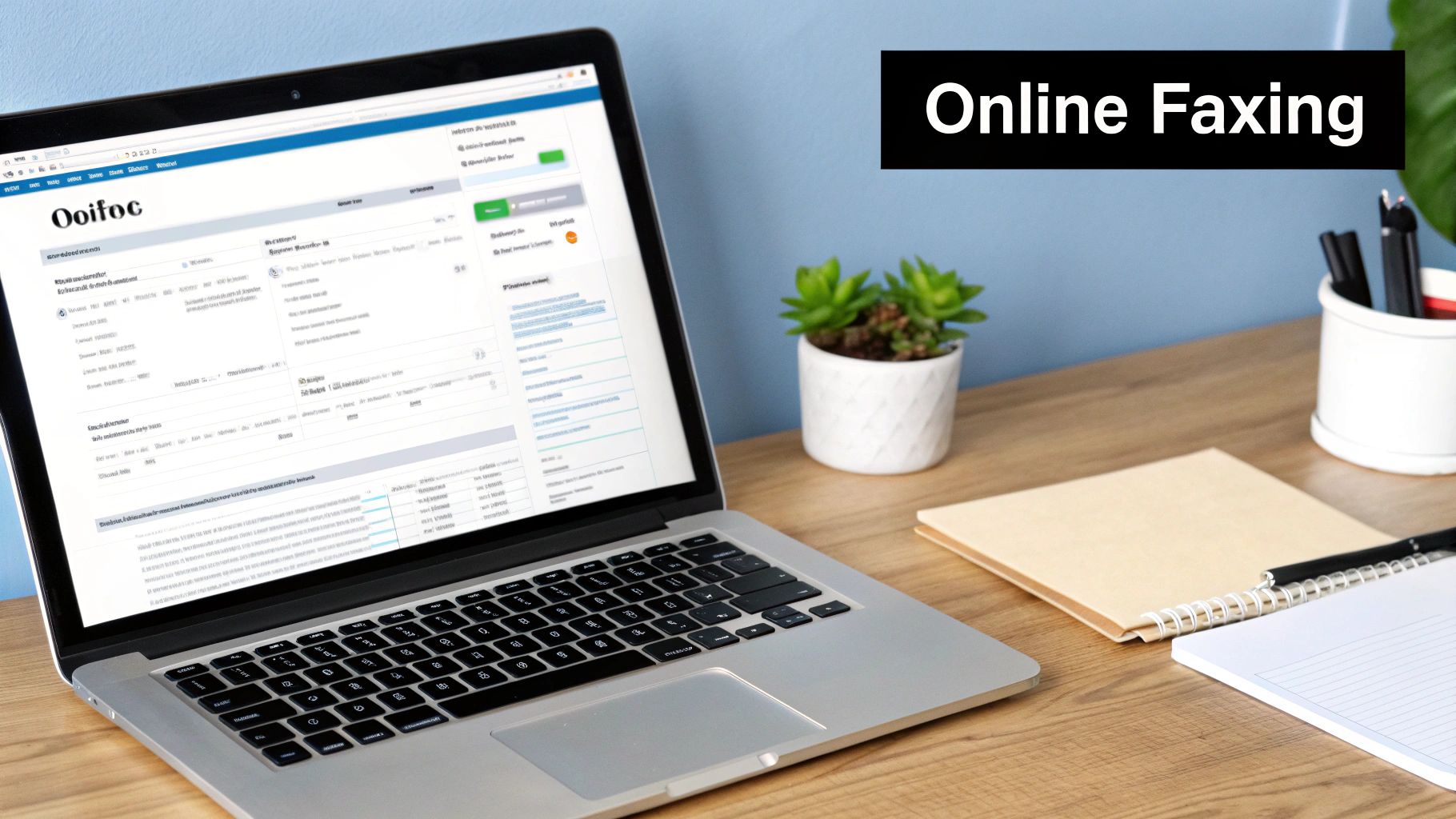
    A laptop on a wooden desk displays a website, with a plant and notebooks nearby, featuring 'Online Faxing' text.

    The concept is surprisingly simple. When you sign up for an online fax service, it gives you the ability to send a regular email to a specially formatted address. The service acts as a middleman, translating your email and its attachments into a standard fax and dialing up the recipient's machine.

    The Anatomy of an Email-to-Fax Message

    To make this work, you just need to structure your email in a specific way. It’s not complicated, but getting the details right is crucial for your fax to go through successfully. The real magic happens in the "To" field of your email.

    Instead of a typical email address, you'll type the recipient's fax number followed by the fax service's domain name. For instance, to send a fax to 1-800-555-1234, the address might look something like 18005551234@senditfax.com. Every service has its own domain, so you'll need to use the one they provide.

    The rest of your email maps directly to the fax itself:

    • Subject Line: This becomes the subject on the automatically generated fax cover page.
    • Email Body: Whatever you write here appears in the "Comments" or "Message" section of the cover page.
    • Attachments: These are the actual documents you’re faxing. The service converts them and sends them as pages following the cover sheet.

    This method is perfect for anyone who values speed and is already glued to their email client all day. There's no new software to learn or separate website to log into every time you need to send a quick document.

    Best Practices for Attachments and Formatting

    While sending a fax from email is incredibly straightforward, a few good habits will ensure your documents arrive looking clean and professional. Compatibility is the name of the game, since the service has to properly interpret and convert your files.

    First, always stick to common file types. PDFs are the gold standard here because they lock in formatting and are universally accepted. Most services also handle Microsoft Word documents (.doc, .docx) and common image files (.jpg, .png) without a hitch. Just try to avoid obscure formats—they're the number one cause of conversion errors.

    File size is another thing to keep an eye on. While online services are far more forgiving than old-school machines, massive files can still cause a transmission to time out. As a general rule of thumb, try to keep your total attachment size under 20 MB. If you have a huge report, it's better to compress it or split it into a couple of smaller faxes.

    Here's a pro tip from experience: always preview your document in black and white before you attach it. Fax machines don't do color or grayscale well. What looks like a beautiful chart on your screen can easily turn into an illegible smudge on the recipient's end.

    If you want to get into the nitty-gritty, our guide on how to fax via email covers even more detailed steps and troubleshooting.

    Putting It All Together: A Practical Example

    Let's walk through a real-world scenario. Imagine you're a freelance designer who needs to send a signed contract back to a new client. Their office is old-school and requires a fax for legal documents.

    1. First, you'd open Gmail, Outlook, or whatever you use and compose a new email. You have to send it from the email address that's registered with your online fax service.
    2. In the "To" field, you’d type the client’s fax number plus the service's domain, like 12128675309@yourfaxservice.com.
    3. For the subject, you'd write something clear and professional, like "Signed Contract for Project Alpha."
    4. In the body, you might add a quick note: "Here is the signed agreement we discussed. Looking forward to getting started!"
    5. Finally, you'd attach the contract, which you've already saved as a PDF.

    Once you hit "Send," the fax service takes over completely. It generates a cover page with your message, converts your PDF, and delivers the fax. A few minutes later, you'll get a confirmation email in your inbox—a perfect paper trail showing your important document was delivered successfully.

    Faxing From Your Smartphone or Tablet

    It’s pretty incredible what our phones can do these days, from managing our finances to ordering groceries. So, it should come as no surprise that they can also send a fax. Mobile fax apps have completely changed the game for anyone needing to send documents on the go. They essentially squeeze a powerful, portable fax machine right into your pocket.

    Think about it: you’re meeting a client, and they hand you a signed contract. The old way meant a trip back to the office to find a scanner. Now, you can take care of it right then and there. That’s the kind of practical convenience these apps deliver.

    The whole process is surprisingly simple. You just need to download a reputable fax app from the Apple App Store or Google Play, create an account, and you’re ready to go. The app turns that physical piece of paper into a digital file, primed for sending.

    Turning Your Camera Into a Scanner

    One of the best parts of any good fax app is the built-in document scanner. It leverages your phone's camera to capture a sharp, clean image of your document. This is way better than just snapping a photo, because the scanner technology is smart enough to find the edges of the page, fix any weird angles, and even boost the contrast so the text is perfectly clear.

    To get the best results, a little preparation helps. I’ve found that placing the document on a dark, flat surface works wonders—the contrast helps the app’s edge detection lock on perfectly. Good lighting is also key. Try to avoid casting shadows over the page with your hand or phone, as that can create dark splotches that make the final fax hard to read.

    Many of today's apps can even compile multiple pages into a single, organized document. Just scan one page after another. Once you’re satisfied with the quality, all that's left is to type in the recipient’s fax number, attach a cover sheet if you need one, and hit send.

    Must-Have Features in a Mobile Fax App

    Of course, not all fax apps are built the same. As you browse the options, there are a few key features that really distinguish a basic app from a serious business tool. These capabilities can make your life a lot easier and give you some much-needed peace of mind.

    Look for apps that offer:

    • Real-Time Push Notifications: This is a big one. You get an immediate alert right on your phone when a fax goes through successfully or if it fails, so you’re never left wondering.
    • Address Book Integration: Being able to pull contacts directly from your phone saves a ton of time and helps you avoid punching in a wrong number by mistake.
    • On-Screen Document Signing: A truly great feature is the ability to sign documents right on your screen. You can add your signature to a form or contract with your finger or a stylus before you fax it.
    • Cloud Storage Access: Look for integration with services like Google Drive, Dropbox, or iCloud. This makes it a breeze to attach files you already have saved online.

    When you combine these features, your phone becomes a full-fledged document hub. You can literally receive a contract by email, sign it in the app, and fax it off in less than a minute—all without ever touching a computer.

    For a more detailed look at the process, we have a complete guide on how to fax from your phone that includes app recommendations and other pro tips. Mobile faxing is the ultimate solution for professionals on the move, giving you the freedom to send a fax without a fax machine from absolutely anywhere.

    Security, Compliance, and What It's Going to Cost You

    When you're looking to send a fax without a machine, two big questions pop up right away: "Is this actually secure?" and "How much is this going to cost me?" These are the right questions to ask, especially if you're handling sensitive documents. After all, the whole reason faxing is still around in fields like healthcare and law is its reputation for secure, point-to-point delivery.

    The good news is that modern online fax services were built with security in mind. Reputable providers use end-to-end encryption to shield your documents from the moment you hit send until they arrive. Frankly, it's a huge step up from an old-school fax machine, where a confidential document could sit on a public tray for hours. Digital faxing keeps your data scrambled and unreadable to anyone who shouldn't see it.

    This focus on security is why, despite seeming old-fashioned, the digital fax market is projected to grow at a 10.2% CAGR between 2023 and 2030. Think about it: in 2019 alone, U.S. healthcare providers sent over 9 billion faxes. They do this because digital faxing meets tough HIPAA rules and provides verifiable, time-stamped proof of delivery. If you're curious, you can learn more about why faxing is still so prevalent today.

    Staying on the Right Side of Compliance

    For a lot of professionals, compliance isn't just a good idea—it's the law. If your work involves handling sensitive personal information, you absolutely must follow strict data protection regulations.

    Here are the big ones to watch for in a fax service:

    • HIPAA (Health Insurance Portability and Accountability Act): This is non-negotiable for anyone in healthcare. It governs the privacy of protected health information (PHI), and a compliant service will offer things like secure data centers and be willing to sign a Business Associate Agreement (BAA).
    • GLBA (Gramm-Leach-Bliley Act): If you're in finance, this one's for you. It requires institutions to protect sensitive customer financial data.
    • SOX (Sarbanes-Oxley Act): Publicly traded companies need to ensure secure record-keeping and data integrity. A solid online fax service helps with this by providing detailed audit trails of every fax sent and received.

    Before you commit to any service, do your homework. Check their security page or terms of service to make sure they meet the standards your industry requires.

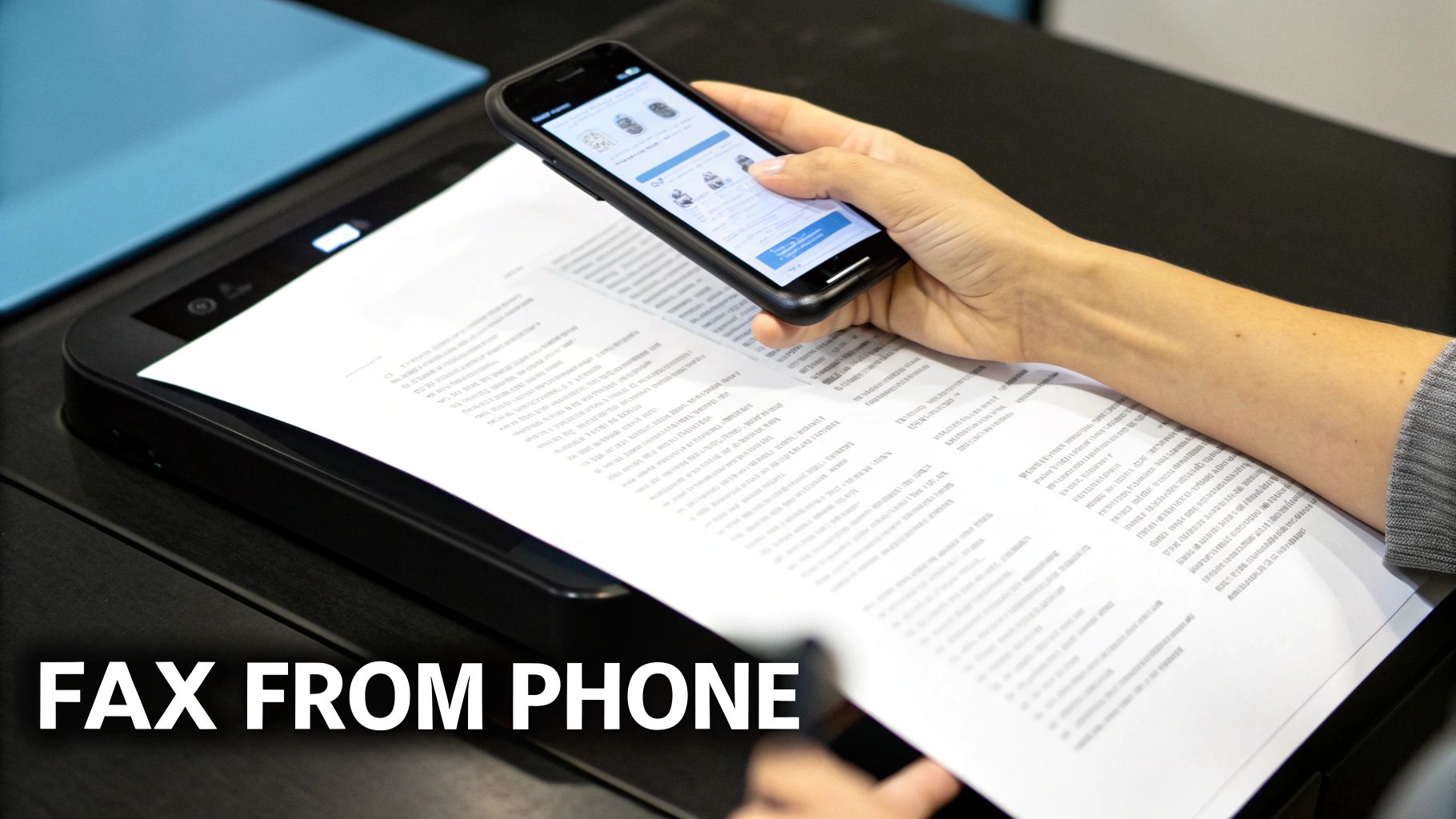
    A person uses a smartphone to scan a document on a scanner, with 'FAX FROM PHONE' text.

    Free vs. Paid Faxing: What's the Real Deal?

    Once you’ve sorted out the security, it's time to talk money. Your options typically boil down to free services or paid subscriptions. Each has its pros and cons, and the right choice really depends on how often you'll be sending faxes.

    Free services are great for that one-off document you need to send right now. If you fax something maybe once or twice a year, there's no sense in paying a monthly fee. But, and this is a big but, these free options are always limited.

    Paid services are built for more consistent use. They ditch the annoying limits of free plans and add a bunch of features that are essential for any kind of professional or business communication.

    Here's the bottom line: match the service to your actual needs. It's a waste of money to pay for a high-volume plan you'll never use, but relying on a flimsy free service for important business faxes can look unprofessional and might not be secure enough.

    To make it clearer, let’s break down the differences.

    Comparing Free vs. Paid Online Fax Services

    This table gives a side-by-side look at what you can expect from each type of service, helping you decide which route makes the most sense for you.

    Feature Free Services Paid Services
    Page Limits Very low, usually 1-5 pages per fax attempt. High monthly allowances, often hundreds or even thousands of pages.
    Cover Page Typically mandatory and branded with the provider's logo or ads. Optional and fully customizable for a professional look (no ads).
    Fax Number You can only send; you can't receive faxes. Includes a dedicated local or toll-free number for receiving faxes.
    Security Basic encryption, may not be suitable for sensitive data. Advanced security, including compliance options (HIPAA, etc.).
    Support Limited to online FAQs or maybe email. Priority customer support through phone, live chat, and email.
    International Faxing Almost never included. Widely available, with clear pricing for different countries.

    Ultimately, the choice comes down to your specific situation. Need to send a quick, non-sensitive form? A free service like the one from SendItFax is a perfect fit. But if you're running a business where security, a professional image, and the ability to receive faxes are crucial, investing in a paid plan is the smart move.

    Got Questions About Faxing Without a Machine?

    Even after seeing how easy it is, you might still have a few questions. That's perfectly normal. When you're sending something important, you want to be sure you're doing it right. Let's walk through some of the common things people wonder about when they ditch the old machine for a modern faxing solution.

    Tablet displaying 'SECURE FAXING' with a cloud and padlock icon, next to a laptop and documents.

    We’ll cover everything from getting faxes back to confirming yours actually landed where it was supposed to.

    Can I Receive Faxes Without a Fax Machine?

    You absolutely can, and this is where a paid online fax service really shines. Once you sign up, you get your own dedicated fax number, which can be local or toll-free. Anyone with a clunky old fax machine can send documents to that number just like they always have.

    But instead of spitting out a physical piece of paper, the incoming fax gets converted into a digital file—usually a PDF. It lands right in your email inbox, and you can typically view and manage all your received faxes in your service's online dashboard. It's a game-changer for staying organized and cutting out paper clutter.

    How Will I Know If My Fax Was Delivered?

    This is probably the most critical question, and the answer is one of the best parts of going digital. Forget standing by a machine and hoping for the best. Every respectable online fax service gives you rock-solid delivery confirmation.

    The moment your fax transmission is complete, you'll get a detailed confirmation email. It typically includes:

    • A clear success or failure notification.
    • The exact date and time it was received.
    • The total number of pages sent.
    • Sometimes, even a thumbnail image of the first page for a quick visual check.

    This confirmation report is your proof of delivery, which is indispensable for contracts, legal filings, or any time-sensitive communication. If it fails, the service will tell you why, often with an error code that helps you figure out what went wrong (like a busy signal or incorrect number).

    The detailed audit trail from an online fax service is a massive upgrade. You get a verifiable, time-stamped record of every single transmission—something that’s invaluable for business and legal peace of mind.

    Is Digital Faxing Legally Binding?

    Yes, it is. Faxes sent through a reputable online provider are considered just as legally binding as those sent from a traditional machine. The whole point of a fax, legally speaking, is the ability to prove it was sent and received. The detailed confirmation reports and audit trails you get from these services are exactly what you need to do that.

    On top of that, many services now incorporate legally recognized e-signature features. This means you can sign a document right on their platform before you send it, creating a secure and legally sound workflow from start to finish. It’s a common practice in industries like law, real estate, and healthcare.

    Do I Need Any Special Software to Send a Fax Online?

    Nope, and that's the beauty of it. For the vast majority of online fax services, all you really need is a web browser and an internet connection. There's nothing to install, update, or maintain.

    You handle the entire process—uploading your document, typing in the fax number, and hitting send—right on the service's website. If you're using the email-to-fax method, you’re just using your regular email client. For mobile apps, it's a simple download from your app store.

    What File Formats Can I Send?

    Most online fax providers are incredibly flexible and support a wide array of common file types. You're almost always covered with these standards:

    • Adobe PDF (.pdf): This is the undisputed champion for faxing. It locks in your formatting and looks the same for everyone.
    • Microsoft Office Documents (.doc, .docx, .xls, .xlsx): Word files and Excel spreadsheets are no problem.
    • Common Image Files (.jpg, .png, .tif): Perfect for faxing photos, scanned IDs, or sketches.
    • Text Files (.txt, .rtf): Basic text documents are also easily converted.

    My pro tip? When in doubt, just convert your file to a PDF before uploading. It’s the surest way to guarantee your document arrives looking exactly the way you intended.


    Ready to send your first fax without a fax machine? With SendItFax, you can send documents from any browser in just a few clicks. Whether you need a quick free option for a few pages or a professional, ad-free solution, we have you covered. Try it now and see how simple faxing can be.

  • How to Fax from Your Phone A Simple Guide

    How to Fax from Your Phone A Simple Guide

    It's surprisingly straightforward to send a fax right from your phone. You just use a web-based service like SendItFax, upload your document from your mobile browser, punch in the recipient's number, and hit send. This whole approach sidesteps the need for a physical machine, effectively turning your smartphone into a powerful, portable fax solution.

    Why Mobile Faxing Still Matters Today

    A person using their smartphone to manage documents while sitting on a couch.

    It might feel a little old-school to be talking about faxing when we have email and instant messaging, right? But the truth is, faxing still holds a critical spot in industries where security and legal weight are everything. I’m talking about healthcare, law, finance, and government—places that deal with sensitive personal data every single day.

    For professionals in these fields, a fax isn't just a relic. It’s a trusted, secure way to send documents. Because a fax travels over a dedicated phone line, it creates a point-to-point connection that's incredibly difficult to intercept. This is precisely why many organizations still insist on faxes for official paperwork like signed contracts, medical records, or court filings.

    Bridging Old Tech with New Habits

    The real story here isn't the death of faxing, but its smart evolution. Learning how to fax from your phone combines the rock-solid security of traditional faxing with the on-the-go convenience we all demand. You're no longer chained to a clunky machine in the corner of an office.

    Instead, you can send a signed mortgage application from your local coffee shop or forward a critical legal document while waiting to board a flight. It’s all about flexibility.

    Modern online fax services are the digital bridge that makes this possible. These platforms take your digital file—whether it's a PDF, a photo, or a Word doc—and convert it into a format that a classic fax machine on the other end can understand and print. It’s really the best of both worlds.

    The real magic of mobile faxing is how it fits a legacy communication standard into a modern, mobile-first workflow. It solves a genuine problem for anyone who needs to connect with organizations still relying on traditional systems.

    Despite the big push toward all-digital solutions, the global market for traditional fax machines is still expected to be around $624 million in 2025. You can dig into the numbers in a recent market analysis from Archive Market Research. This tells us the hardware isn't vanishing; it's just becoming more specialized, which makes services that connect our digital lives to this established network more important than ever.

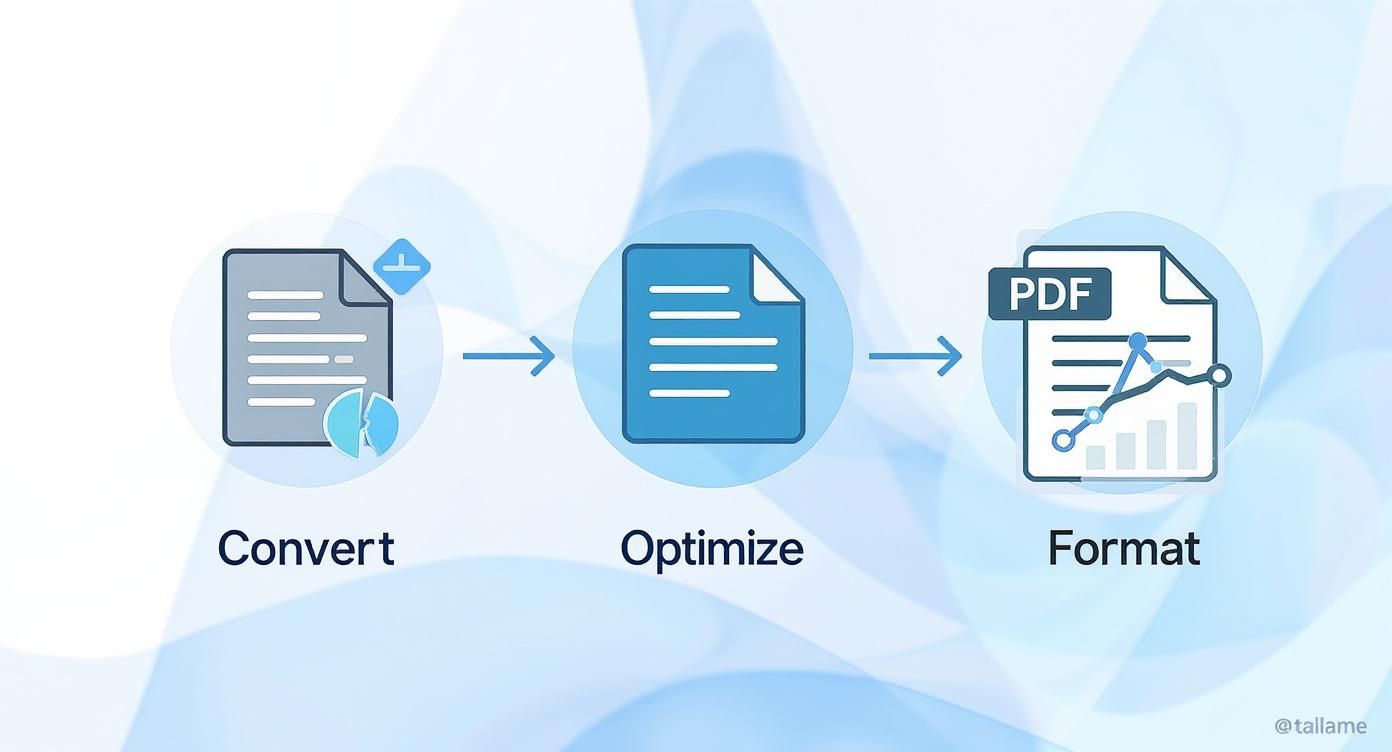
    This is why a reliable online service is such a game-changer. It gives you a way to send official communications without having to own and maintain outdated equipment. The service handles all the tricky parts for you, like making sure the transmission gets a unique identifier. To get a better sense of how this works behind the scenes, you can learn more from our guide on what is a fax number and its role today.

    This isn’t about bringing back old tech; it’s about making its proven strengths accessible from the device you already have in your pocket.

    Mobile vs Traditional Faxing at a Glance

    Here’s a quick comparison highlighting the key differences between sending a fax from your phone and using a conventional fax machine.

    Feature Mobile Faxing (Online Services) Traditional Fax Machine
    Accessibility Send/receive from anywhere with internet Tied to a physical location
    Hardware None needed; uses your phone or computer Requires a dedicated machine and phone line
    Document Format Handles digital files (PDF, DOCX, JPG) Requires a physical paper copy to scan
    Cost Low-cost subscriptions or pay-per-fax Machine purchase, toner, paper, phone line fees
    Security Encrypted transmissions and secure cloud storage Secure point-to-point, but physical documents can be left in the open
    Confirmation Instant email notifications and digital logs Prints a confirmation page (can be lost)

    As you can see, mobile faxing offers a level of convenience and cost-efficiency that traditional machines just can't match, all while maintaining the security needed for professional use.

    Getting Your Documents Ready for Digital Faxing

    Before you can send a fax from your phone, the document itself needs to be in a digital format. Think of it this way: a sharp, clean digital file is the foundation of a successful fax. It's what ensures the person on the other end gets a professional, easy-to-read document every single time.

    Let's start with the most common situation: you've got a signed contract, an invoice, or a medical form sitting on your desk. Your phone is the only tool you need to turn that physical paper into a fax-ready file.

    Turning Physical Paper into a Digital File

    Forget about needing a big, clunky flatbed scanner. Your smartphone is a powerful scanner in its own right, as long as you keep a few things in mind to avoid those frustratingly blurry or skewed images that just look unprofessional.

    • Find good, even lighting. Natural light from a window is fantastic, but a well-lit room works too. The main goal is to avoid casting shadows from your phone or hand across the page, which can hide important details.
    • Lay it completely flat. Put the paper on a dark, contrasting surface like a clean desk or even the floor. This simple trick helps your phone's camera easily find the document's edges and crop it perfectly.
    • Get directly overhead. Hold your phone parallel to the paper, not at an angle. Shooting from the side can warp the text and make it look stretched or crooked. For the best results, always shoot straight down.

    Most modern phones actually have a document scanner built right into the Notes app (iOS) or Files/Drive app (Android). These are great because they automatically straighten the image, fix the perspective, and save it as a crisp, black-and-white PDF—the perfect format for faxing.

    Choosing the Right File Format

    Once you have your digital file, the format matters more than you might think. While many online fax services are flexible, there's one format that's considered the gold standard for a reason.

    Pro Tip: When you have the choice, always go with PDF (Portable Document Format). PDFs are designed to look the same no matter what device they're viewed on. This means the layout, fonts, and spacing you see on your screen are exactly what the recipient's fax machine will print out. It’s the most reliable option, hands down.

    Sure, services like SendItFax often accept DOC, DOCX, and even image files like JPG. But these can sometimes get a little wonky during the conversion process. A Word document with special formatting might not translate perfectly. Sticking with a PDF eliminates that risk and is a small step that makes a big difference.

    If your document is already a digital file—like a report you just typed up in Microsoft Word or Google Docs—the fix is easy. Just use the built-in "Save as PDF" or "Download as PDF" function. That one little click gets your file perfectly prepped for a smooth and successful fax transmission.

    How to Send a Fax from Your Phone Browser

    Alright, you've got your document scanned and saved as a clean PDF. Now for the easy part: sending it straight from your phone's browser. There's no need to download yet another app. Web-based services like SendItFax let you get the job done in just a couple of minutes, and the whole process is surprisingly straightforward, even if you’ve never done it before.

    Infographic about how to fax from your phone

    The move away from clunky old machines is happening fast. In fact, the online fax service market hit a value of $2.52 billion in 2024 and is on track to nearly double to $4.54 billion by 2033. This isn't just a niche trend; it shows a massive demand for more flexible and secure ways to handle important paperwork from anywhere. You can dig into the numbers yourself in the full market analysis from Open PR.

    Getting Started on the Web Service

    First things first, open your favorite browser on your phone—whether it's Safari, Chrome, or something else—and head over to a service like SendItFax. These sites are designed to work perfectly on a small screen, so you won’t have to do any of that annoying pinching and zooming to see what you’re doing.

    The layout is usually very direct. You'll see clear fields for your information (sender) and the recipient's details. This is where you’ll pop in your name, email address, the recipient's name, and of course, their fax number.

    Crucial Tip: I can't stress this enough: double-check the recipient's fax number. A single wrong digit is the number one reason faxes fail to send. Make sure you have the complete 10-digit number, area code and all.

    Uploading Your Document and Adding a Cover Page

    Next, look for a button that says "Upload File," "Attach Document," or something similar. Tapping it will bring up your phone's file browser, letting you find and select that PDF you just prepped.

    Screenshot from https://www.senditfax.com/

    After your file is uploaded, you’ll almost always see an option to add a cover page. This is a great professional touch, especially for business documents. Think of it like the subject line of an email—it gives the person on the other end immediate context.

    Typically, you can add a few key details:

    • A brief subject line: Something like, "Signed Contract for Project Alpha."
    • A short message: For example, "Please find the signed agreement attached. Let me know if you need anything else."
    • The total number of pages: This includes the cover sheet itself.

    If you're sending something less formal or the document is completely self-explanatory, you might decide to skip the cover page. Most services will have a simple checkbox to omit it, though this is sometimes a feature for paid plans.

    Sending the Fax and What to Expect Next

    Once all the information is filled in and your document is attached, you're ready to send. Find that big "Send Fax" button, give all the details one final glance for accuracy, and tap it.

    From here, the service takes over. It converts your digital file into the right format for a traditional fax machine and sends it across the phone network. You don’t have to do a thing; the system handles all the technical wizardry behind the scenes.

    In just a few moments, an email confirmation should land in your inbox. This is your digital receipt, telling you if the fax went through successfully or if it failed. We’ll get into what those notifications mean and how to fix any problems in the next section.

    Confirming Delivery and Solving Common Problems

    https://www.youtube.com/embed/oDQijqiyNC0

    You’ve prepped your document, entered the details, and hit send. So, what happens now? Unlike the old days of dropping a letter in a mailbox and just hoping it arrived, modern faxing gives you immediate feedback. You should get an email confirmation from the service within a few minutes.

    Think of this email as your digital receipt. It’s important. It will tell you in plain terms whether your fax was successful or if it failed. A success message gives you peace of mind—the document is in their hands. A failure notice, on the other hand, means we need to do a little detective work.

    What to Do When a Fax Fails

    Seeing that "failed" notification is frustrating, I get it. But don't just mash the resend button. The problem is usually something simple and quick to fix. Rushing to send it again without figuring out the "why" often just leads to another failure.

    Before you do anything else, let's run through a quick mental checklist.

    • Did you fat-finger the number? A single wrong digit is, by far, the most common reason faxes fail. Double-check that you entered all 10 digits correctly, especially the area code. It’s so easy to mix up numbers on a phone screen.

    • Was the line busy? The receiving fax machine might have been tied up. This happens if it’s getting another fax or if it’s a shared line that also takes phone calls. My rule of thumb is to wait 10-15 minutes and then give it another shot.

    • Are you sure it's a fax line? Sometimes people give out their direct voice line by mistake. If you’re not 100% certain, a quick phone call to the recipient to confirm the number can save you a lot of hassle.

    • How did your document look? Was the file you sent a crisp, clean PDF? A blurry photo or a weirdly formatted document can sometimes be rejected by the receiving machine’s older hardware.

    In my experience, the issue is almost always a simple human error or just bad timing on the recipient's end. If you walk through these steps one by one, you’ll usually find the culprit and get your document sent successfully on the next try.

    Digital Faxing Is More Reliable Than You Think

    This whole process—from sending to getting instant confirmation—is why online faxing has become so essential. It’s not just about keeping old tech alive; it’s about making it smarter and more reliable for how we work today.

    The numbers back this up. The fax services market is expected to grow from $3.31 billion in 2024 to nearly $4.48 billion by 2030. That growth is fueled by cloud services that make knowing how to fax from your phone a genuinely useful skill. For anyone interested in the data, the global fax services market report has a deep dive into these trends. This evolution means that even when you hit a small snag like a failed send, the tools to fix it are right there in your hand.

    Choosing the Right Mobile Faxing Method

    A person looking at their phone and making a decision between different app icons.

    Using a web service like SendItFax right from your phone's browser is perfect for those one-off situations. It's fast, simple, and gets the job done without any fuss. But what if you send faxes more often?

    Your best approach really hinges on your specific needs—how frequently you fax and what features you can't live without. Let's break down the main alternatives to see what makes the most sense for you.

    Dedicated Mobile Faxing Apps

    If you find yourself faxing documents on a regular basis, downloading a dedicated mobile app is almost always the right move. These apps are built specifically for your phone, meaning the entire experience is much smoother and more integrated than using a website.

    For instance, think about getting an instant push notification on your lock screen the second your fax goes through. No more checking your email for confirmation. Many apps also sync with your phone's contact list, so you can just tap a name instead of manually punching in a fax number every single time.

    This level of convenience usually comes with a subscription. Most top-tier apps charge a monthly or annual fee, which is a great value for businesses or professionals who rely on faxing. However, it’s probably not necessary if you only need to send a document once a year.

    The biggest win with a dedicated app is how it plugs directly into your phone's ecosystem. Push notifications, contact list access, and built-in scanning tools create a seamless workflow that a browser just can't match for heavy users.

    Email-to-Fax Services

    Here's a clever option for anyone who spends their day in their email inbox: email-to-fax. The beauty of this method is its simplicity. It feels completely natural because you're using a tool you already know inside and out.

    The process is surprisingly straightforward. You just compose a new email, attach your file (like a PDF or Word doc), and send it to a unique email address. This address is usually a combination of the recipient's fax number and the service's domain, something like 18005551234@faxprovider.com.

    The service handles the rest, converting your email into a fax and sending it on its way. This is also fantastic for record-keeping, as you'll automatically have a copy of what you sent right in your "Sent" folder.


    So, which path should you take? To make it clearer, here’s a quick breakdown of how these methods stack up against each other.

    Which Mobile Faxing Method Is Best for You?

    Method How It Works Best For Common Cost Structure
    Web-Based Service Upload a document directly on a website from your phone's browser. Quick, one-off faxes where you don't need ongoing features. Pay-per-fax or a limited number of free pages.
    Dedicated Mobile App Download an app that offers an integrated, mobile-first experience. Frequent faxing by individuals or businesses who need reliability and extra features. Monthly/annual subscription plans, often with tiered features.
    Email-to-Fax Send an email with an attachment to a specially formatted address. Professionals who want to integrate faxing into their existing email workflow. Usually included with a subscription plan from an online fax service.

    At the end of the day, there's no single "best" choice—only the best choice for you. If you send a fax once in a blue moon, a web service is all you need. If it's a weekly task, investing in a dedicated app will pay for itself in convenience. And for email power users, the email-to-fax route is a no-brainer.

    For a more granular look at the options out there, this detailed online fax services comparison is a great resource to help you match features to your specific needs.

    Got Questions About Mobile Faxing?

    It’s one thing to follow the steps, but it's another to feel confident about the process. If you’ve still got some questions, you're not alone. Let's tackle some of the most common things people ask when they start faxing from their phones.

    Is Faxing From a Phone Actually Secure?

    This is probably the most important question, and the answer is a firm yes—as long as you use a reputable service. When you send a document through a service like SendItFax, the file is encrypted. Think of it as sending your document through a secure, private tunnel where no one else can see it.

    Honestly, it’s often much safer than using the old office fax machine. Those faxes frequently sit in a public tray for anyone to grab. With mobile faxing, the document travels directly from your device to the recipient, and you get a private confirmation.

    The real key to security is picking a provider that takes it seriously. Look for services that encrypt your data both while it's being sent and while it's stored. This level of protection is trusted by professionals in healthcare, finance, and law.

    Can I Really Send a Fax to Another Country?

    Absolutely. Most online fax services are built for global communication. The process itself doesn’t change—you still upload your document and punch in the number.

    The only difference is how you format the number. You'll need to include the country code and often drop the leading "0" from the local number. For example, a UK number would start with +44.

    Just be mindful of the cost. Sending a fax internationally will almost always cost more than a domestic one. Rates can vary wildly depending on the destination, so I always recommend checking the service’s pricing page first to avoid a surprise on your bill.

    What About Receiving Faxes on My Phone?

    While sending is the most common need, receiving faxes is just as easy. To do this, you'll typically need a subscription plan which gives you a dedicated virtual fax number.

    Once you have that number, anyone can send a fax to it from a traditional machine. Instead of printing out on paper, it arrives directly in your email inbox, usually as a PDF. It’s a game-changer for anyone who needs to receive signed contracts or important forms while on the go.

    This turns your phone into a complete, two-way faxing solution. If you want to dive deeper, our guide on how to fax via email breaks down exactly how to set it up and make it part of your daily workflow.


    Ready to send a document right now without the hassle of subscriptions or clunky hardware? With SendItFax, you can fax your documents from any browser in just a few clicks. Whether it's a single page or a lengthy contract, our straightforward service gets it there securely. Try SendItFax today and see how simple faxing can be.

  • How to send fax without fax machine: fast, secure and easy

    How to send fax without fax machine: fast, secure and easy

    Yes, you absolutely can send a fax without a fax machine. Thanks to modern technology, you now have at least three fantastic options right at your fingertips: online fax services, email-to-fax systems, and even mobile apps on your phone.

    These tools take your digital files and convert them into a format that any old-school fax machine can receive and print. It’s a game-changer, making the entire process quicker, more secure, and infinitely more convenient than dealing with a clunky machine.

    Why Do We Still Fax, Anyway?

    It’s a fair question. In a world of instant messaging and email, faxing can feel like a relic from another time. But for many industries, it’s still the gold standard for sending legally binding or highly sensitive documents.

    Think about healthcare, law, and government agencies. For them, security and verifiable delivery aren't just nice-to-haves—they're requirements. Email, for all its convenience, can have security gaps. Faxing, particularly the digital kind, provides a secure, point-to-point connection that’s much harder to intercept. This is the key reason it has stuck around.

    This image shows the three main ways you can send a fax without owning a machine.

    Modern faxing methods showing online service, email-to-fax, and mobile app options for digital communication

    As you can see, whether you're on a computer, in your email inbox, or on your smartphone, there's a modern faxing solution ready to go.

    A Quick Look at Modern Faxing Methods

    Choosing the right method depends on what you need to send and how often you'll be faxing. Here’s a quick rundown to help you decide.

    Modern Faxing Methods at a Glance

    Method How It Works Best For Typical Cost
    Online Fax Service You upload a document to a website, enter the fax number, and click send. The service handles the conversion and transmission. Anyone needing a simple, reliable way to send faxes occasionally or in high volume. Perfect for businesses. Free trials available; monthly plans from $5-$25.
    Email-to-Fax You attach your document to an email and send it to a special address (e.g., 1234567890@service.com). Quick, one-off faxes when you're already in your email client. Great for sending documents directly from your computer. Often included with online fax service subscriptions.
    Mobile Fax App Use your phone's camera to scan a physical document, then send it through the app. Faxing on the go, especially when you need to send a signed paper document and don't have a scanner. Pay-per-fax (e.g., $0.99) or subscription-based.

    Each of these methods bridges the gap between digital convenience and the enduring need for fax technology, offering a solution for just about any scenario.

    Faxing's Surprising Resilience

    You’d be surprised how many businesses still lean on this technology. A recent study found that 17% of businesses worldwide still consider faxing a critical part of their operations. This isn't just inertia; it’s a deliberate choice based on security and legal standing.

    This is especially true in healthcare and legal fields, where the integrity of a document is everything. As you can learn in this Business.com article about business faxing, this continued reliance has paved the way for the cloud-based services that now let anyone send a fax from anywhere.

    How to Use an Online Fax Service (The Easiest Method)

    For most people trying to send a fax without an actual machine, online fax services are, hands down, the best way to go. Think of it as merging the ease of email with the official, secure nature of a traditional fax. It’s incredibly straightforward and comes loaded with features that make it a far better choice for just about anyone, from individuals to large businesses.

    Laptop displaying online faxing service with cloud storage icons on wooden desk workspace

    Let’s paint a picture. You’re a freelancer, and you just landed a new client. They need the signed contract back now to get the project started. Instead of frantically Googling "fax service near me" and running out to a print shop, you can use a service like SendItFax right from your laptop. The whole thing is done in minutes.

    A Quick Look at How It Works

    Getting started is as simple as visiting the service’s website. You don't need to download special software or plug anything in. From there, it's a pretty intuitive process:

    • Upload Your Document: You can grab a file straight from your computer or, even better, link your cloud storage. This lets you pull documents directly from places like Google Drive, Dropbox, or OneDrive.
    • Plug in the Details: Type in the recipient's fax number and your own info. This is also where you’ll create a quick digital cover sheet—just add a subject and a short message.
    • Hit Send: That's it. The service does the heavy lifting, converting your file into a fax-friendly format and sending it over the phone lines to the recipient's machine.

    This isn't just a clever workaround; it's a massive industry. The global market for fax services was valued at USD 3.46 billion in 2023 and is on track to nearly double by 2029. It's all driven by the sheer efficiency of cloud-based faxing. You can read more about the growth of the fax services market to see where the technology is heading.

    The Advantages You Actually Care About

    Beyond just sending a file, these platforms offer powerful tools that old-school machines just can't compete with. These benefits are a huge part of why so many people are ditching the hardware.

    One of the most valuable perks is the delivery confirmation. The moment your fax lands successfully, you get an email receipt. This isn't just a notification; it’s your proof of transmission, complete with the time, date, and recipient. For important things like legal contracts or medical records, this is non-negotiable.

    You also get a bunch of other genuinely useful tools:

    • Fax Scheduling: Need a document to arrive first thing Monday morning? Schedule it over the weekend and forget about it.
    • Digital Archives: Most services keep a secure online log of everything you've sent. It's like having a perfectly organized, paperless filing cabinet.
    • Better Security: Good services use encryption to protect your documents in transit. That's a lot safer than a sensitive fax sitting out in the open on a shared office machine.

    With so many providers out there, picking one can be a little overwhelming. We put together a detailed online fax services comparison that breaks down how different platforms compare on features, security, and price. It’ll help you find the right fit, whether you send one fax a year or hundreds every month.

    Sending a Fax Directly From Your Email

    What if you could send a fax without a fax machine using a tool you already have open all day? That's the beauty of email-to-fax. It's an incredibly practical feature that most top-tier online fax services, including SendItFax, build right into their platforms. It effectively turns your go-to email client—whether it's Outlook, Gmail, or something else—into a full-fledged faxing machine.

    Computer screen displaying email to fax service on modern office desk with keyboard and smartphone

    The real advantage here is how smoothly it fits into your daily routine. You don't have to stop what you're doing to log into a separate website or open another app. It’s a direct, no-fuss way to get documents where they need to go.

    How to Format Your Email for Faxing

    The secret sauce for email-to-fax is all in the "To" field of your email. Instead of a typical email address, you'll use a special format that combines the recipient's fax number with your service provider's domain.

    Here’s how it works:

    • The Recipient's Address: You simply type the 10-digit fax number (including area code) followed by the "@" symbol and your fax service's domain. For a fax number like 1-800-555-1234, the address might look like 18005551234@yourfaxservice.com.
    • The Fax Document: Any file you attach—PDFs, Word docs, JPEGs—gets converted automatically into the pages of the fax. This is what the recipient will see coming out of their machine.
    • The Cover Page: This is the clever part. The system generates a professional cover page using the details from your email itself. Your email's subject line becomes the subject of the fax, and whatever you write in the body of the email becomes the memo.

    Once you hit "Send," the service takes care of all the technical heavy lifting, converting your email into a fax signal and dialing the machine on the other end. You'll get a confirmation email back in your inbox once it's delivered, just like you would if you sent it through a web portal.

    This method is about more than just convenience; it's about workflow integration. For professionals who handle documents all day, being able to send a secure fax directly from Outlook or Gmail saves valuable time and reduces administrative friction.

    A Practical Scenario for Email-to-Fax

    Let’s say you're a remote employee who needs to send signed expense reports to the accounting department. They're old-school and still rely on a central fax machine for their records. The old way would involve printing, signing, scanning, and then uploading the file to a fax website.

    With email-to-fax, the process is much simpler.

    You'd just open a new email from the address linked to your fax account and:

    • Attach the signed expense report PDF.
    • In the "To" field, type accounting's fax number, like 12128675309@senditfax.com.
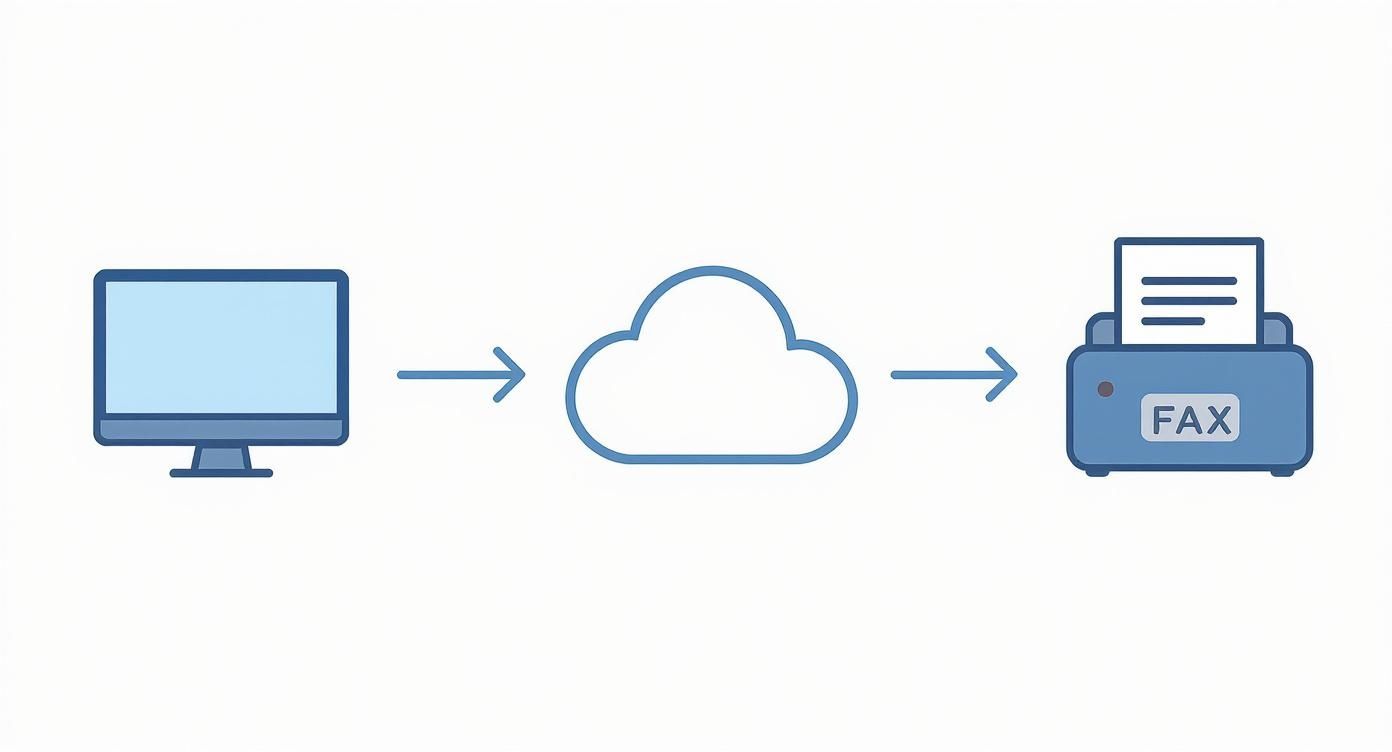
    • Make the subject line something clear, like "Expense Report – [Your Name] – [Date]".
    • Add a quick note in the email body if you need to.

    That's it. Click send, and the document is securely delivered to the accounting office's fax machine, fronted by a perfectly formatted cover page. It feels exactly like sending a regular email.

    To dig deeper into this handy feature, check out our complete guide on how to fax via email.

    How to Fax From Your Phone Using Mobile Apps

    Your smartphone is probably the handiest tool you have for sending a fax without a fax machine, especially when you aren't near a computer. With dedicated mobile faxing apps for both iOS and Android, your phone essentially becomes a pocket-sized scanner and fax transmitter. It’s perfect for getting urgent documents out the door, no matter where you are.

    Let’s say you’re on the road and a client needs a signed contract back right now. Instead of frantically looking for a print shop, you can just pull out your phone. A good fax app lets you snap a picture of the document, add your digital signature, and send it on its way in minutes. For anyone who travels or works remotely, that kind of convenience is a total game-changer.

    Turning Your Phone into a Document Scanner

    At the heart of any solid fax app is its ability to use your phone’s camera as a high-quality scanner. This is way more sophisticated than just taking a photo. The software is built to optimize the image so it looks crisp and professional when it comes through on the other end.

    When you use an app like SendItFax Mobile, the whole process is surprisingly polished.

    • Capturing the Document: The app’s camera interface guides you to get a clear, straight-on shot, often automatically detecting the paper's edges.
    • Enhancing and Cropping: Once you’ve taken the picture, you can instantly crop out your messy desk, boost the contrast, and convert the image to black and white. This step is crucial for making sure the recipient gets a clean fax, not a shadowy, unreadable picture.
    • Adding Signatures and Text: Most apps let you sign your name with your finger or a stylus and even type text directly onto the document. It’s a lifesaver for filling out forms in a pinch.

    This whole workflow digitizes a physical document and gets it ready for sending. From there, modern internet fax services handle the heavy lifting, converting the file into an encoded data stream. Thanks to smart compression, a standard page can be transmitted in as little as 10-15 seconds at speeds up to 33,600 bits per second. If you're curious about the technical side, you can learn more about the technology behind digital faxing and how it all works so seamlessly.

    Understanding App Pricing Models

    Mobile fax apps usually come with a few different payment options, designed for everyone from the occasional user to the small business owner. It pays to think about how often you’ll be faxing before picking a plan.

    Pro Tip: Before you sign up for a monthly plan, try a pay-per-fax option first. It’s a great, low-risk way to see if you like the app's interface and if the fax quality is up to your standards.

    Here are the common pricing structures you’ll run into:

    1. Pay-Per-Fax: This is your best bet for those rare, one-off faxes. You simply pay a small fee for a single transmission or buy a small credit pack. It's perfect if you only send a fax once or twice a year.
    2. Monthly Subscriptions: If you find yourself sending documents regularly, a subscription almost always makes more financial sense. These plans typically give you a certain number of pages each month for one flat fee.
    3. Free Trials: Lots of services will let you send a few pages for free to try them out. It’s a smart way to test the waters before pulling out your credit card.

    Choosing the Right Online Fax Service

    With so many digital fax providers out there, picking the right one can feel a bit overwhelming. The secret is to cut through the marketing fluff and zero in on what really matters: how they charge, how they protect your data, and what features will genuinely make your life easier.

    Getting this choice right from the start will save you a ton of hassle and money down the road. It's worth spending a few minutes comparing options rather than just grabbing the first one you see.

    Matching Price to Your Usage

    Online fax services aren't one-size-fits-all, especially when it comes to pricing. The first thing you need to figure out is your own faxing habits. Are you sending a critical document once a year, or are you faxing contracts every week?

    • Pay-Per-Use Plans: If you just need to send a fax on a rare occasion—like for tax season or a one-off legal form—this is your best bet. You pay a small fee for each fax you send, with no monthly strings attached. It's simple and effective.
    • Monthly Subscriptions: For small businesses, freelancers, or anyone who faxes regularly, a subscription is almost always the more economical route. These plans give you a certain number of pages each month for a flat rate, which is perfect for predictable usage.

    A word of caution: while some services lure you in with super low prices, always check for hidden fees or tight page limits. The cheapest plan isn't always the best value if it doesn't fit how you work.

    Prioritizing Security and Compliance

    Let's be honest, you're probably not faxing your lunch order. You're sending sensitive information, so security can't be an afterthought. A trustworthy service will be upfront about how they keep your documents safe.

    The absolute baseline is TLS encryption. This is the same technology that protects your online banking, and it scrambles your documents as they travel from your computer to their servers. Don't even consider a service that doesn't offer it.

    If you work in healthcare, law, or finance, you have another layer to think about: HIPAA compliance. A service that's HIPAA-compliant follows strict federal rules for protecting sensitive patient information, ensuring you meet your legal obligations for privacy.

    Comparing Key Service Features

    Beyond the big-ticket items like price and security, it’s the little things that often separate a decent service from a great one. These are the quality-of-life features that streamline the whole process.

    As you compare your options, keep an eye out for these game-changers:

    • International Faxing: Need to send a document overseas? Make sure the service supports it and be clear on what it costs. International rates can vary wildly.
    • Cloud Storage Integration: Being able to grab a file directly from Google Drive, Dropbox, or OneDrive is a huge time-saver. It cuts out the annoying step of downloading a file just to re-upload it a second later.
    • Customer Support: When a critical fax fails at the last minute, you need help, and you need it fast. Check what kind of support they offer—live chat, email, or a phone number you can actually call.

    Choosing wisely upfront saves you from switching services later. For a deep dive into how different providers compare on cost, check out our guide to finding the cheapest online fax service on the market.

    Pro Tips for Secure and Successful Digital Faxing

    Sending a fax without a machine is incredibly convenient, but a little prep work goes a long way. Getting your documents ready and knowing how to handle the occasional hiccup are key to making sure everything runs smoothly. These are the tips I've picked up over the years to ensure every fax lands perfectly.

    Tablet displaying digital fax document with security lock icon and notebooks on wooden desk

    Before you hit send, remember that the receiving fax machine is an old-school, low-resolution device. A clean, crisp digital file on your end is the only way to get a readable physical copy on theirs.

    Get Your Documents Ready for a Flawless Send

    The best way to guarantee a good result is to start with a high-quality file. While most online fax services are flexible with formats, some are definitely better than others for the job.

    • PDF is the Gold Standard: If you're sending contracts, reports, or anything with multiple pages, convert them into a single PDF. This locks in the formatting and fonts, so what you see is exactly what they get.
    • Handle DOCX and XLSX with Care: Word docs and Excel spreadsheets are usually fine, but complex layouts or custom fonts can sometimes get garbled during the conversion process. For anything critical, play it safe and save it as a PDF first.
    • Optimize Your Images (JPG, PNG): Faxing a photo of a receipt or an ID? Make sure the image is sharp and has high contrast. I always recommend converting it to black and white before uploading—it gives you a preview of how it will likely look on paper.

    A crucial thing to remember: fax machines only print in black and white. Gray backgrounds, subtle color changes, and light-colored text can turn into unreadable blobs. Always preview your document to catch these issues before you send it.

    Don't Skip the Cover Page

    A professional cover page is more than just a formality. It’s the first thing your recipient sees, and it ensures your fax gets to the right person without delay. It also provides a bit of privacy by keeping the first page of your document under wraps.

    Make sure your cover page has all the essentials:

    • Your Name and Company Name
    • Your contact Phone Number and Fax Number (or email)
    • The Recipient's Name and Company Name
    • The Recipient's Fax Number
    • The Date you're sending it
    • The Total Number of Pages (including the cover page itself)
    • A clear and concise Subject Line

    This information is vital for routing and confirmation, preventing your important paperwork from getting lost on someone's desk.

    How to Troubleshoot Common Faxing Problems

    Even with modern digital services, you might get a "failed transmission" email. Don't worry—it’s usually an easy fix.

    The most common culprit is a busy signal, meaning their machine was already tied up. The best move is to just wait 10-15 minutes and try sending it again.

    Another frequent mistake is simply typing the fax number wrong. It happens to the best of us. Double-check every digit before you resend. If it fails a second time, it might be worth calling the recipient to confirm their machine is on, connected, and has paper. A quick check can save you a lot of frustration.

    Got Questions About Digital Faxing? We've Got Answers

    Switching from a clunky old machine to a new way of doing things always sparks a few questions. When you're ready to send a fax without a fax machine, you're really just stepping into a better, more modern workflow. It's smart to know what you're getting into.

    Here are some of the most common things people ask, with straight answers to get you faxing with confidence.

    Are Faxes Sent Online Legally Binding?

    Yes, they absolutely are. When you use a trusted online fax service, the faxes you send carry the same legal weight as those sent from a traditional machine. Think of it this way: these services are built for business and legal use.

    They provide a full digital paper trail, including detailed transmission logs, precise timestamps, and confirmation receipts. This evidence is rock-solid proof of delivery and is widely accepted in legal situations.

    What about signatures? It's simple. Just add your digital signature to the document before you upload it. This makes it a perfectly valid and efficient way to handle contracts, official forms, and agreements.

    Can I Receive Faxes This Way, Too?

    You bet. This isn't just a one-way street. When you sign up for an online fax service, you get your own dedicated fax number.

    When someone sends a fax to that number, the service does the heavy lifting, instantly converting the transmission into a digital file (usually a PDF). That file lands right in your email inbox. You can also log into your account dashboard or use the mobile app to see, download, and manage all your received faxes. It's like having a secure, paperless filing cabinet for your communications.

    The Bottom Line: Digital faxing is a complete replacement for the physical machine. It handles both sending and receiving, bringing your entire fax workflow into the 21st century.

    Do I Still Need a Phone Line?

    Nope, not at all. And honestly, this is one of the best parts about making the switch. Online faxing works entirely over your internet connection—your Wi-Fi at home, the office network, or even your phone's data plan.

    You just send your document from your computer or phone to the service's servers. From there, they handle the technical magic of sending it across the telephone network to the recipient's machine. This clever setup means no more paying for a dedicated phone line, no extra hardware, and no surprise phone bills.

    How Can I Be Sure My Fax Actually Went Through?

    Every legitimate online fax service gives you a detailed confirmation report for every single fax you send. It's your official receipt for the transmission, and it usually arrives in your email just moments after the fax is delivered.

    This report will clearly state one of two things:

    • Success! You'll see the exact time and date it was delivered, the recipient's number, and how many pages were sent.
    • Transmission Failed. If it didn't go through, the report will tell you why—maybe the line was busy or the number was wrong. That way, you know exactly what happened and can try again.

    Ready to see for yourself? With SendItFax, you can get your document uploaded and sent securely in just a few minutes. Give SendItFax a try now and discover how simple faxing can be.

  • How to Do free faxing from computer: Send a Fax for Free

    How to Do free faxing from computer: Send a Fax for Free

    It's easy to think of faxing as a technology that belongs in a museum, right next to dial-up modems and floppy disks. Yet, the ability to do free faxing from computer is surprisingly relevant—and for some professions, it’s an absolute necessity. It’s the modern way to handle legally binding documents without the clunky hardware and dedicated phone line.

    If you work in healthcare, law, or finance, knowing how to send a secure digital fax is a game-changer.

    Why Bother Faxing From a Computer in 2025?

    Laptop displaying secure faxing software interface on wooden desk with organized binders and plant

    In a world filled with email and instant messaging, the fax machine seems like a dinosaur. But here's the thing: many official institutions and regulated industries haven't moved on, and for good reason. It all comes down to security and legal validity.

    An email can be intercepted, hacked, or altered. A fax, on the other hand, is a secure, point-to-point transmission. This is why it remains the go-to method for sending sensitive information where you need undeniable proof of delivery.

    Just think about some of the real-world situations where a fax is still king:

    • Sending signed contracts to your lawyer.
    • Transmitting patient medical records between a clinic and a specialist.
    • Filing official forms with a government body like the IRS.
    • Submitting signed closing documents for a real estate deal.

    In all these cases, you can't risk the document's integrity. Faxing provides that peace of mind.

    The Best of Both Worlds: Digital Faxing

    Thankfully, the resilience of faxing doesn't mean you're stuck hunting for a machine at a copy shop. Today's tech gives us free faxing from computer, blending the trusted security of old-school faxing with the sheer convenience we expect from modern tools.

    This approach completely sidesteps the classic headaches of hardware maintenance. Forget about paper jams, running out of toner, or getting that frustrating busy signal. Instead, you can attach a PDF or Word document and send it from your laptop in seconds. It’s as simple as sending an email, but infinitely more secure.

    To the person on the other end, your document arrives on their traditional fax machine just like any other. They’ll never know you sent it from your couch. You get a digital confirmation receipt, and the whole process is done.

    Even in 2017, the United States was sending an average of 6,000 fax pages every second. That tells you just how embedded this technology still is in critical business operations. If you're curious about the industry's staying power, iFaxApp.com has some interesting data.

    How It Works Under the Hood

    So, what’s actually happening? At its heart, an online fax service is a translator. It takes your digital file (like a PDF), converts it into the specific black-and-white image format a fax machine understands, and then dials the recipient's number to transmit it over the phone lines.

    The service handles all the technical heavy lifting for you. All you need is the destination number. To the receiver, it’s just another piece of paper coming out of their machine. If the whole idea of a dedicated number for a fax is new to you, this helpful guide explains what is a fax number. It's a simple, elegant system that bridges the gap between digital convenience and old-school security.

    Digital Faxing vs Traditional Machines

    Here's a quick breakdown of how sending a free fax from your computer stacks up against an old-school fax machine.

    Feature Free Faxing From Computer Traditional Fax Machine
    Cost Free for limited use; low-cost subscriptions Requires machine, toner, paper, and a dedicated phone line
    Convenience Send and receive from anywhere with internet access Tied to a physical location; must be present to use
    Security Encrypted digital transmission and secure cloud storage Secure point-to-point connection, but physical copies can be misplaced
    Confirmation Instant digital confirmation sent to your email Prints a confirmation page (if it doesn't run out of paper)
    Document Quality Clear, crisp digital quality Can suffer from smudges, lines, and poor resolution

    As you can see, the digital approach maintains the core security benefit of faxing while leaving behind all the physical limitations and ongoing costs. It’s a clear win for anyone needing to send important documents today.

    Sending Your First Free Fax Online

    Person typing on laptop with mouse and notebook for sending free fax from computer

    Ready to send a document without touching an actual fax machine? You might be surprised how simple it is. I'll walk you through the entire process using a web-based service like SendItFax, showing you how free faxing from computer can be done in just a few minutes.

    The best part is that it’s all done right in your browser. There’s no software to download and you don’t even need to create an account for a quick, one-off fax.

    Getting Your Document Ready

    Before you even open a web browser, get your document in order. Most online fax services, including SendItFax, handle common file types like PDF, DOC, and DOCX without any issues.

    From my experience, it’s always best to convert your file to a PDF first. This locks in the formatting, so what you see on your screen is exactly what the recipient gets.

    Also, take a second to look at your document in black and white. Faxes don't do color, so you want to make sure your fonts are legible and any images have enough contrast to avoid turning into a blurry mess on the other end.

    Plugging in the Details

    Once you land on the service's website, you’ll find a straightforward form. This is the crucial part, and getting the details right ensures your fax actually arrives.

    • Who it's for: Pop in the recipient’s full 10-digit fax number. No need to add a "1" at the beginning for numbers in the U.S. or Canada.
    • Who it's from: You’ll need to enter your name and email address. The email is especially important—that's how you'll get the delivery confirmation.
    • Your number: If you don't have a dedicated fax line (most of us don't!), just use your regular phone number.

    Think of this section as the digital equivalent of a return address. It tells them who sent the fax and gives you peace of mind with a confirmation receipt.

    Should You Add a Cover Page?

    A cover page just looks more professional, and it gives the recipient immediate context for what you've sent. Most free services, like SendItFax, let you add a quick subject line and a short message right in the web form.

    This is incredibly useful when you're sending something like a job application or a signed contract. A simple message like, "Signed contract for Project Alpha" can make sure your document lands on the right desk instead of getting lost in the shuffle.

    It's amazing to think this convenience has roots going back decades. The first computer-based fax board, GammaFax, was actually introduced way back in 1985. That innovation was the first real step toward the digital services we have now, building on concepts that started with the very first fax prototype in 1843. You can get the full story by exploring the evolution of fax technology on Documo.com.
    The Final Check and Send

    Okay, you've filled everything out and attached your file. Before you click that send button, give it one last look. Is the fax number entered correctly? Is there a typo in your email address? A simple mistake here is the most common reason for a fax to fail.

    Once you’re sure everything is correct, go ahead and send it. The service takes over, converting your document and dialing the fax number. A few moments later, you should get an email telling you whether it went through successfully or if there was an error. That confirmation email is your proof of delivery.

    This whole system is a world away from traditional email. In fact, many modern fax services can even deliver incoming faxes right to your inbox. If you're curious about that, check out our guide on the fax to email process.

    What's the Catch with Free Fax Services?

    Let's be honest, the word "free" is always appealing. When you just need to send a single document and have no interest in signing up for a monthly plan, a free online fax service feels like the perfect solution. And for many situations, it absolutely is. These services work on a freemium model—they give you the basic functionality for free, hoping that some users will eventually need more and decide to upgrade.

    This is a fantastic setup for sending a quick form, a signed agreement, or a one-off invoice without any fuss. But as with most things in life, "free" usually comes with a few strings attached. Knowing what they are ahead of time will save you headaches later.

    Understanding the Free Limits

    The first thing you’ll run into are the limits. Most free services cap how much you can send. For instance, with SendItFax, the free tier lets you send a document up to three pages long, plus a cover sheet. For most everyday tasks—like sending a signed contract, a doctor's note, or a receipt—that's plenty.

    You'll also likely find a daily sending limit. It's common to see a cap of something like five faxes per 24-hour period. These limits are there for a good reason: they prevent abuse and keep the service running smoothly for everyone. For the average person, these caps are more than generous.

    The Bottom Line: Free fax services are built for light, occasional use. If you find yourself needing to send lengthy reports or dozens of faxes a day, you’ll quickly realize that a paid plan is the way to go for a smoother workflow.

    This is a classic freemium model, common across all sorts of online tools.

    Free limits text on paper with smartphone showing limit warning on wooden desk workspace

    A large base of free users makes it possible to offer premium features to a smaller group of customers who need more power, higher limits, or dedicated support.

    A Note on Branding and Professionalism

    Another part of the trade-off is branding. To help pay the bills, a free service like SendItFax will usually add their logo to the cover page of your fax. This is completely standard and, for personal faxes, it's rarely a big deal.

    However, if you're sending something where appearances matter—think a formal business proposal or a critical legal document—that third-party branding might not project the professional image you want. This is one of the main reasons people choose to upgrade. A small fee is often all it takes to remove the branding and get a clean, polished look.

    What About Privacy and Your Data?

    Whenever you use an online service, it's smart to think about privacy. To send your fax, the service has to process the document on its servers. The good news is that trustworthy providers use encryption to secure your data in transit and have clear policies about how they handle your information.

    Before you upload anything sensitive, it’s worth taking a couple of minutes to scan the service’s Privacy Policy. Here’s what I always look for:

    • Data Encryption: Do they explicitly mention using encryption (like TLS/SSL) to protect your files?
    • Data Retention: How long do they keep your documents on their servers after the fax has been sent?
    • Information Sharing: Do they share your personal info with other companies?

    Services like SendItFax are upfront about using cookies for site functionality and clearly lay out their data practices. If you want to see how different services compare on security, features, and cost, checking out a detailed online fax services comparison is a great next step. A quick look can give you the confidence that the service you choose fits both your privacy standards and your professional needs.

    Knowing When It's Time to Ditch the Free Plan

    Free online faxing is fantastic for that one-off document you need to send in a pinch. It's quick, easy, and gets the job done. But let's be honest, there's a point where "free" starts to cost you.

    Those built-in limitations—like page caps, daily send limits, and the service's logo plastered on your cover sheet—are what make the free model work. But as your faxing needs get more serious, those same limitations can become a real headache. The trick is recognizing when the trade-offs of a free tool are holding you back.

    When Your Image and Brand Matter

    The first and most obvious reason to upgrade is professionalism. Sending a quick form to your gym with a SendItFax logo on it? No big deal. But sending a signed contract to a new client, a legal document to a law firm, or a patient referral to a specialist? That’s a different story.

    Appearances count, and a paid plan gives you the tools to look the part.

    • Custom Branding (or No Branding): The biggest win is removing their logo. Your faxes look like they came straight from your office, not a freebie website.
    • Your Own Dedicated Fax Number: This is a total game-changer. It means people can send faxes to you, which land right in your email inbox. Your computer suddenly becomes a full-fledged fax machine.
    • International Reach: Most free services keep you locked into domestic numbers. A paid plan lets you send faxes around the globe, which is essential if you work with international clients.

    Upgrading takes online faxing from a handy gimmick to a legitimate business communication tool.

    When Volume and Security Are Non-Negotiable

    Beyond looks, paid services are built for real work. Think about a mortgage broker during a busy season or a clinic managing patient records. The free limit of 5 faxes per day just isn't going to cut it. You can't afford to have a critical document delayed because you hit your daily cap.

    I always tell people that upgrading isn't just about paying for more features; it's about investing in reliability. When a single failed fax can stall a major deal or compromise patient care, a small monthly fee is simply the cost of doing business right.

    A subscription plan gives you the capacity to send hundreds of pages a month without a second thought. But more importantly, it gives you peace of mind.

    Many paid services offer enhanced security features, and for some industries, this is an absolute must. For example, HIPAA compliance is a legal requirement for anyone in healthcare handling patient information. Sending sensitive data through a free, non-compliant service is a massive risk. Upgrading to a secure, compliant service isn't just a good idea—it's essential for protecting your clients and your business.

    What to Do When Your Fax Fails to Send

    Woman at desk viewing laptop screen displaying fix fax errors message with error icon

    It’s bound to happen eventually. You’ve uploaded your document, hit send, and a few minutes later you get that dreaded "transmission failed" notification. It's frustrating, but don't worry—the fix is usually pretty simple. Most of the time, the problem isn't even on your end.

    The most common reason a fax fails is that the recipient's fax machine is busy. Remember, old-school fax machines can only handle one thing at a time. If someone else is sending them a fax or they're sending one out, their line will be engaged. It's the modern equivalent of a busy signal.

    Figuring Out What Went Wrong

    Before you immediately hit "resend," take a second to think through the most likely culprits. A little bit of troubleshooting now can save you from repeated failed attempts.

    Nine times out of ten, a fax fails for one of these reasons:

    • The Line is Busy: Someone else is using the machine you're trying to reach.
    • You Typed the Wrong Number: A simple typo is incredibly common. It’s easy to mix up a digit or two.
    • Their Machine is Offline: The receiving machine could be turned off, out of paper or ink, or simply unplugged.
    • A Problem with Your File: The document you uploaded might be too large, corrupted, or in a format that's causing conversion issues.

    From my own experience, the best first step is to just wait. Give it about 10-15 minutes and then try sending it again. That's usually enough time for the other line to free up. If it fails a second time, it's time to dig a little deeper.

    Simple Fixes to Try on Your End

    If a brief pause doesn't do the trick, the issue could be something you can control. The first and easiest thing to check is the fax number. Go back and carefully re-enter all 10 digits, double-checking them against your source. We've all been there—it's a surprisingly easy mistake to make.

    Next, take a look at the file you're trying to send. While services like SendItFax are pretty flexible with PDF, DOC, and DOCX files, a PDF is almost always the most reliable choice. If you're sending a Word document, try saving it as a PDF first and then uploading that version. This process "flattens" the file, which can often resolve tricky formatting bugs that interfere with the fax conversion.

    Pro Tip: Remember that faxing essentially turns your document into a black-and-white picture. If your original file has complex color graphics, tiny fonts, or a busy layout, it can sometimes trip up the conversion process. For the best results, stick to simple, clean documents with clear, black text.

    If you’ve confirmed the number is perfect and you've tried sending a clean PDF file, the problem is almost certainly with the recipient's machine. At this point, the most effective solution is the old-fashioned one: pick up the phone. A quick call to confirm their fax machine is on, stocked with paper, and ready to receive is the fastest way to solve the mystery.

    Got Questions About Faxing From Your Computer? We’ve Got Answers.

    Even when the steps seem simple, it's natural to have a few questions before you hit "send." I get asked about computer faxing all the time, so let's walk through some of the most common queries. My goal is to help you send those documents with complete confidence.

    How Secure Is It, Really? Can I Send Sensitive Info?

    This is probably the most important question, and for good reason. The short answer is yes, it's generally safe if you stick with a reputable service. Professional online fax providers use TLS/SSL encryption to protect your files the moment you upload them. It’s the same technology your bank uses to keep your financial details private.

    Think of it this way: your document is scrambled and secured from your computer all the way to the service's servers. From there, it's sent over traditional phone lines to the recipient's machine. For contracts, invoices, or applications, this level of security is more than enough. However, if you're handling documents that fall under strict compliance rules like HIPAA, I'd strongly recommend a paid, HIPAA-compliant service built for that specific purpose.

    How Do I Know My Fax Actually Went Through?

    This is one of the best parts of faxing online. You're never left guessing. Moments after you send your fax, the service will pop a delivery confirmation receipt right into your email inbox.

    This email is your proof of transmission. It will clearly state whether the fax was delivered successfully or if it failed. If there was a problem—like a busy signal or a wrong number—the notification usually tells you why, so you can fix it and try again without any guesswork.

    Can I Get Faxes Sent to Me With a Free Service?

    Typically, no. Nearly all free online fax services are a one-way street, designed for outgoing faxes only. Receiving a fax requires a dedicated phone number that's always on and ready to accept incoming transmissions, and that’s a feature reserved for paid plans.

    If you need to receive faxes regularly, you’ll want to look at upgrading to a paid account. They’ll assign you a personal fax number, and any faxes sent to it will land in your email as a PDF.

    The move to online faxing isn't just about convenience; it has a huge environmental upside. Traditional fax machines in the U.S. churn through an estimated 200 billion pages of paper annually. If just 5% of that volume moved online, we could save about one million trees every year. If you're curious, you can learn about the impressive stats of online fax and see the bigger picture.

    Do I Need to Install Any Special Software?

    Nope, not a thing. That’s the real beauty of a web-based service like SendItFax. Everything is handled directly in your browser, whether you're on a laptop, tablet, or even your phone.

    There’s no software to install and no hardware to plug in. As long as you have an internet connection, you have a fully functional fax machine right at your fingertips. It’s perfect for when you’re working from a coffee shop or need to send a signed document while traveling.


    Ready to skip the hassle of finding a physical fax machine? Give SendItFax a try for a quick, secure, and painless experience. Send your first free fax now.

  • Send a Fax From Computer Free A Practical Guide

    Send a Fax From Computer Free A Practical Guide

    Absolutely. You can send a fax from your computer for free using a browser-based service like SendItFax. These platforms are straightforward: you upload your document, punch in the recipient's fax number, and send it off right from your web browser. No account setup, no fax machine needed.

    Why You Still Need to Send Faxes From Your Computer

    A person sending a document from a laptop to a fax machine, illustrating the convenience of online faxing.

    I get it—faxing feels like a technology from a bygone era. But in the professional world, it’s still surprisingly relevant and, in some cases, non-negotiable. While we use email for almost everything, faxing maintains a unique role because of its security and legal weight. It's not a relic; it's a specialized tool.

    Fields like healthcare, law, finance, and government still count on faxing every single day. The reason is simple: a fax transmission is often treated as a legally binding document, and its direct point-to-point connection is considered more secure than email for transmitting highly sensitive data.

    This makes it the preferred method for things like:

    • Signed contracts and official legal paperwork
    • Patient medical records and insurance claims
    • Government forms and applications
    • Purchase orders and critical invoices

    The Modern Way to Fax

    This is exactly why knowing how to send a fax from your computer for free is such a useful skill to have. Online fax services elegantly bridge the gap between this old-school, trusted technology and our modern digital lives. Forget trying to find a working fax machine at a local shop—you can send your most important documents right from your laptop or desktop.

    You might be surprised by its staying power. Back in 2017, the US alone saw about 200 billion fax pages sent, which works out to roughly 6,000 pages every second. It’s a clear sign that this communication method is far from obsolete. You can read more about the resilience of the faxing industry to see just how embedded it still is.

    Taking this digital approach is just smarter. It's incredibly convenient, secure, and saves you money. You cut out the costs of paper, ink, and a dedicated phone line, making the whole process cleaner and far more efficient. For a one-off document or even occasional business use, it’s the most practical way to handle official transmissions.

    Getting Your Documents Ready for Digital Faxing

    Before you can fire off that fax from your computer, you've got to make sure your document is prepped and ready to go. Think of it this way: you wouldn't send a blurry, crumpled piece of paper through a traditional fax machine and expect it to come out clean on the other side. The same principle applies here. The online service needs a clear, compatible file to do its job properly.

    Most free services, including SendItFax, are built to handle a few key file types really well. Sticking with these formats is the easiest way to avoid a frustrating "transmission failed" error.

    Common File Formats for Online Faxing

    Here’s a quick rundown of the most common file types you'll encounter and why they work.

    File Format Commonly Accepted? Best Practice Tip
    PDF (.pdf) Yes (Best Choice) This is the gold standard. It locks in your formatting, so what you see is exactly what they get.
    Word (.docx, .doc) Yes Great for text-based documents like letters, resumes, or reports.
    Image (.jpg, .png) Yes Ideal for sending a quick scan of a signed document, a receipt, or a photo ID.

    Basically, if you can save it as a PDF, you're in great shape. Almost any program you use today, whether it's a word processor or an image editor, has a "Save As" or "Export to PDF" option. It's a simple step that solves 99% of format-related headaches.

    How to Ensure a Clear Transmission

    Getting the file type right is the first step, but the clarity of your document is just as important. A digital fax service takes your file and converts it into a black-and-white image to send over the phone lines. If the source file is fuzzy or low-contrast, the received fax will be even worse.

    The best way to guarantee a readable fax is to use high-contrast documents. Black text on a clean white background is your safest bet. Avoid using fancy fonts, light gray text, or colorful backgrounds, as they often translate poorly and can make the final fax look like a smudged mess.

    For more in-depth advice, our complete guide on how to send a fax online covers everything you need for a perfect transmission.

    Pro Tip: Here’s a quick quality check I always do. Before uploading, zoom in on your document to 200%. If any text or signatures look pixelated or blurry on your screen, you can bet they will be unreadable when the fax arrives.

    A Walkthrough of Sending a Free Online Fax

    With your document prepped and ready to go, it’s time for the easy part: actually sending it. Forget the clunky buttons and weird screeching noises of an old fax machine. Sending a fax from your computer is a straightforward process, and most free services like SendItFax use a similar, intuitive layout.

    When you land on the sending page, you’ll typically find a simple form. This is your entire control panel, where you'll plug in all the details for the transmission.

    Entering Sender and Recipient Details

    First things first, you'll need to enter your own information, usually just your name and email address. That email is important—it's how the service will let you know if your fax went through successfully.

    Next, type in the recipient’s name and, most importantly, their fax number. For faxes going to the U.S. or Canada, just stick to the 10-digit number. No need for dashes or parentheses. If you're sending a fax overseas, you’ll have to add the country code first, like +44 for a number in the United Kingdom.

    I can't stress this enough: double-check that fax number. A single mistyped digit is hands-down the most common reason a fax fails to send.

    This whole digital approach is why the online fax market is on track to hit $1.2 billion by 2025. People and businesses are clearly embracing these simpler, more secure solutions. If you're curious, you can discover more insights about the online fax market and see just how fast it's growing.

    Uploading Your Document and Crafting the Cover Page

    Alright, now look for a button that says something like "Choose File" or "Upload Document." Clicking this will let you browse your computer and select the PDF or DOCX file you prepared earlier. After you select it, you should see the file name appear on the form, which is your confirmation that it's attached.

    The infographic below really nails the workflow for getting your documents in order before you even reach this point.

    Infographic about send a fax from computer free

    Think of that prep work—converting, optimizing, and formatting—as the foundation for a perfect transmission.

    Finally, you’ll see an area to add a cover page message. Don't skip this. A cover page is basically the "subject line" for your fax, telling the recipient who it's from and why it's important.

    A solid, professional cover page should always include:

    • The recipient's full name and department.
    • Your full name and contact info.
    • A clear, concise subject (e.g., "Signed Contract for Project Alpha").
    • The total page count, including the cover page itself.

    Taking 30 seconds to fill this out can be the difference between your document getting immediate attention and it getting lost in a pile on a shared office machine. It just looks more professional and helps get your fax routed to the right person quickly.

    While some platforms also let you send faxes right from your email, I find that using the web form gives you much better control over the cover page. If that email method sounds interesting, though, you can learn all about how to fax via email in our other guide.

    Once all the fields are filled and your document is attached, all that's left is to hit that send button.

    Knowing the Limits of Free Fax Services

    https://www.youtube.com/embed/vwF_GI5AWh0

    The ability to send a fax from computer free is a lifesaver, but it's important to go in with your eyes open. These services are businesses, so they naturally have some ground rules to keep their platforms running without a fee. Understanding these trade-offs from the start will save you from hitting a roadblock when a deadline is looming.

    The first and most common limit you'll run into is the page count. Most free providers will cap a single fax at three to five pages, and that's often not including the cover sheet. This works perfectly for sending a signed contract page or a quick invoice, but it’s a non-starter for a lengthy legal document.

    Daily Sending Caps and Provider Branding

    On top of page limits, almost every free service puts a cap on how many faxes you can send per day. Usually, you’re looking at a maximum of two to five faxes in any 24-hour period. For the average person who only faxes once in a blue moon, that's plenty. But if you need to send the same document to several people, you’ll hit that limit fast.

    Another thing to expect is branding. To cover their costs, free services will typically add their logo or a small ad to your cover page. For personal faxes, it’s no big deal. For official business, however, it might not project the professional image you're going for.

    Free fax services are fantastic tools for occasional, low-volume tasks. They're built for sending a few pages here and there, not for handling the demands of a busy office or high-stakes communication.

    Most free online fax services in 2025 are designed for this kind of light use, often limiting you to just a few faxes per day within the US and Canada. You can see how different providers stack up by checking out some reviews of top free fax providers.

    Finally, and this is a big one, free services are almost exclusively for sending faxes. If you need to receive a fax, you'll need a dedicated fax number. That's a feature that's pretty much always reserved for paid plans. For a more detailed guide, take a look at our post on how to send a fax online for free.

    What Happens After You Send Your Fax

    So, you’ve filled out the form, attached your document, and clicked that big "Send" button. What now? This is where the magic of online faxing really shines, because you’re not left wondering if your document made it to its destination.

    Unlike dropping a letter in a mailbox, you get a clear confirmation.

    Keeping an Eye on Your Fax's Journey

    Once your fax is on its way, the service gets to work. It dials the recipient's number, waits for that classic fax machine handshake (that familiar screeching sound), and then transmits your document page by page. This whole process usually only takes a few minutes.

    The best part? You don't have to babysit it. The service will send you an email notification letting you know the outcome. You can expect one of two messages:

    • Success: A confirmation email will land in your inbox, telling you the fax was delivered successfully. This email is your digital receipt—proof that your document arrived.
    • Failure: If the transmission doesn't go through, you'll get an alert explaining why. This is incredibly helpful because it's usually for a simple, fixable reason.

    A person looking at a laptop screen showing a fax delivery confirmation email.

    Troubleshooting a Failed Fax

    Getting a "failed" notification can be frustrating, but it’s rarely a major issue. In my experience, it almost always comes down to one of these common culprits:

    • The recipient's line was busy. This happens all the time, especially in busy offices. The simple fix is to wait a few minutes and try sending it again.
    • You mistyped the fax number. It's the number one reason for failure. Go back and carefully double-check every single digit before you resend.
    • It was answered by a human voice. Someone might have accidentally picked up the phone on the other end. Just like a busy signal, the solution is to wait a bit and retry.
    • The receiving machine is out of paper or ink. This is an old-school problem, but it still happens. If you’ve tried a couple of times and it keeps failing, it might be worth calling the recipient to let them know.

    Most modern online fax services, including SendItFax, will automatically try to resend the fax a few times if they hit a busy signal. This behind-the-scenes effort solves the problem for you more often than not.

    Commonly Asked Questions About Free Online Faxing

    If you're new to sending faxes from your computer, you probably have a few questions. Here are some of the most common ones I hear, along with straightforward answers.

    Is It Secure to Send Documents This Way?

    Yes, it's generally very secure. Reputable online fax services use SSL encryption to protect your document as it travels from your computer to their servers. The final leg of the journey—the actual transmission over phone lines—is also inherently secure.

    That said, for extremely sensitive information, it's always smart to review the service's privacy policy. Also, be aware that free services often place their own branding or small ads on the cover page, which might not be ideal for every professional situation.

    Can I Receive Faxes on My Computer for Free?

    Receiving faxes is a feature that's almost exclusively part of paid plans. Free services are designed for sending only because receiving requires a dedicated fax number that's assigned just to you. While some providers might offer a free trial that includes a temporary number, it's not a sustainable long-term solution for getting faxes.

    What Should I Do If My Document Is Too Long for the Free Limit?

    If your document is longer than the typical three– to five-page limit, you could split it into multiple faxes. However, that can be a real hassle for the person on the receiving end.

    Honestly, the most practical solution is to just upgrade to a low-cost paid plan for that one fax. These plans give you much higher page limits, remove any branding, and offer a more professional experience for larger or more critical documents.

    Got Questions About Faxing From Your Computer?

    Even with a simple process, a few questions always pop up the first time you try to send a fax from your computer for free. Let's tackle some of the most common ones I hear.

    How Secure Is It, Really?

    This is a big one, and the short answer is: yes, it’s generally quite secure. Any reputable online fax service, including SendItFax, uses SSL encryption. Think of it as the same security that protects your credit card information when you buy something online. It scrambles your document from the moment it leaves your computer until it reaches the fax service's servers.

    From there, the fax travels over traditional phone lines, which are inherently secure. That's a major reason why industries like healthcare and legal still lean on faxing for sensitive documents.

    One thing to keep in mind, though: free services often add their logo or a small ad to the cover page. For most things, this is no big deal. But if you're sending a formal business proposal or a legal document, it might not look as professional as you'd like.

    Can I Get Faxes on My Computer for Free, Too?

    Unfortunately, receiving faxes is almost always a feature you have to pay for. Free services are built for sending documents, not receiving them.

    Think of it this way: to receive a fax, you need a dedicated phone number that belongs only to you, and maintaining that number costs the service provider money.

    You might find a service offering a free trial that includes a temporary number for receiving faxes, but it’s not a permanent solution. For all practical purposes, free online faxing is a one-way street.

    What If My Document Is Too Long for the Free Limit?

    You’ve got a ten-page contract, but the free service caps you at five pages. What now?

    While you could split the document into two separate faxes, that's often a hassle for the person on the other end. Imagine them trying to piece together two different transmissions—it’s not a great experience.

    The best move here is usually to opt for a one-time paid send or a temporary upgrade to a low-cost plan. This lets you send the entire document at once, removes any ads, and gives you a more professional-looking result.


    Ready to send a longer fax without the branding? With SendItFax, you can send up to 25 pages with priority delivery for just a small one-time fee. Try it now at https://senditfax.com.
  • Fax to Email Explained How It Really Works

    Fax to Email Explained How It Really Works

    Fax to email is a clever way to blend old technology with new. At its heart, it’s a service that takes a fax someone sends you and turns it into a digital file—usually a PDF—that lands right in your email inbox. It works by giving you a special, virtual fax number, which means you can finally ditch the clunky old fax machine, along with its constant need for paper and toner.

    Think of it as a digital bridge connecting the world of traditional faxing to your everyday email.

    How Fax to Email Actually Works

    The best way to picture this is to imagine the service as a digital mail courier. When someone sends a fax from a standard machine to your online fax number, you don't hear a thing. The entire process happens behind the scenes.

    Instead of your phone line ringing and a machine starting to print, the service intercepts the transmission in the cloud. Its servers act as the middleman, taking the analog signals from the sender's machine, translating them into a digital format, and packaging the whole thing up as a neat PDF file. From there, it's attached to an email and sent straight to your inbox.

    This flowchart breaks down the journey from a physical document to a digital one.

    Infographic about fax to email

    As you can see, it’s a simple three-step process: the sender faxes, the cloud service converts it, and the document arrives in your email. You can then open, save, or forward it just like any other attachment, whether you're on your computer, tablet, or phone.

    The Technology Behind the Scenes

    This shift from physical to digital faxing is part of a much bigger trend. The move toward fax-to-email services really picked up steam in the early 2000s as businesses looked for ways to cut down on costs like paper, ink, and machine repairs. In fact, a 2015 survey showed that over 60% of medium to large businesses had already switched to some form of digital faxing. You can read more about how this digital shift happened and the impact it's had.

    The technology itself still relies on the Public Switched Telephone Network (PSTN)—the same network that handles traditional phone calls.

    A fax to email service gives you a dedicated phone number on this network. When a fax comes through to that number, the service's servers are the ones that "answer" the call, receive the fax data, and handle the conversion.

    Why This Method Is Different

    The biggest difference is that you're no longer tied to a physical piece of hardware. A traditional fax machine needs its own phone line and has to be plugged in and ready 24/7. A fax to email number, on the other hand, is completely virtual. Its only job is to receive faxes and forward them to you.

    This simple change is what makes it possible to fax without a fax machine, freeing you from the office corner. Your workflow moves from a paper-filled tray to a clean, organized folder in your email account.

    To make the comparison clearer, let's look at them side-by-side.

    Traditional Faxing vs Fax to Email at a Glance

    Feature Traditional Fax Machine Fax to Email Service
    Hardware Requires a physical machine, dedicated phone line No hardware needed; works with any device
    Accessibility Limited to the machine's physical location Accessible from anywhere with an internet connection
    Costs Machine purchase, toner, paper, maintenance, phone line Monthly or annual subscription fee
    Security Documents left on the machine can be viewed by anyone Encrypted transmission and secure digital storage
    Organization Manual filing and storage of paper documents Automatic digital archiving and easy searching
    Reliability Prone to paper jams, busy signals, and mechanical failures Highly reliable with delivery confirmations and no busy signals

    Ultimately, the choice comes down to what fits your workflow. But for most modern businesses, moving away from a physical machine just makes more sense.

    Real-World Benefits of Switching to Online Faxing

    A professional reviews a document on a tablet while sitting in a modern office, symbolizing the efficiency of digital faxing.

    Moving to a fax to email service is about more than just getting rid of that clunky machine in the corner. It's a fundamental shift in how your team handles critical documents, bringing a level of efficiency and security that old-school hardware just can't touch. The most immediate change you'll notice is in your day-to-day workflow.

    Forget waiting by the machine for an urgent contract or sorting through a messy pile of curled-up papers. Now, every fax lands directly in your inbox as a clean, easy-to-manage PDF. Suddenly, every document is searchable, simple to archive, and available on any phone, tablet, or computer.

    Boost Your Operational Efficiency

    Think about all the manual steps that disappear when you manage faxes digitally. The time wasted filing papers, scanning them for digital records, and then digging through cabinets to find them later? Gone. An online service handles all of that automatically.

    This isn't just a minor improvement. Studies show that businesses making the switch from traditional faxing saw their operational efficiency jump by around 30%. The reason is simple: documents become instantly accessible. You can discover more about these efficiency gains here and see how much time is reclaimed when you stop hunting for information and start putting it to work.

    And that’s before we even talk about the money you’ll save.

    • Drastic Cost Reduction: You can say goodbye to endless bills for paper, toner, machine repairs, and that extra phone line.
    • No More Busy Signals: Your clients and partners will never have to hit redial, guaranteeing you get every important document the first time.
    • Scalability: Handling a sudden surge in faxes doesn't require new machines or more phone lines. The system just works.

    Enhance Security and Compliance

    This is where online faxing truly shines. A traditional fax machine is often a huge security hole, sitting out in the open where sensitive documents can be seen by anyone walking by.

    A fax to email service protects your information with end-to-end encryption while it's in transit. Once it arrives, the document is tucked away safely in your email account, where only authorized people can access it.

    This built-in security is a game-changer, especially for anyone in healthcare, law, or finance. Online faxing services create a clean, auditable trail for every single document you send or receive, which is a lifesaver for meeting tough compliance rules like HIPAA. Each transmission generates a confirmation receipt, giving you a rock-solid record for any potential audits.

    At the end of the day, this modern approach doesn't just make your office run smoother—it gives you peace of mind. You know your confidential information is protected by serious security, turning an outdated process into a powerful part of your digital toolkit.

    Your Step-by-Step Guide to Getting Started

    A person at a desk quickly signing up for an online fax service on their laptop, with a coffee cup nearby.

    Making the move to a fax-to-email service is refreshingly straightforward. Forget about technical headaches and complicated installations; you can be up and running in just a few minutes.

    Let's walk through the simple process. First, you'll pick a provider and a plan that fits how you work. Most services offer different tiers based on how many faxes you expect to handle each month, so whether you're a light user or a busy office, there's an option for you.

    Once you've got a plan, it's time to sort out your fax number. This is a crucial step in getting your new system online.

    Choosing Your Fax Number

    You have a couple of choices here, which gives you plenty of flexibility.

    • Get a New Number: You can select a brand-new local or toll-free number. This is perfect if you're just starting out or want a dedicated line for faxes that isn't tied to an existing phone line.
    • Keep Your Existing Number: Got a fax number your clients have known for years? No problem. You can bring it with you through a process called number porting. This ensures a completely seamless transition without disrupting your business communications.

    The ability to port your number is a game-changer. It lets you modernize your whole setup behind the scenes, and your clients won't have to do a thing—they just keep using the number they already have.

    With your number secured, the last piece of the puzzle is connecting it to your email.

    Configuring Your Email and Sending a Test

    This is the easiest part. You simply tell the service which email address—or multiple addresses—should receive incoming faxes. From that moment on, any fax sent to your number gets automatically converted into a PDF and lands right in that inbox.

    Your provider will typically send a confirmation email to let you know the account is active, and then you're ready to go. The best way to make sure everything is working perfectly is to send a quick test fax. You can learn the ins and outs of how to send a fax online to see just how intuitive it is.

    Honestly, in less than an hour, you can go from signing up to having a fully functional, modern faxing solution.

    How to Choose the Right Fax to Email Provider

    Picking the right fax to email provider is a big deal. It affects your daily grind, your budget, and how you protect sensitive information. With so many options out there, it’s easy to get analysis paralysis. The trick is to look past the sticker price and focus on what you actually need to get the job done right.

    First things first, let's talk about money. Don't fall for the cheapest monthly fee you see. The real cost is tied to how many pages you send and receive. A plan that looks like a bargain can get expensive fast if you’re constantly getting hit with overage charges. Take a month or two to track your fax volume so you have a realistic number to work with. That way, you’ll find a plan that fits just right without overpaying for pages you'll never use.

    Evaluating Core Features and Functionality

    Beyond the price tag, the features are what make or break the experience. A bare-bones service might be fine if you send a fax once in a blue moon, but a busy office needs a more powerful toolkit.

    When you're comparing services, here are a few must-haves to look for:

    • Mobile Apps: Does the service have a solid app for iOS and Android? For remote teams or anyone who isn't chained to a desk, being able to send and receive faxes from a phone is non-negotiable.
    • Electronic Signatures: The ability to sign documents right inside the platform is a massive time-saver. It cuts out the old print-sign-scan routine completely.
    • Number Porting: Already have a fax number everyone knows? Make sure you can bring it with you. A good provider will let you port your existing number to their service, so your clients and partners don't miss a beat.

    A provider that offers a comprehensive suite of tools isn't just a utility; it becomes an active part of your workflow. The goal is to find a service that reduces steps, not one that adds complexity to your day.

    Prioritizing Security and Compliance

    For a lot of businesses, security isn't just a nice-to-have—it's the law. If you handle sensitive client data in fields like healthcare, law, or finance, your provider absolutely must offer HIPAA-compliant faxing. This means everything is locked down with end-to-end encryption and the service keeps detailed audit trails of every single fax.

    Don't be shy about asking potential providers about their security protocols and certifications. A reputable service will be upfront about how they protect your data. Skimping on security can lead to huge legal and financial headaches, so this is one area where you can't afford to cut corners. A great way to begin is by seeing what the cheapest online fax service providers offer, then digging into their security credentials from there.

    To help you get a feel for the market, here's a quick look at what different tiers of service typically include.

    Comparing Fax to Email Provider Tiers

    Plan Tier Typical User Key Features Average Monthly Pages
    Basic / Personal Individuals, Freelancers Core faxing, local number, email notifications 100 – 300
    Professional / Business Small to Medium Businesses Mobile app, e-signatures, multiple users 500 – 1,000
    Enterprise Large Organizations HIPAA compliance, API access, advanced security 2,000+

    Ultimately, choosing a fax to email provider comes down to balancing these key factors—cost, features, and security. By taking the time to weigh them carefully, you can find a service that not only works for you today but can also scale with your business down the road.

    Fax to Email Use Cases Across Industries

    Theory is one thing, but seeing how a tool works in the real world is where its value truly clicks. Let's step away from the technical specs and look at how professionals in high-stakes fields are using fax to email to solve everyday problems and get ahead. These aren't just hypotheticals; they're stories of how a simple shift in technology makes a massive difference.

    Think about a busy law firm where every minute counts. A paralegal is in a client meeting across town when an urgent court filing comes in. Instead of it printing on a noisy machine back at the office, it lands as a secure PDF on their smartphone. They can forward it to the lead attorney instantly, saving critical time that could genuinely impact a case's outcome. The old risk of a sensitive document sitting on a shared fax tray is completely gone.

    Streamlining Workflows in Demanding Fields

    Now, let's consider a real estate agent juggling a complex deal. The buyer, seller, and agent are all in different cities, and getting everyone in the same room to sign papers is impossible. Instead of resorting to expensive overnight couriers and waiting days, the agent uses their fax to email service to speed things up.

    • Sending the Contract: The agent simply emails the finalized contract to their fax service, which delivers it as a standard fax to the buyer.
    • Getting the Signature: The buyer prints it, signs it, and faxes it back. The signed document appears in the agent's email inbox moments later.
    • Closing the Deal Faster: The agent then forwards that signed PDF to the seller for their signature, wrapping up the entire process in a few hours.

    This is the kind of agility that sets modern professionals apart. The old way—literally driving to an office to pick up a single piece of paper—is replaced by a workflow that moves as fast as they do.

    The real advantage here isn't just about convenience. It’s about creating a competitive edge. When you remove the logistical roadblocks, you can focus on what actually matters: serving clients, making smart decisions, and closing deals.

    Ensuring Compliance in Healthcare

    Finally, picture a medical clinic that handles a constant flow of patient referrals. Healthcare still depends on faxing to securely transmit protected health information (PHI), but a HIPAA-compliant fax to email service transforms the process.

    When another provider faxes a patient's medical history, it doesn't print out on a communal machine in a busy hallway. Instead, it arrives as an encrypted file directly into a secure, access-controlled email inbox. This instantly creates a digital audit trail, showing exactly who received the file and when. This not only helps satisfy HIPAA's stringent requirements but also makes record-keeping and audits infinitely easier, freeing up staff to focus on patient care instead of paperwork.

    Troubleshooting Common Fax to Email Issues

    A person looking at a laptop with a question mark icon, representing troubleshooting fax to email problems.

    Even the most dependable fax to email setup can have an off day. But don't worry—most of the time, the fix is surprisingly simple once you know what to look for.

    The classic "my fax never arrived" panic is almost always the first issue people encounter. Before you pick up the phone, take a quick peek in your email's spam or junk folder. Overzealous filters are notorious for accidentally flagging legitimate faxes, especially when you're just getting started with a new service.

    If it's not hiding in spam, the next logical step is to check the number. A single wrong digit is all it takes to send a fax into the void. It's also worth checking if your service sent a delivery confirmation; this little report can tell you right away if the transmission failed on the sender's end.

    Solving Quality and Delivery Problems

    So, what happens if the fax does arrive, but it's a blurry, unreadable mess? This is almost always a "garbage in, garbage out" situation. The problem likely started with the quality of the original document. A low-resolution file or a poorly scanned piece of paper will never look sharp on the other end. Your best bet is to ask the sender to try again with a cleaner, higher-quality source.

    On the flip side, what about faxes you don't want? A quality fax to email provider gives you tools to manage your inbox effectively.

    • Block Lists: You can add pesky numbers to a block list, stopping them from ever reaching you again.
    • Secure Senders: Think of this as a VIP list. By creating an "allow list," you guarantee that faxes from your most important contacts always come through without a hitch.

    Getting comfortable with these quick checks can turn a frustrating mystery into a two-minute fix. It’s all about keeping your communication lines open so you never miss a critical document over a small technicality.

    Knowing how to handle these minor bumps in the road empowers you to keep your workflow running smoothly. It builds confidence that your digital faxing solution is working for you, not against you.

    Answering Your Top Questions About Online Faxing

    Thinking about moving away from that old, clunky fax machine? It's a smart move, but it's totally normal to have a few questions before you dive in. Let's walk through some of the most common things people ask, so you can feel confident about switching to a fax to email service.

    Is Faxing Through Email Actually Secure?

    Yes, and in most cases, it’s a whole lot more secure than the old way. Think about a traditional fax machine sitting in an open office—anyone walking by could grab a sensitive document off the tray. It’s basically the digital equivalent of leaving a confidential letter on a public table.

    Online fax services change the game entirely by using strong encryption to protect your documents in transit.

    It’s like this:

    • Traditional Fax: Your document is like a postcard that anyone can read along its journey.
    • Fax to Email: Your document is locked in a digital safe and sent via an armored truck directly to the recipient's inbox. Only the intended person gets the key.

    This level of security is why so many industries, from healthcare to legal, trust online faxing for their most important communications.

    Can I Keep My Current Fax Number?

    Absolutely! This is a huge relief for most businesses. The last thing you want is to have to update all your business cards, website info, and client records.

    Nearly all reputable providers offer a process called number porting. It lets you bring your existing fax number over to their service. The whole process is handled behind the scenes, so from your customers' perspective, nothing changes. They can still fax you at the same number they've always used, but you get all the benefits of a modern system.

    Being able to keep your established number is a game-changer. It means you can completely overhaul your faxing technology without causing the slightest disruption to your business operations or customer contacts.

    How Exactly Do I Send a Fax Using Email?

    It’s surprisingly simple and fits right into the workflow you already use every day. If you can send an email, you can send an online fax.

    You just open a new email, and in the "To:" field, you'll type the recipient's fax number followed by your provider’s special domain (like 15551234567@faxservice.com).

    The email's subject and body become the fax cover sheet, and you just attach your documents—like PDFs, Word docs, or images—just as you would with any other email. Hit send, and the service takes care of the rest, converting it all into a standard fax for the machine on the other end.


    Ready to send a fax the easy way? With SendItFax, you can send documents securely from any device in minutes, no account required. Try SendItFax for free today

  • Send a Free Fax From Computer The Easy Way

    Send a Free Fax From Computer The Easy Way

    Sending a free fax from computer is way easier than you might imagine. All it really takes is an internet connection and your web browser. Online fax services do all the heavy lifting for you, taking your digital file and transmitting it over traditional phone lines—no clunky machine required.

    Faxing Without a Fax Machine Is Simpler Than You Think

    It’s easy to think of faxing as a relic from another time, but it’s still an essential tool in many fields, especially healthcare, law, and real estate where secure document transfer is a must. The old headache was always the machine itself—the paper jams, the busy signals, the dedicated phone line. Thankfully, those days are over.

    With modern digital solutions, anyone can send a secure document from their laptop or desktop in just a few minutes. This isn't just a small trend; it's a huge shift in how people handle documents. The global online fax market has swelled to a value of around USD 4.18 billion, a testament to how many businesses and individuals are ditching old hardware for digital convenience. This boom is fueled by the simple, powerful ability to send a free fax from computer without any special gear. If you're curious, you can read more about the online fax market's growth and see just how widespread this technology has become.

    Why Online Faxing Is the New Standard

    The real draw of online faxing is its sheer simplicity and accessibility. Forget printing a document, walking over to a machine, punching in numbers, and hoping it goes through. Now, you can get it all done with a few clicks.

    This approach brings some obvious wins:

    • It’s Cheaper: You completely cut out the costs of paper, ink, toner, and the inevitable machine repairs.
    • It’s Convenient: Send a fax from wherever you are—your home office, a coffee shop, or even on the go. As long as you have an internet connection, you're all set.
    • You Get a Digital Trail: Most services send an email confirmation, which acts as a digital receipt proving your fax was delivered successfully.

    The beauty of online faxing is how it perfectly bridges the digital and analog worlds. It lets you stay in your modern workflow with PDFs and DOCX files while still communicating seamlessly with organizations that rely on traditional fax machines.

    To really see the difference, let’s put them side-by-side.

    Traditional Fax vs. Online Faxing From Your Computer

    Thinking about the old way versus the new way? The contrast is pretty stark once you break it down.

    Feature Traditional Fax Machine Free Online Fax Service
    Hardware Required Dedicated fax machine, phone line Computer, internet connection
    Supply Costs Paper, ink, toner None
    Accessibility Limited to the machine's location Accessible from any browser, anywhere
    Confirmation Printed confirmation sheet Digital confirmation via email
    Sending Process Manual dialing, feeding paper Upload a file, enter a number, click send

    When you look at it this way, the choice becomes clear. Online faxing takes a process that was tied to a physical location and specific hardware and sets it free, making it accessible, affordable, and a whole lot less frustrating.

    How to Send Your First Online Fax

    So, you need to send a fax but don't have a fax machine. Welcome to the club. Sending a free fax from computer is surprisingly simple once you do it for the first time. Imagine you're a freelancer who just landed a new client. They've asked for a signed contract back, like, yesterday. Instead of hunting down a print shop with a dusty old fax machine, you can handle the whole thing from your computer in less than five minutes.

    The magic happens behind the scenes. An online fax service acts as a translator, taking the digital file from your computer and converting it into a signal that a traditional fax machine on the other end can understand and print.

    This is basically how it works: your file goes from your desktop, through the web service, and pops out of the client's fax machine as a physical document.

    Infographic about free fax from computer

    It’s a perfect bridge between the way we work today and the technology some offices still rely on.

    Getting Your Document Ready

    First things first, you need a file to send. The good news is that most free services are flexible and accept the file types you're already using.

    • PDF (.pdf): This is your best bet. PDFs lock in formatting, so you can be confident that the contract you send will look exactly the same on the other end. No weird line breaks or font issues.
    • Word Documents (.doc, .docx): Super convenient if your document is already in Word. Most services let you upload these directly without needing to convert them to PDF first.

    In our freelancer scenario, they’d scan the signed contract and save it as a PDF. This creates a crisp, professional-looking copy that’s ready to go. It’s also smart to glance at the file size—while most documents are small enough, a massive file with high-res images might take longer to upload or even fail.

    Using the Online Fax Service

    With your document saved, head over to the website of a free fax provider. You'll find the layout is usually clean and designed for one purpose: sending your fax without a headache. It's all about filling in a few key boxes.

    You'll start with your own details—your name and email. Don't rush this part. Your email address is critical because that’s how you'll get the delivery confirmation. It's your digital receipt proving the fax went through.

    Next up, the recipient's information. This is where you need to be extra careful.

    The most common reason a fax fails is a typo in the fax number. Always double-check every digit, including the area code.

    If you're sending to someone in the United States, you’ll enter the standard 10-digit number. Most platforms are smart enough to format it correctly, but a quick second look never hurts.

    Uploading and Sending Your Fax

    Okay, all the info is in. Now it's time for the main event. Look for a button like "Choose File" or "Attach Document." Clicking it will open your computer's file explorer, where you can find and select your contract PDF.

    Once it's uploaded, you'll often see an option to add a message to the cover page. This is a great touch. Our freelancer could add a simple note: “Hi team, here's the signed contract for the Q3 project. Please let me know you've received it. Best, [Your Name]." It’s professional and provides immediate context.

    With everything filled in and your document attached, hit that "Send Fax" button. The service takes over, dialing the number and transmitting your file. In just a few minutes, you should get an email in your inbox confirming a successful delivery. If you're curious about all the moving parts of a service like this, our sample page provides a good overview.

    What to Expect From Free Fax Services

    https://www.youtube.com/embed/hYVqTAdr5eE

    Sending a free fax from computer is a lifesaver when you’re in a pinch, but it's good to know what you're getting into. These services are almost always "freemium," meaning they give you the basics for free and hope you'll upgrade for more powerful features. Understanding their limitations from the start will save you a headache later on.

    Navigating the Inevitable Limits

    First off, don't expect to send a 50-page manuscript. The most common restriction you'll hit is a page limit. Most free fax services cap you at around three to five pages per fax. This is perfectly fine for sending a signed contract, a quick invoice, or a doctor's note, which is what most people need them for anyway.

    On top of that, you'll likely run into a daily sending limit. A typical free plan might let you send a maximum of five faxes within a 24-hour window. This setup is designed for occasional use, not for a business that needs to send out dozens of documents every day.

    The Trade-Off: Branding and Professionalism

    Here’s another thing to keep in mind: nothing is truly free. To pay the bills, these services often add their own branding—a small logo or a line of text—to the cover page they generate for your fax.

    For personal stuff, who cares? But if you’re sending a business proposal, a legal document, or your resume, having another company’s logo slapped on it might not look as professional as you’d like. It's a small detail, but one that could matter depending on who's on the receiving end.

    For many people, the convenience of a free service far outweighs these limitations. It's all about matching the tool to the job at hand. A quick, non-critical document? A free fax service is a no-brainer.

    Faxing itself is a technology that just won't quit. It's been around for nearly two centuries, yet an incredible 80% of enterprises still use it, especially for sending sensitive documents securely. This enduring reliance on faxing is precisely why so many online options, both free and paid, have popped up. If you're curious, you can find out more about the faxing industry's surprising resilience.

    A Quick Word on Privacy and Security

    Anytime you upload a document online, you should have privacy on your mind. Before you send something with your social security number or bank details, take a minute to glance at the service's privacy policy.

    It's smart to see how they handle your data and how long they keep your files on their servers. While most use a secure connection, free plans generally don't come with the heavy-duty encryption or compliance guarantees (like HIPAA for medical records) that paid plans offer. For highly sensitive information, you might want to think twice.

    To help you visualize the differences, here’s a quick comparison of what you typically get with free versus paid plans.

    Free vs. Paid Online Fax Plans At a Glance

    This table breaks down the common differences you'll find when deciding between a free service and an entry-level paid subscription. It really helps clarify what you're getting—and what you're giving up—with a free plan.

    Feature Typical Free Plan Typical Paid Plan
    Sending Limit 3-5 pages per fax, 5 faxes per day 100+ pages per month
    Receive Faxes Not available Yes, with a dedicated fax number
    Cover Page Includes provider's branding Ad-free, customizable cover page
    Security Basic encryption Enhanced security, compliance options
    Delivery Speed Standard delivery Priority delivery
    Support Limited to FAQs or email Dedicated customer support

    Ultimately, free plans are fantastic for what they are: a simple, no-cost way to handle occasional faxing needs. But once your volume increases or you need more professional features like a dedicated number, a paid plan quickly becomes the more practical choice.

    Troubleshooting Common Online Faxing Snags

    A person looking thoughtfully at a laptop screen while working on a document.

    So, you've tried to send a free fax from your computer, but it didn't work. It happens. Even with a simple process, a fax can fail to go through, but don't worry—the fix is almost always surprisingly easy. When that dreaded "transmission failed" message pops up or the confirmation email never arrives, it’s usually one of a few common culprits.

    You won't need to be a tech wizard to figure this out. Most of the time, the solution comes down to double-checking a few details or making a quick tweak to your document. Let's walk through the most common problems and get your fax sent.

    What to Do When a Transmission Fails

    A "failed fax" error is frustrating, but it's often caused by a simple typo. Before you panic, check the recipient's fax number again, digit by digit. Is the area code correct? From my experience, a mistyped number is the number one reason for failure.

    If the number is definitely correct, the problem might be on the other end. The receiving fax machine could be busy, switched off, or even out of paper. The best move here is to just wait 10-15 minutes and try sending it again. Sometimes all it takes is a little patience.

    A lot of online fax services are smart enough to automatically retry sending to a busy line a few times before giving up. So, if you don't get an instant failure notice, just give it a little time to work its magic.

    Still no luck? The issue might be your file. A document that's too big or in a weird format can cause the system to time out. Converting your file to a standard PDF is almost always the most reliable fix.

    Dealing With Garbled or Messy Documents

    Ever sent a fax that arrived looking like a jumbled mess? That’s a classic sign of a file compatibility issue. While many services claim to accept different file types, PDF is the universal language of documents for a reason—it locks everything in place.

    Here’s how to make sure your document looks perfect on the other end:

    • Always Convert to PDF: Before you even think about uploading, save or export your document as a PDF. This ensures your fonts, images, and layout won't shift around during the faxing process.
    • Watch Your File Size: Free services can be picky about file size. A document packed with high-resolution photos can easily exceed the limit. Try compressing the PDF or, if it's a massive report, consider splitting it into two separate faxes.
    • Keep Layouts Simple: Faxes are old technology. Documents with complex tables, layered graphics, or unusual fonts can sometimes get scrambled. A cleaner, simpler layout is always a safer bet.

    My Confirmation Email Never Arrived—Now What?

    That confirmation email is your proof of delivery, so it’s totally understandable to get a little anxious when it doesn't show up. The very first place you should look is your spam or junk folder. It’s incredibly common for these automated emails to get filtered out by accident.

    While you're at it, double-check that you typed your own email address correctly on the sending page. We've all made that mistake before! If you've checked your spam and confirmed your email was right, and it's been more than 30 minutes, it's safest to assume the fax failed. Just resend it to be sure your document doesn't get stuck in digital limbo.

    Knowing When to Upgrade to a Paid Service

    A professional working at a desk, indicating a business decision to upgrade services.

    Sending a free fax from computer is a fantastic solution for the occasional, one-off document. But there’s a tipping point where your needs will almost certainly outgrow what a free service can deliver. Figuring out when you've hit that point is crucial for keeping your work professional and efficient.

    Think of it this way: a free service is a great starter tool. But as your faxing volume picks up or the documents you send become more critical, those free-tier limitations can quickly turn into frustrating bottlenecks.

    Signs You've Outgrown a Free Service

    So, how do you know it's time to make the switch? If you find yourself nodding along to any of these common scenarios, a paid plan is likely a smart move.

    • You're Hitting Daily Limits: Constantly running into that five-faxes-per-day cap? It’s a clear sign your needs have grown. A paid plan lets you send what you need, when you need it, without the daily countdown.
    • You Need to Receive Faxes: This is the big one. Free services are a one-way street—they only let you send. If you need a dedicated fax number for clients, colleagues, or vendors to send documents to you, a paid subscription is non-negotiable.
    • Your Brand's Image Matters: Sending an important contract or a client proposal with another company's branding splashed across the cover page just doesn't look professional. Paid plans give you clean, ad-free cover sheets that you can customize to match your own brand.

    When Security and Support Take Center Stage

    For a lot of us, especially those in healthcare, law, or finance, the decision to upgrade comes down to security. Free services generally don't provide the high-level encryption or compliance guarantees (like HIPAA) required for handling sensitive information.

    The fax services market, currently valued at USD 3.31 billion, is expanding because businesses need secure, cloud-based solutions. In fact, roughly 40% of old, on-site fax servers have already been swapped out for cloud services offering encrypted, compliant communications. This trend alone shows why upgrading is so important for anyone dealing with confidential data.

    Moving to a paid service isn't just an expense; it's a proactive measure to protect client information and meet professional standards. That’s a level of security free options just can't offer.

    And what happens when a time-sensitive fax fails to send? With a paid plan, you typically get access to dedicated customer support that can help you troubleshoot and resolve the issue quickly—a lifesaver when you're on a tight deadline.

    If you're weighing your options and want to see what a professional-grade service looks like, checking out a trusted provider like SendItFax at https://new.senditfax.com/ can give you a clear picture of the benefits you'd gain.

    A Few Lingering Questions

    Sending a free fax from computer is usually a breeze, but a few questions almost always come up. It's smart to know the lay of the land before you send. Let's tackle some of the most common queries I hear.

    Can I Receive a Fax for Free With These Services?

    Unfortunately, the answer is almost always no. Free online faxing is typically a one-way street: you can send, but you can't receive.

    Receiving faxes requires a dedicated, personal fax number that belongs only to you. This is a core feature of paid subscription plans. When you upgrade, you're given a permanent number where anyone can send faxes. The service then converts those incoming faxes into a digital file (like a PDF) and drops it right into your email inbox.

    Are Free Online Fax Services Secure Enough for Sensitive Documents?

    This is a big one, and you’re right to ask. While most free services use some form of encryption during the transfer, the overall security can be a mixed bag. For anything truly sensitive—think medical records governed by HIPAA, confidential legal contracts, or detailed financial statements—you really need to pause and think.

    Free platforms generally don't provide the robust, end-to-end encryption or compliance certifications that you get with a professional-grade service. It’s always a good idea to skim the privacy policy before you upload something confidential. For a deeper dive into best practices for document security, you can check out what our experts have to say in this helpful author's guide.

    For everyday, non-sensitive documents, a free service is perfectly fine. But when confidentiality is non-negotiable, investing in a paid service with explicit security guarantees is the only responsible move.

    Do I Need to Install Special Software on My Computer?

    Nope, and that's the beauty of it. The biggest draw of using a web-based fax service is that everything happens right inside your internet browser. No downloads, no installations, no fuss.

    If you have a stable internet connection and a modern browser like Chrome, Firefox, or Safari, you're all set. You just head to the website, upload your file, plug in the details, and hit send. The whole process is designed to be as familiar and straightforward as sending an email.


    Ready to send your fax without the hassle? SendItFax makes it easy. Upload your document and send it in minutes—no account required. Try it now at https://senditfax.com.
  • How to fax without fax machine: A practical guide

    How to fax without fax machine: A practical guide

    Yes, you can absolutely fax without a fax machine. These days, sending a fax is as simple as sending an email, thanks to a whole ecosystem of online services, email-to-fax gateways, and mobile apps. You can handle everything right from your computer or smartphone, no bulky hardware required.

    Why Faxing Without a Machine Is Now Standard Practice

    Let's be honest, the days of wrestling with paper jams, fighting with toner cartridges, and paying for a dedicated phone line are long gone. While fax technology itself might feel a bit old-school, the need for secure, legally sound document transmission is as critical as ever in many industries. Faxing hasn’t disappeared—it’s just evolved. It’s moved from a clunky piece of hardware in the corner to a flexible tool in the cloud.

    This shift isn't just a minor upgrade; it's a complete change in how we manage important documents.

    A person using a laptop to send a fax online, symbolizing the modern way to fax without a fax machine.

    Moving away from a physical machine unlocks some serious, practical advantages that fit perfectly with how we work today, especially for remote teams or small businesses. The benefits are pretty hard to argue with:

    • Ultimate Convenience: Need to send a contract from a coffee shop or review a legal document while traveling? No problem. You can send and receive faxes from literally anywhere you have an internet connection.
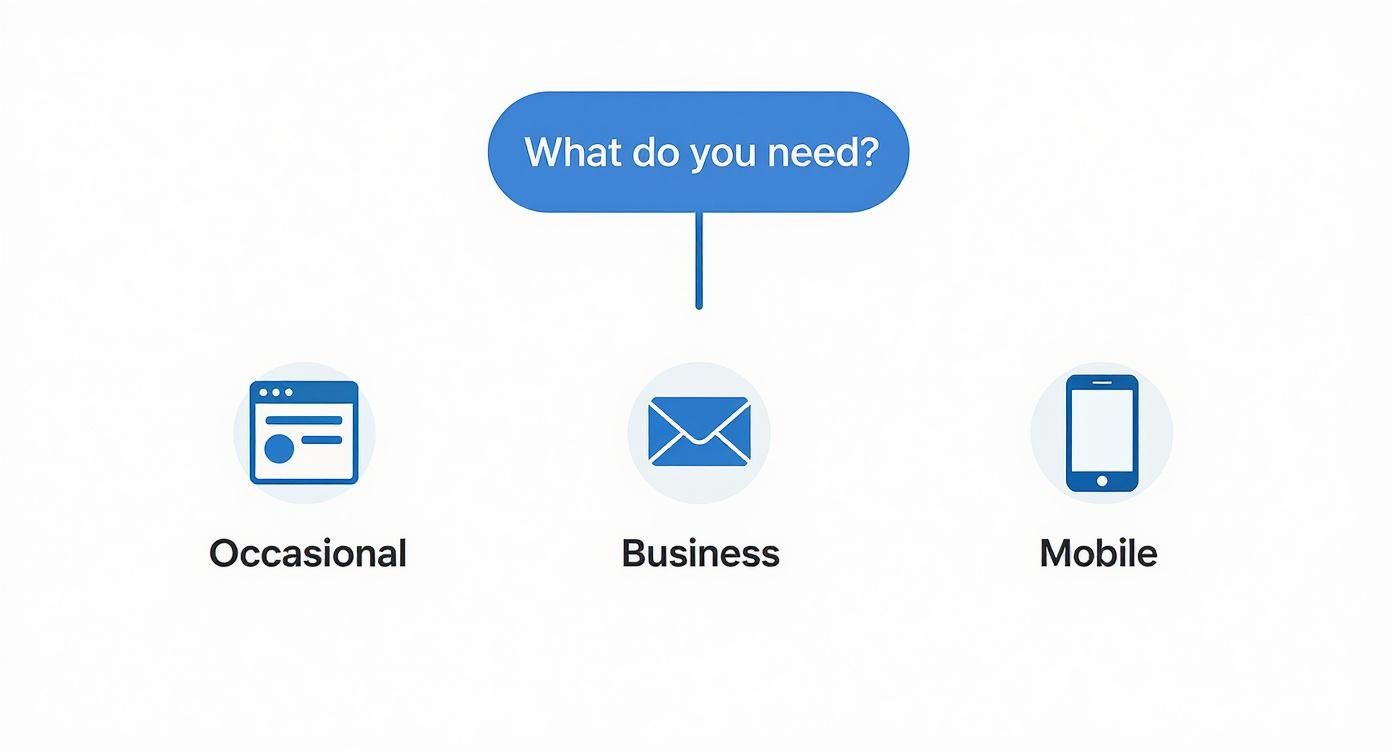
    • Seriously Better Security: Digital faxes are often far more secure than paper ones. Think about it: a traditional fax sits out in the open on a machine for anyone to see. Top online services use strong encryption, sending your documents directly and privately to the intended recipient's inbox or a secure portal.
    • Major Cost Savings: Ditching the machine means you stop paying for paper, ink, toner, maintenance, and that extra phone line. Most online fax services offer flexible plans, including pay-as-you-go options that are perfect if you only fax once in a blue moon.
    • Effortless Organization: Faxes arrive as neat PDF files in your email or an online dashboard. This makes them incredibly easy to save, search for later, and integrate into your existing digital filing system. No more overflowing filing cabinets.

    The Driving Force Behind Digital Fax Adoption

    The move to online faxing isn't just a niche trend; it's a global phenomenon. The market for these services hit USD 4.70 billion in 2022 and is on track to reach an incredible USD 12.32 billion by 2030. What's fueling this growth? Industries like healthcare, law, and finance, where faxing is still a non-negotiable part of compliance for handling sensitive information.

    According to an in-depth online fax market analysis, North America is leading the charge, showing a clear demand for more efficient ways to handle official documents.

    The core reason for this shift is simple: digital faxing retains the legal and procedural weight of a traditional fax while adding the security and flexibility modern work demands. It’s the best of both worlds.

    Modern Faxing vs Traditional Faxing At a Glance

    If you're still on the fence, this quick comparison makes the advantages of going digital crystal clear. The differences in day-to-day use are night and day.

    Feature Modern Faxing (Online/App) Traditional Fax Machine
    Accessibility Send/receive from anywhere Requires physical machine access
    Hardware None required Dedicated machine and phone line
    Cost Low subscription or pay-per-use High (machine, toner, paper, line)
    Security Encrypted and private delivery Documents sit in a public tray
    Organization Digital, searchable PDF archives Bulky paper files
    Speed Instantaneous digital sending Prone to busy signals and slow scans

    When you see it laid out like this, it’s easy to understand why so many businesses and individuals have already made the switch. Modern faxing just makes more sense.

    Digital Faxing Methods That Actually Work

    Alright, now that we've covered why ditching that old machine is a smart move, let's get down to the "how." Sending a fax without a physical fax machine isn't some complex technical puzzle; it's surprisingly simple once you know the modern-day options. The three go-to methods I see people use most successfully are online fax services, email-to-fax, and mobile faxing apps.

    Each one has a slightly different feel and is better suited for certain situations. Let’s walk through them with some real-world examples so you can feel confident sending your next document.

    Using Online Fax Services

    Think of an online fax service as your personal, digital fax concierge. Instead of wrestling with paper jams and busy signals, you just visit a website, upload your file, pop in the recipient's fax number, and click send. It's the most popular way to fax without a fax machine, and for good reason—it’s intuitive and there's zero technical setup on your end.

    Let's imagine you need to send a signed rental agreement to a property management company that still relies on fax.

    • Head to the Website: You'd start by pulling up a web-based faxing platform. Services like SendItFax, for instance, let you send a fax right from your browser without signing up for an account, which is a lifesaver for one-off needs.
    • Upload Your Document: Look for a clear button like "Upload File" or "Select Document." You'd click that and choose the signed rental agreement you've already scanned and saved as a PDF.
    • Fill in the Blanks: Next, you'll type in your details and the property manager's fax number. Most services give you a spot for a cover sheet message. This is where you'd add a quick note like, "Signed rental agreement for Unit 4B, as requested."
    • Send and Get Confirmation: Give everything a quick once-over, then hit the "Send Fax" button. The service does the heavy lifting, translating your PDF into a format a traditional fax machine can read and then dialing the number. A few minutes later, an email confirmation lands in your inbox, proving it was delivered.

    The whole thing takes maybe two minutes, and you get a digital receipt for your records. Try getting that from a dusty machine in the corner.

    Sending a Fax Directly From Your Email

    What if you could send a fax as easily as you fire off an email? That’s the entire idea behind email-to-fax. This feature, offered by most online fax providers, is brilliant for anyone who lives in their email inbox all day.

    The secret sauce is how you format the recipient’s address. It's not a normal email; instead, you combine the fax number with the service's special domain name.

    Key Insight: The email "To:" field essentially becomes a command line. For example, to send a fax to 1-800-555-0199, you might address your email to 18005550199@faxservice.com. The exact domain (@faxservice.com) will be provided by your chosen faxing service.

    Picture this: you're an accountant who needs to securely fax a client's tax form.

    You’d just compose a new email in Gmail or Outlook. In the "To:" field, you'd type the client's 10-digit fax number followed by the service’s domain (e.g., 12128675309@senditfax.net). Then, you attach the tax form PDF just like any other file. The email's subject line automatically becomes the cover sheet's subject, and the body of your email fills out the notes.

    Once you click send, the service's system snags the email, converts the attachment, and sends it on its way. The person on the other end gets a normal-looking fax, completely unaware you sent it from the comfort of your inbox.

    Leveraging Mobile Fax Apps

    In a world where our phones are our command centers, of course, there's an app for faxing. Mobile fax apps are built for those on-the-go moments, effectively turning your smartphone’s camera into a high-powered scanner and fax machine.

    This is the perfect solution when you're holding a physical piece of paper and have no scanner or computer in sight.

    Real-World Scenario: Submitting a Medical Reimbursement Form

    You’ve just left a doctor's office with a signed reimbursement form. Your insurance company, citing compliance rules, insists it must be faxed.

    • Open the App and Snap a Picture: You'd launch a fax app and use its built-in scanner. Just place the form on a flat, well-lit surface and capture a photo.
    • Tidy Up the Image: The app will instantly convert the photo into a clean, black-and-white document. You can easily crop the edges and adjust the contrast to make sure every word is crystal clear.
    • Enter the Details and Send: Just like the web service, you'll plug in the insurance company's fax number and maybe add a quick cover note. A single tap on "send" is all it takes. The app handles the rest and sends you a push notification the moment it's successfully delivered.

    It's an incredibly slick way to turn physical paperwork into a securely transmitted fax in just a few minutes.

    How to Choose the Right Online Fax Service

    With so many ways to fax without a physical machine, picking the right online service can feel like a shot in the dark. The trick is to tune out the marketing noise and zero in on what actually matters for you. A freelancer who just needs to send a single signed contract has a completely different set of needs than a medical office managing a steady stream of patient files.

    The best choice isn't always the cheapest one; it's about finding the perfect match for your faxing habits, security requirements, and budget. Get it right, and you'll have a tool that's both effective and secure.

    This quick visual guide can help you figure out where to start.

    Infographic about fax without fax machine

    As you can see, thinking about how you'll use the service—occasionally, for business, or mainly on your phone—is the best first step to narrowing things down.

    Assess Your Faxing Volume and Frequency

    First things first, ask yourself: "How often will I really send a fax?" Your answer is the single biggest clue to finding the right plan. There's no sense in paying for a hefty monthly subscription if you only fax a document once in a blue moon.

    • Occasional Users: If you're sending a signed form once or twice a year, a pay-per-use service is your best friend. These let you send a fax for a small, one-time fee with zero monthly commitment. It’s the most economical route for sporadic faxing.
    • Regular Senders: For small businesses or professionals sending several faxes a month, a basic monthly subscription makes more sense. These plans typically give you a set number of pages (say, 150 pages/month) for a flat fee, which is far cheaper than paying per fax.
    • High-Volume Organizations: A busy clinic, law firm, or larger company handling hundreds of pages needs a business or enterprise plan. These come with high page limits, accounts for multiple users, and advanced tools for managing everything.

    Prioritize Security and Compliance

    When you’re faxing sensitive information, security isn't just a feature—it's everything. This is especially true in fields like healthcare, finance, and law, where protecting data is a legal requirement.

    Think about it: a traditional fax machine leaves sensitive documents sitting out in the open for anyone to see. The right online fax service, on the other hand, can offer vastly superior protection. Look for providers that are explicitly HIPAA compliant for medical records and use strong encryption (like SSL/TLS during transfer and AES-256 for storage) to keep your data under lock and key.

    Choosing a service with strong security isn't just about ticking a box; it's a critical safeguard. Your confidential documents land directly in a secure inbox, completely bypassing the risk of being picked up by the wrong person at a shared office fax machine.

    The global fax services market was valued at USD 3.31 billion in 2024 and continues to grow precisely because of its role in secure communication for regulated industries. Sectors like healthcare rely heavily on HIPAA-compliant digital faxing, which has helped make North America a dominant market. This tells you just how important it is to pick a service that meets these high security benchmarks. You can find more details on these trends in this detailed industry report.

    Evaluate Usability and Essential Features

    At the end of the day, the best service is one you don't have to fight with. A clunky, confusing interface can turn a simple two-minute task into a twenty-minute ordeal. Most reputable companies offer a free trial, which is the perfect way to take the platform for a test drive before you sign up.

    As you poke around during your trial, keep an eye out for these must-have features.

    A good online fax service should offer a blend of features that cater to different needs, from one-off sends to full business integration. The table below breaks down what you can typically expect from different plan levels.

    Comparing Online Fax Service Features

    Feature Pay-Per-Use Service Basic Monthly Plan Business Plan
    Pricing Model One-time fee per fax Flat monthly fee Higher monthly fee with tiered pricing
    Included Pages None (pay per page) A set number (e.g., 150-300 pages) High volume (e.g., 1,000+ pages)
    Dedicated Fax Number Usually not included Yes, local or toll-free Yes, multiple numbers, toll-free, and vanity numbers
    User Accounts Single user only Typically one user Multiple users with admin controls
    Mobile App Access Limited or none Yes, full-featured Yes, with advanced features
    Security Basic encryption Enhanced encryption (e.g., SSL/TLS) HIPAA compliance, advanced encryption, detailed audit trails
    International Faxing Available, higher per-page rate Often included with specific country rates Preferred rates, broader country support
    API/Integrations Not available Limited or none Yes, for integration with EMR, CRM, and other software

    This comparison makes it clear that your choice really depends on the scale of your needs. For a quick, one-off task, pay-per-use is perfect. But as soon as faxing becomes a regular part of your workflow, a subscription plan offers far more value and functionality.

    While you're testing, also check for these practical features:

    • File Format Support: Can it handle the files you use most, like PDF, DOCX, and JPG?
    • Mobile Access: Is there a clean, functional mobile app for sending documents when you're not at your desk?
    • Confirmation Receipts: Does the service provide detailed confirmation pages that can serve as proof of transmission? This is non-negotiable.
    • International Faxing: If you send faxes abroad, make sure the service supports it and that you understand the costs involved.

    By thoughtfully weighing your volume, security needs, and the overall user experience, you can pick an online fax service that fits like a glove. For more practical advice on modernizing business communications, see what other experts on our team have to say, like in these articles by Eric Dubs.

    Getting Your Documents Ready for a Perfect Send

    Sending a fax without an actual fax machine is a game-changer, but a successful transmission isn't just about picking the right service. The real secret to making sure your documents arrive looking crisp and professional lies in how you prepare them beforehand. Think of it this way: skipping these prep steps is like trying to send a blurry, crumpled letter through the mail. It just won't make a good impression.

    A person at a desk reviewing documents on a computer, preparing them for digital faxing.

    Taking just a couple of minutes to optimize your files and double-check the details can save you from the headache of a failed transmission, unreadable text, or worse—sending confidential info to the wrong number. Let’s walk through the essentials.

    Pick the Right File Format

    When you upload a document to an online fax service, it has to be converted into a language that old-school fax machines can understand. This is where file compatibility really matters. While most platforms are pretty flexible, one format consistently delivers the best results.

    PDF is your best friend here. It's a universal standard that locks in all your formatting, fonts, and images. That means what you see on your computer screen is exactly what the recipient will get. Using other formats like a Word doc (DOCX) or a picture file (JPG) can sometimes cause weird layout shifts or text wrapping issues during the conversion process.

    What if you have a physical piece of paper? Don't just snap a quick, shadowy photo with your phone. To get a clean digital copy:

    • Use a Scanner App: Mobile apps like Adobe Scan or Microsoft Office Lens are fantastic. They’re designed to turn a phone picture into a high-contrast, black-and-white PDF that looks like it came from a proper scanner.
    • Find Good Light: Lay your document on a flat, dark surface in a well-lit room. This simple trick eliminates the shadows that can make text hard to read.
    • Watch the File Size: Most services have an upload limit, usually around 20-25 MB. If your file is too big, just use a free online tool to compress the PDF before you send it.

    Don't Skip the Cover Sheet

    A cover sheet is basically your fax's professional handshake. It instantly tells the recipient who sent the fax, who it's for, and what it's about. It's also your safety net, providing contact info in case something goes wrong.

    Think of a cover sheet as the subject line and introduction of an email, all rolled into one. It provides crucial context and stops your important document from getting lost in a shuffle of papers on the other end.

    Make sure your cover sheet includes these key details:

    • To: Recipient's Name and Company
    • From: Your Name and Company
    • Date: Today's date
    • Fax Number: The recipient’s fax number
    • Pages: The total page count, including the cover sheet itself (e.g., "Page 1 of 5")
    • Subject/RE: A quick, clear description of what's inside

    The good news is that most online fax services generate a cover sheet for you automatically. You just fill in the blanks. Some even let you check out different templates and layouts, like this sample page, to see how it all looks.

    Double-Check Security and Details

    This is, without a doubt, the most important step, especially when you’re handling things like contracts, medical records, or financial data. Sending faxes digitally can be incredibly secure, but you have to be proactive.

    First, make sure the service you’re using offers end-to-end encryption. This technology scrambles your data from the moment you hit "send" until it arrives at the destination, making it unreadable to anyone trying to intercept it.

    Second—and I can't stress this enough—triple-check the recipient's fax number. A single wrong digit could send your private information to a complete stranger. Before you click send, confirm the number on a business card, in an email signature, or on their official website. If it’s really sensitive, a quick phone call to confirm is a small price to pay for peace of mind.

    Solving Common Digital Faxing Problems

    Even when you fax without a fax machine, things don’t always go perfectly. It's easy to get frustrated when a "failed transmission" error pops up or someone calls to say your document is unreadable. But don't worry—these issues are almost always simple to fix.

    Think of yourself as a digital detective. Most problems come down to a handful of common culprits, like a shaky internet connection or a simple typo in the fax number. Let's dig into the most frequent headaches and get them sorted out.

    Decoding the Failed Transmission Error

    That "failed transmission" notification is probably the most common issue you'll run into. It’s the digital version of a busy signal, but the cause can be a bit more mysterious. Instead of just hitting resend and hoping for the best, a little quick investigation will save you a lot of time.

    First things first: double-check the recipient's fax number. Seriously. A single wrong digit is the number one reason faxes fail. Find the number on an official website or in an email signature to be sure.

    Next, think about what might be happening on the other end. Is their fax machine off, out of paper, or tied up with another incoming fax? Sometimes the best move is to simply wait 10-15 minutes and try again.

    Also, take a look at your file size. Many services cap uploads at around 20 MB. If you have a massive, high-resolution scan, it might be timing out. Try using a free online tool to compress the PDF before sending it again. This one small step solves the problem more often than you'd think.

    Why Your Fax Arrived Blurry or Unreadable

    There's nothing worse than sending an important document, only to hear it arrived as a garbled, blurry mess. This problem almost never has to do with the fax service itself; it’s all about the quality of the file you uploaded.

    Remember, fax technology is old-school. It transmits in black and white at a pretty low resolution (around 200 dpi). A color photograph or a document with a gray background just isn't going to look good on the other end.

    To make sure your faxes arrive looking sharp:

    • Start with a High-Quality Scan: Use a scanner app on your phone that creates crisp, black-and-white PDFs. Don't just snap a quick photo of a document in a dimly lit room.
    • Use Simple Fonts: Stick to clean, standard fonts like Arial or Times New Roman. Anything too fancy or tiny can become illegible after transmission.
    • Boost the Contrast: Before you send, make sure your document is just sharp black text on a clean white background. This is the key to readability.

    The core principle is to prepare your document for a low-tech destination. By optimizing for black-and-white and high contrast, you ensure your digital file survives the journey back to an analog world without losing quality.

    Addressing Unexpected Delays

    You sent a fax an hour ago, but the recipient still hasn't seen it. What gives? Delays can happen for a few reasons, from network congestion with your provider to a problem with the receiving machine. Your best troubleshooting tool is the transmission report.

    Check the report for the fax's status. If it says "Pending" or "In Progress," a little patience is usually all that's needed. But if it's been stuck for over 30 minutes, it might be time to cancel and resend. If it keeps happening, a quick message to your service provider's support team can tell you if there’s a wider network issue.

    The move toward digital faxing is a huge part of how modern businesses operate, and it's not slowing down. While the global market for fax machines was valued at around USD 569.54 million in 2024, its projected growth is actually driven by multifunction printers and online fax services, not standalone machines. Industries like healthcare still rely heavily on faxing but are rapidly switching to cloud-based platforms. You can read more about the evolution of the fax market to get a better sense of these industry shifts.

    Common Questions About Faxing in the Modern Age

    Even after you've found a way to send a fax without a dusty old machine, some questions usually pop up. Moving from hardware to a digital service is a change, and it's smart to make sure you're handling your documents correctly. Let's tackle some of the most common questions I hear from people making the switch.

    Are Faxes Sent Online Actually Legally Binding?

    Yes, they are. For almost any situation you'll encounter, a fax sent from a reputable online service carries the same legal weight as one from a traditional machine. What matters in a legal context isn't the machine itself, but the proof that the document was successfully sent and received.

    This is actually an area where online fax services have a serious edge. They automatically generate detailed confirmation reports for every single fax. These digital receipts are gold, typically including:

    • The exact date and time of transmission.
    • The total number of pages that went through.
    • The recipient's fax number.
    • A clear status confirming successful delivery.

    Honestly, this digital paper trail is far more reliable and easier to archive than the flimsy thermal paper receipt you'd get from an old machine. For contracts and official notices, that level of verification is exactly what you need. That said, for super-sensitive legal filings, it never hurts to double-check the recipient's preferred delivery method first.

    Can I Get Faxes Sent to Me Without a Fax Machine?

    You sure can. Receiving faxes digitally is just as straightforward as sending them. When you sign up for an online fax service (even some free ones), you're given your own dedicated fax number. You can usually choose a new local or toll-free number, and some providers will even help you transfer an existing fax number you already use.

    The process is seamless.

    1. Someone sends a document to your new fax number from their machine.
    2. The online fax service's servers catch the transmission.
    3. The service instantly converts that fax into a PDF.
    4. Finally, that PDF lands right in your email inbox or a secure online account.

    It's a game-changer. Suddenly, you can check your faxes from your phone on your lunch break or from your laptop at home. You're completely free from a physical office, not to mention the costs of paper, ink, and toner.

    How Secure Is Sending Sensitive Information This Way?

    This is a big one, and the answer might surprise you: online faxing is often significantly more secure than using a traditional machine. Think about it—a fax sent to a typical office machine sits out in the open on a tray, where anyone can walk by, see it, or even pick it up by mistake.

    Good online fax services completely remove that physical risk. They build their platforms around protecting your data both in transit and at rest.

    When you're choosing a service, the single most important security feature to look for is end-to-end encryption. This scrambles your document the moment you send it and keeps it that way until it reaches the provider's servers, making it gibberish to anyone trying to intercept it.

    If you're handling things like medical records or financial documents, you should also look for services that are compliant with regulations like HIPAA. This ensures your sensitive files are delivered directly to your password-protected inbox, providing a level of privacy that a shared office machine could never hope to match.

    What if I Only Need to Send a Single Fax?

    No problem at all. You definitely don't need to sign up for a monthly subscription if you just have a one-off document to send. The digital faxing world is built to be flexible.

    Plenty of online fax services and mobile apps offer a pay-per-fax option. You just pay a small, one-time fee to send your document and you're done—no strings attached. Some platforms also have a limited free trial, which is perfect for sending a quick, non-urgent fax.

    And if you'd rather handle it in person, you can always head to a public faxing location. Places like FedEx Office or The UPS Store have fax machines available for public use. You just pay a small fee per page. It's a simple, old-school solution for those who only need to fax once in a blue moon.


    Ready to send a fax right now without signing up for an account? With SendItFax, you can send your document securely from your browser in minutes. For quick, reliable, and straightforward faxing, give our service a try.