You can go months with a clean Linux workflow, then one signed form for a bank, clinic, law office, or government office forces fax back into the picture. That usually happens at the worst time. Someone needs a document sent today, and now you have to decide whether to build around Linux-native fax tools or use a browser-based service that gets the job done without telecom work.
Faxing is still tied to industries that care about paper trails, signatures, retention, and predictable delivery. As noted in FaxAuthority's Linux fax overview, HylaFAX and HylaFAX+ remain part of a U.S. fax ecosystem that still sees heavy use, especially in healthcare. For Linux teams, the core question is not whether fax is modern. It is how much control you need, and what you are willing to maintain.
I've seen both paths make sense.
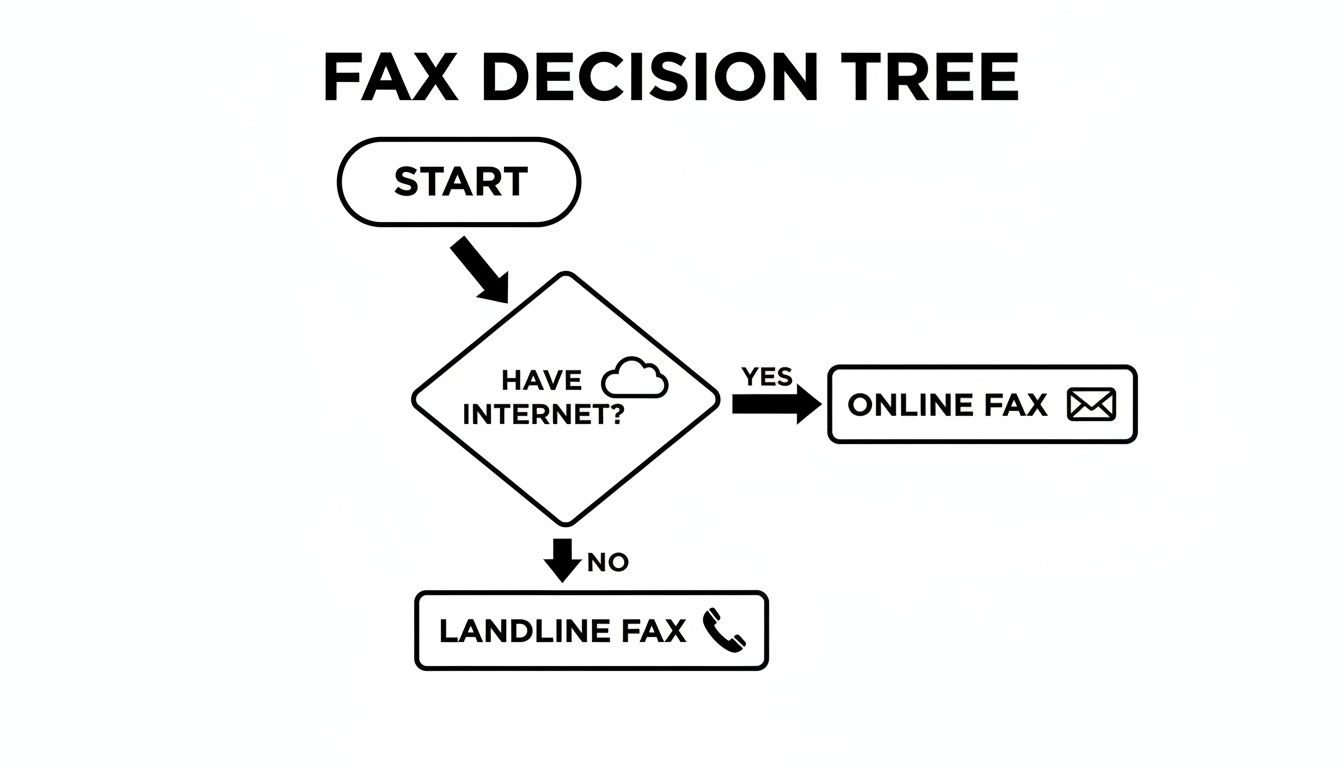
Self-hosted Linux fax software fits teams that already run servers, want local control over routing and retention, and have someone who can handle modem compatibility, SIP trunks, or T.38 troubleshooting. Cloud fax services fit teams that care more about fast deployment, shared inboxes, and avoiding the support burden of fax hardware and telecom tuning. One gives you deeper control. The other saves time and operational overhead.
That split matters in this guide. It separates native Linux options from browser-based services so you can choose based on admin skill, security requirements, and total cost, not just feature lists. If you are still weighing lightweight tools against hosted services, it also helps to review other freeware internet fax software options before you commit to a setup.
The tools below cover both camps, because Linux users often need both perspectives before they can make the right call.
1. HylaFAX+

A compliance team needs inbound faxes routed to the right mailbox, outbound jobs queued after business hours, and copies retained on systems they control. That is the kind of job HylaFAX+ handles well. It is still one of the clearest examples of true self-hosted fax software for Linux, and it makes sense for organizations that want the fax server inside their own environment instead of inside a vendor portal.
I recommend HylaFAX+ to teams that already think like system administrators. You run the service, define routing rules, manage job queues, and connect it to the telephony layer you trust. That can mean analog hardware, IAXmodem, or a FoIP design built around a SIP or T.38 gateway. The upside is control over retention, logging, and workflow integration. The cost is that your team owns setup and support.
Where HylaFAX+ earns the effort
HylaFAX+ fits best in environments where fax is part of an internal process, not just a one-off send button.
- Best fit: Offices that need local control, fixed routing rules, and integration with existing Linux systems.
- Strong points: Queue management, scheduled delivery, shared server use, and support for larger on-prem deployments.
- Real pain points: Modem support, ATA quality, T.38 behavior, SIP timing, and packet loss problems that show up as failed faxes.
I have seen HylaFAX+ run for years with very few surprises once the telecom side was stable. I have also seen admins blame HylaFAX+ for issues caused by poor ATAs and marginal VoIP links. Fax over IP still punishes weak infrastructure.
That is the main trade-off in this guide's self-hosted versus cloud split. HylaFAX+ gives you far more control than a browser service, but it also asks for Linux skills and telecom patience. If your team wants shared access without maintaining fax hardware or troubleshooting trunks, it may be smarter to send faxes from the web with a hosted service instead of building around HylaFAX+.
If you do want the self-hosted route, HylaFAX+ remains a serious option. The official project site is HylaFAX+.
2. efax-gtk

efax-gtk is what I recommend when someone says, “I don't need a server. I just need my Linux machine to send a fax without turning this into a weekend project.” It's a native GTK front-end around the classic efax engine, and that matters because it feels like Linux desktop software instead of a browser tab pretending to be a workstation app.
Its appeal is simple. You get a GUI for sending and receiving, a virtual printer path for faxing from Linux applications, and basic management for received documents. For occasional modem-based faxing, that's enough.
The trade-off nobody should ignore
efax-gtk is only as good as the line and modem behind it. This category of fax software for Linux still expects real telephony in the background.
- Native advantage: You can print to fax from desktop apps and keep the workflow local.
- Operational limit: You still need a compatible modem and a workable analog line or adapter.
- Reliability issue: There's no built-in FoIP stack doing the heavy lifting for you, so setup quality shows up in every failed transmission.
I like efax-gtk for small offices, back desks, and one-person workflows where a USB modem and local control still make sense. I don't like it for teams that need central management, shared inbound routing, or modern audit needs. At that point, either move up to a server platform or go cloud.
A lightweight native app beats a cloud subscription only when the phone side is stable. If the telephony side is shaky, the GUI won't save you.
For people who decide the browser route is simpler after all, this guide on how to send a fax from the web is the practical alternative. The project website is efax-gtk.
3. ICTFax

A common breaking point shows up after the first few shared fax accounts. One team needs a web portal, another needs inbound routing by DID, someone asks for email-to-fax, and suddenly a simple Linux fax setup turns into a service delivery problem. ICTFax is built for that stage.
It is still a self-hosted Linux fax platform, but the operating model is closer to an internal service or customer-facing fax system than a classic fax daemon. That distinction matters. If HylaFAX+ fits admins who want to assemble the stack themselves, ICTFax fits teams that want multi-user access, web management, API hooks, and tenant separation as part of the product.
That makes it a serious option for MSPs, telecom providers, larger internal IT teams, and businesses that expect fax to plug into business workflows instead of living on one server for one department.
Where ICTFax makes sense
The practical advantage is scope. ICTFax covers the pieces that often get bolted onto older Linux fax setups later: browser access, account separation, inbound and outbound handling, API support, and FoIP support such as T.38 and G.711. For the right shop, that saves a lot of custom glue code and admin work.
The trade-off is just as real. You still own the platform. That means telecom interoperability, system updates, web app hardening, authentication, backups, alerting, and user support all stay on your side. A self-hosted portal is more capable than a desktop fax client, but it also gives you more ways to break production if you treat it like a small side project.
- Best fit: Shared fax environments, internal portals, branded fax services, or API-driven document workflows
- Main advantage: Web access and tenant-aware administration without building those layers from scratch
- Main cost: More infrastructure and security responsibility than a simple Linux fax tool
- Poor fit: Small offices that only send a handful of faxes each month
I usually put ICTFax in the short list when the requirement is clear from day one: multiple users, separate accounts, browser-based access, and some level of automation. If the aim is just reliable faxing without running another service stack, it is usually smarter to compare browser-based online fax software for Linux-friendly teams before committing to self-hosting.
The official site is ICTFax.
4. FAX.PLUS

FAX.PLUS is what I'd call the cleanest off-ramp from self-hosted complexity. Open it in a Linux browser, upload the file, assign users and numbers if needed, and you're done. No modem hunt. No ATA argument. No wondering whether your SIP provider treats fax like a first-class workload or an annoying compatibility chore.
That matters because most Linux users who need fax software for Linux don't need local telephony. They need outcome, not infrastructure.
Best for teams that want less plumbing
FAX.PLUS is polished in the places cloud fax should be polished. The web app is easy to hand to non-technical users. Email-to-fax is there. Mobile apps exist for mixed-device teams. API access and team management make it suitable beyond solo use.
The compliance angle also matters for some buyers. The Enterprise tier offers HIPAA support with a signed BAA, which puts it on the shortlist for U.S. organizations that need a browser-first workflow but still care about regulated document handling.
Buying lens: If your users live in browsers and your IT team is small, cloud fax usually wins before the comparison even starts.
I also like that pricing and plan comparison are presented clearly enough that you can estimate fit without a sales call for basic use. The downside is common across SaaS fax platforms. Lower tiers tend to have tighter sending limits, and the best compliance features are pushed upmarket.
If you're comparing several browser-first options, this roundup of the best online fax software is worth skimming. The service itself is FAX.PLUS.
5. SRFax

SRFax has a very specific kind of appeal. It doesn't try to feel like a startup app. It feels like a service built for organizations that still fax every day and care more about dependable healthcare workflows than interface style.
That's why it comes up often in U.S. and Canadian clinical settings, pharmacies, and smaller practices. Linux users don't need native software to use it. A browser and email access are enough.
Where SRFax makes sense
The service offers healthcare-oriented plans, BAA support, web access, email-to-fax, APIs, multiple users, and number management. For offices that receive a lot of inbound faxes and need retention and routing, that combination is practical.
The interface is functional rather than elegant. I don't consider that a dealbreaker in this category. In faxing, “boring but dependable” is often the better trait.
- Good fit: Small and midsize healthcare or legal teams that want compliance-oriented cloud fax without building anything in-house.
- Potential friction: The product lineup can take a little time to decode because there are many plan variations.
- Workflow strength: Shared access, storage, and established North American coverage.
I usually steer people toward SRFax when they care less about modern UI and more about service fit, support expectations, and healthcare readiness. For many offices, that's the right priority order. The website is SRFax.
6. eFax

eFax is one of the brands people already know before they start shopping. That doesn't automatically make it the best choice, but it does make it one of the easiest services to explain to non-technical stakeholders. If someone in finance, legal, or operations asks for a recognizable vendor with browser access and business tiers, eFax usually makes the shortlist quickly.
For Linux users, the model is straightforward. You use the browser interface, email workflows, and admin features. There's no platform penalty for running Linux on the desktop.
The main reason to consider eFax
Scale and familiarity. eFax covers casual use through larger corporate deployments, and its enterprise side includes API and compliance options that matter to bigger organizations. That broad availability is useful when the purchase decision involves procurement, security review, and several departments with different needs.
There are trade-offs. Entry-level pricing can feel high compared with smaller competitors, and support experiences tend to vary. That's common with large legacy brands. You're buying reach and recognition, not necessarily the simplest SMB value.
Large fax vendors are easiest to approve internally. They're not always the easiest to love day to day.
I'd treat eFax as a safer enterprise procurement choice than a default recommendation for small Linux shops. If the organization wants a known name, documented admin controls, and the option to scale without switching platforms, it fits. If the goal is best value or simplest occasional use, there are leaner options. The service is eFax.
7. Documo

Documo is one of the few cloud fax products that feels like it was built with developers and workflow owners in the room. If your Linux environment already automates document handling, webhook delivery, account provisioning, or downstream processing, Documo deserves a serious look.
This isn't the service I'd hand to someone who just wants to send a PDF once a month. It's the service I'd evaluate when fax is part of a larger operational pipeline.
Better for automation than casual use
Documo emphasizes API access, number provisioning, webhooks, enterprise admin controls, and intelligent document processing features. That makes it attractive when teams want to build fax into internal systems rather than making staff live in a web portal all day.
It also offers HIPAA-oriented positioning, SSO, and broader enterprise controls. Those are useful, but the practical question is whether you'll use them. If your workflow is mostly manual, you may pay for sophistication you won't touch.
- Strongest angle: API-first automation and admin depth.
- Less ideal for: Very small offices or occasional senders who don't need integration.
- Operational upside: Easier to connect fax traffic with app workflows, notifications, and structured back-office processing.
I like Documo when the Linux team already thinks in terms of systems integration. In those environments, browser access is only part of the story. The API is the product. The website is Documo.
8. FAXAGE

FAXAGE is one of the more practical picks for small businesses that want cloud fax without paying for cosmetic extras. It doesn't try to impress you with design. It tries to give you web faxing, email faxing, API access, and workable billing.
That makes it a good value candidate for Linux users who don't need native desktop software and don't want to run their own fax stack.
Why budget-conscious teams like it
The service includes multiple sending methods and exposes API capability across plans, which is a smart choice. A lot of smaller services treat API access like a premium feature when it should really be part of the utility.
Its HIPAA guidance and BAA availability on request will matter to some U.S. buyers. The bigger consideration is the billing model. Per-minute charging can be a bargain if your document mix is predictable, but it's less intuitive than per-page pricing for teams that want clean monthly forecasting.
- Best fit: Small businesses and lean IT teams that want low-friction internet fax with API access.
- Not ideal for: Buyers who want the slickest interface or the simplest pricing model to explain internally.
- Real strength: Utility over polish.
FAXAGE is the kind of tool admins often appreciate more after a month than on first impression. It looks plain, but plain tools that do the job consistently tend to last. The service is FAXAGE.
9. SendItFax

A familiar Linux admin problem. Someone needs a signed form faxed in the next ten minutes, but there is no reason to stand up HylaFAX, provision a DID, or buy a monthly plan for a task that may not come up again until next quarter. SendItFax serves that narrow use case well.
It is a browser-based send service, not Linux software in the native sense. That distinction matters in this guide. If you want local control, inbound routing, or a fax workflow you can tie into mail servers and document systems, look at the self-hosted tools earlier in the list. If the job is "send this PDF now from a Linux browser," a lightweight cloud service is often the better fit.
Best for occasional outbound faxing
SendItFax accepts common document formats and focuses on outbound delivery to U.S. and Canada numbers. The free tier is limited, and the paid option is priced per fax rather than as a recurring subscription, according to SendItFax. That pricing model makes sense for low-volume use and falls apart quickly if a team starts faxing every week.
I would treat it as a convenience tool for edge cases. Signed authorizations, school forms, intake paperwork, and one-off legal documents fit. Departmental faxing, shared access, inbound numbers, and compliance-heavy workflows do not.
The trade-off is straightforward. You avoid setup and ongoing cost, but you also give up the features that make fax manageable at business scale. There is no real platform here for queueing, retention policy, user management, or system integration.
For Linux users, that still has value. Sometimes the right answer is not more infrastructure. It is the smallest service that gets a document out the door.
10. FaxZero

FaxZero belongs in this list for the same reason simple shell tools belong in a Linux toolbox. It does one job, and for the right situation, that's enough. If you need to send a small fax from a Linux browser without creating an account, FaxZero is still one of the fastest options to evaluate.
The workflow is simple, and that simplicity is the product.
Where FaxZero is useful
It supports free outbound faxes to U.S. and Canada with branding on the cover page, plus a paid option with higher limits and no branding. You upload the document in the browser, fill in sender and recipient details, and send.
The key is to use it for what it is.
- Good use case: One-time outbound faxing when speed matters more than long-term workflow.
- Bad use case: Receiving faxes, managing a team, or building repeatable business operations.
- Expected compromise: Free sends come with branding and lower priority.
I put FaxZero in the same category as SendItFax rather than in competition with full-service cloud fax platforms. These are convenience tools, not communications systems. If that's the problem you need solved, they're efficient. If you need continuity, compliance controls, or internal routing, they're the wrong class of product. The service is FaxZero.
Top 10 Linux Fax Software Comparison
| Solution | Key Features ✨ | UX / Reliability ★ | Price & Value 💰 | Target Audience 👥 | Unique Selling Point |
|---|---|---|---|---|---|
| HylaFAX+ | Self‑hosted fax server; analog & FoIP; queuing/scheduling ✨ | ★★★, powerful but admin‑heavy | 💰 Free (OSS) + infra/telecom costs | 👥 IT teams, regulated/on‑prem deployments | ✨ Full control; no vendor lock‑in |
| efax-gtk | GTK GUI + virtual printer; local modem send/receive ✨ | ★★★, lightweight, native experience | 💰 Free (OSS); requires modem/line | 👥 Occasional modem users, Linux desktops | ✨ Print‑to‑fax from any Linux app |
| ICTFax | Multi‑tenant web portal, REST API, FoIP & email‑fax ✨ | ★★★★, scalable but complex to operate | 💰 Community edition; infra/ops costs | 👥 MSPs, service providers, enterprises | ✨ Multi‑tenant + API for private platforms |
| FAX.PLUS (Alohi) | Web/email/mobile apps, REST API, team mgmt ✨ | ★★★★, polished cross‑platform UX | 💰 Tiered plans; Enterprise higher cost | 👥 SMBs → Enterprise; HIPAA users (Ent) | ✨ Mature API + Enterprise HIPAA option |
| SRFax | HIPAA/PHIPA plans, web/email, APIs, unlimited storage ✨ | ★★★★, reliable for healthcare workflows | 💰 Subscription with clear healthcare rates | 👥 Clinics, pharmacies, small practices | ✨ Healthcare‑focused compliance & support |
| eFax (Consensus) | Web/email/mobile, corp API, e‑signature & storage ✨ | ★★★★, ubiquitous; enterprise grade | 💰 Higher entry price; enterprise tiers | 👥 Large orgs, regulated enterprises | ✨ Broad enterprise compliance (HITRUST/BAA) |
| Documo (mFax) | REST API, OCR/IDP, HIPAA, SSO, Fax Bridge ✨ | ★★★★, developer & automation friendly | 💰 Volume/quote; enterprise pricing | 👥 Dev teams, high‑volume/automated workflows | ✨ Intelligent doc processing & automation |
| FAXAGE | Web/email/API, per‑minute billing, BAA on request ✨ | ★★★, utilitarian but cost‑efficient | 💰 Low‑cost; per‑minute model | 👥 Small US businesses, cost‑conscious IT | ✨ Transparent low pricing + API on all plans |
| SendItFax 🏆 | No account; upload DOC/DOCX/PDF; free 3 pages + cover; $1.99/fax up to 25 pages ✨ | ★★★★, instant, no signup; send‑only | 💰 Free limited tier; $1.99/fax (Almost Free) | 👥 Individuals & teams needing quick one‑offs | ✨ Fast, no‑signup browser faxing with low per‑fax cost |
| FaxZero | No‑account send‑only; free with cover branding; paid priority ✨ | ★★★, very simple; free lower‑priority sends | 💰 Free tier; paid priority (~$1.99/fax) | 👥 Casual one‑time senders | ✨ Extremely fast, no signup required |
Final Verdict: Integrating Fax into Your Linux Workflow
A Linux shop often reaches the fax decision at the worst possible moment. Legal needs a signed packet sent today, accounting needs inbound routing for vendor forms, or a clinic wants retention controls before go-live. That is when the difference between Linux fax software and a browser-based fax service stops being academic.
The split matters because these tools solve different operational problems. Self-hosted options fit teams that can maintain servers, troubleshoot telephony, and own the security model end to end. HylaFAX+ remains the right choice for admins who want low-level control and are comfortable supporting it over time. ICTFax is easier to hand to a larger team because it adds a web interface and multi-user workflows while keeping the system inside your environment.
efax-gtk belongs in a smaller box.
It still has value for a single desktop tied to known hardware, but I would not build a department workflow around it unless the use case is very stable and very limited. Modem support, local configuration, and user dependency can turn a simple setup into a support ticket generator.
For many businesses running Linux desktops and Linux-backed infrastructure, cloud fax services are the practical answer. They avoid the telecom setup, modem compatibility checks, and ongoing maintenance that make self-hosting expensive in staff time. FAX.PLUS works well for general business use. SRFax is a strong fit where healthcare compliance shapes the buying decision. eFax and Documo make more sense in larger environments with approval chains, integrations, or API-driven document handling. FAXAGE is worth a look if cost discipline matters more than a polished admin console.
One-off sending is its own category. A no-account tool can be the fastest fix for a contract, form, or last-minute document that does not justify provisioning a user or paying for another monthly seat. That convenience has limits, so it should stay a tactical option, not the default process for records-heavy teams.
My rule is simple. Choose self-hosted Linux fax software if you have the technical depth to support it and a clear reason to keep faxing inside your own stack. Choose a cloud service if uptime, shared access, and lower admin overhead matter more than infrastructure control. Choose a no-account sender only for occasional outbound faxing. If signatures are still slowing the process down, learn how to esign documents before the fax step becomes the blocker.