Tag: online fax services

  • Find the Best Online Fax Service for Small Business 2026

    Find the Best Online Fax Service for Small Business 2026

    It’s 2026. A client is ready to sign, a clinic needs records today, or a government office will only accept the form by fax. That request usually arrives after the office fax machine is gone, the phone line has been canceled, and nobody wants to troubleshoot toner, paper jams, or a dedicated device for a task that comes up a few times a month.

    That is why online fax still has a place in small business operations. It handles the same practical jobs. Signed agreements, intake forms, insurance paperwork, medical records, lender requests, and compliance-driven document exchange. The difference is that you can send from a browser or mobile app, upload a PDF or DOC file, and keep the process tied to the tools your team already uses.

    The harder part now is choosing the right service for the way your business works.

    A law office that sends sensitive documents every day needs a very different setup from a contractor who faxes three times a quarter. A medical practice may care most about HIPAA-ready workflows and audit controls. A two-person firm may just want a no-account, pay-as-you-go option for the rare moment fax is unavoidable. That last category matters more than many reviews admit, and it is one reason SendItFax stands out in this guide.

    This article is built around those real use cases, not a generic feature checklist. Each service is matched to a business need such as occasional use, team-based faxing, healthcare compliance, admin control, or integration depth. There is also a decision framework later in the guide to help you choose based on fax volume, security requirements, shared access, and budget, so you do not end up paying for a plan built for a larger team than yours.

    1. SendItFax

    SendItFax

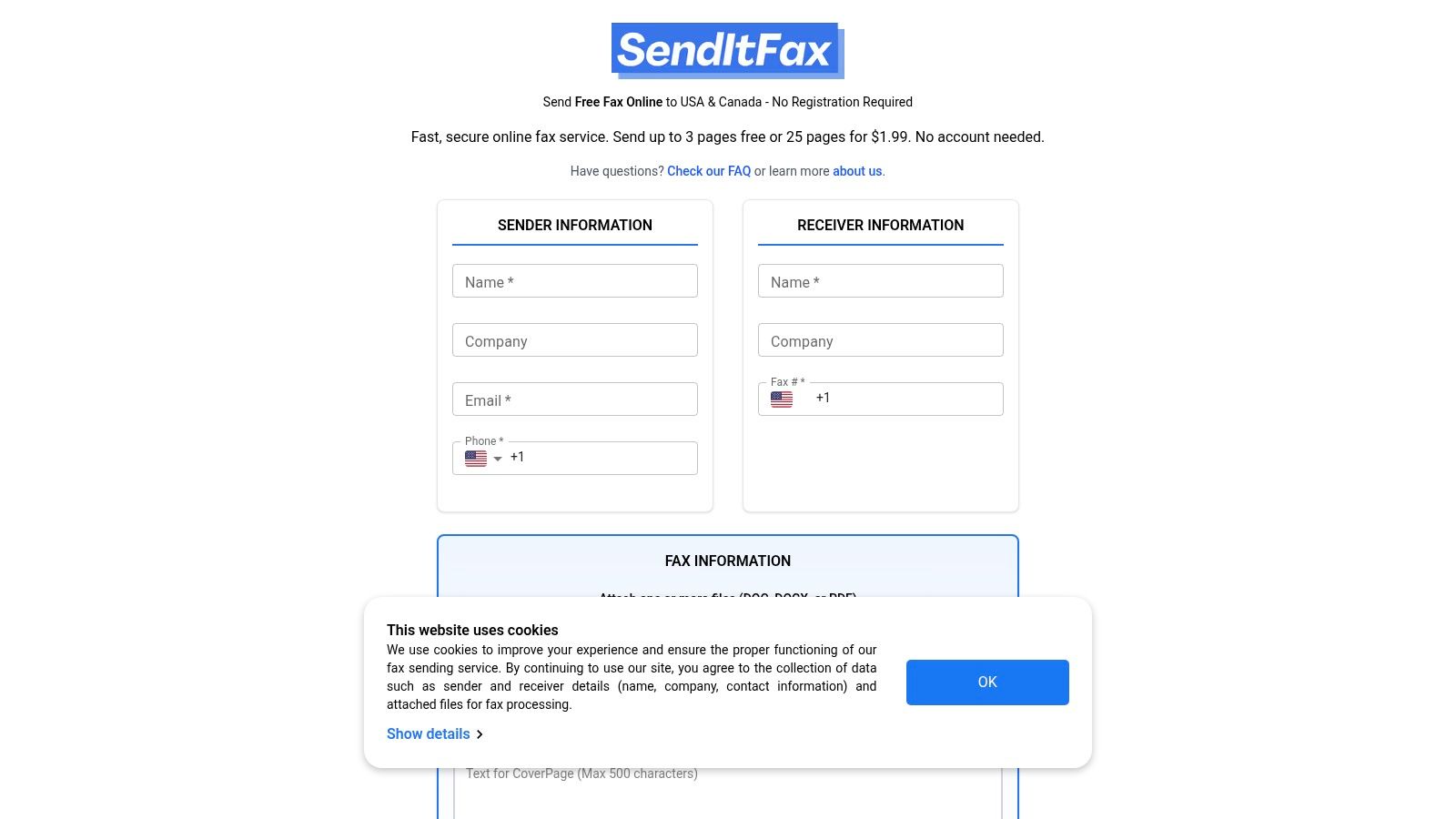
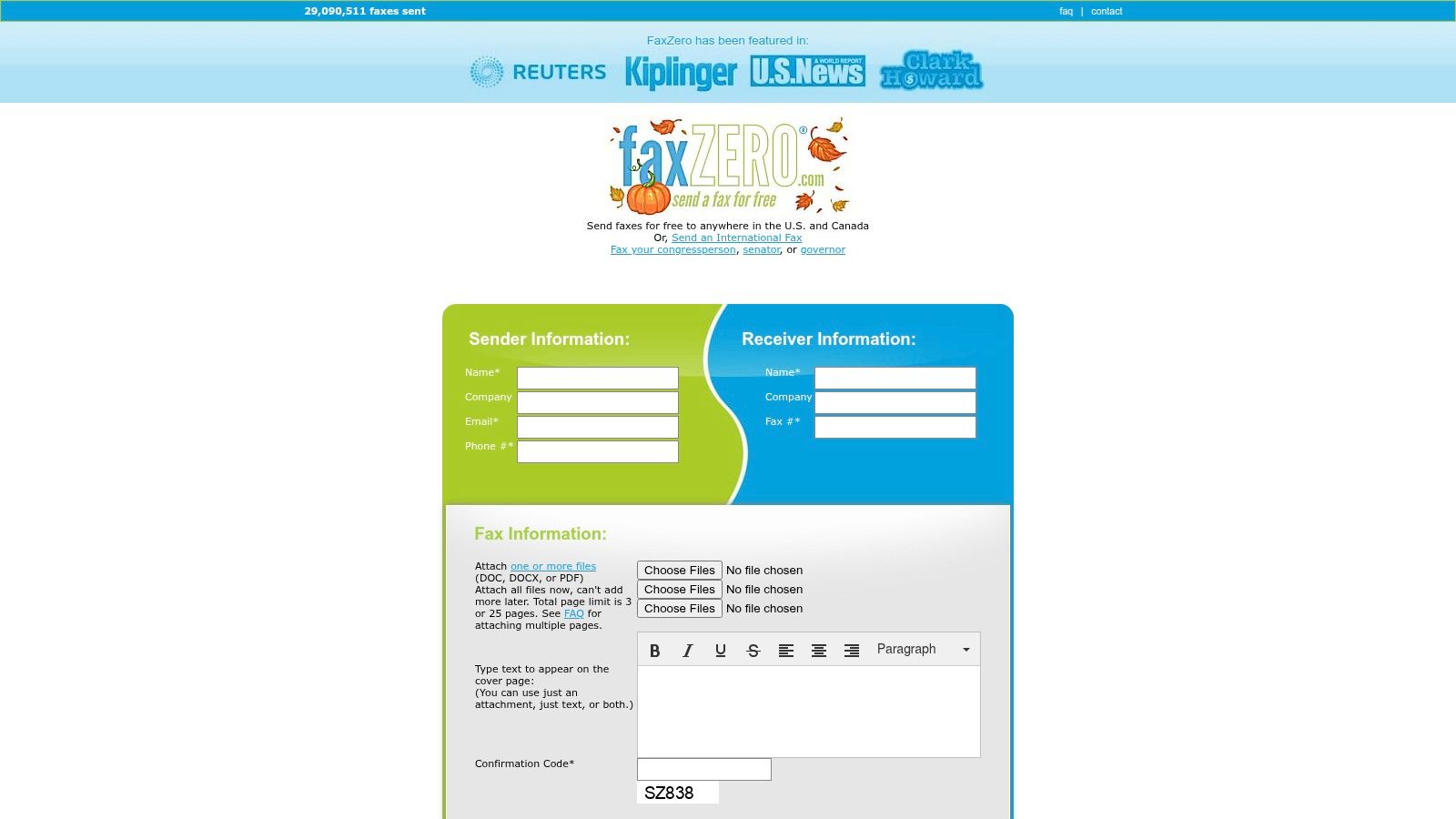
    If your business sends faxes occasionally, SendItFax is the one I’d keep bookmarked. It removes the biggest point of friction in this category. You can send to U.S. and Canadian fax numbers without creating an account, without installing anything, and without committing to a subscription just to push through one contract or form.

    That sounds simple, but in practice it matters a lot. Most small businesses don’t need another monthly tool. They need a fast fallback when a landlord, law office, title company, clinic, or government desk insists on fax.

    Best for occasional use and no-account flexibility

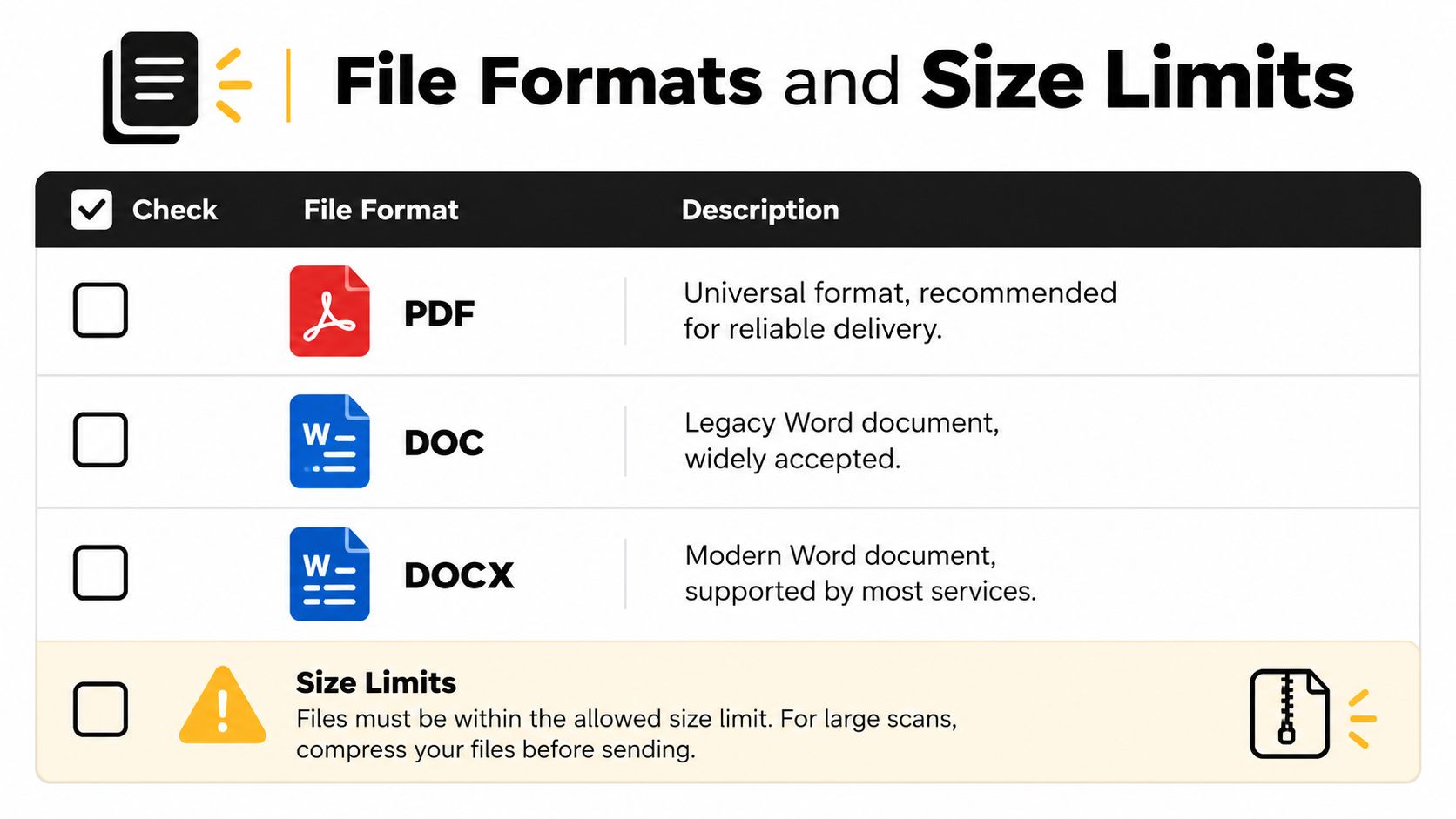
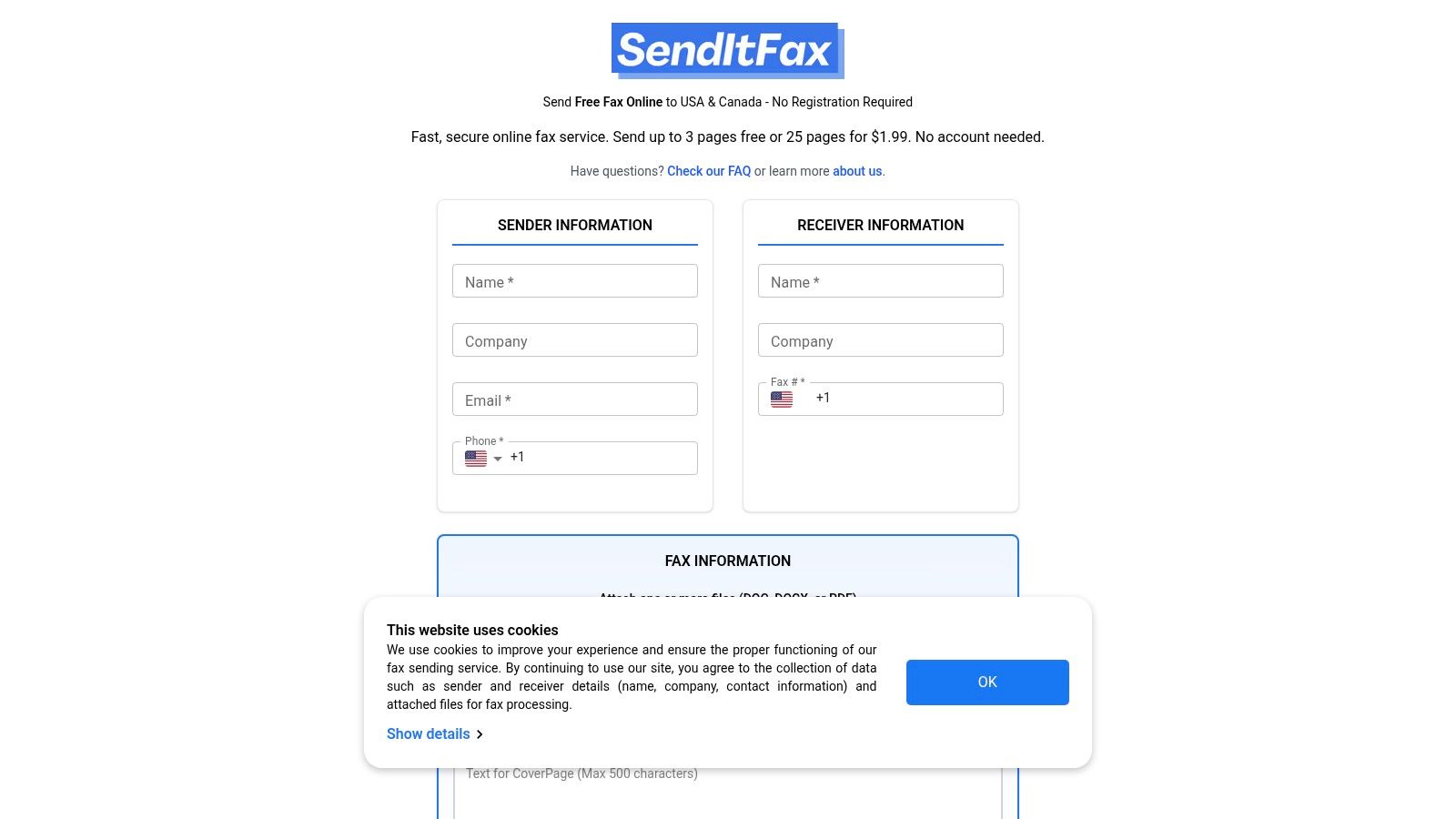
    The workflow is stripped down in a good way. Upload a DOC, DOCX, or PDF, enter sender and recipient details, add a cover message if needed, and send. For free use, the limit is up to 3 pages plus a cover page, with a maximum of 5 free faxes per day, and the free cover includes SendItFax branding. If you need a cleaner presentation or a longer document, the Almost Free option costs $1.99 per fax, supports up to 25 pages, removes branding, and gives you priority delivery.

    That pay-per-fax model is a key differentiator. You’re not guessing whether a monthly plan will go unused. You’re paying when there’s an actual need.

    Practical rule: If you fax less often than you update your business insurance paperwork, a no-subscription option usually fits better than a recurring plan.

    Another practical advantage is device flexibility. Because it’s browser-based, it works well when you’re traveling, working remotely, or sending from a borrowed laptop after hours. That’s a different use case from a full office fax system, and SendItFax leans into it.

    What works and what doesn’t

    What works:

    • Fast access: You can send immediately without account setup.
    • Low-friction pricing: Free for very small sends, then a clear $1.99 step-up for longer or more polished faxes.
    • Good fit for one-offs: Contracts, signed forms, application packets, and occasional notices are where this shines.

    Trade-offs:

    • Free tier limits: The free option won’t cover regular business volume.
    • Compliance needs extra scrutiny: If you’re sending highly regulated health or legal records, verify the compliance posture first rather than assuming it fits a HIPAA workflow.
    • Send-first orientation: This is strongest as an outbound tool for occasional use, not as a full replacement for a shared inbound fax system.

    SendItFax also highlights strong user sentiment, including a 4.8/5 rating from 250+ reviews in its own materials. For small teams that need speed and flexibility more than admin complexity, that’s a compelling package.

    Website: SendItFax

    2. eFax

    eFax

    A common small business scenario looks like this. The owner wants a fax service the staff will recognize, the office manager wants a shared number, and nobody wants to spend a week training people on a new tool. eFax fits that buyer better than a pay-as-you-go option.

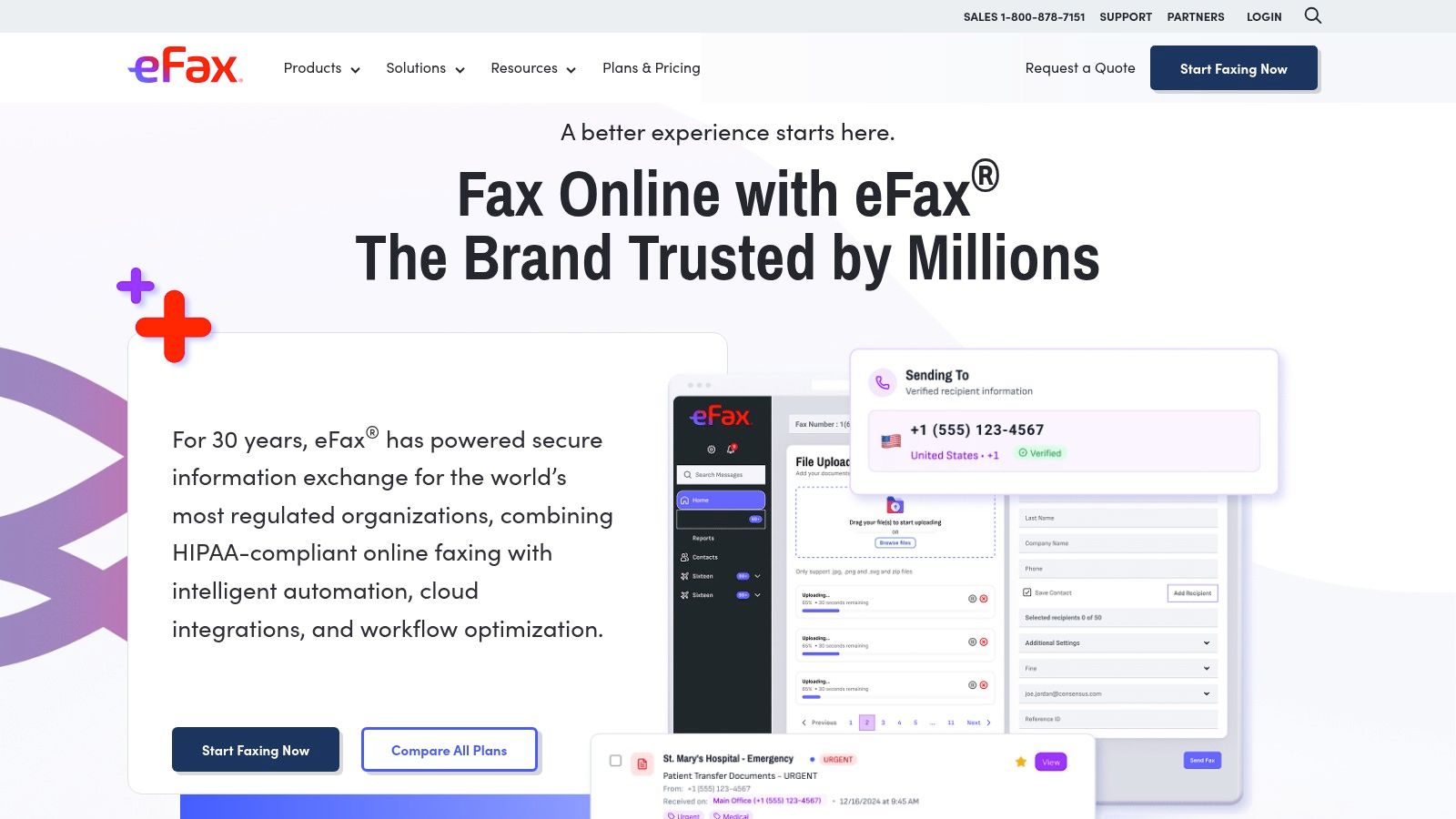
    The draw is familiarity. eFax has been in the market a long time, and that matters when you are choosing software for a team that needs to send and receive documents without much hand-holding. You get web access, email-to-fax support, mobile apps, and business number options in a package that feels built for ongoing use.

    Best for businesses that want a familiar, full-service subscription

    I usually place eFax in the "known brand, recurring workflow" category. It makes more sense for firms that fax often enough to justify a monthly plan than for owners who only send a few documents every now and then. If your office is comparing category leaders by comfort level and ease of adoption, eFax belongs on the shortlist.

    The compliance angle is where eFax becomes more than a convenience buy. Its Protect tier is positioned for HIPAA-ready use and includes the option of a BAA, which puts it in consideration for medical, dental, and other privacy-sensitive operations that want a mainstream provider instead of a smaller specialist.

    The trade-off is cost discipline. For low-volume use, eFax can feel expensive compared with no-account sending tools or lighter monthly services. That does not make it a bad product. It means buyers should match the plan to actual fax volume, not to brand recognition alone.

    I also advise checking three details before purchase: page allowances, overage charges, and cancellation terms. Those are the items that usually create frustration after the first billing cycle, especially for small firms with uneven monthly usage.

    If you want the mechanics before you commit, this guide on how eFax works gives a practical overview.

    Website: eFax

    3. MetroFax

    MetroFax

    MetroFax is the kind of service I usually recommend when a small office has steady, ordinary fax needs and doesn’t want to overthink the purchase. It isn’t trying to be flashy. It’s trying to be predictable.

    That’s often what matters most. If your staff sends and receives faxes every week, a simple monthly plan with email, desktop, and mobile access is easier to manage than a patchwork of one-off sends.

    Best for steady everyday office use

    MetroFax stands out for practical office basics. You can send and receive through email, use a local or toll-free number, port an existing number, and rely on confirmations and automatic retries. Those details sound small, but they reduce the back-and-forth that usually follows a failed transmission.

    This is the sort of service that works well for:

    • Admin-heavy offices: Teams that fax intake forms, vendor paperwork, or signed approvals on a routine schedule.
    • Businesses replacing an old machine: You keep the workflow, lose the hardware headache.
    • Owners who want predictable billing: A recurring plan is easier to budget than ad hoc sending when volume is consistent.

    The main caution is compliance. MetroFax is easy to consider for general business use, but if you handle protected health information or similarly sensitive records, don’t assume a consumer-facing plan covers your obligations. Validate that directly.

    My view is simple. If your office sends enough faxes that “just use the free option” keeps becoming a nuisance, MetroFax becomes much more attractive.

    Website: MetroFax

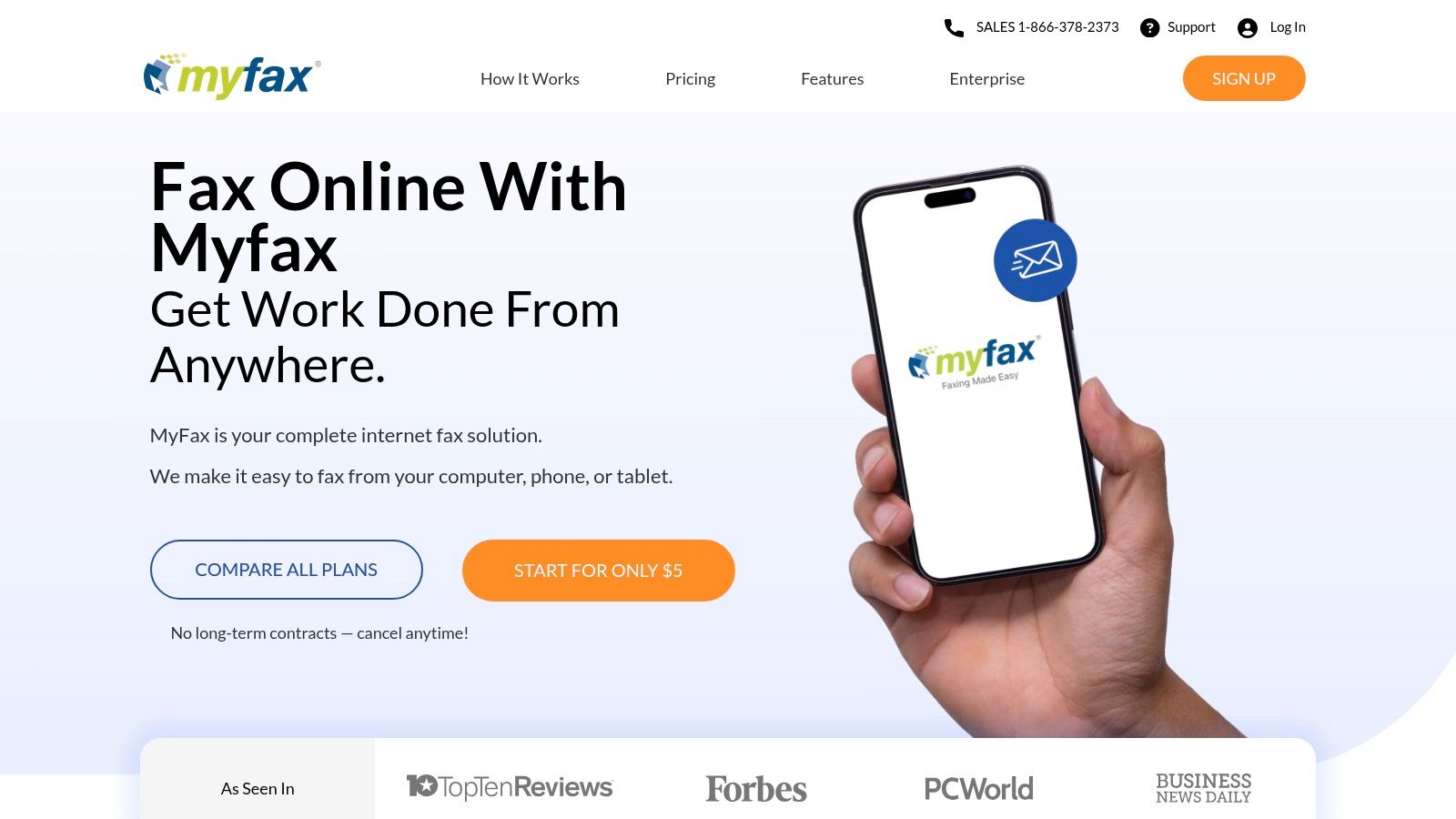
    4. MyFax

    MyFax

    MyFax tends to appeal to businesses that want an easy on-ramp. The plans are usually clear enough to understand quickly, and the product keeps the workflow familiar. Email it, upload it, send it, move on.

    That simplicity is valuable for freelancers, solo operators, and smaller teams that don’t need deep integrations or complex admin controls. If your priority is “make faxing not annoying,” MyFax is worth a look.

    Best for straightforward signup and predictable usage

    The service supports web and email faxing, mobile apps, local and toll-free numbers, and number porting. It’s a practical setup for firms that need two-way faxing but don’t want to retrain everyone on a new process.

    One detail I like is pricing transparency around overages in the public FAQ. Many providers make you dig for that. Knowing the cost structure up front helps avoid the classic small-business problem of choosing a cheap-looking plan that becomes expensive after a few busy weeks.

    A few buying notes:

    • Good fit for general business faxing: Especially if you want standard plans and easy onboarding.
    • Less ideal for regulated workflows: If PHI or similar records are involved, validate whether the plan is appropriate before treating it as compliant.
    • Watch lower tiers: Smaller page pools can get tight if one client or one transaction cycle suddenly spikes usage.

    MyFax is rarely the most specialized option in a comparison, but that’s also its appeal. It’s built for businesses that want a fax line in the cloud without turning faxing into an IT project.

    Website: MyFax

    5. FAX.PLUS by Alohi

    FAX.PLUS (by Alohi)

    A common small-business problem is simple: one person sends the occasional fax from email, another works from Google Drive, and someone in the field needs a phone app that does not create support tickets. FAX.PLUS fits that kind of mixed workflow better than many entry-level fax tools.

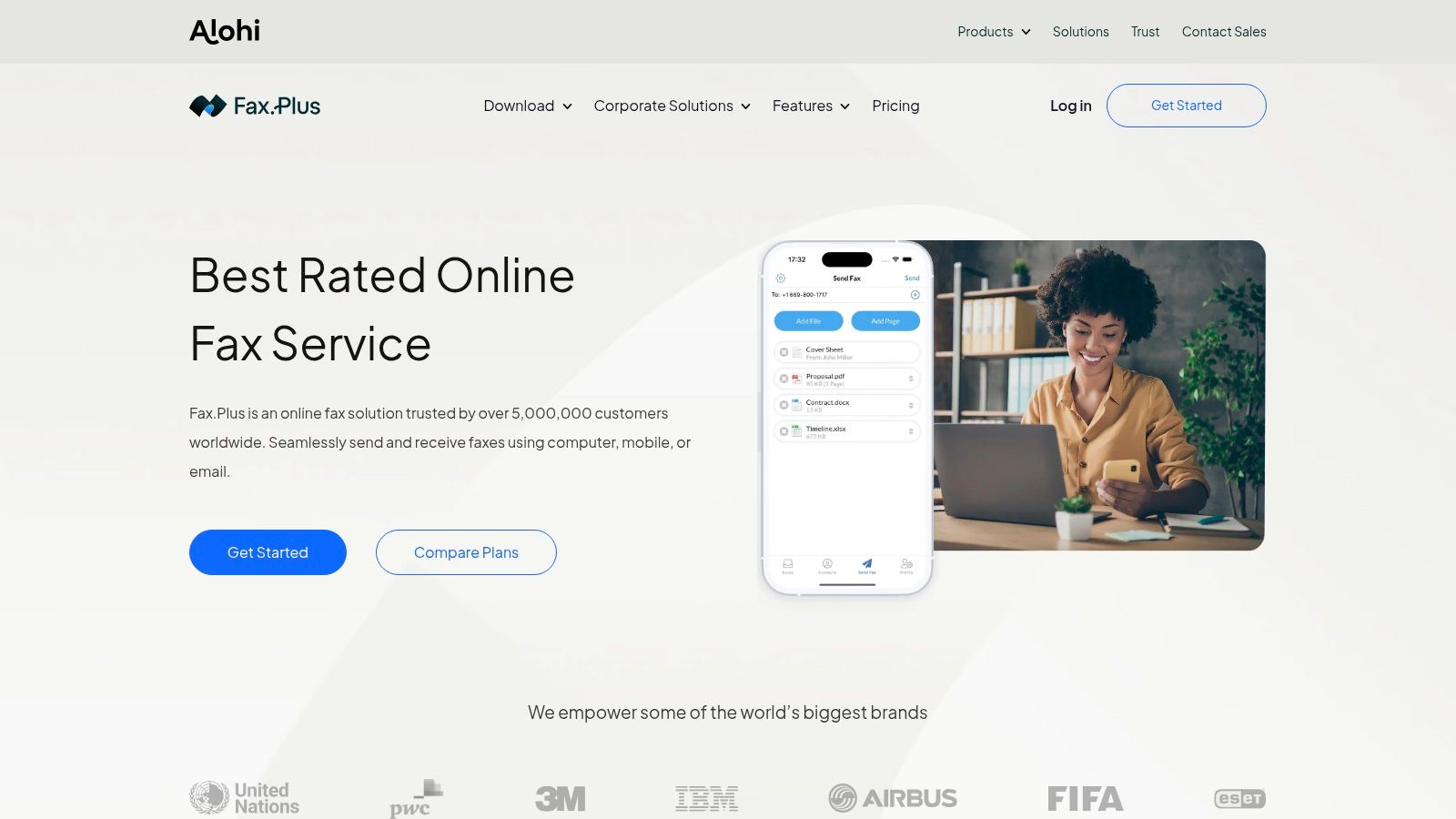
    The product is well suited to businesses that want online faxing to feel like part of their document process, not a separate task. In practice, that means useful cloud storage connections, a polished web app, mobile access, and admin controls that are easier to grow into than many bare-bones services.

    Best for usability and integrations

    FAX.PLUS works well for teams that pass files through shared drives and need staff to send or receive faxes without much training. I see the strongest fit with small offices that have outgrown a very basic fax line but are not ready to buy into a heavier enterprise platform.

    A few details matter here. The service offers tiered plans, supports scheduled sending, and gives businesses room to standardize faxing across desktop and mobile devices. That makes it a practical choice for operations managers, office admins, and owners who want fewer manual handoffs.

    Where I would place it in a buying framework:

    • Best for growing teams with mixed workflows: Good fit if some staff fax from email, others from the browser, and others from mobile.
    • Best for cloud-document offices: Useful if your files already live in Google Drive or Dropbox.
    • Less ideal for budget buyers with strict compliance needs: If you need HIPAA support and a BAA, confirm which plan includes it before you commit.

    That last point is the main trade-off. FAX.PLUS can serve regulated businesses, but the compliance path is not always the cheapest path. For a small clinic, therapy practice, or other business handling protected records, the right plan may cost more than a general business setup. For a real estate office, insurance agency, or contractor that mainly wants clean workflow and reliable two-way faxing, the value case is easier.

    Website: FAX.PLUS by Alohi

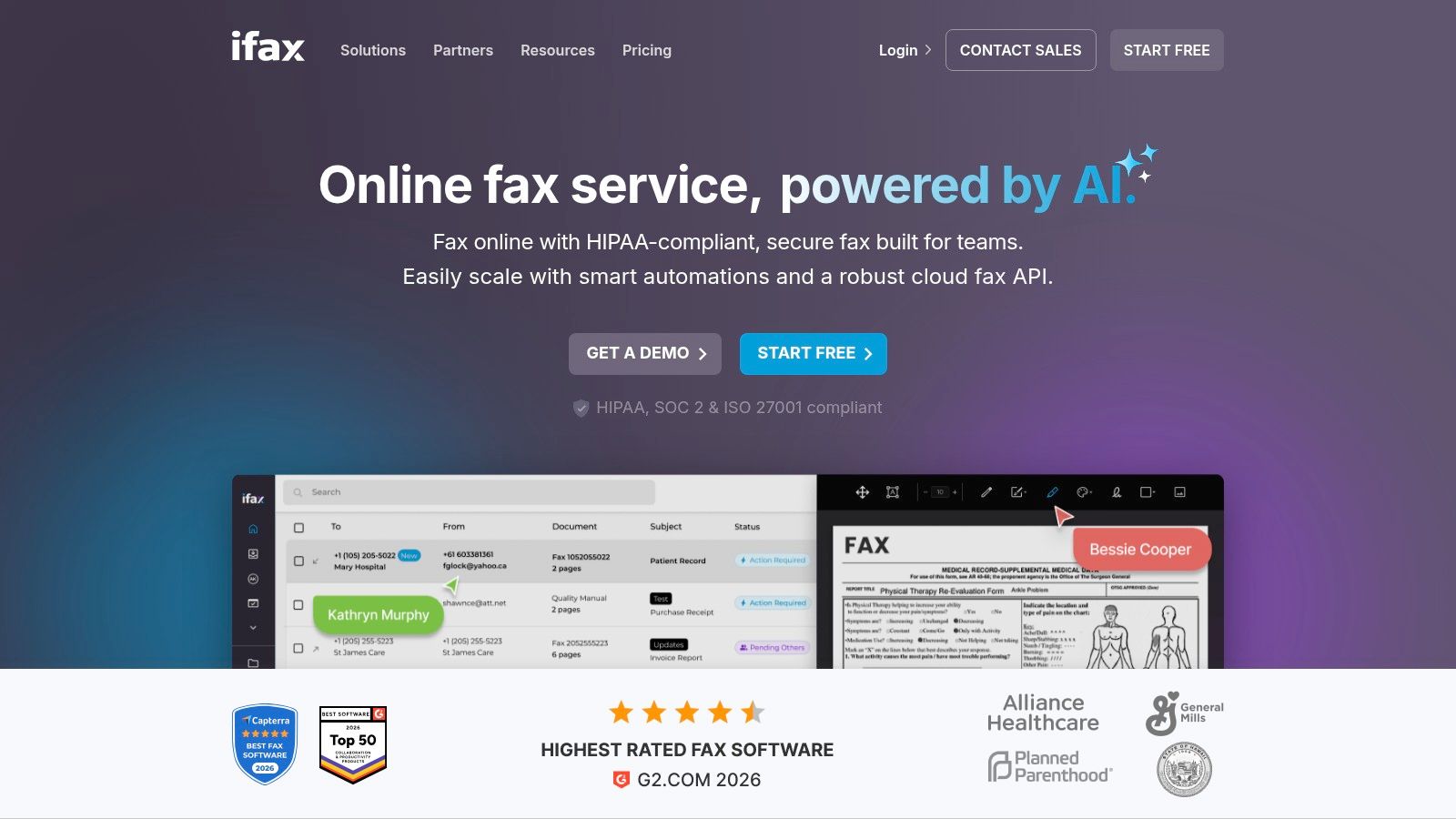
    6. iFax

    iFax

    A common small business problem looks like this. The owner needs staff to send signed forms from a phone, the office manager wants a desktop option, and compliance cannot be an afterthought. iFax fits that kind of operation better than tools that treat mobile access as a secondary feature.

    I usually shortlist iFax for healthcare-adjacent offices, legal practices, and finance teams that need more than basic send-and-receive faxing. The appeal is not just that it supports HIPAA-oriented workflows. It is that the product is built around the channels small teams use every day, including mobile apps, desktop access, and email-based sending.

    Best for mobile-first businesses that still need a compliance path

    iFax stands out when staff are rarely tied to one workstation. If documents get signed in the field, reviewed at the front desk, and forwarded from email, the service is easier to roll out than a fax platform that expects everyone to work from a browser portal alone.

    That makes it a strong category fit in this guide for businesses that need flexibility with some structure. It is also one of the better options to compare in the "How to Choose" stage if your shortlist includes regulated use cases and you know mobile adoption will make or break rollout.

    A practical fit looks like this:

    • Best for mobile-heavy teams: Good for businesses where owners, clinicians, or field staff need to send documents from phones without awkward workarounds.
    • Best for healthcare-adjacent compliance needs: Worth a close look if you need HIPAA support and want to confirm BAA availability before signing.
    • Best for more advanced document workflows: Useful if your team may need features such as fax broadcasting, OCR, or data capture tools rather than simple one-off sending.

    The main trade-off is plan selection. Entry pricing can look reasonable, but the features that matter to a regulated business or a higher-volume office may sit on a higher tier. I recommend mapping out three things before you buy: monthly page volume, whether you need an inbound fax number, and whether your compliance requirements call for a signed BAA and documented controls. That quick check usually tells you whether iFax is a good fit or whether a simpler pay-as-you-go option would be more practical for occasional use.

    Website: iFax

    7. Nextiva vFAX

    Nextiva vFAX is a practical pick for businesses that already work from their inbox and don’t want faxing to become a separate discipline. If your ideal workflow is “send it from email and keep moving,” Nextiva makes sense.

    This is also one of the names I look at when a business wants subscription value without chasing a lot of bells and whistles. It’s not trying to be the fanciest tool on the list. It’s trying to be cost-conscious and usable.

    Best for inbox-driven teams on a budget

    The biggest strength here is the straightforward email-centric approach combined with large page pools on standard plans. That suits offices where admin staff already process documents through shared mailboxes and don’t want to train around a new interface every time they fax.

    I also like Nextiva for organizations that are cost sensitive but still need room for moderate volume. If you’re beyond occasional use and want to avoid premium pricing, this category of provider is where the value conversation gets more interesting.

    Where I’d be careful is compliance. Nextiva offers HIPAA-compliant options through sales contact, but that means you’ll want to verify the specifics directly rather than assuming the public plan page tells the full story. Small businesses often miss that step and only discover the gap during vendor review.

    For plain business faxing, though, the appeal is easy to understand. Good page pools, familiar workflows, and a low barrier to adoption.

    Website: Nextiva vFAX

    8. Documo formerly mFax

    Documo (formerly mFax)

    A common small business breaking point looks like this. Faxed documents come in, staff download them by hand, rename files inconsistently, then forward them to billing, operations, or a patient intake queue. At that point, the problem is no longer sending a fax. The problem is what happens after receipt.

    Documo fits businesses that have reached that stage. I look at it for teams that need fax tied to intake, routing, audit controls, and other downstream tasks instead of a simple send-and-receive inbox.

    Best for healthcare automation and API-driven workflows

    Documo stands out for workflow depth. The service is built around HIPAA-conscious cloud faxing, BAA availability, and tools that support automation instead of forcing staff to babysit incoming documents. That matters in clinics, RCM teams, and document-heavy back offices where a fax may trigger the next operational step.

    The trade-off is straightforward. You get more control, but setup takes more planning. Admin teams need to decide how documents should be tagged, where they should route, who should have access, and whether API or OCR features are worth the extra complexity.

    I generally put Documo on the shortlist when a business needs:

    • A BAA path for healthcare or other sensitive records
    • API access for custom integrations
    • OCR, classification, or extraction tied to inbound fax handling
    • Admin controls for multi-user document workflows

    This is not the service I would put in front of a five-person office that sends a few signed forms each month and just wants the cheapest way to fax online. A lighter option, or even a no-account pay-as-you-go service for occasional use, is usually the better fit in that case. Documo earns its place when fax volume connects directly to revenue, compliance, or patient operations and manual handling is already creating friction.

    Website: Documo

    9. SRFax

    SRFax

    A two-location clinic has a different fax problem than a solo consultant or a five-person office that only sends forms once in a while. SRFax fits the first group. It is one of the services I look at when a business needs healthcare-oriented faxing, wants the compliance conversation handled clearly, and does not want to guess how billing will behave once usage increases.

    Best for healthcare and privacy-first billing clarity

    SRFax earns its place here because it stays focused on a specific buyer. This is a service for practices, medical offices, legal teams, and other privacy-sensitive organizations that want a provider with a long track record in secure online faxing, especially across the U.S. and Canada. That matters if your evaluation checklist includes BAA availability, account controls, and a plan structure that can pass internal review without a lot of interpretation.

    I would shortlist SRFax when a business needs:

    • A clearer healthcare and compliance posture
    • Support for U.S. and Canada operations
    • Predictable monthly billing with visible overage rules
    • A service chosen for policy fit, not consumer-style simplicity

    The trade-off is usability. SRFax is practical, but it does not feel as polished as some newer products. Buyers may need to spend more time reviewing plan options and confirming which tier matches their send volume, retention needs, and user count.

    That extra review is often acceptable in regulated environments. For a practice manager or office admin, the bigger concern is whether the service will hold up under day-to-day document handling and satisfy compliance requirements without a workaround.

    If your business sends only occasional faxes, this is probably more structure than you need. A lighter service, or a no-account pay-as-you-go option, usually makes more sense for that use case. SRFax is a better fit when faxing is tied to patient records, intake, referrals, or other sensitive workflows where clarity matters more than a slick interface.

    Website: SRFax

    10. FAXAGE

    FAXAGE

    FAXAGE is a value pick for buyers who carefully read pricing pages. If that’s you, you’ll probably appreciate how direct it is about plan structure, storage, API access, and HIPAA support with a BAA available on request.

    This is a strong option for cost-conscious small businesses, developers, and healthcare senders who don’t mind understanding the billing model before they buy.

    Best for transparent pricing and developer flexibility

    The first question with FAXAGE is whether minute-based pricing fits how your team thinks. Some buyers prefer page pools because they’re easier to compare. Others don’t care, as long as the rates are clearly stated and the invoices are predictable.

    FAXAGE works well when:

    • You want web, email, and API faxing in one service
    • You care about transparent plan disclosures
    • You may need HIPAA support but don’t need a glossy enterprise interface

    The friction point is mental overhead. Minute-based pricing can be perfectly reasonable, but it asks the buyer to think a little harder about document length, destination, and workflow pattern. Some owners don’t want that. Others are happy to trade simplicity for lower cost and more visibility into the math.

    For technical teams or very budget-aware operators, FAXAGE is often a stronger candidate than its mainstream brand profile suggests.

    Website: FAXAGE

    11. At a Glance Comparing Key Features and Pricing

    If you’ve made it this far, the shortlist usually becomes clearer. Most small businesses aren’t deciding among ten equal options. They’re deciding among three categories: occasional send-only use, everyday office faxing, and regulated workflow faxing.

    That’s the right way to narrow the field. A one-person consultancy doesn’t need the same product as a clinic, and a real estate office doesn’t buy the same way as a distributed startup.

    How to use the comparison table

    Use the table below to sort providers by your actual operating need, not by brand recognition.

    • Start with billing style: Pay-per-fax, low-tier subscription, or larger monthly pool.
    • Then check receive capability: If you need a dedicated number, remove send-only options.
    • Then check compliance: If you need HIPAA or a BAA, filter immediately.
    • Finally check workflow fit: Email-based, browser-only, app-heavy, or API-friendly.

    A separate online fax service comparison can also help if you want a second pass focused just on side-by-side differences.

    The wrong fax service usually isn’t “bad.” It’s just built for a different volume and risk profile than yours.

    12. How to Choose the Best Online Fax Service for Your Business

    Most bad fax purchases happen for one reason. The owner buys for features instead of buying for workflow. The best online fax service for small business is the one that matches your volume, compliance burden, and tolerance for recurring cost.

    Start with honesty about how often you fax. If it’s sporadic, a pay-as-you-go option is usually smarter than carrying another monthly subscription all year.

    A simple decision framework

    Ask these five questions before you choose:

    • How many pages do you send in a normal month: Not the busiest month, the normal one. Light use often points to SendItFax or an entry plan. Recurring office use points to MetroFax, MyFax, Nextiva, or eFax.
    • Do you need HIPAA compliance and a BAA: If yes, narrow the list immediately to services such as SRFax, iFax, Documo, or higher-tier FAX.PLUS options.
    • Do you need to receive faxes: A send-only tool won’t replace a full fax number if vendors or clients fax documents back to you.
    • Do integrations matter: If your team stores files in cloud drives or needs API-level connections, prioritize FAX.PLUS, Documo, or FAXAGE.
    • What budget model fits your business: Predictable monthly billing works for steady volume. Pay-per-fax works better when faxing is irregular.

    This overview of online faxing services for different business needs is worth reading if you’re still split between occasional use and a full subscription model.

    One more rule I give clients. Run a real test before you commit. Send the kinds of files you use, such as signed PDFs, scanned forms, or multi-page packets. The setup that looks cheapest on paper often isn’t the best fit once real documents start moving.

    Top 12 Online Fax Services Comparison

    A comparison table is only useful if it helps narrow the field fast. This one keeps the focus on actual providers, with the buying factors that matter most to small businesses: setup friction, pricing model, receiving capability, and compliance fit.

    Provider Key Features Price & Limits Compliance & Security Best For & USP Rating
    🏆 SendItFax No-account web fax, upload DOC/DOCX/PDF, optional cover page, delivery status Free option with limited pages and daily sends. Paid send option starts at a low per-fax price with higher page allowance No public BAA or HIPAA documentation. Confirm directly before sending PHI Occasional use, urgent one-off sends, businesses that do not want another monthly subscription ★★★★☆ 4.8/5
    eFax Email-to-fax, web portal, local and toll-free numbers, team features Subscription plans with a higher starting cost than budget picks, but broader monthly capacity HIPAA-ready options available on qualifying plans with BAA support Businesses that want a recognized brand and expect regular fax volume ★★★★☆ Established
    MetroFax Email, desktop and mobile faxing, number porting, admin tools Predictable monthly plans with competitive included pages Consumer plans do not clearly position HIPAA support. Verify before use with sensitive records Small offices with steady monthly send and receive needs ★★★☆☆ Budget-friendly
    MyFax Web, email, and mobile faxing, local or toll-free numbers, trial period Clear plan structure with published overage pricing No dedicated HIPAA-first positioning on standard plans. Validate if compliance matters Small teams that want simple setup and straightforward billing ★★★☆☆ Simple
    FAX.PLUS by Alohi Clean apps, Google and Microsoft integrations, API access, scheduled faxing Free through enterprise tiers. Advanced admin and compliance features sit on higher plans BAA and HIPAA support available on qualifying business tiers SMBs that care about integrations, admin control, and a modern interface ★★★★☆ Integrated
    iFax Mobile and desktop apps, pay-per-fax options, broadcast fax, API Mix of subscription and pay-per-use pricing depending on workflow HIPAA-compliant options available on eligible plans with BAA Mobile-first teams, clinics, and businesses that need flexibility in how they buy ★★★★☆ Flexible
    Nextiva vFAX Email-centric workflow, number porting, large page pools Competitive entry pricing with generous page allotments on many plans HIPAA options may require sales contact rather than self-serve signup Budget-conscious SMBs that want faxing to stay close to the inbox ★★★☆☆ Cost-effective
    Documo formerly mFax HIPAA-oriented plans, API, MFP connectors, document workflow features Higher monthly pricing than basic SMB tools. Better fit for process-heavy teams HIPAA-compliant plans with BAA and stronger workflow controls Healthcare, intake-heavy operations, and businesses automating document flow ★★★★☆ Workflow-focused
    SRFax Email and web faxing, long-term storage, broad healthcare plan range Transparent plan tiers with clear page allowances and overage terms HIPAA and PHIPA support with BAA. Strong fit for privacy-sensitive use Medical and legal offices that want predictable compliance-oriented billing ★★★★☆ Healthcare-focused
    FAXAGE Web, email, and API faxing, page-pooled and metered plans Low-cost structure with transparent pricing tables HIPAA-capable options with BAA available Cost-conscious businesses, IT-led teams, and developers needing API access ★★★★☆ Low-cost

    Fax Forward Making the Right Choice for Your Business

    A fax decision usually gets made under pressure. A closing packet needs to go out before the bank stops processing for the day. A referral has to reach a specialist with confirmation. A remote employee has the signed file but no office machine. Small businesses rarely need the service with the longest feature list. They need the one that fits the way documents move through the business.

    Start with the job you need the service to do.

    If faxing is occasional, a monthly subscription often becomes dead weight. A no-account, pay-as-you-go option such as SendItFax makes sense for the owner, office manager, or field employee who sends a contract, authorization form, or one-off packet a few times a month and does not want another login, user seat, or recurring charge to manage.

    If faxing is part of the daily routine, the priorities change. A subscription with a dedicated fax number, predictable page limits, email delivery, and easy record lookup is usually the better fit. MetroFax and MyFax work for businesses that want a familiar setup with little training. Nextiva vFAX suits teams that already run heavily through email. eFax still has a place for businesses that prefer a widely recognized vendor and accept the higher cost that can come with that.

    Compliance narrows the field fast. Healthcare, legal, insurance, and other privacy-sensitive businesses should check BAA availability, retention controls, user permissions, and audit visibility before looking at convenience features. SRFax is a practical option for straightforward compliant faxing. iFax fits teams that work from phones and tablets but still need stronger controls. Documo is a better match when faxing connects to intake, routing, or document workflow. FAX.PLUS stands out for businesses that want compliance options without giving up a polished interface.

    Price still matters, but page volume is only part of the cost. Significant expenses arise from missed inbound faxes, confusing admin controls, weak mobile performance, or staff wasting time searching for delivery records.

    Choose based on your normal week. A business sending a handful of faxes each month should avoid paying for features tied to heavier operations. A front desk receiving signed forms every day should prioritize inbound routing, a dedicated number, and delivery logs that are easy to pull during a dispute or audit. A mobile team should test the browser and app experience on the devices employees already use, not the devices shown in a demo.

    One test saves a lot of regret. Send a real file before committing. Use the documents your business handles now, scanned PDFs, signed contracts, multi-page packets, or intake forms. Then check delivery speed, receipt visibility, search history, and whether another employee can complete the same task without instructions. Weak services usually fail in that trial, not on the pricing page.

    The best online fax service for small business in 2026 is the one that matches your volume, compliance requirements, and staff workflow. For some teams, that means a subscription with inbound faxing and admin controls. For others, it means keeping a pay-as-you-go option available for the moments when a fax has to go out quickly, without hardware and without another monthly bill.

  • Where to Go to Fax a Document: 8 Best Options for 2026

    Where to Go to Fax a Document: 8 Best Options for 2026

    In an era dominated by instant messaging and email, the need to send a fax can feel like a search for a technological relic. Yet, for many official transactions involving legal documents, medical records, and government forms, faxing remains a critical and surprisingly secure method of communication. The good news is you no longer need a bulky, buzzing machine and a dedicated phone line to get the job done. The real challenge has shifted from owning the hardware to simply knowing where to go to fax a document quickly, securely, and affordably.

    Whether you are a freelancer sending a single, time-sensitive contract, a patient transmitting records to a new doctor, or a small business needing a reliable document delivery solution, the options are more diverse and accessible than ever before. This comprehensive guide cuts through the confusion, exploring the best modern and traditional methods available. We will break down everything from instant online fax services and convenient retail counters at stores like FedEx Office to lesser-known options at local libraries and even sophisticated mobile apps. Our goal is to provide a clear roadmap, helping you navigate the costs, privacy considerations, and practical steps for each option so you can find the perfect fit for your specific faxing needs.
    1. Online Fax Services (Web-Based Platforms)

    If you're wondering where to go to fax a document without leaving your desk, an online fax service is the most modern and convenient solution. These web-based platforms transform your computer or smartphone into a powerful fax machine, allowing you to send digital files (like PDFs or Word documents) to any traditional fax number through an internet connection.

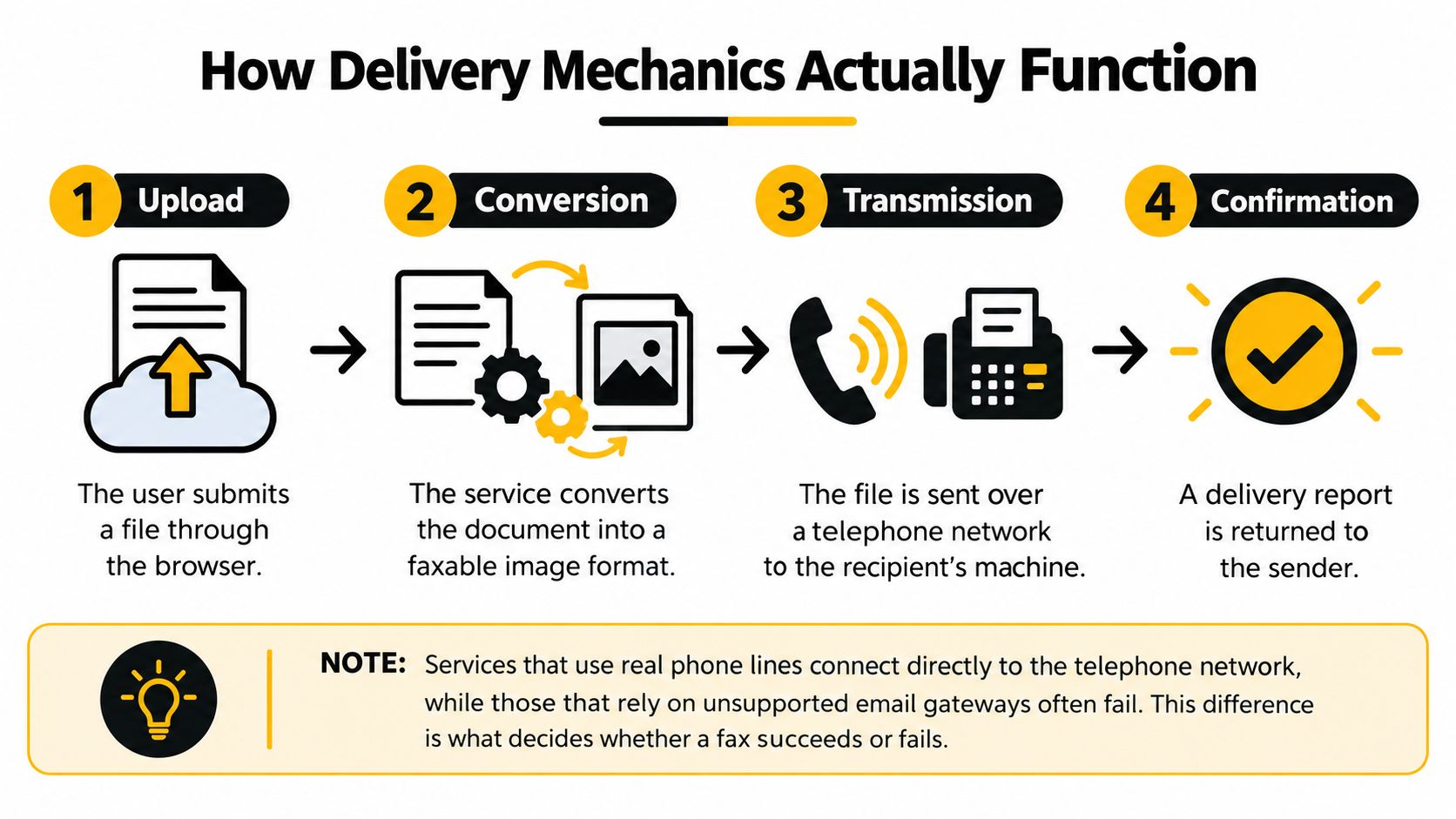
    This method eliminates the need for physical hardware, paper, and ink. You simply upload your document to a website or attach it to an email, enter the recipient's fax number, and click send. The service handles the conversion and transmission, providing a digital confirmation receipt for your records.

    Who Should Use This?

    Online faxing is ideal for remote workers, small businesses, and anyone needing to send a fax quickly and securely. It's especially useful for transmitting sensitive documents in fields like healthcare, law, or finance, as many services offer HIPAA-compliant options and encrypted transmissions that are often more secure than a shared office fax machine.

    Key Advantage: Online fax services offer unparalleled convenience, allowing you to send faxes 24/7 from anywhere with an internet connection. This accessibility makes it the top choice for urgent or time-sensitive documents.

    What to Consider

    Choosing the right platform depends entirely on your needs. For a one-off fax, services like SendItFax offer a free tier (up to 3 pages) or a low-cost, pay-per-fax option. For regular business use, subscription-based services like eFax provide a dedicated fax number and higher volume allowances.
    Actionable Tips:

    • Check Volume Needs: Use a free or pay-as-you-go service for occasional faxes to avoid monthly fees.
    • Confirm File Types: Ensure the service supports your document format (e.g., PDF, DOCX, JPG).
    • Verify Recipient Number: Double-check the fax number, including the country code for international sends, to prevent transmission errors.

    For a detailed breakdown of different platforms and their features, you can explore this online fax services comparison.

    2. Office Supply Retailers (UPS Store, FedEx Office)

    If you need a reliable, in-person option for where to go to fax a document, major office supply and shipping retailers like The UPS Store or FedEx Office are excellent choices. These ubiquitous storefronts offer walk-in faxing services, making them a convenient solution for those who prefer professional assistance or don't have access to the necessary technology at home.

    This method is straightforward: you bring your physical documents to the service counter, and a store associate handles the entire transmission process for you using their commercial-grade equipment. They will provide a printed confirmation sheet as proof of delivery, which is crucial for official or time-sensitive correspondence.

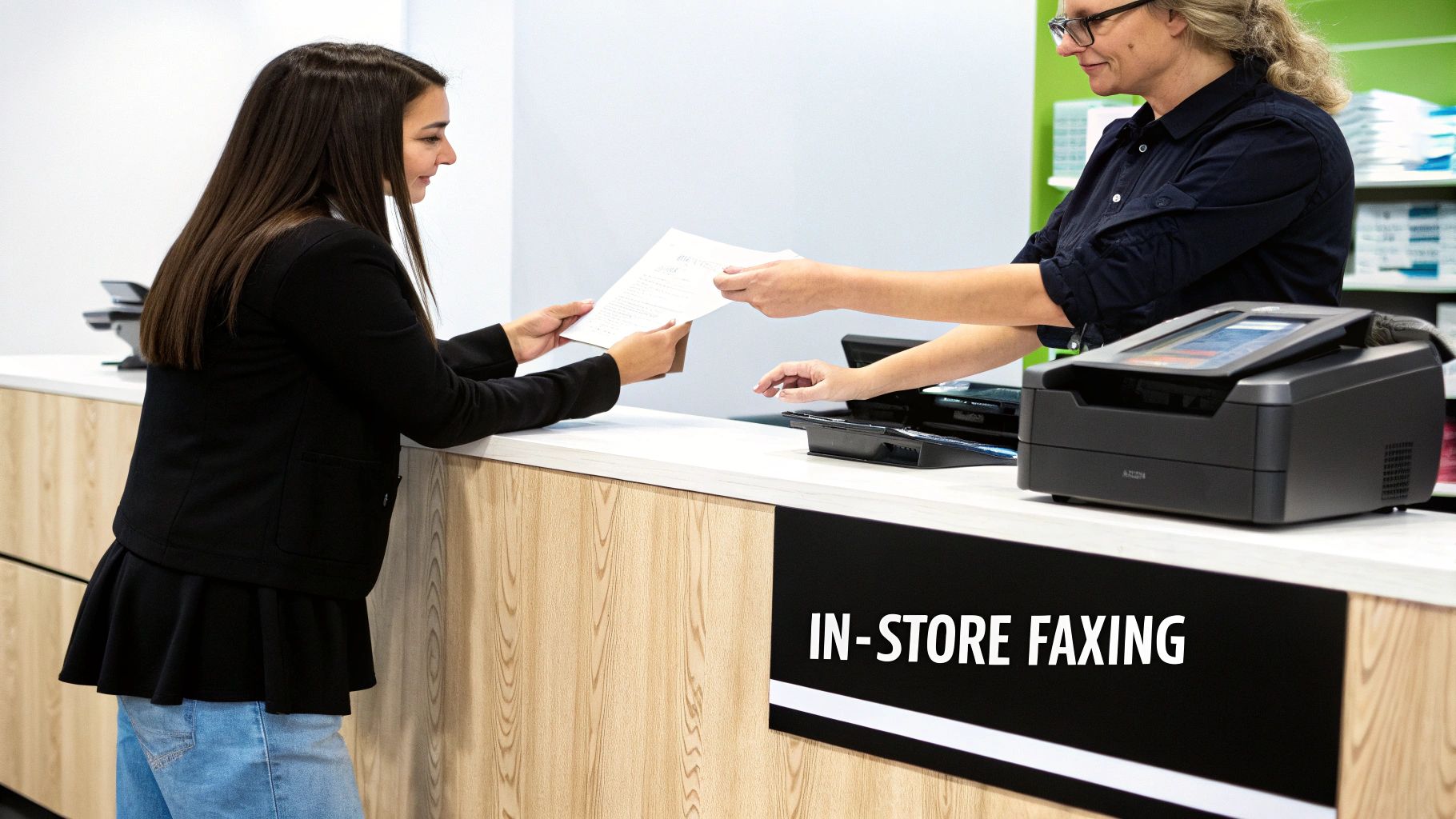
    Customer hands documents to an employee at a service counter with an in-store faxing sign.

    Who Should Use This?

    This option is perfect for individuals who only need to send a fax occasionally and want to avoid signing up for a service. It's also ideal for people who are less comfortable with technology or need to send physical, original documents that haven't been digitized. The immediate, tangible confirmation receipt makes it a trusted choice for sending important legal, financial, or real estate paperwork.

    Key Advantage: The primary benefit is reliability and professional assistance. Having a staff member manage the process and provide a physical confirmation receipt offers peace of mind that your document was sent successfully.

    What to Consider

    Pricing is typically on a per-page basis and can vary significantly by location and whether the fax is local, long-distance, or international. For instance, The UPS Store and FedEx Office have thousands of locations, but their prices are set by individual franchises. It’s wise to call ahead to confirm costs, especially if you have a large document.

    Actionable Tips:

    • Call Ahead: Always contact your local store to verify they offer fax services, check their hours, and ask about the cost per page.
    • Bring Clear Copies: Ensure your documents are clean and legible to guarantee a high-quality transmission.
    • Request a Receipt: Always ask for the printed confirmation page that includes the date, time, and recipient's number for your records.

    For specific locations and services, you can visit The UPS Store's website or your local print shop's page to find a provider near you.

    3. Email-to-Fax Services (Integrated Email Solutions)

    For professionals who live in their email inbox, email-to-fax services offer a seamless way to fax a document without disrupting established workflows. This method integrates faxing capabilities directly into your existing email client, such as Outlook or Gmail, transforming it into a powerful communication hub.

    The process is remarkably simple: you compose a new email, attach your document (like a PDF or Word file), and send it to a specially formatted email address, typically [faxnumber]@[serviceprovider].com. The service then converts the email content and attachment into a standard fax and transmits it to the recipient's machine, sending a confirmation receipt back to your inbox.

    Who Should Use This?

    Email-to-fax is perfect for businesses and individuals who need to send faxes regularly and want to centralize their communications. It's particularly effective in corporate environments where platforms like RingCentral or Nextiva are already used for unified communications, as it keeps all correspondence, including faxes, archived and searchable within one system.

    Key Advantage: The primary benefit is workflow integration. By allowing users to send faxes from the same platform they use for all other business communications, it eliminates the need to learn a new interface and saves significant time.

    What to Consider

    This solution is typically part of a broader subscription package, making it less ideal for a one-time fax. Providers like RingCentral and Nextiva bundle it with their VoIP and business communication suites. For those using Google Workspace or Microsoft 365, various third-party add-ons can enable this functionality directly within the email interface.

    Actionable Tips:

    • Set Up Forwarding: Configure fax-to-email forwarding so that incoming faxes are delivered directly to your inbox for a fully integrated experience.
    • Use Correct Formatting: Always use the precise email address format required by your provider (e.g., 15551234567@rcfax.com) to avoid delivery failure.
    • Enable Delivery Receipts: Turn on email notifications for sent and received faxes to maintain a clear digital paper trail for compliance and record-keeping.

    4. Healthcare and Legal Document Fax Services (Specialized Providers)

    When you need to fax a document containing highly sensitive information, standard services may not meet the stringent security and compliance requirements of regulated industries. Specialized online fax providers cater specifically to sectors like healthcare, law, and finance, offering platforms engineered for secure transmission and regulatory adherence.

    These services go beyond basic faxing by incorporating features like HIPAA-compliant encryption, detailed audit trails, and certified data storage. Platforms such as MetroFax and Biscom are designed to handle protected health information (PHI) and privileged legal documents, ensuring every transmission meets strict legal and ethical standards for privacy and security.

    Who Should Use This?

    This option is essential for medical professionals, legal firms, financial institutions, and any organization handling personally identifiable information (PII). If your document transmission is subject to regulations like HIPAA, PIPEDA, or GDPR, using a specialized, compliant service is not just a best practice; it is often a legal requirement to avoid severe penalties.

    Key Advantage: These providers offer peace of mind with verifiable compliance and security features, including audit logs and encrypted transmissions that are crucial for regulatory investigations and maintaining client trust.

    What to Consider

    Choosing a specialized provider means prioritizing compliance over cost. While more expensive than general-use services, platforms like Documend (for medical records) provide indispensable features tailored to specific industry workflows. Before committing, verify that the provider’s compliance certifications (e.g., HIPAA, SOC 2) align with your specific legal and jurisdictional needs.

    Actionable Tips:

    • Verify Compliance: Always confirm that the service's compliance certifications match your industry’s requirements.
    • Implement Access Controls: Use features like user authentication and role-based access to restrict document access to authorized personnel only.
    • Maintain Logs: Keep detailed transmission logs for regulatory audits, as these services often automate this process for you.
    • Train Your Staff: Ensure anyone sending faxes understands the secure handling procedures required for sensitive information. You can explore the fundamentals of secure faxing to better inform your team.

    5. Library and Community Center Fax Services

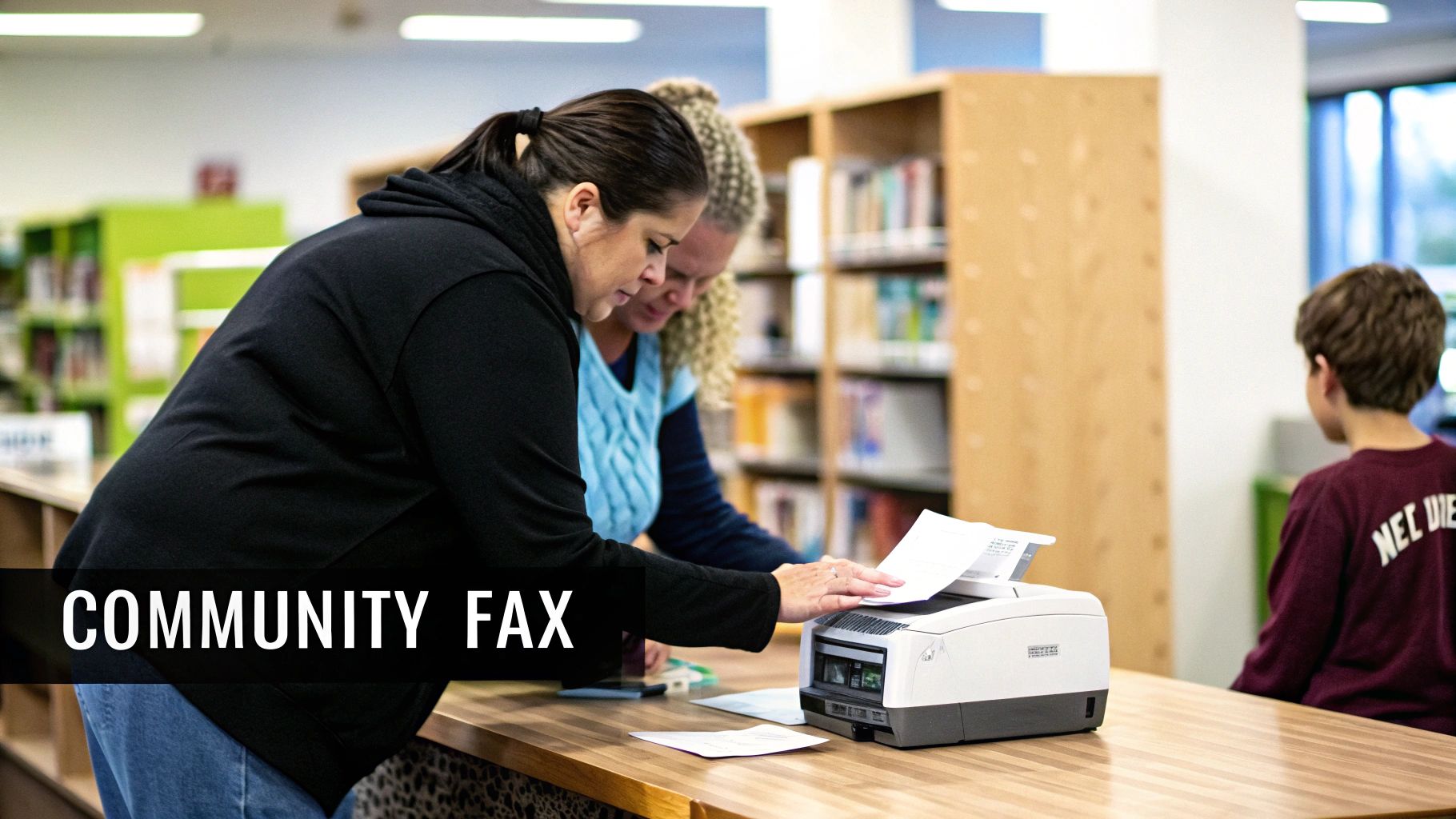
    For those seeking an affordable, community-based option for where to go to fax a document, public libraries and local community centers are invaluable resources. These public-service-oriented locations often maintain a fax machine for patrons, providing a crucial service for individuals who may not have access to office equipment or reliable internet.

    The process is straightforward: you bring your documents to the service desk, and a staff member typically assists with sending the fax. This hands-on help makes it a great option for anyone unfamiliar with faxing. It's a reliable, albeit less private, method for sending non-sensitive paperwork like applications or forms.

    Two women operating a fax machine in a community library, with a boy sitting nearby.

    Who Should Use This?

    This service is perfect for students, senior citizens, job seekers, and anyone needing to send a fax at a very low cost, or even for free. Community centers, YMCAs, and nonprofit job centers often provide this service to support their members. It's an excellent choice for sending local documents where strict privacy isn't the primary concern, such as submitting a form to a local government agency or a job application.

    Key Advantage: The primary benefit is accessibility and affordability. Libraries and community centers offer a welcoming, low-pressure environment with staff available to help you send your fax correctly, making it ideal for first-time users or those on a tight budget.

    What to Consider

    Availability and cost can vary significantly between locations. While some libraries may offer the service for free, others might charge a small fee per page, often around $0.50 to $2.00. Since these are public facilities, they operate on specific schedules, so you are limited to their business hours. Also, remember that a staff member will handle your documents, so this method is not suitable for highly confidential information.

    Actionable Tips:

    • Call Ahead: Always contact the library or center beforehand to confirm they have a working fax machine, check their hours, and ask about any associated costs.
    • Bring Cash: Many locations only accept cash for faxing fees, so come prepared with small bills and coins.
    • Ask for a Receipt: Always request a printed confirmation page to verify that your document was sent successfully.

    6. Virtual Business Address and Mail Services (Regus, iKor, LiquidSpace)

    For professionals seeking a comprehensive business presence, a virtual office or mail service can be an excellent place to go to fax a document. These services provide a physical business address and mail handling, and often bundle in additional administrative support, including access to faxing services, as part of a monthly package.

    Instead of a standalone service, faxing becomes an integrated part of a broader business infrastructure solution. You typically send your documents through a client portal or by emailing them to the service's administrative team, who then handles the transmission. This is a great solution for maintaining a professional image without the high cost of a physical office lease.

    Who Should Use This?

    This option is tailor-made for entrepreneurs, remote-first companies, and startups that need a prestigious business address for registration and client correspondence. It's ideal for those who already require mail forwarding or a physical address and see faxing as a valuable, convenient add-on rather than a primary, high-volume need.

    Key Advantage: These services bundle multiple professional tools into one package, streamlining administrative tasks and providing a polished business identity that includes a physical address, mail handling, and fax capabilities.

    What to Consider

    The key consideration is value: is the entire package worth the cost? For businesses that only need to fax, this is an expensive route. However, for those leveraging the address and mail services, the included faxing is a significant benefit. Global providers like Regus and specialized services like iKor offer various tiers of service.

    Actionable Tips:

    • Evaluate the Bundle: Compare the total cost of the virtual office package against subscribing to a standalone fax service and P.O. box separately.
    • Check Fax Capabilities: Verify if the service includes both sending and receiving, and understand any page limits or per-page fees that might apply.
    • Confirm Address Use: Ensure the provided business address can be legally used for business registration or LLC formation in your state or country.

    7. Smartphone and Mobile App Fax Solutions (Adobe, Microsoft, Specialized Apps)

    For those who need to fax a document while away from a computer, mobile apps provide an incredibly powerful and portable solution. These applications effectively turn your smartphone or tablet into a scanner and fax machine in one, allowing you to capture, sign, and send documents from virtually anywhere. You can use your device's camera to create a high-quality digital scan of a physical paper.

    A person uses a smartphone to scan documents, demonstrating mobile faxing technology.

    This method combines the convenience of online faxing with the added benefit of mobile document capture. Simply scan your document using the app, enter the recipient’s fax number, and send. The entire process is managed within a single application, making it a seamless experience for on-the-go professionals.

    Who Should Use This?

    Mobile fax apps are perfect for field agents, travelers, freelancers, and anyone who operates primarily from their smartphone. They are especially useful for situations where you need to send a signed contract, an invoice, or an ID document immediately without access to a computer or scanner. Apps from trusted names like Adobe Acrobat Reader or the Microsoft Office suite often integrate faxing into their existing document management features.

    Key Advantage: The all-in-one capability of scanning, editing, and faxing from a single device offers unmatched convenience for mobile workers. It eliminates the need for any external hardware and streamlines the entire workflow.

    What to Consider

    Choosing the right mobile fax solution depends on your ecosystem and frequency of use. If you already use Adobe or Microsoft products, their built-in fax features are a logical choice. For more specialized needs, dedicated apps like Fax Burner or iFax offer robust features, including temporary fax numbers and detailed tracking. Pricing models vary from free, ad-supported services for occasional faxes to monthly subscriptions for higher volume users.

    Actionable Tips:

    • Optimize Your Scan: Use bright, natural light without shadows and ensure the document fills the entire frame for a clear, legible scan.
    • Verify Scan Quality: Always preview the scanned document to check for blurriness or cropping issues before sending.
    • Maintain Stable Connection: Ensure you have a strong Wi-Fi or cellular data connection to prevent transmission failures.
    • Keep Your Originals: Hold onto the physical document until you receive a successful transmission confirmation.

    8. Corporate Telephone and VoIP Systems (Built-in Fax Features)

    For businesses already invested in modern communication infrastructure, the answer to "where to go to fax a document" might be their existing telephone system. Many corporate Voice over IP (VoIP) and unified communications platforms include faxing capabilities as a standard or add-on feature, integrating it directly into the company’s workflow.

    This method leverages your internet-based phone system to send and receive faxes digitally. Instead of a separate fax machine or service, employees can send documents through a dedicated software application, a web portal, or even via email-to-fax. Platforms like 8×8, Ooma Office, and Vonage Business often bundle this functionality, centralizing all business communications.

    Who Should Use This?

    This solution is tailor-made for small to large businesses that already use a VoIP system and want to consolidate their communication tools and vendors. It streamlines operations by allowing employees to manage calls, voicemails, and faxes from a single interface, eliminating the need for separate fax contracts and hardware. It’s an efficient way to equip an entire organization with fax capabilities.

    Key Advantage: Integrating faxing with your VoIP system centralizes communications and simplifies billing. It provides a professional, unified solution without adding another standalone service to manage.

    What to Consider

    The primary consideration is whether your current provider offers this feature and if it meets your needs for reliability and volume. Some systems may have limitations on page counts or charge extra for higher usage tiers. It is crucial to confirm that the service quality is sufficient for business-critical documents, as not all VoIP fax integrations are created equal.

    Actionable Tips:

    • Check Your Current Plan: Contact your VoIP provider (e.g., Grasshopper, 8×8) to see if faxing is included or can be added to your existing package.
    • Test Transmission Quality: Before relying on it for important documents, send several test faxes to an external number to verify delivery speed and clarity.
    • Configure Fax-to-Email: Set up incoming faxes to be delivered to an email address for easy digital archiving and distribution.
    • Understand Backup Options: Inquire about system reliability and have a backup method ready for when your phone system undergoes maintenance.

    For more insights into modern faxing alternatives, explore this guide on faxing without a traditional landline.

    8 Ways to Fax: Quick Comparison

    Category Core Features UX & Reliability (★) Price & Value (💰) Target Audience (👥) Unique Selling Points (✨ / 🏆)
    Online Fax Services (Web-Based Platforms) Browser/email sends, PDF/DOC support, cover pages, free + paid tiers ★★★★☆ Fast & simple 💰 Free limited (3p+cover; 5/day), $1.99/fax (25p) 👥 Remote workers, freelancers, small biz ✨ No fax machine, instant delivery; 🏆 Best for quick/occasional use
    Office Supply Retailers (UPS Store, FedEx Office) In-person staff-assisted faxing, scanning, receipts ★★★★☆ Professional & reliable 💰 Higher per-page ($2–5+), pay-per-use 👥 Walk-in customers, no-internet users, high‑stakes docs ✨ Staff prep & verified receipts; 🏆 Best for immediate, in-person proof
    Email-to-Fax Services (Integrated Email Solutions) Send from email, auto-convert, tracking, archive ★★★★☆ Seamless for email workflows 💰 Subscription / higher enterprise cost 👥 Businesses with corporate email/IT ✨ Integrates with email/archives; 🏆 Best for enterprise workflow integration
    Healthcare & Legal Fax Services (Specialized) HIPAA/SOC2, end-to-end encryption, audit trails, EMR integration ★★★★★ High security & compliance 💰 Premium pricing (compliance-focused) 👥 Healthcare, legal, finance, regulated orgs ✨ Compliance-certified, audit-ready; 🏆 Best for PHI/privileged documents
    Library & Community Center Fax Services Free/low-cost in-person fax, scanning, staff help ★★★☆☆ Accessible but limited hours 💰 Free–$1–$3 per fax; excellent community value 👥 Underserved populations, seniors, no‑internet users ✨ Low/no-cost access; 🏆 Best for community members without tech
    Virtual Business Address & Mail Services Business address, mail scanning/forwarding, fax add-on ★★★★☆ Professional bundled service 💰 Monthly plans; higher overall cost 👥 Startups, freelancers needing business presence ✨ All-in-one business infrastructure; 🏆 Best for professional branding
    Smartphone & Mobile App Fax Solutions Camera scanning, edit, one-tap send, cloud sync ★★★★☆ Very portable (scan quality varies) 💰 Pay-per-fax or app subscription; moderate 👥 Field agents, traveling pros, realtors ✨ Scan + send on-the-go; 🏆 Best for mobile faxing
    Corporate Telephone & VoIP Systems Fax via existing phone/VoIP, web portal, fax-to-email ★★★★☆ Integrated; quality varies by provider 💰 Often included in telecom costs; low incremental 👥 Businesses with VoIP systems ✨ Uses existing infrastructure; 🏆 Best for consolidated communications

    Choosing the Right Place to Send Your Next Fax

    Navigating the world of faxing in a digital age can feel like a paradox, yet as we've explored, the need for this secure and verifiable communication method persists across many critical industries. The question of where to go to fax a document no longer has a single, one-size-fits-all answer. Instead, the modern landscape offers a diverse array of options, each tailored to specific needs regarding urgency, security, frequency, and budget. Your ideal solution hinges entirely on which of these factors you prioritize most.

    Synthesizing Your Faxing Strategy

    The key takeaway from this comprehensive guide is the power of choice. You are no longer tethered to a bulky, physical fax machine. For the occasional user sending a single document, the convenience of a local office supply retailer like FedEx Office or The UPS Store is undeniable. These locations provide in-person assistance and immediate confirmation, making them a reliable choice for those who prefer a hands-on approach or are sending documents that are already printed. Similarly, public libraries and community centers offer a valuable, often low-cost, service that supports local residents with essential business needs.

    However, for professionals, remote workers, and small businesses, the paradigm has shifted decisively towards digital solutions. The true evolution in faxing lies in the flexibility and efficiency of online platforms. Services ranging from integrated email-to-fax systems to dedicated mobile apps have transformed the process, turning your smartphone or laptop into a powerful, portable fax machine. This digital-first approach eliminates the need for travel, hardware maintenance, and paper, aligning perfectly with modern, streamlined workflows.

    The Modern Faxing Advantage: Convenience Meets Security

    Ultimately, the best place to fax a document is the one that seamlessly integrates into your life or business operations without compromising on security. While physical locations offer tangible peace of mind, the robust encryption and secure protocols of reputable online fax services provide an equivalent, if not superior, level of data protection for sensitive information. By understanding the distinct benefits and limitations of each option, from specialized legal providers to built-in VoIP features, you can make an informed decision. This empowers you to send your crucial documents with confidence, ensuring they are transmitted efficiently, affordably, and securely every single time. Your next fax doesn't have to be a chore; it can be a simple, strategic task.


    Ready to experience the most convenient way to send your documents? For a fast, secure, and pay-as-you-go solution that eliminates subscriptions and hardware, try SendItFax. Visit SendItFax to send your first fax from any device in just a few minutes.

  • Your Ultimate Guide to Modern Scanning and Faxing

    Your Ultimate Guide to Modern Scanning and Faxing

    The way you scan your document can make or break your fax transmission. It really comes down to what you're sending and what tools you have on hand. For a quick receipt, your phone is more than enough. But for a 30-page legal contract, you'll want something more robust to ensure it looks professional on the other end.

    From Paper Piles to Perfect Pixels

    Before you can even think about faxing, you need a clean, high-quality digital version of your document. This first step is everything. A blurry, crooked scan is like sending a message written in invisible ink—it’s useless and can lead to serious mix-ups or delays.

    The good news? You probably already have a great scanner nearby, whether it's the phone in your pocket or the big printer in the corner of your office. The trick is just picking the right one for the job. Getting this right from the start means your fax will arrive looking sharp and completely legible every single time.

    Choosing the Right Scanning Tool

    Deciding how to scan your document isn't complicated. It's a practical choice based on what you're scanning, how good it needs to look, and how much time you have. Let's look at the most common tools and figure out which one fits your situation.

    Here's a quick comparison to help you decide on the fly:

    Scanning Method Best For Pros Cons
    Smartphone Camera Single-page, on-the-go items like receipts, signed forms, or quick notes. Extremely convenient; no extra hardware needed; fast for simple tasks. Quality can be inconsistent; relies on good lighting and a steady hand.
    Flatbed Scanner High-importance documents: legal contracts, photos, ID cards, medical records. Unbeatable quality and resolution; perfect alignment and even lighting. Slower, especially for multi-page documents; requires dedicated hardware.
    Multi-Function Printer (MFP) Multi-page documents: reports, invoices, applications. Great balance of quality and speed; Automatic Document Feeder (ADF) is a lifesaver. Bulkier than other options; ADF can sometimes misfeed pages if not loaded carefully.
    Each of these tools has its place. Your phone is perfect for speed, the flatbed is the go-to for quality, and the MFP is the all-around workhorse for a busy office.

    The Smartphone: Your Scanner on the Go

    For most day-to-day needs, your smartphone is a powerhouse. When you just need to fax a signed permission slip from the school parking lot or snap a picture of a receipt for your expense report, a mobile scanning app is your best friend. Apps like Adobe Scan or even the built-in Notes app on an iPhone can automatically find the edges of your document, get rid of shadows, and turn it into a crisp PDF. For pure convenience, you can't beat it.

    The Flatbed Scanner: When Quality Is King

    However, there are times when "good enough" isn't good enough. For documents where every single detail matters—think legal contracts, detailed architectural plans, or medical records—a flatbed scanner is the only way to go. It gives you a perfectly controlled environment with even lighting and high-resolution capture that a phone just can't replicate. The result is a flawless digital copy, which is absolutely critical for official or legally binding paperwork.

    The All-in-One: The Office Workhorse

    So, what about a busy office with a mix of scanning jobs? That's where the multi-function printer (MFP), or all-in-one, really shines. These machines are the swiss army knives of the office, combining printing, copying, and scanning into one central hub. They strike a great balance, offering the quality of a flatbed with the speed needed for multi-page documents, all thanks to their automatic document feeders (ADF).

    Real-World Tip: When you're using an ADF to scan a long document like a client agreement or a stack of invoices, always do a quick spot-check. I always glance at the first and last page of the digital file to make sure no pages got skipped or scanned at a weird angle. It takes five seconds and can save you a huge headache.

    The MFP is built to handle the daily grind of an office, easily digitizing everything from a one-page memo to a 50-page report. It's the reliable core of any modern office workflow.

    Getting Your Files Ready for a Perfect Send

    A great scan is the first part of the puzzle, but prepping the file correctly is what really seals the deal. Think of it as a pre-flight check for your documents. Nailing these details ensures what your recipient sees on their end is just as crisp and clear as what's on your screen.

    This workflow breaks down the three most common ways people turn a physical piece of paper into a digital file ready to fax.

    A process flow diagram illustrating three scanning methods: mobile, MFP (multifunction printer), and flatbed.

    Whether you’re using your phone for a quick job or a dedicated scanner for high-quality results, each path has its own pros and cons.

    Dialing in the Right Resolution

    The resolution of your scan, measured in dots per inch (DPI), is a balancing act. It directly affects how readable your document is and how big the file size gets. If the file is too big, the fax might fail. Too small, and it could be a blurry mess.

    For most documents filled with text, 200 DPI is the industry-standard sweet spot. It keeps everything perfectly legible without making the file so large that it chokes the transmission.

    Got a document with tiny footnotes or detailed graphics? Bumping the resolution up to 300 DPI is a smart move. I’d advise against going any higher, though. For faxing, you get diminishing returns on quality, and the file size just balloons, slowing everything down.

    Picking the Best File Format

    The file type you save your scan as is just as critical as the scan itself. While you'll see a lot of options, a couple of formats have proven to be the most reliable for faxing.

    Here’s the breakdown:

    • PDF (Portable Document Format): This is the undisputed king for a reason. PDFs lock in all your formatting, fonts, and images, so that multi-page contract looks exactly how you intended. They are secure and universally accepted.
    • TIFF (Tagged Image File Format): You'll often see TIFF files in medical and legal settings. It's a high-quality "lossless" format, meaning it's great for single-page scans where every last pixel matters. For anything with multiple pages, however, PDF is usually the more practical choice.

    What if your document is already digital, like a Word file? You'll need to convert it properly first. We've put together a complete walkthrough on how to convert Word to PDF that covers all the best practices to get your files fax-ready.

    Making Files Smaller Without Sacrificing Quality

    Compression is your best friend for a fast, successful fax. It shrinks your file size, making it much easier to transmit.

    When you're saving your scan, look for compression settings. If you can, always choose a lossless compression method (like LZW, which is common for TIFFs). This technique reduces the file size without throwing away any data, so the quality stays exactly the same.

    For PDFs, the standard compression settings are usually perfectly optimized for faxing. They intelligently remove junk data while keeping the important stuff—your text and images—sharp. Honestly, this one simple step can be the difference between a frustrating "transmission failed" error and a successful delivery.

    How to Send an Online Fax Confidently

    You’ve done the prep work and have a perfectly optimized file ready to go. Now for the easy part: sending it. Modern online fax services have turned what used to be a clunky, machine-driven process into something as simple as sending an email. Let's walk through the final steps to get your document where it needs to go, securely and without a hitch.

    Even with all our digital tools, faxing has held on surprisingly well. The global fax machine market was valued at USD 1.5 billion in 2023 and is actually expected to grow, thanks to industries like healthcare and government that rely on its security. According to DataIntelo's market analysis, this isn't just nostalgia; it's a testament to its enduring role. This is exactly why knowing your way around scanning and online faxing is still such a practical skill.

    Uploading Your Document and Entering Details

    Getting your document into the system is usually the most straightforward step. Services like SendItFax are designed to be intuitive, so you’ll typically just see a "Choose File" button or a drag-and-drop area.

    Once your document is uploaded, you'll need to fill out the sender and recipient info. This is the one place you really need to slow down and double-check everything.

    • Your Information: Pop in your name and email address. This is critical because it’s how you’ll get the confirmation that your fax was delivered successfully.
    • Recipient’s Information: Carefully type in the recipient's name and, most importantly, their fax number. A single mistyped digit is the number one reason faxes fail to send.

    This is what a typical online fax interface looks like—clean, simple, and designed to guide you through the process.

    A laptop on a desk displays 'SEND FAX NOW' on its screen, featuring an online fax service.

    The layout helps you avoid mistakes by making sure every required field is filled out before you move on.

    Choosing Your Service Tier

    Most online fax services offer a couple of options to fit different needs. With SendItFax, for example, your choice really comes down to what you're sending and to whom.

    Pro Tip: Think about your audience. A free cover page with the service's logo is fine for casual faxes. But if you're sending a job application or a legal document, the small investment for a clean, unbranded transmission looks far more professional.

    • Free Plan: This is great for quick, one-off faxes that aren't super critical. You can usually send a few pages, but the cover page will have the service's branding on it. It’s perfect for sending a signed permission slip to your kid's school or a quick form to a local business.
    • Paid Plan (like the "Almost Free" plan): For anything that requires a more professional touch, a low-cost, per-fax plan is the way to go. It removes the branding, lets you send longer documents (often up to 25 pages), and can even give your fax priority in the sending queue.

    Ultimately, it’s about matching the tool to the task.

    Adding a Professional Cover Sheet

    The cover sheet is your document's first impression. It tells the recipient who the fax is for, who sent it, and what it’s about. When you use an online service, you’ll just type your message into a text box, and the system will automatically format it into a clean, professional-looking cover page.

    For many people, the real game-changer is being able to send a fax right from their email inbox. It blends the security of faxing with the convenience of a tool you use every day. If that sounds useful, you can learn more in our detailed guide on how to fax via email.

    Before you hit send, just give everything one last look—the recipient’s number, your email, and the file you attached. Then, you can send it off with confidence.

    Confirming Delivery and Troubleshooting Common Errors

    So you’ve scanned your document, prepared the file, and clicked "Send." What now? This next part is arguably the most critical: making sure your fax actually landed where it was supposed to. With an online service, you won't hear that classic fax machine screech, but you'll get something much better—a clear, digital confirmation. Think of it as your official receipt.

    You should get an email notification almost instantly once the transmission finishes. This report is your proof, containing all the important details like the date, time, recipient's number, and the final delivery status. I always make it a habit to file these confirmation emails away, especially for anything that's legally binding or on a tight deadline.

    Decoding Your Fax Status

    Your delivery report will tell you exactly what happened, and knowing how to read the status is key. Most of the time, you'll see a success message, but other statuses are a signal that you might need to step in.

    Here’s a quick breakdown of what you’ll typically see:

    • Sent/Delivered: This is what you want to see. It means your fax went through perfectly and was received by the other machine. Mission accomplished.
    • Busy: This is probably the most common error you'll encounter. It just means the recipient's fax line was tied up when your service tried to connect. The good news is that most services will automatically try again a few times.
    • No Answer: This one means the receiving machine never picked up the call. It could be turned off, out of paper, or having some other technical hiccup.
    • Failed: This is a more generic error that could mean a few different things—a bad connection, an issue with your file, or even a wrong number.

    A "Busy" signal isn't a failure—it's just bad timing. Before you resend, I always suggest waiting about 15-20 minutes. This gives the other line a chance to clear and often solves the problem without any extra effort on your part.

    Quick Fixes for Common Faxing Problems

    When a fax fails, it’s usually for a pretty simple reason. Instead of getting frustrated, just run through this mental checklist to figure out what went wrong.

    First, check the fax number. I know it sounds obvious, but a single mistyped digit is the number one reason faxes fail. Carefully double-check that you entered the right number, including the full area code. It’s an easy mistake to make when you're moving fast.

    If the number is right and you're still getting "Busy" or "No Answer" errors, the problem is almost certainly on their end. Their machine might be offline, out of paper, or just unplugged. The simplest solution is often the best: give the recipient a quick phone call to ask if their machine is on and ready to receive. It can save you a ton of hassle.

    Finally, take a look at your file. If it’s too large or saved in an unsupported format, the transmission might time out or fail. Stick to standard PDF files and keep an eye on the page count to ensure a smooth delivery.

    Getting Serious About Security and Compliance

    For a lot of us, how a document gets sent is just as important as what’s inside it. When you're dealing with medical records, legal contracts, or financial statements, security isn't just a nice-to-have feature—it's a hard requirement. The entire process, from scanning a piece of paper to hitting "send" on a fax, needs to line up with some pretty strict legal and privacy standards.

    There's a reason faxing has stuck around for so long, and it's all about security. A traditional fax machine creates a direct, point-to-point connection over a telephone line. That makes it a whole lot harder to intercept than your average email, which is why industries governed by rules like HIPAA in healthcare still rely on it day in and day out.

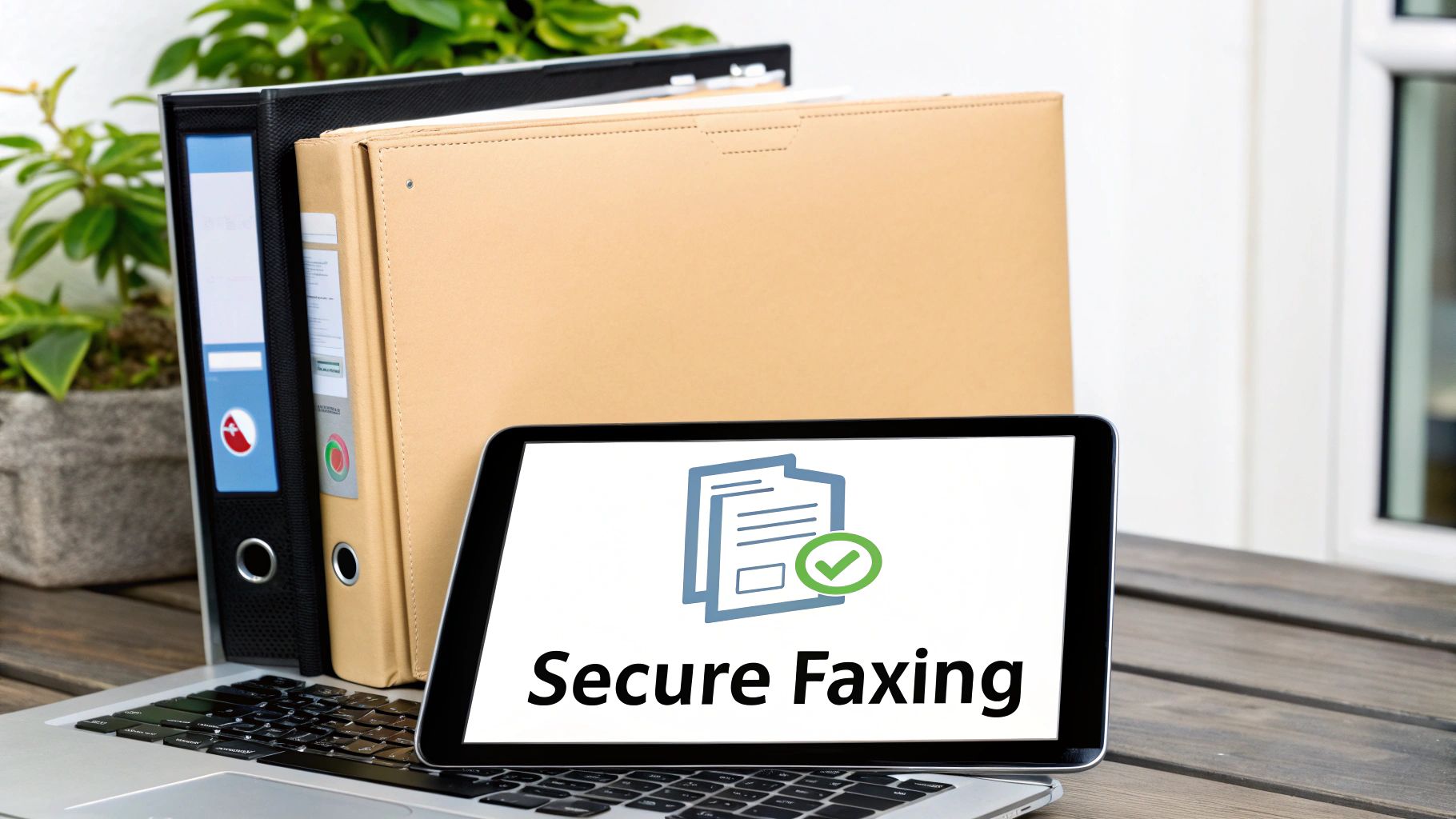
    Tablet displaying 'Secure Faxing' on a laptop keyboard, with office binders in the background.

    And this isn't some fringe technology holding on. People sent over 17 billion faxes in 2019, with US healthcare alone accounting for more than 9 billion of them. The numbers don't lie. Faxing is still the king where compliance is the top priority. A survey even found that 82% of large companies said their fax usage was either holding steady or actually growing.

    How Modern Encryption Elevates Fax Security

    Today's online fax services take that classic security and beef it up with modern digital protection. When you upload a document to a platform like SendItFax, it's immediately wrapped in the same kind of heavy-duty encryption used by your online bank.

    Here’s what’s happening behind the scenes to protect your data:

    • Encryption in Transit: From the moment your file leaves your computer until it reaches the recipient's fax machine, it's scrambled using SSL/TLS encryption. Think of it as sending your document through a secure, armored tunnel where no one can peek inside.
    • Encryption at Rest: Good services don't stop there. They also encrypt your files while they're stored on their servers. This is a critical second layer of defense, protecting your documents before they're sent and after they've been delivered.

    By blending the direct-dial security of old-school faxing with the power of modern encryption, online faxing gives you the best of both worlds. It’s a hybrid approach that satisfies legacy systems while meeting today's tough data privacy demands.

    Practical Tips for Handling Sensitive Information

    While the technology provides a secure pipeline, compliance is a team sport. It starts the second you lay a document on the scanner glass and requires a bit of thoughtful handling all the way through. If you're curious about the nitty-gritty differences, our guide on whether fax is more secure than email is a great read.

    Building a few good habits into your workflow can dramatically lower your risk and keep you on the right side of the law.

    Secure Your Digital Files First

    Before you even get to the sending part, stop and think about where your scanned document is living. Don't be the person who leaves a sensitive client contract or a patient's medical chart sitting on the desktop of a shared office computer. That's just asking for trouble.

    Instead, make it a rule to save scanned files directly to a secure, access-controlled folder.

    Once you get that fax confirmation receipt, have a clear policy for the digital original. If you don't need it anymore, delete it securely. This minimizes your data footprint. For instance, a law firm could have a process where a scanned contract is immediately uploaded to an encrypted client portal, and the local copy on the scanning computer is permanently deleted. It’s a simple step that closes a common security gap.

    Your Questions About Modern Scanning and Faxing, Answered

    Even as we've all moved toward more digital workflows, scanning and faxing haven't gone away. They've just changed. If you’re finally ready to ditch that old, noisy machine in the corner, you probably have a few questions about how this all works today. Let's tackle some of the most common ones I hear.

    The biggest shift is mental—getting past the idea that you need a dedicated, physical machine for these tasks. The modern approach is all about using the tools you already own to get things done faster and more securely.

    Do I Really Still Need a Physical Fax Machine?

    Nope, not at all. Think of an online fax service as a digital bridge. It takes a file from your email or a website and sends it directly to a traditional fax machine on the other end.

    You just upload your document, and the service does all the heavy lifting, handling the transmission over phone lines. This means you can manage everything right from your computer or smartphone without ever needing to touch a dedicated piece of hardware.

    What's the Best File Format to Use for Faxing?

    While you can often send things like DOCX files or even JPG images, PDF is the gold standard. It’s hands-down the most reliable format for any professional document because it locks in all your formatting, fonts, and images exactly as they are.

    When you send a PDF, you know the contract or invoice the recipient sees on their end will look precisely how you designed it. That kind of consistency is absolutely critical for important business communications.

    Is It Secure Enough for Sensitive Information?

    Yes, and honestly, it's often much more secure than the old way. Think about the shared office fax machine, where sensitive documents could sit out in the open for anyone to see.

    Reputable online fax services use strong, end-to-end encryption (like SSL/TLS) to protect your data as it travels. This scrambles the information, making it unreadable if intercepted. It's a method trusted for legal, financial, and even healthcare documents that fall under compliance rules.

    Can I Actually Get a Good Scan From My Phone?

    You absolutely can. Your smartphone, combined with a good scanning app, is a surprisingly powerful tool for creating high-quality digital documents. For most everyday needs, you don't need any other expensive equipment.

    The trick is just to follow a few best practices to get a professional result:

    • Lay your document on a flat surface with a contrasting background, like a dark desk.
    • Make sure you have plenty of light to avoid weird shadows or a grainy-looking image.
    • Let the app's edge detection work its magic to automatically find, crop, and straighten the document for you.

    With the right app, a quick snapshot becomes a clean, squared-up, and fax-ready PDF in just a few seconds. It makes the whole process incredibly smooth.


    Ready to send a fax without the hassle of a machine? With SendItFax, you can upload your document and send it securely in minutes. Try it now at https://senditfax.com.

  • Your Ultimate Guide to Faxing Without a Landline

    Your Ultimate Guide to Faxing Without a Landline

    Believe it or not, that clunky, noisy fax machine tethered to a dedicated phone line is a relic of the past. Today, faxing without a landline isn't some clever workaround—it’s the new standard for getting business done efficiently. It's all about using the cloud to send your documents from literally anywhere.

    The End of the Landline Era for Faxing

    For years, the fax machine and its dedicated phone line were a package deal. It was a costly and rigid setup, but it was the only way to send documents over those old analog signals. As businesses embraced the internet, the traditional fax became a major bottleneck. You were stuck paying a monthly phone bill for a single-use device, not to mention the constant costs of paper, ink, and repairs.

    This old-school approach just doesn't fly in today's flexible work environment. What if you need to send a signed contract while you're working from a coffee shop or a client's office? With a traditional machine, you’d have to wait until you got back to your desk. It’s exactly this kind of limitation that pushed people to find a better way.

    The Modern Shift to Digital Fax

    The solution that emerged is Fax over IP (FoIP), the technology that makes online faxing possible. Instead of wrestling with analog signals, FoIP converts your document into secure digital packets and sends them over the internet. This jump to digital brings some huge advantages to the table.

    • It’s Cheaper: Ditching a dedicated phone line is an immediate cost saving. No more random monthly bills for a machine you barely use.
    • Work From Anywhere: You can send and receive faxes from your laptop, tablet, or phone—any device with an internet connection.
    • Way More Secure: Reputable online fax services use strong encryption to protect your sensitive documents while they're in transit.
    • Simplified Workflow: Faxes land directly in your email inbox as PDFs, making them incredibly easy to save, organize, and share.

    This isn't just a small trend, either. The fax is still a surprisingly critical tool for many industries. A mind-boggling 17 billion faxes were sent globally just last year. And while 66% were still sent from traditional machines, the shift to cloud-based, landline-free faxing is picking up serious speed. You can learn more about the state of faxing on FileCenter.com.

    To give you a clearer picture, let's quickly compare the old way with the new.

    Landline Faxing vs Modern Alternatives at a Glance

    This table breaks down the core differences between sticking with a traditional fax machine and moving to a modern, internet-based service.

    Feature Traditional Landline Fax Online Faxing (No Landline)
    Required Hardware Fax machine, dedicated phone line Computer, smartphone, or tablet
    Mobility Tied to a physical office location Send/receive from anywhere with internet
    Cost Monthly phone line fee, paper, ink, maintenance Monthly or annual subscription fee
    Document Format Physical paper Digital files (PDF, DOCX, JPG, etc.)
    Security Susceptible to physical interception End-to-end encryption, secure cloud storage
    Organization Physical filing cabinets, manual sorting Automatic digital archiving, easy search

    The contrast is pretty stark. One method is rooted in a physical location and analog technology, while the other is built for the digital, mobile way we work now.

    The key takeaway is simple: Faxing technology hasn't disappeared, it has evolved. By moving from physical phone lines to the internet, it has become more secure, convenient, and better suited for the way we work today. The need to transmit secure documents remains, but the bulky hardware and dedicated landline are no longer necessary. This guide will show you exactly how to make the switch.

    Choosing the Right Digital Fax Method for You

    Once you've decided to ditch the landline for faxing, the real question becomes: which digital tool is right for you? It's not a one-size-fits-all situation. The best method really depends on what you do every day, whether you're a freelancer constantly on the move or a small office handling sensitive documents.

    Think about how you work. For example, a real estate agent who needs to get signed offers submitted while out showing properties would find a mobile faxing app to be a lifesaver. They can literally scan a document with their phone's camera, add a signature, and send it off from their car in just a few taps.

    On the other hand, a medical billing office that deals with patient records all day needs something far more secure and organized. For them, a full-featured online fax service with HIPAA compliance, audit trails, and end-to-end encryption is non-negotiable. It's all about matching the tool to the task.

    This simple flowchart really breaks down the core decision.

    A fax decision tree flowchart outlining options: online fax if internet is available, or landline fax if not.

    As you can see, as long as you have an internet connection, you have a clear path away from that old, clunky fax machine.

    Comparing Your Main Options

    So, let's get into the nitty-gritty of your three main options for faxing without a landline. Each has its own strengths, and one will likely feel like a more natural fit for you.

    • Dedicated Online Fax Services: Think of these as your command center for faxing. You log in through your web browser to a full platform. They typically give you a dedicated fax number, serious security features, and handy integrations with cloud storage like Google Drive or Dropbox. This is the go-to for businesses that fax regularly and need robust, reliable service.
    • Mobile Faxing Apps: Built for pure convenience, these apps effectively turn your smartphone into a scanner and fax machine. They're perfect for individuals or professionals who just need to send a fax here and there, especially when they're away from the office. Most work on a pay-per-fax basis or a small subscription.
    • Email-to-Fax Systems: This is a brilliantly simple method that hooks right into your existing email. You just type up an email, attach your document, and send it to a specially formatted address that includes the recipient’s fax number (like 18005551234@senditfax.com). It's a fantastic choice if you practically live in your inbox and don't want to juggle another login or platform.

    The best tool is always the one that slots into your workflow without causing friction. If you're an email power user, email-to-fax is a no-brainer. Always on your phone? A mobile app is your best friend.

    Factors to Guide Your Decision

    As you weigh the options, keep these key points in mind. They’ll help you pick a service that not only works for you today but can also grow with you. For a much more detailed breakdown of specific providers, check out our online fax services comparison.

    Feature Best For… Key Consideration
    Cost Structure Occasional users vs. high-volume businesses Pay-per-fax models are great for sending a few pages a year. Monthly plans offer much better value if you're faxing regularly.
    Security Needs Legal, healthcare, and financial industries Look for services that explicitly mention end-to-end encryption and compliance with regulations like HIPAA.
    Ease of Use Users who want simplicity and speed Mobile apps and email-to-fax are usually the easiest to pick up and use immediately, with almost no learning curve.
    Integrations Businesses using cloud storage & other tools Does it connect to the tools you already rely on? Check for compatibility with Google Workspace, Microsoft 365, Dropbox, etc.

    Sending Your First Online Fax in Minutes

    Jumping into online faxing is way easier than wrestling with old hardware. Let's walk through a real-world example to show you just how fast it can be.

    Imagine you need to get a signed rental agreement over to a property manager, like, right now. The signed PDF is sitting on your desktop, and you need it delivered securely in the next five minutes. No problem.

    With an online fax service like SendItFax, this is surprisingly painless. You just pull up the website and get started. There's no software to install or a confusing manual to decipher; the whole thing is set up to feel as familiar as sending an email.

    Hands typing on a laptop keyboard with a prominent 'SEND IN MINUTES' banner, indicating fast communication.

    From Document to Delivery Confirmation

    First things first, you need to upload your document. You’ll see a clear button to "Upload File" where you can select the rental agreement PDF from your computer. Most services are flexible and accept common file types like DOCX and even JPGs, so you don't have to stress about converting anything.

    Pro Tip: I always recommend using a PDF when possible. It locks in the formatting, so you know what you send is exactly what they'll see on their end—no weird line breaks or font issues.

    Next, you'll fill in the recipient's details, just like addressing an envelope. Pop the property manager's fax number into the field. Make sure to double-check this number! A single wrong digit is the number one reason faxes fail to send. Then, you’ll add your own name and email so the service can send you the confirmation receipt.

    This is the magic of faxing without a landline. The service is basically a digital translator, taking your uploaded file and web form details and converting them into a standard fax transmission that any traditional fax machine can understand.

    Many platforms, including SendItFax, also let you add a simple cover page. This is incredibly useful for adding context. For that rental agreement, you could write a quick note like, "Attached: Signed lease for Unit 4B. Please confirm receipt. – Jane Doe." It’s a small touch that prevents any confusion.

    Once you give everything a final look, just hit "Send." The service handles all the technical stuff—dialing the number and transmitting your document. You'll usually see a progress screen, and in just a few minutes, a confirmation email will hit your inbox. That email is your proof of delivery, detailing the time, date, and transmission status. For a more detailed walkthrough, you can check out our guide on how to send a fax online.

    The Shift to Digital Faxing

    This incredible ease of use is a huge part of why the online fax market has exploded. It was recently valued at over $2.5 billion and is projected to keep growing through 2029. This boom is a direct result of people and businesses ditching their landlines in favor of more flexible, internet-based communication tools. You can explore a full report on these market trends at Global Market Monitor for a deeper dive.

    Receiving faxes is just as simple. When someone sends a fax to your dedicated online number, it doesn't print out on a clunky machine. Instead, the service converts it into a PDF and delivers it straight to your email inbox as an attachment. This means you can get, review, and save important documents from anywhere, on any device, without ever needing to touch a piece of paper.

    Keeping Your Digital Faxes Secure and Private

    A tablet displaying secure information with a padlock icon, next to a document reading 'Secure Faxing' with another padlock.

    When people think "fax," security might not be the first thing that comes to mind. But for industries like healthcare, finance, and law, it’s the very reason this technology has stuck around. The good news is that when you switch to faxing without a landline, you don't lose that security—in fact, you often gain a whole lot more.

    A standard email can be easily intercepted or misaddressed, but a secure online fax service creates a protected, point-to-point connection for your documents. It’s less like sending a postcard and more like using a digital armored car.

    Take healthcare, for instance. A staggering 75% of all medical communication around the globe still happens via fax. In the United States, that translated to over 9 billion faxes in a single year, largely because of strict privacy laws like HIPAA. The future of this market is clearly in the cloud, as explained in this article on the future of cloud faxing at Documo.com.

    Key Security Features to Look For

    Not all online fax services are built the same. When you're handling sensitive information, it pays to know what’s happening behind the scenes. Here are the non-negotiable security features to look for.

    • End-to-End Encryption: Your document should be unreadable from the moment you send it until it’s delivered. Look for services that use TLS (Transport Layer Security) encryption—the same technology that secures your online banking.
    • Detailed Audit Trails: A clear digital paper trail is essential. Reputable services give you detailed confirmation reports with timestamps, recipient numbers, and delivery status, which can serve as legal proof of transmission.
    • Secure Cloud Storage: Where are your faxes stored? The best providers have SOC 2 (Service Organization Control 2) compliance, meaning they’ve passed tough third-party audits on their data security controls.

    The real advantage of a quality online fax service is verifiable security. It turns a simple transmission into a documented, encrypted, and compliant event, giving you peace of mind when sending confidential client or patient files.

    Meeting Strict Compliance Standards

    For many businesses, following industry regulations isn't a choice. A single data breach can result in massive fines and destroy client trust. This is where a compliant online fax service becomes an essential part of your toolkit.

    Healthcare providers, for example, must comply with the Health Insurance Portability and Accountability Act (HIPAA). A truly HIPAA-compliant fax provider will sign a Business Associate Agreement (BAA), which is a legal commitment to protect patient information according to federal law.

    Many professionals wonder whether to use fax or email for secure documents. For regulated industries, the choice is pretty clear. We explored this topic in detail in our breakdown of whether fax is more secure than email.

    Ultimately, choosing a provider that builds its service around these security protocols means you're not just sending a file—you're protecting your business, your reputation, and your clients.

    Working Through Common Digital Faxing Problems

    Even with the best online tools, sending a digital fax can occasionally hit a bump in the road. Getting that "fax failed" notification is always a pain, but the fix is usually something simple. When you're faxing without a landline, most headaches come down to just a handful of common, easy-to-fix issues.

    More often than not, the culprit is a simple typo in the recipient's information. A single wrong digit in the fax number guarantees an immediate failure. It sounds almost too basic to mention, but you'd be surprised how many transmission errors are caused by just that. Always double-check every digit, including the area code, before you send.

    Another frequent problem is a low-quality document. If you're scanning a physical paper to create your file, look out for blurriness, dark shadows, or text that's hard to read. A traditional fax machine on the other end might see a blurry scan as a transmission error. A clean, high-resolution scan is your best bet for a successful send.

    When Your Fax Just Won’t Send

    So, you’ve confirmed the number is correct and your document looks sharp, but it's still not going through. The issue might not be on your end at all. The recipient's machine could simply be busy on another call, turned off, or out of paper. Most online fax services are smart enough to automatically try resending it a few times.

    If repeated attempts fail, here are a few other things to check:

    • Look at the File Size: Many services have a limit on how large a file can be. If you’re sending a massive, high-res PDF, try compressing it. Scanning at a lower resolution like 200 DPI is usually perfectly fine for most documents and creates a much smaller file.
    • Check Your Internet: Is your own internet connection stable? If it drops out while the fax is being sent, the transmission will fail.
    • Call the Recipient: It might feel old-school, but a quick phone call is the fastest way to confirm their machine is on and ready to receive.

    A "delivery failed" error isn't always a sign of a problem with your setup. The classic busy signal is still a thing, even in the digital age. A little patience goes a long way, as most platforms will automatically retry for you.

    "I Never Got It": Handling Receipt Denials

    What happens when you get a delivery confirmation, but the person on the other end swears they never received your fax? This is a common scenario, especially in busy offices where a printed fax can easily get lost in a stack of papers.

    Your delivery confirmation report is your proof of transmission. It includes a precise timestamp and other data showing that the fax was successfully delivered to the receiving machine. The best approach is to politely share this confirmation with the recipient and ask them to check their machine's print tray or ask around the office.

    Services like SendItFax are built to make this process as smooth as possible, with clean interfaces that help prevent user error from the start. In the end, troubleshooting a digital fax is just a matter of checking your work methodically—from the number you typed to the quality of the file you sent.

    Common Questions About Faxing Without a Landline

    Moving on from a technology that's been a business staple for decades naturally brings up a few questions. When you're used to the familiar hum of a fax machine, switching to a digital method can feel like a big leap.

    Let's clear up some of the most common uncertainties about ditching the landline so you can feel confident making the change.

    Are Faxes Sent Online Still Legally Binding?

    Yes, absolutely. Faxes sent through a reputable online service are just as legally binding as those sent from a traditional machine. In many ways, they're even better from a legal standpoint.

    Modern fax services create detailed confirmation pages and audit trails that serve as solid proof of transmission and receipt. These digital records capture exact timestamps and all the sender and receiver info, making them incredibly reliable for contracts, official forms, and legal notices.

    Can I Keep My Existing Fax Number?

    For most businesses, this is a huge relief: yes, you can. If you have an established fax number that clients and partners have been using for years, you don’t have to give it up. The process is called "porting," and it's just like moving your cell phone number to a new carrier.

    Most major online fax providers will handle the porting process for you. It can take a few days or a couple of weeks, but once it's done, the transition is seamless. All faxes sent to your old number will land right in your email inbox, so you won't miss a thing.

    Being able to port your number is a game-changer. It means you don't have to reprint business cards, update your website, or notify every client—making the switch to landline-free faxing completely invisible to the people you work with.

    Do I Need Any Special Software or Hardware?

    Nope, and that's one of the biggest perks. The days of dedicating a corner of your office to a clunky machine are long gone. All you really need is a device with an internet connection.

    That could be your:

    • Computer (desktop or laptop)
    • Tablet
    • Smartphone

    There’s no hardware to buy or complicated software to install. You just log in to your online fax service through their website or open their mobile app. You can send documents you already have saved, or even snap a picture of a physical paper with your phone's camera and fax it on the spot.

    How Much Does It Cost to Fax Without a Landline?

    It’s almost always cheaper than the old-school way. When you factor in the cost of a dedicated phone line, paper, ink, and inevitable machine maintenance, the savings from going digital add up fast. Most online fax services are subscription-based.

    Plans for personal or light use often start around $5 to $10 per month, which typically gets you a generous number of pages to send and receive. For businesses with higher volume, plans might range from $20 to $50 per month for thousands of pages and features like multi-user access. When you compare that to the hundreds you could spend on a traditional setup each year, the choice is pretty clear.


    Ready to send a fax in minutes without the hassle of a landline or creating an account? With SendItFax, you can upload your document and send it securely right from your browser. Try SendItFax for your next fax today.

  • How to Send a Fax from Computer for Free a Practical Guide

    How to Send a Fax from Computer for Free a Practical Guide

    Yes, you absolutely can fax from a computer for free. In fact, it’s a lot easier than you might think. Several web-based services act as a digital bridge, taking your document and zapping it over to a traditional fax machine on the other end. No special hardware, no dedicated phone line, and no clunky software required.

    Why Computer Faxing Is Still a Big Deal

    You might be wondering why anyone still bothers with faxing. It seems like a technology from a bygone era, right? But for some of the most critical industries—think healthcare, law, and government—faxing isn't just an old habit. It’s often a strict requirement.

    The reason it has stuck around is surprisingly simple: security and legal standing. A fax transmission is a direct, point-to-point delivery, creating a verifiable record that a document was sent and received. This makes it a legally recognized form of communication for things like medical records or legal contracts.

    A laptop displays 'SECURE FAXING' with a padlock icon on a wooden desk, alongside a stethoscope, notebook, and plant.

    That's precisely why learning how to fax from a computer for free is such a game-changer. You get the best of both worlds: the trusted, secure nature of a traditional fax combined with the sheer convenience of modern technology. Instead of being chained to a desk with a bulky machine that’s always out of paper or ink, you can send crucial documents from your laptop, wherever you happen to be.

    The Modern Advantage of Digital Fax

    Let's be clear, switching to online faxing isn't just about convenience. It’s a smart move for your wallet and your workflow. When you ditch the physical hardware, you’re also saying goodbye to all the hidden costs—maintenance, dedicated phone lines, paper, and pricey toner cartridges.

    When you weigh the old against the new, the benefits of faxing from your computer become obvious.

    Traditional Fax Machine vs Free Computer Faxing

    Feature Traditional Fax Machine Free Computer Fax Service
    Hardware Requires a physical machine, phone line None needed—just a computer & internet
    Supplies Constant need for paper, ink, toner Completely paperless
    Cost Machine purchase, line rental, supply costs Free for occasional use, low monthly fees for more
    Location Tied to a physical location Send from anywhere in the world
    Confirmation Prints a confirmation sheet (if it works) Digital confirmation sent to your email

    As you can see, the shift to digital is a significant upgrade.

    This move to online services brings some serious perks:

    • Total Accessibility: Need to send a time-sensitive contract? You can do it from home, a coffee shop, or your hotel room. No more hunting for a FedEx or a local print shop.
    • Real Cost Savings: For those one-off faxes, a free service is perfect. You avoid the per-page fees that can quickly add up, which often range from $0.10 to $0.50 per page with traditional methods.
    • Tighter Security: Good online fax providers use encryption to scramble your data as it travels, adding a layer of security you don’t get from a document sitting on a public fax machine tray.
    • Eco-Friendly: Going paperless means you’re saving trees and keeping toner cartridges out of landfills. It's a small change with a real environmental impact.

    Don't just take my word for it. The global market for fax services, including platforms that let you fax from a computer for free, was valued at a staggering USD 3.31 billion in 2024.

    This isn't a niche market; it's a direct response to a persistent business need. You can dive deeper into the fax service market analysis to see just how relevant this technology remains. For small businesses and freelancers, the savings are tangible, often running into thousands per year. This isn't about replacing email—it's about having a modern tool for a communication standard that, for better or worse, is here to stay.

    How to Choose the Right Free Fax Service

    Let's be honest, navigating the world of "free" online fax services can feel like walking through a minefield of hidden limitations and surprise paywalls. The word "free" is a powerful magnet, but not all services are created equal. Picking the right one is the key to getting your document sent without frustration, unexpected costs, or privacy headaches.

    Before you even think about uploading a file, the first thing you need to hunt down is the page limit. This is the biggest catch with any service that lets you fax from a computer for free. Most providers cap how many pages you can send in one go, per day, or over a month. For a quick, one-page invoice, you're golden. But for a 15-page contract? You could hit a wall fast.

    The reality is that free services are designed for occasional, low-volume users. They offer a taste of convenience, hoping you'll upgrade if you need more. Always find the fine print on page limits before you start—it'll save you from a nasty surprise when you're on a deadline.

    Digging Into the Details

    Once you've confirmed the page count works for you, file compatibility is your next checkpoint. The best services are flexible, but you can't assume they'll take any file you throw at them.

    Here's what to look for:

    • PDF: This is the gold standard. It's universally accepted and the safest bet for making sure your document's formatting doesn't get messed up.
    • Microsoft Word (DOC, DOCX): A lot of platforms handle Word files just fine, which is a huge time-saver if you don't want to convert your document first.
    • Image Files (JPG, PNG): Need to send a scanned receipt or a photo of a signature? Make sure the service explicitly supports common image formats.

    The overall experience matters, too. Some services make you jump through hoops, forcing you to create an account just to send a single fax. That usually means verifying your email and opting into their marketing list. Others, like SendItFax, get straight to the point, letting you send a document without any sign-up required. It’s perfect for those one-off, hassle-free tasks.

    Here’s a quick visual of how online faxing works behind the scenes. It helps to understand how a web service can talk to an old-school fax machine.

    This diagram shows your digital file being converted and sent over traditional phone lines to its destination, with the online provider acting as the middleman.

    To make this easier, I've put together a quick comparison of some popular options so you can see the trade-offs at a glance.

    Feature Comparison of Popular Free Fax Services

    Service Name Free Pages per Day/Month Account Required? Includes Cover Page? Supported File Types
    SendItFax 5 pages/day No Yes PDF, DOC, DOCX, JPG, PNG
    FaxZero 5 faxes/day (3 pages each) No Yes (with ads) PDF, DOC, DOCX
    GotFreeFax 2 faxes/day (3 pages each) No Yes (optional) PDF, DOC, DOCX, RTF
    Fax.Plus 10 pages total (one-time) Yes Yes PDF, DOC, JPG, PNG, TIFF

    This table highlights the most common limitations you'll encounter. For a simple, one-time send, a service without an account requirement is usually the fastest path.

    Security and the Fine Print

    Finally, and this is the big one, you have to think about privacy. When you upload a document, you're putting your trust in that company. A reputable provider will be transparent about how they handle your data. Look for any mention of encryption (like SSL/TLS) on their site—that's the technology that scrambles your data to keep it safe on its journey.

    Taking a minute to skim the privacy policy is always a good move, especially if you're faxing sensitive information like financial or medical records. You want to be sure your files aren't being sold or stored forever. For a much deeper dive into this, you can check out this comprehensive online fax services comparison that weighs the good and the bad of different providers. A little research upfront can save you from a major headache down the road.

    Sending Your First Fax from Your Computer

    Alright, you've picked out a free service. Now for the easy part: actually sending the fax. The good news is this is a lot less frustrating than wrangling with an old-school fax machine. You can get this done in just a couple of minutes.

    Let's get your document sent with zero guesswork.

    Getting Your Document Ready to Go

    Before you even open a web browser, take a moment to prep your file. This single step will save you a world of headaches later.

    When it comes to online faxing, PDF is the undisputed champion. Why? Because it locks in all your formatting. What you see on your screen is exactly what prints out on the other end, with no weird line breaks or missing fonts.

    Most programs you use every day, like Microsoft Word or Google Docs, have a built-in "Save as PDF" or "Print to PDF" option. Just use that. If you're trying to fax a picture (like a JPG or PNG), a quick search for a free online PDF converter will do the trick.

    This simple diagram lays out the key things to keep in mind before you click send.

    A diagram illustrating the free fax service selection process, detailing pages limit, file types, and security.

    Think of it as a pre-flight checklist: check your page count, make sure your file is a PDF, and stick with a secure service.

    Using the Online Fax Service

    With your PDF ready, head over to the website of the free service you chose. You'll find the interface looks a lot like sending a basic email—no complicated menus or confusing settings.

    You'll typically see a simple form asking for:

    • Your Details: Your name and email address. The email is non-negotiable, as this is how you'll get the confirmation that your fax was delivered successfully.
    • Their Details: The recipient's name and their full fax number. Don't forget the area code!
    • Your File: An "Upload," "Attach File," or "Choose File" button. Click it, find the PDF you just saved, and select it.

    My Pro Tip: The most common mistake I see is a simple typo in the fax number. Seriously, double-check it. Then check it again. One wrong digit and your fax goes nowhere. If you're sending internationally, make sure you've got the country code right, too.

    Adding a Digital Cover Page

    Nearly every free service will automatically create a cover page for you. This is your fax's version of an envelope, telling the recipient who it's from and why you sent it.

    Don't skip this part! Filling out the cover page looks professional and prevents your document from getting lost on a shared office machine. Just add your name, contact info, the recipient's name, the date, and a clear subject line like, "Signed Agreement – Invoice #54321".

    Once everything is filled out and your file is attached, hit the big "Send Fax" button. The service handles the rest, and you'll get a confirmation receipt in your email inbox, which is your proof of transmission.

    The whole ecosystem of sending a fax from a computer for free is surprisingly massive. This isn't some niche technology; the global online fax market was valued at a whopping USD 4.18 billion in 2024 and is expected to soar to USD 12.52 billion by 2031. That growth is largely fueled by industries like healthcare and legal services that rely on faxing for its security. You can read more about the online fax market's growth if you're curious.

    Mastering Page Limits, Cover Pages, and Confirmations

    So you've figured out the basics of sending a fax from your computer. Great. But successfully sending a document is one thing; mastering the little details is what separates a smooth experience from a frustrating one. Let's break down the three things that often trip people up: page limits, cover pages, and delivery confirmations.

    The Hard Truth About Free Page Limits

    The biggest "gotcha" when you fax from computer for free is almost always the page limit. These aren't just friendly suggestions—they're hard caps that dictate what you can actually send.

    Most free fax websites set a daily limit, which is often around five pages. Some might give you a one-time "bucket" of free pages that disappear once used, while others have a small monthly allowance. Before you even think about uploading your file, hunt down this number. It’s the single most important piece of information on the entire site.

    Why Your Cover Page Is Non-Negotiable

    After you’ve got the page limit sorted, the next detail to focus on is the cover page. Many free services include one automatically, and you should always take advantage of it. Think of it as the professional handshake before your document even gets read. It's what keeps your important papers from getting lost in the shuffle on a shared office machine.

    A solid cover page needs to clearly state:

    • To: The recipient’s full name and department, if you know it.
    • From: Your name and a way to reach you (email or phone).
    • Subject: A quick, clear description like "Signed Rental Application" or "Invoice #7891."
    • Pages: The total page count, including the cover sheet itself.

    This simple step adds a layer of professionalism and makes it much easier for your document to find its way to the right person. Some services, like SendItFax, even let you customize the message, which is perfect for adding specific instructions or a personal note.

    "Sent" vs. "Delivered": The Confirmation That Actually Matters

    Finally, we need to talk about the most crucial piece of the puzzle: the confirmation. Hitting "send" doesn't mean your job is done. You need proof that your fax actually arrived, and it's important to understand that not all confirmations are the same.

    You'll almost always get an email, but you have to read it carefully. A "sent" notification just means the service successfully transmitted your data into the ether. What you're really looking for is a "delivery" confirmation. This is the one that verifies the machine on the other end actually received the transmission successfully.

    This digital receipt is your modern-day equivalent of the old paper confirmation sheet. It’s your proof that the document arrived. Without it, you’re just hoping for the best.

    The ability to fax from computer for free is part of a massive market valued at an impressive USD 4,177.5 million in 2024. This growth is fueled by its ability to slash hardware costs by 70-90% for people who only need to fax occasionally. You can dig into more data on the online fax market's rapid expansion to see just how big the shift has been.

    If you find the free limits are holding you back, exploring a fax online free trial with a paid service can be a great next step. It often unlocks higher page counts and more business-focused features. Getting these details right from the start ensures every important document you send is professional, confirmed, and successfully delivered.

    How to Troubleshoot Common Free Faxing Errors

    A person in a black shirt looks at a computer screen under a 'FIX FAX Errors' banner.

    It happens. You've followed all the steps, hit send, and then… nothing. Or worse, you get a "failed transmission" notification. When you fax from computer for free, a glitch can be a real headache, especially when a document is time-sensitive. But don't worry, most of these errors are surprisingly easy to sort out.

    The classic culprit is a "busy signal" or "no answer" message. This isn't your fault at all. It just means the fax machine on the other end is already tied up or nobody's there to answer. The fix here is simple: just be patient.

    Give it 10-15 minutes and try again. More often than not, the line will be free, and your fax will sail through on the second try.

    Fixing File Format and Page Limit Issues

    Another common snag is the dreaded "unsupported file format" error. Even if a service says it accepts DOCX or JPG files, those formats can sometimes get mangled during the conversion process, messing up your document's layout.

    The surefire way to avoid this is to always convert your document to a PDF first. A PDF locks everything in place, so what you see on your screen is exactly what they’ll get on their end. It’s the gold standard for online faxing and just takes a quick "Save as PDF."

    If you get a generic "transmission failed" message, run through this quick mental checklist before doing anything else:

    • The Fax Number: This is the #1 reason faxes fail. Did you double-check every digit? Make sure you included the full area code and the country code (like "1" for the U.S. and Canada) if needed. A single wrong number is all it takes.
    • The Page Count: Did you slip over the free service's page limit? Don't forget, most services count the cover page as one of your pages. If you're over the limit, the fax will simply be rejected.

    Here's a pro tip for troubleshooting: try to isolate the problem. If you think it might be your file, send a single, blank page to the same fax number. If that goes through successfully, you know the recipient's line is fine and the issue is with your original document.

    When the Problem Is on Their End

    Sometimes, the issue is completely out of your hands. You've waited out a busy signal, you've confirmed the fax number is perfect, and your file is a clean PDF. At this point, the problem is almost certainly with the receiving machine.

    It could be out of paper, turned off, or just having a technical tantrum.

    If you can, it's worth reaching out to the recipient through another channel, like a quick phone call or email. Just a simple message like, "Hey, I've been trying to send you a fax, but it's not going through. Can you check your machine?" can save you a lot of time and frustration. It stops you from repeatedly sending a document into the void.

    Have More Questions About Faxing From Your Computer?

    Even after a walkthrough, it's natural to have a few questions pop up when you're about to fax from a computer for free. Let's dig into some of the most common ones I hear, so you can send your documents without any second-guessing.

    Is It Really Free to Send a Fax from My Computer?

    Yes, it really is—for light, occasional use. Most online fax services have a free tier that’s perfect for sending a signed contract or a one-off form. They’re designed for the person who doesn't need to fax every day.

    The catch is usually in the limits. For instance, a free service might cap you at five faxes per day, with each fax being no more than three pages. If your needs go beyond that, or if you want premium features like a professional cover page without ads, that's when you'll be prompted to look at their paid plans.

    Can I Receive Faxes for Free with These Services?

    This is a big one, and the short answer is almost always no. Free online fax services are built as a one-way street: for sending documents out.

    To actually receive a fax, you need a dedicated fax number that’s always online and ready for incoming files. This is a core feature of paid subscription plans. When you upgrade, the service gives you a unique number that acts as your digital fax line, allowing others to send documents directly to you.

    Think of it this way: free services let you mail a letter. A paid plan gives you a permanent P.O. Box to receive mail back.

    Are Free Online Fax Services Secure Enough for Sensitive Documents?

    This is a critical question, and frankly, it depends on what you're sending. Most reputable services use standard SSL/TLS encryption to protect your files while they're in transit, which is fine for everyday documents like a signed permission slip.

    However, if you're dealing with highly confidential information—think medical records governed by HIPAA or sensitive financial contracts—you need to be much more careful. Always read the privacy policy to see how they store your data after the fax is sent. Digging into reviews that examine if a service like FaxZero is safe can also give you a better picture. For peace of mind and guaranteed compliance, a paid, business-grade service is the only way to go.

    Do I Need to Install Special Software?

    Nope, not at all! One of the best things about modern online faxing is that it's completely browser-based. You don’t have to download a clunky program or install anything on your computer.

    You handle everything right on the service's website. Just upload your file, enter the fax number, and hit send. The whole experience is designed to feel as simple as attaching a file to an email, which is why so many people now choose to fax from computer for free.


    Ready to send your fax without the hassle of creating an account? SendItFax lets you send documents securely and quickly right from your browser. Try our simple, no-signup service today at https://senditfax.com

  • Free Send Fax From Computer A Practical Guide

    Free Send Fax From Computer A Practical Guide

    Even with email and instant messaging, learning how to send a free fax from a computer is a surprisingly useful skill. Web-based services have made it incredibly simple to send digital documents through a fax line, no clunky hardware required. It’s a modern twist on a communication method that’s still essential in many professional circles.

    Why Sending Faxes From a Computer Still Makes Sense

    It’s easy to think faxing is a relic of the past, but for many industries, it's not just an option—it’s a requirement. If you work in healthcare, law, or finance, you know that faxing is still the go-to for secure and legally binding documents. Sending a signed contract, a patient’s medical records, or a sensitive legal filing requires a level of security that a standard email just can't promise.

    A person sitting at a desk and using a computer to send a document.

    This is where the ability to free send fax from a computer bridges the gap. You get the trusted delivery of a traditional fax without needing to own an actual machine. It’s truly the best of both worlds: the convenience of your digital files and the rock-solid reliability of a fax transmission.

    The Modern Faxing Landscape

    The fax machine hasn't disappeared; it's just evolved. Today, most "faxing" happens through online platforms, right from a laptop or desktop. This isn't just about making things easier—it’s about how businesses now handle their most secure information.

    • Security and Compliance: Reputable online fax services use encryption, which is a huge deal for things like HIPAA or legal compliance where data security is non-negotiable.
    • Cost and Efficiency: Think about it: no physical machine, no dedicated phone line, and no more buying paper and toner. The savings in both money and office space add up quickly.
    • Accessibility and Convenience: You can send a fax from literally anywhere you have an internet connection. Your computer becomes a powerful, portable fax machine.

    It might surprise you, but the resilience of faxing is clear: over 80% of organizations reported that their fax usage either stayed the same or increased in the last year. That's a testament to its ongoing importance.

    This trend is backed up by the swift move to cloud-based solutions. Around 31% of high-usage fax industries have already switched to cloud fax systems, and that number is expected to more than double in the next three years. If you're curious, you can explore more insights about the faxing industry to see just how relevant it remains.

    A Practical Skill for Today's Professional

    Knowing how to send a fax from your computer is more than a neat trick; it's a genuinely practical skill. Picture this: you need to send a signed lease agreement to your new landlord immediately, or you have a time-sensitive form for a government agency that only accepts faxes. Instead of scrambling to find a local print shop with a fax machine, you can get it done in minutes, right where you are.

    This guide will walk you through exactly how to do that.

    Getting Your Documents Ready for a Perfect Fax

    Before you even think about sending a free fax from your computer, the real work happens offline. Getting your documents prepped correctly is the key—it’s what separates a clean, successful transmission from a garbled mess on the other end.

    A person scanning a document with their smartphone to create a digital file.

    Often, you're starting with a physical piece of paper, like a signed form or an invoice. These days, your smartphone is your best friend for this. You don't need a clunky office scanner; an app like Adobe Scan or even the native Notes app on an iPhone can produce a surprisingly sharp digital copy.

    Turning Paper Into a Digital File

    Good lighting is your secret weapon when scanning. Find a spot with even, bright light and avoid casting shadows across the page. I've found that laying the document on a dark, flat surface really makes the text pop and helps the camera focus.

    Hold your phone parallel to the paper to avoid that weird, distorted look. Remember, the recipient needs to be able to read every word. If it's a signed contract, that signature has to be crystal clear. Once you’re happy with the scan, save it as a PDF. It's the gold standard for online faxing and just about every service accepts it.

    If you're new to this whole process, our complete guide on how to send a fax online is a great place to start. It walks you through everything from start to finish.

    Handling Files Already on Your Computer

    What if your document is already digital, like a Word file or a Google Sheet? The best practice is to convert it to a PDF first. This simple step locks everything in place—the fonts, the layout, the tables—so it looks exactly the same for the recipient as it does for you.

    Most programs make this incredibly easy:

    • In Microsoft Word, just go to File > Save As and select PDF from the format list.
    • In Google Docs, you’ll find it under File > Download > PDF Document (.pdf).

    This small action prevents a world of headaches from compatibility problems.

    A common pitfall I see is people trying to fax huge image files. Free fax services always have size limits. A standard, text-based PDF is lightweight and transmits smoothly, avoiding timeouts or failures.

    One last tip: if you have a multi-page document, like an application or a report, combine all the pages into a single PDF file. It’s far more professional and guarantees the pages arrive in the right order. There are plenty of free online tools, like Adobe’s PDF merger, that can stitch them together for you in just a few clicks.

    How to Send Your First Free Fax From Your Computer

    Alright, you've got your document scanned and saved. Now for the easy part. Let's walk through actually sending that fax. We'll use a real-world example: you need to get a signed rental application over to a property manager, and they're asking for a fax. Classic situation.

    Head over to the SendItFax website. The first thing you'll notice is how simple the layout is—it’s designed to get your fax out the door without a bunch of confusing steps. You’ll see a clean form asking for sender and receiver info.

    Filling Out Sender and Recipient Info

    This is the part you want to get right on the first try. Start by putting in your name and a good email address. Why is the email so important? Because that's where your delivery confirmation will land. That email is your proof that the fax went through successfully, so make sure it’s an address you check regularly.

    Next up is the recipient’s information. Enter their name and, most critically, their fax number. For faxes going to the U.S. or Canada, it's just the standard 10-digit number. Getting even one digit wrong is the number one reason faxes fail, so it pays to be careful here.

    My Two Cents: Before I send anything important, I always double-check the fax number. A quick phone call or an email to the recipient to confirm the number can save you a massive headache later. It takes 30 seconds and prevents a failed transmission every time.

    Uploading Your Document and Prepping a Cover Page

    Time to get your document loaded up. You’ll see a button that says something like "Upload File" or "Choose File." Clicking it will open your computer’s file explorer. Go find that rental application PDF you just created and select it. The file name should pop up on the page, letting you know it's attached and ready to go.

    The SendItFax interface is really clean, as you can see. Everything is clearly labeled, so you’re not left guessing where to put the recipient's name or how to attach your file.

    Now, let's talk about the cover page. Even though it might be optional, I always recommend using one. Think of it as the envelope for your fax—it tells the person on the other end exactly who this is for, who sent it, and what they're about to read.

    A good cover page message doesn't need to be long, just clear.

    • To: "Attn: Jane Doe, Property Manager"
    • From: "John Smith"
    • Re: "Rental Application for 123 Main St."
    • Pages: "4 (including cover)"

    This little bit of info is a game-changer in a busy office. It makes sure your application lands directly on the right desk instead of getting lost in a pile of papers. This is a perfect example of how modern tech makes old-school processes better. If you're curious about the mechanics behind this, you can learn more about how fax to email technology works and connects these two worlds.

    With all your info entered and the file attached, you’re on the final step. You'll probably see a quick CAPTCHA to verify you're a human. Check that box, hit the send button, and you're done. The service takes over, and you just have to wait for that confirmation email to hit your inbox.

    What's the Catch with Free Fax Services?

    It's great that you can free send fax from a computer, but it’s wise to go in with your eyes open. "Free" almost always comes with a few trade-offs. These services are genuinely perfect for sending a quick form here and there, but they have some very real limitations you need to know about before you start.

    A magnifying glass hovering over the fine print of a document.

    The most obvious trade-off is branding. To keep the lights on, most free providers will add their logo or a small ad to your cover page. If you're just sending a permission slip to your kid's school, who cares? But if it's a client proposal or a sensitive legal form, that third-party logo can look a little unprofessional.

    Getting to Grips with Page and Daily Quotas

    Beyond branding, you're going to run into usage caps. This is how providers ensure the service is available for everyone and isn't dominated by a few power users. Think of it less like an all-you-can-eat buffet and more like a free sample at the grocery store.

    The limits are usually broken down in two ways:

    • Pages Per Fax: You’ll be limited in how many pages you can include in a single transmission. Most free plans cap this at 3 pages plus the cover sheet.
    • Faxes Per Day: There's also a daily limit on the number of faxes you can send in a 24-hour period.

    This is why it pays to shop around. For example, a service like FaxZero might let you send up to five free faxes daily (each with that three-page limit). Another, like GotFreeFax, might only offer two per day. You can always compare different free online fax services to see which one fits your immediate need.

    The bottom line is this: free services are built for the short-and-sweet fax. They are ideal for sending a quick, one-off document like a signed permission slip or a doctor's referral form.

    When It's Time to Upgrade to a Paid Plan

    So, when does a free service stop being a good deal? The tipping point usually comes when your faxing needs become more frequent, more professional, or both. For just a few dollars, you can unlock a suite of features that free services just don’t offer.

    Here’s a quick comparison of what you can typically expect from free versus paid online faxing.

    Free vs Paid Online Fax Service Comparison

    Feature Free Services (Typical Offering) Paid Services (Typical Offering)
    Sending Faxes Yes, with page and daily limits Yes, with much higher or unlimited volume
    Receiving Faxes No Yes, with a dedicated fax number
    Cover Page Branding Mandatory provider branding/ads Clean, customizable, or optional
    Document Length Limited (e.g., 3-5 pages) High (e.g., 25-200+ pages)
    Customer Support Limited to FAQs or email Phone, chat, and priority email support
    Security Basic encryption Enhanced security, HIPAA compliance options
    Fax Storage None or very limited Secure cloud storage and fax history

    This table makes it pretty clear. If you find yourself in any of the situations below, it's probably time to consider a paid plan.

    • You need to receive faxes. This is the number one reason to upgrade. Free services are a one-way street; if you need clients to send documents to you, you need a dedicated fax number from a paid plan.
    • You're sending more than a couple of faxes a day. Hitting those daily limits gets old fast. Paid services let you send a much higher volume without worry.
    • Your documents are more than a few pages long. A free service won't cut it for a 20-page contract. A paid plan, like the Almost Free option from SendItFax, easily handles documents of 25 pages or more.
    • You need to look professional. A clean, unbranded cover sheet (or no cover sheet at all) makes a world of difference. Upgrading ensures your correspondence looks polished every single time.

    What to Do When Your Fax Fails to Send

    It’s happened to all of us. You’ve prepped your document, filled everything out, hit send… and a few minutes later, you get that dreaded "transmission failed" notification. It’s frustrating, but don't worry—the fix is usually something simple.

    Nine times out of ten, the problem is a simple typo in the fax number. It’s so easy to do, especially when you’re in a rush. Before you start digging into complex solutions, just double-check the number you typed against the one you were given. A single wrong digit will send your fax into the void.

    Digging a Little Deeper: Common Sticking Points

    If you're positive the number is correct, the next thing to check is the document you're trying to send. While online fax services are pretty flexible, they can sometimes choke on specific files. The two biggest culprits I see are file size and scan quality.

    A massive, high-resolution PDF packed with images might be too much for a free service to process, causing the connection to time out. On the flip side, a poor-quality scan with blurry text or dark smudges might be unreadable to the receiving fax machine, which will just reject it.

    My Go-To Trick: If you suspect your file is too large, try re-saving it as a "reduced size" or "compressed" PDF. Pretty much any PDF software (like Adobe Acrobat or even the Preview app on a Mac) has this feature. This one step can shrink the file down dramatically without losing much clarity, often fixing the problem instantly.

    Another classic issue is just a plain old busy signal. A fax number is still a phone line, after all. If the machine on the other end is in the middle of receiving another fax or is an all-in-one printer being used to make copies, your attempt will fail. The only solution here is patience. Give it 10 or 15 minutes and try again.

    Quick Fixes for Common Headaches

    Let's run through the most common issues you'll face when you free send fax from a computer and exactly how to solve them.

    • The Problem: "Transmission Failed" Error

      • The Fix: First, re-verify every digit of the fax number. Seriously. If that’s not it, shrink your document's file size. As a last resort, wait about 15 minutes and resend it to get past a potential busy signal.
    • The Problem: They Received It, but It's Blurry

      • The Fix: This is almost always a bad scan. Find a spot with good, even lighting and re-scan your document. Hold your phone or scanner steady and perfectly parallel to the page. Zoom in on the PDF to make sure it's sharp before you try sending it again.
    • The Problem: It Never Arrived, but You Got No Error Message

      • The Fix: Check your email for a delivery confirmation. If the service says it was delivered, the problem is likely on their end. A quick phone call to the recipient often reveals their machine is out of paper or toner.

    And a quick note on security: Reputable online fax services encrypt your documents during transit. This often makes sending a fax from your computer a more secure choice than using the shared office machine where your sensitive papers might sit in the output tray for anyone to see.

    With these troubleshooting tips in your back pocket, you can handle just about any little hiccup that comes your way.

    Knowing When to Upgrade to a Professional Fax Service

    The ability to free send fax from computer is a lifesaver for those one-off situations. Need to send a signed document to your accountant? Perfect. But at some point, you might find that the limitations of a free tool start to get in the way. Knowing when you’ve hit that wall is key to keeping your workflow smooth and professional.

    Frankly, the most obvious sign it's time to upgrade is when you need to receive faxes. Most free services are a one-way street—they let you send documents out, but that’s it. If you have clients, doctor's offices, or vendors who need to send faxes to you, a paid service with your own dedicated fax number becomes essential. There’s really no way around it.

    Identifying Your Upgrade Triggers

    Beyond just receiving faxes, there are a few other clear signals that you've outgrown a free plan. If any of these start to sound familiar, it’s probably time to look into a professional service.

    • You're Sending A Lot: Are you constantly bumping up against the daily sending limits? Or maybe you’re trying to send a 20-page contract and the free service caps you at five pages. This becomes a real bottleneck, fast.
    • You Handle Sensitive Information: If you're in healthcare, law, or any field dealing with private data, you can't afford to take risks. A paid service offering HIPAA compliance and robust security isn't just a nice-to-have; it's a requirement.
    • Your Brand's Image Matters: That "Sent via SendItFax" branding on the cover page is fine for personal use. But when you’re sending a business proposal or a legal notice, you need a clean, professional look. An unbranded fax is non-negotiable for serious business.

    The infographic below shows a simple troubleshooting flow, but the same thinking applies here. When you keep running into the same limitations over and over, that's your cue to upgrade.

    Infographic about free send fax from computer

    If you’re repeatedly getting errors or hitting page limits, it’s a strong sign you need a more robust tool with better support and fewer restrictions.

    The Value of a Paid Subscription

    Stepping up to a paid plan isn’t just about removing the annoyances of a free service. It’s about unlocking a whole new set of professional tools. Think electronic signatures, integrations that automate parts of your workflow, and detailed transmission logs that give you peace of mind. The online fax market is exploding—projected to hit $4.48 billion by 2030—precisely because of these powerful, cloud-based features. You can dig into the numbers yourself on the global fax services market on Research and Markets.

    Ultimately, upgrading is an investment in reliability and professionalism. When faxing becomes a regular part of your operations, a dedicated service ensures every document is handled securely and efficiently, reflecting the quality of your work.

    Choosing the right service really comes down to what you need. To help you sort through the options, check out our online fax services comparison where we break down the different plans and features.


    When you're ready for more features, SendItFax offers a powerful yet affordable Almost Free plan. Remove branding, send up to 25 pages, and get priority delivery for just $1.99 per fax. Get started today at https://senditfax.com.

  • How to send fax from computer free – Easy Online Faxing

    How to send fax from computer free – Easy Online Faxing

    Absolutely. You can send a fax from your computer for free with web-based services like SendItFax. Think of it as a digital bridge—you upload your document, type in the recipient’s fax number, and send it off right from your browser. No physical fax machine required.

    Why Bother Faxing from a Computer in 2024?

    It sounds a bit old-school, right? But faxing is still a go-to method in many industries for a reason. Fields like healthcare, law, and government rely on it for transmitting sensitive documents securely. When you need to send a signed contract, a patient's medical records, or an official government form, a fax is often treated as a legally binding transfer, which isn't always the case with email.

    The great thing is you don't need a bulky machine gathering dust anymore. Sending a fax from your computer for free perfectly blends today's digital convenience with these long-standing business needs.

    What Are the Real Perks of Online Faxing?

    Switching from a traditional machine to a free online fax service comes with some immediate, tangible benefits. The convenience alone is a huge win—you can send documents from your home office, a coffee shop, or anywhere you have an internet connection.

    Then there are the cost savings. You can say goodbye to expenses for paper, ink cartridges, toner, and surprise machine repairs.

    Security is another big one. Good online services use encryption to safeguard your documents in transit. Frankly, that’s often a lot more secure than leaving a sensitive document sitting out in the open on a shared office fax machine.

    Traditional Fax Machine vs Online Fax Service

    Here’s a quick comparison to see how sending a fax from your computer stacks up against the old-school method.

    Feature Traditional Fax Machine Free Online Fax Service
    Hardware Requires a dedicated fax machine and phone line None; uses your computer and internet connection
    Supplies Needs paper, ink, or toner None; completely digital
    Accessibility Limited to the physical location of the machine Accessible from anywhere with internet
    Cost Machine purchase, line rental, and supply costs Free for basic use; no recurring costs
    Security Documents can be left exposed on the machine Uses encryption for secure transmission
    Confirmation Prints a physical confirmation page Sends an email confirmation

    As you can see, the online approach offers a modern, efficient, and cost-effective alternative without sacrificing the core function of faxing.

    How Does It Actually Work?

    Behind the scenes, the process is pretty clever. When you send a fax from your computer, the online service acts as a digital middleman. It takes your file—like a PDF or Word document—and converts it into the specific analog signal that a traditional fax machine can understand.

    The service then dials the recipient's fax number over a phone line and transmits your converted document.

    It’s like having a temporary digital connection to the global telephone network, just for your fax. You get the benefits of the old system without needing any of the old hardware. It’s a simple and effective solution for a common business task.

    This is why you need the recipient's information, including a valid fax number. If you're curious about the technical side, our guide on what is a fax number explains what makes it different from a standard phone number. The shift to these services is a global trend, with the online fax market expected to hit $1.2 billion by 2025 as more businesses embrace cloud-based tools.

    Sending Your First Free Fax From Your Computer

    So, you need to send a fax and don't have a machine? No problem. Let's walk through how to send a document right from your computer, completely free. We'll use a popular service as our example to show you just how simple it is. You can have your fax sent in the next few minutes.

    First things first, pull up your web browser and navigate to a free online fax site like SendItFax. The great thing about services like this is their simplicity. You land on the page, and the sending tool is right there—no need to create an account or install any software. Perfect for when you're in a hurry.

    This is what you'll see on their homepage. Everything you need is on one screen.

    As you can see, it's a clean, no-fuss layout designed to get your document on its way without any confusion.

    Who's Receiving the Fax?

    The most important part, of course, is telling the service where your fax needs to go. Find the section for the recipient's information.

    You’ll need to fill in these details:

    • Recipient's Name: Pretty self-explanatory. Pop in the name of the person or company you're sending the fax to. It just helps make sure it lands on the right desk.
    • Fax Number: This is where you need to be careful. Enter the full 10-digit fax number. Don't add any spaces or dashes. A single typo here is the number one reason faxes fail, so I always give it a second look.
    • Country Code: Don't skip this! The default is usually +1 for the U.S. and Canada. If you're sending a fax within North America, you're good to go. But sending internationally without the correct code is a guaranteed failure.

    My Personal Tip: If it's a really critical document, I'll often make a quick phone call to the recipient's office just to confirm the fax number. It takes 30 seconds and has saved me from a lot of headaches over the years.

    How Will You Know It Arrived?

    Next up, you'll see a spot for your information. This isn't just for show; it's how the service sends you a confirmation that your fax was delivered successfully (or not). If you skip this, you'll be left wondering if it ever went through.

    All you really need to provide is your name and a valid email address. That confirmation email is your proof of transmission, so use an email you actually monitor.

    Adding Your File and a Quick Cover Note

    Alright, now for the main event: attaching your document. Look for the "Choose File" or "Upload Document" button. Clicking it will let you browse your computer and select the file you want to send.

    Keep in mind that most free services, including SendItFax, are a bit picky about file types. Stick to common formats like PDF, DOC, or DOCX to avoid any issues.

    Once your file is attached, you'll see an option to include a cover page message. While you can skip it, I think it adds a professional touch. A simple subject line and a brief message give the recipient immediate context. Something like, "Subject: Invoice #4582 for Your Records" is a lot more helpful than a mystery document arriving out of the blue.

    With all the fields filled out, just take one final scan. Is the fax number correct? Is your email spelled right? Once you're confident, hit that "Send Fax" button. The system takes it from there and will shoot you an email as soon as the fax is delivered.

    It’s a world away from wrestling with paper jams and busy signals. If you're curious about the tech behind this, you can learn more about how to fax without a traditional fax machine in our deeper dive on the topic.

    Getting Your Documents Ready for Faxing

    Laptop displaying send fax free message with paper airplane icon on wooden desk

    Before you hit send, it pays to make sure your document is actually ready to be faxed. I’ve seen countless faxes fail not because of a wrong number, but because of a simple file issue. Taking a minute to prep your document correctly is the difference between a successful transmission and a frustrating error message.

    The first thing to nail down is the file format. You need to put your document into a language the fax service and the receiving machine can both understand perfectly.

    Choosing the Best File Format

    While a service like SendItFax can handle common file types like DOCX or even JPG images, I always steer people toward PDF (Portable Document Format). There’s a good reason for this: a PDF locks everything in place.

    Your fonts, your margins, your image placement—it all stays exactly where you put it. This is absolutely critical for things like contracts, invoices, or official forms where the layout is part of the document's integrity. Just about every word processor today has a built-in "Save as PDF" or "Export to PDF" function, so it’s an easy win.

    Managing File Size and Quality

    Here's a common stumbling block: file size. Free services have limits, and trying to upload a massive, high-resolution document is a surefire way to get rejected. The trick is to strike a balance between a small, easy-to-send file and one that’s still perfectly clear on the other end.

    Here are a few tips I use to keep my files in check:

    • Compress Your Images: If you have photos or logos in your document, run them through a compression tool before you add them. Plenty of free online tools can shrink the file size without any noticeable loss in quality.
    • Optimize the PDF Itself: When you’re saving as a PDF, look for an option like "Optimize for size" or "Minimum size." This tells the software to make the file as compact as possible.
    • Ditch Unnecessary Elements: Is that high-resolution company logo essential? Sometimes a smaller version or even just text will do. Those big graphics can really bloat a file.

    It might seem old-school, but faxing is still incredibly relevant. Back in 2017, an estimated 200 billion pages were sent via fax in the U.S. alone. As digital faxing grows, that reliance continues in many industries. You can dive deeper into these faxing trends from iFaxApp.

    Crafting a Professional Cover Page

    Finally, let’s talk about the cover page. Even if it’s optional, you should always use one. Think of it as the professional envelope for your fax—it tells the recipient who it's from, who it's for, and why they should care. It’s a small touch that makes a huge difference.

    Most free fax services generate a cover page for you using the details you provide. To make sure yours is effective, always include these key pieces of information:

    • Your Name and Contact Info: So they know who sent it.
    • Recipient’s Name and Fax Number: To get it to the right desk.
    • Date of Transmission: Essential for record-keeping.
    • A Clear Subject Line: Something like, "Signed Contract for Project Phoenix."
    • Number of Pages: Be sure to include the cover page in the total count!

    Ticking these boxes ensures your fax doesn’t just get there, but that it arrives with the clarity and professionalism needed to send fax from computer free without any headaches.

    Knowing the Limits of Free Online Faxing

    Tablet displaying prepare documents text with document icon on wooden desk with papers and notebook

    Sending a fax from your computer for free is a fantastic tool to have in your back pocket, but it’s important to go in with your eyes open. These services are businesses, and the free version is really designed for light, occasional use. Understanding the trade-offs ahead of time will save you from hitting a wall when you're trying to send something important.

    The most common limit you’ll run into is a daily cap. Think of it as a fair-use policy. Many services will let you send a handful of faxes—often around five—per day. This keeps the platform from getting bogged down by commercial users and ensures it's available for everyone who just needs to send a quick document.

    Page Counts and Company Branding

    On top of a daily limit, you can almost guarantee there will be a page limit for each fax you send. Free plans aren't meant for transmitting a 50-page legal brief. You'll typically find the cap is somewhere around three to five pages, and that’s not including the cover sheet. If your document is longer, you’ll either need to send it in batches (if the daily limit allows) or look at a paid service.

    Another thing you'll see is company branding. Don't be surprised if the cover page includes a small logo or a line that says "Sent via SendItFax." This is completely standard and, frankly, a small price to pay for the convenience. It’s the advertising that helps keep the service free for you.

    A key thing to remember is that free services are almost always for sending faxes only. Receiving faxes requires a dedicated, always-on virtual number, and that’s a feature universally reserved for paid subscriptions. If you need two-way fax communication, a free plan simply won't work.

    This "send-only" free model has become incredibly popular, especially for individuals and small businesses that don't fax often but appreciate being able to do it without buying a machine. G2's learning hub offers some great insights into how free online fax services cater to specific user needs and why this approach works so well.

    Is a Free Service Right for You?

    So, when does a free service make perfect sense? It’s the ideal solution for those one-off situations. You need to fax a signed permission slip back to your kid's school, send a medical form to a new doctor's office, or fire off a single invoice to a client who insists on fax.

    For these quick, infrequent tasks, the limitations are no big deal. But if you start needing to send multi-page reports, require a professional-looking, unbranded cover page, or find yourself faxing every week, those are all clear signs that it’s time to look at affordable paid plans.

    For a deeper dive into what you get when you upgrade, check out our online fax services comparison to see how the features stack up.

    Keeping Your Information Secure and Private

    https://www.youtube.com/embed/A1UrpDM97Gg

    When you send a fax from your computer for free, that document is traveling across the internet. It's only natural to wonder just how safe it is. Let's be honest, while free services are incredibly convenient, their security measures can vary wildly.

    Your first line of defense is something called encryption. You should look for services that clearly state they use SSL (Secure Sockets Layer) or TLS (Transport Layer Security). This is the standard security technology that keeps your credit card details safe when you shop online, creating a secure, scrambled connection between you and the service.

    How Do These Services Handle Your Data?

    This is the big question. Once you hit "send," where does your file go and how long does it stick around? Any reputable service should be upfront about its data retention policies. It's always a good idea to spend two minutes scanning their privacy policy before you upload a single document.

    Here are a few key things to look for:

    • Data Deletion: Does the service automatically purge your files from their servers after the fax is sent? The best ones do, usually within a few hours or days.
    • Information Sharing: Take a look at whether they share or sell your personal info, like your name or email address, to outside marketers. A clear "no" is what you want to see.
    • File Storage: How are your files stored, even temporarily? You want to see that they take server security seriously.

    A good rule of thumb for free fax services is to treat them like public Wi-Fi. They're fantastic for everyday, low-stakes tasks, but you probably wouldn't use them to access your bank account or send top-secret business plans.

    Practical Steps for Safe Faxing

    Beyond just picking a decent service, there are a few simple habits you can adopt to keep your information safe. Always try to send faxes from a secure, private Wi-Fi network—your home or office is ideal. Sending documents from a public network at a coffee shop, library, or airport just isn't worth the risk.

    Think about what you're sending, too. For something routine like a signed form for school or a simple invoice, a free service is a great fit.

    But if you’re dealing with highly sensitive information—think medical records, documents with Social Security numbers, or detailed financial statements—it's time to consider a paid service. Many offer enhanced security and even HIPAA compliance, which is a small price to pay for genuine peace of mind.

    Common Questions About Free Online Faxing

    Person using laptop computer for secure faxing with shield and lock icon displayed on screen

    Even with a simple process, a few questions always pop up when you first send a fax from your computer for free. It's totally normal. Let's tackle the most common ones so you can fax with confidence and know what to expect.

    A lot of people I talk to worry about whether their document actually arrived. That's a fair point, especially if you're used to the satisfaction of seeing a printed confirmation sheet spit out of a physical fax machine. The good news is, the digital world has this covered.

    How Do I Know My Fax Was Delivered Successfully?

    Almost every online fax service, SendItFax included, will shoot you a confirmation email once the transmission is complete. This email is your digital proof of delivery, clearly stating whether the fax went through successfully or if it failed.

    If a problem occurred, the email usually gives you a reason—like a busy signal or an invalid number. I always tell people to check their inbox (and the spam folder, just in case!) for this message. It’s the only way to be certain.

    What Happens If the Recipient's Fax Line Is Busy?

    Here’s where online services really shine compared to old-school machines. Instead of you having to stand there and redial over and over, the service handles it for you. It will automatically try to resend the fax several times.

    You don't have to lift a finger. The system keeps trying for a set period. If it still can't get through after all attempts, you’ll get that final confirmation email letting you know the transmission failed. No more guessing games.

    The main job of a free fax service is sending documents. To receive faxes, you need a dedicated virtual fax number that's always active, and that's a feature you'll find in paid subscriptions. If you need a two-way street for sending and receiving, an upgrade is the way to go.

    Can I Send an International Fax for Free?

    This is a big one. Generally, the answer is no. Most free services limit you to domestic numbers, like those within the United States and Canada. Sending a fax overseas costs more, so that capability is almost always reserved for paying customers.

    Before you even try to send a document abroad, do a quick check of the service’s website or FAQ to see their policy. It’s better to assume that free means domestic-only. If you try to send an international fax without the right plan, it will just fail.


    Ready to send a fax right now without the hassle? With SendItFax, you can upload your document and send it from your computer in minutes. There's no account needed for quick, occasional faxes. Try SendItFax for free today.

  • How to Do free faxing from computer: Send a Fax for Free

    How to Do free faxing from computer: Send a Fax for Free

    It's easy to think of faxing as a technology that belongs in a museum, right next to dial-up modems and floppy disks. Yet, the ability to do free faxing from computer is surprisingly relevant—and for some professions, it’s an absolute necessity. It’s the modern way to handle legally binding documents without the clunky hardware and dedicated phone line.

    If you work in healthcare, law, or finance, knowing how to send a secure digital fax is a game-changer.

    Why Bother Faxing From a Computer in 2025?

    Laptop displaying secure faxing software interface on wooden desk with organized binders and plant

    In a world filled with email and instant messaging, the fax machine seems like a dinosaur. But here's the thing: many official institutions and regulated industries haven't moved on, and for good reason. It all comes down to security and legal validity.

    An email can be intercepted, hacked, or altered. A fax, on the other hand, is a secure, point-to-point transmission. This is why it remains the go-to method for sending sensitive information where you need undeniable proof of delivery.

    Just think about some of the real-world situations where a fax is still king:

    • Sending signed contracts to your lawyer.
    • Transmitting patient medical records between a clinic and a specialist.
    • Filing official forms with a government body like the IRS.
    • Submitting signed closing documents for a real estate deal.

    In all these cases, you can't risk the document's integrity. Faxing provides that peace of mind.

    The Best of Both Worlds: Digital Faxing

    Thankfully, the resilience of faxing doesn't mean you're stuck hunting for a machine at a copy shop. Today's tech gives us free faxing from computer, blending the trusted security of old-school faxing with the sheer convenience we expect from modern tools.

    This approach completely sidesteps the classic headaches of hardware maintenance. Forget about paper jams, running out of toner, or getting that frustrating busy signal. Instead, you can attach a PDF or Word document and send it from your laptop in seconds. It’s as simple as sending an email, but infinitely more secure.

    To the person on the other end, your document arrives on their traditional fax machine just like any other. They’ll never know you sent it from your couch. You get a digital confirmation receipt, and the whole process is done.

    Even in 2017, the United States was sending an average of 6,000 fax pages every second. That tells you just how embedded this technology still is in critical business operations. If you're curious about the industry's staying power, iFaxApp.com has some interesting data.

    How It Works Under the Hood

    So, what’s actually happening? At its heart, an online fax service is a translator. It takes your digital file (like a PDF), converts it into the specific black-and-white image format a fax machine understands, and then dials the recipient's number to transmit it over the phone lines.

    The service handles all the technical heavy lifting for you. All you need is the destination number. To the receiver, it’s just another piece of paper coming out of their machine. If the whole idea of a dedicated number for a fax is new to you, this helpful guide explains what is a fax number. It's a simple, elegant system that bridges the gap between digital convenience and old-school security.

    Digital Faxing vs Traditional Machines

    Here's a quick breakdown of how sending a free fax from your computer stacks up against an old-school fax machine.

    Feature Free Faxing From Computer Traditional Fax Machine
    Cost Free for limited use; low-cost subscriptions Requires machine, toner, paper, and a dedicated phone line
    Convenience Send and receive from anywhere with internet access Tied to a physical location; must be present to use
    Security Encrypted digital transmission and secure cloud storage Secure point-to-point connection, but physical copies can be misplaced
    Confirmation Instant digital confirmation sent to your email Prints a confirmation page (if it doesn't run out of paper)
    Document Quality Clear, crisp digital quality Can suffer from smudges, lines, and poor resolution

    As you can see, the digital approach maintains the core security benefit of faxing while leaving behind all the physical limitations and ongoing costs. It’s a clear win for anyone needing to send important documents today.

    Sending Your First Free Fax Online

    Person typing on laptop with mouse and notebook for sending free fax from computer

    Ready to send a document without touching an actual fax machine? You might be surprised how simple it is. I'll walk you through the entire process using a web-based service like SendItFax, showing you how free faxing from computer can be done in just a few minutes.

    The best part is that it’s all done right in your browser. There’s no software to download and you don’t even need to create an account for a quick, one-off fax.

    Getting Your Document Ready

    Before you even open a web browser, get your document in order. Most online fax services, including SendItFax, handle common file types like PDF, DOC, and DOCX without any issues.

    From my experience, it’s always best to convert your file to a PDF first. This locks in the formatting, so what you see on your screen is exactly what the recipient gets.

    Also, take a second to look at your document in black and white. Faxes don't do color, so you want to make sure your fonts are legible and any images have enough contrast to avoid turning into a blurry mess on the other end.

    Plugging in the Details

    Once you land on the service's website, you’ll find a straightforward form. This is the crucial part, and getting the details right ensures your fax actually arrives.

    • Who it's for: Pop in the recipient’s full 10-digit fax number. No need to add a "1" at the beginning for numbers in the U.S. or Canada.
    • Who it's from: You’ll need to enter your name and email address. The email is especially important—that's how you'll get the delivery confirmation.
    • Your number: If you don't have a dedicated fax line (most of us don't!), just use your regular phone number.

    Think of this section as the digital equivalent of a return address. It tells them who sent the fax and gives you peace of mind with a confirmation receipt.

    Should You Add a Cover Page?

    A cover page just looks more professional, and it gives the recipient immediate context for what you've sent. Most free services, like SendItFax, let you add a quick subject line and a short message right in the web form.

    This is incredibly useful when you're sending something like a job application or a signed contract. A simple message like, "Signed contract for Project Alpha" can make sure your document lands on the right desk instead of getting lost in the shuffle.

    It's amazing to think this convenience has roots going back decades. The first computer-based fax board, GammaFax, was actually introduced way back in 1985. That innovation was the first real step toward the digital services we have now, building on concepts that started with the very first fax prototype in 1843. You can get the full story by exploring the evolution of fax technology on Documo.com.

    The Final Check and Send

    Okay, you've filled everything out and attached your file. Before you click that send button, give it one last look. Is the fax number entered correctly? Is there a typo in your email address? A simple mistake here is the most common reason for a fax to fail.

    Once you’re sure everything is correct, go ahead and send it. The service takes over, converting your document and dialing the fax number. A few moments later, you should get an email telling you whether it went through successfully or if there was an error. That confirmation email is your proof of delivery.

    This whole system is a world away from traditional email. In fact, many modern fax services can even deliver incoming faxes right to your inbox. If you're curious about that, check out our guide on the fax to email process.

    What's the Catch with Free Fax Services?

    Let's be honest, the word "free" is always appealing. When you just need to send a single document and have no interest in signing up for a monthly plan, a free online fax service feels like the perfect solution. And for many situations, it absolutely is. These services work on a freemium model—they give you the basic functionality for free, hoping that some users will eventually need more and decide to upgrade.

    This is a fantastic setup for sending a quick form, a signed agreement, or a one-off invoice without any fuss. But as with most things in life, "free" usually comes with a few strings attached. Knowing what they are ahead of time will save you headaches later.

    Understanding the Free Limits

    The first thing you’ll run into are the limits. Most free services cap how much you can send. For instance, with SendItFax, the free tier lets you send a document up to three pages long, plus a cover sheet. For most everyday tasks—like sending a signed contract, a doctor's note, or a receipt—that's plenty.

    You'll also likely find a daily sending limit. It's common to see a cap of something like five faxes per 24-hour period. These limits are there for a good reason: they prevent abuse and keep the service running smoothly for everyone. For the average person, these caps are more than generous.

    The Bottom Line: Free fax services are built for light, occasional use. If you find yourself needing to send lengthy reports or dozens of faxes a day, you’ll quickly realize that a paid plan is the way to go for a smoother workflow.

    This is a classic freemium model, common across all sorts of online tools.

    Free limits text on paper with smartphone showing limit warning on wooden desk workspace

    A large base of free users makes it possible to offer premium features to a smaller group of customers who need more power, higher limits, or dedicated support.

    A Note on Branding and Professionalism

    Another part of the trade-off is branding. To help pay the bills, a free service like SendItFax will usually add their logo to the cover page of your fax. This is completely standard and, for personal faxes, it's rarely a big deal.

    However, if you're sending something where appearances matter—think a formal business proposal or a critical legal document—that third-party branding might not project the professional image you want. This is one of the main reasons people choose to upgrade. A small fee is often all it takes to remove the branding and get a clean, polished look.

    What About Privacy and Your Data?

    Whenever you use an online service, it's smart to think about privacy. To send your fax, the service has to process the document on its servers. The good news is that trustworthy providers use encryption to secure your data in transit and have clear policies about how they handle your information.

    Before you upload anything sensitive, it’s worth taking a couple of minutes to scan the service’s Privacy Policy. Here’s what I always look for:

    • Data Encryption: Do they explicitly mention using encryption (like TLS/SSL) to protect your files?
    • Data Retention: How long do they keep your documents on their servers after the fax has been sent?
    • Information Sharing: Do they share your personal info with other companies?

    Services like SendItFax are upfront about using cookies for site functionality and clearly lay out their data practices. If you want to see how different services compare on security, features, and cost, checking out a detailed online fax services comparison is a great next step. A quick look can give you the confidence that the service you choose fits both your privacy standards and your professional needs.

    Knowing When It's Time to Ditch the Free Plan

    Free online faxing is fantastic for that one-off document you need to send in a pinch. It's quick, easy, and gets the job done. But let's be honest, there's a point where "free" starts to cost you.

    Those built-in limitations—like page caps, daily send limits, and the service's logo plastered on your cover sheet—are what make the free model work. But as your faxing needs get more serious, those same limitations can become a real headache. The trick is recognizing when the trade-offs of a free tool are holding you back.

    When Your Image and Brand Matter

    The first and most obvious reason to upgrade is professionalism. Sending a quick form to your gym with a SendItFax logo on it? No big deal. But sending a signed contract to a new client, a legal document to a law firm, or a patient referral to a specialist? That’s a different story.

    Appearances count, and a paid plan gives you the tools to look the part.

    • Custom Branding (or No Branding): The biggest win is removing their logo. Your faxes look like they came straight from your office, not a freebie website.
    • Your Own Dedicated Fax Number: This is a total game-changer. It means people can send faxes to you, which land right in your email inbox. Your computer suddenly becomes a full-fledged fax machine.
    • International Reach: Most free services keep you locked into domestic numbers. A paid plan lets you send faxes around the globe, which is essential if you work with international clients.

    Upgrading takes online faxing from a handy gimmick to a legitimate business communication tool.

    When Volume and Security Are Non-Negotiable

    Beyond looks, paid services are built for real work. Think about a mortgage broker during a busy season or a clinic managing patient records. The free limit of 5 faxes per day just isn't going to cut it. You can't afford to have a critical document delayed because you hit your daily cap.

    I always tell people that upgrading isn't just about paying for more features; it's about investing in reliability. When a single failed fax can stall a major deal or compromise patient care, a small monthly fee is simply the cost of doing business right.

    A subscription plan gives you the capacity to send hundreds of pages a month without a second thought. But more importantly, it gives you peace of mind.

    Many paid services offer enhanced security features, and for some industries, this is an absolute must. For example, HIPAA compliance is a legal requirement for anyone in healthcare handling patient information. Sending sensitive data through a free, non-compliant service is a massive risk. Upgrading to a secure, compliant service isn't just a good idea—it's essential for protecting your clients and your business.

    What to Do When Your Fax Fails to Send

    Woman at desk viewing laptop screen displaying fix fax errors message with error icon

    It’s bound to happen eventually. You’ve uploaded your document, hit send, and a few minutes later you get that dreaded "transmission failed" notification. It's frustrating, but don't worry—the fix is usually pretty simple. Most of the time, the problem isn't even on your end.

    The most common reason a fax fails is that the recipient's fax machine is busy. Remember, old-school fax machines can only handle one thing at a time. If someone else is sending them a fax or they're sending one out, their line will be engaged. It's the modern equivalent of a busy signal.

    Figuring Out What Went Wrong

    Before you immediately hit "resend," take a second to think through the most likely culprits. A little bit of troubleshooting now can save you from repeated failed attempts.

    Nine times out of ten, a fax fails for one of these reasons:

    • The Line is Busy: Someone else is using the machine you're trying to reach.
    • You Typed the Wrong Number: A simple typo is incredibly common. It’s easy to mix up a digit or two.
    • Their Machine is Offline: The receiving machine could be turned off, out of paper or ink, or simply unplugged.
    • A Problem with Your File: The document you uploaded might be too large, corrupted, or in a format that's causing conversion issues.

    From my own experience, the best first step is to just wait. Give it about 10-15 minutes and then try sending it again. That's usually enough time for the other line to free up. If it fails a second time, it's time to dig a little deeper.

    Simple Fixes to Try on Your End

    If a brief pause doesn't do the trick, the issue could be something you can control. The first and easiest thing to check is the fax number. Go back and carefully re-enter all 10 digits, double-checking them against your source. We've all been there—it's a surprisingly easy mistake to make.

    Next, take a look at the file you're trying to send. While services like SendItFax are pretty flexible with PDF, DOC, and DOCX files, a PDF is almost always the most reliable choice. If you're sending a Word document, try saving it as a PDF first and then uploading that version. This process "flattens" the file, which can often resolve tricky formatting bugs that interfere with the fax conversion.

    Pro Tip: Remember that faxing essentially turns your document into a black-and-white picture. If your original file has complex color graphics, tiny fonts, or a busy layout, it can sometimes trip up the conversion process. For the best results, stick to simple, clean documents with clear, black text.

    If you’ve confirmed the number is perfect and you've tried sending a clean PDF file, the problem is almost certainly with the recipient's machine. At this point, the most effective solution is the old-fashioned one: pick up the phone. A quick call to confirm their fax machine is on, stocked with paper, and ready to receive is the fastest way to solve the mystery.

    Got Questions About Faxing From Your Computer? We’ve Got Answers.

    Even when the steps seem simple, it's natural to have a few questions before you hit "send." I get asked about computer faxing all the time, so let's walk through some of the most common queries. My goal is to help you send those documents with complete confidence.

    How Secure Is It, Really? Can I Send Sensitive Info?

    This is probably the most important question, and for good reason. The short answer is yes, it's generally safe if you stick with a reputable service. Professional online fax providers use TLS/SSL encryption to protect your files the moment you upload them. It’s the same technology your bank uses to keep your financial details private.

    Think of it this way: your document is scrambled and secured from your computer all the way to the service's servers. From there, it's sent over traditional phone lines to the recipient's machine. For contracts, invoices, or applications, this level of security is more than enough. However, if you're handling documents that fall under strict compliance rules like HIPAA, I'd strongly recommend a paid, HIPAA-compliant service built for that specific purpose.

    How Do I Know My Fax Actually Went Through?

    This is one of the best parts of faxing online. You're never left guessing. Moments after you send your fax, the service will pop a delivery confirmation receipt right into your email inbox.

    This email is your proof of transmission. It will clearly state whether the fax was delivered successfully or if it failed. If there was a problem—like a busy signal or a wrong number—the notification usually tells you why, so you can fix it and try again without any guesswork.

    Can I Get Faxes Sent to Me With a Free Service?

    Typically, no. Nearly all free online fax services are a one-way street, designed for outgoing faxes only. Receiving a fax requires a dedicated phone number that's always on and ready to accept incoming transmissions, and that’s a feature reserved for paid plans.

    If you need to receive faxes regularly, you’ll want to look at upgrading to a paid account. They’ll assign you a personal fax number, and any faxes sent to it will land in your email as a PDF.

    The move to online faxing isn't just about convenience; it has a huge environmental upside. Traditional fax machines in the U.S. churn through an estimated 200 billion pages of paper annually. If just 5% of that volume moved online, we could save about one million trees every year. If you're curious, you can learn about the impressive stats of online fax and see the bigger picture.

    Do I Need to Install Any Special Software?

    Nope, not a thing. That’s the real beauty of a web-based service like SendItFax. Everything is handled directly in your browser, whether you're on a laptop, tablet, or even your phone.

    There’s no software to install and no hardware to plug in. As long as you have an internet connection, you have a fully functional fax machine right at your fingertips. It’s perfect for when you’re working from a coffee shop or need to send a signed document while traveling.


    Ready to skip the hassle of finding a physical fax machine? Give SendItFax a try for a quick, secure, and painless experience. Send your first free fax now.

  • Find the Cheapest Online Fax Service for Your Needs

    Find the Cheapest Online Fax Service for Your Needs

    Figuring out the cheapest online fax service really boils down to how much you fax and what you need from the service. If you only send a fax once in a blue moon, a free service is a no-brainer. For sporadic use, a pay-as-you-go plan gives you flexibility. But for any kind of regular business faxing, a low-cost monthly plan offers the best bang for your buck.

    Your Guide to Finding the Best Value in Online Faxing

    A person sitting at a desk with a laptop, comparing different options on a screen, representing the choice of an online fax service.

    Choosing the most affordable online fax service isn't as simple as grabbing the plan with the lowest price tag. Real value comes from finding a provider that fits your workflow, volume, and security needs without nickel-and-diming you with hidden fees. This guide is designed to help you look past the sticker price and give you a solid framework for making the right call.

    We'll dig into the total cost of ownership, which means looking at factors people often miss in a quick price scan. Getting these details right is the key to avoiding a service that looks cheap on the surface but ends up costing you more in overage fees or sheer frustration.

    Key Factors That Define a "Good Value" Fax Service

    Before we jump into comparing specific services, let's get clear on what actually matters. The perfect service for a freelancer sending a single monthly invoice is going to be a terrible fit for a small medical office that needs to protect patient data.

    Here are the core elements that determine the true cost and usefulness of any online fax plan:

    • Fax Volume: Be honest—how many pages do you really send and receive each month? This is the most critical question.
    • Cost Structure: Does a free plan, a pay-per-fax model, or a monthly subscription best match your faxing habits?
    • Security Needs: Are you dealing with sensitive information that demands HIPAA compliance? This is a major dividing line.
    • Must-Have Features: Do you need a mobile app to fax on the go, email-to-fax capabilities, or the ability to pull documents from cloud storage?

    The goal is to find a service that saves you money without causing operational headaches. A cheap plan with a clunky interface or spotty delivery can cost you far more in wasted time and lost opportunities than a slightly more expensive but reliable alternative.

    Comparing the Core Pricing Models

    To see how your specific needs drive the decision, let's break down the three main pricing models. Each one is the "cheapest" for a very different type of user.

    Model Type Best For Typical Cost Key Limitation
    Free Services Infrequent, non-sensitive faxes (1-5 pages/month) $0 Branded cover pages, no receiving faxes, ads.
    Pay-As-You-Go Unpredictable, low-volume needs $0.10 – $2.00 per page/fax Higher per-page cost than subscriptions.
    Monthly Subscription Consistent, moderate to high volume (20+ pages/month) $5 – $15 per month Unused pages don't always roll over.

    This table makes it clear why there's no single "cheapest" service for everyone. By first figuring out your own needs with the checklist above, you can confidently pick the right online fax service that delivers genuine value for your specific situation.

    Comparing the Three Main Online Fax Pricing Models

    A chart on a tablet screen comparing different pricing models, illustrating the process of choosing an online fax service.

    To find the cheapest online fax service that actually saves you money, you first have to understand how these providers charge. The "best deal" is completely situational—it all comes down to how often you fax, how many pages you send, and what features you absolutely need. Most services fall into one of three buckets: free, pay-per-page, or a monthly subscription.

    Each model is built for a different type of user. Picking the wrong one can mean you’re either paying for features you don't use or hitting frustrating limits right when you need to send something important. Let's break down each one so you can match your needs to the right plan.

    The Free Plan Model

    For the occasional, minimalist user, you can’t beat free. These plans are designed for people who need to send a single-page document once or twice a year—think sending a signed form for a personal matter or a quick proof of residency.

    Of course, "free" always comes with a catch. Most free services slap their own branding on your cover page, put tight caps on daily and monthly page counts, and almost never give you a dedicated number to receive faxes. For instance, SendItFax offers a handy free tier for sending up to three pages, but it includes their branding. Security can also be less robust, which makes these plans a poor choice for sensitive documents.

    The Pay-Per-Page Model

    This is the perfect middle ground for freelancers, consultants, or small businesses with unpredictable faxing needs. If you send a 15-page contract one month and then nothing for the next two, a pay-per-page plan saves you from paying a recurring fee for a service you aren't using.

    You only pay for what you send. It’s that simple. SendItFax’s $1.99 per fax option is a great example of this, stripping away the branding and upping the page limit for a small one-time payment. This approach gives you a professional look without locking you into a monthly plan, making it a smart move for sporadic but important business faxes.

    Key Takeaway: The pay-per-page model is the financial sweet spot. It's for anyone who needs more than a free plan can offer but whose faxing volume is too inconsistent to justify a monthly subscription.

    The Monthly Subscription Model

    For any business or individual with a steady faxing habit—even just 10-15 pages per month—a subscription almost always works out to be the cheapest on a per-page basis. These plans are built for regular use, like sending out invoices, processing client forms, or handling medical records.

    They deliver the best overall value by bundling a set number of pages for a flat monthly fee. This model is also where you unlock critical business features like your own dedicated fax number for receiving, HIPAA compliance, and integrations with other software. The cost difference is stark when you compare it to old-school methods. Sending a fax at a retail store can run you over $1.50 per page, while some online subscription plans can bring that cost down to just a few cents.

    A 2025 pricing analysis showed that services like Notifyre can offer rates as low as $0.03 per page on plans starting around $4.90 for 200 pages. You can dig deeper into these online fax cost comparisons to see just how much you can save.

    Diving Into the Details: A Head-to-Head Look at Low-Cost Fax Services

    Alright, now that we've covered the different ways these services charge, it's time to roll up our sleeves and put the top low-cost options under the microscope. Finding the truly cheapest online fax service isn't about grabbing the lowest monthly price you see. The real cost is hidden in the details.

    A service that looks like a bargain can quickly drain your wallet if you go over your page limit or need a feature that's locked away in a pricier plan. We're going to cut through the marketing fluff and focus on what actually impacts your spending: overage fees, storage limits, international rates, and how easy the tools are to use day-to-day.

    How We're Making a Fair Comparison

    To keep things honest, we’re zeroing in on the entry-level paid plans from the most popular budget-friendly services. This is the starting point for most folks and small businesses. Our goal isn't just to find the cheapest price tag, but to find the best overall value for your money.

    We’ll look at the big players and see how they stack up against practical, real-world needs. This way, you can see where each one shines and, more importantly, where its limitations might cause a headache for you.

    Low-Cost Online Fax Service Feature and Price Comparison

    To get a quick sense of the landscape, here's a side-by-side breakdown of the key players. This table gives you a snapshot of pricing and core features, helping you quickly identify which services align with your needs before we dive deeper into each one.

    Service Provider Cheapest Plan Price Included Pages (Send/Receive) Overage Fee Per Page Key Features (e.g., HIPAA, Mobile App) Best For
    Fax.Plus $6.99/month (annual) 200 Pages (pooled) $0.10 Mobile App, Integrations, Email-to-Fax Businesses wanting a slick interface and app connections.
    iFax $12.49/month (annual) 200 Pages (pooled) $0.10 HIPAA Compliance, Mobile App, 24/7 Support Healthcare or legal pros who need top-notch security.
    MetroFax $9.96/month (annual) 550 Pages (pooled) $0.03 Huge page allowance, Mobile App Anyone with high but unpredictable fax volume.
    FaxZero $2.09 per fax 25 Pages (send-only) N/A No account needed, quick sends Super casual, one-off personal faxes.
    SendItFax $1.99 per fax 25 Pages (send-only) N/A No branding, no account needed Quick, professional faxes without a subscription.

    While this table offers a great starting point, the real decision comes from understanding the nuances behind these numbers. A low overage fee or built-in HIPAA compliance can easily be the tie-breaker.

    Fax.Plus: The Modern Choice for Business

    Fax.Plus is a fan favorite for anyone who appreciates a clean, modern design and smooth functionality. Its entry-level "Basic" plan is priced right and gives you a pool of 200 pages for sending and receiving, which is a solid starting point.

    Where it really pulls ahead is with its integrations. You can connect it to tools you already use, like Google Workspace and Slack, which is a huge time-saver for small businesses. Their mobile app is also genuinely pleasant to use.

    The catch? That $0.10 per page overage fee is pretty standard, but it can sting if your faxing volume is all over the place. And while the service is secure, you'll have to upgrade to their pricey Enterprise plan for full HIPAA compliance—a deal-breaker for anyone in healthcare.

    iFax: Putting Security First

    When you're dealing with sensitive documents, security isn't just a feature; it's everything. iFax stands out by offering robust, HIPAA-compliant faxing right out of the gate with its entry-level plan at $12.49 per month (annually). That price gets you 200 pages and peace of mind.

    This focus on security makes it a default choice for medical practices, law firms, and financial advisors who can't afford to mess around with compliance. Most competitors make you pay a lot more for that level of protection. For a closer look at their value proposition, check out their post on affordable eFax service offerings.

    Key Insight: iFax essentially packages enterprise-level security into a small business plan. If compliance is your number one concern, it's tough to beat the value here, even if it costs a few extra bucks a month.

    MetroFax: For When You Just Need to Fax a Ton

    MetroFax has a simple, powerful pitch: more pages for your money. For less than $10 a month on its annual plan, you get a massive 550-page allowance. That’s more than double what most others offer for a similar price.

    This makes it a no-brainer for anyone with consistently high faxing volume. On top of that, their overage fee is an incredibly low $0.03 per page, so you have a huge safety net if you have a particularly busy month.

    The trade-off is a user interface that feels a bit behind the times, especially next to something like Fax.Plus. It’s perfectly usable, but it lacks the polish and slick integrations some people want. If you care more about raw page count than a pretty design, MetroFax is a beast.

    Pay-Per-Fax: When a Subscription Is Overkill

    What if you only send a fax once in a blue moon? A monthly subscription just doesn't make sense. That's where pay-per-fax services come in, offering ultimate flexibility.

    FaxZero is the classic option here. It has a free service that puts their branding on your cover sheet, or you can pay $2.09 to send up to 25 pages without the ad. It’s perfect for sending a quick, non-critical document.

    SendItFax takes a similar approach but elevates the experience. For $1.99, you can send up to 25 pages with some key professional perks:

    • No Branding: Your cover page looks clean and is all about you, no "Sent via SendItFax" logos.
    • No Account Required: No sign-up process. Just upload, pay, and send.
    • Priority Delivery: Your fax jumps to the front of the line.

    This makes SendItFax the ideal choice for a freelancer sending an invoice, a consultant submitting a proposal, or anyone who needs to send a professional-looking document without the commitment. If you're just looking to send something from your desk, our guide on how to send a free fax from your computer can walk you through the options for less urgent needs.

    Ultimately, choosing between them comes down to context. For a personal form, FaxZero is totally fine. For a business contract where first impressions count, that small investment in a service like SendItFax is well worth it.

    How to Choose the Right Low-Cost Service for You

    Figuring out which service is right for you means looking beyond the price tag and getting honest about your own needs. The cheapest online fax service isn't just the one with the lowest monthly bill. It’s the one that fits your workflow and volume without hitting you with surprise fees.

    To find that perfect match, you need to ask a few key questions. This simple checklist will help you connect your answers to the types of services we’ve covered, making sure you pick a plan that feels like it was made just for you.

    Start With Your Faxing Volume

    The first and most important factor is how many pages you actually send and receive each month. Be realistic. If you overestimate, you'll end up paying for a subscription you don't use. If you underestimate, you could get stung by expensive overage charges.

    • Infrequent User (1-10 pages/month): If you only send a fax once in a blue moon, a monthly plan is a waste of money. Pay-per-fax services like SendItFax or a free option will be your most cost-effective bet.
    • Consistent Low Volume (15-100 pages/month): This is the ideal range for most entry-level subscriptions. A plan that gives you a pool of around 200 pages offers a nice cushion for those slightly busier months.
    • High or Unpredictable Volume (100+ pages/month): If you’re a heavy user or your faxing needs swing wildly from month to month, look for plans with generous page allowances and low overage fees, like those offered by MetroFax.

    This infographic lays out a simple decision path to help you see how your fax volume, security needs, and mobility requirements point toward the right kind of service.

    Infographic about cheapest online fax service

    As you can see, everything starts with your usage. Once you've got that pinned down, you can filter your choices based on the features that really matter.

    Evaluate Your Security and Compliance Needs

    Next up is a critical question: how sensitive are the documents you're sending? This is a deal-breaker and can immediately knock many of the cheapest online fax services—especially the free ones—out of the running.

    If you handle patient records, legal documents, or financial data, you must have a service that is HIPAA compliant. There’s no way around it. Some providers like iFax build this into their basic plans, but others hide it away in expensive enterprise tiers. Don't ever trade security for a lower price; the penalties and damage to your reputation just aren't worth it.

    For many professionals, the real bargain is finding the "cheapest" compliant service. A provider offering solid security like AES encryption and HIPAA adherence gives you peace of mind that's worth far more than its monthly fee.

    Assess Your Daily Workflow and Feature Requirements

    Finally, think about how you'll actually use this service day in and day out. A cheap plan that constantly gets in your way isn't a good deal at all.

    • Do you need to fax on the go? If so, a slick, reliable mobile app is a must-have. Check user reviews before you commit, as a clunky app can be a major source of frustration.
    • Will you send faxes from your email? The email-to-fax feature is a huge time-saver. Make sure the service you choose offers it and that it's easy to set up.
    • Do you need to receive faxes? This question instantly rules out most free services and even some pay-per-fax options. A dedicated fax number is a standard feature of any paid subscription.

    For a deeper dive into how this all works without clunky hardware, you can learn more about how to fax without a traditional fax machine from our comprehensive guide.

    By answering these three questions honestly—about volume, security, and workflow—you'll move beyond a simple price list. You'll be able to confidently pick the cheapest online fax service that not only fits your budget but actually makes your work easier.

    Looking Beyond the Price Tag for True Value

    A magnifying glass hovering over a price tag, symbolizing a closer look at the true costs of an online fax service.

    That eye-catching monthly price for an online fax service? It's often just the starting point. If you want to find the cheapest online fax service that actually saves you money, you have to dig a little deeper and understand what you'll really be paying. A low sticker price can be incredibly misleading, quickly ballooning with hidden costs that turn a great deal into a bad one.

    It’s in the fine print where many of these "budget" plans start to fall apart. What looks like a bargain on the surface can get expensive fast once you see how they handle real-world usage.

    Uncovering Common Hidden Costs

    The biggest trap to watch out for is the overage rate. Lots of services lure you in with a cheap plan that includes a fixed number of pages. The catch? The second you go over that limit, they hit you with a steep penalty for every single extra page. A $0.10 per page fee doesn't sound like much, but if you need to send an unexpected 20-page document, you’ve just added $2.00 to your bill. It adds up.

    Keep an eye out for these other common costs, too:

    • Number Porting Fees: Want to bring your existing fax number with you? Some providers will charge you a one-time fee just to transfer it over.
    • Setup Fees: They’re becoming less common, but some services still charge an initial fee just to get your account activated.
    • International Rates: Faxing someone overseas can be shockingly expensive. The rates for international sends can vary wildly from one service to the next.

    A service is only truly "cheap" if its pricing structure aligns with your actual usage. A plan with a high page limit and low overage fees might offer better long-term value than a rock-bottom monthly rate with a punishing penalty for going over.

    Identifying True Value-Added Features

    On the other hand, some services might cost a bit more upfront but bundle in features that are genuinely worth it. These aren't just flashy extras; they're practical tools that can save you time, improve security, and make your workflow smoother. The trick is figuring out which ones you’ll actually use.

    For example, if you're in healthcare or law, solid security isn't optional. A service that includes HIPAA or SOC 2 compliance as part of its standard plan offers tremendous value and peace of mind. To get a better sense of how this works without old-school hardware, check out our guide on sending faxes without a landline.

    How Integrations and Security Create Value

    For a lot of small businesses, workflow integrations are a massive win. Being able to send and receive faxes right from the software you already use every day is a huge time-saver. Some providers have smart pricing tiers built around this. For instance, Fax.Plus has a free plan for sending up to 10 pages a month, but its paid plans—starting at $6.99 per month for 200 pages—really shine with integrations for Google Workspace and Slack that can make a team much more efficient. You can dig into other small business fax solutions to see how they stack up.

    In the end, the smartest move is finding a balance between a low price and features that actually help you get work done. When you weigh the potential for hidden fees against valuable tools like e-signatures, top-tier security, and software integrations, you’ll find a service that’s not just affordable, but incredibly effective.

    Got Questions About Online Faxing? Let's Clear Things Up.

    Once you start digging into the cheapest online fax services, you'll probably run into a few common questions. It’s completely normal. Getting solid answers to these sticking points is often the final step before you can confidently pick the right service. So, let's tackle the big ones.

    For most businesses, the biggest concern is their existing fax number. It’s on your business cards, your website, and your client invoices. The thought of losing it is a non-starter, and thankfully, you usually don't have to.

    Can I Keep My Current Fax Number?

    Yes, in most cases, you absolutely can. The majority of paid online fax providers let you port your existing fax number over to their service. Think of it like moving your cell phone number to a new carrier—it’s the same idea. You just give your new fax service the account details from your old provider, and they’ll take care of the transfer.

    Just keep a few things in mind before you jump in:

    • Porting Fees: Some services charge a one-time fee to move your number, while others roll it into the subscription cost.
    • Timeframe: This isn't an instant switch. The process can take anywhere from a few days to a couple of weeks, so plan accordingly.
    • Service Requirement: Number porting is almost always a feature of paid plans. You won't find this option with most free or simple pay-per-fax services.

    If keeping your number is a dealbreaker, make sure you check the provider's specific porting policy before you commit to anything.

    Are Free Online Fax Services Secure Enough?

    This is a huge question, and the honest answer is: it depends entirely on what you're faxing. If you're sending something non-sensitive, like a permission slip or a registration form for a local event, a free service is probably fine. It gets the job done without you having to open your wallet.

    However, the moment you need to send anything with personal, medical, or financial data, free platforms just don't cut it. They almost never have the kind of encryption or access controls needed to truly protect that information, and you can forget about them being HIPAA compliant.

    When sensitive documents are involved, the "cheapest" option isn't the one with the lowest price tag—it's the one that saves you from a disastrous and expensive data breach. A low-cost, secure paid service is a tiny investment for total peace of mind.

    For things like legal contracts, patient files, or financial reports, you need to go with a paid service that specifically mentions security features like AES-256 bit encryption and compliance with industry standards.

    How Do I Send a Fax from My Email or Phone?

    This is where online faxing really shines. Being able to send a fax right from the devices you use all day is a game-changer. The best part? It's incredibly easy, and the process is pretty much the same no matter which provider you choose.

    Sending a Fax from Your Email (Email-to-Fax):

    1. Start a new email: Just open up Gmail, Outlook, or whatever you use.
    2. Address it to the fax machine: In the "To:" field, type the 10-digit fax number followed by the provider’s special email domain (it’ll look something like 1234567890@faxprovider.com).
    3. Attach your file: Add the PDF, Word doc, or image you need to send.
    4. Write your cover page: Anything you type in the body of the email will automatically become the text on the fax cover page.
    5. Hit send: That's it. The service handles the rest, converting your email into a fax and sending it on its way.

    Using your phone is just as simple, as most services have dedicated mobile apps. You just open the app, pick a file from your phone (or even snap a picture of a paper document), type in the fax number, and tap send. This kind of flexibility is exactly why moving away from that clunky old fax machine is such a smart move.


    Ready to send a fax right now without the commitment of a subscription? SendItFax offers a simple, pay-per-fax solution for just $1.99. Send up to 25 pages with priority delivery and no branding on your cover page—no account needed. Send your professional-looking fax in minutes at https://senditfax.com.