Tag: secure faxing

  • Fax Confidentiality Statement: A Complete 2026 Guide

    Fax Confidentiality Statement: A Complete 2026 Guide

    You've got a document ready to send. Maybe it's a patient record, a signed contract, a mortgage form, or an HR document. You open the fax screen, attach the file, and then pause at the cover page field.

    Do you need a fax confidentiality statement, or is that just legal filler people paste in because everyone else does?

    That hesitation is reasonable. It is widely understood that a fax disclaimer is intended to provide assistance, but the specific functions, limitations, and critical use cases of these statements are not always clear. This confusion increases online because many templates suggest that a single paragraph of legal language can resolve a security issue on its own. It cannot.

    Your Guide to Fax Confidentiality Statements

    A fax confidentiality statement is a short notice, usually placed on a fax cover sheet, that tells the recipient the material is sensitive and gives instructions if the fax reaches the wrong person. In plain English, it says: this information is private, it's meant for a specific recipient, and if you received it by mistake, don't share it. Contact the sender and destroy it.

    A person typing on a computer keyboard to send a confidential fax document from an office.

    That sounds simple because it is simple. The statement isn't there to impress a regulator with fancy wording. It exists to create a clear rule for the person on the other end. If your fax lands in the wrong office, the statement acts like instructions taped to a lost package.

    People often mix this up with other confidentiality tools. A fax disclaimer is not the same thing as an NDA or a full contract. If you want a good plain-language breakdown of that difference, it helps to compare confidentiality agreements before assuming all privacy language works the same way.

    What the statement is really for

    A useful fax confidentiality statement does three jobs:

    • It identifies sensitivity. The recipient sees right away that the document isn't routine junk fax material.
    • It gives error-handling instructions. If the fax is misdirected, the unintended recipient knows what to do next.
    • It shows good-faith care. If anyone reviews your process later, you can show that you didn't send sensitive material casually.

    A fax confidentiality statement is best understood as a warning label and instruction card, not as armor.

    That distinction matters. You should use one when the fax contains private health, legal, financial, employment, or personal data. But you should also know that the statement is only one part of proper handling. The legal reality is more practical than dramatic. A strong statement helps. A secure process protects.

    Why Fax Disclaimers Are Still Necessary

    A fax disclaimer works a lot like a “return to sender” note on misdelivered mail. If an envelope reaches the wrong address, the label tells the finder what the sender expects. A fax confidentiality statement does the same thing for sensitive information that may arrive at the wrong machine, inbox, or digital fax queue.

    The need for that kind of instruction didn't disappear when offices started using cloud faxing. Sensitive documents still get sent under time pressure. Numbers still get entered manually. Shared office devices still exist. Digital systems reduced some problems and created others.

    The legal reason people care so much

    In healthcare, the issue became especially important because HIPAA's establishment in 1996 mandated “reasonable safeguards” for protecting health information during transmission, including faxes. The risk was not theoretical. HHS data from 2009 to 2019 reported over 2,100 fax-related PHI breaches affecting more than 712,000 individuals, often because of simple misdials, as summarized by HIPAA Vault's discussion of confidential fax safeguards.

    Those numbers explain why the standard disclaimer became so common. When private information is involved, one wrong digit can send a document to a stranger. A confidentiality statement can't undo that mistake, but it can tell the stranger exactly what they should do next.

    Why the statement still matters in ordinary business use

    You don't need to work in a hospital to see the value. Think about common fax situations:

    • A law office sends draft settlement paperwork to opposing counsel.
    • A real estate agent sends loan forms containing financial details.
    • An HR manager sends onboarding records with personal identifying information.
    • A freelancer sends a signed agreement with addresses, rates, and tax details.

    In each case, the sender is handing over information that could cause harm if the wrong person reads it. The fax confidentiality statement doesn't create privacy out of thin air. The information is already sensitive. The statement marks it clearly and gives the recipient a protocol.

    Practical rule: If you wouldn't leave the document face-up in a shared office kitchen, it probably deserves a confidentiality statement on the fax cover page.

    Why “reasonable safeguards” means more than text on a page

    Readers often encounter confusion at this stage. They assume the disclaimer is the safeguard. It isn't. It's one visible part of a broader process.

    Real protection comes from habits like these:

    1. Verify the recipient number before sending.
    2. Use a secure transmission method rather than treating faxing as automatically safe.
    3. Keep the cover page generic so the exposed first page reveals as little as possible.
    4. Confirm delivery and follow up if something looks wrong.
    5. Limit who can access incoming faxes at the receiving end.

    If you want a broader overview of secure fax handling beyond the statement itself, this guide on fax security practices is a useful companion.

    A disclaimer is necessary because people make mistakes. It gives those mistakes a cleanup procedure. That's why it has lasted so long.

    Anatomy of an Effective Confidentiality Statement

    Most fax disclaimers look like one long block of legal text. That format makes them seem mysterious, but the good ones are built from a few clear parts. Once you break them apart, they're easier to write and much easier to evaluate.

    An infographic detailing the four essential components of an effective professional fax confidentiality statement.

    The four parts that do the heavy lifting

    Here's the structure I look for when reviewing a fax confidentiality statement.

    Component What it does
    Recipient restriction Identifies who the fax is intended for and signals that others shouldn't read it
    Confidentiality notice States that the contents are confidential, privileged, or otherwise protected
    Usage and disclosure instructions Tells unintended recipients not to copy, share, or act on the contents
    Error reporting instruction Tells the wrong recipient to contact the sender and destroy or return the fax

    Each part has a job. Remove one, and the statement becomes weaker or less useful in practice.

    What each line means in plain language

    Recipient restriction tells the reader this fax was directed to a specific person or entity. That matters because privacy often depends on intended use. If the message isn't for you, your next move should be caution, not curiosity.

    Confidentiality notice labels the contents as protected. In healthcare, that might refer to protected health information. In legal work, it may refer to privilege. In general business use, it tells the reader that the contents aren't for open circulation.

    Usage and disclosure instructions answer the silent question, “What am I not allowed to do with this?” A useful statement doesn't stop at “confidential.” It says not to copy, distribute, or rely on the contents if the fax was misdirected.

    Error reporting instruction is the practical close. If a fax reaches the wrong hands, the statement should tell the recipient to notify the sender and destroy or return copies.

    A good statement doesn't try to sound intimidating. It tries to remove ambiguity.

    Digital faxing changes the standard

    Paper-era wording still matters, but digital faxing adds another layer. If a fax moves through web-based systems, app notifications, email alerts, or cloud storage, you need more than a traditional disclaimer.

    For web-based fax services, digital HIPAA cover sheets must integrate technical safeguards, and Compliancy Group says encrypted workflows with clear disclaimers can reduce ePHI exposure risk by 85% compared with traditional analog faxes, according to Compliancy Group's overview of HIPAA fax cover sheets.

    That finding supports a basic compliance lesson. The statement helps define expected behavior. The secure workflow helps prevent exposure in the first place.

    What else belongs on the cover page

    A strong fax confidentiality statement works best when the rest of the cover sheet is clean and complete. Include the sender, recipient, contact details, date, and page count. Keep the subject line general. Don't put the most sensitive details on the page everyone sees first.

    For a practical checklist of standard cover-sheet fields, this article on what belongs on a fax cover sheet is worth reviewing. If you also care about how digital tools handle documents behind the scenes, this explanation of how DocsBot handles business documentation safely is a useful example of the kind of operational transparency responsible tools should provide.

    Sample Wording and Industry-Specific Templates

    Most readers don't want theory here. They want wording they can use. That's fair. The safest approach is to start with a general statement, then adjust it for the type of information you're sending.

    A fax confidentiality statement should sound clear, not theatrical. You're trying to communicate instructions to a human reader, not write courtroom dialogue.

    A simple general-purpose version

    Use this when the fax contains private business information but doesn't need industry-specific language:

    CONFIDENTIALITY NOTICE: This fax and any attached pages are intended only for the person or organization listed above and may contain confidential information. If you are not the intended recipient, do not review, copy, distribute, or rely on this material. Please contact the sender immediately and destroy all copies.

    That version covers the core functions well. It identifies the recipient, labels the contents, prohibits misuse, and gives next steps.

    A fuller version for higher-risk use

    When the material is more sensitive, use language with a little more detail:

    CONFIDENTIALITY NOTICE: This facsimile transmission contains information intended solely for the use of the individual or entity named above. The contents may be confidential, privileged, or otherwise protected from disclosure. If you are not the intended recipient, you are notified that any review, copying, distribution, or use of this transmission is prohibited. If you received this fax in error, please notify the sender immediately by telephone and destroy or return all copies.

    That wording is still readable, but it better fits legal, healthcare, and financial settings where formality may be expected.

    Fax confidentiality wording examples

    The wording should match the kind of confidential interest you're protecting. Here's a side-by-side guide.

    Context Sample Wording
    General business This fax contains confidential information intended only for the named recipient. If you are not the intended recipient, do not copy, share, or act on this information. Please notify the sender and destroy all copies.
    Healthcare This fax may contain protected health information intended only for the named recipient. If you are not the intended recipient, any unauthorized review, disclosure, or copying is prohibited. Please notify the sender immediately and destroy all copies.
    Legal This fax may contain confidential information subject to attorney-client privilege or related protections. If you are not the intended recipient, do not review, copy, distribute, or use this communication. Notify the sender immediately and destroy or return the material.
    Real estate or finance This fax may contain private financial or personal information intended only for the listed recipient. If received in error, do not disclose or use the contents. Contact the sender and destroy all copies.
    HR and employment This fax may contain confidential employee or applicant information. If you are not the intended recipient, do not copy, forward, or rely on the contents. Please notify the sender and destroy the document.

    How to adapt the wording without overdoing it

    A common mistake is adding too much. The cover sheet becomes so packed with legal language that nobody reads it carefully. Keep these drafting rules in mind:

    • Name the type of sensitivity when needed. Healthcare faxes should say the material may contain protected health information. Legal faxes can mention privilege.
    • Use direct instructions. “Notify the sender and destroy all copies” works better than vague warnings.
    • Don't overload the subject line. The cover page should identify the transmission, not reveal the private details you're trying to protect.
    • Keep the statement readable. A person who receives a misdirected fax should understand the instruction on first read.

    A quick healthcare example

    Suppose a clinic is sending test records to a specialist. The cover page should identify sender and recipient, list total pages, and include a healthcare-specific notice that the fax may contain protected health information. The message field should stay generic. Something like “Requested records” is better than describing a diagnosis on the cover page.

    A quick legal example

    A lawyer sending draft advice to a client should mention confidentiality and privilege. The point isn't to make the fax look severe. The point is to signal that the communication falls into a protected legal context.

    If you change the wording, preserve the four core parts. That matters more than sounding formal.

    For more examples to adapt for your own use, this collection of confidential statement examples for fax cover pages can help you compare styles without starting from a blank page.

    Common Mistakes and The Limits of Liability

    This is the part many articles gloss over. A fax confidentiality statement is useful, but it is not a magic liability shield.

    People love boilerplate because it feels concrete. You can paste it in, check a box, and move on. Compliance rarely works that way. Regulators and courts usually care more about your full process than your favorite paragraph.

    The myth of the perfect disclaimer

    The strongest proof comes from enforcement reality. A 2023 HHS OCR analysis of 127 fax-related HIPAA breach reports found that 89% included cover sheets with confidentiality notices, yet OCR still issued fines or corrective action in 62% of those cases because safeguards beyond the disclaimer were inadequate, as described in this review of HIPAA-compliant fax cover sheet enforcement issues.

    That's the practical legal truth. A statement can show good faith. It cannot excuse weak handling.

    What actually gets organizations into trouble

    When a fax breach is investigated, the questions usually sound like this:

    • Did someone verify the recipient before sending?
    • Was the fax sent through a secure method?
    • Could unauthorized people access the received document?
    • Did the sender limit unnecessary exposure on the cover page?
    • Was there a documented process for handling mistakes?

    A disclaimer helps with the last item. It does very little for the others.

    Reality check: A confidentiality statement can help explain your intent. It can't replace secure transmission, recipient verification, or controlled access.

    Common mistakes that weaken the whole process

    The most frequent problems are practical, not literary.

    Relying on copied template language alone. People assume that because the statement looks formal, the transmission must be compliant. That's backwards.

    Putting sensitive facts on the cover page. The cover sheet is the first page seen by anyone who intercepts or receives the fax.

    Skipping recipient verification. One wrong digit can defeat every sentence in your disclaimer.

    Using insecure workflows. If the service, device, or delivery path is sloppy, a great statement won't save you.

    If you want a broader operational mindset for avoiding this kind of failure, this strategic guide to avoiding compliance failures is a useful read because it emphasizes systems and controls, not just paperwork.

    The right way to think about liability

    Think of the statement as the seatbelt, not the brakes. It's necessary. It's responsible. But it isn't the only thing that prevents harm.

    A stronger approach looks like this:

    1. Use a cover sheet with a clear fax confidentiality statement.
    2. Verify the number and recipient identity.
    3. Send through a secure service with controlled access.
    4. Keep exposed details minimal on the cover page.
    5. Retain proof of what was sent and when.

    That combination shows judgment. The statement is part of the evidence that you tried to handle sensitive information carefully. It just isn't the whole story.

    How to Add a Statement Using SendItFax

    If you're sending an occasional fax online, the easiest place to add a fax confidentiality statement is usually the cover page message area. That keeps the notice attached to the transmission without forcing you to redesign your original document.

    Screenshot from https://senditfax.com/

    A simple way to do it

    When you prepare a fax in SendItFax, use this workflow:

    1. Upload your document. Start with the file you need to send, such as a PDF, DOC, or DOCX.
    2. Enter sender and recipient details carefully. Slow down here. The most polished disclaimer won't help if the number is wrong.
    3. Use the cover page message field for the statement. Paste in your confidentiality wording so it appears as part of the cover material.
    4. Keep the message neutral. Don't reveal more than necessary on the visible cover page.
    5. Review before sending. Check names, number, page count, and whether your wording fits the type of information being transmitted.

    What to include in digital fax wording

    Digital faxing needs a slightly more modern mindset than paper-only faxing. Comscore data from early 2026 showed U.S. and Canada online fax traffic up 37% year over year, and HHS guidance issued in February 2026 said digital-specific notices are needed to warn users about cloud routing and secure deletion from apps, according to this summary of digital fax disclaimer updates.

    That means a digital fax statement shouldn't assume the document only exists on a machine tray. If your workflow involves browser access, apps, notifications, or downloaded files, the notice should fit that reality.

    Free use and cleaner professional presentation

    For casual personal use, the free option may be enough. For professional settings, presentation often matters. A branded cover page may be acceptable in some contexts, but many users prefer a cleaner format for client, medical, legal, or property-related documents.

    The paid option is usually the better fit when you want a more polished cover page, more room for longer files, or faster handling. The key point is this: whichever option you use, treat the confidentiality statement as part of a wider secure-sending routine. It should sit alongside careful recipient entry, thoughtful cover-page wording, and review before transmission.


    If you need to send a fax today and want a browser-based option that lets you upload documents, add a cover page message, and fax to U.S. or Canadian numbers without setting up a machine, SendItFax gives you a straightforward way to do it. Use the free option for occasional simple sends, or choose the Almost Free plan when you want a cleaner cover page, more pages, and priority delivery for professional documents.

  • How to Send Fax Online Secure: 2026 Guide to Compliance

    How to Send Fax Online Secure: 2026 Guide to Compliance

    You're usually not thinking about fax security until the moment it matters. A clinic asks for an intake form. A lawyer wants a signed page today. A lender won't accept email for a disclosure. You don't have a fax machine, you're working from a laptop, and the primary question isn't just how to send it. It's how to send it without creating a new privacy problem.

    That's where people make rushed choices. They attach the file to email, send it to a public copy shop, or use the first “free fax” site they find without checking how it handles documents after upload. For ordinary paperwork, that may feel harmless. For contracts, financial forms, HR records, medical paperwork, and identity documents, it isn't.

    A secure online fax workflow is less about nostalgia and more about control. You want the document protected in transit, the recipient number verified, the delivery logged, and the file handled with a retention policy you can live with afterward. If you need to send fax online secure, the safest approach is to treat the whole process like a short compliance exercise, even if you're only sending one document.
    Why Secure Online Faxing Is No Longer Optional

    The old choices both have obvious flaws once you look closely. A traditional fax machine sends over analog lines without modern encryption safeguards, and it often leaves paper sitting in trays where the wrong person can see it. Standard email feels modern, but for sensitive documents it creates a different set of risks.

    A young person with glasses sitting at a desk reviewing a contract while working on a laptop.

    The strongest argument for secure online faxing is simple. Online faxing outperforms standard email in security, with 256-bit end-to-end encryption rendering intercepted data unreadable, while standard email travels unencrypted by default. Phishing and inbox compromises drive over 90% of cyber incidents involving sensitive documents according to Notifyre's fax versus email security analysis.

    What secure online fax changes

    A modern online fax service moves the risky parts into a more controlled process. Instead of dropping a sensitive attachment into someone's inbox and hoping their mailbox security is strong, you use a system built around document transfer, delivery tracking, and recipient-specific routing.

    That matters in everyday office work:

    • For healthcare staff: patient forms need stronger handling than a normal email attachment.
    • For legal teams: signed pages and supporting records need clearer delivery evidence.
    • For real estate and finance: disclosures and ID documents shouldn't sit in inbox threads.
    • For freelancers and small firms: one urgent contract can carry the same privacy risk as a larger transaction.

    Practical rule: If you'd hesitate to leave the document printed on a shared office printer, don't send it through a casual workflow either.

    The real upgrade is discipline

    What works is a process that combines convenience with safeguards. You upload from your browser, the file is encrypted during handling, the number is checked before transmission, and you get confirmation afterward. What doesn't work is treating fax as a loophole where security doesn't matter because the task feels old-fashioned.

    Secure faxing is now the middle ground many professionals need. It avoids the paper exposure of legacy faxing and the inbox exposure of email. For sensitive documents, that's no longer a niche concern. It's normal office hygiene.

    Preparing Your Documents for Secure Transmission

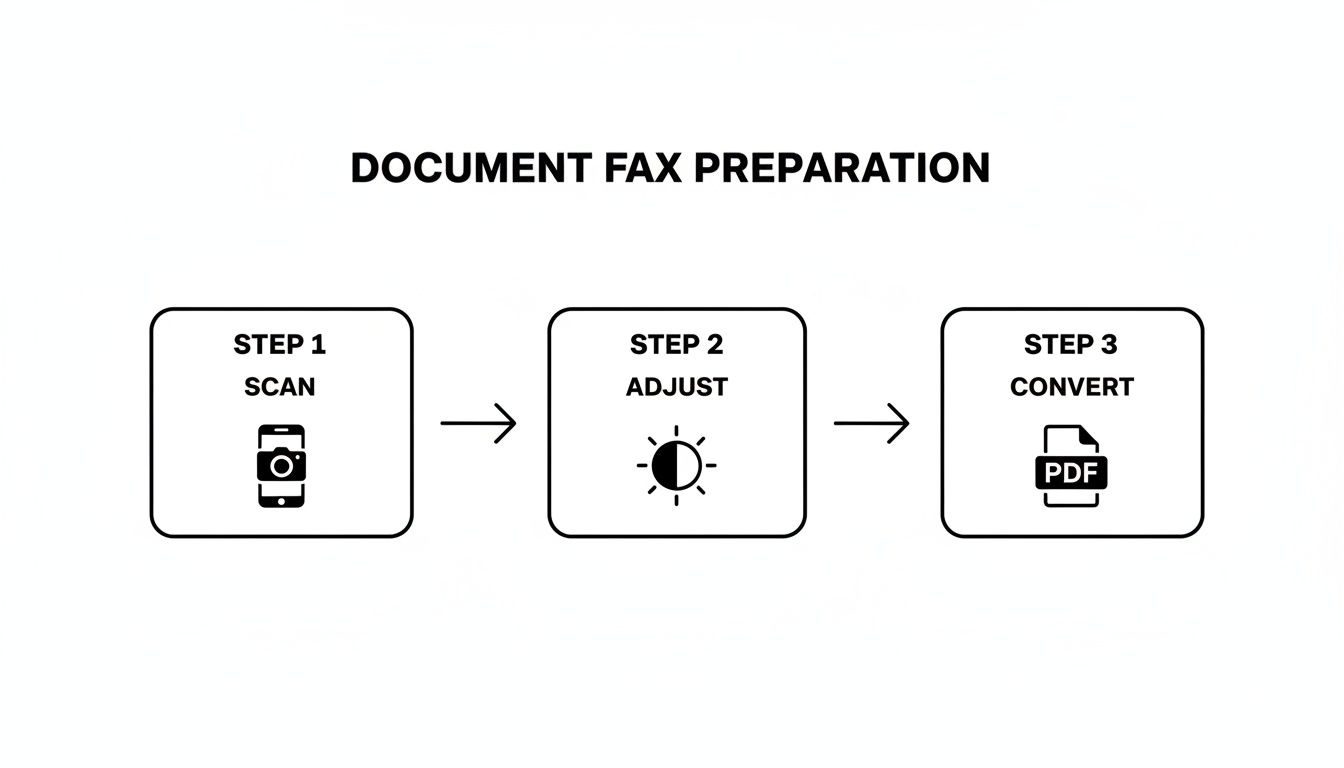
    Most fax mistakes happen before the file is ever uploaded. The document itself often contains more than the visible page. Metadata, revision history, hidden comments, and accidental extra pages all create avoidable exposure.

    Start with a clean file

    For routine business sending, PDF is usually the safest format because layout stays fixed and page order is easier to verify. DOCX can work, but only if you're certain the receiving workflow accepts it cleanly and the formatting won't shift. Before sending, open the final file and check every page in order.

    Use this short pre-send checklist:

    • Remove comments and tracked changes: Contract drafts and internal notes often survive into the “final” file.
    • Check headers and footers: Old client names, file paths, or internal references can remain in templates.
    • Confirm page count: The wrong attachment is common, especially when multiple versions sit in the same folder.
    • Rename the file clearly: A simple file name helps with audit trails and reduces confusion later.

    If you handle forms regularly, it also helps to understand how documents get structured and cleaned before transmission. A practical reference on extracting data from PDFs with Matil is useful for seeing how much information can sit inside a PDF beyond what appears on the page.

    Convert with consistency

    If the document began in Word, convert it before sending and review the exported version, not the original. Font substitutions, page breaks, and signature block shifts are minor layout issues until they land on a regulatory form or execution page.

    A straightforward workflow is to convert first, then inspect the output in a standard PDF viewer. If you need a quick process, this guide on how to convert Word to PDF is a useful baseline for getting to a stable file format before transmission.

    A secure send starts with a boring file review. That's a good sign. The less drama in the document, the lower the risk later.

    When to password-protect the PDF

    Password protection adds a second layer when the file contains especially sensitive details or will move across several hands before reaching the right person. The trade-off is practical. The recipient needs the password through a separate channel, and that only helps if your process for sharing it is sensible.

    Use password protection when:

    • The document includes identity data: intake forms, IDs, financial statements.
    • Several people may touch the fax on arrival: front desk teams, shared office lines, general mailrooms.
    • You don't fully control the destination workflow: especially with external offices.

    Don't use it blindly. If the recipient can't open the file quickly, they may ask for a resend through a weaker channel. Secure workflows need to be usable, not just strict.

    Sending Your Fax Securely with an Online Service

    Once the file is ready, the sending process should feel deliberate, not improvised. Good online faxing follows a repeatable pattern: authenticate, upload, verify the recipient, transmit through encrypted channels, then confirm delivery.

    A person using a tablet to send an online fax document while sitting at a wooden desk.

    The secure online faxing process includes user authentication, document upload with malware scanning, recipient number verification, and data encryption using 256-bit SSL/AES. Recipient number errors account for 12% of failures, and the overall methodology yields success rates exceeding 98% for US and Canada numbers based on Fax.live's explanation of online fax workflows.

    Step one, verify the destination like it matters

    The most common practical failure isn't exotic. It's the wrong number. If you're sending a medical form, signed agreement, or account document, a mistyped digit isn't just an inconvenience. It can become a disclosure problem.

    Before you upload anything, confirm:

    1. The full fax number.
    2. The department or named recipient.
    3. Whether a cover page is expected.
    4. Whether the receiving machine is monitored by a front desk, records team, or specific staff member.

    If the office gave you the number by phone, repeat it back. If it came by email, compare it against the organization's website or prior correspondence when possible.

    Step two, upload only what you mean to send

    Most occasional users need a browser-based tool with simple format support. Services in this category often accept PDF, DOC, and DOCX, which is enough for common office documents. The point isn't feature overload. The point is sending one clean file without opening another risk path.

    For a plain browser workflow, online faxing services vary mostly in account requirements, limits, and delivery options. SendItFax is one example built for occasional U.S. and Canada sending without an account. It supports DOC, DOCX, and PDF uploads, offers a free send option for short documents, and a paid option that removes branding and supports longer transmissions.

    Step three, use the cover page for control

    A cover page isn't decoration. It helps route the document to the right person and signals that the pages behind it may be confidential. For offices with shared intake points, that first page often determines whether your fax lands on the right desk.

    A useful cover page includes:

    • Recipient name or department: not just the organization.
    • Sender contact details: so staff can resolve failures quickly.
    • A short subject line: enough to identify the matter without oversharing.
    • A confidentiality notice: especially helpful in legal, healthcare, and finance settings.

    If the service allows you to omit the cover page, do that only when the recipient has specifically asked for it and you're confident the destination is tightly controlled.

    Here's a simple visual walk-through of the browser-based process and what to expect when submitting a document:

    Step four, pause before you click send

    This is the easiest security habit to teach and the hardest for people to keep under deadline pressure. Take one last pass over the essentials:

    • Recipient number: digit by digit.
    • Attachment: the final file, not a draft.
    • Page order: especially if signatures are involved.
    • Cover page details: recipient, matter name, callback number.

    If the fax is sensitive, don't send while multitasking. Most preventable mistakes happen when someone is also answering messages, taking a call, or rushing to leave.

    Step five, save the confirmation

    A delivery report matters. It gives you a record that the system accepted and completed transmission. If the fax fails, treat that as useful information, not just friction. Busy lines, invalid numbers, and receiving-side issues all need different follow-up.

    What works is a closed loop. Send, confirm, and file the confirmation with the matter if the document is important. What doesn't work is assuming “submitted” means “received and handled.”

    Free vs Paid Faxing The Security and Professionalism Trade-Offs

    Free faxing is fine for low-stakes use when the document is short, the deadline is soft, and you can tolerate a branded cover page. It's a poor fit when the fax represents a client matter, a legal filing, a medical record, or anything that needs to look clean and move quickly.

    A comparison infographic showing the advantages of paid online fax services over free, less secure alternatives.

    One practical difference is capacity. Online fax platforms often have daily limits such as 5 free faxes. Paid tiers can add priority queuing for sub-5-minute delivery and remove branding on cover pages, which matters for professional presentation of contracts and forms, according to this business-focused online fax overview.

    SendItFax free and paid options compared

    Feature Free Plan Almost Free Plan ($1.99)
    Page limit Up to 3 pages plus cover Up to 25 pages
    Daily usage 5 free faxes per day Pay per fax
    Cover page branding SendItFax branding included Branding removed
    Cover page option Standard cover workflow Can omit cover page entirely
    Delivery speed Standard handling Priority delivery
    Best fit One-off, low-stakes personal sending Contracts, forms, cleaner business presentation

    What you're really paying for

    The fee isn't only about more pages. You're paying for fewer avoidable frictions.

    • Cleaner presentation: A branded cover can look out of place on legal, lending, or client-facing paperwork.
    • Better urgency handling: Priority delivery matters when a closing, intake, or signed approval is time-sensitive.
    • Less compromise in format: Longer documents don't need to be chopped into smaller sends.
    • More control over the first page: Removing branding or skipping the cover can make the fax look like it came from a professional office workflow rather than a public utility.

    Decision shortcut: Use free when the consequence of delay or appearance is low. Pay when the document affects trust, timing, or compliance.

    The mistake I see most often is using a free workflow for a document that carries professional consequences. The sender saves a small amount and then spends more time explaining the odd cover page, resending pages, or answering whether the transmission was complete. For sensitive office work, low cost is useful. False economy isn't.

    Advanced Security Best Practices for Regulated Industries

    A secure platform helps, but regulated work still depends on user behavior. Healthcare staff, law offices, finance teams, and property professionals all handle documents that can trigger reporting, contractual, or privacy obligations if sent carelessly. The tool can't fix a loose process.

    A woman examining a tablet displaying a data encryption dashboard, highlighting industry compliance and security.

    Modern online fax services use AES-256 encryption for data at rest and TLS protocols for transmission. For healthcare, reputable providers achieve HIPAA compliance through Business Associate Agreements, and audit trails also support GLBA and GDPR requirements as described in the FTC Privacy Impact Assessment for online fax services.

    Compliance starts before the upload

    Encryption matters, but regulated users should think in layers. Ask what device you're sending from, who else can access it, what network you're on, and whether the recipient is prepared to receive the document appropriately.

    A disciplined workflow usually includes:

    • Private network use: Avoid public Wi-Fi when sending sensitive forms. If you must work remotely, use a trusted secured connection.
    • Minimal local storage: Don't leave downloaded copies in shared folders or on public-facing desktops.
    • Recipient confirmation: Verify not only the fax number but also the intended receiving party or department.
    • Need-to-know sending: Only include pages that the recipient needs.

    Industry-specific caution points

    Healthcare teams have the clearest obligations. If a service will handle protected health information, confirm whether a Business Associate Agreement is available and required for your use case. If you're comparing broader infrastructure choices around remote operations and protected records, this overview of Cloud solutions for healthcare compliance gives helpful context for the wider environment around secure document handling.

    Legal offices face a different problem. They often assume confidentiality is obvious, but intake staff and shared fax destinations create handoff risk. A precise cover sheet, limited page set, and documented delivery matter more than people think.

    Real estate and financial services usually work under deadline pressure. That's where users skip the final review and send a disclosure or identity document to the number from an old thread. Speed increases risk unless the office has a repeatable checklist.

    Audit trails are part of the defense

    The value of audit logging is practical. If a client asks when a record was sent, or a compliance review asks for evidence of transmission, a documented trail is much stronger than “we're pretty sure it went through.”

    For teams that regularly send protected or regulated documents, a more specific resource on HIPAA compliant fax service can help frame what to check in a vendor and in your internal process.

    Security controls only work when the sender respects them. A compliant platform plus a careless workflow still creates preventable exposure.

    Small habits that prevent larger problems

    These aren't glamorous, but they work:

    • Log out after sending: especially on shared or borrowed devices.
    • Use password-protected PDFs when appropriate: particularly for highly sensitive forms.
    • Document exceptions: if a recipient insists on an unusual workflow, note who approved it.
    • Train staff on receiving context: a fax sent to the correct machine can still be mishandled if the office doesn't route it correctly.

    A lot of compliance trouble starts with ordinary office shortcuts. The safest teams aren't the ones with the most policies. They're the ones that follow the same careful routine every time.

    Confirming Delivery and Understanding Data Retention

    Clicking send isn't the end of the job. You still need to confirm that the fax completed successfully and think about what happens to the uploaded file afterward.

    Delivery notifications help with the first part. If the fax shows as delivered, keep that confirmation with the matter record when the document is important. If it fails, don't just hit resend blindly. Check whether the number was entered correctly, whether the recipient can receive at that time, and whether the file itself caused a problem.

    Why retention policy matters

    The second part is less visible and often more important. Some services store documents indefinitely, which raises breach exposure over time. The Verizon DBIR also noted fax services in 15% of some phishing incidents via stored documents, which is why short, clear deletion practices matter for sensitive forms, as discussed in this iFax-focused retention and security discussion.

    What to look for after sending:

    • Clear deletion timing: vague retention language is a warning sign.
    • Minimal account dependency: one-off sends shouldn't require leaving documents in a dashboard forever.
    • Useful delivery records without excessive storage: you want proof of transmission, not unnecessary document persistence.

    If your organization is improving its handling rules more broadly, this collection of data retention policy examples is a practical way to compare policy language and tighten your own standards.

    A secure fax process is complete only when you know two things. The document reached the right place, and it won't sit around longer than necessary in someone else's system.


    If you need a simple browser-based option to send occasional faxes to U.S. or Canadian numbers without a fax machine, SendItFax fits the one-off use case well. It lets you send without creating an account, supports common office file formats, and gives you a free path for short documents plus a paid option when you need more pages, priority handling, or a cleaner presentation.

  • Your Guide to a Fax Cover Sheet Confidential Statement

    Your Guide to a Fax Cover Sheet Confidential Statement

    Think of a confidential fax cover sheet as your document's first line of defense. It’s not just a formality; it's a critical tool that acts as both a legal and practical shield, making it absolutely clear that the pages that follow are private and meant for one person's eyes only. In professional communication, this isn't optional—it's essential.

    Why a Confidential Fax Cover Sheet Is So Important

    At its heart, a confidential fax cover sheet is a fundamental security practice. It's the modern-day equivalent of a sealed envelope marked "Private and Confidential." This simple page immediately flags the document's sensitive nature to anyone who might see it, dramatically cutting down the risk of it falling into the wrong hands.

    Imagine a busy law office faxing critical case files. The last thing they need is for that information to be left sitting on a shared office machine for anyone to see. The cover sheet is that immediate, clear warning sign that tells the person at the other end to handle the document with care and get it directly to the right person, now.

    Protecting Sensitive Information Where It Matters Most

    This practice is absolutely non-negotiable in fields with tight privacy rules. Take healthcare, for instance, where faxes often contain Protected Health Information (PHI). A properly worded cover sheet is a cornerstone of HIPAA compliance. The medical world still relies heavily on faxing for transmitting PHI, and as FitSmallBusiness explains, using a secure cover sheet is a key safeguard against unauthorized viewing.

    It's the same story for financial firms sending account details or legal teams sharing privileged client communications. That cover sheet is what helps them meet their professional and ethical duties to protect client data.

    A well-crafted cover sheet doesn't just protect the information in the fax—it protects your organization. It shows you're doing your due diligence and are serious about privacy, which can be a lifesaver if there's ever an audit or an accidental misdelivery.

    This one simple step turns a routine task into a powerful security measure. For those in the healthcare field, our guide on creating a HIPAA-compliant fax cover sheet walks through the specific steps you need to take.

    To put it simply, a confidential fax cover sheet serves several crucial purposes. Here’s a quick look at its primary jobs.

    Key Functions of a Confidential Fax Cover Sheet

    Function Description Industries Impacted
    Legal Protection Creates a formal privacy notice and gives instructions on how to handle the document, which can limit liability. Legal, Healthcare, Finance
    Preventing Disclosure Warns anyone who receives the fax by mistake that the content is private and tells them to destroy it immediately. All industries
    Ensuring Compliance Helps organizations meet regulatory standards like HIPAA by showing that necessary safeguards are in place. Healthcare, Government
    Directing Delivery Clearly names the intended recipient, making sure the document doesn't get lost in the shuffle or left on a machine. Corporate, Real Estate

    Ultimately, this single page is what ensures your sensitive documents arrive safely and are handled correctly from the moment they land on the fax machine.

    What Makes a Confidential Cover Sheet Actually Work?

    Creating an effective confidential fax cover sheet is more than just plugging information into a template. It's about being deliberate. Every single field you fill out plays a role in protecting the document and making sure it gets into the right hands. When you get these details right, that simple piece of paper becomes a surprisingly strong security measure.

    Think of it this way: the cover sheet is the first line of defense for the sensitive information that follows. It's the gatekeeper.

    A document security process flow diagram showing a sensitive document, a cover sheet, and a recipient.

    As you can see, it’s a critical step that shields the document before it ever reaches the intended reader.

    The Essential Fields for Your Confidential Fax Cover Sheet

    Let's break down exactly what needs to be on your cover sheet. Skipping any of these can lead to confusion or, worse, a privacy breach. This table covers the non-negotiable fields and why they matter.

    Field Name Purpose Example
    Recipient Name & Title Ensures the fax is routed to a specific person, not a general pile. To: Jane Doe, HR Director
    Sender Name & Company Clearly identifies who the fax is from for immediate context. From: John Smith, Acme Corp.
    Recipient & Sender Fax # Confirms the transmission details and provides a return number. Fax: (555) 123-4567
    Direct Phone Number Gives the recipient a way to call you about transmission errors. Phone: (555) 867-5309
    Date of Transmission Creates a timestamped record of the communication. Date: October 26, 2023
    Total Page Count Allows the recipient to verify they've received the entire document. 7 pages (including cover)
    Subject Line Provides immediate context on the document's content. RE: Confidential: Signed Contract for Project Phoenix
    Confidentiality Warning A bold, top-line statement that flags the document's sensitivity. CONFIDENTIAL DOCUMENT ENCLOSED

    Getting these basics down pat is the first step toward a secure and professional-looking fax.

    Getting the Language Right: The Confidentiality Notice

    This is the legal powerhouse of your cover sheet. The confidentiality notice is a clear set of instructions for anyone who might receive the fax by mistake. It’s your main safeguard against accidental disclosure.

    A solid notice really only needs to do three things:

    • State the Obvious: Mention that the information is confidential and legally privileged.
    • Prohibit Action: Explicitly forbid any reading, copying, or sharing by unintended recipients.
    • Give Clear Instructions: Tell anyone who received it by mistake to call the sender immediately and then destroy the document.

    Here’s a great all-purpose example you can adapt:

    "The documents accompanying this transmission contain confidential information belonging to the sender that is legally privileged. This information is intended only for the use of the individual or entity named above. If you are not the intended recipient, you are hereby notified that any disclosure, copying, distribution, or action taken in reliance on the contents of these documents is strictly prohibited. Please notify the sender immediately by telephone to arrange for the return or destruction of these documents."

    This kind of precise, direct language leaves no room for error. For more examples and layouts you can use right away, check out our guide on creating a fax cover sheet template.

    Crafting Your Confidentiality Statement Wording

    Let's talk about the most important part of your cover sheet: the confidentiality statement. This isn't just a formality. It’s the specific legal language that does all the heavy lifting, turning a simple notice into a powerful instruction that protects you and your sensitive information.

    Getting the wording right is what establishes clear boundaries and tells anyone who sees it exactly what to do. The goal isn't to sound like a stuffy lawyer, but to be direct and unambiguous. A strong statement clearly defines the information as confidential, names the intended recipient, and gives explicit instructions for anyone who receives the fax by mistake. This leaves absolutely no room for interpretation.

    General Purpose Confidentiality Statement

    For most day-to-day business faxes—think contracts, financial reports, or internal memos—a standard, all-purpose statement works perfectly fine. It's professional, clear, and covers all the essential legal bases without getting bogged down in industry jargon.

    Here's a solid example you can use:

    "The documents accompanying this transmission contain confidential information belonging to the sender that is legally privileged. This information is intended only for the use of the individual or entity named above. If you are not the intended recipient, you are hereby notified that any disclosure, copying, distribution, or action taken in reliance on the contents of these documents is strictly prohibited. Please notify the sender immediately by telephone and destroy the transmitted documents."

    This statement is effective for a few key reasons:

    • It Establishes Privilege: Using phrases like "legally privileged" immediately sets a formal, serious tone.
    • It Forbids Misuse: The language is crystal clear that copying or sharing is "strictly prohibited."
    • It Provides Actionable Steps: It tells an accidental recipient exactly what to do: "notify the sender" and "destroy the documents."

    HIPAA Compliant Statement for Medical Faxes

    Now, if you're working with Protected Health Information (PHI), things get more serious. Your statement has to be much more explicit to comply with HIPAA regulations. This is non-negotiable for clinics, hospitals, insurance companies, or any organization touching patient data.

    A HIPAA-compliant fax cover sheet absolutely must mention that the contents are protected health records. You can’t leave it to chance.

    Here's a HIPAA-specific example:

    "CONFIDENTIALITY NOTICE: The information contained in this facsimile transmission is legally privileged and confidential information intended only for the use of the individual or entity named above. This information may contain Protected Health Information (PHI) and is protected under the Health Insurance Portability and Accountability Act (HIPAA). If the reader of this message is not the intended recipient, you are hereby notified that any dissemination, distribution, or copying of this communication is strictly prohibited. If you have received this communication in error, please immediately notify the sender by telephone and return the original message to us at the address above via the U.S. Postal Service. Thank you."

    Best Practices for Cover Sheet Design and Layout

    How your confidential fax cover sheet looks is just as important as what it says. A clean, professional design isn’t just about making things look nice; it’s a functional tool that guides the recipient’s eye and ensures your critical warnings are seen immediately. Think of it as the user interface for your document—if it’s confusing or cluttered, people will miss the most important parts.

    The whole point is to eliminate any chance of misinterpretation. Your design should draw instant attention to the confidentiality notice and make the recipient’s details impossible to miss.

    A confidential document with 'Design for Clarity' text, resting on a laptop and wooden table.

    Make Your Warning Impossible to Ignore

    The word "CONFIDENTIAL" needs to be the first and most obvious thing someone sees. Don't bury it in a block of text.

    Instead, put a bold, capitalized warning right at the very top of the page. I've seen organizations even add a second one at the bottom, like a bookend. This repetition really hammers the message home and ensures it gets noticed, even if the page is sitting upside down or partially covered on a busy desk.

    A classic mistake I see is using a small font for the confidentiality notice. You have to remember that faxes can lose quality in transmission. What looks perfectly clear on your screen might turn into a blurry, unreadable smudge on an older, low-resolution machine at the other end.

    To get around this, use a simple, clean font like Arial, Helvetica, or Times New Roman. These standard fonts hold up well and stay legible even when the fax quality isn't great.

    Use Layout to Guide the Eye

    A smart layout prevents confusion and helps the recipient process the information instantly. The best cover sheets use plenty of white space to separate different sections, making the entire page scannable in a few seconds.

    Here are a few design principles I always stick to:

    • Top-Down Hierarchy: The most critical info—that confidentiality warning and the recipient’s name—always goes at the top. No exceptions.
    • Logical Grouping: Keep the sender and recipient details in their own separate, clearly labeled blocks. This just makes sense.
    • Readable Fonts: Stick to 12-point font or larger for all the essential details. Don't make people squint.
    • Minimalism is Your Friend: Avoid unnecessary graphics, complicated logos, or fancy borders. They just clutter the page and distract from the core message.

    This kind of structured, common-sense approach ensures that even a busy administrative assistant can immediately see who the fax is for and understand its sensitive nature. It’s about protecting your information from the very moment it arrives.

    Taking Security Digital with Online Fax Services

    Think about the biggest weakness of a traditional fax machine. That sensitive document you just sent could be sitting out in the open on a shared machine for hours, free for any curious passerby to read. It's a massive physical security gap.

    Online faxing plugs that hole completely. It takes the whole process digital, moving your documents from a risky paper tray into a secure, encrypted workflow.

    This simple shift means there's no physical document to be intercepted on the other end. Your fax lands in a secure digital inbox, not on a public printer. It’s a huge upgrade for privacy, ensuring your "confidential" warning on the cover sheet is actually backed by solid technology.

    Laptop displaying 'Secure EFAX' with a green padlock icon, alongside documents and a smartphone on a desk.

    From Flimsy Paper Trails to Solid Digital Proof

    Remember those little confirmation slips that old fax machines spit out? They were your only proof of transmission, and they were ridiculously easy to lose or damage.

    Online services give you something much more substantial: a concrete, auditable digital receipt. You get detailed logs showing exactly when your fax was sent and successfully received. This digital trail is gold for compliance and record-keeping, especially when you're dealing with legal or medical documents that have strict deadlines. You have undeniable proof it arrived.

    Making the Cover Sheet Part of a Smooth Workflow

    Moving to a cloud-based service changes how you handle cover sheets, too. Instead of fussing with a separate document, modern platforms often build them right into the sending process. As remote work became the norm, this became even more important—letting people upload documents and add cover pages from anywhere, on any device.

    This is exactly where a service like SendItFax comes in. It makes creating a professional cover sheet a natural part of sending a fax.

    You just:

    • Upload your file: Grab the PDF or Word doc from your computer.
    • Add your message: Type your cover page notes, including the confidentiality statement, directly in the interface.
    • Send it securely: The document and its cover sheet are bundled and sent over an encrypted connection.

    With a platform like SendItFax, the confidential fax cover sheet isn't an afterthought. It's built into a single, fluid process, which dramatically reduces the chance you'll forget this critical step.

    For those who need a truly professional look, the '$1.99 Almost Free' plan removes all third-party branding from the cover sheet. This makes sure it looks clean and comes directly from you. It’s a practical way to connect all the best practices we've discussed with a modern, digital-first tool. To dive deeper, check out our guide on the enhanced security of modern fax transmissions.

    Common Questions About Confidential Faxing

    Even with the best templates and practices, real-world situations can bring up tricky questions. Let's walk through some of the most common ones I hear, so you're prepared for anything.

    Is a Fax Cover Sheet Legally Binding?

    This is a great question. While a cover sheet isn't a formal contract, its legal weight shouldn't be underestimated. That confidentiality disclaimer is an official notice, and it establishes a clear legal expectation of privacy.

    Think of it this way: you're creating a paper trail that proves you took all the right steps to protect the information. This is absolutely critical for staying compliant with regulations like HIPAA or for upholding attorney-client privilege. If a fax goes astray and the information is misused, that cover sheet—with its clear instructions to "destroy and notify sender"—becomes powerful evidence. It helps show that the recipient acted negligently by ignoring your explicit directions.

    Can I Just Handwrite a Cover Sheet?

    You can, but in any professional context, I'd strongly advise against it. A typed or digitally generated cover sheet is always the better choice, for two simple reasons. First, it ensures the recipient's information is perfectly clear, drastically reducing the risk of a simple delivery error. Second, it guarantees your all-important confidentiality notice is legible and can't be misinterpreted.

    Sloppy handwriting could easily lead to the fax being mishandled, or worse, your legal disclaimer being ignored completely. Sticking with a digital template or an online fax service gives you a clean, professional, and consistently formatted document every single time, removing that risk of human error.

    A professional presentation reinforces the serious, confidential nature of the documents that follow. A hastily scribbled note simply doesn't convey the same level of importance and can undermine the perceived security of the entire transmission.

    What Should I Do If I Send a Fax to the Wrong Number?

    It’s a moment of panic we all dread, but the key is to act immediately and methodically. If you realize you've sent sensitive information to the wrong person, here’s what you do:

    • Call Them Immediately: Pick up the phone and call the incorrect number. Calmly explain that a confidential fax was sent by mistake and politely ask them to destroy it without reading it. You can even refer them to the instructions on the cover sheet you sent.
    • Document Everything: Create an incident report right away. Note the date, the time, the wrong number you dialed, and the details of your conversation. This log is crucial for your internal records and any compliance requirements.
    • Follow Your Protocol: If the document contained Protected Health Information (PHI), you must immediately trigger your organization's HIPAA breach notification process. There's no room for delay here.
    • Resend to the Right Place: Once you've handled the breach, double-check the correct fax number and securely resend the document to its intended recipient.

    Does Using a Free Fax Service Impact Confidentiality?

    When it comes to the actual security of the transmission—things like encryption—most free and paid services are on pretty equal footing. The real difference comes down to professionalism and presentation.

    The catch with most free services is that they plaster their own branding and ads all over your cover sheet. For sensitive legal, medical, or financial faxes, that third-party logo can look unprofessional and ultimately weaken the authority of your confidentiality notice. A dedicated, low-cost service gives you a clean, brand-neutral slate that maintains a professional standard. While both let you add your disclaimer, a premium service ensures the focus stays entirely on your message.


    For a clean, professional, and secure way to send your documents, SendItFax offers an unbranded cover sheet and priority delivery. Send your confidential fax now with SendItFax.

  • Your Essential Guide to the HIPAA Fax Cover Sheet

    Your Essential Guide to the HIPAA Fax Cover Sheet

    Think of a HIPAA fax cover sheet as the confidential envelope for a fax. It's the first page that goes through, and its job is to protect sensitive patient information—what the law calls Protected Health Information (PHI)—as it travels from one machine to another. It ensures the documents get to the right person and provides a clear legal warning if they accidentally land in the wrong hands. In healthcare, using one isn't optional; it's a must-have for compliance.

    The Critical Role of a HIPAA Fax Cover Sheet

    A fax machine, stethoscope, and stack of papers on a wooden desk with 'Confidential FAX' text.

    Sending medical records without a cover sheet is like mailing a postcard with a patient’s private diagnosis written on the back for anyone to read. It's a huge, unnecessary risk. The cover sheet acts as the first line of defense against accidental disclosure of PHI.

    It works as both a guide and a guard. By clearly marking who the sender and intended recipient are, it drastically cuts down the odds of human error. And if the fax does end up on the wrong machine, the cover sheet immediately alerts whoever sees it to the sensitive nature of the following pages.

    Why Faxing Still Matters in Healthcare

    It might seem old-school, but faxing is still a workhorse in healthcare. A surprising 70% of healthcare providers continue to use fax machines for transmitting everything from lab results to specialist referrals. Because it’s so common, mastering the rules around it, like using a proper cover sheet, is more important than ever.

    The Health Insurance Portability and Accountability Act (HIPAA), passed back in 1996, set the national standards for protecting patient health information. Since anyone can misdial a fax number or leave documents sitting on a shared machine, faxing creates a specific kind of compliance challenge. Skipping a proper cover sheet isn't just a simple mistake—it can lead to serious penalties, with fines that can climb as high as $50,000 per violation. You can find more details on HIPAA enforcement guidelines on faxplus.com.

    The Three Primary Jobs of a Cover Sheet

    A well-designed HIPAA fax cover sheet really has three key jobs to do, all of which are vital for protecting patient privacy and staying compliant:

    • Ensures Proper Delivery: It clearly states who the fax is meant for, reducing the chance it gets picked up or read by unauthorized staff. This is especially important in a busy hospital or large clinic where a single fax machine serves multiple departments.
    • Provides Immediate Warning: The required confidentiality statement lets anyone who lays eyes on it know that the attached documents contain legally protected health information.
    • Gives Clear Instructions: It tells an unintended recipient exactly what to do (and what not to do) if they receive the fax by mistake. The instructions are usually simple: destroy the documents and notify the sender immediately.

    A HIPAA fax cover sheet isn't just administrative paperwork; it's a fundamental security measure that demonstrates due diligence in protecting patient data, forming a critical part of any healthcare organization’s compliance strategy.

    Anatomy of a Compliant HIPAA Fax Cover Sheet

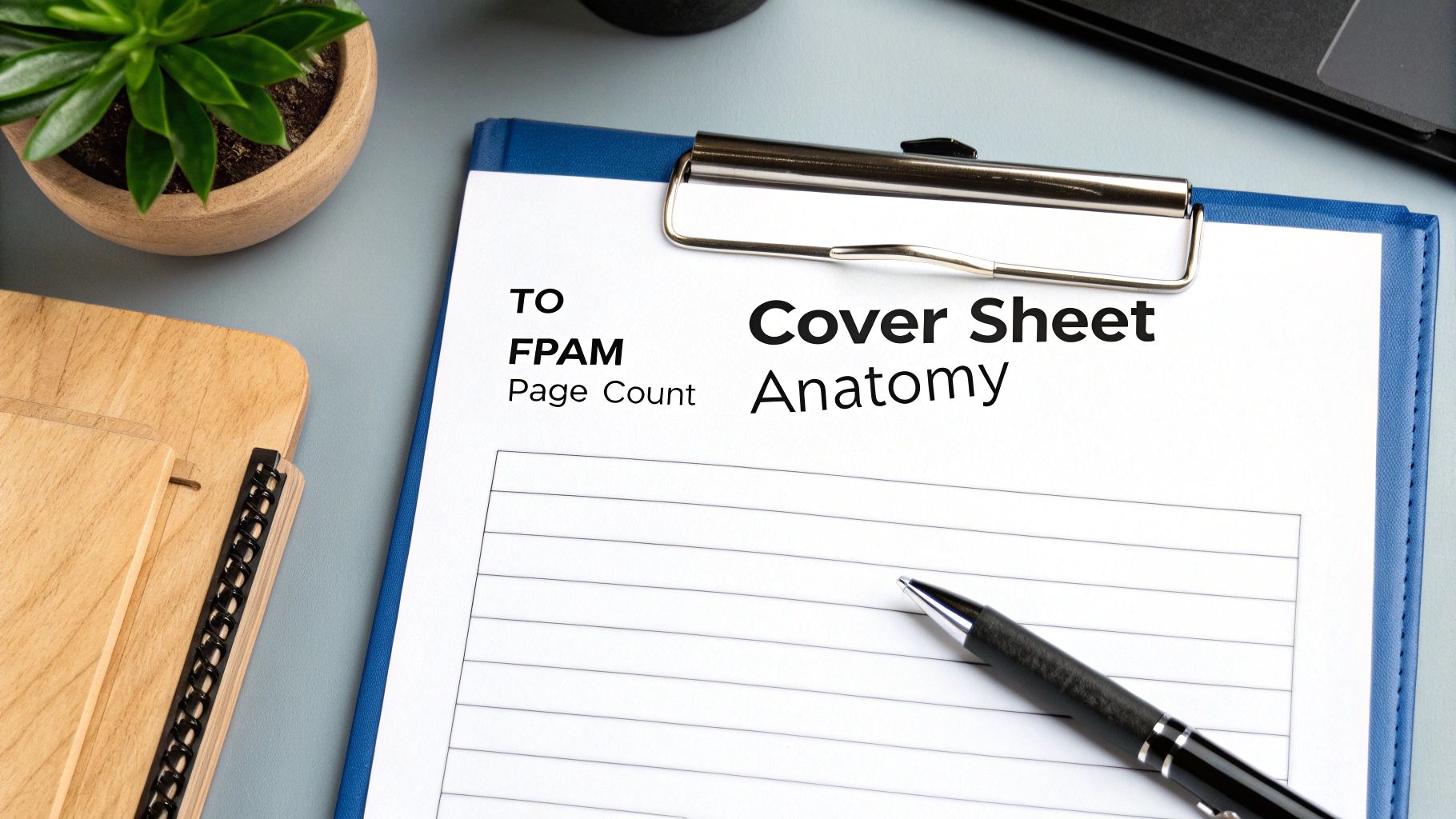
    A close-up of a document titled "Cover Sheet Anatomy" on a clipboard with a pen, next to a small plant.

    A compliant HIPAA fax cover sheet isn't just a formality—it’s a critical security tool. Think of it as the first line of defense for protecting sensitive patient information. Every field on that page has a specific job, working together to guide the fax to its proper destination and shield it from prying eyes.
    If you're building a cover sheet from scratch, it’s not enough to know what to include. You need to understand why each piece of information matters. Getting this right is a proactive step that shows you're serious about patient privacy and staying on the right side of regulations.

    Core Components You Cannot Skip

    Some elements are simply non-negotiable when you're faxing Protected Health Information (PHI). These required fields are the absolute backbone of a compliant document, creating a clear and secure trail for every transmission.

    Since HIPAA was enacted back in 1996, the rules have been refined to demand specific information that protects PHI. This includes the sender's full name and contact info, the recipient's name and fax number, the date, and the total number of pages. You'll also need a powerfully worded confidentiality disclaimer. While HIPAA doesn't give you a script, the message has to be unmistakable.

    At its core, a compliant fax cover sheet answers three critical questions for anyone who sees it: Who sent this? Who is it for? And what should I do if I’m not the right person?

    These essential details are the foundation of secure communication.

    Recommended Fields for Enhanced Security

    Beyond the must-haves, you can add extra layers of information to really tighten up your security. These recommended fields aren't strictly required by HIPAA, but they go a long way in preventing mistakes and demonstrating a commitment to best practices.

    For example, adding a simple subject line can provide immediate context without revealing any PHI. Mentioning the sender’s department can also help a large hospital or clinic route the fax to the right person much faster, which means less time sitting on a shared machine.

    If you're looking for a solid starting point, downloading a pre-made HIPAA fax cover sheet template PDF can show you how to structure both the required and recommended information effectively.

    HIPAA Fax Cover Sheet Checklist Required vs Recommended Fields

    To make things easy, I've broken down what’s absolutely essential versus what’s just a really good idea. You can use this table as a quick checklist to review your current cover sheets or to build a new one that’s 100% compliant.

    Field Requirement Level Purpose and Example
    Sender Information Required Identifies who sent the fax for accountability. Example: Dr. Emily Carter, Oak Valley Medical
    Recipient Information Required Ensures the fax goes directly to the intended person. Example: Dr. John Smith, Pine Ridge Specialty Clinic
    Date and Time Required Creates a timestamp for the transmission, which is vital for audit trails. Example: Oct 26, 2026, 2:15 PM
    Total Page Count Required Helps the recipient confirm the entire document arrived. Example: "Pages: 5 (including cover)"
    Confidentiality Notice Required The legal disclaimer warning against unauthorized access or sharing of PHI.
    Subject Line Recommended Best Practice Adds context without exposing sensitive data. Example: "Patient Referral Information"
    Sender's Department Recommended Best Practice Helps get the fax to the right place faster internally. Example: "Cardiology Department"
    Sender's Fax Number Recommended Best Practice Makes it easy for the recipient to reply or confirm they got it.
    Urgency Indicator Recommended Best Practice Flags the document for time-sensitive review. Example: "Urgent," "For Immediate Review"

    By carefully including these fields, you're not just sending a fax—you're transforming a simple cover page into a powerful tool for HIPAA compliance and ensuring every piece of patient information gets the protection it deserves.

    Crafting a Bulletproof HIPAA Confidentiality Statement

    If the sender and recipient details are the address on an envelope, then the confidentiality statement is the legally binding seal. It's easily the most critical block of text on your HIPAA fax cover sheet. This isn't just polite boilerplate; it's a powerful legal notice that turns a simple message into a protected communication.

    This statement is your first line of defense against accidental disclosure. Faxes sometimes land on the wrong machine—it’s a common and potentially costly mistake in healthcare. When that happens, this disclaimer immediately puts the unintended recipient on notice about their legal obligations. It’s not a suggestion; it’s a clear directive with the full weight of federal law behind it.

    Think of it as a digital "do not enter" sign. It clearly marks the information as private, confidential, and meant for one specific person's eyes only. Without that explicit warning, someone who gets a fax by mistake might not realize the sensitive nature of the documents, raising the risk of a breach.

    Decoding the Legal Language

    The language in these statements can feel a bit dense, but every phrase serves a specific and vital purpose. Once you understand the key components, you’ll see why they are non-negotiable for staying compliant. Let's break down what makes a strong HIPAA disclaimer work.

    • Protected Health Information (PHI): This phrase is the heart of HIPAA. Including it makes it crystal clear that the documents contain sensitive patient data protected by federal law. This immediately raises the legal stakes for anyone who handles the fax.

    • Intended Recipient Only: Simple but powerful, this phrase draws a clear line in the sand. It establishes that the information is privileged and legally addressed to a single person or entity, making it obvious that anyone else is an unauthorized viewer.

    • Prohibited from Further Disclosure: This is the core instruction. It tells anyone who reads it that they cannot legally share, copy, or distribute the information in any way. If someone receives the fax by mistake, this clause forbids them from forwarding it or showing it to others.

    A well-crafted confidentiality statement is your organization's legal armor. It demonstrates due diligence, minimizes liability, and provides clear, actionable instructions that protect patient privacy in the event of a misdelivery.

    Sample Confidentiality Statements for Your Fax Cover Sheet

    While HIPAA doesn’t demand exact wording, the message has to be direct and unambiguous. Your organization's legal counsel is always the best resource, but the examples below provide a solid starting point. You can adapt the structure and content to fit your specific needs, much like you'd tailor a general fax cover letter for different situations.

    Example 1: Concise and Direct
    This shorter version is perfect for routine communications where you need to be clear without taking up too much space.

    "CONFIDENTIALITY NOTICE: The documents accompanying this fax transmission contain confidential health information that is legally privileged. This information is intended only for the use of the individual or entity named above. If you are not the intended recipient, you are hereby notified that any disclosure, copying, distribution, or action taken in reliance on the contents of these documents is strictly prohibited. If you have received this fax in error, please notify the sender immediately to arrange for the return or destruction of these documents."

    Example 2: Comprehensive and Detailed
    For highly sensitive records, a more detailed statement adds an extra layer of legal protection and gives more specific instructions.

    "IMPORTANT WARNING: This facsimile is intended for the exclusive use of the person or entity to whom it is addressed and contains confidential information protected by the Health Insurance Portability and Accountability Act (HIPAA). Unauthorized review, use, disclosure, or distribution is prohibited. If you are not the intended recipient, please contact the sender by reply fax or telephone immediately and destroy all copies of the original message. Your cooperation is required by law to protect this privileged information."

    Best Practices for Secure and Compliant Faxing

    A compliant HIPAA fax cover sheet is just the starting point. Truly secure faxing is about the entire process—from the moment you decide to send a document to the second you get a confirmation of receipt. Think of it like a chain of custody for sensitive information; every single link in that chain has to be strong to protect patient privacy and stay compliant.

    Adopting a solid set of best practices turns faxing from a routine task into a genuine security protocol. It means looking beyond the cover sheet and building in checks and balances before, during, and after you send anything. After all, a simple human error like misdialing a number can snowball into a major data breach. A clear, well-defined process is your best defense against these risks.

    Pre-Transmission Security Checks

    Before your finger even gets near the "send" button, a few simple checks can head off the most common—and costly—mistakes. This first stage is all about verification and making sure you’re only sending what’s absolutely necessary.

    • Verify Recipient Fax Numbers: This is a big one. Never, ever rely on memory or a scribbled sticky note. Always confirm the recipient's fax number against a trusted source, like an official provider directory or their verified letterhead. Double-checking the number is probably the single most effective thing you can do to prevent a misdirected fax.

    • Apply the Minimum Necessary Rule: HIPAA is clear on this: you should only disclose the minimum amount of Protected Health Information (PHI) required to get the job done. Before you send, give the documents a quick once-over to ensure you aren't accidentally including extra, unneeded patient data.

    • Prepare a Compliant Cover Sheet: Make sure every required field is filled out correctly, especially the confidentiality statement. This sheet is your first line of defense if the fax ends up in the wrong hands.

    The moments right before you send a fax are your best chance to prevent a breach. Taking a deliberate, methodical approach to verification is the hallmark of a truly secure faxing policy.

    Post-Transmission Protocols and Documentation

    Okay, the fax is sent. But you're not done yet. What happens next is just as critical for confirming delivery and creating the audit trail that HIPAA demands. This documentation is your proof that you took every reasonable step to protect PHI.

    It’s important to remember that HIPAA's allowance for faxing isn't a free pass; it's a regulated process that requires strict safeguards. To put it in perspective, the healthcare industry saw a staggering 276 million records breached last year, and misdirected faxes are often a contributing factor. The penalties for non-compliance are no joke either, reaching up to $50,000 per violation. For more on this, you can read the full breakdown of HIPAA faxing rules and best practices on accountablehq.com.

    Here’s what you need to do after every transmission:

    1. Confirm Successful Transmission: Don't just assume it went through. Check for a confirmation receipt from your fax machine or digital service that verifies the transmission was completed successfully.

    2. Follow Up with the Recipient: Whenever possible, especially for highly sensitive information, a quick phone call to the intended recipient to confirm they received the document is a powerful best practice.

    3. Maintain an Audit Trail: Keep a log of every fax containing PHI. This log should include the date, time, recipient's name and number, and a short description of what was sent. Most digital fax services do this for you automatically, creating a permanent, unchangeable record.

    Modernizing Your Faxing Strategy

    While traditional fax machines are still around, they come with built-in physical security risks. How many times have you seen a document with PHI just sitting on a shared machine, visible to anyone who walks by? Modern digital fax services solve this problem by delivering faxes directly to a secure, password-protected email inbox or online portal.

    These services also offer features like end-to-end encryption, which scrambles the data as it travels, making it unreadable to anyone trying to intercept it. If you’re looking to update your systems, you can learn more about the security of fax technology in our detailed guide. By pairing a proper cover sheet with modern technology and a rigorous workflow, you can build a faxing environment that is both secure and compliant.

    How to Send a HIPAA Compliant Fax with SendItFax

    Knowing the rules for a HIPAA fax cover sheet is one thing, but actually putting them into practice day-to-day is where compliance really happens. This is where modern online fax services like SendItFax come in, turning a potentially tedious task into just a few simple clicks. These platforms are built with security and compliance baked right in, making it much easier to protect sensitive patient information.

    Let's walk through the exact steps for sending a secure, compliant fax using SendItFax. This isn't just theory; it's a practical guide showing how the right tool can help you sidestep the common pitfalls of old-school fax machines.

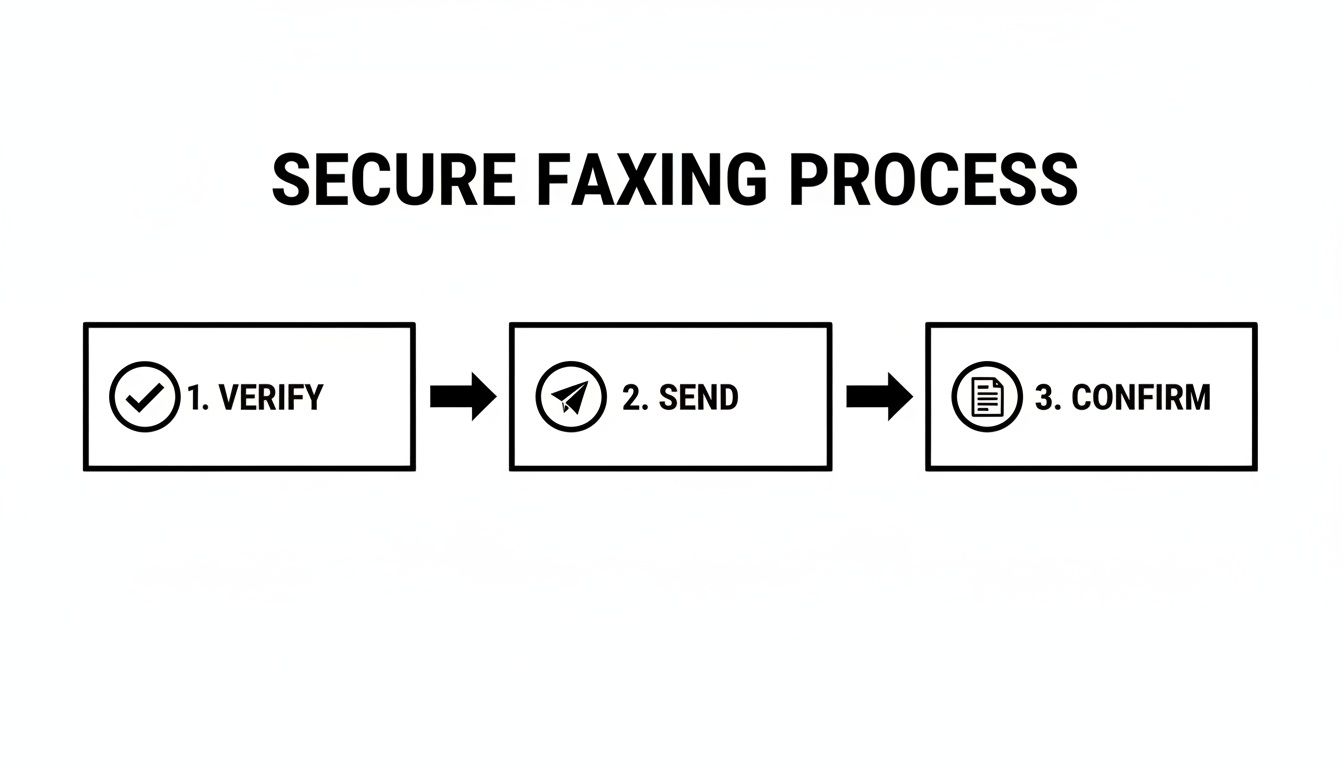
    The whole process boils down to a simple, repeatable workflow: verify your recipient, send the document securely, and get confirmation that it arrived safely.

    A diagram illustrating the secure faxing process in three steps: Verify, Send, and Confirm, with icons.

    This three-stage approach is the backbone of secure faxing. Each step plays a critical role in ensuring your transmission is both compliant and reliable.

    Step 1: Enter Sender and Recipient Information

    First things first, you need to clearly identify who's sending the fax and where it's going. SendItFax starts you off with a clean, straightforward interface for all the essential contact details.

    You’ll begin by entering your information—name, company, email, and phone number. Next, you'll do the same for your recipient. This step is more than just busywork; the platform uses these details to automatically populate the fax cover sheet, which helps ensure accuracy and saves you from typing it all out yourself.

    Step 2: Upload Your Documents and Add a Cover Page Message

    With the "to" and "from" fields sorted, you're ready to attach the actual documents. SendItFax handles common file types like PDF, DOC, and DOCX, so you can easily upload patient records, referral forms, or any other sensitive files right from your computer.

    This is also your chance to add a message to the cover page. Think of this as the subject line for your fax—a spot for a brief, non-confidential note. Just remember to keep any and all Protected Health Information (PHI) out of this message. The goal is to keep the cover sheet itself clean of any sensitive data.

    SendItFax then generates a professional cover sheet that automatically includes:

    • All the sender and recipient details you just entered.
    • A precise date and time stamp, creating a perfect record for your audit trail.
    • Your cover page message, placed prominently for the recipient.

    By automatically generating the cover sheet, SendItFax ensures no critical information gets left out by mistake. This built-in feature strengthens your compliance by standardizing the information included on every single fax you send.

    Step 3: Review and Send Your Secure Fax

    Before hitting send, you get a chance to review everything. This is your final checkpoint—a crucial moment to double-check that recipient's fax number and confirm you've attached the right files. A quick review here can prevent a misdirected fax, which is a major HIPAA headache.

    Once you’re confident it’s all correct, you can send it on its way. This is where SendItFax really shines. Behind the scenes, your documents are transmitted over an encrypted connection, a world away from the unsecured phone lines used by traditional fax machines.

    This digital approach has some huge advantages:

    1. Eliminates Physical Risks: Your documents go from your secure device straight to the recipient's fax or digital inbox. There's no shared office machine where confidential papers can be left sitting out in the open.
    2. Creates an Automatic Audit Trail: The service logs every single transmission—date, time, recipient, and delivery status. This unchangeable digital record is your proof of compliance if you ever need it.
    3. Provides Solid Delivery Confirmation: You'll get an email notification confirming whether the fax went through successfully or if it failed. No more standing by the machine, wondering if your important documents actually arrived.

    Using a service like SendItFax transforms a manual, error-prone chore into an automated, secure, and fully documented workflow. It not only makes sending a HIPAA fax cover sheet and its attachments easier but also gives your organization a much stronger and more defensible compliance posture.

    Got Questions About HIPAA Faxing? We've Got Answers.

    When you're dealing with HIPAA-compliant faxing every day, you know the real world doesn't always fit neatly into a textbook. You run into specific situations and tricky "what-if" scenarios that can leave you wondering if you're making the right call.

    This section tackles some of the most common questions we hear from healthcare professionals and administrators about using a HIPAA fax cover sheet and keeping the whole process secure. Think of it as your quick-reference guide for handling those gray areas with confidence. Getting these details right is crucial, because even a small slip-up can lead to big compliance headaches.

    Is a HIPAA Fax Cover Sheet Actually Required by Law?

    This is the big one, and the answer isn't a simple yes or no. The HIPAA Security Rule doesn't have a line that says, "You must use a fax cover sheet." What it does require is that you put "reasonable and appropriate" safeguards in place to protect Patient Health Information (PHI) from being seen by the wrong people.

    In the real world, a cover sheet is considered one of the most fundamental and effective safeguards you can use. It’s a universally accepted best practice for preventing accidental breaches.

    While the law doesn't name it directly, not using a cover sheet is seen as failing to take a basic, reasonable precaution. If you were ever audited, an investigator would almost certainly flag its absence as a major compliance gap. It's become a de facto requirement for any organization that's serious about protecting patient data.

    Can I Put Patient Information on the Cover Sheet Itself?

    An emphatic no. The whole point of a HIPAA fax cover sheet is to shield the PHI, not advertise it. Putting any patient-specific details on that front page—like their name, a diagnosis, or a medical record number—completely defeats its purpose.

    Here’s a simple analogy: think of the cover sheet as a sealed envelope and the PHI as the confidential letter inside. You wouldn't write the private details of your letter on the outside of the envelope for everyone to see. The same logic applies here. The cover sheet should only ever include contact information for the sender and recipient, the page count, and the confidentiality statement.

    What Happens If a Fax Goes to the Wrong Number?

    Mistakes happen. A single wrong digit is all it takes. For HIPAA compliance, what really matters is how you prepare for and respond to that mistake. A well-written cover sheet is your first line of defense when a fax ends up in the wrong hands. That confidentiality statement immediately tells the unintended recipient what their legal obligations are.

    If a misdirected fax occurs, here’s the protocol you should follow:

    1. Immediate Contact: The recipient should see your contact info on the cover sheet and notify you right away.
    2. Destruction Confirmation: You need to ask them to securely destroy the documents. For physical pages, that means shredding them.
    3. Breach Assessment: Back at your office, you must conduct a risk assessment to figure out if the incident qualifies as a reportable breach under the HIPAA Breach Notification Rule. This involves looking at what kind of PHI was sent and the chances it was compromised.

    Are Digital Fax Services More Secure Than Old-School Machines?

    In almost every case, yes. Modern online fax services offer security features that are light-years ahead of traditional analog fax machines. A physical machine just sends data over a phone line, but a digital service wraps that data in multiple layers of protection.

    Here’s why they’re better:

    • Encryption: Services like SendItFax scramble the data during transmission, making it unreadable to anyone who might try to intercept it.
    • Secure Delivery: Faxes arrive in a password-protected online inbox instead of sitting on a communal printer tray where anyone can see them.
    • Automated Audit Trails: Every single fax you send or receive is automatically logged with a timestamp and delivery status. This creates a perfect, unchangeable record for any compliance audits.

    Do I Need a Patient's Consent Before Faxing Their Records?

    This is a nuanced part of HIPAA. For routine activities falling under TPO (Treatment, Payment, and Healthcare Operations), you generally do not need to get a separate, specific authorization from the patient to fax their records.

    For example, faxing a patient’s chart to a specialist you're referring them to is a normal part of "treatment." Faxing a claim to their insurance company is a core part of "payment." These activities are expected and are covered by the general consent forms patients sign when they first come to your practice. However, if you need to send PHI for any reason outside of TPO, you would absolutely need to get explicit patient authorization first.

    Can My Staff Use Any Old Fax Machine in the Office?

    Definitely not, at least not without strict controls. If your office still uses physical fax machines, they need to be in a secure, low-traffic area that only authorized staff can access. A fax machine sitting out in a busy hallway or at the main reception desk is a huge security risk.

    Think about it: sensitive documents could easily be seen, picked up by the wrong person, or just forgotten on the tray. The best practice is to have a designated, secure room or office for faxing and a clear policy that everyone understands about sending and retrieving documents safely.


    Ready to make your faxing process simpler and lock down your HIPAA compliance? SendItFax offers a secure, web-based solution that automatically generates compliant cover sheets and protects every transmission with end-to-end encryption. You can send your first fax in minutes and see just how easy secure document delivery can be.

  • Security of Fax: How to Protect Your Documents and Stay Compliant

    Security of Fax: How to Protect Your Documents and Stay Compliant

    Even with all the new ways we have to send messages, fax security is still a huge deal, especially for industries that have to follow strict privacy rules. Old-school faxing creates a direct line between two machines, which cleverly sidesteps a lot of the security nightmares we see on the internet. It's a surprisingly tough and reliable way to send sensitive paperwork.

    Why the Security of Fax Still Matters

    An office desk with a fax machine, papers, and text 'Fax Security Matters' and 'Confidential'.

    It’s easy to think of faxing as a relic in our digital world. But the reason it’s still around in critical fields like healthcare, law, and finance isn't about being old-fashioned. It’s all about a unique security model that’s worlds apart from modern tools like email. Grasping this difference is the first step to understanding why professionals who handle confidential information still prioritize the security of fax.

    The real strength of a traditional fax is how it sends information. It travels over the Public Switched Telephone Network (PSTN), essentially creating a private, temporary phone call just for your document. This simple, direct route avoids the complex, multi-server journey an email takes, drastically shrinking the opportunity for cybercriminals to jump in.

    The Email Vulnerability Gap

    Email is incredibly convenient, but it also comes with a long list of security headaches that faxing just doesn't have. When you hit "send" on an email, it gets copied and passed through several servers on its way to the recipient. Each one of those stops is a potential weak point for an interception.

    And that’s before you even consider the common threats that target email every single day:

    • Phishing Attacks: Crafty emails that trick people into giving away logins or personal data.
    • Server Breaches: Hackers breaking into an entire email server, getting their hands on thousands of accounts at once.
    • Malware and Ransomware: Nasty attachments or links that can infect a whole network, leading to stolen data or costly shutdowns.

    This fundamental difference in risk is a major reason why so many organizations still put their trust in fax machines. If you want to dive deeper into this comparison, our guide on whether fax is more secure than email breaks it all down.

    A Legacy of Trust in Regulated Fields

    The proof is in the numbers. In 2019 alone, businesses and individuals sent over 17 billion individual documents by fax across the globe. The U.S. healthcare industry was a massive part of that, accounting for more than 9 billion of those faxes.

    This isn't just a habit; it's a strategic choice. That direct, peer-to-peer connection is a proven way to avoid internet-based risks like the mass hacking events that plague email systems.

    This isn't about resisting change. It's about smart risk management. For many, a direct, verifiable transmission method is simply a safer bet than the convenience of less secure digital options—especially when a data breach could lead to serious legal and financial trouble.

    The Hidden Dangers of Traditional Fax Machines

    It’s a common misconception that traditional faxing is inherently secure. While the direct, point-to-point transmission over a phone line has some built-in privacy, the fax machine itself is often a gaping security hole. Think of it as an open mailbox plopped down in the middle of a busy office. The letter might have arrived safely, but its confidentiality is gone the second it lands in the tray, exposed for anyone to see, copy, or lose.

    This is the central problem with analog faxing: a complete lack of endpoint security. A document with sensitive patient data, confidential legal plans, or private financial records can sit unattended for hours. This creates a huge risk for an internal data breach, where unauthorized employees or even office visitors can access information they have no business seeing.

    The Problem of Physical Exposure

    The most glaring threat to fax security is the physical piece of paper itself. Unlike a digital file that can be locked behind a password, a printed fax has zero built-in access controls. It depends entirely on someone being there to grab it immediately.

    Common security failures with physical faxes include:

    • Unattended Documents: Faxes sent after hours or during a lunch rush can sit on the output tray for ages, visible to anyone walking by.
    • Accidental Misappropriation: In a busy office, it’s all too easy for someone to mistakenly pick up a sensitive document along with their own stack of papers.
    • Improper Disposal: Faxes are often just tossed into a trash or recycling bin without being shredded, making them an easy target for dumpster diving.

    These aren't just theoretical worries. One study revealed that 15% of healthcare data breaches were a direct result of improperly disposing of physical records. A single forgotten fax page can be enough to trigger major compliance violations and steep financial penalties.

    Imagine a law firm receiving a critical piece of evidence for a high-profile case. If that fax is left on the machine, a member of the cleaning crew, a visiting client for another case, or even an employee from a rival firm in the same building could potentially see it. The chain of custody is broken, and confidentiality is compromised instantly.

    No Digital Footprints

    Beyond the physical risks, old-school fax machines have a critical accountability problem. They're analog devices struggling to keep up in a digital world, and that creates a massive traceability gap. When you send or receive a fax, the machine might spit out a little confirmation slip, but that flimsy piece of paper is a poor substitute for a real audit trail.

    There’s no digital record proving who sent the document, who actually picked it up from the machine, or what happened to it afterward. This makes it nearly impossible to investigate a potential data leak or prove you're following regulations like HIPAA, which demand strict tracking of protected health information (PHI). Without an electronic log, you can't answer the most basic questions about a document's journey.

    The Risk of Tapped Phone Lines

    Finally, while the Public Switched Telephone Network (PSTN) is generally reliable, it’s not invincible. The analog signal carrying your fax data can be "tapped" by a determined attacker who gains physical access to the phone line. While it’s less common than a digital hack, it remains a real threat, especially for high-value targets.

    The fax signal itself isn't encrypted. Anyone who manages to intercept the transmission can reconstruct the document. When you combine this vulnerability with the lack of audit trails and the high risk of physical exposure, the conclusion is clear: traditional fax machines are a weak link in any modern security plan. They simply can’t offer the robust, verifiable protection needed for today’s sensitive information.

    How Online Faxing Changed the Security Game

    When faxing moved from the whirring machine in the corner to the cloud, it wasn't just about convenience. It was a complete overhaul of document security. Think of it this way: traditional faxing was like sending a postcard, readable by anyone who happened to walk by the machine. Online faxing is like sending that same information in a locked, armored briefcase.

    Instead of a physical piece of paper sitting out in the open, your sensitive document becomes a secure digital file. This simple change allows for layers of protection that were never possible with the old analog hardware. Let's dig into how these digital safeguards work together to create a fortress for your information.

    Encryption: A Digital Shield for Your Documents

    The biggest leap forward is encryption. It's the core technology that scrambles your data, making it completely unreadable to anyone who isn't supposed to see it. Online fax services apply this powerful protection at two crucial points in your document's journey.

    First, there's encryption in transit. This protects your file as it travels from your device to the online fax service, and then onward to the recipient. This is typically handled by Transport Layer Security (TLS), the very same standard that protects your information during online banking or when you make a purchase from an e-commerce site.

    Think of TLS like an armored car service for your documents. It seals your file in a locked box (encryption) and transports it along a private, monitored route, ensuring no one can intercept it or peek inside along the way.

    Second is encryption at rest. After your faxes are sent or received, they don't just sit on a server unprotected. They are stored in an encrypted state, usually with 256-bit Advanced Encryption Standard (AES), which is considered military-grade. This means that even if a server were somehow physically compromised, the files on it would be nothing more than garbled, useless data.

    An illustration of traditional fax dangers, including exposed documents, no audit trail, and line tapping.

    As you can see, the old way of faxing left documents exposed, offered no real proof of delivery, and was even vulnerable to physical line tapping—all problems solved by modern digital methods.

    Creating a Clear, Verifiable Paper Trail

    Another game-changer is the automatic creation of detailed audit trails. Gone are the days of relying on a flimsy, often unreadable confirmation slip from a physical machine. Online faxing gives you a permanent, detailed electronic record for every single transmission.

    These digital logs are essential for accountability and compliance, capturing key details like:

    • Sender and recipient info: Exactly who sent what and to which number.
    • Detailed timestamps: The precise date and time a fax was sent, received, and completed.
    • Delivery status: A clear confirmation of success or failure.
    • Document details: The number of pages sent and other metadata.

    This digital footprint is non-negotiable for meeting today’s regulatory standards. While the fax machines of the 1980s had no real tracking, modern laws like HIPAA demand verifiable proof of transmission and robust security measures. Online faxing delivers on this by design.

    To give you a clearer picture, here’s a quick comparison of the old vs. new.

    Traditional Fax vs Online Fax Security Features

    Security Feature Traditional Fax Machine Modern Online Fax Service
    Transmission Security Unencrypted; vulnerable to line tapping. TLS encryption protects data in transit.
    Storage Security None. Printed documents are left exposed. AES 256-bit encryption protects data at rest.
    Access Control Open access; anyone near the machine can view. Password-protected portals and secure email delivery.
    Audit Trails Basic, often unreliable confirmation slips. Detailed, permanent digital logs for compliance.
    Document Archiving Requires manual filing; prone to loss or theft. Secure, centralized cloud storage.

    The difference is stark. Modern services build security into every step of the process, a fundamental shift from the inherent risks of analog technology.

    You Control Access and Storage

    Ultimately, online faxing puts you back in the driver's seat. Instead of faxes piling up on a shared office machine, they arrive in a secure, password-protected online portal or directly to a designated email inbox. This simple change completely eliminates the risk of a confidential document being picked up by the wrong person. Our guide on the advantages of cloud-based faxing dives deeper into this benefit.

    Beyond that, these platforms provide secure, centralized cloud storage for all your sent and received faxes. This not only creates an organized, searchable archive but also ensures your documents are protected by the provider's enterprise-grade security infrastructure. This powerful trio—encryption, audit trails, and access controls—transforms faxing into a truly modern and secure communication tool.

    Navigating Compliance With Secure Faxing

    For anyone handling sensitive information, sending a document securely isn't just a good idea—it's often the law. In fields like healthcare, finance, and legal services, strict regulations are in place to protect confidential data, making compliance a cornerstone of secure fax communication.

    Think of these regulations not as suggestions, but as legally binding rules of the road. Getting it wrong can lead to staggering fines, legal battles, and a loss of trust that can be nearly impossible to win back.

    Understanding Key Regulatory Frameworks

    While dozens of regulations touch on data privacy, a few major ones really highlight why secure, modern faxing is so important. Each has its own specific demands for handling information, and today's online fax services are built from the ground up to meet them.

    • HIPAA (Health Insurance Portability and Accountability Act): This is the big one for patient privacy in the U.S. HIPAA demands that healthcare providers and their partners put serious safeguards in place to protect electronic Protected Health Information (ePHI).
    • SOX (Sarbanes-Oxley Act): Aimed squarely at the financial world, SOX requires public companies to keep meticulous, verifiable records of their financial dealings. That means ensuring the documents they send and receive can't be tampered with.
    • GLBA (Gramm-Leach-Bliley Act): This law forces financial institutions to be transparent about how they protect and share customer information, which naturally extends to the communication methods they use.

    What do all these laws have in common? They all demand that data is shielded from prying eyes, that its journey can be tracked, and that access is tightly controlled. Old-school fax machines just weren't built for that, but online faxing gives you the tools you need.

    The real heart of these regulations is accountability. They force organizations to prove they’ve taken every reasonable step to lock down sensitive data. A flimsy confirmation sheet from a thermal-paper fax machine just doesn't cut it as proof, but a detailed digital audit log absolutely does.

    The Non-Negotiable Features for Compliance

    To stay on the right side of the law, a secure fax solution needs to do more than just send a file from point A to point B. It needs a specific toolkit that creates a defensible, auditable security process. Without these features, you’re taking a huge risk.

    Three things are absolutely essential:

    1. Verifiable Audit Trails: When regulators come knocking, you need to show them a clear, unchangeable history of a document's life. Who sent it? Who got it? When did it arrive? Was the transmission successful? This digital paper trail is your best evidence of compliance.
    2. Encrypted Storage: Data isn't only vulnerable when it's in transit. Rules like HIPAA also require data "at rest" to be locked down. Storing faxes on a server protected with AES 256-bit encryption means that even if someone managed to breach the server, the files themselves would be unreadable gibberish.
    3. Business Associate Agreements (BAAs): If you operate under HIPAA, this is a must. A BAA is a formal contract between a healthcare organization and a service provider (like an online fax company) that will handle ePHI. It legally binds the provider to uphold the same strict HIPAA standards, sharing the responsibility for keeping patient data safe.

    Picking a service with these features is your first and most important step toward a compliant workflow. Our comprehensive comparison of online fax services is a great place to start looking for providers who check all these critical security and legal boxes.

    By making sure your faxing practices meet these regulatory demands, you're doing more than just sending documents. You're operating a secure, accountable, and legally sound communication channel that protects your clients, your patients, and your entire organization.

    Your Actionable Fax Security Checklist

    A tablet displaying 'FAX Security Checklist' with a pen and paper on a wooden office desk.

    Knowing the theory behind fax security is great, but putting it into practice is what actually keeps your information safe. This is a no-nonsense checklist with simple, powerful steps you can take to lock down every document you send.

    These tips will make an immediate difference, whether you're just sending a one-off form or you're part of a business that handles sensitive faxes all day long.

    Foundational Steps for Every User

    Before you hit "send," a few quick checks can sidestep the most common security blunders. These are good habits for everyone, no matter how you're sending your fax.

    • Double-Check the Recipient's Number: This is, without a doubt, the most important step. One wrong digit, and your private information ends up in the hands of a total stranger. Always confirm the number directly with the recipient, especially the first time you fax them.

    • Avoid Public Wi-Fi for Online Faxing: If you're using a service like SendItFax, you need to think about it like you would online banking. Public Wi-Fi at a coffee shop or airport is notoriously insecure, making it a prime spot for snoops to intercept your data. Only fax from a trusted, password-protected network, like your home or office.

    • Confirm Receipt: Don't just fire off a fax and hope for the best. A quick follow-up call or email to make sure the right person got it is crucial. This simple action closes the communication loop and confirms your document didn't get lost or land on the wrong desk.

    These basic precautions are your first line of defense. They’re all about preventing the simple human errors that are behind so many data leaks and are fundamental to maintaining the security of fax transmissions.

    Think of it like sending a valuable package. You wouldn't just scribble a partial address and hope it gets there. You'd verify the address, use a courier you trust, and track it until you see a "delivered" confirmation. Your sensitive documents deserve the same care.

    Advanced Checklist for Business Environments

    When your business relies on faxing, especially if you're in a field like healthcare or law, you need to be more systematic about security. The goal is to build a reliable process that minimizes risk and keeps everyone on your team accountable.

    Here are the next-level controls to implement for a truly secure faxing workflow in your organization.

    1. Establish Clear Access Controls: Not everyone in your company needs to see every fax. A good online fax service will let you set up individual user accounts with different permission levels. This means employees only see the faxes relevant to their job, which dramatically shrinks the risk of an internal data breach.

    2. Develop a Document Retention and Destruction Policy: Figure out how long you actually need to keep old faxes for legal or business reasons. Then, create a formal process for getting rid of them securely. Letting sensitive documents pile up in digital storage indefinitely is a disaster waiting to happen. A clear policy ensures data is properly purged when it's no longer needed.

    3. Use Cover Sheets for All Transmissions: A cover sheet isn't just a formality—it's a critical security tool. It needs to have a bold confidentiality notice, a disclaimer, and clear instructions on what to do if someone receives the fax by mistake. This one page can be the difference between a simple mix-up and a serious data leak.

    4. Regularly Review Audit Logs: Get into the habit of checking the detailed audit trails provided by your online fax service. This is where you can spot red flags—like faxes going to strange numbers or someone logging in at 3 AM. Catching this unusual activity early lets you investigate potential security issues before they blow up into a real problem.

    Common Questions About Fax Security

    Even after digging into the details, it's natural to have a few lingering questions. Let's tackle some of the most common ones that come up when people compare old-school faxing with today's technology.

    Is Online Faxing Really More Secure Than Email?

    It’s a fair question, since both use the internet. But for sensitive documents, especially those covered by regulations, secure online faxing has a definite edge. Standard email is a massive target for phishing scams and data breaches, making it a risky bet for confidential information.

    Compliant online fax services are built differently. They use end-to-end encryption and direct, point-to-point delivery. This creates a verifiable audit trail—a crucial requirement for laws like HIPAA—that most standard email systems just don't have.

    Think of it this way: Email is like sending a postcard that hops between different mail carriers. A secure online fax is like using a bonded courier who delivers a locked briefcase directly to the recipient's hand.

    Do I Still Need a Physical Fax Machine to Send a Secure Fax?

    Not at all. In fact, ditching the clunky hardware is one of the biggest security upgrades you can make. Modern online fax platforms let you send and receive faxes securely right from your computer, tablet, or smartphone.

    This shift does more than just save you money on a machine you barely use. It eliminates the single biggest physical security risk of traditional faxing: sensitive documents sitting forgotten on a shared office machine, visible to anyone who walks by.

    How Can I Be Sure My Fax Was Delivered Securely?

    Forget about those flimsy, easy-to-lose paper confirmation sheets. A good online fax service gives you solid digital proof of every transmission. You'll get detailed delivery confirmations and complete logs for every single fax.

    Instead of a piece of paper that could end up anywhere, you have a time-stamped, electronic record. This digital trail is your proof that the document arrived safely, giving you an ironclad audit log for compliance and your own peace of mind.


    Ready to send a document with the security and ease of a modern platform? With SendItFax, you can send your files securely from any web browser, no account required. Try sending your first fax now by visiting senditfax.com.

  • How to Send a Fax: Easy Online Guide You Can Do Now

    How to Send a Fax: Easy Online Guide You Can Do Now

    Sending a fax online is surprisingly straightforward. You just upload your document to a web service like SendItFax, punch in the recipient's fax number, and hit send. That's it. This approach ditches the need for a clunky machine and a dedicated phone line, letting you send files like PDFs or Word docs right from your computer or phone in a matter of minutes.

    Why Online Faxing Still Matters

    It's easy to think of faxing as something that went out with dial-up internet, but for a lot of professionals, it’s still a go-to tool. Fields like healthcare, law, and government hang on to it for good reason: it’s incredibly secure and holds up legally. When you’re handling sensitive information, the direct point-to-point connection of a fax gives you a level of security that your average email just can't promise.

    A laptop displaying 'Secure Faxing' on its screen sits on a wooden desk with paper documents.

    Learning to send a fax online isn't about dusting off old tech. It’s about getting comfortable with a modern communication method that puts security and reliability first, whether you’re using it for work or personal stuff.

    The Enduring Role of Fax in Key Industries

    So, why are so many vital sectors still leaning on this method? It all comes down to compliance and having a paper trail. Take healthcare, for instance. Doctors and hospitals have to follow strict HIPAA rules to keep patient information private. Faxing gives them a secure, verifiable way to send records between clinics, pharmacies, and insurance companies.

    The numbers really tell the story. At its peak, global fax transmissions hit over 17 billion documents in a single year. The U.S. healthcare system alone accounted for more than 9 billion of those. Even now, about 17% of businesses around the world still use faxing, which shows just how essential it remains in certain fields.

    The real advantage? A fax transmission creates a solid record of exactly when a document was sent and successfully received. That kind of proof is gold for legal and medical paperwork.

    Thinking about making the switch? It helps to see the differences side-by-side.

    At a Glance Comparing Traditional vs Online Faxing

    This table provides a quick comparison of the key differences between using a traditional fax machine and a modern online fax service, helping you understand the benefits of going digital.

    Feature Traditional Fax Machine Online Fax Service
    Hardware Requires a dedicated machine and phone line. No special hardware needed—just a computer or smartphone.
    Cost High initial cost plus ongoing expenses for paper, ink. Low monthly subscription fees, often with free trial options.
    Accessibility You have to be physically present at the machine. Send and receive faxes from anywhere with an internet connection.
    Document Quality Can be blurry or distorted depending on the connection. Delivers crisp, clear digital copies every time.
    Security Secure point-to-point, but documents can be left exposed. Enhanced with end-to-end encryption and secure cloud storage.
    Confirmation Prints a confirmation page (if it doesn't jam). Sends instant email notifications and provides a digital log.

    As you can see, online faxing takes the core strengths of traditional faxing and modernizes them for today’s needs, offering a more flexible and cost-effective solution.

    Security and Legal Recognition

    Faxing is often considered a safer bet than email when you're sending sensitive documents. A classic fax travels over a dedicated phone line, which is much harder to intercept than hacking into an email server. You can dive deeper into whether fax is more secure than email in our detailed comparison.

    Today's online fax services build on that security with features like end-to-end encryption. This scrambles your documents from the moment you send them until they land safely on the recipient's machine. It’s this blend of old-school reliability and new-school security that makes faxes legally binding in many situations, from signing contracts to submitting official paperwork. It’s a surprisingly useful skill to have in your back pocket.

    Getting Your Documents Ready for a Perfect Send

    Before you even get to the "send" button, the single most important thing is the quality of your document. I’ve seen it happen countless times: a blurry or poorly formatted file gets sent, and it arrives as an unreadable mess on the other end. This wastes time and can cause real headaches, especially with important paperwork.

    The goal here is simple: start with a clean, crisp digital file. That one step will solve 90% of potential problems down the line.

    Choosing the Right File Format

    The file type you use has a direct impact on how your fax looks when it prints out of that machine miles away.

    For anything with a lot of text—think contracts, applications, or official letters—PDF is the gold standard. It’s the closest thing to a guarantee that your formatting, fonts, and layout will stay exactly as you intended.

    If you have a Word document, I strongly recommend converting it first. It only takes a second. Our guide on how to convert a Word document to a PDF shows you exactly how.

    Other common formats that usually work well include:

    • DOC/DOCX: Microsoft Word files are accepted almost everywhere, but be aware that formatting can sometimes get a little wonky during the fax conversion process. PDF avoids this.
    • JPG/PNG: These are perfect for sending photos, diagrams, or scanned papers. Just make sure they are high-resolution. A fuzzy image will only look worse after being faxed.

    Pro Tip: Think of your digital file as the "original" master copy. The better its quality, the clearer the final fax will be. You can't make a low-resolution scan look sharp on the other end.

    How to Scan Physical Papers (Without a Scanner)

    What if your document is a physical piece of paper? You don’t need to hunt down a bulky office scanner anymore. Your smartphone is more than capable of creating a great-looking digital copy.

    For the best results, lay the document on a flat surface with plenty of light. Watch out for your own shadow! Position yourself so the light source isn’t directly behind you, casting a shadow over the page.

    Modern phone cameras and scanning apps (like Adobe Scan or even your phone's built-in Notes app) are smart enough to find the document's edges and automatically straighten the image for you.

    Once you have the picture, take 30 seconds to edit it. The most important tweak is to increase the contrast. This makes the text pop and the background a clean white. It makes a massive difference in readability for the person receiving the fax. Zoom in and double-check that even the fine print is sharp.

    Finally, save your freshly scanned document as a PDF or a high-quality JPG. Taking these few extra minutes to prep your file properly is the secret to a smooth transmission every single time. It's the foundational step that ensures your message gets received loud and clear.

    The Complete Walkthrough for Sending Your First Online Fax

    Alright, you've got your documents scanned, cleaned up, and ready to go. Now for the easy part: actually sending the fax. If you're used to wrestling with an old, clunky fax machine, you're in for a pleasant surprise. The whole process is much more like sending an email.

    Let's walk through it together using a service like SendItFax as our example. The goal of these platforms is to be dead simple—get your file from your computer to their machine with zero fuss.

    This little visual sums up the prep work perfectly. You scan it, tweak it for clarity, and save it as a PDF. That's it.

    A three-step process for document fax preparation: Scan with a phone, adjust settings, then convert to PDF.

    Getting this part right is the secret to making sure your fax lands on the other end looking sharp and professional.

    Entering Sender and Recipient Information

    First things first, you have to tell the service who you are and where the fax is going. Think of it as the "To" and "From" on an envelope. On the sender side, you'll plug in your name, maybe your company, and your email. That email address is critical—it’s where your delivery confirmation (or failure notice) will land.

    Now for the recipient's info. The make-or-break detail here is the fax number. This is where most mistakes happen, so pay close attention.

    • Sending to the U.S. or Canada? You'll need all 10 digits: area code plus the number. Something like 212-555-0199.
    • Going international? You'll have to lead with the country code, then the city/area code, and the local number. A fax to London, for example, would look something like +44 20 7946 0958.

    I can't stress this enough: double-check every single digit. One wrong number and your fax either vanishes into the ether or ends up in the wrong hands. It’s the digital version of sending a sensitive contract to the wrong street address.

    Uploading Your Document and Adding a Cover Page

    Next, you'll see a big, friendly button to upload your file. This is where you grab that polished PDF you just created. Most services these days even let you drag the file from your desktop and drop it right into the web page. Easy.

    This is also your chance to add a cover page. Don't skip this. While it might seem optional, a cover page is essential for any kind of professional communication. It’s the first thing the recipient sees and tells them what they’re looking at and who it’s for.

    A good cover page is your fax’s handshake. It provides immediate context and makes sure your document doesn't get lost in a pile on a shared office machine. It gets it routed to the right person, right away.

    So, what goes on a great cover page?

    1. A Clear Subject Line: Get straight to the point. Instead of "Fax," try "Signed Lease Agreement" or "Invoice #5829 for Payment."
    2. A Quick Note: This is the spot for a brief message. Something like, "Hi John, attached are the 5 signed pages for your records. Please confirm receipt."
    3. The Page Count: Always, always include the total number of pages you're sending, including the cover page itself. This is how the recipient confirms they got the whole thing.

    Once all the fields are filled and your document is attached, take one last look over everything. Is the fax number perfect? Names spelled correctly? Happy with your cover page message?

    When you’re good to go, hit "Send." The service takes over from there, translating your digital file into a signal that a traditional fax machine can understand and dialing up the recipient. Within a few minutes, you should get an email in your inbox confirming whether the fax went through successfully.

    Free vs. Paid Online Faxing: Which One Is Right for You?

    When you're ready to send a fax online, you’ll quickly hit a fork in the road: go free, or pay for a subscription? There’s no single right answer. The best choice really boils down to what you’re sending and how often you’ll be sending it. Let's break down what you get—and what you give up—with each.

    Free services, like the starter option here at SendItFax, are fantastic for those one-and-done situations. Imagine you just need to send a signed three-page contract to a vendor. A free plan is the perfect tool for the job. No cost, no commitment.

    But, as with most things in life, "free" comes with a few strings attached. You'll usually run into some predictable limitations:

    • Strict Page Limits: Most free services cap you at just a handful of pages per fax.
    • Forced Branding: Expect the service’s logo or a small ad to appear on your cover page.
    • Slower Delivery: Your fax often gets put in a queue behind paying customers, so it might not go out immediately.

    For a single, non-urgent document, those trade-offs are usually a no-brainer. But if your faxing needs are more consistent or business-related, you'll start feeling the limitations of the free model pretty quickly.

    When Does It Make Sense to Pay for a Fax Service?

    If you're sending faxes more than once in a blue moon, or if they're for professional purposes, upgrading to a paid plan is less of a luxury and more of a practical necessity. Paid services are built for consistency, better security, and a polished, professional look.

    This shift towards professional-grade services is actually driving major growth in the industry. The global market for online faxing was valued at $3.3 billion in 2024 and is projected to reach $4.47 billion by 2030. Why? Because businesses need features that free plans simply can't provide, like advanced security and software integrations.

    Stepping up to a paid plan isn't just about getting rid of ads. It’s an investment in a professional toolkit that ensures your faxes are delivered securely, reliably, and with the clean presentation your business deserves.

    The Real Perks of a Premium Plan

    So, what exactly are you paying for? A premium online fax service unlocks a whole suite of powerful features that make a real difference.

    The biggest game-changer is getting a dedicated fax number. This means you can not only send faxes but also receive them, effectively turning your email into a two-way virtual fax machine. You also get a major security boost with features like end-to-end encryption. This is non-negotiable for anyone handling sensitive information in fields like healthcare (think HIPAA compliance) or law.

    On top of that, you can typically expect:

    • Generous page limits, and sometimes even unlimited faxing.
    • Detailed delivery confirmations and an organized, searchable archive of sent faxes.
    • Priority delivery, so your faxes jump to the front of the line.
    • A clean, professional look with no third-party branding on your cover sheets.

    If you're still on the fence, check out our online fax service comparison to see a side-by-side breakdown. For the occasional personal document, free is often all you need. For anything more, a paid plan is a smart move for pure reliability.

    Keeping Your Faxes Secure and Private

    When you're handling sensitive documents—think medical records, legal contracts, or financial statements—security isn't just a feature; it's a necessity. Knowing how to send a fax online is less about convenience and more about using a channel known for its robust privacy. Unlike an email, which can be intercepted at various points, a secure online fax creates a much more direct and protected pathway for your information.

    A wooden desk with a document, a black padlock, and a tablet, with a text overlay 'Encrypted FAX'.

    This heightened security is exactly why so many regulated industries still depend on faxing. It’s not an outdated habit; it’s a deliberate choice to meet strict legal and compliance requirements.

    How Encryption and Compliance Work

    The magic behind modern online fax security is end-to-end encryption. Imagine locking your document in a digital safe the moment you hit "send." The file is instantly scrambled into unreadable code and isn't pieced back together until it safely arrives at the recipient's fax service. This process shields it from prying eyes while it's in transit.

    This level of protection is a game-changer for meeting compliance standards like HIPAA (for healthcare) and GDPR (for data privacy). These regulations have strict rules about handling personal information, which is especially critical in healthcare, where about 75% of providers communicate digitally. To send a fax that holds up legally, a service must offer features like encryption and a zero-trust framework, giving your documents a legal standing that a standard email just can't match. You can learn more about where this technology is headed from these future trends in faxing from FaxFix.com.

    When you're picking a service, always look for explicit mentions of HIPAA compliance or TLS encryption. That's your green light, signaling that the provider has the right infrastructure to protect your data seriously.

    Practical Tips to Keep Your Faxes Safe

    While a good service handles the technical heavy lifting, you're the first line of defense. Keeping your own account secure is just as crucial as the transmission itself.

    Here are a few simple but powerful habits to get into:

    • Create Strong Passwords: Don't just recycle your email password. Make a unique, complex password for your fax service account to keep it locked down.
    • Turn On Two-Factor Authentication (2FA): If the service offers it, enable 2FA immediately. It adds a vital second layer of security by asking for a code from your phone before you can log in.
    • Triple-Check the Number: This one is huge. Always, always double-check the recipient's fax number before sending. A single wrong digit could land your confidential document in the hands of a complete stranger.

    By pairing the provider's security features with your own smart practices, you can send faxes with complete peace of mind, knowing your documents are protected every step of the way.

    Of course. Here is the rewritten section, crafted to sound completely human-written and natural.


    What to Do When Your Online Fax Fails

    Even the most reliable online fax service can hit a roadblock now and then. But don't worry—most of the time, the fix is surprisingly simple once you know what to look for. Figuring out why a fax failed is the first step to making sure it gets through on the next try.

    The most frequent error you'll encounter is the classic "busy signal." It means exactly what it sounds like: the receiving fax machine is already tied up with another transmission, or maybe someone left the phone off the hook.

    My advice? Don't hit resend right away. Just give it 15 or 20 minutes. Nine times out of ten, the line will be free when you try again.

    Digging into Other Error Messages

    Sometimes you'll get a more puzzling message, like "no answer" or a generic "communication error." These usually signal a problem on the other end—it could be a bad phone line, or the machine itself might be powered off or out of paper.

    Before you start pulling your hair out, run through this quick checklist:

    • Is the number right? It sounds obvious, but you’d be surprised how often a single wrong digit is the culprit. Double-check it.
    • Is their machine actually on? A quick phone call or email to your recipient can save you a lot of hassle. Just ask if they're ready to receive a fax.
    • Could it be your file? On rare occasions, a corrupted file or one that’s unusually large can cause the transmission to time out and fail. Try re-saving it or reducing the file size if possible.

    The single most useful tool you have is the delivery confirmation report. It’s not just a pass/fail notification; it gives you specific codes and reasons for the failure. Always check it before you do anything else—it takes all the guesswork out of the equation.

    Learning how to troubleshoot these little hiccups is just as important as knowing how to send the fax in the first place. A proactive approach turns a potential headache into a minor delay, and you can get back to your day.

    Got Questions? We’ve Got Answers.

    When you're trying a new way to handle an old task, a few questions are bound to come up. Sending a fax online is a perfect example—it blends a technology we all know with the convenience of the internet. Let's clear up some of the most common sticking points people run into.

    You might be wondering what you actually need to get started. Honestly, it's less than you think. All it takes is a device with an internet connection (your laptop, tablet, or phone will do) and the document you want to send saved as a digital file. No dedicated phone line, no bulky machine.

    Another big one we hear all the time: "Is an online fax even a 'real' fax in the eyes of the law?" For most situations, the answer is a resounding yes.

    Is an Online Fax Legally Binding?

    When you send a fax through a trusted service, it carries the same legal weight as one sent from a clunky old machine. Courts, government bodies, and businesses generally accept electronically sent documents and signatures as completely valid.

    This is a game-changer for time-sensitive things like signed contracts or official applications where you need solid proof of delivery. The digital delivery confirmation you get is your verifiable record that the document arrived safe and sound.

    For anyone working in healthcare or finance, online faxing is often the smarter choice. Modern services use security measures like end-to-end encryption, creating a protected digital trail that a traditional fax machine could never provide.

    Can I Receive Faxes This Way, Too?

    Absolutely. While one-off sending services are fantastic for a quick task, most paid online fax platforms give you your own dedicated fax number.

    This means you can start receiving faxes right in your email inbox, usually as a PDF attachment. It turns your email into a full-fledged faxing hub, letting you handle back-and-forth communication without ever touching a piece of paper.


    Ready to send your document without the headache? SendItFax lets you send secure faxes right from your browser in under a minute. Try it now at https://senditfax.com and see how easy it can be.

  • Your Ultimate Guide to Modern Scanning and Faxing

    Your Ultimate Guide to Modern Scanning and Faxing

    The way you scan your document can make or break your fax transmission. It really comes down to what you're sending and what tools you have on hand. For a quick receipt, your phone is more than enough. But for a 30-page legal contract, you'll want something more robust to ensure it looks professional on the other end.

    From Paper Piles to Perfect Pixels

    Before you can even think about faxing, you need a clean, high-quality digital version of your document. This first step is everything. A blurry, crooked scan is like sending a message written in invisible ink—it’s useless and can lead to serious mix-ups or delays.

    The good news? You probably already have a great scanner nearby, whether it's the phone in your pocket or the big printer in the corner of your office. The trick is just picking the right one for the job. Getting this right from the start means your fax will arrive looking sharp and completely legible every single time.

    Choosing the Right Scanning Tool

    Deciding how to scan your document isn't complicated. It's a practical choice based on what you're scanning, how good it needs to look, and how much time you have. Let's look at the most common tools and figure out which one fits your situation.

    Here's a quick comparison to help you decide on the fly:

    Scanning Method Best For Pros Cons
    Smartphone Camera Single-page, on-the-go items like receipts, signed forms, or quick notes. Extremely convenient; no extra hardware needed; fast for simple tasks. Quality can be inconsistent; relies on good lighting and a steady hand.
    Flatbed Scanner High-importance documents: legal contracts, photos, ID cards, medical records. Unbeatable quality and resolution; perfect alignment and even lighting. Slower, especially for multi-page documents; requires dedicated hardware.
    Multi-Function Printer (MFP) Multi-page documents: reports, invoices, applications. Great balance of quality and speed; Automatic Document Feeder (ADF) is a lifesaver. Bulkier than other options; ADF can sometimes misfeed pages if not loaded carefully.

    Each of these tools has its place. Your phone is perfect for speed, the flatbed is the go-to for quality, and the MFP is the all-around workhorse for a busy office.

    The Smartphone: Your Scanner on the Go

    For most day-to-day needs, your smartphone is a powerhouse. When you just need to fax a signed permission slip from the school parking lot or snap a picture of a receipt for your expense report, a mobile scanning app is your best friend. Apps like Adobe Scan or even the built-in Notes app on an iPhone can automatically find the edges of your document, get rid of shadows, and turn it into a crisp PDF. For pure convenience, you can't beat it.

    The Flatbed Scanner: When Quality Is King

    However, there are times when "good enough" isn't good enough. For documents where every single detail matters—think legal contracts, detailed architectural plans, or medical records—a flatbed scanner is the only way to go. It gives you a perfectly controlled environment with even lighting and high-resolution capture that a phone just can't replicate. The result is a flawless digital copy, which is absolutely critical for official or legally binding paperwork.

    The All-in-One: The Office Workhorse

    So, what about a busy office with a mix of scanning jobs? That's where the multi-function printer (MFP), or all-in-one, really shines. These machines are the swiss army knives of the office, combining printing, copying, and scanning into one central hub. They strike a great balance, offering the quality of a flatbed with the speed needed for multi-page documents, all thanks to their automatic document feeders (ADF).

    Real-World Tip: When you're using an ADF to scan a long document like a client agreement or a stack of invoices, always do a quick spot-check. I always glance at the first and last page of the digital file to make sure no pages got skipped or scanned at a weird angle. It takes five seconds and can save you a huge headache.

    The MFP is built to handle the daily grind of an office, easily digitizing everything from a one-page memo to a 50-page report. It's the reliable core of any modern office workflow.

    Getting Your Files Ready for a Perfect Send

    A great scan is the first part of the puzzle, but prepping the file correctly is what really seals the deal. Think of it as a pre-flight check for your documents. Nailing these details ensures what your recipient sees on their end is just as crisp and clear as what's on your screen.

    This workflow breaks down the three most common ways people turn a physical piece of paper into a digital file ready to fax.

    A process flow diagram illustrating three scanning methods: mobile, MFP (multifunction printer), and flatbed.

    Whether you’re using your phone for a quick job or a dedicated scanner for high-quality results, each path has its own pros and cons.

    Dialing in the Right Resolution

    The resolution of your scan, measured in dots per inch (DPI), is a balancing act. It directly affects how readable your document is and how big the file size gets. If the file is too big, the fax might fail. Too small, and it could be a blurry mess.

    For most documents filled with text, 200 DPI is the industry-standard sweet spot. It keeps everything perfectly legible without making the file so large that it chokes the transmission.

    Got a document with tiny footnotes or detailed graphics? Bumping the resolution up to 300 DPI is a smart move. I’d advise against going any higher, though. For faxing, you get diminishing returns on quality, and the file size just balloons, slowing everything down.

    Picking the Best File Format

    The file type you save your scan as is just as critical as the scan itself. While you'll see a lot of options, a couple of formats have proven to be the most reliable for faxing.

    Here’s the breakdown:

    • PDF (Portable Document Format): This is the undisputed king for a reason. PDFs lock in all your formatting, fonts, and images, so that multi-page contract looks exactly how you intended. They are secure and universally accepted.
    • TIFF (Tagged Image File Format): You'll often see TIFF files in medical and legal settings. It's a high-quality "lossless" format, meaning it's great for single-page scans where every last pixel matters. For anything with multiple pages, however, PDF is usually the more practical choice.

    What if your document is already digital, like a Word file? You'll need to convert it properly first. We've put together a complete walkthrough on how to convert Word to PDF that covers all the best practices to get your files fax-ready.

    Making Files Smaller Without Sacrificing Quality

    Compression is your best friend for a fast, successful fax. It shrinks your file size, making it much easier to transmit.

    When you're saving your scan, look for compression settings. If you can, always choose a lossless compression method (like LZW, which is common for TIFFs). This technique reduces the file size without throwing away any data, so the quality stays exactly the same.

    For PDFs, the standard compression settings are usually perfectly optimized for faxing. They intelligently remove junk data while keeping the important stuff—your text and images—sharp. Honestly, this one simple step can be the difference between a frustrating "transmission failed" error and a successful delivery.

    How to Send an Online Fax Confidently

    You’ve done the prep work and have a perfectly optimized file ready to go. Now for the easy part: sending it. Modern online fax services have turned what used to be a clunky, machine-driven process into something as simple as sending an email. Let's walk through the final steps to get your document where it needs to go, securely and without a hitch.

    Even with all our digital tools, faxing has held on surprisingly well. The global fax machine market was valued at USD 1.5 billion in 2023 and is actually expected to grow, thanks to industries like healthcare and government that rely on its security. According to DataIntelo's market analysis, this isn't just nostalgia; it's a testament to its enduring role. This is exactly why knowing your way around scanning and online faxing is still such a practical skill.

    Uploading Your Document and Entering Details

    Getting your document into the system is usually the most straightforward step. Services like SendItFax are designed to be intuitive, so you’ll typically just see a "Choose File" button or a drag-and-drop area.

    Once your document is uploaded, you'll need to fill out the sender and recipient info. This is the one place you really need to slow down and double-check everything.

    • Your Information: Pop in your name and email address. This is critical because it’s how you’ll get the confirmation that your fax was delivered successfully.
    • Recipient’s Information: Carefully type in the recipient's name and, most importantly, their fax number. A single mistyped digit is the number one reason faxes fail to send.

    This is what a typical online fax interface looks like—clean, simple, and designed to guide you through the process.

    A laptop on a desk displays 'SEND FAX NOW' on its screen, featuring an online fax service.

    The layout helps you avoid mistakes by making sure every required field is filled out before you move on.

    Choosing Your Service Tier

    Most online fax services offer a couple of options to fit different needs. With SendItFax, for example, your choice really comes down to what you're sending and to whom.

    Pro Tip: Think about your audience. A free cover page with the service's logo is fine for casual faxes. But if you're sending a job application or a legal document, the small investment for a clean, unbranded transmission looks far more professional.

    • Free Plan: This is great for quick, one-off faxes that aren't super critical. You can usually send a few pages, but the cover page will have the service's branding on it. It’s perfect for sending a signed permission slip to your kid's school or a quick form to a local business.
    • Paid Plan (like the "Almost Free" plan): For anything that requires a more professional touch, a low-cost, per-fax plan is the way to go. It removes the branding, lets you send longer documents (often up to 25 pages), and can even give your fax priority in the sending queue.

    Ultimately, it’s about matching the tool to the task.

    Adding a Professional Cover Sheet

    The cover sheet is your document's first impression. It tells the recipient who the fax is for, who sent it, and what it’s about. When you use an online service, you’ll just type your message into a text box, and the system will automatically format it into a clean, professional-looking cover page.

    For many people, the real game-changer is being able to send a fax right from their email inbox. It blends the security of faxing with the convenience of a tool you use every day. If that sounds useful, you can learn more in our detailed guide on how to fax via email.

    Before you hit send, just give everything one last look—the recipient’s number, your email, and the file you attached. Then, you can send it off with confidence.

    Confirming Delivery and Troubleshooting Common Errors

    So you’ve scanned your document, prepared the file, and clicked "Send." What now? This next part is arguably the most critical: making sure your fax actually landed where it was supposed to. With an online service, you won't hear that classic fax machine screech, but you'll get something much better—a clear, digital confirmation. Think of it as your official receipt.

    You should get an email notification almost instantly once the transmission finishes. This report is your proof, containing all the important details like the date, time, recipient's number, and the final delivery status. I always make it a habit to file these confirmation emails away, especially for anything that's legally binding or on a tight deadline.

    Decoding Your Fax Status

    Your delivery report will tell you exactly what happened, and knowing how to read the status is key. Most of the time, you'll see a success message, but other statuses are a signal that you might need to step in.

    Here’s a quick breakdown of what you’ll typically see:

    • Sent/Delivered: This is what you want to see. It means your fax went through perfectly and was received by the other machine. Mission accomplished.
    • Busy: This is probably the most common error you'll encounter. It just means the recipient's fax line was tied up when your service tried to connect. The good news is that most services will automatically try again a few times.
    • No Answer: This one means the receiving machine never picked up the call. It could be turned off, out of paper, or having some other technical hiccup.
    • Failed: This is a more generic error that could mean a few different things—a bad connection, an issue with your file, or even a wrong number.

    A "Busy" signal isn't a failure—it's just bad timing. Before you resend, I always suggest waiting about 15-20 minutes. This gives the other line a chance to clear and often solves the problem without any extra effort on your part.

    Quick Fixes for Common Faxing Problems

    When a fax fails, it’s usually for a pretty simple reason. Instead of getting frustrated, just run through this mental checklist to figure out what went wrong.

    First, check the fax number. I know it sounds obvious, but a single mistyped digit is the number one reason faxes fail. Carefully double-check that you entered the right number, including the full area code. It’s an easy mistake to make when you're moving fast.

    If the number is right and you're still getting "Busy" or "No Answer" errors, the problem is almost certainly on their end. Their machine might be offline, out of paper, or just unplugged. The simplest solution is often the best: give the recipient a quick phone call to ask if their machine is on and ready to receive. It can save you a ton of hassle.

    Finally, take a look at your file. If it’s too large or saved in an unsupported format, the transmission might time out or fail. Stick to standard PDF files and keep an eye on the page count to ensure a smooth delivery.

    Getting Serious About Security and Compliance

    For a lot of us, how a document gets sent is just as important as what’s inside it. When you're dealing with medical records, legal contracts, or financial statements, security isn't just a nice-to-have feature—it's a hard requirement. The entire process, from scanning a piece of paper to hitting "send" on a fax, needs to line up with some pretty strict legal and privacy standards.

    There's a reason faxing has stuck around for so long, and it's all about security. A traditional fax machine creates a direct, point-to-point connection over a telephone line. That makes it a whole lot harder to intercept than your average email, which is why industries governed by rules like HIPAA in healthcare still rely on it day in and day out.

    Tablet displaying 'Secure Faxing' on a laptop keyboard, with office binders in the background.

    And this isn't some fringe technology holding on. People sent over 17 billion faxes in 2019, with US healthcare alone accounting for more than 9 billion of them. The numbers don't lie. Faxing is still the king where compliance is the top priority. A survey even found that 82% of large companies said their fax usage was either holding steady or actually growing.

    How Modern Encryption Elevates Fax Security

    Today's online fax services take that classic security and beef it up with modern digital protection. When you upload a document to a platform like SendItFax, it's immediately wrapped in the same kind of heavy-duty encryption used by your online bank.

    Here’s what’s happening behind the scenes to protect your data:

    • Encryption in Transit: From the moment your file leaves your computer until it reaches the recipient's fax machine, it's scrambled using SSL/TLS encryption. Think of it as sending your document through a secure, armored tunnel where no one can peek inside.
    • Encryption at Rest: Good services don't stop there. They also encrypt your files while they're stored on their servers. This is a critical second layer of defense, protecting your documents before they're sent and after they've been delivered.

    By blending the direct-dial security of old-school faxing with the power of modern encryption, online faxing gives you the best of both worlds. It’s a hybrid approach that satisfies legacy systems while meeting today's tough data privacy demands.

    Practical Tips for Handling Sensitive Information

    While the technology provides a secure pipeline, compliance is a team sport. It starts the second you lay a document on the scanner glass and requires a bit of thoughtful handling all the way through. If you're curious about the nitty-gritty differences, our guide on whether fax is more secure than email is a great read.

    Building a few good habits into your workflow can dramatically lower your risk and keep you on the right side of the law.

    Secure Your Digital Files First

    Before you even get to the sending part, stop and think about where your scanned document is living. Don't be the person who leaves a sensitive client contract or a patient's medical chart sitting on the desktop of a shared office computer. That's just asking for trouble.

    Instead, make it a rule to save scanned files directly to a secure, access-controlled folder.

    Once you get that fax confirmation receipt, have a clear policy for the digital original. If you don't need it anymore, delete it securely. This minimizes your data footprint. For instance, a law firm could have a process where a scanned contract is immediately uploaded to an encrypted client portal, and the local copy on the scanning computer is permanently deleted. It’s a simple step that closes a common security gap.

    Your Questions About Modern Scanning and Faxing, Answered

    Even as we've all moved toward more digital workflows, scanning and faxing haven't gone away. They've just changed. If you’re finally ready to ditch that old, noisy machine in the corner, you probably have a few questions about how this all works today. Let's tackle some of the most common ones I hear.

    The biggest shift is mental—getting past the idea that you need a dedicated, physical machine for these tasks. The modern approach is all about using the tools you already own to get things done faster and more securely.

    Do I Really Still Need a Physical Fax Machine?

    Nope, not at all. Think of an online fax service as a digital bridge. It takes a file from your email or a website and sends it directly to a traditional fax machine on the other end.

    You just upload your document, and the service does all the heavy lifting, handling the transmission over phone lines. This means you can manage everything right from your computer or smartphone without ever needing to touch a dedicated piece of hardware.

    What's the Best File Format to Use for Faxing?

    While you can often send things like DOCX files or even JPG images, PDF is the gold standard. It’s hands-down the most reliable format for any professional document because it locks in all your formatting, fonts, and images exactly as they are.

    When you send a PDF, you know the contract or invoice the recipient sees on their end will look precisely how you designed it. That kind of consistency is absolutely critical for important business communications.

    Is It Secure Enough for Sensitive Information?

    Yes, and honestly, it's often much more secure than the old way. Think about the shared office fax machine, where sensitive documents could sit out in the open for anyone to see.

    Reputable online fax services use strong, end-to-end encryption (like SSL/TLS) to protect your data as it travels. This scrambles the information, making it unreadable if intercepted. It's a method trusted for legal, financial, and even healthcare documents that fall under compliance rules.

    Can I Actually Get a Good Scan From My Phone?

    You absolutely can. Your smartphone, combined with a good scanning app, is a surprisingly powerful tool for creating high-quality digital documents. For most everyday needs, you don't need any other expensive equipment.

    The trick is just to follow a few best practices to get a professional result:

    • Lay your document on a flat surface with a contrasting background, like a dark desk.
    • Make sure you have plenty of light to avoid weird shadows or a grainy-looking image.
    • Let the app's edge detection work its magic to automatically find, crop, and straighten the document for you.

    With the right app, a quick snapshot becomes a clean, squared-up, and fax-ready PDF in just a few seconds. It makes the whole process incredibly smooth.


    Ready to send a fax without the hassle of a machine? With SendItFax, you can upload your document and send it securely in minutes. Try it now at https://senditfax.com.

  • Online Fax Service Comparison Choosing the Best

    Online Fax Service Comparison Choosing the Best

    Even in an age of instant messaging, the idea of faxing can feel a little… old-fashioned. And yet, it's still an essential tool for securely sending documents in fields like healthcare, law, and finance where security is absolutely critical. The technology has just moved on from those clunky office machines to sleek online services.

    Why Businesses Still Rely On Digital Faxing

    A laptop displaying 'DIGITAL FAXING' with a checkmark, alongside a stack of papers and a plant.

    The staying power of faxing isn’t about being stuck in the past; it’s a smart move grounded in security and legal weight. Regular email can be intercepted, but online faxing establishes a secure, point-to-point connection for sensitive information. That's why it's still a core part of many modern business operations.

    This shift from hardware to cloud platforms is fueling some serious growth. The global online fax service market was valued at USD 2.11 billion in 2024 and is expected to hit USD 4.5 billion by 2035. This growth underscores the real, and growing, demand for secure digital document exchange. You can find more market insights over at wiseguyreports.com.

    The Modern Case for Online Faxing

    Moving to digital faxing solves several key business problems at once, which makes a detailed online fax service comparison crucial for any team. Here are the main reasons it remains so relevant:

    • Enhanced Security: The best services provide end-to-end encryption and meet strict regulations like HIPAA. This keeps sensitive documents, from patient records to legal contracts, properly protected.
    • Legal Compliance: Faxes often count as legally binding documents and come with verifiable transmission receipts. This is incredibly important for contracts, government forms, and court submissions.
    • Operational Efficiency: Getting rid of physical fax machines cuts down on costs for paper, ink, and maintenance. Plus, it frees up your team to send and receive documents from anywhere, on any device.

    The real magic of online faxing is how it mixes old-school reliability with modern-day convenience. It satisfies tough legal standards while giving you the flexibility of a cloud tool.

    Picking the right service means looking deeper than just the price. You have to consider whether you need a dedicated line for incoming faxes—which you can learn more about in our article on what is a fax number—or if you just need to send a document out every now and then. This guide will give you a clear roadmap to compare your options and find the perfect fit.

    Core Criteria For Your Online Fax Service Comparison

    Before you start comparing online fax services side-by-side, it’s smart to figure out what actually matters. Picking the right provider isn't just about finding the lowest price—it's about matching the service to how you'll actually use it. A little structure now will help you make a strategic choice, not just a quick one.

    This framework helps you cut through the marketing fluff and focus on what impacts your workflow, security, and budget. When you know what to look for, you can confidently size up each provider and find the one that truly fits your needs.

    Pricing Models and Page Limits

    The first thing you’ll notice is how different services charge. Most providers use either subscription plans or a pay-per-use model. Subscriptions are great for businesses with a predictable, steady stream of faxes, giving you a set number of pages each month for a flat fee.

    But what if you only fax once in a blue moon? A pay-per-use service like SendItFax makes a lot more sense. You pay a small fee only when you send a fax, so you're not stuck with a monthly bill for a service you hardly touch. When looking at subscriptions, always check the overage fees. These charges for exceeding your monthly page limit can run anywhere from three to ten cents a page and can sting if you're not careful. Our guide to the cheapest online fax service digs deeper into how these models really affect your bottom line.

    Essential Features and Functionality

    Beyond the basics of sending and receiving, today's fax services are packed with tools that can genuinely make your life easier. Think about what your team absolutely needs:

    • Mobile Apps: Need to send faxes while on the go? An app is a must for anyone working out in the field or from home.
    • E-Signatures: If you’re constantly sending contracts or forms that need a signature, integrated e-signature features are a game-changer.
    • API Access: This is a big one for larger companies. An API lets you plug faxing capabilities directly into the software you already use, like your CRM or an EHR system.
    • Cloud Storage Integration: Being able to grab a document right from Google Drive or Dropbox instead of downloading and re-uploading it saves a ton of time.

    The key is to distinguish between "nice-to-have" features and essential tools. A solo user sending a few documents a month has vastly different needs than an enterprise that requires deep system integration.

    Security Protocols and Compliance

    For many industries, security isn't just a feature—it's the whole point. People often use fax instead of email because it's more secure, but not all online fax services are created equal. You'll want a provider that offers end-to-end encryption to keep your data safe, both while it's being sent and while it's stored.

    If you're in healthcare, finance, or law, compliance is non-negotiable. Look for providers that explicitly offer HIPAA or GLBA-compliant plans. Crucially, they must be willing to sign a Business Associate Agreement (BAA). This is a legally required contract for handling protected health information (PHI) and other sensitive data. Without one, you're exposing your business to serious legal and financial risks.

    Comparing The Leading Online Fax Providers

    Now that we know what to look for in an online fax service, it's time to see how the top players really stack up. A direct online fax service comparison shows that while most services handle the basics, the real differences are in the details—how they’re priced, who they’re built for, and the specific problems they solve. We're going to dig into the practical side of things.

    This isn't about just ticking boxes on a feature list. We’ll look at these services from the perspective of real users, whether you're a freelancer sending one invoice or a hospital that needs ironclad security. The goal is to find the perfect fit for how you actually work.

    The image below breaks down the three main pillars we're using for this comparison: Price, Features, and Security.

    Flowchart illustrating product evaluation criteria: price, features, and security, represented by icons.

    Finding the right service is all about balancing these three elements to match your specific needs.

    SendItFax: The No-Account Champion for Occasional Faxing

    SendItFax has cleverly carved out a space for itself by focusing on people who just need to send a fax right now, without the hassle of signing up for a subscription. It’s designed for those one-off tasks.

    The biggest draw? You don't need to create an account. You can send a document to any number in the U.S. or Canada straight from their website. Their free option is fantastic for quick jobs, giving you up to five faxes a day, with each fax limited to three pages. It’s perfect for sending a signed contract, a receipt, or any other document when you can't use email.

    For those times when you need a bit more, the Almost Free plan is a game-changer. It's a simple, flat fee of $1.99 per fax for up to 25 pages, and they even remove their branding from the cover page. This pay-as-you-go model is the ideal middle ground for anyone who doesn't want to be locked into a monthly plan they'll barely use.

    Key Differentiator: SendItFax's magic is its no-registration, pay-per-fax model. It’s the digital equivalent of walking up to a physical fax machine, sending your document, and walking away. No commitment, no fuss.

    This on-demand approach taps into a real need. While the online fax market is dominated by subscriptions—in 2024, North America held about 37% of the global market, with subscriptions making up roughly 63% of that—SendItFax caters to everyone else. You can read more on these trends in a detailed report from Credence Research.

    eFax: The Enterprise-Grade Powerhouse

    eFax is one of the original players in the online fax game, and its platform is built for big businesses with high-volume demands and complex needs. Think of it less as a simple tool and more as a complete communications system.

    Its standout features include the ability to handle massive files (up to 3GB) and send a single fax to 20 different people at once. This is a must-have for companies distributing things like detailed financial reports, architectural blueprints, or large legal documents.

    Security is also a major focus for eFax. They offer HIPAA-compliant plans and are willing to sign a Business Associate Agreement (BAA). With features like searchable cloud storage and a detailed admin portal, it's a solid choice for regulated industries that need pristine records and audit trails. All this power comes at a price, though, making it a bit much for small businesses or individuals.

    Dropbox Fax: Seamless Integration for Cloud Users

    Formerly known as HelloFax, Dropbox Fax plays to its strengths by tying faxing directly into your cloud storage workflow. Its best feature is its deep integration with services like Dropbox, Google Drive, and OneDrive, letting you grab a document, sign it electronically, and fax it off without ever leaving your cloud environment.

    This cloud-first design is a huge win for teams that live and breathe in these platforms. It makes faxing feel like a natural part of managing documents, not a separate, clunky task you have to switch over to.

    Dropbox Fax has a free plan, but it's limited to just five pages for the entire life of your account, so it's really more of a trial. The paid plans are fairly priced and include international coverage, making it a good all-rounder for businesses with a global reach. The one catch is the lack of a dedicated mobile app, which might be a problem for anyone who needs to send faxes while on the move.

    SRFax: The Healthcare and Compliance Specialist

    While other services might offer HIPAA compliance as a feature, SRFax has built its entire service around it. It’s laser-focused on the needs of healthcare providers, law firms, and anyone else handling sensitive personal information.

    SRFax comes loaded with heavy-duty encryption, comprehensive audit logs, and a signed BAA for all its healthcare-focused plans. One of its more unique features is a secure downloader tool that automatically pulls faxes from their server to your local computer, ensuring that sensitive data isn't left sitting in the cloud.

    The user interface does feel a bit dated compared to its competitors, and it doesn't have the slick cloud integrations of a service like Dropbox Fax. But for any organization where security and compliance are non-negotiable, SRFax's specialized approach offers peace of mind that's hard to find elsewhere.

    Online Fax Provider Feature Comparison

    To make things even clearer, here’s a quick-reference table that boils down the key differences between these top online fax services. This helps cut through the marketing fluff to show what really matters for you.

    Provider Pricing Structure Starting Price Monthly Page Limit HIPAA Compliant Plan Ideal Use Case
    SendItFax Free & Pay-Per-Fax $0 (Free) / $1.99 (Per Fax) N/A (Pay-per-use) No Individuals, freelancers, and occasional users.
    eFax Subscription $18.95 / month 200 pages Yes (Protect Plan) Large businesses and enterprises with high volume.
    Dropbox Fax Subscription $9.99 / month 50 pages No Teams deeply integrated with cloud storage platforms.
    SRFax Subscription $3.95 / month 25 pages Yes (Healthcare Plans) Healthcare, legal, and compliance-focused industries.

    This table makes it obvious there's no single "best" service—just the right service for a particular job.

    A freelancer who only sends a few contracts a year would be wasting money on an eFax subscription; their needs are perfectly met by SendItFax’s Almost Free plan. On the other hand, a large hospital would find SendItFax completely unsuitable for its compliance needs, making SRFax or eFax the only logical choices. The right decision always comes back to your specific use case, faxing volume, and security requirements.

    Taking a Closer Look at Security and Compliance

    For many businesses, faxing isn't a throwback—it's a deliberate security measure. When you're dealing with sensitive documents like patient records or legal agreements, the security of a fax service is the only thing that matters. This is why any good online fax service comparison has to dig much deeper than just page limits and monthly fees.

    The heart of modern secure faxing is encryption. A trustworthy provider must protect your documents at every stage, both while they are traveling across the internet (in-transit encryption) and when they are sitting on their servers (at-rest encryption). If a service is missing either one, you're leaving a door open for potential data breaches.

    Making Sense of HIPAA and GLBA Compliance

    If you work in a regulated industry, compliance isn't just a feature; it's a legal necessity. The Health Insurance Portability and Accountability Act (HIPAA) and the Gramm-Leach-Bliley Act (GLBA) establish firm rules for how personal information must be handled.

    The truth is, not all online fax services are created equal in this regard. Some providers, like SRFax and eFax, have built their services from the ground up to meet these strict requirements.

    • HIPAA Compliance: This is non-negotiable for anyone in healthcare. A HIPAA-compliant service uses powerful encryption and strict access controls to secure protected health information (PHI).
    • GLBA Compliance: Financial firms are bound by GLBA to protect consumer financial data. This involves secure data handling and robust privacy protocols.
    • Business Associate Agreement (BAA): Any provider that handles PHI for you must be willing to sign a BAA. This is a legal contract that holds them accountable for protecting that data, making it a cornerstone of your compliance efforts.

    Choosing a provider that won't sign a BAA for handling PHI is a major compliance risk. For any healthcare-related organization, this is a deal-breaker.

    This focus on compliance is driving market trends. Many businesses are now adopting hybrid models—combining cloud convenience with on-premise security—to satisfy regulations like HIPAA. It’s no surprise that small and medium-sized businesses in healthcare, law, and insurance are major players, with these sectors projected to contribute over USD 200 million to the market by 2030, according to insights from Research and Markets.

    What Security Looks Like in the Real World

    Beyond the big compliance labels, it’s the practical, day-to-day security features that show you how reliable a service truly is. For example, some platforms offer detailed audit trails that log every action taken on a fax. This kind of record-keeping is incredibly useful for internal security checks and proving compliance.

    Here are a few other critical features to look for in your online fax service comparison:

    • Secure Cloud Storage: Faxes should always be stored in an encrypted environment.
    • User Authentication: Features like multi-factor authentication provide an essential extra layer of account security.
    • Data Residency: Some services allow you to choose the geographic location where your data is stored, which can be crucial for complying with regional privacy laws.

    Even services built for casual use need to take security seriously, though they approach it differently. A free fax service probably won't be HIPAA-compliant, but it should still use basic encryption to safeguard your transmission. When looking at no-account options, it's smart to ask a simple question: for the document I'm sending, is FaxZero safe? This helps you match the security level to the sensitivity of your information.

    In the end, checking for security isn't just ticking a box. It's about deeply understanding your legal responsibilities and finding a service with a security framework strong enough to fulfill them. For anyone in a regulated industry, this will always be the most important part of the decision.

    Which Online Fax Service Fits Your Needs?

    Person holding a tablet showing 'CHOOSE YOUR FAX' options for occasional, small business, and enterprise plans.

    There’s no single "best" fax service. The right choice really comes down to how you work, what you send, and what you’re willing to spend. A proper online fax service comparison shows that each provider has its own sweet spot. To help you sort through the options, I’ve broken down my recommendations based on who you are and what you actually need.

    This isn't about just listing features; it's about matching the tool to the job. Whether you send one fax a year or thousands, there's a service that will feel like it was made for you.

    The Occasional User

    You’re a freelancer with an invoice, a homeowner submitting a permit, or just someone who needs to get a signed form back to the doctor’s office—and you need to do it now. A monthly subscription makes no sense, and you definitely don’t want to create another account for a one-off task.

    Recommendation: SendItFax

    For this exact scenario, SendItFax is hands-down the best option. Its whole model is built around speed and convenience, letting you skip the sign-up process entirely.

    • Free Faxes: You get up to five free faxes a day (up to three pages each) to anywhere in the U.S. and Canada.
    • Almost Free Plan: If you need more pages, the pay-per-fax plan is just $1.99 for up to 25 pages, and it removes the SendItFax branding from the cover sheet.

    It’s the digital equivalent of walking up to a machine, sending your document, and walking away. No commitment, no wasted money on a service you barely use.

    The Small Business

    Your team relies on faxing for purchase orders, client contracts, and other official correspondence. You need an affordable plan that can grow with you, support multiple team members, and play nice with the cloud storage tools you already depend on.

    Recommendation: Dropbox Fax

    Dropbox Fax (which you might remember as HelloFax) is a fantastic choice for small businesses that live in the cloud. Its biggest advantage is the seamless integration with Google Drive, Dropbox, and OneDrive. This completely simplifies document workflows. Plus, the pricing is competitive, and the plans are built to support multiple senders, making it a solid tool for collaboration.

    The ability to pull a document from your cloud drive, sign it digitally, and send it as a fax without ever downloading a file is a huge time-saver for a busy team.

    The Healthcare Clinic

    For you, security isn't just a feature—it's everything. You handle Protected Health Information (PHI) all day long and have to meet strict HIPAA standards. Your fax service is a critical piece of your legal and ethical responsibility to protect patient privacy.

    Recommendation: SRFax

    While other services might be HIPAA-compliant, SRFax has built its entire reputation on it. They go all-in with strong encryption, detailed audit trails, and will readily sign a Business Associate Agreement (BAA), which is an absolute must-have for any healthcare provider. Their platform is specifically hardened for the demands of clinics, hospitals, and medical billing offices.

    The Integrated Enterprise

    Your organization needs more than just a fax number; you need faxing capabilities baked directly into your core business applications, like an Electronic Health Record (EHR) or a CRM system. You're dealing with high volumes, and automation is the name of the game.

    Recommendation: eFax

    eFax is a heavyweight contender built for exactly this kind of large-scale operation. It offers a powerful API that lets developers wire fax functionality into custom software, paving the way for fully automated workflows. With enterprise-grade features like support for huge files (up to 3GB), searchable fax archives, and a central admin portal, it has the muscle to handle complex corporate needs.

    Frequently Asked Questions About Online Faxing

    Even after a detailed online fax service comparison, it's normal to have a few questions rolling around in your head. Making the right choice is all about confidence, so let's clear up some of the most common things people ask. This is the final check to make sure you’re picking the perfect service.

    These answers cover the nuts and bolts of digital faxing, from how secure it really is to what happens with your fax number.

    Is Online Faxing Genuinely More Secure Than Email?

    Yes, absolutely—especially when you go with a provider that takes compliance seriously. Unlike standard email, the best online fax services use end-to-end encryption. Think of it as creating a secure, private tunnel for your document to travel through, from your screen to the recipient's fax machine. A normal email, on the other hand, can be exposed at multiple points along its journey if it isn't properly locked down.

    On top of that, services designed for sensitive industries provide things like detailed audit trails and encrypted document storage. This creates a solid, verifiable record of when a fax was sent and received, which is exactly why faxing is still trusted for critical legal, financial, and medical documents.

    The real security edge of online faxing comes from its direct, encrypted connection. Fax technology was built from the ground up for document integrity, while standard email was made for open communication. They're just built differently.

    Do I Need A Physical Phone Line To Send Faxes?

    Not at all. A physical phone line is a thing of the past with online faxing. These services are powered entirely by the internet, so you can ditch the extra cost and hassle of traditional fax hardware. As long as you have an internet connection, you can send and receive faxes from anywhere.

    You can do it right from a web browser, through a mobile app on your smartphone, or even by sending an email. Your provider takes care of all the technical heavy lifting on their end, including managing the fax number and converting your digital files into a format that a fax machine can understand. It makes faxing a completely flexible, on-the-go tool.

    Can I Port My Existing Fax Number To A New Service?

    Yes, you almost always can. Any reputable online fax provider will let you port your existing number over. This is a must-have feature for any business that wants to modernize its setup without confusing customers or partners who already have your contact info. Porting simply means you transfer your current fax number to the new online service.

    The process usually just requires you to fill out a request form with your new provider, and sometimes there's a small one-time fee. It’s a little bit of paperwork for a huge payoff: you get all the benefits of a modern fax service without having to reprint business cards or update your website.

    What Happens If I Exceed My Monthly Page Limit?

    Most online fax subscriptions give you a certain number of pages each month. If you send or receive more than that, you'll be charged an overage fee for every extra page. These charges usually fall somewhere between $0.03 and $0.10 per page.

    It's really important to look at those overage rates before you sign up, because they can add up fast if you have a busy month. If you don't fax consistently, or your volume changes a lot, a pay-per-fax service like SendItFax’s Almost Free plan often makes more financial sense than a subscription where you could get hit with high overage fees.


    Ready to send a fax without the commitment of a monthly plan? SendItFax lets you send secure faxes to the U.S. and Canada on a pay-per-fax basis—no account needed. Try it now at senditfax.com.

  • How to Send E Fax: how to send e fax in browser

    How to Send E Fax: how to send e fax in browser

    Think of sending an e-fax as being just as easy as sending an email. The whole process happens right inside your web browser. All you really need is your document saved as a digital file (like a PDF), an online fax service, and the recipient’s fax number. It’s the perfect blend of modern convenience and old-school fax security.

    Sending an E-Fax From Your Browser Explained

    A laptop on a wooden desk displays 'Send Fax Online', with a book and pencil nearby.

    If you still picture a clunky machine humming away in a corner office when you hear the word "fax," it’s time for a mental refresh. Learning how to send an e-fax today is all about using a simple website. You can send critical documents straight from your computer or phone without ever touching a piece of paper or needing a dedicated phone line.

    This approach gives you the reliability of a traditional fax transmission with the speed and ease of modern tech. Online fax services essentially act as a digital go-between. You upload your file, and the service translates it into a format that any standard fax machine can understand and print. It’s all handled securely over the internet.

    Before we dive into the nitty-gritty, let's look at the big picture. Sending an e-fax can be broken down into four main phases.

    Core Steps for Sending an E Fax Online

    Phase What You'll Do Why It's Important
    1. Preparation Get your documents ready and ensure they are in a supported file format. Prepping your files correctly prevents transmission errors and ensures the recipient sees exactly what you intended.
    2. Composition Upload your files to the service, add a cover page, and fill in sender/recipient details. This is like addressing an envelope. Accurate information is crucial for delivery and for the recipient to know who it's from.
    3. Transmission Choose your delivery option (free or paid) and hit the "Send" button. The service takes over, converting your digital file into a transmittable fax signal.
    4. Confirmation Receive a confirmation receipt and track the status of your fax. This provides a legal audit trail, giving you peace of mind and proof that your document arrived safely.

    This table gives you a quick roadmap of the process we're about to walk through step-by-step. Each phase is simple, but getting it right ensures your documents are sent securely and professionally.

    Why E-Faxing Is Still Essential

    It’s a fair question: with email, why does anyone still fax? The answer almost always comes down to security and legal weight. Many industries—especially healthcare, legal, and government—depend on faxing because it’s a secure and legally recognized way to transmit documents, often helping them stay compliant with regulations like HIPAA.

    An e-fax provides a verifiable audit trail. You get a confirmation page that acts as legal proof of delivery. This is a game-changer when you're sending sensitive information like:

    • Legal documents: Signed contracts, affidavits, and court filings.
    • Medical records: Patient charts, insurance claims, and prescriptions.
    • Financial forms: Loan applications, real estate agreements, and tax documents.

    The continued reliance on fax isn’t just about habit; it's a strategic choice for security and compliance. Modern e-fax platforms add layers of encryption, creating a secure channel for sensitive data that’s much harder to intercept than a standard email.

    The Shift to Digital Transmission

    The move away from physical fax machines is more than a trend—it's a massive market shift. The online fax market is growing much faster than traditional fax services. In fact, projections show the online fax market could hit USD 11,027.27 million by 2032, growing at a compound annual growth rate of 12.9%.

    This growth is all about demand for solutions that are convenient, paperless, and mobile-friendly. For a complete walkthrough of how it works, you can check out our guide on how to send fax online. Services like SendItFax let you send a quick fax to anyone in the U.S. or Canada without the hassle of creating an account, which is perfect for the way modern professionals and individuals work.

    Getting Your Documents Ready to Fax

    A modern workspace with a tablet displaying documents, papers, notebooks, and a plant, promoting document preparation.

    Before you can hit send, your document needs to be in the right digital format. This first step is crucial—think of it like making sure your paper is clean and uncreased before feeding it into an old-school fax machine. The quality of your digital file directly determines how clear the fax will be on the other end.

    Fortunately, most modern online fax services, including ours at SendItFax, are incredibly flexible with the file types they accept. This is a huge part of what makes sending an e-fax so much easier than its predecessor.

    What File Types Work Best?

    Chances are, your document is already in a compatible format. Most services are built to handle the files you work with every day.

    Here are the most common and reliable options:

    • PDF (.pdf): This is the gold standard for a reason. PDFs lock in your formatting, so you can be confident that your fonts, images, and layouts will show up exactly as you intended.
    • Microsoft Word (.doc, .docx): Perfect for text-heavy documents like contracts, letters, or reports. The service automatically converts the file into a fax-friendly format for you.
    • Image Files (.jpg, .png, .tiff): The go-to choice for sending scanned pages, photos, or graphics. Just make sure you start with a clear, high-resolution scan for the best results.

    If you have a file in a less common format, the easiest fix is to convert it to a PDF. Almost any program you use will have a built-in "Save as PDF" or "Print to PDF" function. It takes just a second and creates the most dependable file for faxing.

    A Few Quick Tips for a Clearer Fax

    Remember, traditional fax machines print in black and white. Your pristine color document gets converted into a two-tone image, so a little prep work goes a long way in ensuring it looks good on the other end.

    A few quick checks can make a huge difference:

    1. Keep Fonts Simple: Stick with standard, clean fonts like Arial, Calibri, or Times New Roman. Anything too thin or fancy can become a blurry mess after fax transmission.
    2. Go for High Contrast: Nothing beats classic black text on a plain white background. Avoid colored text or shaded backgrounds, which often turn into muddy gray smudges on paper.
    3. Clean Up the Layout: Simple is better. Complex layouts with overlapping elements don't translate well. Give your content some breathing room with plenty of white space.

    Pro Tip: Before you upload, zoom out and view the whole page on your screen. If any part looks cramped or is tough to read from that distance, it’s a red flag that it won’t be legible on the final fax.

    Uploading From Your Computer or the Cloud

    Once your file is prepped, getting it into the system is as easy as attaching a file to an email. Just look for the "Upload File" or "Attach Document" button and select the document from your computer.

    Many platforms also connect directly to cloud storage. This is a fantastic feature that lets you pull files right from Google Drive, Dropbox, or OneDrive without having to download them first. It's a real lifesaver for staying organized, especially when you're not at your main computer. For a deeper dive, check out our guide on how to fax documents from a computer.

    With your document ready and uploaded, you’re all set for the next step.

    Putting It All Together: Your Fax and Cover Page

    A person is typing on a laptop and holding a pen over a document at a wooden desk.

    Okay, your documents are ready and uploaded. Now comes the part that ensures they actually get where they need to go, and that the person on the other end knows what they're looking at. This is where you address your fax and add the professional touches.

    Think of it like sending a physical package. A small mistake in the address can send it to the wrong place or get it returned to you. The same principle applies here—getting the details right is just as important as the document itself.

    The Most Important Part: The Fax Number

    Believe it or not, the most common reason a fax fails is a simple typo in the recipient's number. It happens more often than you'd think. Before you hit "send," double-check every single digit.

    Most online fax services need the number in a specific format: the full number, including the country code, with no spaces or dashes.

    For a U.S. number like (555) 123-4567, you'd type 15551234567. Forgetting that initial "1" for the country code is a classic mistake that will cause an immediate sending error.

    Pro Tip: Make sure you're sending to a real fax line. Sending to a regular voice line will fail every time because there's no machine on the other end to pick up the signal.

    Why You Should Never Skip the Cover Page

    In the business world, sending a fax without a cover page is like showing up to a meeting without an agenda. It’s unprofessional and creates confusion. The cover page isn't just a formality; it gives instant context and makes sure your document lands on the right desk.

    A solid cover page does a few key things:

    • Identifies You: It clearly states your name, company, and contact details.
    • Names the Recipient: It specifies who the fax is for, which is a lifesaver in a busy office.
    • Explains the "Why": A quick subject line and a short note tell them what the fax is about.
    • Confirms the Length: It lists the total number of pages, so they know if anything is missing.

    Thankfully, you don't have to create one from scratch. Most online fax platforms, including SendItFax, have built-in cover page templates. You just fill in the blanks, and the service generates a clean, professional-looking page for you. It's the fastest way to get it done right.

    Adding a Personal Note

    Even when using a template, you can add a human touch. The "Comments" or "Message" field is perfect for a quick, clear note to the recipient. This isn’t the place for a novel, just a concise summary.

    A good example would be: "Attached are the signed contract pages for the Henderson project. Please confirm receipt at your earliest convenience."

    This simple sentence does two things: it clarifies the purpose of the fax and tells the recipient exactly what you need them to do next. If you have your own branded letterhead you'd rather use, most services also give you the option to attach your own custom cover sheet as the first page of your uploaded document.

    Giving Your E-Fax the Final Go-Ahead

    Alright, you’ve uploaded your documents and sorted out the cover page. You’re at the home stretch, but don't just hit "send" yet. This final step is where the real magic of digital faxing comes into play, giving you a level of control and confirmation you just can't get with an old-school machine.

    Take a quick second to give everything one last look. Is the recipient's fax number correct? Did you attach the right file? This is your last chance to catch a simple typo that could send a sensitive document to the wrong place. Think of it like proofreading an important email—a few seconds of review can save you from a major headache later.

    Send It Now or On a Schedule

    Most online fax platforms give you a choice: send the fax immediately or schedule it for a specific time. Sending it right away is the default, of course, but scheduling is a surprisingly useful feature I've come to rely on.

    For example, if you're working late but need a contract to land on a client's desk first thing in their morning, you can schedule it to arrive at 9:00 AM in their time zone. It ensures your document is at the top of their queue. It's also great for managing large projects where you need to send out documents in a specific sequence or on specific dates without having to do it manually each time.

    The All-Important Confirmation Receipt

    Once you click send, your job isn't quite done. The real peace of mind comes from the digital confirmation trail that follows. Gone are the days of standing by a noisy machine, wondering if all the pages actually went through.

    Almost immediately after your fax is successfully delivered, you'll get a confirmation email. This isn't just a simple "it sent" notification; it's a detailed report. It'll typically show you:

    • The exact date and time of the transmission.
    • How many pages were sent successfully.
    • The recipient’s fax number.
    • A small image of the first page for quick identification.

    This confirmation report is your official proof of delivery. For legal contracts, medical records, or financial paperwork, this digital receipt is often far more reliable and easier to store than those flimsy, fading confirmation slips from a traditional fax machine. It's a permanent record for your files.

    And what if it doesn't go through? If the line is busy or you typed the number wrong, you’ll get a failure notification right away. This lets you pinpoint the issue, fix it, and resend immediately, ensuring your critical communications aren't lost in limbo.

    Secure E-Faxing for Professional Use

    When you’re a professional handling sensitive information, sending a document isn't just about getting it from A to B. It’s about making sure that journey is secure, compliant, and legally sound. For anyone in healthcare, law, or finance, this isn't just a "nice-to-have"—it's an absolute requirement.

    Learning how to send an e-fax securely means choosing a service that understands these high stakes. While standard email can be surprisingly leaky, modern e-fax services are built from the ground up with robust security features designed to shield confidential data from prying eyes.

    For healthcare providers, this is non-negotiable. The Health Insurance Portability and Accountability Act (HIPAA) sets iron-clad rules for handling protected health information (PHI). A HIPAA-compliant e-fax service is essential, as it uses security measures like end-to-end encryption to create a private tunnel for patient records, lab results, and insurance claims.

    Why Compliance is King

    The global fax services market has stayed incredibly relevant, largely because it’s the go-to tool for regulated industries. In fact, the healthcare sector is the most profitable segment for fax providers, with clinics, insurance firms, and legal teams driving the lion's share of revenue. This isn't nostalgia; it's a strategic choice tied to faxing's security advantages. You can see the full research on fax services to get a better sense of these market trends.

    When choosing a service, professionals must look for a provider that will sign a Business Associate Agreement (BAA). This is a critical legal contract that confirms the service meets HIPAA security standards and is willing to share responsibility for protecting PHI. Without a BAA in place, you simply aren't HIPAA compliant.

    After you hit "send," the e-fax service gives you clear feedback on whether the transmission was successful.

    A flowchart illustrating the decision process for sending a message: 'Sent?' leads to 'Retry' or 'Done'.

    This kind of confirmation loop is exactly what you need when you can't afford uncertainty.

    Practical Security Scenarios

    Let's look at a few real-world examples to see why this level of security is so important.

    • For a Law Firm: A lawyer needs to send a time-sensitive, signed contract to opposing counsel. Using a secure e-fax provides a tamper-proof transmission receipt, which serves as legal proof of delivery with a precise timestamp.
    • For a Medical Clinic: A specialist needs to share patient records with a primary care physician. A HIPAA-compliant e-fax ensures the PHI is encrypted in transit, preventing unauthorized access and upholding patient confidentiality.
    • For a Financial Advisor: An advisor is sending account transfer forms to a client for their signature. Secure e-faxing protects this sensitive financial data from being intercepted, which is crucial for preventing fraud and identity theft.

    For professionals, the audit trail is one of the most powerful features of e-faxing. Every sent and received fax is logged with details like date, time, and status, creating a comprehensive record for compliance checks and legal verification.

    When you're evaluating different services, it’s vital to dig into their specific security features. While many platforms offer basic functionality, not all are built the same. You can learn more about assessing a service's safety to help you make an informed choice. Ultimately, using e-fax as a professional tool is about embracing its convenience without ever compromising your duty to protect sensitive information.

    Security Feature Checklist for Regulated Industries

    To maintain compliance and protect client data, certain security features are non-negotiable. This table breaks down what professionals in high-stakes fields should look for in an e-fax provider.

    Feature Importance in Healthcare (HIPAA) Importance in Legal and Finance
    HIPAA Compliance & BAA Mandatory. Essential for handling any Protected Health Information (PHI). A provider must sign a Business Associate Agreement. Highly Recommended. Demonstrates a commitment to data privacy, which is vital for maintaining client trust and meeting regulatory standards.
    End-to-End Encryption Critical. Protects PHI from being intercepted during transmission, ensuring data remains confidential between sender and receiver. Critical. Prevents unauthorized access to sensitive legal documents, contracts, and financial records, protecting against breaches and fraud.
    Detailed Audit Trails Essential. Provides a verifiable record of all fax transmissions, which is necessary for compliance audits and tracking information access. Essential. Creates a legal record of when documents were sent and received, providing proof of delivery for contracts and time-sensitive notices.
    Secure Cloud Storage Very Important. Ensures that archived faxes containing PHI are stored in an encrypted, access-controlled environment. Very Important. Protects stored client files, case documents, and financial statements from unauthorized access or data loss.

    Choosing a provider that ticks all these boxes is the first step toward integrating e-faxing into your workflow responsibly. It’s about building a foundation of trust—both with your clients and with regulatory bodies.

    Common Questions About Sending an E-Fax

    Switching from a clunky office machine to a browser-based fax service is a big improvement, but it's natural to have a few questions along the way. Getting your head around how to send an e-fax is pretty simple, but a little insider knowledge can make the whole process feel even more seamless.

    Here are the answers to the most common questions we hear from people making the switch. Think of this as your quick-reference guide for navigating the day-to-day of online faxing.

    Can I Receive Faxes Too?

    Yes, you absolutely can, and this is where online faxing really shines. When you sign up for most paid services, you'll get your own dedicated online fax number. Anyone with a traditional fax machine can send documents to that number just like they normally would.

    The magic happens on our end. The service catches that incoming transmission and instantly converts it into a digital file—almost always a PDF. That file lands right in your email inbox or your service's online portal. Suddenly, you can save, forward, or delete faxes with a click, just like any other email. No paper, no toner, no hassle.

    What Happens If My E-Fax Fails?

    It's frustrating when a fax doesn't go through, but online services make troubleshooting a lot less mysterious. If a transmission fails, you’ll get an alert—usually an email—letting you know what went wrong.

    Nine times out of ten, it’s one of these issues:

    • The recipient's line was busy.
    • You typed in a wrong or disconnected fax number.
    • Their machine is out of paper or ink (an old classic).

    Most services will automatically try resending the fax a few times for you. If it keeps failing, the very first thing you should do is double-check every single digit of the recipient's fax number. If you're certain the number is correct, the problem is almost definitely on their end.

    Are E-Faxes Legally Binding?

    For most industries and in most places, the answer is a firm yes. Documents sent via e-fax are considered just as legally valid as those sent from a traditional machine. In many ways, they actually provide a stronger legal foundation thanks to the detailed digital paper trail they create.

    Online fax services generate comprehensive transmission logs that act as concrete proof of delivery. These reports record the exact time, date, recipient number, and confirmation of success, creating a far more reliable and verifiable record than a flimsy, fading receipt from an old thermal machine.

    This built-in documentation is why e-faxing is a go-to for sensitive documents in the legal, medical, and financial fields, where having undeniable proof of receipt is non-negotiable.

    Do I Need to Install Any Software?

    Nope! For almost every online fax service out there, you don't need to install a thing. One of the best parts is that the entire system is web-based. You can manage everything right from your internet browser.

    You can learn how to send an e-fax from any computer or tablet with an internet connection. While some providers offer handy mobile apps for your phone, the core service is always accessible straight from their website. It’s a truly flexible way to handle your documents, whether you're at your desk or on the go.


    Ready to send a fax in minutes without the hassle? SendItFax lets you send documents to anyone in the U.S. or Canada directly from your browser—no account needed. Try it now at SendItFax.com.

  • Your Guide to a Free Printable Fax Cover Sheet No Download Needed

    Your Guide to a Free Printable Fax Cover Sheet No Download Needed

    Need a professional fax cover sheet right now, but don't want to download sketchy software or clutter your computer? You're in the right place. You can generate a free printable fax cover sheet with no download required by using an in-browser tool or whipping one up in a cloud document editor like Google Docs.

    It’s fast, it’s secure, and it gets the job done in minutes.

    How to Get a Fax Cover Sheet Without Any Downloads

    Let's cut to the chase. You need a clean, compliant fax cover sheet immediately, without the hassle of installations. Maybe you’re on a public computer, a work device with tight restrictions, or you just prefer to keep your machine lean. Whatever the reason, modern web-based tools make this incredibly simple.

    Choosing Your No-Download Method

    The best path forward really depends on one thing: do you need this cover sheet for a one-off fax, or will you need one again in the future?

    • Online Fax Service Generators: These are purpose-built for speed. You just pop your details into a web form—To, From, Subject—and hit print. It’s the perfect solution for a single, urgent fax.
    • Google Docs or Office Online: This is my go-to for creating a reusable template. You can design a professional document, save it in the cloud, and have it ready to go anytime.
    • Basic HTML: If you’re a bit more tech-inclined, you can even create a simple HTML file. It opens in any browser and works as a bare-bones template you can access offline.

    This simple chart helps you decide which route is best for you.

    A flowchart asking 'Need it now?' shows a fast web app for YES and a standard document for NO.

    The takeaway is clear: for immediate needs, a dedicated web tool is your fastest bet. For a long-term, reusable solution, a cloud document is the way to go.

    Comparing No-Download Fax Cover Sheet Methods

    To make it even clearer, here’s a quick breakdown of how these no-download methods stack up against each other.

    Method Best For Time to Create Customization Level
    Online Generator Urgent, one-time faxes ~2 minutes Low (pre-set fields)
    Google Docs/Office Online Creating reusable templates ~5-10 minutes High (full control)
    Basic HTML Tech-savvy users wanting an offline option ~10-15 minutes Medium (requires code)

    Ultimately, any of these options will give you a professional free printable fax cover sheet no download required. And if you're looking for more ways to manage faxing without commitments, our guide on how to get a free online fax with no sign up offers some great tips.

    Why Skipping the Download for Fax Cover Sheets is a Smart Move

    Grabbing a free printable fax cover sheet with no download required is about more than just convenience. It’s a practical decision that boosts your security and efficiency, especially when you're in a hurry. When you steer clear of downloading random files, you're actively dodging a major security headache.

    Think about it: many "free" software packages are notorious for bundling in unwanted extras like malware, adware, or even viruses. It's a well-known tactic for cyberattacks, making a no-download option the safer bet by default, particularly when you're handling sensitive business or personal information.

    A laptop displaying a fax cover sheet template, with a pen and notebook on a wooden desk.

    The Beauty of Simplicity and Access Anywhere

    Beyond the security angle, the sheer practicality of a browser-based tool is a huge win. Have you ever needed to send a fax from a public library computer, or from a work laptop where you don't have permission to install new software? This is where no-download solutions shine.

    A tool that lives in your web browser works on any machine, period. It doesn't matter if you're on a Windows PC, a Mac, or a Chromebook. This kind of universal access gives you true freedom and keeps your own devices free from software clutter you'll only use once.

    The real advantage here is immediacy. You can get in, create your cover sheet, print it, and be done. It turns a clunky, multi-step process into a quick, single-session task.

    This approach saves you time and ensures you have a solution ready to go whenever and wherever you need it. The upsides are crystal clear:

    • Zero Installation: Your device stays clean and your storage space isn't wasted on single-use programs.
    • Device Agnostic: It just works, whether you're on a desktop, laptop, or even a tablet.
    • Instant Access: No more waiting for files to download and installers to run.

    At the end of the day, a no-download method is the perfect fit for anyone who needs a fax cover sheet on the fly, without the hassle of installing yet another piece of software.

    What Makes a Great Fax Cover Sheet?

    A fax cover sheet is more than just a formality; it’s the first impression your document makes. It’s a critical routing slip that can mean the difference between your fax landing on the right desk immediately or getting lost in a paper shuffle. Think of it as the clear, professional handshake before the real conversation begins.

    Sure, using a free printable fax cover sheet no download tool gives you a head start, but what you put on it is what really counts. Every field has a job to do, and getting those details right is key to a smooth, successful transmission.

    The Must-Have Fields for Any Cover Sheet

    There are a few pieces of information that are absolutely non-negotiable. These are the core details that help the person on the other end know exactly what they've received and what to do with it.

    • To and From: Get specific here. Instead of just a company name, write something like "Attn: Jane Doe, Human Resources." In a big office, that one little detail prevents your resume from ending up in the accounting pile.
    • Fax Numbers: Always, always double-check the recipient's number. And don't forget to include your own—it’s essential if the transmission fails and they need to call you back.
    • Date: This is your official timestamp. It’s crucial for time-sensitive documents like legal filings or contract submissions.
    • Total Pages: This is a simple but vital check. Stating the total number of pages, including the cover sheet itself (e.g., "5 pages total, including cover"), helps the recipient confirm they got everything. No more guessing if a page was missed.

    Your cover sheet is the first thing a recipient sees. Its clarity sets the tone for the entire communication and helps ensure that your important documents are handled with the urgency they require.

    Don't Skip the Comments Section

    That blank 'Comments' or 'Subject' box is your best tool for providing immediate context. Leaving it empty is a missed opportunity. Use it to give your fax a clear purpose and make it instantly actionable.

    For instance, a subject line that just says "Invoice" is okay, but "Re: Invoice #INV-45821 for Project Phoenix" is so much better. The accounting department immediately knows what they're looking at and can process it without having to dig for information.

    Here are a few real-world examples to get you thinking:

    • For Medical Records: "Confidential patient information for appointment on 11/22. Ref: Patient ID 78910."
    • For Job Applications: "Application for Senior Marketing Manager position, Job ID #MKTG-004."
    • For Legal Documents: "Urgent: Signed copy of the Non-Disclosure Agreement for the Acme merger."

    By being specific, you turn a simple piece of paper into a powerful directive. You're not just sending a fax; you're telling the recipient exactly what it is and why it matters, ensuring it gets the right attention, right away.

    A Practical Guide to Using In-Browser Creation Tools

    Let's be honest, sometimes you just need a fax cover sheet right now. You don't want to hunt for software or download a random file. The good news is, you don't have to. Creating one directly in your browser is easily the fastest way to get a professional-looking document on the fly.

    Online fax services like SendItFax often have free, web-based tools that are perfect for this. It's the best route when you need a one-off cover sheet and you're short on time.

    You'll usually find a simple web form with all the essential fields: recipient's name, their fax number, your details, a subject line, and the page count. Just fill in the blanks. The tool instantly generates a clean, standard cover page. From there, you can hit print or save it as a PDF. It’s a dead-simple solution that delivers a free printable fax cover sheet with no download in less than a minute.

    A white card with "Professional Layout" text on a wooden desk with a clipboard, pen, and smartphone.

    Building Your Own Reusable Template

    If you find yourself sending faxes more than just once in a blue moon, setting up your own template is a much smarter move. Using something like Google Docs or Microsoft Office Online gives you total control over the design. You can pop in your company logo or add other branding elements for a look that's all your own.

    Getting started is easy. Just open a new document and create a simple two-column table to keep things organized. This is my go-to structure for a clean layout.

    Labels Information
    To:
    From:
    Fax:
    Date:
    Pages:
    Subject:

    After you’ve laid out the basics, add a bold "Fax Cover Sheet" title at the top and leave some space for a comments section at the bottom. The real magic is in saving it for later. Name the file "Fax Cover Sheet Template" (or something equally obvious) and stick it in your cloud drive. Now, whenever you need to send a fax, you just open it, make a copy, fill it in, and you're ready to print.

    A reusable template isn't just about saving time; it's about consistency. Every fax you send reinforces your professional image, and this is a simple way to get that right every time.

    This approach gives you a permanent, personalized tool that you can get to from any computer or phone. And if you want a complete picture of the whole process, our guide on how to send a fax online walks you through everything from the cover sheet to hitting 'send'. By using these in-browser options, you can get a polished document ready to go without downloading a single thing.

    Getting Your Print Settings Right & Keeping Your Documents Secure

    You've designed your free printable fax cover sheet no download, but don't hit that "Print" button just yet. The final steps are just as important for making sure your fax looks professional and stays secure.

    Before you print, always use the print preview function. It’s a simple check that can save you a lot of headaches, catching common problems like text getting chopped off at the margins or your carefully chosen font looking blurry.

    To keep everything looking sharp and properly aligned, make sure your printer is set to 100% scale. Avoid using settings like "Fit to Page," as they can distort the layout you worked to create. This one small tweak ensures what you see on your screen is exactly what comes out of the printer.

    Don't Overlook Confidentiality

    Think of your fax cover sheet as the envelope, not the letter inside. It's the first thing anyone sees, so it’s crucial to avoid putting any highly sensitive information on it. This means absolutely no:

    • Social Security numbers
    • Bank account details
    • Credit card information

    That kind of private data belongs only in the actual documents you're faxing, never on the cover page.

    Your cover sheet is a routing slip, not a secure vault. Treat it like a postcard—only write what you'd be comfortable with a stranger seeing as it makes its way to the recipient.

    If you’re working in a shared office space, be extra careful. A printed cover sheet left sitting on the printer tray is an open book. Grab it immediately to protect the recipient's privacy and keep your communication professional. It’s always a good practice to understand how different services handle security; for instance, you can learn more by checking if platforms like FaxZero are safe to get a better sense of industry standards.

    Got Questions About Free Fax Cover Sheets?

    When you're trying to send a fax, especially last minute, questions inevitably pop up. If you're hunting for a free printable fax cover sheet no download needed, you want something fast, but you also don't want to sacrifice security or look unprofessional. Let's tackle some of the most common concerns.

    Is Using a Browser-Based Tool Actually Safe?

    It’s a fair question. The short answer is yes, as long as you use a trusted source. Creating a cover sheet directly in your browser or with a well-known service like Google Docs is often much safer than downloading a random program from the internet.

    Think about it: those "free" software downloads can sometimes come bundled with malware or spyware. Sticking to a browser-based tool eliminates that risk entirely, keeping your computer and your information safe.

    A hand presses buttons on a black multifunction printer, printing documents on a wooden desk.

    Will My Fax Cover Sheet Look Professional?

    Definitely. Professionalism comes from the content and layout, not the software you used to create it. A clean, simple cover sheet made in a web browser can look just as sharp as one made with expensive, installed software.

    What really matters is including the right information clearly. A professional cover sheet always has:

    • The recipient’s name and your name (To / From)
    • Both fax numbers
    • The date and total number of pages (including the cover)
    • A clear subject line so they know what it's about

    Is Faxing Even Still a Thing?

    It might feel like a throwback, but faxing is still surprisingly vital in many fields. In fact, the global market for fax services was valued at around USD 3.31 billion in 2024 and is still growing.

    Industries like healthcare, law, and finance rely on it for secure document transmission. For a deeper dive into why it's still so prevalent, you can check out some great industry analysis by faxination.com. This isn't just nostalgia; it's a critical business tool, which is why having a good cover sheet matters.

    Ultimately, the best cover sheet is the one that gets your document to the right person without any fuss. No-download options give you exactly that—efficiency without the extra risk or hassle.


    Ready to send that fax? With SendItFax, you can get it done in seconds. Send up to three pages for free, or grab our Almost Free plan for more pages without our branding. Head over to https://senditfax.com to get started.