Tag: send fax from computer

  • How to Send eFax from Your Computer in Minutes

    How to Send eFax from Your Computer in Minutes

    Sending a fax used to mean wrestling with a clunky machine and hoping the phone line was free. Thankfully, those days are long gone. Now, you can send an eFax right from your web browser in just a couple of minutes, no account needed, using a service like SendItFax. It's as easy as sending an email.

    This shift from hardware to web-based services isn't just a niche trend; it's a massive industry-wide change. The global online fax market exploded from USD 3.16 billion in 2026 and is on track to hit a projected USD 7.22 billion by 2035. If you're curious about the forces driving this growth, you can explore the market trends to see why so many businesses are moving to the cloud for secure document transmission.

    The whole process is designed to be quick and painless. Let's walk through it.

    Get Your Files in Order

    Before you even think about sending, you need to have your document ready. Most web faxing services, including SendItFax, play nicely with the most common file types:

    • PDF (.pdf)
    • Word Documents (.doc or .docx)

    From my own experience, I can’t recommend this enough: always convert your file to a PDF first. It’s a simple step that locks in your formatting, fonts, and images. This way, you can be confident that what you see on your screen is exactly what the recipient will see on their end, avoiding any weird layout shifts that can sometimes happen with Word files.

    Here’s a look at the SendItFax interface. You’ll notice it’s clean and straightforward, with clear fields for all the necessary information.

    As you can see, everything you need is right there: sender and recipient details, the attachment button, and a spot to add a cover page message. No clutter, no confusion.

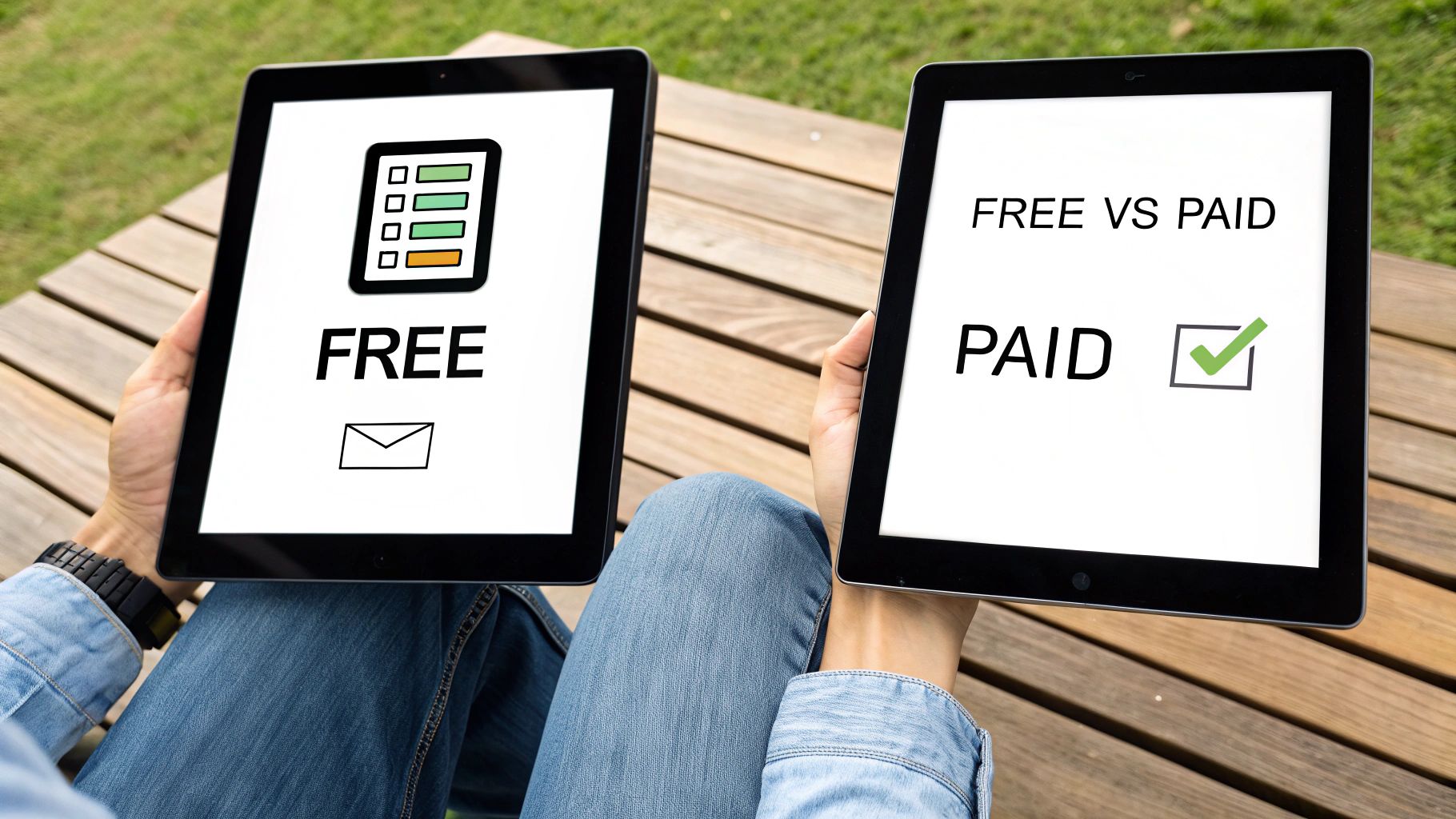
    Choosing Between Free and Paid Sending

    You'll have a choice to make: send for free or opt for a small upgrade. The free option is fantastic for quick, one-off tasks, like sending a signed permission slip or a single-page form. It gets the job done without any fuss.

    However, if you're sending something more official, like a multi-page contract, an invoice, or an application, the "Almost Free" plan is well worth considering.

    For just a few dollars, you can remove all the SendItFax branding from the cover page and get priority delivery. This makes your fax look far more professional and gives you that extra bit of confidence that it arrived promptly.

    Your decision really comes down to the context. For a quick, casual fax, free is perfect. For anything business-related or important, the small upgrade is a no-brainer.

    A Practical Walkthrough of Browser-Based Faxing

    Alright, enough with the theory. Let's jump right in and walk through sending your first eFax from a web browser. I’ll be using a service like SendItFax as the example, but the core steps are pretty universal. It's a straightforward process, but a few small details can mean the difference between a successful transmission and a frustrating failure.

    Getting the Sender and Recipient Details Right

    First things first: you need to fill out the "To" and "From" fields. This might seem basic, but it’s where a lot of faxes go wrong.

    When you enter the recipient’s fax number, be precise. The most common slip-up I see is people forgetting the area code or adding extra symbols.

    • For any number in the U.S. or Canada, you need the complete 10-digit number (e.g., 555-123-4567).
    • A quick pro-tip: Don't add a "1" at the beginning. The system is built for North American faxing and handles that part for you.

    Next up is your information—the sender details. This is what populates the cover page, so don't skip it! This is how the person on the other end knows who you are and why you're sending them a document. Always include your name, your company if it's relevant, and an email address where you can get the confirmation.

    A fax with a blank "From" section looks unprofessional at best and like spam at worst. I've heard from offices that simply toss out unidentified faxes, so take the extra ten seconds to fill this out properly.

    Attaching Your Document and Adding a Cover Page Note

    With the contact info sorted, it's time to upload your file. Most online fax services are flexible, accepting common formats like PDF, DOC, and DOCX.

    After years of sending digital faxes, I can tell you that PDF is always the best choice. It’s a static format, which means all your formatting, fonts, and images get locked in place. Your document will look exactly how you designed it, no matter what machine the recipient uses.

    If you have a Word doc, it’s worth taking a moment to convert it. We have a handy guide that shows you exactly how to convert your file to a PDF. This one small step can save you a world of headache.

    Finally, you’ll write a brief message for the cover page. This is your opportunity to add context. Think of it as the Post-it Note on top of the physical document.

    Scenario 1: An Urgent Legal Contract
    Your message should be direct and professional. "Attached is the signed commercial lease agreement for 123 Main Street. Please confirm receipt at your earliest convenience."

    Scenario 2: A Simple Medical Form
    Here, something simple and clear is perfect. "Here is the completed patient intake form for John Doe's appointment on Friday."

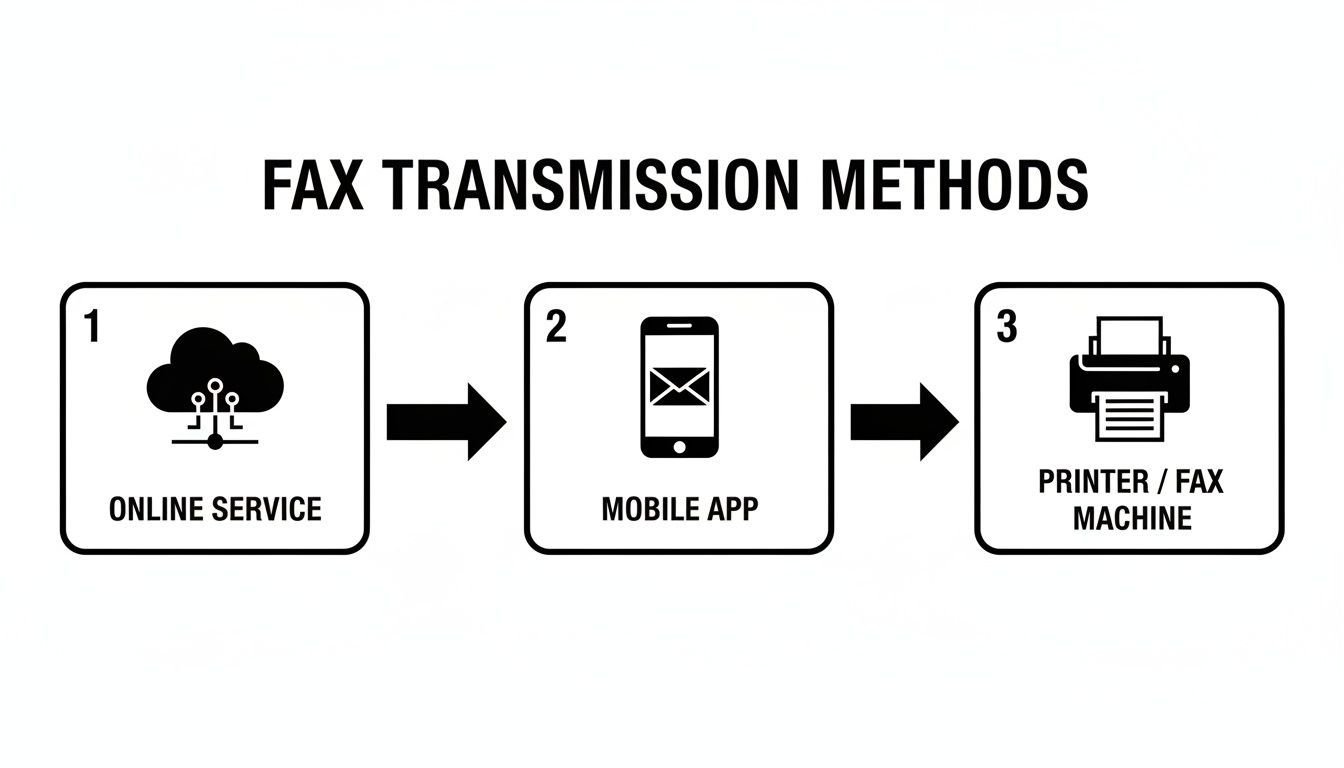
    At its heart, the entire process is just a few simple actions.

    A visual diagram illustrating the three-step eFax transmission process: prepare, website, send.

    As you can see, you just get your file ready, use the website to put everything together, and hit send. No clunky hardware, no busy signals. Once it's on its way, you just wait for the delivery confirmation email to land in your inbox, giving you peace of mind that your document arrived safely.

    Choosing the Right Plan for Your Situation

    When you’re ready to send your efax, one of the first things you'll decide is whether to use a free or paid option. There’s no single "best" choice—it really just boils down to what you're trying to accomplish with this particular fax.

    For plenty of one-off tasks, the free plan is a perfect solution. Maybe you're a student sending a single-page financial aid form, or a parent who needs to get a signed permission slip over to your kid's school. In those situations, a free fax is fast, simple, and gets the job done without costing a dime.

    When Free Is the Best Fit

    The free service is built for sending small, simple documents without any fuss. You can send up to three pages plus a cover page, and you get up to five free faxes per day. It’s ideal for moments when the content is all that matters.

    • Submitting a one-page form: Perfect for things like a quick rebate form or a basic application.
    • Sending a signed document: If you just need to return a single signed page, this works flawlessly.
    • Personal, non-business use: Sending documents to friends or family where a branded cover page isn't an issue.

    Why You Might Choose the "Almost Free" Plan

    Things change when your fax is for professional or high-stakes business. Imagine you're a real estate agent submitting a 20-page offer on a house. A cover page with third-party branding just doesn't project the professional image you need in that moment.

    That’s where the "Almost Free" plan, at just $1.99 per fax, is a much smarter move. This small investment delivers a huge boost in professionalism.

    For just under two dollars, you get to remove all SendItFax branding, send up to 25 pages, and receive priority delivery. It's a small price for presenting a polished, professional image when it matters most.

    This upgrade is about more than just appearances; it's about how your client perceives you, the urgency of your delivery, and the security of the document. Faxing is still a surprisingly critical tool in many industries. In fact, over 80% of businesses report that their fax usage is stable or has even increased, and 17% of global firms rely on it for operations where email just won’t cut it legally. You can read more about why business faxing is still so common to see just how prevalent it is.

    For these sectors, a paid, unbranded option isn't a luxury—it's a fundamental part of doing business. Paying that small fee ensures your document gets the professional attention it deserves. If you find yourself sending faxes often, you might also want to check out our breakdown of the cheapest online fax services for some long-term savings strategies.

    Ultimately, picking the right plan isn't about getting upsold. It's a practical decision. Just weigh the document's length, its urgency, and the impression you want to make. That will tell you everything you need to know.

    Why eFax Beats Email for Secure Documents

    It’s a fair question we hear all the time: "Why should I bother with eFax when I can just email this document?" For casual messages, email is perfect. But when you’re handling sensitive information, the answer boils down to one critical factor: security.

    Email feels quick and easy, but it’s fundamentally less secure than a modern online fax service. Think of a standard email as a postcard. As it bounces from server to server on its way to the recipient, it’s open to being intercepted and read. That means confidential data—a patient’s medical chart, a signed contract, or private financial records—is left exposed.

    A person holds a tablet displaying a lock icon and a document, illustrating secure eFax services.

    The eFax Encryption Advantage

    This is where services like SendItFax change the game. Instead of sending an open "postcard," modern eFax wraps your documents in layers of security. The process uses robust encryption to scramble your file into unreadable code the moment you send it. That code stays scrambled until it safely reaches its destination, making it completely useless to anyone who might try to snoop on it in transit.

    This level of protection is precisely why eFax is a cornerstone of HIPAA (Health Insurance Portability and Accountability Act) compliance. The act has strict rules for safeguarding patient health information, and encrypted eFaxing meets those high standards.

    • End-to-End Encryption: Your document is protected from your screen all the way to the recipient’s secure inbox or fax machine.
    • Verifiable Audit Trail: Ever had an important email disappear into a spam folder? eFax provides delivery confirmations that serve as a legal record of transmission and receipt. No more guessing if it arrived.

    These safeguards are why professionals in regulated fields still trust fax technology. To see a full breakdown, you can learn more about if fax is more secure than email in our detailed comparison.

    Real-World Scenarios for Secure Faxing

    This isn't just a theoretical benefit; it has major real-world implications. Imagine a law firm needing to send discovery documents protected by attorney-client privilege. An email breach could be disastrous. For situations like that, a dedicated and encrypted platform is non-negotiable. If your work involves secure file sharing with clients, you already know how critical it is to have a locked-down process.

    Here’s the bottom line: Email was built for communication. eFax was built for secure document delivery. That distinction is everything when compliance and confidentiality are on the line.

    Ultimately, choosing to send an eFax isn't an outdated move—it's a smart one. By using a service that prioritizes encryption and verifiable delivery, you’re making a deliberate choice to protect your most sensitive information. It’s about gaining peace of mind that your documents will get where they need to go, safely and securely.

    Troubleshooting Common eFax Transmission Problems

    A person works on a laptop with an open book on a wooden desk, overlaid with 'TROUBLESHOOT FAX' text.

    Even with a tool as simple as online faxing, things can occasionally go sideways. You hit send, wait a few minutes, and then get that dreaded "transmission failed" notification. Your first reaction might be to just send it again, but that’s usually a waste of time if you don't know what went wrong in the first place.

    Taking a moment to play detective is the fastest way to get your document delivered. Most of the time, the fix is surprisingly simple. Once you know what to look for, you can solve the immediate problem and avoid it altogether in the future.

    Let’s walk through the most common reasons an eFax fails and how to fix them in seconds.

    Double-Check the Recipient's Fax Number

    More often than not, a failed fax comes down to a simple typo. It’s incredibly easy to swap a couple of digits or forget one entirely, especially when you’re trying to get something sent off quickly.

    For services like SendItFax sending to the U.S. or Canada, you just need the full 10-digit number.

    • Correct: 555-123-4567 (just the area code and number)
    • Incorrect: 1-555-123-4567 (don't add the "1" for country code)

    The system is smart enough to handle the proper formatting, so adding extra characters or country codes can actually cause the transmission to fail.

    Here's a little trick I use: I always read the number out loud to myself before clicking send. It sounds silly, but it forces my brain to slow down and process each digit, which has helped me catch dozens of typos over the years.

    Resolve File-Related Errors

    If the number is correct, the next place to look is the file you’re trying to send. A document might fail to go through if the file is corrupted, too large, or in a format the service doesn't support.

    The easiest, most reliable fix is to convert your document to a PDF. PDFs are the gold standard for a reason—they lock in your formatting, are universally accepted, and are much less likely to get corrupted during the digital-to-analog conversion process.

    Another common culprit is the page count. A free plan, like the one on SendItFax, typically has a limit, such as three pages plus your cover sheet. If your document is 10 pages long, the system will reject it. Always be aware of your plan's limits before attaching a file.

    The online fax market is exploding, projected to jump from USD 4.70 billion to USD 12.32 billion by 2030. Yet, with an estimated 43 million old-school fax machines still buzzing away in offices worldwide, compatibility is key. These online fax market insights really highlight why using a universal format like PDF is so vital for bridging the gap between new tech and legacy hardware.

    Proactive Steps for Smooth Sending

    Ultimately, the best way to troubleshoot is to prevent problems from ever happening. If you build a few good habits into your eFax workflow, you can get your delivery rate close to 100%.

    Think of it as a quick pre-flight check before you send.

    • Confirm the Number: If it's your first time faxing someone, double-check the number with them. A quick email or call can save a lot of hassle.
    • Always Use PDF: Make this your standard operating procedure. Convert every document to a PDF to eliminate file-related headaches.
    • Mind the Page Count: Glance at your document's page count and make sure it aligns with your plan's limits.
    • Check for Confirmation: Don't just send and forget. Keep an eye out for that "delivery successful" email to be sure your fax arrived.

    A Few Common Questions About Sending an eFax

    Even with a step-by-step guide, a few questions almost always pop up before someone sends their first online fax. It's totally normal to have some lingering "what ifs." My aim here is to tackle those common concerns head-on so you can fax with total confidence.

    Let's dig into the questions I hear most often.

    Can I Send an eFax to an International Number?

    This is a great question, and the answer really comes down to the service you choose. Many straightforward, web-based tools like SendItFax are built to excel in specific regions to keep the process simple and affordable for most users.

    Right now, the platform supports sending faxes to any number in the United States and Canada. If you need to send a document to someone in Europe, Asia, or anywhere else, you’ll want to look for an eFax provider that specifically advertises its international capabilities.

    How Do I Know My eFax Was Delivered Successfully?

    You won't be left in the dark. Once you send your document, the service gives you a delivery status update. If you're on the paid "Almost Free" plan, you get a priority delivery confirmation that acts as your official receipt.

    For free sends, you still get a confirmation on a best-effort basis. It's a smart habit to always check the status screen after sending anything. If a fax happens to fail, the system typically provides an error message that helps you figure out what went wrong before you try again.

    The ability to confirm receipt is one of the main reasons faxing is still so relevant in business and healthcare. An email can vanish into a spam folder, but a fax confirmation gives you a verifiable audit trail that your document arrived successfully.

    Is It Safe to Send Sensitive Documents via eFax?

    Yes, it's dramatically safer than sending a standard email. A quality eFax service uses strong encryption to shield your documents from the moment you hit send until they arrive. This robust security is precisely why eFax is a go-to for sending files governed by privacy laws like HIPAA.

    I like to use this analogy: a regular email is like a postcard anyone can read along its journey. An encrypted eFax is like a sealed, armored briefcase sent directly to its destination. This secure channel is why professionals trust it for everything from confidential legal contracts to private medical records.

    Do I Need to Install Any Software to Send an eFax?

    Not at all. Modern tools like SendItFax are designed to work entirely within your web browser, which means there’s nothing to download or install. This is a huge leap forward from older digital faxing methods that made you juggle clunky desktop software.

    As long as you have an internet connection, you can send a fax from practically any device you own, including your:

    • Desktop or laptop
    • Tablet
    • Smartphone

    This flexibility means you’re never tied to your desk. You can send an urgent document while traveling for work, from a home office, or even from a coffee shop, all without compromising security.


    Ready to send your first fax without the hassle? Give SendItFax a try for a quick, simple, and secure way to deliver your documents straight from your browser. You can get started right here: https://senditfax.com.

  • Your Guide to Using a Fax Service Online in 2026

    Your Guide to Using a Fax Service Online in 2026

    It might sound strange to talk about faxing in an age of email and instant messaging, but the fax machine isn't a museum piece just yet. It has simply evolved. An online fax service is the modern version of that old office workhorse, letting you send and receive faxes with nothing more than an internet connection.

    Why Online Fax Is Still a Big Deal

    Let's be honest, most of us probably think of faxing as an outdated hassle. But online fax services have completely changed the game. Think of it as a bridge connecting your digital world to the traditional fax network. It takes your PDF or Word document and translates it into the language old-school fax machines understand, sending it securely over the web.

    This digital makeover preserves the one thing that has kept faxing indispensable for decades: its security and legal standing. Unlike a standard email, which can be easily missed or disputed, a fax creates a direct, point-to-point connection with a verifiable confirmation of delivery.

    A fax provides a verifiable, legally-recognized trail that standard email often can't match. This is why it remains a trusted method for transmitting sensitive information in critical sectors.

    This kind of reliability is absolutely essential in certain fields. For instance:

    • Healthcare: Medical practices rely on fax to send patient records and signed consent forms, where security and privacy are legally required under regulations like HIPAA.
    • Legal: Law firms use it to exchange signed contracts and court filings that demand undeniable proof of receipt and a precise timestamp.
    • Government: Many agencies still require applications to be faxed for official processes, leaning on the established and secure protocol.

    The Growing Market for Digital Faxing

    The numbers don't lie—this isn't just a niche tool. The global online fax market was valued at around USD 3.16 billion in 2026 and is on track to hit USD 7.22 billion by 2035. This shows that the need for a dependable fax service online is growing, not shrinking. North America is leading the charge with a huge 38% market share, largely because of early adoption and strict industry rules that make digital faxing a must-have. You can dive deeper into these trends in the full research report.

    Modern tools like SendItFax bring this secure technology right to your fingertips, allowing anyone in the U.S. and Canada to send important documents from their browser without getting locked into a subscription. The move from clunky office hardware to a simple web page proves that this "old" technology has found a powerful new purpose. It’s not about being nostalgic; it’s about solving a very real need for secure, verifiable document delivery in a much more convenient way.

    How Sending a Fax Online Actually Works

    Ever wondered what really happens when you hit “send” on an online fax service? It feels instant, but there’s some clever tech working in the background to bridge the gap between your computer and a traditional fax machine.

    Think of an online fax platform as a digital middleman. It takes the file you see on your screen—a PDF, a Word doc, or even a photo—and translates it into the old-school analog language that fax machines understand. It's all about converting modern files into a format that can travel over a standard phone line.

    The process kicks off the second you upload your document to a secure platform like SendItFax and provide the recipient's fax number.

    The Conversion and Transmission Process

    First, the service takes your digital file and converts it into a specific black-and-white image format, usually a TIFF file. This is a critical step. It standardizes your document, stripping away colors and complex formatting to create a simple, flat image that any fax machine on the planet can interpret correctly.

    Once the file is converted, the service uses Voice over Internet Protocol (VoIP)—the same technology that powers internet-based phone calls—to dial the recipient's fax number. When the receiving machine answers with that familiar screech, your online service transmits the image data over the line.

    This diagram breaks down that three-step journey.

    A diagram illustrating the online faxing process from document to secure server to receiving fax machine.

    As you can see, the secure server is the heart of the operation. It handles the heavy lifting of both converting your file and making the call. To the person on the other end, a physical document simply prints out. They have no idea it started its journey on a laptop or smartphone.

    The Role of the Fax Cover Page

    A professional fax transmission almost always starts with a fax cover page. This isn't just a formality; it's your document's introduction, ensuring it gets to the right person and provides immediate context.

    A good cover page should always include:

    • Sender Information: Your name, company, and contact number.
    • Recipient Information: The intended person's name and their fax number.
    • Date and Time: A clear timestamp for official records.
    • Number of Pages: Helps the recipient verify they received the full document.
    • A Brief Message: A subject line or short note explaining the fax's purpose.

    Think of the cover page as a routing slip and a business card rolled into one. In a busy office, it prevents your document from getting lost in a pile on the fax machine.

    Services like SendItFax build this step right into the workflow. You just fill out a simple form with the recipient's details and your message, and the platform generates a clean, professional cover sheet for you. Some paid plans even offer the flexibility to send without a cover page if you prefer.

    This whole process—uploading, adding details, and letting the service do the rest—is what makes online faxing so incredibly efficient. You get the legal and procedural benefits of faxing without touching a single piece of hardware. Plus, receiving faxes directly as email attachments is just another way these services are bringing a classic tool into the modern age. If you're curious about that, you should explore the benefits of a fax-to-email setup.

    Finding the Right Online Fax Service Model

    Picking an online fax service is about more than just a list of features. It’s about matching the payment model to how you actually work. After all, why pay for a firehose when you only need a garden hose? Not everyone faxes every day, and your bill should reflect that.

    Most services fall into one of three pricing buckets, each built for a different kind of user. Think of it like a cell phone plan—you wouldn't get an unlimited international plan if you never leave the country. Getting this right is the first step to making sure you're not overpaying. Let's dig into the options.

    Subscription Plans for High Volume Users

    This is the classic, all-you-can-eat model of the online fax world. You pay a flat fee each month or year and get a big bucket of pages to send and receive. For businesses and professionals who are constantly sending documents back and forth, this makes a ton of sense.

    If your office is churning out contracts, patient records, or purchase orders daily, a subscription quickly becomes the cheapest way to operate. The cost per page drops to pennies, and you get that all-important dedicated fax number for receiving documents, which is a must-have for any serious business.

    The catch? It's a "use it or lose it" deal. If you hit a slow month and only send a fax or two, you're still on the hook for the full subscription fee. It’s a commitment that really only pays off with consistent, predictable faxing.

    Pay-Per-Use Models for Ultimate Flexibility

    On the other end of the spectrum is the pay-per-use model. It’s exactly what it sounds like: no monthly fees, no commitments. You just pay for the faxes you send, when you send them. This is a game-changer for people with sporadic faxing needs.

    Consider these common situations:

    • Sending a single, signed lease agreement.
    • Submitting a one-time form to a government agency.
    • A freelancer who faxes a new contract just a few times a year.

    In any of these cases, a subscription would feel like a waste of money. This is where services like SendItFax come in. Our "Almost Free" plan is built for this—you pay a simple, flat fee of $1.99 per fax for up to 25 pages. No surprises, no recurring bills, just a straightforward cost.

    Pay-per-use frees you from monthly bills. You only pay for what you use, making it the perfect choice for those occasional but critical documents.

    This model is all about putting you in control. For a more detailed look at how different providers stack up, our comprehensive comparison of online fax services breaks it all down.

    Free Services for One-Off Needs

    And then there's the free option. These services are fantastic for sending a very short, non-urgent document without reaching for your wallet. Think of it like the free fax machine at a public library, but from the comfort of your home.

    These services have to pay the bills somehow, so they are typically supported by ads or have some pretty firm limits. For example, the free tier at SendItFax lets you send up to three pages plus a cover sheet, with a cap of five free faxes per day. The catch is that the cover page will include our branding.

    This works perfectly for a student submitting a form or someone sending a quick note who isn't concerned about a branded cover page. For business documents or sensitive information, however, the limitations and branding might not be the right professional look.

    Online Fax Service Models Compared

    Choosing the right model really boils down to your own needs: How often do you fax? How many pages do you send? And how professional do you need to appear? Seeing the options side-by-side can make the decision much clearer.

    Here’s a simple table to help you weigh your options.

    Service Model Best For Typical Cost Key Features & Limitations
    Subscription Plan Businesses with consistent, high fax volume. Monthly or annual fee with a generous page allowance. Very low cost per page, but you pay whether you use it or not. Includes a dedicated number.
    Pay-Per-Use Individuals & small businesses with occasional needs. A flat fee for each fax sent. Total flexibility with no recurring costs. Can be more expensive for high-volume users.
    Free Service Quick, one-off, non-critical faxes. Free, with clear limitations. Strict page and daily limits. Usually includes provider branding on cover pages.

    Ultimately, the best service is the one that fits so well into your workflow you forget it’s even there. For anyone who dreads another monthly bill, the freedom of a pay-per-use or free service is a powerful, modern alternative to the old-school subscription.

    Understanding Security in Digital Faxing

    If you're sending sensitive documents, security isn't just a feature—it's everything. Let's be honest, the main reason faxing is still around is its reputation as a secure, point-to-point delivery method. But how does a modern fax service online live up to that legacy? It all comes down to multiple layers of digital protection that often leave traditional fax machines in the dust.

    The first and most important layer is encryption. When you upload a document to a web-based fax service, its journey from your computer to their servers is shielded by SSL/TLS encryption. Think of it as sending your document through a private, armored digital tunnel. No one can peek inside while it's on its way.

    This is a massive step up from the old way of doing things. A clunky, old-school fax machine sends data over an analog phone line, which is usually unencrypted and can be intercepted. By simply using an online service, you're adding a powerful layer of security before the fax even leaves the station.

    A laptop screen displays a green padlock icon, with text 'Digital Fax Security' overlaid.

    Compliance in Regulated Industries

    It’s not just about general privacy, either. Many industries have to follow strict data protection laws. For anyone in healthcare, the Health Insurance Portability and Accountability Act (HIPAA) is the gold standard for protecting patient information. Faxing has long been a trusted method, but not all online services are built to meet these tough requirements.

    For a service to be truly effective in fields like healthcare or law, it must support compliance. This usually means it has:

    • Secure Access Controls: Making sure only authorized people can send or see sensitive documents.
    • Audit Trails: Keeping a detailed log of every fax—who sent it, when, and its delivery status—for a verifiable paper trail.
    • Data Handling Policies: Using strict internal rules for managing and securely deleting your data after a fax is complete.

    While many subscription services designed for large businesses heavily promote their HIPAA compliance, a pay-per-use model can be just as secure for one-off needs. A service with robust encryption and transparent data policies lets you send documents with confidence, without having them stored long-term on a third-party platform. For a closer look at the nuts and bolts, you can learn more about the security of faxing in our detailed article.

    A modern fax service online truly gives you the best of both worlds: the proven reliability of faxing combined with the advanced security protocols of the internet.

    Market Demand Driven by Security Needs

    This focus on security isn't just a talking point; it's what drives the market. North America currently makes up 38% of the global online fax market, which was valued at a whopping USD 1.79 billion in 2022. This huge share is fueled by regulations in healthcare, legal, and finance, where secure, verifiable delivery is a must-have, not a nice-to-have.

    In fact, over 50% of U.S. hospitals still depend on fax for daily communications. That's a powerful testament to its trusted status. This demand, which has only grown since the rise of remote work, highlights just how critical secure, browser-based tools are.

    So, what does this mean for you? It means that individuals and small businesses can now get the same level of secure transmission that was once only available to big corporations with dedicated fax lines. Whether you're sending a signed contract, a medical form, or a government application, a quality online service ensures your document gets there safely—with a clear confirmation to prove it. It perfectly bridges the gap between old-world reliability and new-world convenience.

    Alright, we've covered the technical side of things, but where does sending a fax online actually come in handy? Let's step away from the theory and look at real-life situations where you're in a jam and a fax is the only way out.

    Think about it: in each of these scenarios, a clunky fax machine is nowhere to be found, but the need for a secure, verifiable document is immediate.

    Let’s say you’re a freelance designer who just landed a huge new client. The contract is signed, sealed, and ready to go. The problem? Their legal department is old-school and will only accept signed contracts via fax for compliance. You work from a home office and ditched your all-in-one printer years ago. A trip to the local print shop would kill your momentum.

    Hand interacting with a tablet to send documents, surrounded by digital service icons.

    This is a textbook case for a browser-based fax service online. You can just snap a picture of the signed contract with your phone, upload it to a service like SendItFax, type in the fax number, and click send. Within minutes, your legally binding document is in their hands, and you have a digital confirmation receipt for your records. No fuss, no wasted time.

    When Personal and Professional Lives Collide

    The need to fax often pops up when you're dealing with big, established institutions—the kind that haven't quite caught up with modern tech. These moments can be personal, professional, or a stressful mix of both, and they always seem to require a fast, foolproof solution.

    Here are a few classic examples I see all the time:

    • Urgent Medical Records: You need to get your child’s medical history over to a specialist before a big appointment. Citing HIPAA security rules, their office only accepts records by fax. Emailing that kind of sensitive data is a non-starter.
    • Time-Sensitive Government Forms: A small business owner is racing against the clock to apply for a government grant. The application requires a signature, and the official instructions state it must be submitted by fax. Missing that deadline means losing the opportunity.
    • Real Estate Transactions: An agent is trying to close a deal with a buyer who lives out of state. Offer sheets and counteroffers are flying back and forth and need to be exchanged instantly and with proof of delivery. Faxing provides the critical timestamps and verification needed for these legal documents.

    In every one of these cases, someone is under pressure and doesn't have a fax machine. They need a tool that works right now, is secure, and is easy to use from whatever device they have on hand.

    Think of a web-based fax service as your personal document courier. It ensures your critical papers arrive securely and on time, without the expense or hassle of owning the hardware.

    The Modern Solution to an Old Problem

    What’s so brilliant about a pay-per-use fax service online is how elegantly it solves these real-world headaches. You don't have to waste time searching for a local print shop that still offers faxing (a service that's getting harder and harder to find). Sure, some public libraries might do it for free, but their hours are limited and it's rarely convenient.

    Instead of derailing your day, you can handle the entire task right from your desk or even from your phone in line at the grocery store. For just a few dollars, a service like SendItFax sends your document, adds a professional cover page (if you want one), and gives you priority delivery. It completely removes the friction from the process.

    This modern approach shows that the value of faxing was never about the machine itself. It’s always been about the security, reliability, and legal standing of the transmission. By moving that capability online, these services have made faxing accessible to anyone, anytime, solving urgent problems with just a few clicks.

    Sending Your First Online Fax Step-by-Step

    So, you're ready to send your first fax without ever touching a physical machine? Let's walk through it. You'll be surprised at how this once-clunky process has been boiled down to just a few clicks in your web browser.

    Before you jump in, it helps to ask a few quick questions to make sure you're on the right track:

    • How often will you be faxing? Is this a one-and-done task, or will you need to send documents regularly?
    • Where is it going? Are you sending a fax within the United States and Canada, or somewhere else?
    • What's your budget like? Are you looking for a free, no-frills option or a low-cost service with more professional features?

    We'll use a straightforward service like SendItFax as our example to show you just how quickly you can get this done.

    Your 6-Step Guide to Sending a Fax

    The beauty of this process is its simplicity. There's no account to create, no password to forget, and no software to install. You just need your document and the recipient's fax number.

    1. Open the Website: Pull up a fax service online right in your browser. The entire thing happens on one page, whether you're on your computer, tablet, or phone.

    2. Enter Sender and Recipient Info: Next, you'll fill in the essentials: your name and email (so you can get the confirmation receipt) along with the recipient's name and fax number. Double-checking the fax number here is the most important part!

    3. Upload Your Document: Now for the main event. Just click the upload button and grab the file from your device. Most modern services, including SendItFax, handle common file types like PDF, DOC, and DOCX without any issue.

    Think of this as handing your document to a digital courier. The service takes over from here, converting your file into the proper format and dialing the fax machine for you.

    1. Add a Cover Page Note: If you want, you can jot down a quick note for the recipient. This message appears on the cover sheet, giving them immediate context for why you're sending the fax. On a service like SendItFax, this is optional for paid faxes but included by default on free ones.

    2. Choose Your Sending Plan: Here’s where you pick your option. With SendItFax, for instance, you can send up to three pages completely free (with their branding on the cover page). If you need more, you can pay $1.99 to send up to 25 pages with priority delivery and no branding.

    3. Click 'Send' and You're Done: Give everything a final look, and hit the send button. The service will queue up your fax and start the transmission process. You'll get an email confirmation as soon as it's successfully delivered, which acts as your proof of delivery.

    And that's really all there is to it. This simple, six-step flow takes a task that used to be tied to bulky office equipment and makes it accessible and convenient for anyone with an internet connection.

    Frequently Asked Questions About Online Faxing

    Even after getting the hang of the basics, you'll probably still have a few practical questions. That’s perfectly normal. Let's clear up some of the most common things people wonder about when they start using a fax service online.

    Can I Receive Faxes with an Online Fax Service?

    It really depends on the type of service you choose. Many online fax providers, especially the subscription-based ones, give you a dedicated virtual fax number. With that number, you can receive faxes straight to your email inbox, usually as a PDF attachment.

    On the other hand, services designed for quick, one-off sends—like SendItFax—are built for just that: sending. They’re streamlined for getting your document out the door without the need for a dedicated number, which is perfect when you just need to send something and don't expect a fax in return.

    Is Sending a Fax Online Legally Binding?

    Yes, it is. In places like the U.S. and Canada, an electronically sent fax carries the same legal weight as one sent from a traditional machine. The secret sauce is the verifiable transmission record, which proves your document was successfully delivered and includes a timestamp.

    This digital proof of delivery is precisely why faxing is still trusted for high-stakes documents, including:

    • Legal contracts
    • Real estate agreements
    • Official government forms

    Of course, it's always smart to double-check if your specific industry or transaction has any unique requirements, but for the most part, you're covered.

    What makes a fax legally sound is the proof of delivery. An online service gives you a digital receipt that serves as this critical confirmation, often landing right in your email inbox.

    Do I Need Special Software to Use a Fax Service Online?

    Nope! For most web-based services, there's absolutely nothing to download or install. If you have a modern web browser (like Chrome, Firefox, or Safari) and an internet connection, you have everything you need.

    You can send a fax right from your computer, tablet, or even your phone just by visiting the service’s website. The whole process—uploading your file, typing in the fax number—happens in your browser, so you can skip any complicated setup.

    What Happens if the Recipient's Fax Line Is Busy?

    This is one of the best parts of using an online service. Instead of getting that dreaded busy signal and having to start over, the service handles it for you. It will automatically keep trying to send the fax for a set period.

    Think of all the time you'll save not having to stand over a machine and hit redial. The service will keep you in the loop with email notifications, letting you know if the fax went through, if it failed, or if it's still trying.


    Ready to send a fax without all the hassle? SendItFax lets you send documents securely from any browser, with no account or subscription required. You can get started in seconds.

    Send Your Fax Now

  • How to Fax Documents Online: how to fax documents online, Quick Secure PDF Guide

    How to Fax Documents Online: how to fax documents online, Quick Secure PDF Guide

    It’s 2026, and sending a fax can feel like a throwback to a different time. Yet, for many of us in fields like healthcare, law, or government, it’s still a daily requirement. The good news is you don’t need an old, clunky machine. With a service like SendItFax, you can simply upload a file like a PDF and send it right from your browser. It’s faster, far more secure, and frankly, a much more convenient way to manage important documents.

    A laptop, smartphone with a scanning app, and printer on a wooden desk, advertising online fax services.

    Faxing Without a Fax Machine Is Easier Than You Think

    When you think "fax," you probably picture a big, noisy machine humming away in a corner office. For decades, that was the only way to send signed contracts, medical records, or government forms. But as our workplaces have changed, that traditional fax machine—with its constant need for paper, toner, and a dedicated phone line—has become more of a liability than a tool.

    This is exactly why knowing how to fax documents online is such a valuable skill. It perfectly bridges the gap between old-school compliance and modern, efficient workflows.

    Before diving into the "how," let's quickly compare the two methods. It really puts the benefits of online faxing into perspective.

    Online Fax vs Traditional Fax: A Quick Comparison

    This table breaks down the fundamental differences between using a modern online fax service and a conventional fax machine, highlighting key aspects like cost, convenience, and security.

    Feature Online Fax Service (e.g., SendItFax) Traditional Fax Machine
    Hardware None needed. Uses computer, phone, or tablet. Requires a physical fax machine.
    Supplies None. Completely digital. Requires paper, ink, and toner.
    Phone Line Not required. Uses an internet connection. Requires a dedicated phone line.
    Accessibility Send/receive from anywhere with internet. Must be physically present at the machine.
    Security Encrypted transmission; private digital delivery. Faxes can sit openly on the receiving tray.
    Cost Low monthly subscription. High upfront cost, plus ongoing supply costs.
    Organization Faxes are stored as digital files (PDFs). Creates paper clutter; manual filing needed.

    Seeing it laid out like this makes the choice pretty clear for most modern needs. Online services simply remove all the physical friction from the process.

    The Shift to Digital Faxing

    This move away from bulky hardware isn't just about convenience; it’s a direct response to how we all work now. With so many people working remotely or in hybrid setups, having a solution that isn't tied to a specific location is no longer a luxury—it's essential. The market's explosive growth tells the same story.

    The global online fax service market was valued at roughly $3.16 billion in 2026, jumping from $2.5 billion in 2024. Projections show it soaring to $7.22 billion by 2035. This isn't just a niche trend; it’s a clear signal that businesses and individuals are enthusiastically trading in their old machines for web-based services. You can get a deeper look into the market forces driving this change by reading the full research on online fax services.

    The real advantage is simple: you get the security and legal weight of a traditional fax without being chained to a physical machine. It's about having the confidence to send a critical document from your laptop at a coffee shop just as you would from a corporate mailroom.

    Why Online Fax Services Are the New Standard

    Services like SendItFax have streamlined what used to be a tedious chore into just a few clicks. Forget printing a document, walking over to a machine, and punching in a number. Now, you just upload a file and hit send.

    This digital-first approach brings some powerful benefits to the table:

    • Total Accessibility: Send or receive faxes from any device that has an internet connection—your computer, tablet, or smartphone.
    • Serious Cost Savings: You completely cut out expenses for machine maintenance, extra phone lines, paper, and pricey toner cartridges.
    • Better Security: Digital faxes are typically encrypted during transit, which means no more sensitive documents left sitting on a shared machine for anyone to see.
    • Effortless Organization: Your sent and received faxes arrive as digital files (usually PDFs), making them incredibly easy to save, search for, and organize.

    Understanding these points helps clarify that this isn't just about replacing one piece of tech with another. It's about fundamentally upgrading an entire process to fit the way we work today.

    Preparing Your Documents for Flawless Online Faxing

    Before you hit send on that online fax, a little prep work goes a long way. Think of it as a quick pre-flight check for your files. Taking just a minute to get your document in the right shape is often the difference between a successful transmission and a frustrating "failed delivery" email.

    First things first, let's talk file formats. While services like SendItFax can handle a variety of common file types, including DOCX from Microsoft Word or image files like JPG and PNG, one format stands head and shoulders above the rest: PDF.

    Why PDF Is the Gold Standard for Faxing

    Using a PDF is the single best way to guarantee that what you see on your screen is exactly what prints out on the recipient's fax machine. It essentially locks in all your formatting, fonts, and images, so nothing gets jumbled or re-arranged during the journey.

    Imagine sending a carefully formatted legal contract, only to have the recipient get a garbled mess because their system didn't have the specific font you used. A PDF completely sidesteps that entire problem.

    Plus, PDFs are universal. Pretty much any computer or smartphone can open them without special software. If your document is currently in Word format, converting it is dead simple. If you need a hand, our guide on how to convert a Word document to a PDF will walk you right through it.

    Pro Tip: If you're scanning a physical paper, always set the scanner to Black & White mode, not grayscale or color. Fax is a black-and-white technology at its core, so this setting creates a much cleaner, higher-contrast image that transmits beautifully and results in a smaller file size.

    Your Pre-Send Document Checklist

    Got your document saved as a PDF? Great. Now, run through this quick final checklist. It only takes a second and can spare you a lot of grief later.

    • Do the Legibility Test: Zoom in on your document to 200%. Is every word, number, and signature line crystal clear? If anything looks blurry or pixelated to you, it will almost certainly turn into an unreadable smudge on the receiving end. If it's fuzzy, go back and re-scan or re-export the file at a higher quality, like 300 DPI.

    • Merge Everything into One File: If you're sending a multi-page document, like an application form along with a copy of your driver's license, combine them into a single PDF. Sending them as separate files is risky—they could arrive out of order, or worse, one of the files might fail to send entirely.

    • Watch That File Size: Online fax services are pretty generous, but massive files (think over 20-25 MB) can sometimes struggle to upload or cause the transmission to time out. If your PDF is unusually large, look for a "reduce file size" or "compress" option in your PDF software. This usually shrinks the file dramatically without any real loss in quality.

    Getting these details right from the start sets you up for a smooth, successful online fax every single time.

    Choosing the Right Online Fax Plan for Your Needs

    One of the first questions people ask when they start faxing online is, "Do I really need to pay for this?" The honest answer is: it depends entirely on what you're sending. Picking the right plan is key to getting your fax delivered efficiently without spending more than you have to.

    Sometimes, a free service is exactly what you need. Think about it—you just need to send a signed, one-page permission slip to your child's school. It isn't a high-stakes document, and you probably don't mind if the fax service puts their logo on the cover sheet.

    This is the perfect job for a free tool. A service like SendItFax offers a free option designed for these quick, one-off tasks. It gets the job done without any fuss.

    When a Small Upgrade Is Worth It

    But what if the situation is different? Let's say you're a freelancer sending a 25-page contract to land a big client. The deadline is tomorrow, and you want to look as professional as possible.

    This is where a small upgrade makes all the difference. For just a couple of dollars, a plan like the $1.99 Almost Free option from SendItFax gives you some serious advantages. Most importantly, it removes their branding from your fax, so your document looks clean and is all about you. Plus, you often get priority delivery, which bumps your fax to the front of the line—a lifesaver for time-sensitive materials.

    No matter which plan you choose, your document format is crucial for a successful transmission.

    A flowchart showing decision process for document formats: PDF, Word, Image, and Other.

    As you can see, PDF is the gold standard. While you can send Word docs or images, converting them to a PDF first is the most reliable way to ensure what you see is what your recipient gets.

    SendItFax Plan Comparison: Free vs. Almost Free

    To make the decision even clearer, here’s a quick side-by-side look at what you get with each plan. This should help you decide which lane to choose for your specific faxing job.

    Feature Free Plan Almost Free Plan ($1.99)
    Best For Quick, non-urgent, single-page forms Multi-page contracts, professional documents
    Page Limit Up to 3 pages Up to 25 pages
    Cover Page Included, with branding Optional, with no branding
    Delivery Standard Priority
    Cost $0 $1.99 per fax

    Ultimately, it’s all about matching the tool to the task.

    The bottom line is to think about the stakes. For casual faxes where speed and branding don't matter, a free service is a fantastic resource. But for anything that affects your business, reputation, or a tight deadline, spending a couple of dollars for a premium send is a no-brainer.

    If you want to explore even more options, our comprehensive online fax services comparison takes a deeper look at different providers in the market. A smart choice upfront ensures you get exactly what you need.

    Alright, you've got your documents ready and have an idea of which service you'll use. Now for the actual sending part. If you’re using a web-based platform like SendItFax, you’ll find the process is incredibly straightforward—honestly, it’s not much different from sending an email. No paper jams, no weird screeching noises.

    Most online fax services have a clean, no-fuss interface that gets straight to the point. They only ask for what's absolutely necessary to get your document from point A to point B successfully.

    You'll typically see a simple form like this one. Everything is clearly labeled, so you know exactly what to put where.

    A hand types on a laptop displaying a 'Send First Fax' screen with a green 'NO' button.

    The layout is designed to prevent mistakes by keeping sender info, recipient details, and your attachments in separate, logical sections.

    Entering Sender and Recipient Details

    First up is your own information. You’ll need to enter your name and email address. Pay close attention to your email—this is where your delivery confirmation (or failure notice) will be sent. A simple typo here can leave you wondering if your fax ever made it.

    Next, you'll plug in the recipient’s information. This is where you need to be precise.

    • Recipient's Name: While optional on some platforms, it’s good practice to include it. It helps ensure your fax gets routed to the right person or department on the other end.
    • Fax Number: This is the most critical part. You'll enter the 10-digit fax number without any dashes, spaces, or parentheses. For services like SendItFax that primarily serve the U.S. and Canada, you don’t even have to add the country code "1," as the system handles it for you.

    Trust me on this one: an incorrect fax number is the single most common reason for a transmission to fail. It’s always worth taking five extra seconds to double-check it.

    Uploading Your File and Crafting the Cover Page

    With the contact info locked in, it's time to attach your file. Look for a button labeled "Upload File" or something similar, click it, and browse your computer for the document you prepared earlier.

    You’ll also see a section for a cover page. This is your chance to add a quick note giving the recipient some context. Think of it as the body of an email—keep it short, clear, and professional.

    For example, a perfect cover page note might read: "Subject: Signed Agreement for Project Phoenix. Please forward to the legal department. Thank you." This immediately tells them what the document is and what to do with it.

    That said, a cover page isn't always necessary. If you're sending a standardized form that speaks for itself, or if you're using a bare-bones plan like SendItFax’s $1.99 Almost Free option, you can usually skip the cover page.

    It's this kind of flexibility that’s making online faxing so popular, especially with small to medium-sized businesses. While large companies made up over 50% of the online fax market in 2022, the SME segment is catching up, growing at an impressive 15% annually. Today, cloud-based faxing holds 45% of the market, driven by its ease of use and speed. If you're interested in the data, you can read the full research on online fax market trends and see how the industry is evolving.

    Once everything is filled out, give it all one final scan. Is your email spelled correctly? Is the fax number right? Did you attach the correct file? If it all looks good, hit that "Send Fax" button. And just like that, you now know how to fax documents online.

    Confirming Delivery and Troubleshooting Common Issues

    A smartphone displaying 'DELIVERED' with a green checkmark next to a cardboard box and a document, confirming successful delivery.

    You’ve clicked "Send," and your document is officially off your desk. But knowing how to fax documents online is only half the job. The real peace of mind comes from knowing it actually arrived. Simply sending it into the digital ether isn't a guarantee, so what happens next is what truly counts.

    Almost any online fax service, including SendItFax, will immediately follow up with a confirmation email. Think of this email as your official receipt for the transmission. Learning how to read it is key.

    Understanding Your Delivery Notification

    That confirmation email will usually report one of three statuses. Figuring out what each one means tells you exactly what to do next (or if you can just relax).

    • Delivered: This is what you want to see. It means every single page of your document was successfully received by the recipient's fax machine. You can file that confirmation email away and consider the task complete.

    • Failed: This status flags a problem that stopped the transmission cold. The cause can be anything from a simple typo in the fax number to a more technical glitch on the other end.

    • Busy Signal: If you see this, it means the recipient's fax line was already in use. Good online services will automatically try again a few more times over the next several minutes without you having to do a thing.

    If you get a "Busy Signal" notice, the best first step is to just wait. Give it about 15-20 minutes before you start investigating. The service is most likely still working on it for you.

    Troubleshooting Common Fax Failures

    A "Failed" or persistent "Busy" notification is annoying, but it's rarely a major crisis. The fix is usually straightforward, so don't hit the panic button. Instead, just work through these common culprits.

    In my experience, the number one reason a fax fails is simple human error. Before you assume it’s a technical disaster, always, always double-check the 10-digit fax number you typed in. A single transposed digit is responsible for more failed faxes than any other issue.

    If you've checked the number and the fax still won't go through, here are a few other things to try:

    • Send it during off-peak hours. If you're constantly getting a busy signal, you might be trying to reach a high-volume office. Try sending it again first thing in the morning, over the lunch hour, or later in the afternoon when their machine is less likely to be tied up.

    • Break up very large documents. Faxes with a huge page count can sometimes time out during transmission. If your document is pushing past 20 pages, try splitting it into two smaller faxes. Just make sure to add a note on the cover sheet like, "Contract – Part 1 of 2."

    • Verify the recipient's setup. It's not just about typos. Is it possible the business updated its fax line? A quick phone call to their front desk can confirm you have the right number and, just as importantly, that their fax machine is actually turned on and working.

    Your Online Faxing Questions, Answered

    Even with a straightforward process, it's natural to have a few questions before you hit "send." I've been helping people move from clunky fax machines to online services for years, and a few key questions always come up. Let's walk through them so you can fax with confidence.

    Is It Really Secure and Legally Binding?

    This is probably the most important question, and the answer is a resounding yes. An online fax is considered just as legally valid as a traditional one for nearly all purposes, including critical documents for legal, real estate, and healthcare fields.

    In fact, the security is often a significant upgrade. Think about it: a physical fax can sit out in the open on a shared machine for anyone to see. Online fax services, on the other hand, wrap your documents in encryption during transmission.

    The big advantage here is combining the legal weight of a classic fax with the privacy of modern digital security. It’s a much safer way to handle sensitive information than leaving it unattended in an office mailroom.

    Always look for a service that is transparent about its security measures. A good provider will use strong encryption to ensure your files are protected from the moment you upload them until they are delivered.

    Can I Send a Fax to Another Country?

    This really comes down to the specific provider you're using. Many online fax services are built with a specific audience in mind. For instance, a service like SendItFax is tailored specifically for sending faxes to numbers within the United States and Canada.

    If you need to get a document to someone in Europe, Asia, or anywhere else, you'll need to find a provider that explicitly supports international faxing.

    My best advice is to check this before you even start preparing your document. A quick look at a service’s features or FAQ page will tell you about their geographic coverage and save you the headache of a failed delivery notice later.

    I Haven't Received My Confirmation Email—What Should I Do?

    Don't worry if a confirmation email doesn't show up right away. This happens from time to time, and the solution is usually simple. If you've been waiting for more than 15 minutes, run through this quick checklist:

    • Check your spam or junk folder. This is the culprit more often than not. Automated emails from web services are prime targets for aggressive spam filters.
    • Double-check the email address you entered. It's incredibly easy to make a small typo, like "gamil" instead of "gmail." Go back to the sending page and make sure the address you provided is perfect.
    • Try sending it again. If you've checked both of the above and still see nothing, the transmission might have glitched. It's often easiest to just resend the fax, paying close attention to every detail this time around.

    Following these simple checks solves this issue over 90% of the time. A little patience and a careful eye for detail are all you need.

    Do I Need to Install Any Software?

    Nope, not at all! This is one of the best parts about modern online faxing. The entire process runs right from your web browser.

    There's no software to download and no complicated setup. It's designed to be as user-friendly as sending an email, and you can do it from any device with an internet connection.

    Whether you're on your desktop at the office, a laptop at a coffee shop, or even your phone while on the go, the process is exactly the same. All you need is your document and an internet connection. This freedom from software installation is what makes online faxing so incredibly convenient.


    Ready to send your first fax without the machine? With SendItFax, you can upload your document and send it to any number in the U.S. or Canada in just a few clicks. Try our free or Almost Free plans today and see how simple faxing can be. Get started now at SendItFax.

  • How to Fax From Computer for Free: The Ultimate Guide

    How to Fax From Computer for Free: The Ultimate Guide

    You might be surprised to learn that sending a fax from your computer is actually pretty simple. Using a web-based service, you can upload a document, punch in the recipient's fax number, and send it off right from your browser—no fax machine, phone line, or special software needed.

    Why Bother Faxing From a Computer Anyway?

    I get it. In an age of instant messaging and email, faxing can feel like a relic. But in a lot of professional circles, it’s still a non-negotiable part of doing business. While email is great for a quick note, it just doesn't cut it when you need top-notch security, legal standing, and a guarantee that your document will get where it's going. This is exactly why knowing how to fax from your computer for free is such a handy skill to have in your back pocket.

    Faxing's Staying Power in the Real World

    Believe it or not, fields like healthcare, law, and real estate still run on faxes. It's often a strict requirement, not just a preference.

    Think about these everyday situations:

    • For Medical Staff: A clinic needs to send sensitive patient files to a specialist across town. A HIPAA-compliant fax is the gold standard for keeping that information private. Standard email? It's just too risky and prone to being intercepted.
    • For Legal Professionals: A paralegal has a contract with a fresh ink signature that needs to be sent now. Faxing it provides a verifiable receipt of transmission, which is often a must-have for court documents and official records.
    • For Real Estate Agents: You've got a signed offer that has to get to the seller's agent immediately. Faxing cuts through the noise of spam filters and email delays that could kill a time-sensitive deal.

    In all these cases, faxing delivers a direct and secure connection that email often can't match.

    The real magic of faxing is its simplicity. It’s a direct point-to-point connection. Your document goes straight from your end to theirs without lingering on a bunch of servers, which dramatically lowers the risk of a data breach.

    A Modern Fix Using a Trusted Tool

    The fact that so many businesses still rely on fax isn't about being old-fashioned; it's a smart response to very modern security threats. Despite how common email is, a huge number of businesses haven't given up their fax machines—in fact, usage is holding steady, and in some areas, it's even growing. For a deeper dive, you can check out some fascinating insights into the faxing industry's surprising growth and market value.

    This brings up a practical problem: how do you send a secure document without buying a clunky piece of hardware you'll barely use? Digital faxing is the answer. By learning how to fax from computer for free, you get all the security benefits of old-school faxing with the click-and-send convenience we all expect today. It's the perfect example of a time-tested solution solving a very current problem.

    Choosing the Right Free Fax Method for Your Needs

    Before jumping in, it’s worth taking a moment to figure out which free faxing method is actually the right fit for you. They all get the job done, but the best one really depends on how often you need to send a fax, what kind of documents you're dealing with, and how much time you want to spend on setup.

    For most people just needing to send a quick document—say, a signed form or a receipt—an online fax service is the clear winner. You don't have to install anything. Just open your browser, upload the file, punch in the number, and you're done. It's the path of least resistance when you're in a hurry.

    Then you have the email-to-fax option. This is a fantastic choice if you practically live in your inbox and need a way to fax on the go. Once it's set up, sending a fax is as simple as composing a new email, which is incredibly convenient for frequent use without being tied to a specific website.

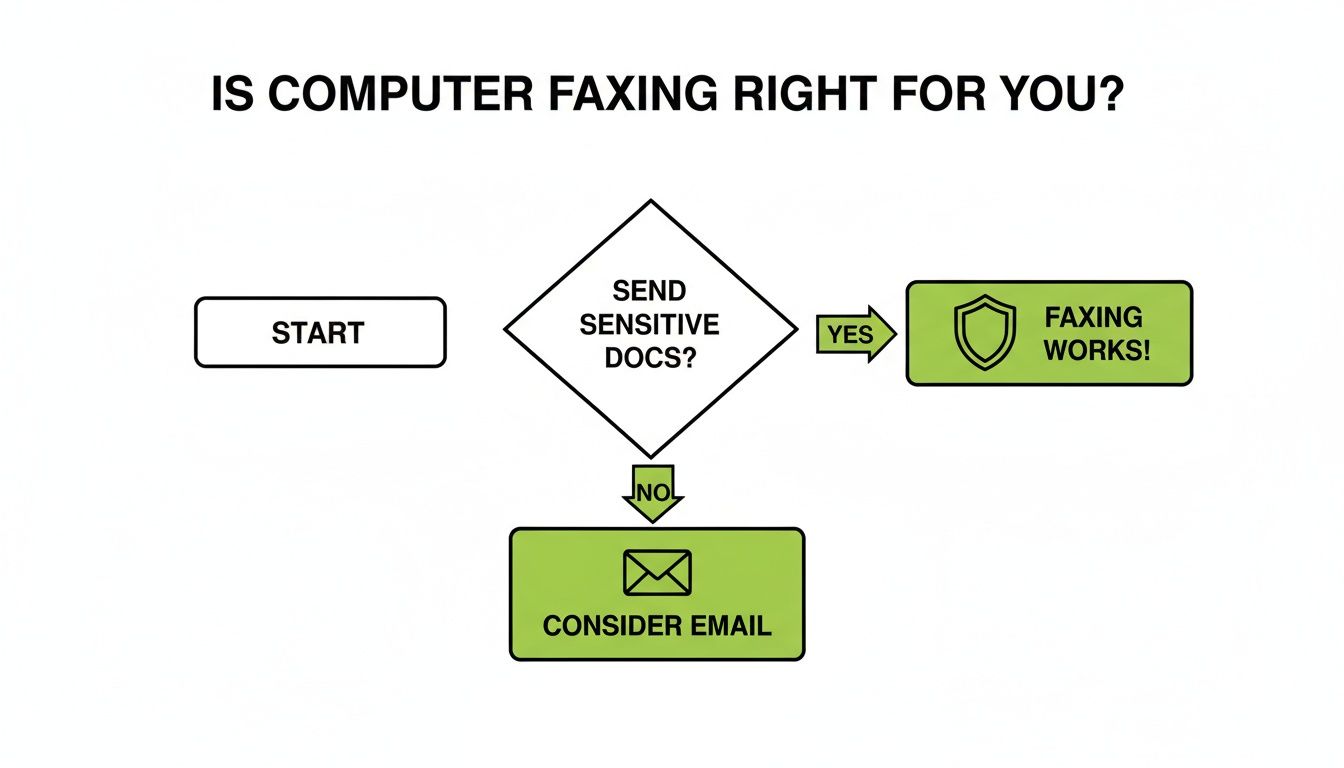
    Sometimes, the big question is whether to fax or email a sensitive document in the first place. This decision tree can help clear things up.

    Flowchart guiding users on whether computer faxing or email is right for sending sensitive documents.

    The bottom line? When you're handling information that absolutely has to stay secure, faxing offers a direct point-to-point connection that standard email just can't match.

    Comparing Your Options at a Glance

    To help you decide, let's lay out the key differences. While all these methods let you fax from a computer for free, they each have their sweet spots. For an even deeper dive into various platforms, check out our complete online fax services comparison guide.

    This table offers a quick snapshot to help you weigh the trade-offs.

    Comparing Free Computer Faxing Methods

    Method Best For Setup Required Typical Limitations
    Online Fax Service Quick, occasional faxes None; entirely browser-based Daily send limits, ads on cover page
    Email-to-Fax Mobile use and email-centric workflows Account creation and setup Special formatting for email addresses
    Windows Fax & Scan High-security, offline use Requires modem and phone line Hardware dependency; not portable

    Looking at the options, you can see how each one caters to a different need, from pure convenience to total hardware control.

    Lastly, there's the old-school approach: using built-in software like Windows Fax and Scan. This is definitely a niche choice these days, as it requires you to have a physical fax modem and a landline connected to your PC. It’s the most hands-on method, but it gives you a completely private, direct line for sending faxes without any third-party service involved. If you happen to have the hardware and prioritize absolute control, it's still a solid option.

    Putting It Into Practice: A Walkthrough with an Online Fax Service

    Okay, let's stop talking theory and see how this actually works. The easiest way to get comfortable with sending a fax from your computer is to just do it. We'll use SendItFax for this example—it’s a popular browser-based tool and, best of all, you don't need an account or credit card for a quick, one-off send.

    The beauty of these services is their simplicity. You land on the homepage, and everything you need is laid out right in front of you. No sign-ups, no lengthy setup. It’s perfect for when you just need to get a single, urgent document out the door now.

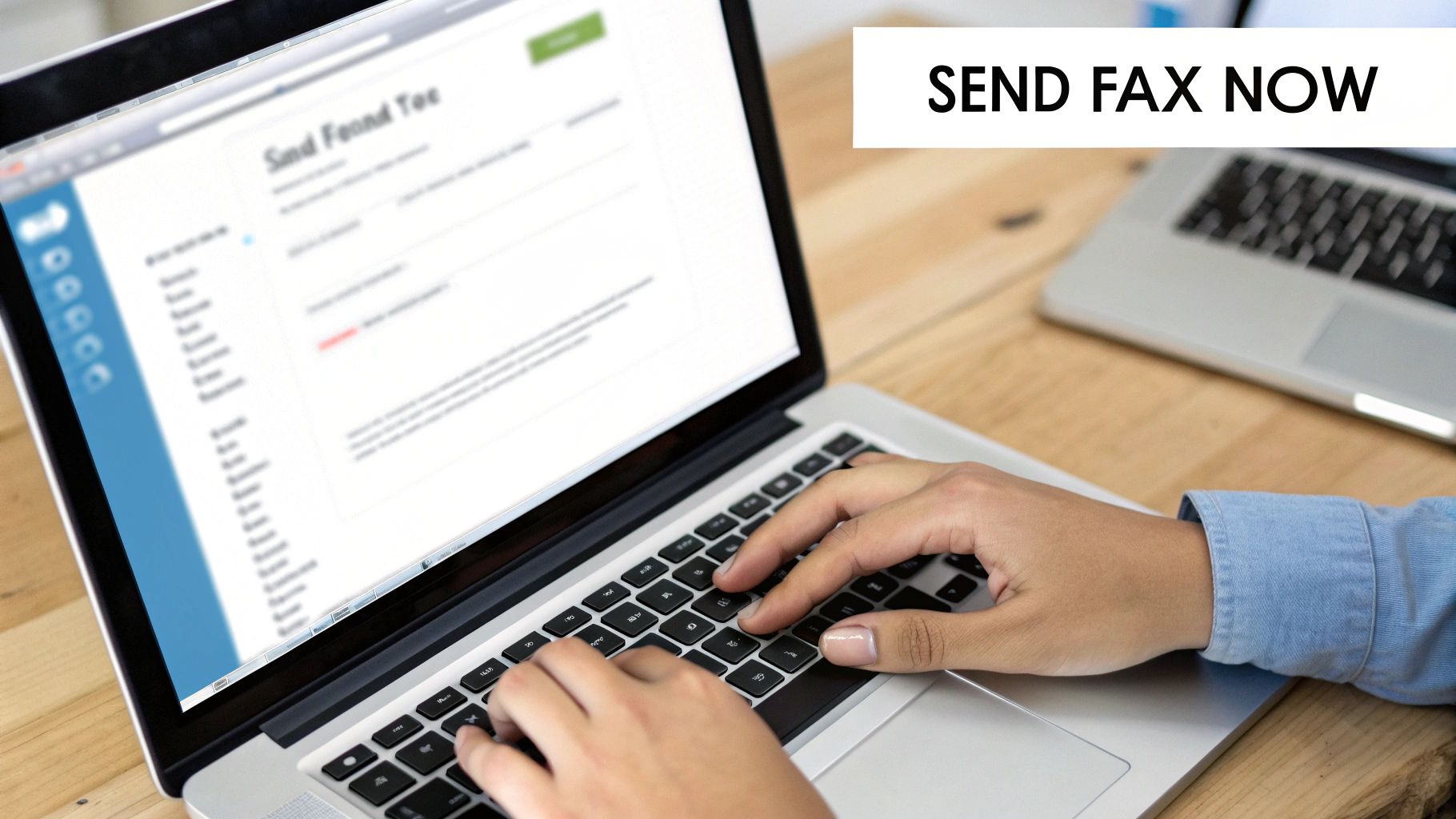
    A person types on a laptop, using an online interface to send a fax now.

    The interface is clean and straightforward. You’ve got fields for your info, the recipient's info, and a big button to upload your file. This design means you can punch in the details, attach your document, and hit send without clicking through a maze of pages.

    Getting Your Document Ready

    Before anything else, you need your document saved and ready to upload. While services like SendItFax are flexible and accept common file types like PDF, DOC, and DOCX, I always recommend using a PDF.

    Why? Because PDFs lock in your formatting. What you see on your screen is exactly what the recipient gets on their end. Think about sending a signed contract—saving it as a PDF prevents any weird formatting shifts or accidental edits that can happen with a Word file. It's a small step that makes a big difference in professionalism.

    Once it's saved as a PDF, you're ready to go.

    Filling In Sender and Recipient Details

    This part is all about accuracy. Get it wrong, and your fax is going nowhere.

    • For the Recipient: Double- and triple-check that fax number. One wrong digit means a failed transmission. It's also good practice to include the person's name and company so it gets routed correctly on the other end.
    • For the Sender: Put in your name, company (if applicable), and a real email address you check often. This is where the service will send your delivery confirmation or, just as importantly, a failure notification.

    Think of this section like addressing a physical envelope. Correct details aren't just a suggestion; they're essential for a successful delivery and for letting the recipient know who it’s from at a glance.

    Adding a Professional Cover Page

    Most free services, SendItFax included, will automatically create a cover page for you. This is your chance to add a clear subject line or a quick note, like "Signed Rental Agreement for Unit 4B" or "Patient Referral for John Smith." Giving that context is incredibly helpful for the person receiving it.

    Just be aware that free services usually put their logo or a small ad on the cover page. It’s the small price you pay for the convenience. If you absolutely need a completely clean, unbranded document, you'll probably have to spring for a paid, one-time send.

    Knowing the Limits of Free Services

    Free online faxing is a game-changer for occasional use, but it’s important to understand the built-in limitations. These services aren't designed for high-volume faxing, but for those who don't need a full subscription, they're perfect.

    For example, a service like FaxZero lets you send five faxes per day, but each one has a three-page maximum. GotFreeFax offers two daily faxes within the US and Canada. SendItFax is quite generous, offering five faxes per day, each up to three pages plus a cover sheet. This makes it a solid choice for a realtor sending a contract or a clinic sending a patient form without paying traditional fees. You can find more details in various free fax service comparisons and their specific limits.

    These caps are in place to keep the services available for everyone and prevent abuse. For most one-off tasks, like sending a signed form to your accountant or a medical record to a specialist, these limits are more than enough.

    Exploring Other Ways to Fax for Free

    Browser-based services are a lifesaver when you need to send a fax in a pinch, but they aren't the only game in town. Depending on your setup and what you're trying to accomplish, a couple of other methods might be a better fit, especially if you're looking for a more integrated or old-school approach.

    The Clever Trick: Email-to-Fax

    One of the most elegant solutions out there is Email-to-Fax. The idea is brilliant in its simplicity: you compose an email, and a service provider converts it into a fax for you. This means you never have to open a browser or log into a website just to send a document.

    It’s as easy as it sounds. You’d just attach your file (like a PDF or Word doc) to a new email and send it to a special address, something like 18005551234@senditfax.com. The service does all the heavy lifting. This is a game-changer for anyone who lives in their inbox or needs to send documents on the go from their phone. If that sounds like your workflow, our detailed guide on how to fax via email breaks down the exact steps.

    The Old-School Route: Windows Fax and Scan

    What if you don't want to use a third-party online service at all? If you're running a Windows machine, Microsoft has a built-in utility called Windows Fax and Scan that offers a direct, private way to send faxes right from your desktop. It’s been part of the operating system for ages.

    But here’s the catch—and it's a big one. This method requires a fax modem. Your computer has to be physically plugged into a landline phone jack. Modern laptops and even desktops rarely include this hardware anymore, which makes this a pretty niche solution today.

    Still, if you're in an office that still has a landline and a computer with a modem, this option provides top-notch security. Your document never passes through a third-party server on the public internet.

    • The Good: It's completely free (no subscription), highly secure, and built right into Windows.
    • The Bad: You need a fax modem and an active phone line, which is impractical for most people.

    Think of this method as the digital equivalent of owning your own fax machine. You get total control and privacy, but it comes with the trade-off of needing specific—and now mostly outdated—hardware.

    The fact that these options even exist speaks to the surprising resilience of faxing. The global fax services market was valued at $3.31 billion in 2024 and is still expected to grow. A huge chunk of that demand comes from freelancers, remote workers, and small businesses who just need to send a contract quickly without buying a machine. For them, cloud-based services perfectly bridge the gap between old and new. You can dive deeper into the data by checking out the full research on the growing global fax services market.

    At the end of the day, you have choices. Whether it's the convenience of email-to-fax or the locked-down security of a modem, you can definitely fax from your computer without spending a dime.

    Getting Your Faxes Sent Securely and Successfully: A Few Best Practices

    Sending a fax from your computer is a game-changer for convenience, but a few smart habits will make the whole process smoother and much more secure. Taking a moment to follow these tips ensures your sensitive documents arrive safely and look professional on the other end.

    A professional desk setup featuring documents, a pen, a binder, a tablet, and a plant, with a 'Secure Faxing Tips' overlay.

    It really all starts with a professional cover sheet. While you can skip it, I wouldn’t recommend it. A cover sheet is standard courtesy and provides crucial context at a glance, telling the recipient who you are, what you've sent, and how many pages to expect.

    Don't Skip the Cover Sheet

    A clean, informative cover sheet is your best defense against your fax getting lost in a busy office. It doesn’t need to be fancy, but it absolutely should include these key details:

    • Your Info: Your name and a good contact number.
    • Recipient Info: The name of the person and their company.
    • Page Count: Be specific! Write something like "4 pages total" (including the cover sheet). This helps them know if the transmission was complete.
    • A Clear Subject: Something like "Signed Contract for Project Phoenix" immediately tells them what they’re looking at.

    These simple details can prevent a lot of confusion and make sure your documents get routed to the right person quickly.

    Your cover sheet is more than a formality—it's a critical communication tool. It confirms receipt, provides context, and helps prevent lost pages, protecting the integrity of your transmission.

    Beyond that, the simplest mistake can derail everything. I've seen it happen. Always, always double-check the recipient's fax number before you hit send. A single wrong digit could mean your fax fails or, even worse, lands in the wrong hands, creating a serious privacy breach.

    Protecting Your Information

    When you’re sending a fax online, especially for free, you're usually going through a third-party service. With that convenience comes the responsibility to be smart about your data's security.

    If you’re sending anything sensitive—think medical records, financial documents, or legal paperwork—take a minute to vet the service. Check out their privacy policy. You're looking for how they handle your data, their data retention policies, and whether they use encryption. For a deeper dive, you can explore more about the security of modern faxing solutions in our detailed guide.

    Finally, always save your transmission confirmation report. This little digital receipt is your proof of delivery. It shows the date, time, and status of your fax, and it can be a lifesaver if there’s ever a dispute about whether a document was sent or received.

    Got Questions About Free Computer Faxing?

    Even after walking through the steps, you might still have a few questions. That's perfectly normal. Let's clear up some of the most common things people ask so you can fax from your computer with total confidence.

    Can I Receive Faxes with a Free Service?

    This is probably the number one question I get. The short answer is almost always no. The free, browser-based services we've been talking about are built for one-way traffic: sending faxes only.

    They don't give you a dedicated fax number where people can send documents back to you. To get that, you'll need to look at paid subscription plans from online fax providers. A paid plan is what gets you your own virtual fax number for both sending and receiving.

    How Secure Are These Free Fax Platforms?

    It's smart to think about security, especially if you're sending something sensitive. Reputable free services do use encryption to protect your document while it's in transit.

    However, remember that your file is still passing through a third-party server.

    My rule of thumb is this: for everyday documents like a signed permission slip, a standard invoice, or a basic contract, the security on a top-tier free service is perfectly fine. But for something highly confidential—like sensitive legal documents or a top-secret business plan—I'd lean toward a more direct method like a dedicated fax machine or the Windows Fax and Scan tool if you have the hardware.

    Always take a quick look at the service's privacy policy. It’s good to know how they handle your data before you upload.

    What Do I Do If My Fax Fails to Send?

    Don't panic! A failed fax is a common hiccup and usually an easy fix. I've found it’s almost always one of these three things:

    • You typed the number wrong. It happens to the best of us. Double-check every single digit and try again. This is the culprit 90% of the time.
    • There's an issue with your file. Make sure the document you uploaded isn't corrupted and that it's in a common format the service supports, like PDF, DOCX, or JPG.
    • The machine on the other end is the problem. The recipient's fax machine might be busy on another call, switched off, or simply out of paper or ink. Just wait about 10-15 minutes and give it another shot.

    Most services are good about sending you an email if the transmission fails, and they'll often include an error code that can point you in the right direction.

    Why Do Free Fax Services Have Page Limits?

    Ever wonder why you can only send 5 pages or fax 3 times a day for free? It's all about keeping the service running smoothly for everyone.

    These limits prevent the system from getting bogged down by a handful of power users sending massive documents all day. By setting fair usage caps, these companies ensure their servers can handle the load and continue offering a reliable free tool for the rest of us who just need to send a quick fax now and then. It’s a smart balance that keeps a valuable resource available.


    Ready to skip the hassle and send your first fax? SendItFax is a great tool for sending documents to the U.S. and Canada directly from your browser—no sign-up required. For a fast and straightforward experience, give it a try. Head over to https://senditfax.com to get started.

  • How to Fax Without a Phone Line A Modern Guide

    How to Fax Without a Phone Line A Modern Guide

    It's a common question I hear all the time: "Can you really send a fax without a phone line?" The answer is a resounding yes, thanks to modern online fax services. These platforms completely sidestep the need for a landline, letting you send documents straight from your computer or smartphone to any old-school fax machine out there. All you need is an internet connection.

    Why Faxing Still Matters in a Digital World

    A modern home office setup with a fax machine, laptop, smartphone, and a plant, emphasizing the relevance of fax.

    I get it—talking about faxing can feel like stepping back in time, especially when we live in a world of instant messaging and cloud storage. But faxing hasn't disappeared; it's just changed its clothes. The fundamental need for a secure, legally recognized way to send documents is as strong as ever, particularly in fields like law, healthcare, and government where compliance is king.

    The real problem was never the fax itself, but the clunky hardware. Nobody wants a bulky machine and a dedicated phone line cluttering up their workspace anymore. That's exactly why learning how to fax without a phone line is such a game-changer. It bridges the gap, giving you a digital-first solution that fits right into how we actually work today.

    The Modern Faxing Advantage

    Think about it. Instead of printing a document, walking over to a machine, and punching in a number, you can now send that same document with the ease of firing off an email. This modern approach keeps all the security and legal weight of traditional faxing but cuts out the biggest headaches. A real-world example? A doctor can securely send patient records from their laptop to a clinic's ancient fax machine without ever worrying about a HIPAA violation.

    The benefits are pretty clear:

    • Convenience: Send a fax from your couch, a coffee shop, or halfway across the world. If you have internet, you have a fax machine.
    • Cost Savings: Ditching the dedicated phone line is just the start. You also save on paper, ink, toner, and those inevitable machine repair bills.
    • Enhanced Security: Digital faxing often uses encryption, which is far more secure than leaving a sensitive document sitting out in the open on a shared fax machine tray.
    • Digital Trail: You get instant email confirmations and a clean digital record of every fax you send or receive. It makes creating an audit trail almost effortless.

    And this isn't just a niche solution for a few holdouts. The "network effect" of faxing is incredibly powerful. The global fax services market was valued at a massive $3.46 billion in 2023 and is expected to hit $6.5 billion by 2029. Why? Because there are still an estimated 43 million traditional fax machines plugged in and waiting for documents worldwide. Those numbers prove there’s a huge demand for services that connect today’s users to that established network. You can dig into more of the data on the business faxing market to see just how relevant it remains.

    The real change isn't about replacing faxing itself; it's about replacing the clunky, expensive hardware. Online faxing preserves the function while modernizing the form, making it accessible to everyone.

    This guide is for anyone who needs to send an official document but doesn't have—or want—a landline. Whether you're a freelancer sending a single contract or a small business needing a reliable communication tool, you’ll learn exactly how to use today's technology to solve this age-old business need.

    Picking the Right Way to Fax Without a Phone Line

    So, you're ready to ditch the old-school phone line but still need to send a fax. Good move. You've got a few solid options, and the best one for you really boils down to how you work. Are you sending a one-off contract from a coffee shop, or are you a small medical office handling sensitive patient files all day? Let's walk through the main ways to get it done.

    Your Three Main Choices

    Your decision will likely hinge on a mix of convenience, cost, and how often you're actually sending faxes.

    The most popular route these days is an online fax service, like the one we offer at SendItFax. Think of it as email for faxes. You log into a website from any computer or tablet, upload your document, type in the fax number, and hit send. It's perfect for anyone who needs a reliable, documented trail for important paperwork, from freelancers to entire businesses.

    Next up, you have dedicated mobile faxing apps. These are brilliant for people who are always on the move. Your smartphone's camera becomes your scanner, and you can send a signed form or a receipt for an expense report right from the palm of your hand. If you're a real estate agent getting a signature at a property or a contractor sending an invoice from a job site, this is your jam.

    Finally, don't forget about your printer. Many modern multi-function printers (MFPs) come with internet faxing built right in. If you already have one of these in your office, you might be able to connect it to your Wi-Fi and send faxes directly from the machine—no phone cord in sight. This works well for offices that still like having a central, physical machine but are tired of paying for an analog line.

    How to Make the Call

    Let's be real—a freelance designer sending one contract a month has totally different needs than a law firm sending dozens of time-sensitive documents every day. Each method has its trade-offs.

    Here’s a quick gut check to help you figure out what fits:

    • How much are you willing to spend? Mobile apps and some online services have pay-as-you-go plans, which are great if you only send a fax once in a blue moon. If you’re faxing regularly, a monthly subscription is almost always cheaper in the long run.
    • Where do you work? If you're constantly out and about, a mobile app is a no-brainer. If you're mostly at a desk, an online service offers the most flexibility. An MFP only makes sense if you're tied to a physical office.
    • How sensitive are your documents? This is a big one. For anything confidential, like medical records or legal files, a professional online fax service is the way to go. They're built with security features like encryption and can offer HIPAA compliance, which you won't get from a simple mobile app.

    The "best" way to fax isn't about the flashiest tech. It's about finding the tool that slots so seamlessly into your workflow that you forget it's even there.

    This isn't just a niche trend; it's a huge industry shift. The global online fax market hit an impressive $2.55 billion in 2024 and is still climbing. Why? Because businesses are realizing they can get the security and reliability of faxing without the cost and hassle of an old-fashioned phone line. This is especially true in the U.S. and Canada, where industries like healthcare and legal still count on that verifiable proof of transmission. You can read more about the booming online fax market if you're curious about the numbers.

    Feeling a bit stuck? Don't worry, we've been there. For a much more detailed breakdown of specific providers, check out our guide on how different online fax services compare to see which features and pricing plans will work best for you.

    Sending Your First Online Fax with SendItFax

    Jumping from knowing about online faxing to actually sending one can feel like a big step, but it’s surprisingly simple. We're not dealing with paper jams, busy signals, or that nagging feeling of "did it actually go through?" Sending a fax online with a service like SendItFax feels more like sending an email, just with the added security and legal standing of a traditional fax.

    Let's walk through a common scenario. Imagine you're a freelance graphic designer who just wrapped up a project. The client’s accounting department needs a signed W-9 form, and, of course, they only accept faxes. You don't have a landline, much less an old-school fax machine. This is a perfect real-world example of where an online service shines.
    Getting Your Document Ready

    First things first, you need your document in a digital format. Most services, including SendItFax, play well with common file types like PDF, DOC, and DOCX. If your W-9 is a physical, signed paper, no problem. Just use a scanning app on your smartphone to create a clean, crisp PDF.

    Right away, you can see a major benefit of sending a fax without a phone line: your original document remains perfect. You don't have to worry about smudges, low toner, or a blurry copy coming out of a poorly maintained machine on the other end. Your digital file is sent with perfect clarity every time.

    How to Send Your Fax: A Quick Walkthrough

    Once your file is ready, the rest is a breeze—it usually takes just a minute or two. You'll head over to the SendItFax website, where the interface is built to be intuitive, even if it's your first time.

    Diagram showing three fax transmission methods: online service, mobile app, and a printer/fax machine.

    Here's the simple breakdown of what to do:

    • Attach Your File: Just like an email, you’ll click to upload the W-9 PDF from your computer or a cloud drive.
    • Enter the Destination: Type in the recipient’s fax number. For our designer, this is the accounting department’s number. I always recommend adding the recipient's name or department here, too—it just helps things get to the right person faster.
    • Add Your Details: Put in your name and email address. This part is critical, as it’s how you’ll get your delivery confirmation.
    • Write a Cover Page Note: This is your chance to add some context. A simple, professional note like, "W-9 form for [Your Name] as requested. Please confirm receipt," does the trick.

    After you've filled that out, you just hit send. The service handles all the technical heavy lifting, converting your file into a signal that a traditional fax machine can understand and dialing out over the phone network.

    The best part? That confirmation email. It’s your digital receipt, giving you a timestamped record that your fax was successfully delivered—a level of certainty you just don’t get from a faded, curled-up printout from an old machine.

    Choosing the Right Plan for the Job

    For a one-off document like that W-9, the free option at SendItFax is perfect. It covers you for up to three pages (plus the cover sheet) and you can send up to five free faxes per day. It's ideal for those occasional, non-urgent needs.

    But what if the situation is different? Let's say you're a real estate agent who needs to send a 15-page signed contract. This is where the $1.99 Almost Free plan makes a lot more sense. It boosts your page limit to 25, gives your fax priority delivery, and removes the SendItFax branding from the cover page for a more professional touch. For a time-sensitive document like a contract, that small one-time fee is well worth the peace of mind.

    If you want to explore more advanced features and scenarios, our complete guide on how to send a fax online is a great next step. It’s packed with more tips to help you get the most out of the service.

    Is It Safe and Legal to Fax Without a Phone Line?

    A hand holds a document titled 'Security & Compliance' with tablets showing digital security and data.

    So, you're ready to fax without a dedicated phone line, but a few questions are probably nagging you. Is it expensive? How secure is it, really? And can I use it for official documents? These are all valid concerns, and the answers are exactly why so many people have made the switch to online faxing.

    Let's unpack the real-world implications of cost, security, and legal compliance.

    The True Cost of Old vs. New

    On the surface, a traditional fax machine seems like a one-time purchase, but the hidden costs bleed your budget dry over time. It's a classic case of death by a thousand cuts.

    Think about what it takes to keep an old-school fax machine running:

    • A Dedicated Phone Line: You're stuck paying a monthly fee, typically between $25 and $50, just to keep the line active.
    • Constant Supplies: You’re always buying paper, ink, and toner. For any business sending more than a few faxes a month, this adds up fast.
    • Inevitable Repairs: Fax machines have moving parts that break down. That means surprise repair bills and productivity-killing downtime.
    • Wasted Time: The hours your team spends printing documents, walking to the machine, waiting for a connection, and then filing the paper is a huge operational cost that rarely makes it onto a spreadsheet.

    Online faxing flips this script completely. The pricing is transparent and predictable. With a service like SendItFax, you can either send a few pages for free or pay a small, one-time fee for a bigger job. No contracts, no monthly bills, no surprises. Budgeting becomes incredibly simple.

    How Secure Is Your Data in Transit?

    This is where the digital approach isn't just better—it's in a different league entirely. Picture this: a sensitive document sitting in the output tray of a shared office fax machine. Anyone can walk by and pick it up. Or worse, you accidentally misdial by one digit and send confidential information to a total stranger, with absolutely no way to get it back.

    Online fax services were engineered to solve these exact problems.

    Your document is converted into an encrypted digital file the moment you hit "send." This encryption scrambles the data, making it completely unreadable to anyone who might try to intercept it. It’s a level of security that analog technology just can't match.

    Another huge win is the automatic audit trail. You get a timestamped confirmation email for every single delivery. No more squinting at a faded confirmation slip and hoping it doesn’t get lost. You have a clear, verifiable record that your document arrived safely. If you want to get into the weeds on this, you can learn a lot more about the modern security of fax technology.

    Meeting Legal and Compliance Standards

    For many professionals, a document’s legal standing is everything. This is especially true in fields like healthcare, law, and finance, where regulations like the Health Insurance Portability and Accountability Act (HIPAA) set strict rules for handling private information.

    There's a common myth that only traditional faxes are legally binding, but that’s outdated thinking. Faxes sent through a secure online platform—one that uses strong encryption and provides a verifiable delivery receipt—are widely accepted as legally compliant.

    These services are built from the ground up to meet the tough standards of regulated industries. For a doctor's office, this means they can send patient records with confidence, knowing they are fully adhering to HIPAA’s privacy and security rules. That digital confirmation email serves as the official proof of transmission, giving you the paper trail you need, without any of the actual paper.

    Solving Common Online Faxing Problems

    Even the most reliable tech has its off days. When you fax without a phone line, the good news is that most hiccups are minor and have a simple fix. Knowing what to look for means you won't get stuck, and you can make sure your important documents always arrive safely.

    The most common moment of panic is that dreaded "failed transmission" notification. Don't worry—this almost never means your document vanished into the digital ether. Nine times out of ten, the problem is on the other end. The recipient's fax machine could be turned off, out of paper, or just busy on another line.

    My first move is always to just give it a few minutes and try again. If it fails a second time, my next step is to carefully double-check the fax number I typed in. It’s amazing how often a single wrong digit is the culprit.

    Improving Your Fax Quality

    Ever had someone on the other end say your fax came through blurry or was completely unreadable? I can almost guarantee the issue wasn't the fax service—it was the quality of the original file you sent. A low-resolution scan or a photo of a document taken in a dim room will look ten times worse after being squeezed through a fax transmission.

    To get a crisp, professional-looking result every single time, I stick to a few simple rules:

    • Start with a High-Quality Source: If you’re scanning a paper document, make sure to set your scanner’s resolution to at least 300 DPI (dots per inch).
    • Use Clear Fonts: Stick with standard, business-friendly fonts like Arial or Times New Roman. Fancy script fonts or super-thin typefaces just don't translate well.
    • Create a Clean PDF: The best method is to convert your document directly to a PDF from whatever program you created it in (like Microsoft Word or Google Docs). This is always sharper than scanning a printed version.

    Here's a pro tip I've picked up over the years: before you hit send, zoom in on your document. If it looks even slightly pixelated or fuzzy on your high-res computer screen, it's going to be a mess when it prints out on a fax machine.

    What Happens if You Enter the Wrong Number

    We've all been there—that sinking feeling when you realize you sent something to the wrong number. If that document contained sensitive information, the concern is real. Unlike an old-school fax machine that just sends and hopes for the best, online services provide a clear digital trail. You’ll get a delivery confirmation or a failure notice for the exact number you entered.

    If you catch the mistake, there's unfortunately no "unsend" button for a fax. Once it's gone, it's gone. This is exactly why the single most important habit to develop is meticulously double-checking the recipient’s number before you click "send." Taking an extra five seconds for that final check can save you from a massive headache down the line.

    Your Top Online Faxing Questions, Answered

    If you're new to sending faxes without a phone line, you probably have a few questions. That's completely normal. Let's walk through some of the most common concerns I hear so you can fax with total confidence. The answers are usually simpler than you'd expect.

    Is an Online Fax Legally Binding?

    This is a big one, and for good reason—especially when you're sending contracts, legal documents, or official forms. The short answer is yes. For most purposes, a fax sent through a reputable online service is considered just as legally valid as one sent from a classic fax machine.

    What really matters is the proof of transmission. When you use an online service, it generates a digital confirmation receipt with a precise timestamp and delivery status. Honestly, this digital trail is often more reliable and easier to file than those flimsy paper slips that always seem to get lost. It holds up for most legal and official needs.

    How Will I Know My Fax Went Through?

    Remember the old days of standing by the fax machine, listening to all the screeching and beeping, just hoping your document made it? Online faxing gets rid of all that anxiety.

    The moment your transmission is finished, you’ll get an email notification. This isn't just a simple "sent" message; it's a detailed confirmation that acts as your proof of delivery. It includes the date, time, and final status, giving you a clean, permanent record for your files. You never have to guess again.

    The digital confirmation email is your official, timestamped proof of delivery. It provides a level of certainty and a clean audit trail that traditional faxing simply can't match.

    Can I Receive Faxes Without a Phone Line, Too?

    You definitely can, but it's important to know the difference between sending and receiving services. Some platforms, like SendItFax, are built specifically for sending faxes out. They’re fantastic for those one-off situations when you just need to get a document over to someone quickly.

    If you need to both send and receive faxes regularly, you'll want a service that provides a dedicated virtual fax number. This number works through your email, not a physical phone line. When someone faxes that number, the service digitizes the document into a PDF and sends it right to your inbox. It’s a complete, two-way fax solution that lives entirely online.


    Ready to send your first fax without a phone line? SendItFax makes it fast and free. Upload your document and send it in minutes at https://senditfax.com.

  • How to Send Internet Fax: A Modern Guide

    How to Send Internet Fax: A Modern Guide

    Sending an internet fax is surprisingly straightforward. Think of it like sending an email, but with the rock-solid security and legal weight of a traditional fax. You just upload your digital document to a service like SendItFax, type in the recipient's fax number, and hit send. That's it. You can do it from your computer, tablet, or phone—anything with an internet connection.

    Why Internet Faxing Still Matters

    A medical professional works at a reception desk with documents, featuring a 'SECURE FAXING' sign.

    It's tempting to write off faxing as a relic, but for a lot of critical industries, it's still the gold standard for secure communication. The "why" is simple: security and legal validity. When you send an email, that message can get intercepted, changed, or just buried in a spam filter. Internet faxing, however, creates a secure point-to-point connection that's incredibly tough to crack.

    This level of reliability is exactly why certain professions count on it every single day. For anyone working in healthcare, law, or finance, protecting data isn't just a good idea—it's a legal requirement.

    The Driving Force of Security and Compliance

    Laws like the Health Insurance Portability and Accountability Act (HIPAA) have very strict rules about handling sensitive patient data. A standard email just doesn't cut it. An internet fax, with its built-in security protocols, gives you a compliant way to send documents that absolutely have to stay private.

    Let's look at a few real-world examples:

    • Healthcare: A doctor’s office needs to get a patient’s chart over to a specialist. Using an encrypted internet fax service keeps that information confidential and compliant with HIPAA.
    • Legal: A law firm has to send a signed, time-sensitive contract. A fax doesn't just send the document; it gives them a verifiable receipt showing exactly when it was transmitted, which is invaluable for legal records.
    • Finance: A mortgage broker is handling loan applications filled with personal financial details. Internet faxing provides a secure pipeline that guards against data breaches.

    In all these situations, the need for a secure, trackable delivery makes internet faxing the clear winner. You can dig deeper into these important distinctions by exploring how fax security compares to email.

    The staying power of faxing isn't just anecdotal. The online fax service market is projected to jump from USD 3.16 billion in 2026 to an impressive USD 7.22 billion by 2035. This boom is largely fueled by adoption in North America, where regulations like HIPAA are a major factor.

    Services like SendItFax connect that old-school need for security with the convenience we expect today. You get to send a secure, compliant fax right from your web browser, no bulky machine required.

    Getting Your Documents Ready for a Perfect Send

    A desk with a laptop, documents, and a pen, highlighting the preparation of various file formats like PDF, DOCX, and JPG.

    Before you hit send on that fax, the first and most critical step is getting your document ready for the trip. A little prep work goes a long way, and it’s what separates a smooth, successful transmission from a frustrating "failed" notification.

    The good news? It’s pretty straightforward. The key is to stick with file formats that are universally accepted and play nicely with fax technology. Think of them as the tried-and-true workhorses of the document world.

    • PDF (Portable Document Format): This is the undisputed champion of faxing. A PDF is fantastic because it locks in your formatting, so what you see on your screen is exactly what prints out on the other end. No surprises.
    • DOCX (Microsoft Word): Also a solid choice and widely supported. It’s perfect for documents that are mostly text, like reports or official letters. For something like a final contract, you can learn how to convert a Word document to a PDF to guarantee it looks perfect.
    • JPG/JPEG (Image File): Your go-to for sending images. This is what you'll want to use for things like a scanned receipt, a photo of a signed form, or a copy of a driver's license.

    Fine-Tuning for a Flawless Fax

    Even though we're talking about internet faxing, the technology at its core still converts your document into a black-and-white image. A few small adjustments on your end can make a massive difference in quality and prevent annoying transmission errors.

    First off, keep an eye on the file size. While services like SendItFax handle files efficiently, trying to upload a gigantic document can slow everything down. A good rule of thumb is to keep your file under 50MB.

    Next, think about clarity. This is especially true if you’re sending something you scanned. Make sure the contrast is high enough so the text is bold and easy to read against the background. Any faint text or shadowy corners on your original can become completely unreadable once it's been faxed.

    Pro Tip: If you're sending more than one page, always combine them into a single file. Sending one consolidated PDF is far more professional and reliable than uploading a bunch of separate files and just hoping they arrive in the right order.

    Why You Shouldn't Skip the Cover Page

    Think of a cover page as your fax's digital handshake. It’s not always required, but it’s a non-negotiable for professional communication, especially if you’re sending something to a busy office with a shared fax machine. It’s your chance to tell the recipient who you are, who the fax is for, and what it’s about.

    A good cover page should include the essentials:

    • Recipient's Name and Fax Number
    • Your Name and Contact Info
    • The Date
    • Total Page Count (including the cover page itself!)
    • A quick, clear subject line (e.g., "Invoice #12345" or "Signed Contract for Project Alpha")

    It's the digital equivalent of an envelope. A well-written cover page ensures your important documents get routed directly to the right person instead of getting lost in the shuffle.

    Let's Send Your First Fax with SendItFax

    Alright, you've got your document prepped and ready to go. Now for the easy part: actually sending it. Forget everything you know about old-school faxing—the screeching modem sounds, the paper jams, the mystery of whether it ever actually arrived. Sending a fax online with a service like SendItFax feels more like sending an email. It’s that simple.

    The best part is you don't need to download any special software or jump through hoops signing up for an account just to send one document. Everything you need is right there in your web browser, which means you can send a fax from your office computer, your laptop at a coffee shop, or even your tablet.

    Getting Around the Web Interface

    When you land on the SendItFax website, you’ll see a clean, simple form. It's designed to be completely intuitive, walking you through exactly what’s needed without any confusing jargon or unnecessary steps.

    This is what you'll see—a single, straightforward screen for the whole process.

    Man using a laptop to send a fax online, screen displays 'SEND FAX NOW'.

    As you can see, all the key pieces are laid out right in front of you: who it's going to, who it's from, the file itself, and the cover page. No clicking through multiple pages.

    Let's run through a quick, real-world example. Imagine you're a freelance graphic designer who just needs to get a signed contract over to a new client. It’s a time-sensitive document that needs to be secure. This is the perfect job for a quick online fax.

    First things first, you'll fill in your own details. This is non-negotiable, as it tells the recipient exactly who sent the fax and how to get back to you.

    • Your Name: So they know who it’s from.
    • Your Email Address: This is super important. It’s where your delivery confirmation receipt will be sent.
    • Your Phone Number: Good to include in case they need to call you directly.

    Next up, the recipient's information. This is where you need to be precise. One wrong digit and your fax ends up in limbo. Take a moment to double-check that you have the correct 10-digit fax number for your client, especially if you're sending within the U.S. or Canada.

    Attaching Your File and Adding a Cover Page

    Once the contact info is squared away, it’s time to add your document. Look for the "Upload File" button—you can’t miss it. Click that, and just select the PDF of your signed contract from your computer. The platform handles common file types like PDF, DOC, and DOCX, so the file you already prepared will work perfectly.

    Now, let's talk about the cover page. For something official like a contract, I always recommend using one. Think of it as the professional envelope for your digital document; it makes sure your fax gets to the right person's desk, especially in a busy office.

    You’ll see a text box where you can add a short, clear message. Something simple and direct works best. For our designer example, you might write:

    "Hi Jane, here's the signed contract for the Q3 brand identity project. I’m excited to get started! Best, [Your Name]"
    This little note provides instant context and just feels more professional.

    With everything filled out, just give it all one last look to make sure there are no typos. Ready? Hit that "Send Fax" button. From here, SendItFax handles the technical stuff—it converts your digital file into a signal that a traditional fax machine can read and sends it securely. In a few minutes, you’ll get an email confirmation that it was successfully delivered. That email is your proof, giving you a digital paper trail and total peace of mind.

    Choosing the Right Service: Free vs. Paid Faxing

    Hands holding two tablets displaying 'FREE' and 'PAID' options with relevant icons.

    When you need to send a fax online, the first question is usually whether to go with a free or paid service. The truth is, it really just comes down to what you’re sending and who it's for. Not every situation calls for a paid plan. Sometimes, a simple, no-frills option is exactly what you need.

    For those one-off tasks, a free service is a perfect fit. Maybe you need to send a signed permission slip to your child’s school or a single-page insurance form. In these cases, you just need a reliable way to get the document from point A to point B without any fuss. The SendItFax free plan was designed for precisely these moments.

    When Free Makes Perfect Sense

    Our free plan is your best bet for simple, non-urgent, personal documents. The key is knowing what you get, so you can use it effectively. With SendItFax, you can send up to three pages plus a cover page, which is more than enough for most quick tasks.

    Here are a few classic examples where a free send is ideal:

    • Sending a medical form: Quickly get a signed patient intake form to a new clinic.
    • Submitting a receipt: Fax a copy of a receipt for a warranty claim or reimbursement.
    • Returning a signed document: Send back a single-page agreement you’ve just signed.

    The main trade-off is that the required cover page will include SendItFax branding. For personal stuff, this is rarely an issue. You can see how we stack up against others by checking out our online fax services comparison.

    Stepping Up to a Paid Plan

    Of course, there are times when presenting a professional image is non-negotiable. If you’re a freelancer sending a multi-page contract to a new client or a small business submitting a proposal, a branded cover page might not project the right image. This is where paying a tiny fee adds a ton of value.

    The “Almost Free” plan from SendItFax costs just $1.99 and immediately upgrades your experience. It removes all our branding, bumps the page limit up to 25 pages, and gives your transmission priority delivery status. It’s a small investment that makes sure your important business documents look polished and professional.

    You might be surprised to hear that faxing is not only relevant but growing. The market was valued at USD 3.31 billion in 2024 and is expected to hit USD 4.48 billion by 2030. Healthcare alone makes up 42% of this usage, an industry where professionalism and compliance are everything. You can read more about the modern state of business faxing on Business.com.

    To make the choice crystal clear, I’ve put together a quick comparison of what you get with each SendItFax option.

    SendItFax Plan Comparison: Free vs. Almost Free

    This table breaks down the key differences to help you decide which plan is the right tool for your specific job.

    Feature Free Plan Almost Free Plan ($1.99)
    Best For Personal, one-off faxes Business & multi-page documents
    Page Limit 3 pages + cover page 25 pages + optional cover page
    Cover Page SendItFax Branded (Required) No Branding (Optional)
    Delivery Standard Priority

    At the end of the day, it's all about context. For a quick, personal task, the free plan is fantastic. For anything that represents you or your business, the small cost of a paid send is an easy choice to maintain a professional appearance.

    Solving Common Internet Faxing Problems

    Let’s be honest, even though sending an internet fax is a breeze, technology can throw a curveball now and then. Seeing a "failed transmission" email pop up is frustrating, especially when you're up against a deadline. But don't worry—most of the time, the fix is surprisingly simple.

    More often than not, the problem isn't with the service itself but a tiny detail we missed. The number one culprit I see? A simple typo in the fax number. One wrong digit is all it takes to send your document into limbo. Before you do anything else, go back and carefully double-check that 10-digit number.

    Another classic issue is just a busy signal. Remember, unlike email, an old-school fax machine can only do one thing at a time. If someone else is sending a fax to that machine, you'll get a busy signal. Services like SendItFax will automatically retry a few times, but if the line stays busy, the best move is often to just grab a coffee, wait a few minutes, and try sending it again.

    Diagnosing Document and Quality Issues

    What if the fax sends successfully, but the person on the other end says it looks blurry or totally unreadable? This almost always comes down to the quality of the file you uploaded in the first place. A low-resolution scan or a document with faint text is only going to look worse after it gets converted into a fax.

    For a crisp, clean delivery every time, here are a few pro tips:

    • Pump Up the Contrast: Before you even think about uploading, crank up the contrast on your document. You want sharp, dark black text against a clean, bright white background.
    • Simplify Your Graphics: Faxes are a black-and-white medium. Intricate, colorful charts or super-detailed images just don't translate well. If you can, simplify them. If the detail is critical, it might be better to send that specific graphic as an email attachment.
    • Stick to Classic Fonts: This isn't the time for fancy, artistic fonts. Stick with clean, readable standards like Arial or Times New Roman. Thin or overly stylized fonts can easily become distorted and illegible.

    A mistake I see all the time is people uploading a smartphone photo of a document taken in a poorly lit room. The shadows and uneven background create a mess that fax machines can't decipher. For best results, always use a scanner app on your phone or, even better, a proper flatbed scanner.

    Handling Delayed Confirmations

    You’ve hit "send" and you're anxiously waiting for that confirmation email… but it’s nowhere to be found. Before you start to worry, take a quick peek in your spam or junk folder. Automated emails from online services can get accidentally filtered out.

    If it's not in spam, just give it a moment. While delivery is typically almost instant, sometimes network traffic can create a small lag. You should usually see a confirmation within 5-10 minutes. If more time has passed and you still have nothing, it might be time to resend—and yes, start by triple-checking that fax number again! Following these simple steps will clear up nearly any internet faxing hiccup you run into.

    Still Have Questions About Internet Faxing?

    It's one thing to read a guide, but another to feel completely comfortable when you're about to send a sensitive document for the first time. Let's walk through some of the common questions people have when they're making the switch to online faxing.

    A huge one I hear all the time is about security. Can sending a document over the internet really be as safe as using a clunky, old-school machine? The answer is a resounding yes. In fact, it's usually much, much safer.

    Any service worth its salt uses powerful encryption protocols, like TLS, to scramble your documents during transit. It's like putting your file inside a locked digital briefcase before it hits the network, making it unreadable to anyone who might try to intercept it.

    Practical Questions on Everyday Use

    Beyond the security aspect, most questions boil down to the day-to-day logistics. Here are a few quick answers to the things people ask most often.

    • Can I send a fax from my phone? You bet. Because services like SendItFax are web-based, you can pull up the site on any browser—whether you're on your laptop, tablet, or smartphone. No app download required.

    • How do I know my fax actually went through? You're not left in the dark. As soon as your fax is successfully delivered, you'll get a detailed confirmation receipt right in your email inbox. This is your proof of delivery, showing the exact time, date, and status.

    • Do I need a fax number just to send something? Nope. You only need the recipient's fax number to send a document out. Platforms like ours handle the transmission, so you don’t need your own number unless you plan on receiving faxes, too.

    Why So Many Industries Rely on Online Faxing

    This high level of security is precisely why heavily regulated fields have jumped on board. It turns out security and compliance are massive drivers for adoption, with 82% of users citing them as key factors.

    Industries like healthcare, which make up a whopping 42% of the market, depend on the high (83%) encryption implementation rate to stay compliant with strict privacy laws like HIPAA. You can dig deeper into the growth of the online fax market to see the trends.

    Think about it: a traditional fax might sit out in the open on a shared machine for anyone to grab. An internet fax, on the other hand, lands securely in a designated digital inbox. That end-to-end confidentiality is a game-changer for sensitive information.


    Ready to send your first document with total confidence? With SendItFax, you can get it done in minutes, straight from your browser. Give SendItFax a try today and see just how simple secure faxing can be.

  • How to fax a document from a computer: Quick, secure, and easy

    How to fax a document from a computer: Quick, secure, and easy

    Sending a fax from your computer is surprisingly simple with an online service. You just upload your document, punch in the recipient's fax number, and hit send. This whole process bypasses the need for a clunky, physical fax machine and effectively turns your computer into a secure document-sending powerhouse.

    Why Bother Faxing from a Computer?

    A laptop on an office desk displays a secure padlock icon and 'Confidential' text, emphasizing secure faxing.

    I know what you're thinking. In a world of instant messaging and email, why are we even talking about faxing? But the fax machine never really disappeared—it just went digital. Knowing how to send a fax from your computer isn't just a neat trick; it's a genuinely practical skill that blends old-school reliability with the convenience we expect today.

    The Unmatched Security of Faxing

    The number one reason faxing has stuck around is its rock-solid security. When you send a fax, your document travels over the Public Switched Telephone Network (PSTN). Think of it as a direct, dedicated line from you to your recipient.

    This point-to-point connection is inherently safer and far less vulnerable to hacking or interception than email, which bounces your data across multiple servers.

    For some industries, this level of security is absolutely essential:

    • Healthcare: To stay compliant with HIPAA privacy rules, medical offices routinely fax sensitive patient records.
    • Legal: Signed contracts, court filings, and other confidential notices are often faxed to ensure verifiable, secure delivery.
    • Finance & Real Estate: Loan applications, closing documents, and financial agreements rely on the secure and legally recognized nature of faxing.

    It's a Legally Binding Form of Delivery

    In many legal situations, a faxed document—complete with its confirmation page—is treated as a legally binding original. That little confirmation slip is your proof, a receipt showing precisely when and where the document was successfully received.

    Email just doesn't offer that same level of verifiable proof, which is why it often falls short for official business where you absolutely need to confirm delivery.

    The staying power of faxing is truly impressive. Even today, an estimated 9 billion faxes are sent worldwide each year, which speaks volumes about its role in professional communication.

    The fact that so many organizations still maintain active fax numbers is a testament to its reliability. It remains a standard for secure document exchange. Learning how to fax from your computer lets you tap into this trusted network without leaving your chair, giving your documents the security and legal weight they need.

    For a closer look at the security side of things, check out our article on whether fax is more secure than email.

    Sending Your First Fax with SendItFax

    Let’s walk through the process of sending a fax right from your computer. We'll use a real-world example: you need to send a signed lease agreement to your new landlord, and you need it done fast. This is the perfect job for an online fax service like SendItFax, which lets you handle the whole thing in minutes without creating an account or messing with complicated software.

    The beauty of this method is its simplicity. You just upload your document, punch in a few details, and off it goes.

    Preparing Your Document for Sending

    First things first, get your document ready. SendItFax plays nice with the most common file formats you'll encounter, like PDF, DOC, and DOCX. So, for our lease agreement, you’d just need the final, signed version saved as a PDF on your computer.

    A quick tip from experience: a clean, high-contrast document faxes best. If you scanned the signed pages, double-check that the text is sharp and easy to read. Anything blurry or faded can turn into an unreadable mess on the other end.

    Here’s a look at the simple interface you’ll use.

    A person types on a laptop screen displaying a 'SEND Fax Now' interface with a document icon.

    As you can see, it’s all laid out cleanly, guiding you straight to what you need to do. No guesswork. Once you've selected your file, it's time to tell the system where it's going.

    Entering Sender and Recipient Details

    This part is all about accuracy. You’ll need to provide just a few pieces of information so the fax gets to the right person and you get a confirmation receipt.

    For our lease agreement scenario, it would look something like this:

    • Your Name: Jane Doe
    • Your Email: janedoe@email.com (This is crucial! It's where your delivery confirmation lands.)
    • Recipient’s Name: John Smith (The landlord)
    • Recipient’s Fax Number: The landlord’s complete 10-digit fax number.

    I can't stress this enough: always double-check the recipient's fax number. A single wrong digit is the number one reason faxes fail. It’s exactly like dialing a wrong phone number—it just won’t connect.
    This information also helps build the cover page, so your landlord knows immediately who the fax is from.

    Crafting a Professional Cover Page

    The cover page is basically your introduction. While it might be optional depending on the service plan, it's good practice and a professional touch. It prevents your important documents from getting lost in a shuffle of papers at the receiving end.

    Think of it as the envelope for your digital letter. You can add a short, clear message explaining what's inside. For our example, a simple note does the trick:

    “Hi John,

    Please find the signed lease agreement for 123 Main Street attached. I look forward to moving in on the 1st!

    Thanks,
    Jane”

    That little bit of context removes any confusion and is a key part of learning how to fax a document from a computer like a pro.

    Finalizing and Sending Your Fax

    Okay, your document is uploaded, and all the details are filled in. You're ready to hit send. But first, take one final glance over everything. Is the fax number correct? Is your email spelled right for the confirmation?

    Once you’re confident, go ahead and send it. The service does the heavy lifting, converting your file into a signal that a traditional fax machine can understand and dialing the number. If you're curious about the tech behind this, we have a great guide on how to send a fax online that breaks it all down.

    The best part? No waiting around a noisy machine. Within minutes, an email should land in your inbox confirming your fax was successfully delivered. That email is your proof of receipt, giving you peace of mind that your landlord got the signed lease. The entire process often takes less time than it takes to make a cup of coffee.

    Choosing the Right SendItFax Plan for Your Task

    Two planners, one black saying 'PICK A PLAN' and another brown with lines, on a white desk.

    Let's be honest, not every fax is a high-stakes business contract. Sometimes you're just sending a signed form, and other times it’s a critical, multi-page proposal. The key is to match the tool to the task.
    Picking the right SendItFax plan ensures you aren't paying for features you'll never use or, worse, hitting a wall when sending an important document. The choice really comes down to two simple options: the Free plan and the Almost Free ($1.99) plan.
    When the Free Plan Is Your Best Bet

    The Free plan is perfect for those quick, one-off tasks. I think of it as my go-to for personal errands—the kinds of things that just need to get done without any fuss.

    Here are a few classic examples where the Free plan is all you need:

    • Sending a signed permission slip to your kid's school.
    • Faxing a quick doctor's note over to HR.
    • Returning a single signed form to a government agency.

    For situations like these, you're probably sending just a few pages, and the SendItFax branding on the cover page is no big deal. The plan lets you send up to five free faxes per day, which is plenty for most people's everyday needs. It’s simple, effective, and costs you nothing.

    Upgrading to Almost Free for Professional Needs

    When things get a bit more serious, the Almost Free plan is a no-brainer. For just $1.99, it unlocks the features you need for business or more sensitive communications. It’s a tiny price to pay for a much more polished and powerful experience.

    This is the plan I'd use to fax a 15-page client proposal or submit a detailed insurance claim with supporting documents.

    The big wins with the Almost Free plan are the higher page limit (up to 25 pages), the removal of all SendItFax branding for a professional look, and priority delivery that bumps your fax to the front of the line.

    For freelancers or small business owners, that kind of flexibility is essential. It's also the only way to go if you want to skip the cover page entirely for a more direct message.

    SendItFax Free vs Almost Free Plan Comparison

    To make the decision even clearer, here’s a simple side-by-side look at what each plan offers. This should help you pinpoint exactly which one fits your immediate needs.

    Feature Free Plan Almost Free Plan ($1.99)
    Cost $0.00 $1.99 (one-time payment)
    Page Limit Up to 3 pages per fax Up to 25 pages per fax
    Faxes Per Day Up to 5 Unlimited
    Cover Page Branding SendItFax branding included No branding (professional look)
    Delivery Speed Standard Priority delivery (sent first)
    Omit Cover Page No Yes
    Best For Personal forms, quick one-offs Business documents, long faxes, urgent needs

    After looking at the table, the choice is usually pretty obvious. It really boils down to how many pages you're sending and how professional it needs to look.

    If you’re still curious how these stack up against the broader market, checking out a detailed online fax services comparison can offer some valuable perspective.

    Ultimately, deciding how to fax a document from a computer comes down to your immediate goal. For a quick form, free is fantastic. For anything longer, more urgent, or business-related, that $1.99 is a small price for total peace of mind.

    Other Ways to Send a Fax from Your Computer

    While dedicated online fax services are easily the simplest way to get the job done, it's worth knowing about the other methods out there. Understanding the alternatives gives you the full picture and really shows why web-based platforms became the go-to solution for anyone needing to fax a document from their computer.

    Believe it or not, the idea of faxing from a PC has been around since 1985 when GammaLink introduced the first computer-based fax board. But early on, this "high-tech" solution was often more of a headache than just using a regular old fax machine. That early frustration paved the way for the simple, hardware-free online services we have now. You can take a deeper dive and discover insights into fax history on FaxAuthority.com.

    These older methods relied on specific hardware and setups that feel pretty clunky compared to just dragging and dropping a file on a website.

    Using Built-In Operating System Tools

    Some operating systems, particularly Windows, have had built-in faxing tools for a long time. The Windows Fax and Scan utility, for instance, lets you send and receive faxes right from your desktop.

    There's a massive catch, though, which makes this option a non-starter for just about everyone today. For it to work, your computer needs to be physically plugged into:

    • A landline telephone jack.
    • An internal or external fax modem.

    Let's be realistic: most modern computers haven't shipped with fax modems in over a decade, and a huge number of homes don't even have an active landline anymore. This complete dependence on outdated hardware is why the feature is now a relic. You’d have to go out of your way to buy old tech for a task that web services handle in seconds. For most people, it's more of a history lesson than a practical solution.

    Exploring Email-to-Fax Services

    Another long-standing method is the email-to-fax service. This is actually a pretty clever workaround that lets you send a fax using your everyday email client, whether that’s Gmail, Outlook, or something else. It effectively turns your email account into a fax gateway.

    The process is fairly straightforward. You attach your document to a new email and send it to a specially formatted address from the fax provider. This address usually looks something like the recipient’s fax number followed by the service’s domain—for example, 18005551234@faxservice.com.

    The service takes it from there. It intercepts your email, converts the attachment into a format a fax machine can understand, and then dials the number to transmit it. It's a smart bridge between two very different communication technologies.

    While this system definitely works, it can feel a bit less intuitive than using a clean web interface. You lose that simple, guided experience of uploading a file, adding a cover sheet, and getting a clear confirmation all in one place. It serves a purpose, but it doesn't quite match the sheer accessibility of modern online fax platforms.

    Tips for Sending a Flawless Online Fax

    Overhead view of a modern wooden desk with a pen, a notebook titled 'FAXING TIPS', and a hand holding a tablet displaying an article.

    Sending a fax from your computer is incredibly convenient, but getting it right involves a little more than just clicking "send." A few smart preparations can make all the difference, ensuring your document arrives looking crisp and professional, not like a blurry, unreadable mess.

    Think about what's happening behind the scenes. Your pristine digital file gets converted into sound, sent over a phone line, and then reassembled by a machine on the other end. The cleaner your starting document, the better it will survive that journey.

    Get Your Document Ready for the Trip

    Before you even upload your file, give it a quick once-over to make sure it’s fax-friendly. Since faxes are purely black and white, high contrast is everything. A document with gray text or a busy background is a recipe for a failed transmission.

    For the best possible quality, I always stick to these rules:

    • Use simple, bold fonts. Standard choices like Arial or Times New Roman work wonders. I'd recommend a font size of at least 12 points to ensure it's readable. Avoid those fancy, thin, or script-like fonts.
    • Go for high contrast. Make sure your text is solid black on a perfectly white background. If you're working with a scanned document, check for any weird shadows or smudges that could muddy the final result.
    • Keep the layout clean. Get rid of unnecessary graphics, watermarks, or complex tables. They rarely translate well and can obscure the information that actually matters.

    Here's something to keep in mind: The fax machine on the receiving end has a much lower resolution than your computer monitor. What looks perfectly fine on your screen can become a blob of ink on their end. Simplicity is key.

    Double-Check the Details Before You Send

    I've seen it happen more times than I can count—the most common reason a fax fails is simple human error. One wrong digit in the fax number, and your sensitive document is sent into limbo. It’s a small mistake that can cause big headaches, especially with time-sensitive paperwork.

    So, before you hit that send button, run through this quick checklist:

    1. Confirm the Fax Number: Is the 10-digit number (including the area code) absolutely correct? If you're not 100% sure, a quick phone call to the recipient to confirm their number is time well spent.
    2. Check Your Email Address: This is where your delivery confirmation will land. A typo here means you'll be left in the dark, wondering if your fax ever made it.
    3. Review the Cover Page: Is your message clear and to the point? It should tell the recipient exactly who it's from and what it's about, leaving no room for confusion.

    Taking just a few extra seconds to proofread is a small price to pay for the peace of mind that comes with a successful, reliable fax transmission.

    Frequently Asked Questions About Computer Faxing

    Switching from a traditional fax machine to an online service can feel like a big leap, and it's natural to have a few questions. Let's tackle some of the most common things people ask when they're learning how to send a fax right from their computer.

    Do I Still Need a Fax Machine or Phone Line?

    Nope, not at all! This is probably the best part about using a modern, web-based service. When you use a platform like SendItFax, your computer and a basic internet connection are literally all you need.

    Think of the online service as the middleman. It does all the heavy lifting by converting your digital file into the right format, dialing the number, and transmitting it over the phone network to the recipient's machine. You get the reliability of a fax without any of the bulky hardware.

    What Kind of Files Can I Actually Send?

    You'll find that most online fax services are designed to work with the file types you're already using. For example, SendItFax handles the big three with no problem:

    • DOC and DOCX (Microsoft Word files)
    • PDF (Adobe Acrobat documents)

    Pro Tip: If you want to be absolutely sure your document looks perfect on the other end, send it as a PDF. It's the best way to lock in formatting, fonts, and images so what you see on your screen is precisely what prints out of their machine.

    Regardless of the format, always start with a clean, high-contrast document. A blurry or low-quality original will only look worse after being transmitted.

    Is It Safe to Fax Sensitive Information This Way?

    Yes, it's generally very secure. In fact, sending a fax from your computer through a reputable service is often considered safer than sending an unencrypted email.

    Faxes travel over the Public Switched Telephone Network (PSTN), which creates a direct point-to-point connection. This makes it much less vulnerable to the types of broad cyberattacks that frequently target email servers. For peace of mind, just make sure you pick a service that clearly outlines its privacy and security measures. A quick look at their privacy policy can tell you a lot about how they handle your data.


    Ready to send a fax without all the fuss? With SendItFax, you can get your document on its way securely in just a couple of minutes. Give it a try for free at SendItFax.com.

  • How to Send a Fax: Easy Online Guide You Can Do Now

    How to Send a Fax: Easy Online Guide You Can Do Now

    Sending a fax online is surprisingly straightforward. You just upload your document to a web service like SendItFax, punch in the recipient's fax number, and hit send. That's it. This approach ditches the need for a clunky machine and a dedicated phone line, letting you send files like PDFs or Word docs right from your computer or phone in a matter of minutes.

    Why Online Faxing Still Matters

    It's easy to think of faxing as something that went out with dial-up internet, but for a lot of professionals, it’s still a go-to tool. Fields like healthcare, law, and government hang on to it for good reason: it’s incredibly secure and holds up legally. When you’re handling sensitive information, the direct point-to-point connection of a fax gives you a level of security that your average email just can't promise.

    A laptop displaying 'Secure Faxing' on its screen sits on a wooden desk with paper documents.

    Learning to send a fax online isn't about dusting off old tech. It’s about getting comfortable with a modern communication method that puts security and reliability first, whether you’re using it for work or personal stuff.

    The Enduring Role of Fax in Key Industries

    So, why are so many vital sectors still leaning on this method? It all comes down to compliance and having a paper trail. Take healthcare, for instance. Doctors and hospitals have to follow strict HIPAA rules to keep patient information private. Faxing gives them a secure, verifiable way to send records between clinics, pharmacies, and insurance companies.

    The numbers really tell the story. At its peak, global fax transmissions hit over 17 billion documents in a single year. The U.S. healthcare system alone accounted for more than 9 billion of those. Even now, about 17% of businesses around the world still use faxing, which shows just how essential it remains in certain fields.

    The real advantage? A fax transmission creates a solid record of exactly when a document was sent and successfully received. That kind of proof is gold for legal and medical paperwork.

    Thinking about making the switch? It helps to see the differences side-by-side.

    At a Glance Comparing Traditional vs Online Faxing

    This table provides a quick comparison of the key differences between using a traditional fax machine and a modern online fax service, helping you understand the benefits of going digital.

    Feature Traditional Fax Machine Online Fax Service
    Hardware Requires a dedicated machine and phone line. No special hardware needed—just a computer or smartphone.
    Cost High initial cost plus ongoing expenses for paper, ink. Low monthly subscription fees, often with free trial options.
    Accessibility You have to be physically present at the machine. Send and receive faxes from anywhere with an internet connection.
    Document Quality Can be blurry or distorted depending on the connection. Delivers crisp, clear digital copies every time.
    Security Secure point-to-point, but documents can be left exposed. Enhanced with end-to-end encryption and secure cloud storage.
    Confirmation Prints a confirmation page (if it doesn't jam). Sends instant email notifications and provides a digital log.

    As you can see, online faxing takes the core strengths of traditional faxing and modernizes them for today’s needs, offering a more flexible and cost-effective solution.

    Security and Legal Recognition

    Faxing is often considered a safer bet than email when you're sending sensitive documents. A classic fax travels over a dedicated phone line, which is much harder to intercept than hacking into an email server. You can dive deeper into whether fax is more secure than email in our detailed comparison.

    Today's online fax services build on that security with features like end-to-end encryption. This scrambles your documents from the moment you send them until they land safely on the recipient's machine. It’s this blend of old-school reliability and new-school security that makes faxes legally binding in many situations, from signing contracts to submitting official paperwork. It’s a surprisingly useful skill to have in your back pocket.

    Getting Your Documents Ready for a Perfect Send

    Before you even get to the "send" button, the single most important thing is the quality of your document. I’ve seen it happen countless times: a blurry or poorly formatted file gets sent, and it arrives as an unreadable mess on the other end. This wastes time and can cause real headaches, especially with important paperwork.

    The goal here is simple: start with a clean, crisp digital file. That one step will solve 90% of potential problems down the line.

    Choosing the Right File Format

    The file type you use has a direct impact on how your fax looks when it prints out of that machine miles away.

    For anything with a lot of text—think contracts, applications, or official letters—PDF is the gold standard. It’s the closest thing to a guarantee that your formatting, fonts, and layout will stay exactly as you intended.

    If you have a Word document, I strongly recommend converting it first. It only takes a second. Our guide on how to convert a Word document to a PDF shows you exactly how.

    Other common formats that usually work well include:

    • DOC/DOCX: Microsoft Word files are accepted almost everywhere, but be aware that formatting can sometimes get a little wonky during the fax conversion process. PDF avoids this.
    • JPG/PNG: These are perfect for sending photos, diagrams, or scanned papers. Just make sure they are high-resolution. A fuzzy image will only look worse after being faxed.

    Pro Tip: Think of your digital file as the "original" master copy. The better its quality, the clearer the final fax will be. You can't make a low-resolution scan look sharp on the other end.

    How to Scan Physical Papers (Without a Scanner)

    What if your document is a physical piece of paper? You don’t need to hunt down a bulky office scanner anymore. Your smartphone is more than capable of creating a great-looking digital copy.

    For the best results, lay the document on a flat surface with plenty of light. Watch out for your own shadow! Position yourself so the light source isn’t directly behind you, casting a shadow over the page.

    Modern phone cameras and scanning apps (like Adobe Scan or even your phone's built-in Notes app) are smart enough to find the document's edges and automatically straighten the image for you.

    Once you have the picture, take 30 seconds to edit it. The most important tweak is to increase the contrast. This makes the text pop and the background a clean white. It makes a massive difference in readability for the person receiving the fax. Zoom in and double-check that even the fine print is sharp.

    Finally, save your freshly scanned document as a PDF or a high-quality JPG. Taking these few extra minutes to prep your file properly is the secret to a smooth transmission every single time. It's the foundational step that ensures your message gets received loud and clear.

    The Complete Walkthrough for Sending Your First Online Fax

    Alright, you've got your documents scanned, cleaned up, and ready to go. Now for the easy part: actually sending the fax. If you're used to wrestling with an old, clunky fax machine, you're in for a pleasant surprise. The whole process is much more like sending an email.

    Let's walk through it together using a service like SendItFax as our example. The goal of these platforms is to be dead simple—get your file from your computer to their machine with zero fuss.

    This little visual sums up the prep work perfectly. You scan it, tweak it for clarity, and save it as a PDF. That's it.

    A three-step process for document fax preparation: Scan with a phone, adjust settings, then convert to PDF.

    Getting this part right is the secret to making sure your fax lands on the other end looking sharp and professional.

    Entering Sender and Recipient Information

    First things first, you have to tell the service who you are and where the fax is going. Think of it as the "To" and "From" on an envelope. On the sender side, you'll plug in your name, maybe your company, and your email. That email address is critical—it’s where your delivery confirmation (or failure notice) will land.

    Now for the recipient's info. The make-or-break detail here is the fax number. This is where most mistakes happen, so pay close attention.

    • Sending to the U.S. or Canada? You'll need all 10 digits: area code plus the number. Something like 212-555-0199.
    • Going international? You'll have to lead with the country code, then the city/area code, and the local number. A fax to London, for example, would look something like +44 20 7946 0958.

    I can't stress this enough: double-check every single digit. One wrong number and your fax either vanishes into the ether or ends up in the wrong hands. It’s the digital version of sending a sensitive contract to the wrong street address.

    Uploading Your Document and Adding a Cover Page

    Next, you'll see a big, friendly button to upload your file. This is where you grab that polished PDF you just created. Most services these days even let you drag the file from your desktop and drop it right into the web page. Easy.

    This is also your chance to add a cover page. Don't skip this. While it might seem optional, a cover page is essential for any kind of professional communication. It’s the first thing the recipient sees and tells them what they’re looking at and who it’s for.

    A good cover page is your fax’s handshake. It provides immediate context and makes sure your document doesn't get lost in a pile on a shared office machine. It gets it routed to the right person, right away.

    So, what goes on a great cover page?

    1. A Clear Subject Line: Get straight to the point. Instead of "Fax," try "Signed Lease Agreement" or "Invoice #5829 for Payment."
    2. A Quick Note: This is the spot for a brief message. Something like, "Hi John, attached are the 5 signed pages for your records. Please confirm receipt."
    3. The Page Count: Always, always include the total number of pages you're sending, including the cover page itself. This is how the recipient confirms they got the whole thing.

    Once all the fields are filled and your document is attached, take one last look over everything. Is the fax number perfect? Names spelled correctly? Happy with your cover page message?

    When you’re good to go, hit "Send." The service takes over from there, translating your digital file into a signal that a traditional fax machine can understand and dialing up the recipient. Within a few minutes, you should get an email in your inbox confirming whether the fax went through successfully.

    Free vs. Paid Online Faxing: Which One Is Right for You?

    When you're ready to send a fax online, you’ll quickly hit a fork in the road: go free, or pay for a subscription? There’s no single right answer. The best choice really boils down to what you’re sending and how often you’ll be sending it. Let's break down what you get—and what you give up—with each.

    Free services, like the starter option here at SendItFax, are fantastic for those one-and-done situations. Imagine you just need to send a signed three-page contract to a vendor. A free plan is the perfect tool for the job. No cost, no commitment.

    But, as with most things in life, "free" comes with a few strings attached. You'll usually run into some predictable limitations:

    • Strict Page Limits: Most free services cap you at just a handful of pages per fax.
    • Forced Branding: Expect the service’s logo or a small ad to appear on your cover page.
    • Slower Delivery: Your fax often gets put in a queue behind paying customers, so it might not go out immediately.

    For a single, non-urgent document, those trade-offs are usually a no-brainer. But if your faxing needs are more consistent or business-related, you'll start feeling the limitations of the free model pretty quickly.

    When Does It Make Sense to Pay for a Fax Service?

    If you're sending faxes more than once in a blue moon, or if they're for professional purposes, upgrading to a paid plan is less of a luxury and more of a practical necessity. Paid services are built for consistency, better security, and a polished, professional look.

    This shift towards professional-grade services is actually driving major growth in the industry. The global market for online faxing was valued at $3.3 billion in 2024 and is projected to reach $4.47 billion by 2030. Why? Because businesses need features that free plans simply can't provide, like advanced security and software integrations.

    Stepping up to a paid plan isn't just about getting rid of ads. It’s an investment in a professional toolkit that ensures your faxes are delivered securely, reliably, and with the clean presentation your business deserves.

    The Real Perks of a Premium Plan

    So, what exactly are you paying for? A premium online fax service unlocks a whole suite of powerful features that make a real difference.

    The biggest game-changer is getting a dedicated fax number. This means you can not only send faxes but also receive them, effectively turning your email into a two-way virtual fax machine. You also get a major security boost with features like end-to-end encryption. This is non-negotiable for anyone handling sensitive information in fields like healthcare (think HIPAA compliance) or law.

    On top of that, you can typically expect:

    • Generous page limits, and sometimes even unlimited faxing.
    • Detailed delivery confirmations and an organized, searchable archive of sent faxes.
    • Priority delivery, so your faxes jump to the front of the line.
    • A clean, professional look with no third-party branding on your cover sheets.

    If you're still on the fence, check out our online fax service comparison to see a side-by-side breakdown. For the occasional personal document, free is often all you need. For anything more, a paid plan is a smart move for pure reliability.

    Keeping Your Faxes Secure and Private

    When you're handling sensitive documents—think medical records, legal contracts, or financial statements—security isn't just a feature; it's a necessity. Knowing how to send a fax online is less about convenience and more about using a channel known for its robust privacy. Unlike an email, which can be intercepted at various points, a secure online fax creates a much more direct and protected pathway for your information.

    A wooden desk with a document, a black padlock, and a tablet, with a text overlay 'Encrypted FAX'.

    This heightened security is exactly why so many regulated industries still depend on faxing. It’s not an outdated habit; it’s a deliberate choice to meet strict legal and compliance requirements.

    How Encryption and Compliance Work

    The magic behind modern online fax security is end-to-end encryption. Imagine locking your document in a digital safe the moment you hit "send." The file is instantly scrambled into unreadable code and isn't pieced back together until it safely arrives at the recipient's fax service. This process shields it from prying eyes while it's in transit.

    This level of protection is a game-changer for meeting compliance standards like HIPAA (for healthcare) and GDPR (for data privacy). These regulations have strict rules about handling personal information, which is especially critical in healthcare, where about 75% of providers communicate digitally. To send a fax that holds up legally, a service must offer features like encryption and a zero-trust framework, giving your documents a legal standing that a standard email just can't match. You can learn more about where this technology is headed from these future trends in faxing from FaxFix.com.

    When you're picking a service, always look for explicit mentions of HIPAA compliance or TLS encryption. That's your green light, signaling that the provider has the right infrastructure to protect your data seriously.

    Practical Tips to Keep Your Faxes Safe

    While a good service handles the technical heavy lifting, you're the first line of defense. Keeping your own account secure is just as crucial as the transmission itself.

    Here are a few simple but powerful habits to get into:

    • Create Strong Passwords: Don't just recycle your email password. Make a unique, complex password for your fax service account to keep it locked down.
    • Turn On Two-Factor Authentication (2FA): If the service offers it, enable 2FA immediately. It adds a vital second layer of security by asking for a code from your phone before you can log in.
    • Triple-Check the Number: This one is huge. Always, always double-check the recipient's fax number before sending. A single wrong digit could land your confidential document in the hands of a complete stranger.

    By pairing the provider's security features with your own smart practices, you can send faxes with complete peace of mind, knowing your documents are protected every step of the way.

    Of course. Here is the rewritten section, crafted to sound completely human-written and natural.


    What to Do When Your Online Fax Fails

    Even the most reliable online fax service can hit a roadblock now and then. But don't worry—most of the time, the fix is surprisingly simple once you know what to look for. Figuring out why a fax failed is the first step to making sure it gets through on the next try.

    The most frequent error you'll encounter is the classic "busy signal." It means exactly what it sounds like: the receiving fax machine is already tied up with another transmission, or maybe someone left the phone off the hook.

    My advice? Don't hit resend right away. Just give it 15 or 20 minutes. Nine times out of ten, the line will be free when you try again.

    Digging into Other Error Messages

    Sometimes you'll get a more puzzling message, like "no answer" or a generic "communication error." These usually signal a problem on the other end—it could be a bad phone line, or the machine itself might be powered off or out of paper.

    Before you start pulling your hair out, run through this quick checklist:

    • Is the number right? It sounds obvious, but you’d be surprised how often a single wrong digit is the culprit. Double-check it.
    • Is their machine actually on? A quick phone call or email to your recipient can save you a lot of hassle. Just ask if they're ready to receive a fax.
    • Could it be your file? On rare occasions, a corrupted file or one that’s unusually large can cause the transmission to time out and fail. Try re-saving it or reducing the file size if possible.

    The single most useful tool you have is the delivery confirmation report. It’s not just a pass/fail notification; it gives you specific codes and reasons for the failure. Always check it before you do anything else—it takes all the guesswork out of the equation.

    Learning how to troubleshoot these little hiccups is just as important as knowing how to send the fax in the first place. A proactive approach turns a potential headache into a minor delay, and you can get back to your day.

    Got Questions? We’ve Got Answers.

    When you're trying a new way to handle an old task, a few questions are bound to come up. Sending a fax online is a perfect example—it blends a technology we all know with the convenience of the internet. Let's clear up some of the most common sticking points people run into.

    You might be wondering what you actually need to get started. Honestly, it's less than you think. All it takes is a device with an internet connection (your laptop, tablet, or phone will do) and the document you want to send saved as a digital file. No dedicated phone line, no bulky machine.

    Another big one we hear all the time: "Is an online fax even a 'real' fax in the eyes of the law?" For most situations, the answer is a resounding yes.

    Is an Online Fax Legally Binding?

    When you send a fax through a trusted service, it carries the same legal weight as one sent from a clunky old machine. Courts, government bodies, and businesses generally accept electronically sent documents and signatures as completely valid.

    This is a game-changer for time-sensitive things like signed contracts or official applications where you need solid proof of delivery. The digital delivery confirmation you get is your verifiable record that the document arrived safe and sound.

    For anyone working in healthcare or finance, online faxing is often the smarter choice. Modern services use security measures like end-to-end encryption, creating a protected digital trail that a traditional fax machine could never provide.

    Can I Receive Faxes This Way, Too?

    Absolutely. While one-off sending services are fantastic for a quick task, most paid online fax platforms give you your own dedicated fax number.

    This means you can start receiving faxes right in your email inbox, usually as a PDF attachment. It turns your email into a full-fledged faxing hub, letting you handle back-and-forth communication without ever touching a piece of paper.


    Ready to send your document without the headache? SendItFax lets you send secure faxes right from your browser in under a minute. Try it now at https://senditfax.com and see how easy it can be.

  • How to Send a Fax Online A Modern Professional’s Guide

    How to Send a Fax Online A Modern Professional’s Guide

    Sending a fax online is surprisingly straightforward. You just pick a service, upload your document, punch in the recipient's fax number, and hit send. It effectively turns your computer or phone into a fax machine, but without the bulky hardware or the need for a separate phone line.

    Why Online Faxing Still Matters in a Digital World

    An office worker is sending a fax online using a modern computer, symbolizing the blend of old and new technology.

    I get it. Faxing sounds like a relic from a bygone era, something you'd find collecting dust next to a Rolodex. But the truth is, in a lot of critical professions, it’s still an essential communication tool. This isn’t about being old-fashioned; it’s about security, legal weight, and compliance.

    For anyone working in law, healthcare, or finance, a simple email often isn't enough. These industries are governed by strict regulations like HIPAA, where protecting sensitive client and patient data is a legal mandate, not just a good idea. Online faxing bridges that gap, giving you the trusted security of a traditional fax with the ease of modern tech.

    The Enduring Relevance of Fax Technology

    Think about a real estate agent on a tight deadline to submit a signed purchase offer. Emailing a document that sensitive opens it up to all sorts of interception risks. Sending it through an online fax service, on the other hand, creates a secure, point-to-point transmission that’s legally recognized and provides a verifiable receipt of delivery.

    This combination of old-school security and new-school convenience is precisely why faxing is still around. We're not trying to bring back obsolete tech; we're just applying its strengths in a modern context. The numbers back this up, too. The global fax services market was valued at USD 3.31 billion and is expected to climb to USD 4.48 billion by 2030. That growth is fueled by the roughly 17% of businesses that still rely on faxing for their most important operations. You can discover more insights about the fax market on ResearchAndMarkets.com.

    A Practical Solution for Modern Needs

    Online faxing solves a few key problems that other digital communication methods can't always handle:

    • Legal Admissibility: Faxes are widely accepted as legally binding documents, which is crucial for things like contracts, court filings, and official records.
    • Enhanced Security: Unlike email, which is susceptible to hacking and phishing scams, fax transmissions travel over the public switched telephone network (PSTN), a much more secure channel.
    • Audit Trails: Good online fax services give you detailed confirmation reports. This creates a clear, auditable trail proving when a document was sent and successfully received.

    The real value of learning how to send a fax online is realizing it's a modern skill for secure communication, not an outdated task. It's the digital equivalent of a sealed, hand-delivered envelope for your most important documents.

    At the end of the day, knowing how to send a fax from your computer is a genuinely practical skill for anyone who deals with confidential information. It’s a simple way to ensure your documents are sent securely, arrive without being tampered with, and meet the strict compliance standards of many professional fields.

    A Practical Walkthrough to Sending Your First Online Fax

    A person is sitting at a clean desk, using a laptop to send a digital fax, with a satisfied expression.

    Jumping into any new technology can feel a little intimidating, but sending an online fax is surprisingly straightforward. Let's walk through it together. We'll use a popular service like SendItFax as our example, since its workflow is typical of most top-tier platforms.

    First things first, you need an account. Most services offer a few different plans, from free tiers for the occasional one-off fax to paid subscriptions for businesses that need more volume and features. Once you're signed up and logged in, you’ll land on the main dashboard.

    This is your command center. Just look for a big, obvious button that says something like “Send Fax” or “New Fax” to get started.

    Navigating the Sending Interface

    Clicking that button will take you to a simple form that should feel a lot like sending an email. This is where you’ll plug in the recipient’s information, attach your files, and add a cover sheet.

    The most important field here, without a doubt, is the recipient's fax number. Getting this right is everything.

    • Entering the Fax Number: Always include the full number, starting with the area code. For international faxes, you'll need the country code first (e.g., +44 for the UK).
    • Adding Multiple Recipients: One of the real perks of online faxing is the ability to send the same document to several numbers at once. It's a massive time-saver for things like company announcements or client updates.

    Pro Tip: I can't stress this enough: double-check the fax number. A single wrong digit is the number one reason for a failed fax. It’s a simple check that saves a ton of headaches.

    Assembling Your Fax Package

    With the number locked in, it’s time to add your documents. Most services handle all the common file types you'd expect—PDF, DOCX, JPG, you name it. You can either drag and drop files from your computer or, even better, pull them directly from cloud storage like Google Drive or Dropbox.

    This is a huge part of why people are learning how to send a fax online; it completely cuts out the annoying print-and-scan step.

    Next up is the cover page. Don't skip this! It's not just a formality; it’s what tells the recipient who you are and why you're sending them a document.

    Nearly every platform provides a simple template. You’ll just fill in a few key details:

    • To: Recipient's name and company.
    • From: Your name and company.
    • Subject: A clear, concise description. Think "Signed Contract – Account #54321" instead of just "Contract."
    • Message: A spot for a quick, optional note.

    Taking 30 seconds to fill this out properly makes you look professional and ensures your fax gets to the right person quickly. For a deeper look at faxing without the clunky hardware, our guide on how to fax without a fax machine has you covered.

    The Final Review and Send

    Before you commit, any good service will give you one last confirmation screen. This is your final chance to give everything a once-over.

    Your Pre-Flight Checklist:

    1. Recipient's Number: Is it perfect? Country code included?
    2. Attached Documents: Are the right files there? Does the page count look correct?
    3. Cover Page Details: Any typos in the names or subject line?
    4. Plan Limits: Give a quick thought to how many pages you’re sending. Make sure it fits within your plan to avoid any surprise fees.

    Once everything looks good, hit "Send Fax." The service takes it from there—dialing the number, transmitting your files, and then sending you a confirmation notice right to your email or dashboard. And that's it! You've officially sent an online fax.

    Getting Your Documents Ready for a Perfect Send

    Preparing documents for a clear online fax

    A blurry or unreadable fax can bring a deal to a screeching halt. The secret to a crisp, professional-looking fax on the other end is all in the prep work. What you send is what they get, so a few minutes of setup makes all the difference.

    Think of it this way: your digital file is about to be translated into an old-school analog signal and then back again. Garbage in, garbage out. The cleaner your starting file, the better the final result will be.

    Choose The Best File Format

    When in doubt, go with a PDF. It’s the gold standard for online faxing because it locks in your formatting—fonts, images, and layout stay exactly where you put them. No nasty surprises like a signature line jumping to the next page.

    While you can often send a DOCX or JPG file, they can be a bit of a gamble.

    • DOCX: A Word file can look different on the receiving end if they don't have the same fonts installed, shifting your carefully crafted layout.
    • JPG: Great for a quick photo or a single-page scan, but small text can get fuzzy.
    • PNG: Usually offers better quality for graphics than a JPG, but the files can get large.
    • TIFF: This is the heavyweight champion for quality, often used in legal and medical fields for its high detail, but the file sizes are massive.

    Industry experience shows that using a PDF can cut down on layout-related transmission errors by as much as 75%.

    Here’s a quick cheat sheet on why PDF usually comes out on top:

    Format Pros Cons
    PDF Layout is locked and reliable Can be a slightly larger file
    DOCX Easy to edit Display can be inconsistent
    JPG Small file size Quality loss is common (lossy compression)
    TIFF Extremely high detail Creates very large files

    Optimize Scanned Documents

    If you're working with paper, how you scan it is critical. For documents with text, aim for a resolution of 300 dpi. This is the sweet spot for crisp, readable characters without creating a giant file. Going higher, like 600 dpi, is usually overkill and can bog down the transmission.

    Before you hit "scan," make sure you crank up the contrast. You want bold, dark text on a clean, white background. This simple tweak makes a huge difference in legibility. If you're using a flatbed scanner, ensure there are no shadows creeping in from the edges.

    A few more pro tips for scanning:

    • Scan in black-and-white for text-only documents. It keeps file sizes tiny.
    • Wipe down the scanner glass to get rid of any dust or smudges.
    • Crop out any unnecessary white space or margins.
    • Always preview the scan on your full screen to catch any issues.

    Compress Without Losing Clarity

    Huge files are the enemy of a successful fax. If your document is loaded with high-resolution images, the file size can quickly balloon, leading to failed transmissions. Most online fax services have a file size limit, often around 2 MB.

    You can use tools like Adobe Acrobat's optimizer or a free online compressor to shrink your file down. The goal is to make it lean without turning your text into a blurry mess.

    Here's how to do it smartly:

    1. Lower the resolution on images from 300 dpi to 200 dpi—it's usually fine for faxing.
    2. If you're saving a JPG, reduce the quality setting to around 75%.
    3. Strip out any unnecessary data like embedded thumbnails or extra color profiles.

    A smaller, optimized file can cut your transmission time by up to 40% and helps you avoid frustrating timeouts.

    Some fax services automatically compress files when you upload them, which is handy. Just be sure to double-check their settings to ensure your images don't get too compressed and lose important detail.

    Your Final Pre-Flight Checklist

    Before you hit that "send" button, run through this quick final check. It's saved me from countless headaches.

    1. File Format: Is it a PDF? If not, are you confident the chosen format will work?
    2. Page Count: Does the total number of pages fit within your plan's limits?
    3. Readability: Is the text clear and the contrast sharp on every single page?
    4. Cover Page: Are all the names, numbers, and details correct?
    5. Final Preview: Give it one last look in the fax service's preview window.

    I once heard from a real estate agent who nearly lost a same-day closing because he skipped the readability check. The signed contract he scanned arrived as a faint, illegible smudge. A five-second check could have saved him hours of stress. Taking a moment to prepare your files properly ensures they arrive looking professional, clear, and ready for action.

    How to Choose the Right Online Fax Service

    https://www.youtube.com/embed/tw6LzYHD9z4

    With so many online fax providers popping up, picking the right one can feel a bit overwhelming. The good news? The best choice really just boils down to your specific situation. By thinking through how often you fax, what you're sending, and your budget, you can quickly find the perfect fit.

    The first big question to answer is how you want to pay. Pretty much every service falls into one of two buckets: a monthly subscription or a simple pay-as-you-go model. Neither one is inherently better, but one will almost certainly make more sense for you.

    Online Fax Service Models Compared

    To figure out which model is right for you, it helps to see them side-by-side. Think about your faxing habits over the last year—were they consistent or just a one-off thing? This table breaks down the main differences.

    Feature Subscription-Based Plans Pay-Per-Use Services
    Best For Businesses and individuals who fax regularly (e.g., several times a month). People who only need to send a fax occasionally (e.g., a few times per year).
    Cost Structure A flat monthly fee for a set number of pages. Pay for each fax you send, with no recurring charges.
    Cost-Per-Page Typically very low, making it economical for high volume. Higher per page, but you save money by not paying for an unused service.
    Included Features Often includes a dedicated fax number, advanced security, and integrations. Focused on the core function of sending a fax quickly and easily.
    Commitment Requires an ongoing monthly commitment. No commitment; you only pay when you need to send something.
    Common Use Cases A medical office sending patient files, a law firm submitting legal documents, a real estate agent sending contracts. Sending a signed form to a government agency, submitting a one-time application, faxing a document while traveling.

    In the end, it’s a simple calculation: if you fax often enough that the subscription fee is less than what you’d pay for individual faxes, go with the subscription. If not, pay-per-use is the way to go.

    Subscription Plans for Frequent Users

    If sending faxes is a regular part of your workflow, a subscription plan is almost always the smartest financial decision. These plans give you a certain number of pages each month for a flat fee, which dramatically lowers your cost per page.

    Think about a small medical practice that faxes 20-30 documents a month or a law firm constantly filing paperwork with the courts. For them, a subscription is a no-brainer. These plans also tend to bundle in premium features that professionals rely on, like a dedicated fax number, HIPAA compliance, and detailed logs for auditing purposes.

    A good subscription service is like a business utility—you pay a predictable monthly fee for reliable, high-volume access with advanced features. It’s designed for integration into daily operations.

    Pay-Per-Use for Occasional Needs

    On the flip side, what if you only need to send a fax once in a blue moon? A pay-per-use service is your best bet. This is perfect for when you need to send a signed contract, submit a single form to a government agency, or fax a document while you're on the road.

    You simply pay for the single transmission without getting locked into a monthly bill. Services like SendItFax are designed for exactly this kind of scenario. While the cost for one fax might be a bit higher than the per-page rate on a subscription, you end up saving a ton of money by not paying for a service you hardly ever use.

    Key Features You Shouldn't Overlook

    Beyond just the price, a few key features can make a huge difference in your experience. As you compare services, decide which of these are must-haves for you.

    • Security and Compliance: If you handle sensitive information, this is non-negotiable. Look for services that offer TLS encryption to protect your faxes. For anyone in healthcare, HIPAA compliance is an absolute requirement.
    • International Faxing: Don't just assume every service can send faxes globally. If you need to reach numbers outside your country, double-check that the service supports it and take a close look at their international rates. They can vary a lot.
    • Cloud Storage Integrations: The ability to pull a document straight from Google Drive, Dropbox, or OneDrive is a massive time-saver. It means you don’t have to download files to your computer just to upload them again.
    • Mobile Apps: For anyone who works on the go, a good mobile app for iOS or Android is a game-changer. It effectively turns your smartphone into a portable fax machine.
    • API Access: This one is more for businesses. If you want to build faxing directly into your own software, like a CRM or an EHR system, you'll need a service that offers an API to automate those workflows.

    The online fax industry is growing fast—its market value is on track to hit USD 5 billion by 2030. This boom is happening because more and more professionals, especially in legal and healthcare, need secure, mobile-friendly ways to send documents. You can read more about the growth of online fax services on LLCBuddy.com.

    Ultimately, picking the right service comes down to matching its features to what you actually need. For a deeper dive, check out our full online fax services comparison to see how the top providers stack up. Taking a few minutes to think about your needs now will save you a lot of time and money later.

    Confirming Delivery and Troubleshooting Common Errors

    A close-up shot of a computer screen showing a fax delivery confirmation report, with a checkmark indicating success.

    You might think that hitting “send” is the finish line, but until you see that confirmation, the fax hasn’t truly arrived. Delivery confirmation reports act as your digital receipt, giving you a clear audit trail. They’re indispensable when you’re passing along time-sensitive or legally binding documents.

    Most online fax providers either email this report to you automatically or make it available in your dashboard within minutes. Treat it like proof of delivery—keep it on file whenever you’re dealing with contracts, medical records, or financial statements.

    Decoding Your Fax Confirmation Report

    At first, the confirmation report can look a bit dense. Once you know where to focus, though, it becomes a simple overview of your fax’s journey.

    A typical report highlights:

    • Transmission Status: Clear labels such as Success, Delivered, or Failed.
    • Date and Time: The exact moments when the fax was sent and when the session wrapped up.
    • Recipient’s Number: The fax number you dialed, for cross-checking.
    • Number of Pages: Verifies how many pages actually went through.
    • Thumbnail Image: A quick peek at the first page, so you know it’s the right document.

    The confirmation report is more than just a notification; it's your proof of delivery. For legal contracts, medical records, or financial documents, this report can be an invaluable, legally admissible record.

    Solving Common Fax Transmission Errors

    Not every fax sails through on the first attempt, and that’s okay. A “Failed” label usually points to something fixable. Your confirmation report’s error code is your roadmap to a solution.

    Here are the most frequent hiccups:

    • Busy Signal or Line Is Busy: The recipient’s machine was in use. Wait 10–15 minutes and try again.
    • No Answer or No Response: The fax didn’t connect. Check if the receiving machine is powered on, loaded with paper, and has a solid phone line.
    • Invalid Fax Number or Number Unobtainable: A hard failure—double-check that the number is correct and still active.

    These simple steps resolve most issues. If failures persist, verifying the number should be your first move. You can learn more about managing faxes digitally in our guide to the benefits of fax to email systems.

    Proactive Tips For Preventing Failures

    Why troubleshoot when you can prevent errors upfront? A few smart habits can boost your success rate dramatically.

    • Send during off-peak hours. Early mornings or late afternoons often dodge busy signals in busy offices.
    • Embrace cloud-based fax services. The market is projected to hit USD 1,034.34 million by 2025, reflecting a growing need for secure, efficient document delivery. Discover more insights about cloud fax services in a report by DataInsightsMarket.com.

    By getting comfortable with confirmation reports and these troubleshooting steps, you’ll turn faxing from a guessing game into a reliable, trackable process.

    Answering Your Questions About Online Faxing

    If you're new to sending a fax from your computer, you probably have a few questions. It's a big change from the clunky machine in the corner, but the whole point is to make your life easier. Here are the most common things people ask when they're getting started.

    Is It Really Safe to Send Sensitive Documents This Way?

    This is usually the first question people ask, and for good reason. The answer is yes, as long as you use a reputable service. These providers don't just zap your document into the ether; they protect it.

    Top-tier services use strong SSL/TLS encryption—the same security that protects your online banking—to shield your information as it travels to the fax network. Honestly, it's a lot more secure than leaving a sensitive contract sitting on a shared office fax machine for anyone to see.

    For those in fields like healthcare, law, or finance, the stakes are even higher. If that's you, look for services that are specifically HIPAA compliant. This isn't just a buzzword; it means they meet strict federal standards for protecting private information, often including things like secure data storage and detailed audit trails. For many professionals, this makes online faxing the more secure choice.

    The real advantage of a good online fax service isn't just convenience; it's the added security. Encrypting your data and delivering it to a private inbox eliminates the physical risks that come with a traditional fax machine.

    Can I Get Faxes This Way, Too?

    Absolutely. This is where online faxing really shines. Most subscription-based services will give you your own dedicated fax number, and you can usually pick a local or toll-free one that fits your business.

    When someone sends a document to your number from a regular fax machine, the service catches it, converts it into a PDF, and sends it right to your email. You can open, download, and save your faxes just like any other attachment. Your laptop or phone instantly becomes a fax machine, no extra hardware required.

    Do I Need to Buy Any Special Equipment?

    Nope, and that's the whole point. The main reason people look up how to send a fax online is to get rid of the extra hardware and dedicated phone lines. You don't need any of it.

    All you really need is an internet connection. You can send and receive everything right from your web browser or a mobile app on your phone. The service itself handles all the technical heavy lifting of talking to the old-school telephone network, so you don't have to think about it.

    How Is This Any Different From Just Emailing a PDF?

    It’s a great question, because on the surface, they seem similar. But they operate in fundamentally different ways, and those differences are a big deal when it comes to security and legal standing.

    An email bounces across the public internet from server to server, which opens it up to security risks if it isn't perfectly encrypted. An online fax, on the other hand, travels over the Public Switched Telephone Network (PSTN). That’s the same secure, closed network that handles phone calls, and it delivers your document directly to a specific fax number.

    Here's why that matters:

    • It Holds Up Legally: Because of that secure, point-to-point transmission, a fax is often considered a legally binding document for things like contracts or court filings where a simple email might not be accepted.
    • You Get Proof of Delivery: Online fax services give you a detailed confirmation report that acts as a verifiable receipt. It shows the exact time your fax was successfully delivered, something standard email just can't do.
    • It Works for Everyone: You can send a document to someone who only has a traditional fax machine. They don’t need a computer or an email address to get what you sent.

    Think of it this way: online faxing gives you the ease of email but with the security, legal weight, and verifiability of a traditional fax. It's the best of both worlds.


    Ready to send your first fax without the hassle? With SendItFax, you can send your documents from any browser in just a few clicks—no account or subscription needed. Experience the convenience and security for yourself. Send a fax online now with SendItFax.

  • How to Send Fax Online The Definitive Guide

    How to Send Fax Online The Definitive Guide

    Sending a fax online is surprisingly simple: just upload your document to a web service, punch in the recipient's fax number, and hit send. That’s really all there is to it. The service takes care of the technical side, translating your digital file into a signal that any old-school fax machine can understand and print.

    Why Online Faxing Is Your Modern Solution

    A person using a laptop to send documents, symbolizing the ease of online faxing.

    If the word "fax" still makes you picture a clunky machine screeching away in a dusty corner, it's time for a new mental image. Modern faxing has completely ditched the dedicated phone line and evolved into a flexible digital tool you can use right from your browser.

    Think of online fax services as a digital bridge. They connect your modern devices—like a laptop or smartphone—to the traditional fax machines still used in many industries. This isn't just a gimmick; it’s a practical shift toward smarter, more secure communication.

    The Real-World Benefits

    Making the switch from a physical machine to an online service comes with some serious perks. From my experience, these are the advantages that really convince people to go digital.

    • Slash Your Costs: Forget about buying paper, ink, or toner. And you can finally ditch that dedicated phone line, which often saves a surprising amount on monthly overhead.
    • Seriously Better Security: Your documents are sent using encryption. This protects sensitive information from prying eyes, which is a real risk with a shared office fax machine where pages can sit out in the open.
    • Work-From-Anywhere Convenience: Need to send a time-sensitive document while you're at a coffee shop or working from home? No problem. As long as you have an internet connection, you're good to go. This flexibility is a huge reason why so many now choose to fax without a traditional landline.
    • A Greener Choice: Keeping the entire process digital means you’re not printing pages just to send them. It’s a small change that significantly cuts down on paper waste.

    The global online fax service market was valued at USD 2.52 billion in 2024 and is on track to hit USD 4.54 billion by 2033. This isn't just a niche trend; it shows a massive, industry-wide move away from outdated hardware. You can dig into the numbers on the growth of the online fax market.

    Stick with me, and I’ll walk you through just how easy it is to send your first online fax—you won't even need to create an account.

    Getting Your Documents Ready for Online Faxing

    Before you can fire off a fax from your browser, you need to get your document into the right digital shape. Getting this part right is the key to making sure your fax arrives looking clean, professional, and exactly as you intended.

    Think of it this way: a traditional fax machine scans a physical piece of paper and transmits a black-and-white image. Online faxing does the same thing, but it starts with a digital file. That's why the file format you choose is so critical—it prevents weird formatting glitches and ensures a perfect delivery.

    The Best File Format for Faxing

    While our service at SendItFax is flexible and accepts common formats like Microsoft Word files (DOC/DOCX) and even images (JPG/PNG), there's one format that stands head and shoulders above the rest: PDF (Portable Document Format).

    So, why is PDF the gold standard? It essentially freezes your document in time, locking in all the fonts, images, and layouts. A Word document, on the other hand, can sometimes look different on another computer, which is the last thing you want when sending an important contract. Using a PDF guarantees that what you see on your screen is precisely what will print out on the other end.

    My Go-To Tip: When you're ready to save, always look for the "Save as PDF" or "Export to PDF" option in whatever program you're using. If you're scanning a physical document, set the scanner to save directly to PDF. This one small step saves a world of potential headaches.

    From Paper to Pixels: How to Digitize Your Documents

    What about that signed contract or filled-out form sitting on your desk? You’ll need to turn it into a digital file first. Don't worry, you don't need any fancy equipment for this—your smartphone is more than capable.

    • Your Smartphone is a Scanner: Apps like Adobe Scan and Microsoft Office Lens are fantastic for this. Even the built-in Notes app on an iPhone works great. Just place your document on a flat, well-lit surface, and snap a picture. The app will automatically straighten it out, boost the contrast, and give you a sharp, readable PDF.
    • A Desktop Scanner: If you're dealing with a stack of pages, a traditional flatbed scanner is still a great choice. To ensure everything is crystal clear, set the resolution to at least 200 DPI (dots per inch) and save all the pages as a single PDF file. This makes uploading a breeze.

    Don't Forget the Cover Sheet

    A fax cover sheet is like a professional handshake. It quickly tells the recipient who you are, who the fax is for, and what’s inside. Even if the service you’re using can generate one automatically, taking a moment to fill it out properly adds a layer of clarity and professionalism.

    A solid cover sheet should always contain these four things:

    1. To: The recipient’s full name and fax number.
    2. From: Your name, company, and a good callback number.
    3. Subject: A quick, clear summary of what you're sending.
    4. Page Count: The total number of pages, including the cover sheet itself.

    Many online fax platforms, including SendItFax, build the cover sheet right into the sending workflow. You’ll be prompted to fill in these details just before you hit send. If you want to dive deeper into how this works with different setups, you can read more about various ways to handle email to fax transmissions, which often manage cover page info automatically. A few seconds spent here ensures your important document lands on the right desk without any confusion.

    Sending Your First Online Fax Without an Account

    Alright, you've got your documents prepped and ready to go. Now for the easy part: actually sending the fax. The beauty of modern online faxing, especially without needing an account, is how quick and painless it is. The goal is to get your document where it needs to be with zero headaches.

    Let’s walk through how this works in the real world using a pay-as-you-go service. These are my go-to recommendation when you just need to send a single document and don't want to get roped into a monthly subscription. Everything happens on one simple page.

    The Core Sending Process

    Getting started is as intuitive as you'd hope. First, you'll upload the document you just prepared—maybe it's a PDF of a signed contract or a Word doc of an invoice. Most services, including SendItFax, let you just drag and drop the file right onto the page or use a standard "Upload" button.

    Once your file is loaded, you just need to plug in the delivery details. This is where you'll tell the service who it's going to and who it's coming from.

    This infographic breaks down the prep work that makes the sending process so smooth.

    Infographic about how to send fax online

    A successful fax really starts before you even hit "send." A clean scan, the right format, and a professional cover sheet set you up for success.

    Entering the Right Information

    This is the one part where you need to be meticulous. One wrong digit in the fax number, and the whole thing fails. Pay close attention here.

    • Recipient's Fax Number: Type in the full 10-digit number for any US or Canada destination. Don't add a "1" in front of the area code like you would for a long-distance call; it's not needed.
    • Your Information: You’ll need to provide your name and a valid email address. The email is critical—it’s where your delivery confirmation receipt will be sent.
    • Cover Page Message: You'll see a spot to add a short message. This is perfect for a subject line ("Invoice #4521") or a quick note ("Signed contract attached, as requested.").

    Choosing Between Free and Paid Options

    One of the biggest questions I get is whether to use a free service or spring for a low-cost paid one. Honestly, the answer just depends on what you're sending and to whom.

    Free services are fantastic for quick, non-sensitive documents. They usually let you send a few pages at no cost but will place their own branding or a small ad on the cover page. If you're sending something informal, they work great.

    On the other hand, a low-cost, one-time payment option (what we call an "Almost Free" plan) gives you a professional edge for less than the price of a coffee. You typically get to send more pages, your fax gets priority in the queue, and—most importantly—there’s no third-party branding on your cover sheet. For any kind of business communication, that clean look is worth the tiny cost.

    Here's a quick way to look at it:

    Choosing Your Online Faxing Method

    Deciding between free and paid often comes down to the purpose of your fax. This table breaks down the key differences to help you make the right call in seconds.

    Feature Free Services Paid Services (e.g., 'Almost Free')
    Cost $0 A small, one-time fee (typically $1-$2)
    Cover Page Includes service branding or ads Clean, professional, and brand-free
    Page Limit Usually limited (e.g., 3-5 pages) Higher page count included (e.g., up to 25 pages)
    Delivery Speed Standard queue Priority delivery
    Best For Personal, non-urgent, or informal documents Business, legal, healthcare, or any professional use
    Security Basic transmission security Often includes enhanced security and HIPAA compliance
    Confirmation Basic email confirmation Detailed confirmation with a transmission record

    Ultimately, if you're sending a registration form to your local gym, the free option is probably fine. But if you’re submitting a time-sensitive legal document or a patient intake form, the paid option is the only way to go.

    For a deeper dive, our guide on how to send a free fax from your computer really gets into the weeds on the pros and cons of each.

    Once you’ve filled everything out and chosen your service level, you just hit the send button. The platform handles the rest, converting your digital file and dialing up the recipient's fax machine. In a few minutes, you’ll get that confirmation email, giving you a clear record that your document arrived safely.

    Keeping Your Faxes Secure and Private

    A digital lock icon overlaid on a document, symbolizing secure online faxing.

    Let's be honest—when you're sending a fax, it’s usually because the contents are important. We’re talking about contracts, medical records, or sensitive financial documents. The last thing you need is that information getting into the wrong hands. This is where understanding how to send a fax online securely gives you a massive advantage over the old-school way.

    Just picture a traditional fax machine humming away in a busy office. Your confidential report prints out and just… sits there. It's out in the open for anyone walking by to see. Online faxing completely sidesteps that risk. Your document is sent digitally, landing securely in the recipient's inbox, not on a shared paper tray.

    The Tech Keeping Your Documents Safe

    Good online fax services don’t just send your files; they wrap them in a layer of powerful encryption from the moment you click "send." The workhorse behind this is SSL/TLS (Secure Sockets Layer/Transport Layer Security). If that sounds familiar, it should—it’s the exact same security standard your bank uses to protect your online transactions.

    What SSL/TLS does is create a private, encrypted tunnel for your document to travel through. So, even if someone managed to intercept the data while it’s in transit, all they’d get is a bunch of unreadable, scrambled code. It's a level of security that an old analog phone line just can't offer.

    Why Professionals Trust Online Fax for Compliance

    For anyone working in healthcare, law, or finance, data security isn't just a good idea; it's a legal necessity. Regulations like HIPAA in the United States mandate the secure handling of patient health information, which is a big reason why the market shift towards secure online faxing is so pronounced in medical fields. They need the encryption and audit trails that traditional faxing simply doesn't provide.

    A huge benefit here is the automatic digital paper trail. Every fax you send comes with a clear record.

    • A precise timestamp of when you sent it.
    • A clear confirmation of successful delivery.
    • A permanent record of the recipient's fax number.

    This audit trail is pure gold when you need to prove a document was sent and received on a specific date, which is often crucial for legal notices or time-sensitive contracts.

    Choosing a service built with security in mind really just gives you peace of mind. You can send sensitive information with confidence, knowing it’s protected by solid encryption and backed by a verifiable delivery record.

    At the end of the day, it’s all about making sure your private information stays private. Using an encrypted online fax service is a simple but powerful step to protect your data.

    What to Do When Your Online Fax Fails

    Even the best online fax services can hit a snag. Seeing that "transmission failed" email can be annoying, but don't worry—it’s usually an easy fix. Unlike an old-school fax machine that just gives you a cryptic error code, online services give you clear clues about what went wrong.

    Most of the time, the problem isn't some major technical meltdown. It’s often something simple: the line was busy, you mistyped a number, or there was an issue with your file. Instead of just hitting "send" again and again, let's figure out what’s actually happening.

    Figuring Out the Failure Message

    That notification email is your best friend. It almost always tells you why the fax failed, so you know exactly what to do next.

    Here are the most common culprits I see and how to handle them:

    • Busy Signal: This is the big one. It just means the recipient's fax machine was already tied up or maybe even switched off. The fix is simple: just give it 10-15 minutes and try again.
    • No Answer: This means their machine never picked up the call. The first thing you should do is double-check the fax number you entered. It's so easy to get one digit wrong, and that's all it takes for the fax to go into the void.
    • File Error: Sometimes the problem is the document itself. If your file is too big or in a format the service doesn't like, it won't go through. Stick to standard formats like PDF, DOC, or DOCX, and keep an eye on the page limit (most services have a cap, like 25 pages).

    Believe it or not, faxing is still incredibly busy. Industry data shows 82% of workers at large companies send the same faxes daily, and 89% of IT professionals continue to rely on faxing. All that traffic means busy signals are more common than you might think. You can dig into more of these online fax statistics to see just how prevalent it still is.

    A Quick Troubleshooting Checklist

    Before you try sending it again, run through these quick checks. In my experience, this solves 99% of delivery issues and will save you a ton of headache.

    1. Check the Fax Number (Again): Seriously, look at it one more time. Carefully re-type the full 10-digit number for faxes to the US or Canada. A single transposed digit is the most common reason for failure.
    2. Look at Your Document: Is the scan clean and easy to read? A fuzzy or crooked document can get rejected by the receiving machine. If it looks rough, just rescan it with good lighting.
    3. Think About File Size: If you're sending a huge contract loaded with images, the file might be too large to transmit reliably. If you keep getting an error, try splitting the document into two smaller faxes.

    Running through these steps will help you quickly pinpoint the problem and get it fixed. It’s a much better approach than just guessing, and it ensures your documents get where they need to go.

    Got Questions About Online Faxing? We've Got Answers.

    Alright, now that you've seen how the process works, let's dig into some of the questions that pop up when people first start faxing online. Getting these sorted out will help you send your next document with complete confidence.

    The great thing is, most of the common hang-ups are simpler than you'd expect. Modern online faxing was designed from the ground up to be intuitive, getting rid of all the old technical headaches.

    Can I Also Receive Faxes This Way?

    Absolutely. While this guide is all about sending, most dedicated online fax platforms offer plans that give you your very own virtual fax number. This is a total game-changer if you need to both send and receive documents on a regular basis.

    Here's how it works: when someone faxes your virtual number, there's no physical machine involved. The service instantly converts the incoming fax into a PDF and delivers it straight to your email. You can then open, save, or forward it just like any other attachment, from anywhere in the world.

    Do I Need Any Special Equipment?

    Nope, and that’s one of the best parts. You can completely forget about bulky fax machines, dedicated phone lines, and all the toner and paper that goes with them.

    All you need is a device with an internet connection. Your laptop, your tablet, even your smartphone is all the hardware you need to get the job done. This freedom is what makes online faxing a perfect fit for remote work, business travel, or just clearing clutter off your desk.

    Is It Safe and Legal to Fax Sensitive Documents Online?

    Yes, it’s not only legal but often far more secure than using a traditional fax machine. Any reputable online fax service builds its platform with security as the top priority, using strong encryption to protect your documents while they're in transit.

    Many services are specifically built to be compliant with tough industry regulations like HIPAA (Health Insurance Portability and Accountability Act). This makes them a trusted and legally sound choice for professionals in healthcare, law, and finance to send contracts, patient records, and other confidential files.

    Plus, the digital confirmation receipt you get for every transmission provides a clear audit trail—something a dusty old machine could never offer.

    How Can I Be Sure My Fax Was Actually Delivered?

    This is where online faxing really shines. Gone are the days of listening for a specific beep or trying to decipher a cryptic error code. Online services give you a clear, definitive digital paper trail.

    Shortly after you hit send, you'll receive an automated email confirmation that serves as your proof of transmission. No more guessing games.

    • This receipt will tell you point-blank if the delivery was successful or if it failed.
    • If it failed, it usually gives a reason, like a busy signal or an invalid number.
    • This lets you immediately pinpoint the issue, fix it, and resend with confidence.

    This instant feedback loop takes all the anxiety out of the process. You'll always know the exact status of your documents, which offers some serious peace of mind.


    Ready to send your first fax without the hassle? With SendItFax, you can send your document securely from any browser in just a few clicks—no account needed. Try our Almost Free plan for a professional, ad-free experience at https://senditfax.com.